


22,99 €
Mehr erfahren.
- Herausgeber: John Wiley & Sons
- Kategorie: Fachliteratur
- Sprache: Englisch
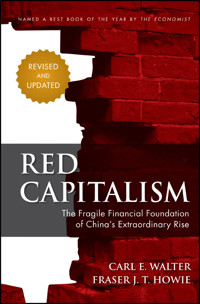
The truth behind the rise of China and whether or not it will be able to maintain it How did China transform itself so quickly? In Red Capitalism: The Fragile Financial Foundation of China's Extraordinary Rise, Revised Edition Carl Walter and Fraser Howie go deep inside the Chinese financial machine to illuminate the social and political consequences of the unique business model that propelled China to economic powerhouse status, and question whether this rapid ascension really lives up to its reputation. All eyes are on China, but will it really surpass the U.S. as the world's premier global economy? Walter and Howie aren't so certain, and in this revised and updated edition of Red Capitalism they examine whether or not the 21st century really will belong to China. * The specter of a powerful China is haunting the U.S. and other countries suffering from economic decline and this book explores China's next move * Packed with new statistics and stories based on recent developments, this new edition updates the outlook on China's future with the most cutting-edge information available * Find out how China financed its current position of strength and whether it will be able to maintain its astonishing momentum Indispensable reading for anyone looking to understand the limits that China's past development decisions have imposed on its brilliant future, Red Capitalism is an essential resource for anyone considering China's business strategies in today's extremely challenging global economy.
Sie lesen das E-Book in den Legimi-Apps auf:
Seitenzahl: 396
Veröffentlichungsjahr: 2012
Ähnliche


















Contents
Preface to the Second Edition
Preface to the First Edition
List of Abbreviations
Chapter 1: Looking Back at the Policy of Reform and Opening
Thirty years of opening up: 1978–2008
Thirteen years of reform: 1992–2005
The end of reform: 2005
China is a family business
Chapter 2: China’s Fortress Banking System
Banks are China’s financial system
China’s banks are big banks
Crisis: The stimulus to bank reform, 1988 and 1998
China’s fortress banking system in 2010
The sudden thirst for capital and cash dividends, 2010
Chapter 3: The Fragile Fortress
The People’s Bank of China restructuring model
The Ministry of Finance restructuring model
The “perpetual put” option to the PBOC
The new Great Leap Forward Economy
China’s latest banking model
Valuing the asset management companies
Implications
Chapter 4: China’s Captive Bond Market
Why does China have a bond market?
Risk management
The base of the pyramid: Protecting household depositors
Chapter 5: The Struggle over China’s Bond Markets
The CDB, the MOF, and the Big 4 Banks
Local governments unleashed
Credit enhancements
China Investment Corporation: Linchpin of China’s financial system
Cycles in the financial markets
Chapter 6: Western Finance, SOE Reform, and China’s Stock Markets
China’s stock markets today
Why does China have stock markets?
What stock markets gave China
Chapter 7: The National Team and China’s Government
Zhu Rongji’s gift: Organizational streamlining, 1998
How the National Team, its families, and friends benefit
A casino or a success, or both?
Implications
Chapter 8: The Forbidden City
The Emperor of Finance
Behind the vermillion walls
An Empire apart
Have the walls been breached?
Cracks in the walls
Imperial ornaments
Appendix
Select Bibliography
Index
Copyright © 2012, 2011 John Wiley & Sons Singapore Pte. Ltd.
Published in 2011, 2012 by John Wiley & Sons Singapore Pte. Ltd., 1 Fusionopolis Walk, #07-01, Solaris South Tower, Singapore 138628.
All rights reserved.
No part of this publication may be reproduced, stored in a retrieval system, or transmitted in any form or by any means, electronic, mechanical, photocopying, recording, scanning, or otherwise, except as expressly permitted by law, without either the prior written permission of the Publisher, or authorization through payment of the appropriate photocopy fee to the Copyright Clearance Center. Requests for permission should be addressed to the Publisher, John Wiley & Sons Singapore Pte. Ltd., 1 Fusionopolis Walk, 07-01, Solaris South Tower, Singapore 138628, tel: 65-6643-8000, fax: 65-6643-8008, e-mail: [email protected].
This publication is designed to provide accurate and authoritative information in regard to the subject matter covered. It is sold with the understanding that the Publisher is not engaged in rendering professional services. If professional advice or other expert assistance is required, the services of a competent professional person should be sought. Neither the authors nor the Publisher is liable for any actions prompted or caused by the information presented in this book. Any views expressed herein are those of the author and do not represent the views of the organizations he works for.
Other Wiley Editorial Offices
John Wiley & Sons, 111 River Street, Hoboken, NJ 07030, USA
John Wiley & Sons, The Atrium, Southern Gate, Chichester, West Sussex, P019 8SQ, United Kingdom
John Wiley & Sons (Canada) Ltd., 5353 Dundas Street West, Suite 400, Toronto, Ontario, M9B 6HB, Canada
John Wiley & Sons Australia Ltd., 42 McDougall Street, Milton, Queensland 4064, Australia
Wiley-VCH, Boschstrasse 12, D-69469 Weinheim, Germany
ISBN 978-1-118-25510-0 (Hardcover)
ISBN 978-1-118-25511-7 (e-book)
ISBN 978-1-118-25512-4 (e-book)
ISBN 978-1-118-25513-1 (e-book)
To John Wilson Lewis
Preface to the Second Edition
We have been overwhelmed by the warm reception of this book, having never imagined that, as one reader put it, “a history of China’s financial system . . . (could be) compelling reading.” Of course, we thought it was a compelling story and in discussions with scores of readers around the world, we have been pleased to discover that others felt the same. This second edition updates some of the data in the book and we have also added a few new sections, but the larger story itself has not changed. In fact, the news out of China since publication in November 2010 has only confirmed our overall perspective. On the other hand, readers have raised many good questions about China’s financial system and its health, some we had never even dreamed about and many we simply don’t have good answers for. We make no claims for omniscience. We also found it interesting that we have had a deeper dialogue about China outside of Asia than in places where one would have expected a detailed understanding of the issues due to proximity. We have tried to respond to some inquiries in this edition’s text, but for other questions we thought it might be better to address them separately in this preface.
Perhaps the most common question we have been asked is a variation of “When will China’s economy crash?” and “What will make it crash?” While developing an answer may be an interesting exercise, it is not what this book is about. What we are trying to explain is how the Communist Party of China manages the Chinese economy and why it will continue to support the status quo for as long as it is able. Indeed, after the lending binge of the past three years, we believe that from a structural point of view, the Party has less room for maneuver than it did even five short years ago. The key arrangements underlying China’s current political economy might include: 1) continued high savings by the people of China placed with the big state banks (heaven forbid that Chinese savers come to prefer depositing their cash with HSBC or Citi); 2) administratively set interest rates, a non-convertible currency, and continued capital controls; and 3) confidence among the rising middle class in the Party’s ability to promote the country’s rapid development. Volatile developments in the international financial system during 2011, including events following Standard & Poor’s downgrade of the United States’s credit rating, have increased pressure on this fragile structure. Even so, we believe that the government has the capacity to manage these problems, but the stresses on China’s closed economy are growing.
A subset to this question relates to the strength of China’s banks, the pillars of the entire financial system. While we have analyzed aspects of the balance sheet quality of China’s major banks, this book is not meant to be a substitute for the work of a good bank analyst. Our objective is to show how China’s banks, all majority-owned and controlled by the Party, are part of a larger system. From this angle, analyzing bank performance per se is just the first step in coming to grips with the overall political economy. If the question is only about bank risk, however, we are certain that the government has the means to handle problem loans and continuously bolster bank capital, even if the support of international and domestic non-state investors is only lukewarm.
It is important to understand, however, that to date fixing the balance sheets of banks has meant increasing systemic leverage. The bulk of the over US$500 billion in problem loans of the last decade have yet to be written off. So, in considering China’s banks, it is better to step back and consider the risks borne by the overall system. Some observers take comfort in the fact that the government controls so many aspects of the system, and have suggested that the current financial arrangements are robust, not fragile. It seems to us this view ignores how systemic risk is built up by the real economic costs associated with malinvestment and inflation. If there is a popular backlash against corrupt investment decisions or inflation that brings protests to the streets of Beijing or Shanghai, the robustness of such arrangements will certainly be tested! In China, the Mandate of Heaven is not just a quaint historical concept.
A much more important question, it seems to us, is not what will cause a crash, but rather what costs do China, the Chinese people, and the global economy bear as a result of the Party’s management of the financial system. This is a far too complicated issue for this book, and assigning a cost to certain things that may have no price is, moreover, a fool’s errand. Nevertheless, there has been a heavy price and it may be too early to know just how heavy. In recent times, however, we have all begun to see that it does exist, as have many Chinese, who are beginning to draw the conclusion that development has been far too rapid, too unbalanced, and too inequitable. For now, perhaps the larger point is that after stagnation, war, and political chaos for over 100 years, China in the past three decades has moved forward and the lives of a billion people have materially improved. From this point of view, the political economic arrangements in place were suited to the country’s needs, as some argue. But we do not believe they are now suited to China’s needs. Any material change to them, however, will in the near term be exceptionally difficult for the structural reasons set out in this book.
In the current environment, in which both European and American politicians and bankers have difficulty accepting the extent of the financial problems burdening their countries, it is tempting to say that China’s economic arrangements are no worse than those of Western economies. It is true that the unwillingness of the Federal Reserve Bank or the European Central Bank to allow firms or governments to default has significantly weakened the role of markets in pricing risk. In spite of this, however, we believe such a relativistic view is ill-informed and, worse, helps obscure the fact that the current Chinese economic framework is fundamentally weaker than the market-based approaches of the developed economies.
A decade ago, ignorance of China’s domestic financial arrangements could be understood. Today, however, China is an important part of the world economy and its actions materially affect us. As this book seeks to demonstrate, the current Chinese system does not allow for market pricing of capital, requires almost continuous injections of capital into its banks, and has created an oligarchic and still uncompetitive state-owned corporate sector despite 30 years of reform efforts. In spite of the country’s many successes, its financial system remains unable to withstand the opening of the capital account, depends on administrative pricing of capital, and its domestic markets inevitably must remain closed to foreign financial firms. The government’s inability to move decisively on the RMB rate, and just as importantly how it will be traded going forward, creates inflation and highly imbalanced flows into and then out of the country. Yet, this is all happening in an economy that has grown anywhere from 9 to 14 percent over the past decade.
What does this mean in the China context? Since at least the mid-1990s, the Party has taken the country’s nominal GDP growth rate as almost the sole metric by which its own economic success is measured. If, in fact, this is the sole criterion of economic development, then China’s is the economy to keep faith with, as is the Party’s stewardship of it. But catching up to the size of America’s GDP is a very narrow measure. To make this point, in 1912, the year of the Qing Dynasty’s collapse, Imperial China’s GDP at US$241 billion was larger than those of Germany and England and second only to that of the United States. Another example: when, 20 years later in 1932, the Japanese Kwantung Army invaded Manchuria, China’s GDP was more than twice that of Japan’s. In short, the size of a country’s GDP says little about a country’s economic competitiveness, its overall power as a nation, or the well-being of its population.
Yes, China appears rich today because of its extraordinary foreign exchange reserves, but these symbolize the problem. They exist because China’s currency has been mismanaged. Their value is illusory, since they are too big to spend, impossible to diversify, and falling in real value. In fact, the best thing China could do with its reserves would be to pay off all U.S. credit card debt, the mortgages held by Fannie Mae and Freddie Mac, and the student loans held by Sallie Mae as well! All are U.S. dollar denominated; with the United States unburdened of its debt, its economy would boom and China’s existing development model would be in business again for the next market cycle. Of course, this is a completely unrealistic course of action, but it illustrates just how distorted China’s finances have become. The developed markets have made many mistakes and will go on making them in the future, but what can be adopted from China’s experience to address the ongoing debt crisis is surely not asset management companies and central government receivables.
Finally, it must be remembered that the current policy path being followed by the Chinese government was not the only possible route. As this book describes, China’s accession to the World Trade Organization in 2001 was part of a major effort to reorganize the country’s financial and industrial framework. Had the government then started to appreciate the renminbi in a determined manner and allowed it to trade more freely within the bounds of certain capital controls, China’s GDP today may have been somewhat smaller. The point is, however, that it would almost certainly have been more balanced and less dependent on government investment and low-end exports. That lack of follow-through is the root problem in China. How can markets, including those for capital, be truly open when the monopoly powers of the state sector and historic political arrangements are dependent on maintaining the status quo? From this viewpoint, it seems to us disingenuous to argue that we should take comfort that China’s economic system is no worse than the West’s. Or, arguing from the other angle, how exactly can China be expected to show global leadership or greatness if its system is just as bad?
For this second edition, as with the first, we would like to thank all of our friends at our publisher, John Wiley & Sons, for their continuing support. We would also like to thank all our readers who have asked so many constructive questions. How we understood those questions and what we have written here remains solely our responsibility and reflects only our own views. All errors are our own. As for our families, we have, like many countries in the past few years, gone even deeper into debt than before. We make no more promises!
New York and Singapore
September 2011
Preface to the First Edition
After three rounds of Privatizing China, our book about China’s stock markets, we felt like we wanted to look into something new. Since we took our first look at the stock markets in 1999, we have been interested to note the lack of work on the financial side of China’s miracle that gets beyond the macroeconomics of things. We are the first to agree that living and working in the country for 25 years may not qualify us as experts in economics. We do believe, however, that our experience has given us a feel for how China’s political elite manages money and the country’s economy. Having worked in banks for longer than we care to remember, we wanted to try to understand how China and its ruling class finance themselves and we knew we had to begin with the banks since, in truth, they are China’s financial system. Those looking for tales of corruption and princelings with their hands in the till will be disappointed though. We think that the financial side of the story behind a 30-year boom that changed the lives of one billion people is much more interesting; so this is our effort at staking out modern China’s political economy “inside the system.”
We do not believe in Chinese exceptionalism. China’s economy is no different from any other, in spite of the inevitable Chinese characteristics. If there are such things as economic laws, they work just as well in China and for Chinese businesses as they do in other markets. We also do not believe in the recent triumphalism of China’s bankers and many of its leaders; this is only a diplomatic ploy. China’s banks survived the global financial crisis, as one senior banker has publicly stated, simply because the financial system is closed off from the world. Having seriously studied the collapse of Mexico’s peso in 1994, the Asian Financial Crisis of 1997 and those sovereign-debt crises that have followed, China’s political elite has no intention of exposing itself to international capital markets. The domestic economy and markets are, and will continue to be, most deliberately closed off. With a non-convertible currency, minimal foreign participation and few overseas assets beyond U.S. Treasuries and commodity investments that will neither be marked-to-market nor sold, why shouldn’t the system survive a major international crisis better than open economies? China’s financial system is designed so that no one is able to take a position opposite to that of the government.
Of course, the private export-oriented sector suffered massive losses in jobs, earnings and the closure of small companies in 2008 and 2009. But China’s banks were not exposed in any material way to this sector. It is a simple fact that China’s financial system and its stock, bond and loan markets cater only to the state sector, of which the “National Champions” represent the reddest of the Red. These corporations, the heart of China’s state-owned economy, are “inside the system.” The private economy, no matter how vibrant, is “outside the system” and, in fact, serves at the will of the system. If nothing else, the events of the fall of 2008 added an additional seal to the Party’s determination to sustain a closed, tightly controlled, economy. “Don’t show me any failed models,” is the refrain of the Chinese officialdom these days. But is China’s own financial system a model for the world to study? Can China be thought of as an economic superpower, either now or in the future, with such a system?
With this sort of question in mind, we began to look at the financial history of the People’s Republic of China. We were fortunate that 2008 was the thirtieth anniversary of China’s highly successful Reform and Opening Policy, so there were many excellent retrospectives prepared by the government agencies. The People’s Bank of China, in particular, produced very useful material, some of which took one of us back 30 years to Beijing University where his study of Chinese banks began. We hasten to emphasize that all the information used in writing this book derives from purely public sources. In China, all of the important ministries, corporations, and banks maintain excellent websites, so data is just out there in the wind waiting to be downloaded. In particular, China Bond and the National Association of Financial Market Institutional Investors (NAFMII), a sub-set of the People’s Bank, have extensive websites providing access to information, in both Chinese and English, on China’s fixed income markets. Data for the stock markets have always been plentiful and, we believe, accurate. Again, Wind Information, China’s Bloomberg equivalent, has been a rich source for us. Then, there are the audited financial statements of China’s banks, all available online since the respective listings of each bank. Reading these statements has been highly educational. We strongly encourage others, including China’s regulators, to do the same.
So the modern age of technology provided all the dots that, linked together, present a picture of the financial sector. How they are connected in this book is purely the authors’ collective responsibility: the picture presented, we believe, is accurate to the best of our professional and personal experience. We hope that this book will, like Privatizing China, be seen as a constructive outsiders’ view of how China’s leadership over the years has put together what we believe to be a very fragile financial system.
For all the fragility of the current system, however, one of us is always reminded that his journey in China began in Beijing back in 1979 when the city looked a lot like Pyongyang. With North Korea in the headlines again for all the wrong reasons, it is worth remembering and acknowledging the tremendous benefits the great majority of Chinese have reaped as a result of the changes over the past 30 years. This can never be forgotten, but it should also not be used as an excuse to ignore or downplay the very real weaknesses lying at the heart of the financial system.
We would like to thank those who have helped us think about this big topic, including in no particular order Kjeld Erik Brosdgaard, Peter Nolan, Josh Cheng, Jean Oi, Michael Harris, Arthur Kroeber, Andrew Zhang, Alan Ho, Andy Walder, Sarah Eaton, Elaine La Roche, and Victor Shih. Over the years we have grown to greatly appreciate our friends at John Wiley, starting with Nick Wallwork, our publisher who kickstarted our writing career in 2003, Fiona Wong, Jules Yap, Cynthia Mak, and Camy Boey. Professionals all, they made working on this book easy and enjoyable. John Owen was an unbelievably quick copyeditor and Celine Tng, our proofreader, gave “detail-oriented” a whole new definition! We thank you all for your strong support. What we have written here, however, remains our sole responsibility and reflects neither the views of our friends and colleagues, nor those of the organizations we work for.
We have dedicated the book to John Wilson Lewis, Professor Emeritus of Political Science at Stanford University. John was the catalyst for Carl’s career in China and, indirectly, Fraser’s as well. Without his support and encouragement, it is fair to say that this book and anything else we have done over the years in China might never have happened. We both continue to be very much in debt to our wives and families who have continued to at least tolerate our curious interest in Chinese financial matters. We promise to drop the topic for a while now, even though we are well aware that there remains much that needs to be looked at in the financial space, including trust companies and asset-transfer exchanges. May be next time.
Beijing and Singapore
October 2010
List of Abbreviations
ABCAgricultural Bank of ChinaAMCasset management companyBOCBank of ChinaCBRCChina Banking Regulatory CommissionCDBChina Development BankCGBChinese government bondCICChina Investment CorporationCPcommercial paperCSRCChina Securities Regulatory CommissionICBCIndustrial and Commercial Bank of ChinaMOFMinistry of FinanceMORMinistry of RailwaysMTNmedium term notesNAVnet asset valueNDRCNational Development and Reform CommissionNPCNational People’s CongressNPLnon-performing loanPBOCPeople’s Bank of ChinaSAFEState Administration for Foreign ExchangeSASACState Administration of State-owned Assets CommissionCHAPTER 1
Looking Back at the Policy of Reform and Opening
“One short nap took me all the way back to before 1949.”
Unknown cadre, Communist Party of China Summer 2008
It was the summer of 2008 and the great cities of eastern China sparkled in the sun. Visitors from the West had seen nothing like it outside of science fiction movies. In Beijing, the mad rush to put the finishing touches on the Olympic preparations was coming to an end—some 40 million pots of flowers had been laid out along the boulevards overnight. The city was filled with new subway and light-rail lines, an incomparable new airport terminal, the mind-boggling Bird’s Nest stadium, glittering office buildings, and the CCTV Tower! Superhighways reached out in every direction, and there was even orderly traffic. Bristling in Beijing’s shadow, Shanghai appeared to have recovered the level of opulence it had reached in the 1930s and boasted a cafe society unsurpassed anywhere in Asia. Further south, Guangzhou, in the footsteps of Shanghai Pudong, was building a brand new city marked by two 100-story office, hotel, and television towers; a new library, an opera house, and, of course, block after block of glass-clad buildings. Everyone, it seemed, was driving a Mercedes Benz or a BMW; the country was awash in cash.
Lesen Sie weiter in der vollständigen Ausgabe!
Lesen Sie weiter in der vollständigen Ausgabe!
Lesen Sie weiter in der vollständigen Ausgabe!
Lesen Sie weiter in der vollständigen Ausgabe!
Lesen Sie weiter in der vollständigen Ausgabe!
Lesen Sie weiter in der vollständigen Ausgabe!
Lesen Sie weiter in der vollständigen Ausgabe!
Lesen Sie weiter in der vollständigen Ausgabe!
Lesen Sie weiter in der vollständigen Ausgabe!
Lesen Sie weiter in der vollständigen Ausgabe!




