


9,99 €
Mehr erfahren.
- Herausgeber: Leo Caputti
- Kategorie: Lebensstil
- Sprache: Englisch
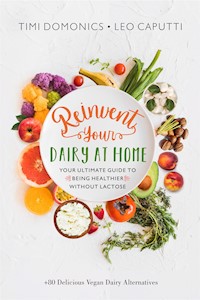
If one quick guide could show you how to do lactose-casein-gluten-soy-sugar-FREE delights that imitate dairies’ flavours and textures, wouldn’t you try it?
Would you be happy enjoying healthier plant-based versions of milk, cheese, yoghurt, butter, chocolate, condensed milk, whipped cream, desserts and +80 nutritious alternatives to dairy products?
Yes, BUT - you might be thinking - I need them to be EASY and PRACTICAL…
Ok! So the good news is that you can start immediately with “Reinvent Your Dairy at Home”.
And even if you struggle not to eat dairy because you love them, this is your chance to be surprised by delicious healthy flavours you never imagined existed before!
You will love “Reinvent Your Dairy at Home” if you are looking for:
- Easy-to-follow recipes for all levels - basic, intermediate and sophisticated
- 100% plant-based, vegan, natural dairy substitutes enriched with superfoods and sprouted seeds
- Much better nutrition without missing or giving up your favourite flavours
- Saving money by doing healthier food at home instead of buying more expensive products
- Easy-to-find cheap and healthy ingredients
- Taking good care of your gut, your brain, your skin, your energy levels!
And besides boosting your health - and possibly losing some weight as an additional bonus - you will also learn:
1. Practical recommendations to strengthen your bones
2. Calcium-rich foods versus calcium stealing foods
3. Common mistakes to avoid when trying to substitute dairy
4. How to sprout seeds
And much more!
That’s it!
Are you feeling like putting the hands-on straight to the point?
So GET NOW your copy of “Reinvent Your Dairy at Home”, start enjoying the nutrition & health you deserve and feel amazing!
With love,
Timi & Leo
PS. We are sure that soon you will be the one leaving a testimonial here and tagging us @ReinventYourDairyAtHome on Instagram with your delicious new creations!
Das E-Book können Sie in Legimi-Apps oder einer beliebigen App lesen, die das folgende Format unterstützen:
Veröffentlichungsjahr: 2020
Ähnliche


















Introduction
In 2013, my husband and I decided to move to a small rural town in Brazil to live a simpler, quieter life.
We found a comfortable home with a large yard and several fruit trees! There, we learned to grow our own food and could finally take care of our mind, body, and soul.
Having this experience was so impactful that we realized that our purpose was to inspire others and help them on their way toward a healthy lifestyle.
That is why we decided to dive headfirst into the world of functional nutrition and online education. This resulted in a video course on how to substitute foods containing gluten.
It also led to the creation of our gluten-free recipe eBooks for breakfast, lunch and dinner, and this book.
The idea is simple: Develop the autonomy to make healthy, tasty food at home without missing the original versions.
In this book, we share all of our knowledge so that you can achieve this goal and learn alternatives to dairy-based and dairy-derived products.
You will be able to recreate your dairy products using only plant-based ingredients.
Let’s do this together!
Cordially,
Timi Domonics
Table of Contents
PART I – Essential Information About Dairy
Forewords
What is cow’s milk? What is it made of and how is it obtained?
How are the cows producing the milk people drink raised?
What are the benefits claimed by dairy supporters?
And what do dairy opponents claim?
How can you know whether you have any problem with dairy products?
Conclusions
References
PART II – Ready to make new recipes at home?
It’s time to reinvent your dairy!
Milk
Yogurt
Butter
Whipped Cream
Requeijão (Typical creamy Brazilian cheese)
Non-fermented Cheese
Fermented Cheese
Cream Cheese
Cream
Curd
Smoothies
Condensed Milk
Desserts
Mayonnaise
Chocolate
Attachment 1
Attachment 2
Attachment 3
Acknowledgments
PART I
Essential Information About Dairy
Forewords
The purpose of this eBook is not to condemn or argue for dairy products. We are not here to discuss whether you should consume them or not.
Let’s leave this to scientists, researchers, and experts.
The decision whether or not to eat dairy products is up to you, together with your trusted nutritionist or doctor.
Our goal with this book is to give you some essential information on the subject so that you can draw your own conclusions.
This is a vast, complex, and controversial topic. There are many opinions and interests at stake, and many scientific studies with opposing views. So, do not expect anyone to be absolutely right when saying something like “milk is good” or “milk is bad.” Watch out for over-simplified visions!
We also really want to help you expand your possibilities with this book.
You may be surprised at how many delicious and easy-to-make recipes you will be able to prepare at home starting today: Healthy, tasty recipes - free of controversy.
Feel free to reinvent yourself. Become a better version of yourself and enjoy all the happiness this can bring.
That being said, let’s learn some more.
Cow’s milk is produced from the mammary glands of this animal. It is a white fluid containing nutrients and different substances that allow the calf to double its size in 47 days. By comparison, a human baby doubles in size in 138 days, almost three times what a calf needs to grow the same amount.
In its purest natural state, without any human intervention, milk contains:
Water
(87 %)
Lactose
or milk sugar
Saturated fat
Casein
: one of the milk proteins, along with albumin and globulin
Minerals
: calcium, magnesium, and phosphorus
Vitamins
: A, D, E, K, P, B1, B2, B6, B12
Bovine hormones
: about 60 types
Bacteria
However, the milk we have access to in the supermarkets is different from that mentioned above. Currently the milk people consume is a product modified by industries and commercially produced in large factories and quantities. It’s not the organic raw milk from healthy happy cows that our grandparents used to consume. This is a crucial point you should keep in mind.
In the next pages, we are going to focus a little more on this industrial transformation process that milk goes through.
First, you need to know that the non-organic cow’s milk that you can buy contains unsafe doses of the following substances:
Antibiotics
used to treat common diseases affecting farm animals
Hormones
given to the animals to accelerate and increase milk production
Pesticides
that come from the feed they ingest
Urea
, due to poor hygiene conditions
Substances
that may leak from the milk
packaging
In other words, despite being a nutritionally complete food, the cow’s milk that we buy nowadays is also a significantly contaminated product.
Not to mention that cases of milk adulterated with undesirable substances such as formaldehyde, caustic soda, water, salt, sugar, corn starch, hydrogen peroxide, or quicklime are not uncommon in many countries. You can research for yourself online and you will probably discover several cases, including some involving popular national brands.
Is this intended to scare you? No. It is only a question of becoming a better informed and more conscious consumer.
Furthermore, another point to take into consideration is the pasteurization process. It basically consists of heating the milk to 162°F (72°C) for 15 seconds, and then immediately cooling and packaging it to kill pathogenic bacteria.
Even more common is Ultra-High Temperature processing (UHT), which is a kind of improved pasteurization. In this case, the milk is heated to between 284° and 293°F (140° and 145°C) for approximately 4-5 seconds, then immediately cooled down and packaged in a sterile container.
As a consequence, milk has a longer shelf life: It will keep for an incredible 180 days (six months) instead of a few days as is the case for fresh milk!
On the one hand, this process is something helpful: It significantly reduces the risk of buying spoiled milk. We all feel more secure knowing that the milk we are buying is free of bacteria, especially if it was shelved more than a week ago, right?
On the other hand, there is a disadvantageous “side effect” for those who drink it. The problem is that this sterilization process alters the milk proteins, causes the loss of other nutrients, destroys probiotic bacteria (which are beneficial), and changes the taste of the milk.
But in the end, consuming a food that is poorer than the original from a nutritional perspective might not seem like such a high price to pay for the safety and convenience gained by these industrial processes.
Let’s learn more...
Nowadays, a farmed cow produces an average of 10 times more milk for longer periods during its gestation cycle. Obviously, this is made possible due to artificial “handling” techniques of this living being.
In practice, cow’s milk is collected over a period three times longer than before (nine months instead of three, generally), including those months in which cows produce very high levels of hormones, which are also passed into the milk.
The milk people drink is actually a blend of milk from several cows at different stages of gestation. However, this does not reduce the important presence of the hormone estrone - indicated as highly carcinogenic - and another 59 different bovine hormones that are not compatible with the human body, according to Dr. Lair Ribeiro (Brazil).
Additionally, cows receive high doses of antibiotics to control mastitis, an inflammation of their udders that is highly common due to this artificial exhaustive milking process.
Furthermore, farmed cows live in confined spaces and eat transgenic (GMO) feed. Their current life expectancy is five years, compared to 20 if they were to live naturally. For comparison purposes, it is as if you lived only 20 years instead of 80. Doesn’t it seem odd to you?
Besides the animal cruelty, do you really think it is safe to consume a product derived from such a process?
Let’s just think about it…
Main argument: Milk is extremely rich in calcium, which supposedly strengthens bones and teeth and prevents osteoporosis. Accordingly, it constitutes an essential source to supply the daily nutritional needs of this mineral.
It is also said that milk is a very complete food from a nutritional perspective: It is rich in vitamins, high-quality proteins, and other nutrients important to the human body.
Additionally, it is an accessible and relatively inexpensive food.
Other arguments by nutritionists and scientists linked to the dairy industry include:
Some scientific studies have concluded that milk does not cause cancer or heart disease.
They claim that milk is a natural and safe product.
The World Health Organization (WHO) recommended in 2012 an annual intake of 200 liters (52 US gal lqd) per person, that is to say a daily intake of about 0.5 L (2 cups) of milk per person.
One more argument: milk is rich in protein. A glass of milk contains about 8 grams of the nine essential amino acids that our organism does not synthesize by itself, but needs for different biochemical functions.
But be very careful with this! Indeed, there is currently an excessive focus on the consumption of proteins, which leads many people to consume a daily dose well above their needs, mostly animal proteins.
This can be extremely harmful to your health, especially your heart, liver and kidneys. There is a healthy daily limit of proteins that should not be exceeded.
If you want to increase your intake of plant-based foods, remember that you can also meet all of your essential amino acid needs by using different plant-based sources of protein. You have a choice.
Balance is one of the keys to good health. Remember: Too much of something that is good for you can also do you harm. So, moderation is key!
According to Dr. Mercola (USA), in order to calculate your daily protein needs, you need to consider your weight and body composition instead of your age and gender.
Step by step:
Determine your percentage of body fat and lean body mass, balanced by a percentage of fat.
Divide your lean body mass by 100.
Multiply your current weight by the number obtained.
Finally, divide this result by 2.
For example:
Let’s assume you weigh 154 lbs. (70 kg) and your fat percentage is 23% and your lean mass is 77%. If you divide the lean mass rate by 100, the result is 0.77. If you multiply your current weight by 0.77, you get 53.9. Applying the rule of 0.5 g of protein per weight unit, we divide 53.9 by 2: the result is 26.95. There you have it: You only need 26.95 g of protein per day.
Here are some examples of plant-based protein sources:
1 serving (28g – 1 oz.) of vegetables contains 1 to 2 g of protein
1 serving (85g – 3 oz.) of chestnuts and seeds contains 4 to 9 g of protein
1 serving (170g – 6 oz.) of cooked legumes contains 7 to 8 g of protein
1 serving (340g – 0.75 lb.) of cooked grains contains 9 to 17 g of protein
1 serving of salad contains 2 to 5 g of protein
Some argue the following:
Cow’s milk is meant to meet the calf’s needs, not human needs, especially after the age of 9.
Humans are the only mammal that drinks the milk of another mammal.
Humans are the only mammal that drinks milk throughout its entire life.
This is true, but does this mean that milk is bad for human health?
Not necessarily. Maybe or maybe not. It depends on the case, on the individuals constitution and lifestyle.
But there is some evidence that milk may not be that “innocent”…
The U.S. documentary Got the Facts on Milk? by director Shira Lane, released in 2008, states that from 1988 to 1993 there were 2,700 articles on milk published in U.S. medical records.
“Quite surprisingly, however, and regardless of those that dealt exclusively with animals, esoteric research and inconclusive studies, none of them presented milk as an excellent food for human consumption, unlike the milk industry portrays it or mass propaganda has always publicized. Instead, they revealed intestinal bleeding, bovine leukemia (AIDS-like virus), asthma, childhood diabetes, heart problems, anemia, arthritis, allergic reactions, and cancer. If all of this is really true... why have we never heard about it?”
Another serious position that is quite critical:
In 2011 the U.S. Department of Public Health and Department of Medicine of the respected Harvard University stated that dairy products were not part of a healthy diet. So, they have recommended limiting consumption in their guide entitled Healthy Eating Plate, as seen below:




