


9,99 €
Niedrigster Preis in 30 Tagen: 7,49 €
Niedrigster Preis in 30 Tagen: 7,49 €
Mehr erfahren.
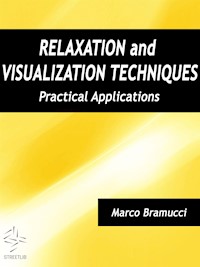
- Herausgeber: Marco Bramucci
- Kategorie: Ratgeber
- Sprache: Englisch
Relaxation is a natural condition that owing to stress or excess of activity is often confined to the detriment of our health. The aim of relaxation techniques is to regain and increase our wellbeing, reducing anxiety, stress and all the problems that stem from them. Visualization is a mental technique that has been used for centuries in eastern meditation and that leverages our imaginative potential. When combined, relaxation and visualization techniques can give us great benefits, giving us the opportunity to use all our capacities, overcome our limits, reduce anxiety or stress related illnesses, and promote personal change.
The following is a list of some of the book contents:
• 2 complete and independent relaxation exercises, to start relaxing in no time
• More than 15 guided visualizations to increase wellbeing and promote self-change
• Hints to create yourself your own effective visualizations
• A complete course of Autogenic Training (standard exercises)
• Advanced applications of Autogenic Training (affirmations or self-suggestions)
• Progressive Muscular Relaxation course
• How to use mental techniques for sports and pain management.
Marco Bramucci is a Complementary Medicine operator. He studied Acupuncture and Tuina massage, and has been using Mental Techniques for more than twenty years, especially Autogenic Training, Visualization and Buddhist Meditation. This is his second book after Usa i tuoi Sogni (Use your Dreams), a course in Dreamwork.
Das E-Book können Sie in Legimi-Apps oder einer beliebigen App lesen, die das folgende Format unterstützen:
Veröffentlichungsjahr: 2017
Ähnliche
















Marco Bramucci
RELAXATION AND VISUALIZATION TECHNIQUES
Practical applications
©2017 Marco Bramucci
All rights reserved.
This work is protected byCopyzero.
Disclaimer Although the techniques and exercises contained in this bookcan be of great benefit, they do not replace medicalorpsychological therapiesand diagnoses. Relaxationand visualizationexercisesmustnot bedonewhile driving, workingorcarrying outother activities that require attention. The author is not responsible forthemisuse of the information contained in thisbook.
Table of contents
Introduction
Why combining visualization and relaxation techniques
Stress, relaxation and inner resources
Basic concepts on the techniques discussed in the book
Relaxation
Progressive Relaxation exercise
Complete version
Short version
Fast version
The Body Scan exercise
General Relaxation exercise with self-suggestions
Visualization
Duration, environment and positions to perform visualization
Guided visualizations
The waterfall of light
Embracing yourself in the past
Meeting the self from the future
The newborn
Reaching the center of the sun
Imagine you are there
Finding your own inner oasis
In the rainbow
The wooden mountain hut
Disperse the unpleasant sensations
The source of healing
Imagine your body made of light
Waves of light
Stopping the reproduction of diseased cells
The sphere of light
Before falling asleep and after waking up
Breathing the light
How to cope with distressing images
Tips for visualization in case of physical ailments
Relaxation Techniques
Autogenic Training
Theory
Setting and positions for the practice of relaxation
Standard Autogenic Training exercises
Explanations and considerations on the experiences during the exercises
How to shorten the execution time
Simplified Autogenic Training
Affirmations: what they are and how they work
How to create your own affirmations
Autogenic Training for sports
Extreme applications of Autogenic Training
Advanced exercises
Conclusions
Progressive Muscle Relaxation
Theory
Practice
Shortened routine
Alternative and additional exercises
How to combine Progressive Muscle Relaxation with Autogenic Training
Mental techniques for sports
Mental techniques for survival
Visualization and relaxation for pain management
The soothing power of natural elements
Selected bibliography
Introduction
Thisbookisaddressed toallthepeople who want to make the most of their potential,overcometheir limits, eliminate or reduceailmentscaused byanxiety and stress, and develop a better mental and physicalcondition. Totake advantageofthetechniquesthatI willexpose,no prior knowledge on the subjectisrequired,thereforethe book can be used bybothbeginners andexperts.I have written this book aftermore thantwenty years ofpersonalexperience in the field of relaxation and visualization. I was twenty-threewhen I learnedAutogenic Trainingand started using it.Since thenIhave appliedit,together withall theothertechniqueshere exposed,indifferentfields: sports, meditation, qigong, work,and of courseIhaveusedthemasmererelaxationtechniques. I have learnedmost of thesemethodsunder the supervision ofteachers(martial arts, qigongand meditationmasters, andpsychotherapists),but alsobyresearchingand personalstudy.
Relaxation and visualization techniques are self-help tools that havethe followinggoals:
increase
peacefulness
and concentration
reduce the level of anxiety and stress
increase
recuperative powers
and improve sports performances
promote
personal change
,
by
both
changing your
behavior and motivat
ing
yourself
.
You willrealizethat using relaxation and visualization islikegoing onajourneyinsideyourself.I will giveyoutheinstructions tomove around andwillenable youtodraw your ownmap oftheterritory.
With regard to the organization of the book, after some brief introductoryremarkson relaxation and visualization, we will start with a simple but effective progressive relaxation exercise that will allow you to relax and relieve many stress-related disorders.Thiswill befollowed by another general relaxationexercise which ispreparatory to the use of self-suggestions. Boththeexerciseswillbe useful for the practice of visualization, a topic that will be discussed in thefollowingchapter,containing a series of guided visualizationexercises.ThenI’ll thoroughly explaintwoof the best known and practicedrelaxation techniques:Autogenic Training and Progressive Muscle Relaxation.Compared tothe first twoexercises, boththeserelaxationsystemsneed a longer period to be learned, but haveawiderfield of applicationand therefore youwill be able toemploythemmore extensively.Subsequently, Iwill introduce some examples forsports, military or paramilitaryapplications, and finallyI will talk abouthowtouse all the techniques forpainmanagement.I advise you nottojumpimmediatelyto the part of the book that interests youthemost,and highly recommendtoreadthe entire book, from beginning to end, get an idea of whichtechniques maybemore suitablefor you, and then choose the one ortheones topractice.
Whycombiningvisualization and relaxationtechniques
The boundariesbetween thedifferentrelaxation and visualization methods are not clear and often these methodsare similarin some way.In fact,to create a calming effect,all relaxation techniques reducethe attention totheexternal stimuliand directit tothebody,for example tothebreathing.Another example is the fact thatwhen we relax, some physical sensations, likeheaviness, warmth oratingling sensationinthe limbs,emergeregardless of the system used torelax.So, don’t lose your patience if I will repeat someconcepts orgo into themin the explanation of different relaxation and visualization techniques. In part these repetitions willbe usefulto make the various chapters independent of each other.However,eachtechnique has its own characteristics and particularuses, as we will see. To get the mostout ofthis book, I recommend to learn and master a specifictechnique, but also to take advantage of the others tocomplementyour favoriteone.As an example, theProgressiveRelaxation exercisematches perfectly with visualization, andeven greater effects can be obtained by combiningAutogenic Trainingand visualization. Relaxation and visualization can both be leveraged to achieve a state of mental and physicalrelaxation,the one increasing the effect of the other and vice versa.
The main purpose ofrelaxation techniques is toleadus to a state ofdeeptranquility. They act against the negative effectscausedbyan excess of activitywhich isnormally requiredat workandin many otherspheres of our lives.Usually we are required to beactive, busy, smart and toachieve goals as quickly as possible. If we do it,they will think highly of us,but in the endcomplying with this way of livingwill make usrestless, tenseandunbalanced towards a way of being alwayson the look-out.Moreover, thisunhealthy way of livingbecomes the norm,soeven when it wouldn’tbe required, we stay on the look-out.Thismakesus lose the ability to relax andfinallyit makes us loosetheconnectionwithour inner selves. Relaxation techniques tend torestore thelostbalance,addingquietto our stressfulandhectic lives.In this respect, theyareameansfordeconditioning. It’slike to retire to a desert island for a fewminutes toregainourenergy,to recharge our batteries so that we canface the dailyroutinewith greater calm, clarity and vitality. The main purpose ofvisualizationis self-change and in general the improvement of some kind of performance.For this technique torun smoothly,youhave toperformitinastate of relaxation.Visualization, in turn,has a calming effect anddeepensthe state of relaxation. That’s why,as I said earlier, the boundary between visualizationand relaxation techniques isnot so neat.They both calm us down.
Stress, relaxation and innerresources
We allreactto stress with the fight or flight response, the same ancestral method usedbythefirsthominids. This ancientbehaviorhas allowed us tosurvivewhen facingreal dangers, such asanattack by wild beasts. It consistedintwo possible reactions:attackingand fightingthe enemy, or runningaway from it.However,in today's societyobstaclesusuallyaren’t tangible, but areabstractinstead.Fear of failure, uncertainty of the future,and so no, are our actual enemies.Nevertheless,we respond to these stressorslike if they were real and material(thewild beasts),but unfortunately thefight or flight behavior isn’t appropriate nor effectivein these cases.In fact, it produces an excess of stress hormones which are useful ifwemust attack or flee, but poisonous ifthere aren’t tangibleobstacles.Basicallyifstress hormones aren’t usedto fight or run away, theychronically keep on circulate through the body. Their constant presencesends to the body a danger signalto which thebody respondsreducingallthephysiologicalfunctionsthatarenot strictly necessary to survive, that is:
the immune system stops working properly. This explains why we get sick more easily when we are stressed.
Sexual functions are inhibited.
Growth hormone production decreases. Usually, children living in difficult situations grow more slowly.
Metabolism changes: the assimilation of sugars, immediately ready to be absorbed, is favored at the expense of the assimilation of fat. This leads to an accumulation of fat and finally to obesity.
The muscles tend to be chronically tense, causing fatigue, pain, and contractures.
Unfortunately, the negative effects aremorethantheonesjust mentioned. The good news is thatwe allhavea huge amount of resources and direct or indirect experiences to use andrefer to,in ordertosolve our problems. Often these experiences and resources are not fully accessible because we are




