


9,99 €
Mehr erfahren.
- Herausgeber: Sonicbond Publishing
- Kategorie: Geisteswissenschaft
- Sprache: Englisch
All author royalties and publisher profits from the sale of this book will go to The Live Aid Trust
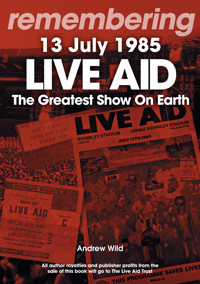
On Saturday, 13 July 1985, a blazing, cloudless summer day, millions of people settled in front of the television. It was just before noon in London, 7 am in Philadelphia, and around the world, it was time for Live Aid. This pair of huge concerts had been arranged in fewer than four months by singer and activist Bob Geldof of The Boomtown Rats: from a standing start to sixteen hours of music, seventy-plus artists and close to two hundred songs. These concerts mesmerised a huge global audience and raised millions for the starving in Ethiopia. This book revisits every band and every song that made up the two Live Aid concerts.
Some made their name at Live Aid — U2 in particular. Some bands reunited — Status Quo, The Who, Black Sabbath — and some were performing their last show together. Certain performances last long in the memory — Queen, of course, but also David Bowie, Elton John, Santana and others. Indeed, some are best forgotten …
And, behind it all, the drive of Bob Geldof: ‘the best day of my life,’ he admitted. For a generation of music fans, 13 July 1985 was a landmark day. It was The Greatest Show On Earth. How much of it do you remember?
Andrew Wild is an experienced writer, music collector and film buff with many books to his name, including recent publications about Queen, The Allman Brothers Band, Pink Floyd, Dire Straits and Crosby, Stills and Nash. His comprehensive study of every song recorded and performed by the Beatles between 1957 and 1970 was published by Sonicbond in 2019. He lives in Rainow, Cheshire, UK.
Das E-Book können Sie in Legimi-Apps oder einer beliebigen App lesen, die das folgende Format unterstützen:
Seitenzahl: 205
Veröffentlichungsjahr: 2024
Ähnliche


















Remembering Live Aid 13July 1985
The Greatest Show On Earth
Andrew Wild
Sonicbond Publishing Limited
www.sonicbondpublishing.co.uk
Email: [email protected]
First Published in the United Kingdom 2024
First Published in the United States 2024
British Library Cataloguing in Publication Data:
A Catalogue record for this book is available from the British Library Copyright Andrew Wild 2024
ISBN 978-1-78952-328-7
The right of Andrew Wild to be identified
as the author of this work has been asserted by him
in accordance with the Copyright, Designs and Patents Act 1988.
All rights reserved. No part of this publication may be reproduced, stored in a retrieval system or transmitted in any form or by any means, electronic, mechanical, photocopying, recording or otherwise, without prior permission in writing from Sonicbond Publishing Limited
Contents
Social Media
Introduction
1. Prologue: Do They Know It’s Christmas?
2. Coldstream Guards
3. Status Quo
4. Style Council
5. Boomtown Rats
6. Adam Ant
7. INXS
8. Ultravox
9. Japanese Live Aid
10. Spandau Ballet
11. Bernard Watson
12. Joan Baez
13. Elvis Costello
14. The Hooters
15. Austrian Live Aid
16. Nik Kershaw
17. The Four Tops
18. BB King
19. Billy Ocean
20. Sade
21. Black Sabbath
22. Yugoslavian Live Aid
23. Run DMC
24. Sting and Phil Collins
25. Rick Springfield
26. REO Speedwagon
27. Howard Jones
28. Russian Live Aid
29. Bryan Ferry
30. Crosby, Stills and Nash
31. German Live Aid
32. Judas Priest
33. Paul Young with Alison Moyet
34. Bryan Adams
35. U2
36. The Beach Boys
37. Dire Straits with Sting
38. George Thorogood
39. Queen
40. Intermission
41. Simple Minds
42. David Bowie
43. Drive
44. Pretenders
45. The Who
46. Santana
47. Norwegian Live Aid
48. Elton John
49. Ashford ad Simpson
50. Kool and The Gang
51. Madonna
52. Mercury and May
53. Paul McCartney
54. Band Aid
55. Tom Petty
56. Kenny Loggins
57. The Cards
58. Neil Young
59. The Power Station
60. Thompson Twins
61. Eric Clapton
62. Phil Collins
63. Led Zeppelin
64. CSNY
65. Duran Duran
66. Cliff Richard
67. Patti Labelle
68. Hall and Oates
69. Mick Jagger with Tina Turner
70. Bob Dylan and Friends
71. USA For Africa
Epilogue
Bibliography
Social Media
Follow us on social media:
Twitter: https://twitter.com/SonicbondP
Instagram: www.instagram.com/sonicbondpublishing_/
Facebook: www.facebook.com/SonicbondPublishing/
Linktree QR code:
Thank you Nick Jackson
Introduction
On Saturday 13 July 1985, three weeks past my 19th birthday, I settled in front of the television in our small semi-detached house in Stockport. It was just before noon in London, 7 am in Philadelphia, and around the world, it was time for Live Aid. Sixteen hours later, I was still there, having watched the entire BBC broadcast from end to end (with a small gap during George Thorogood’s set in the early evening to fetch my tea). I also taped around three hours of the BBC Radio 1 broadcast onto two C90 cassettes: as I recall, I snagged sets from Dire Straits, The Who, Santana, Freddie Mercury And Brian May, Paul McCartney, Band Aid, Neil Young, Eric Clapton, Led Zeppelin, Patti LaBelle, Mick Jagger and Bob Dylan. Not so far away, my future wife and her sisters were doing much the same – watching, taping and making indelible memories.
Years later, I found a 17xCD bootleg set of every available audio recording from the London and Philadelphia shows – there was significant overlap in performances on the day, and the first three hours from Philadelphia were not broadcast in the UK at all, so even though I’d sat through the entire broadcast, what I’d seen was far from complete. This bootleg filled in many of the gaps. Much of the video footage from both concerts is available on YouTube.
This book revisits the seventy-plus artists and close to 200 songs that made up Live Aid. How much of it do you remember? For my generation, 13 July 1985 was a landmark day. It was ‘The Greatest Show On Earth’.
Andrew Wild
Rainow, Cheshire, 2024
Prologue: Do They Know It’s Christmas?
It’s Tuesday, 23 October 1984. Images of hundreds of thousands of people starving to death in Ethiopia are shown on the UK’s BBC TV news bulletins. Michael Buerk described it as ‘a biblical famine in the 20th century’ and ‘the closest thing to hell on Earth’. Buerk in the Guardian, 2004:
I was based in Johannesburg at the time and was the BBC’s correspondent in Africa. The rains that should have come in around August to Ethiopia had failed again for the sixth season running and it tipped over from being a crisis to a catastrophe. People suddenly realised they were going to die and this huge mass migration started. It tipped very quickly. We flew and then drove up there and the roads were just littered with dying people. It was extraordinary; it was just on such a huge scale.
Buerk noted that at Korem, there were 40,000-45,000 people, and in Makele, there were another 80,000-90,000. He remembered that they grouped along the road that led north from Addis, where they thought relief would get to them.
It’s difficult to express the inadequacy I felt. You take refuge in the technicalities of filming, finding sequences, working out the logistics and so on. There were two films, two pieces that finally aired. I knew they wanted about three minutes, but I cut eight and thought, fuck ‘em. In those days as a foreign correspondent, communications being what they were, I tended to work on the basis that they got what they were given. I knew it was a very powerful film.
Irish musician Bob Geldof, the outspoken and fiercely intelligent singer with The Boomtown Rats, saw the broadcast at home in London. He had spent the day promoting the band’s upcoming single ‘Dave’, the third single from their latest album In The Long Grass, which was six months old and a decided flop. He recalled later that he was resigned to the decline of a band he’d led for nine years. He went home and switched on the television. The news report was of famine in Ethiopia. He wrote, later:
I saw something that placed my worries in a ghastly new perspective. From the first seconds, it was clear that this was a horror on a monumental scale. The pictures were of people who were so shrunken by starvation that they looked like beings from another planet. Their arms and legs were as thin as sticks, their bodies spindly. Swollen veins and huge, blankly staring eyes protruded from their shrivelled heads. The camera wandered amidst them like a mesmerised observer, occasionally dwelling on one person so that he looked directly at me, sitting in my comfortable living room surrounded by the fripperies of modern living, which we were pleased to regard as necessities. Their eyes looked into mine.
Unable to sleep, Geldof mused on how he might be able to help.
To allow it to continue would be tantamount to murder. I would send some money; I would send more money. But that was not enough. What else could I do? I was only a pop singer. And, by now, not a very successful pop singer. I could not help the tottering man to carry his burden. All I could do was make records that no one bought. But I would do that, I would give all the profits of the next Rats record to Oxfam. What good would that do? It would be a pitiful amount. But it would be more than I could raise by simply dipping into my shrunken bank account. Maybe some people would buy it just because the profits were for Oxfam. Yet, that was still not enough. I fell into a fitful sleep.
The next day, Geldof’s partner, the broadcaster Paula Yates, had been in Newcastle filming an episode of The Tube with Ultravox’s Midge Ure. ‘After the show, I dropped into Paula’s dressing room for a natter.’
Yates was chatting on the phone with Geldof. She handed Ure the phone and Geldof asked him if he’d seen the TV reporty about the famine in Ethiopia. Ure confessed that he hadn’t. Geldof explained about how he wanted to do something about it and asked Ure to help. Ure agreed and they agreed to meet up a few days later at Langan’s Brasserie in Mayfair.
Ure wrote:
Over the weekend, I made a point of watching the reports from Ethiopia. They were all over the box, so I couldn’t miss it. I found it horrific that we should be seeing images like that in this day and age, but I also couldn’t escape the feeling that anything I did would be nothing more than an empty gesture. At Langan’s, Bob and I talked around a bunch of bizarre schemes before coming to the obvious conclusion that the only thing we could do was make a record. The quickest option – covering somebody else’s song like ‘White Christmas’ – was out of the question because almost half of the monies earned by a record go to the writer. There we were, two songwriters sitting at the same table arguing over which old chestnut we could cover when, eventually, we realised that what we had to do was to write and record a new song and that we only had a few weeks left before Christmas. Initially, we calculated that if we came up with something, invited our friends to sing on it and managed to get a hit, we could raise £100,000. I told him, ‘You are a songwriter; just write a song.’ I was his backstop, his credibility; once I’d agreed to write with him, he could tell people, ‘Midge and I are writing the song together.’
Ure went home and started work on what would become the ‘feed the world’ chorus of ‘Do They Know It’s Christmas?’. Geldof, for his part, phoned Sting and Simon Le Bon, who said yes, then headed towards the Picasso bar in Chelsea to look for well-known musicians. On the way, he bumped into Gary Kemp of Spandau Ballet. Kemp said:
I was in an antique store [Antiquarius] on the King’s Road. Geldof saw me and came in. He sucked the air out of the place and took over, as he does. He said, ‘Did you see the news?’ He was clearly very moved. ‘Maybe if we got a few people together, yourselves, Duran and some others, would you be interested in making a record?’ I said yeah, sure and that was it.
Reassured, Geldof opened his address book and started to make calls. ‘I called Virgin records to get the number for Boy George’, he wrote. ‘I rang ZTT for Frankie Goes To Hollywood. I got hold of numbers for Paul Young, Paul Weller of The Style Council and Phil Oakey of The Human League.’ He bumped into Francis Rossi of Status Quo in the offices of their mutual record company. And, needing the kernel of a song, he reworked an unfinished Boomtown Rats track called ‘It’s My World’, and thus, the verses of ‘Do They Know It’s Christmas?’ were in place. Geldof and Ure later worked together on the middle eight and the ‘let them know it’s Christmas time’ refrain. There is no chorus. One can argue that the lyrics are patronising, and to a degree, they are, but they’re simple, catchy and memorable.
Geldof and Ure wanted Trevor Horn to produce the recording sessions, but Horn was unable to commit to such a tight schedule. Instead, Horn donated his Sarm West Studios in Notting Hill, London, for recording sessions. Geldof and Ure were given 24 hours to record and mix the single. The date: Sunday 25 November 1984. ‘Trevor would have taken six weeks to produce it’, Ure said, who elected to produce the single himself. ‘I enjoy the pressure of a deadline and I’m good at dealing with artists.’
The basic track was recorded by Ure in his home studio in Chiswick, with some vocals laid down on the day before the Sarm sessions. John Taylor of Duran Duran provided bass guitar and Paul Weller played a guitar part that was ultimately mixed out.
‘On the Sunday morning, Bob and I pitched up first’, Ure wrote:
The studio was just off Portobello Road. At eight o’clock in the morning, the whole area is usually empty, filthy and damp, suffering from a Saturday night hangover. On this Sunday, the world’s media were standing outside, TV crews and photographers poking cameras in my face, journalists waving microphones. There was no one else inside the studio. Not a single star in sight. Bob looked at me. ‘If it’s only The Boomtown Rats and Ultravox,’ he said, ‘it’s going to be a fucking dull record.’
Geldof had no certainty that anyone would come. But people started to arrive. ‘Most people looked as if they had just got out of bed,’ he wrote, ‘which, by and large, they had. I remember seeing Sting strolling up the street half-reading his Sunday paper, Paul Weller, all nervous energy, emerging striding from the opposite direction and Marilyn flouncing around the corner like a beautiful starlet on her way to the corner shop to buy some milk. I looked around and saw that the room held most of the stars of British pop music. They looked like a bunch of yobs down the pub on a Sunday lunchtime.’
‘Drinking pints of milk in a valiant attempt to cure our persistent hangovers,’ writes Heaven 17’s Martyn Ware, ‘we stumbled towards the studio only to be confronted by an unimaginable scene. There were multiple TV crews and their remote vans, journalists, artists arriving by the truckload with their entourages, security guards – the lot. Glenn [Gregory] and I had no idea where to go, but we were hustled into the studio away from the crazy hubbub outside.’ ‘Midge phoned me the night before’, Gregory said. ‘Martyn and I lived literally around the corner, so we could walk there the next day. I hope that’s not the only reason we were asked.’
Spandau Ballet and Duran Duran flew into London from Germany, where they had appeared on a TV show together. Ure: ‘The studio reception was packed with the biggest artists that the UK had to offer in 1984: Paul Young, Spandau Ballet, Wham!, Duran Duran and Bananarama. ‘Bananarama shared record company offices with The Boomtown Rats’, Keren Woodward told Classic Pop Presents in 2023. ‘Bob came up to us and said, ‘I’m doing a charity thing, will you do it?’ We had no idea of the scale of it, but I don’t think anyone did. If I had known, I might not have turned up to the recording with a hangover, wearing an old grey jumper with my hair in a ponytail.’
‘There were a few strange ones’, Ure recalled. ‘Hot American funk band Kool And The Gang, who happened to be in town, and Francis Rossi and Rick Parfitt from Status Quo.’ Rossi:
I have to confess that Rick and I were nervous about turning up at Sarm West that day. We had only met Geldof once before, bumping into him at the offices of Phonogram. We didn’t know most of the others. We wondered if they would just see us as these incredibly old farts like Mum and Dad turning up and ruining the kids’ party. We needn’t have worried, though.
Everyone was as nice as pie. It turned out that the first gig Paul Weller ever went to was to see Quo perform. He said it was so loud and exciting; it was the final clincher in his decision to form his own band.
Mark Ellen, editor of Smash Hits, was one of just two journalists present. ‘A shrieking Bananarama queued at the coffee machine with Francis Rossi’, he wrote later:
A quiet, fizzing tension filled the air, everyone trying to work out the pecking order or finding some distraction that made them look cool and detached. Nick Rhodes stuck some money in the Asteroids machine. John Taylor ordered chilli con carne. Weller and Bananarama watched a TV set with the sound off. Status Quo, the Duran rhythm section and some Boomtown Rats found cans of lager and went out for a smoke. The briefly chart-troubling Marilyn appeared uninvited, but he came anyway.
The group choruses were recorded first, as Ure and Geldof decided who would take which parts of each line. ‘One by one,’ Ellen observed, ‘the lead singers were summoned for their parts. Tony Hadley stepped up first and I felt for him. Could any audience be more terrifying than his peers and chart rivals squinting from the control room? The whole thing had the undercurrent of a penalty shoot-out: they had to put one away for the team but also, ideally, ram as much of their own personality into their few seconds as possible.’
Boy George arrived from New York after an appearance on Late Night With David Letterman. ‘The Band Aid event was one of the few times I’ve felt comfortable around other pop stars’, he wrote in Take It Like A Man. ‘It was as if everybody had deflated their egos for the evening. It all seemed very natural. There was no banquet laid on for the stars, just cups of tea and coffee and bacon and cheese sandwiches.’
Perhaps inevitably, Phil Collins plays drums. ‘I turned up expecting the band to be George Michael, Sting, Bob Geldof, Midge Ure and me on drums’, Collins wrote in Not Dead Yet. ‘Instead, there was this assembled Who’s Who. I’d met Sting before, and always thought he was hip and I wasn’t, but we struck up a friendship that day.’
Sting: ‘It was a funny day, like a school reunion for truants. All of us had a lot in common but had rarely been in the same room together. There were no fights, as I remember.’
Ure: ‘The hardest part was not getting people there but getting them to leave.’
Francis Rossi: ‘What I hadn’t expected was how much many of us had in common when it came to cocaine. Naturally, Rick and I had ensured we would get through the day feeling as little pain as possible and brought our own not-inconsiderable supplies. Very soon, our little corner of the studio became the go-to hangout for quite a few others.’
Martyn Ware: ‘The legend of that session is that the ‘bad boys’ – i.e. Spandau Ballet, Status Quo and us – were on the hunt for pharmaceutical enhancement, but I can confirm that this wasn’t the case.’
Rossi: ‘As the day flashed by and Rick and I were finally called to add our vocals, poor old Rick had shoved so much powder up his hooter, his voice had cracked. So, I ended up overdubbing his part. It didn’t make any difference. I’d had Rick’s voice singing in my ears for nearly 20 years, so I could do a passable imitation. Being Rick the rock star, he did manage to push himself right to the front for the group picture afterwards though, standing next to Sting like they were the best mates in all the world.’
Recording finished mid-evening. The featured vocalists, in order of appearance, are:
Paul Young: It’s Christmas time, there’s no need to be afraid. At Christmas time, we let in light and we banish shade
Boy George: And in our world of plenty, we can spread a smile of joy. Throw your arms around the world at Christmastime
George Michael: But say a prayer. Pray for the other ones. At Christmas time…
Simon Le Bon: …it’s hard, but when you’re having fun, there’s a world outside your window
Simon Le Bon with Sting: And it’s a world of dread and fear
Sting with Tony Hadley: Where the only water flowing is the bitter sting of tears
Sting with Bono: And the Christmas bells that ring there are the clanging chimes of doom
Bono: Well tonight thank God it’s them instead of you
Boy George, Sting, Bono and Paul Young, with Midge Ure, Paul Weller and Glenn Gregory: And there won’t be snow in Africa this Christmas time. The greatest gift they’ll get this year is life. Where nothing ever grows, no rain or rivers flow, do they know it’s Christmas time at all?
Glenn Gregory with Marilyn: Here’s to you
Paul Young: Raise a glass for everyone
Glenn Gregory and Marilyn: Here’s to them
Paul Young: Underneath that burning sun
Paul Young, Marilyn & Glenn Gregory: Do they know it’s Christmas time at all?
Other artists who contribute to massed group vocals include Jody Whatley of Shalamar and members of Bananarama, The Boomtown Rats, Culture Club, Duran Duran, Heaven 17, Spandau Ballet, Status Quo, U2 and Ultravox.
The song was mixed throughout the night. The B-side, an instrumental version, features spoken messages from some of the artists who couldn’t take part, including Big Country, Holly Johnson of Frankie Goes To Hollywood, David Bowie and Paul McCartney.
The master went immediately to the pressing plant, and Geldof took a cassette to BBC Radio 1, where it was played on Simon Bates’ mid-morning show. The single was released on 3 December under the group name Band Aid. Geldof persuaded Michael Grade, then controller of BBC 1, to broadcast a special screening ahead of that week’s Top Of The Pops. Bob Geldof asked David Bowie to introduce it as he had been unable to take part in the recording of the song. ‘Bowie arrived fashionably late with his PA’, Midge Ure recalled. ‘We all stood up as if the headmaster had arrived. Everyone turned into giggling fans, hanging on his every word. He readily agreed to introduce the single, even though he’d have to cut off the goatee he’d started growing to enable him to go out shopping in London without being recognised.’
‘Do They Know It’s Christmas?’ was an immediate number one, staying on top of the charts for five weeks. The songs raised £8 million, staying in the charts for the whole of 1985 and spawning re-recordings in 1989, 2004 and 2014. It remains the second best-selling single ever in the UK. ‘I’d expected Band Aid would be for that one Christmas and never heard of again’, Geldof told Classic Pop. ‘We’d give Oxfam a couple of hundred grand and that’s it, the most we could do. Millions of sales later, it was a phenomenon. I got a bit scared, but I said I’d ride it out and I did.’
Band Aid has raised over £100 million. Geldof, unsurprisingly, has no truck with anyone who questions the lyrics:
What about it isn’t politically correct? There won’t be snow in Africa this Christmastime? Well, there won’t be. Extinction Rebellion will tell you that. I couldn’t give a fuck, it’s nonsense. Criticise it from a musical point of view, say it’s a shit pop song, whatever, okay. But still today, Europe is the richest continent in the world, when it’s eight miles from the poorest. Still today, Africa is open to being pillaged. I work every day on Band Aid, so anyone who says it’s not politically correct: go fuck yourself.
Elsewhere, ‘Do They Know It’s Christmas?’ topped the charts in Australia, Austria, Belgium, Canada, Denmark, Ireland, Italy, The Netherlands, New Zealand, Norway, Sweden, Switzerland and West Germany, as well as landing just outside the top ten in the US.
‘‘Do They Know It’s Christmas?’ stands apart from the rest of my career’, says Midge Ure. ‘It was both a purely selfless act and the most cold, calculated thing I’ve ever done in my life. It is a song that has nothing to do with music. It was all about generating money – get the artists there, make this event happen, get the cameras there, it will sell. That was the mantra. The names were much more important than the song. The song didn’t matter: the song was secondary, almost irrelevant.’
The song was number one in the UK over Christmas and Bob Geldof arranged a group performance for Top Of The Pops. Paul Young, Boy George, Simon Le Bon, Sting, Tony Hadley and Paul Weller (miming Bono’s part) take the spotlight. Dozens of other pop stars join in the chorus, including some of those who took part in the original recording – Status Quo, Midge Ure and Phil Collins – and many who didn’t. Just before Christmas, on 22 December 1984, Culture Club played the last date of a UK tour at Wembley Arena. As a finale, George Michael, Tony Hadley, Marilyn, Paul Young and Elton John joined Culture Club on stage for ‘Do They Know It’s Christmas?’. Bob Geldof was also present and Boy George suggested to him that they should consider organising a benefit concert.
Speaking to Melody Maker at the beginning of January 1985, Geldof said:




