


9,99 €
Mehr erfahren.
- Herausgeber: Sonicbond Publishing
- Kategorie: Geisteswissenschaft
- Serie: On Track
- Sprache: Englisch
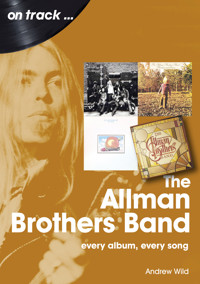
In 1973, the Allman Brothers Band were one of the most popular in America. They headlined the Watkins Glen Summer Jam – attended by 600,000 people – and their album Brothers and Sisters was number one for five weeks. The group made the cover of Newsweek and Rolling Stone named them ‘band of the year’.
Always a strong live draw, in the two years prior to Watkins Glen, they released one of the greatest live albums of all time and lost two founding members in motorcycle accidents, including guitar genius Duane Allman. Drug use and a ruinous 1976 court case forced the band apart, but a three-album reunion between 1978 and 1982 rekindled some of the old fire. It was with their twentieth anniversary and second reformation in 1989 that provided a degree of stability.
Their legacy of eleven studio albums and six contemporaneous live albums include classics such as their self-titled debut, the sophomore Idlewild South, the definitive live document At Fillmore East and the astounding final album Hittin’ The Note from 2003.
The music of the Allman Brothers is the pure distillation of the four main ingredients of American music: blues, rock, jazz and country. At their best, they transcended genre: they just were.
Andrew Wild is an experienced writer, music collector and film buff with many books to his name, including recent publications about Queen, Pink Floyd, Dire Straits and Crosby, Stills and Nash. His comprehensive study of every song recorded and performed by The Beatles between 1957 and 1970 was published by Sonicbond in 2019. He lives in Rainow, Cheshire, UK.
Das E-Book können Sie in Legimi-Apps oder einer beliebigen App lesen, die das folgende Format unterstützen:
Seitenzahl: 248
Veröffentlichungsjahr: 2025
Ähnliche

















The Allman Brothers band
Andrew Wild
Dedicated to all the brothers we have lost. And to Amanda, Rosie and Amy, with love.
Contents
Acknowledgments
Foreword
Introduction
Chapter 1
I. 26 March 1969 – 4 May 1976
1. Idlewild South (1970)
2. At Fillmore East (1971)
3. Friday, 29 October 1971, Macon, GA
4. Eat a Peach (1972)
5. Brothers and Sisters (1973)
6. Saturday, 28 July 1973, Watkins Glen, NY
7. Win, Lose or Draw (1975)
8. Wipe the Windows, Check the Oil, Dollar Gas (1976)
II. 16 August 1978-23 January 1982
9. Enlightened Rogues (1979)
10. Reach for the Sky (1980)
11. Brothers of the Road (1981)
III. 28 June 1989-7 May 2000
12. Seven Turns (1990)
13. Shades of Two Worlds (1991)
14. An Evening with the Allman Brothers Band: First Set (1992)
15. Where It All Begins (1994)
16. Thursday 12 January 1995, The Waldorf, New York City, NY
17. An Evening with the Allman Brothers Band: 2nd Set (1995)
18. Peakin’ at the Beacon (2000)
19. Sunday 7 May 2000, Atlanta, GA
IV. 16 June 2000-28 October 2014
20. One Way Out: Live at the Beacon Theatre (2004)
21. The Fox Box (2004)
22. Wednesday 19 December 2007, Macon, GA
23. The Beacon Box (2009)
24. Tuesday, 28 October 2014
25. Retrospective Live Albums
26. Epilogue: The Road Goes On Forever
Bibliography
Acknowledgments
Many grateful thanks to Richard Brent – Executive Director of The Allman Brothers Band Museum at the Big House – and to John Lynskey, former publisher/editor of Hittin’ the Note magazine, and historian/archivist at the Big House: 2321 Vineville Avenue, Macon, GA, 31204.
Thank you also to Hans van Ryswyk for the peerless DuaneAllman.info website, and for attention to detail in our email exchanges. Gracias to Eric Senich for the Alan Walden book. Greetings Mike Bowen. Hello and thank you to John Ryan the Chicago Kid, for correspondence. Big, big thanks to Art Dobie and Gary Nagle. Kudos to Emma Spires, Gareth Cole, Lee Abraham, Tim Sparks and Mark Spencer for contribution to a lively debate about Duane Allman’s slide guitar-playing. Thumbs up to Bob Beatty. Buy his book!
There is a voice from the tomb sweeter than song. There is a remembrance of the dead to which we turn even from the charms of the living.
Washington Irving, The Sketchbook of Geoffrey Crayon, 1820
There’s wildness, and then there’s pandemonium.
Gregory Allman, 2013
Foreword
The Allman Brothers Band was a group like no other. These masters of improvisation defined how rock music should be played in a concert setting for more than four decades.
Founded and led by visionary guitarist Duane Allman in 1969, the band quickly exceeded even his lofty expectations. Aided and abetted by his younger brother Gregg on vocals and keyboards, the dual drumming of Butch Trucks and Jaimoe, the rock-bottom bass of Berry Oakley and the lead guitar partnership of Dickey Betts, the sum of the group’s talent, far exceeded its considerable individual parts. The ABB blended elements of rock, jazz, blues and country into a volatile musical mixture that left audiences literally worn out. No band played more often, in more places, for anyone who would listen, than the original Allman Brothers did. Their reputation was cemented in July 1971 with the release of At Fillmore East: widely considered to be the greatest live performance recording in the history of rock music.
Even after the devastating losses of Duane Allman in October 1971 and Berry Oakley 13 months later, the band found a way to soldier on. Despite these crushing blows, the ABB’s level of musicianship remained non-pareil. Chuck Leavell, Lamar Williams, Warren Haynes, Allen Woody, Marc Quinones, Oteil Burbridge, Jack Pearson, Derek Trucks and Jimmy Herring maintained the incredible standards set by Duane Allman. The Allman Brothers Band is the only group to place four members in Rolling Stone’s list of 100 Greatest Guitarists; what more needs to be said?
In 2014, the ABB called it a career after 45 years, but their legacy lives on. Part of that legacy is the story of the true brotherhood that existed between the band members, the road crew and extended family and friends – and that spirit can be experienced firsthand at the Allman Brothers Band Museum at the Big House. Located at 2321 Vineville Avenue in Macon, Georgia, the Big House served as the centre of the group’s universe from 1970 to 1973. It was the ultimate hippie communal living experience –one practised by many bands, including Grateful Dead, Jefferson Airplane, Lynyrd Skynyrd and The Doobie Brothers – but the Big House is the only official rock-&-roll band house museum in the country. Fans come from all over the world to soak up the vibe of the OG Six in the Ramblin’ Tudor-style mansion they once called home. Triumph and tragedy, joy and sorrow, loss and rebirth – it all happened at the Big House, and we are proud to carry on that indomitable spirit 50 years later.
Yes, The Allman Brothers Band was a band like no other; and this, a book like no other. Andrew Wild has produced a work worthy of the ABB’s Hall- of-Fame status. His focus on detail and facts is astonishing. What Andrew has chronicled for the likes of The Beatles, Eric Clapton, Pink Floyd, Queen and Fleetwood Mac, has been done again in spades with The Allman Brothers Band On Track.
It’s an honour to write the preface to this book, from Duane Allman’s bedroom at the Big House. Savour it, and enjoy every page.
Eat a Peach.
John Lynskey
Former publisher/editor of Hittin’ the Note magazine, and historian/archivist at the Big House
Introduction
In 1973, The Allman Brothers Band were one of the most popular in America. They headlined the Watkins Glen Summer Jam – attended by an estimated 600,000 people – on 28 July, and their album Brothers and Sisters was number 1 for five weeks on the Billboard listings that summer. The single ‘Ramblin’ Man’ hit 2 in October. The group made the cover of Newsweek. Rolling Stone named them ‘Band of the Year’.
Their story can only be described as unpredictable. Always a strong live draw since forming in 1969, in the two years prior to Watkins Glen, they had released one of the greatest live albums of all time and lost two founding members in near-identical motorcycle accidents: including guitar genius: 24-year-old Duane Allman. Increased drug use and a ruinous 1976 court case forced the band apart. A three-album reunion between 1978 and 1982, rekindled some of the old fire, but it was their 20th anniversary and second reformation in 1989 that provided a degree of stability and renewed acclaim. The album Seven Turns (1990) introduced guitarist/vocalist Warren Haynes to the Allman Brothers Band. Haynes – and later the mercurial Derek Trucks – added a powerful presence after founding-member Dickey Betts was fired in 2000 due to ‘creative differences’.
The band’s annual residency at the Beacon Theatre in New York City (from 1989) comprised over 200 shows across 25 years. This remarkable series of concerts concluded with the final performance of their career – 28 October 2014, stretching over four hours into the early morning of the 43rd anniversary of Duane Allman’s death.
The passing of founder members Butch Trucks and Gregg Allman in 2017 definitively ended the band’s story. Their legacy of 11 studio albums, six contemporaneous live albums and several box sets, includes classics such as their self-titled debut, the sophomore Idlewild South (their artistic and commercial breakthrough), the definitive live document At Fillmore East, and the astounding final album Hittin’ The Note from 2003.
The Allman Brothers Band was one of the great American rock groups – phenomenal musicians capable of delivering honesty and dynamism, both in performance and on record. As Gregg Allman said, ‘If your music doesn’t have dynamics, you might as well get another job. Just like the rising and falling of a poem, the music also travels, and you have to feel it’. Their music is the pure distillation of the four main ingredients of American music: blues, rock, jazz and country.
Bob Beatty wrote in Play All Night!: ‘At times, the guitars stand out. At other times, it’s the drums. Sometimes it’s Gregg’s vocals or the magnificent swirling sound of his Hammond B3. Undergirding it all is a rock-solid foundation of ensemble-playing; each musician making up his part as he goes along. It is a musical conversation, and The Allman Brothers Band are among the premier musical conversationalists in the history of rock music’.
At their best, The Allman Brothers Band transcended genre: they just were.
Chapter1
Before The Allman Brothers Band
Gregg Allman (born 8 December 1947) and his older brother Duane (20 November 1946) were both born in Nashville. In 1949, they moved to Virginia, where their father Willis was killed in a robbery that December. The family returned to Nashville, and from 1955 – with their mother Geraldine studying to qualify as an accountant – the brothers were sent to be educated at Castle Heights Military Academy in Lebanon, Tennessee: 30 miles east of ‘Music City’. ‘Having my older brother with me was the only thing that saved me’, Gregg wrote in his memoir.
The family moved to 100 Van Avenue, Daytona Beach, Florida in 1959. Geraldine lived there until her death in 2015.
Gregg told Rolling Stone in 1979:
I didn’t start playing music till we moved to Daytona Beach. I started on guitar in the summer of 1960, and Duane picked it up by the fall. I taught him the basics, and he really took a yen to it, quit school… that’s all he ever did … many nights I’d wake up and there he’d be, just pickin’ away. We listened to Elmore James, Sonny Boy Williamson, Howlin’ Wolf, Ray Charles, B.B. King. I guess Little Milton was about my favourite. We went, let’s just say, across the tracks. Our mother called it somethin’ else. We had to ease over there. and for about 97 cents, you could buy these old albums. I’ve still got a few of ‘em.
Originally, Duane would borrow Gregg’s Silvertone guitar, for which he saved hard, and bought from the local Sears store, as Gregg recalled: ‘He looks at my guitar and says, ‘Now what you got there, baby brother?’. I go, ‘Now all right, Duane, that’s mine’. He would slip into my room and play it. I swear to God, we had more fights over that guitar than you’d believe’.
Soon, Duane had a guitar of his own. He told Crawdaddy:
The guitar saved me from so much grief. I was a hoodlum ... then that old guitar came along and I had something to do. When I get pissed off, I just sit down and beat the fire out of some old Jimmy Reed shit instead of going out and drinking and fighting and falling down and going crazy. It would take me all the way, man, and put me on a good note.
‘Then not only was there peace in the family’, Gregg wrote, ‘but we started playing together. I had shown him how to play at the beginning, then he started showing me some licks, and we would just help each other out – that’s how we learned’.
Gregg subsequently developed a powerful, distinctive and very soulful singing voice. Their ambitions were heightened during a summer trip back to Nashville to visit their grandparents, as Gregg recalled:
One night, my mother dropped me and my brother off at the Nashville Municipal Auditorium, and we spent a buck and a quarter to sit in the cheap seats. Jackie Wilson was the headliner. Cheap seats or no cheap seats, it was amazing. Next to Jackie was Otis Redding, and Otis just took it, man. He got the whole place singing, and moving faster and faster. My brother was just mesmerized – he was frozen, and he looked stuffed, like a taxidermist had gotten through with him. Nothing on his body moved during the whole concert. That music was in his heart, and it was in mine too. Then we got to playing it, and we realized how important it really was.
They quickly upgraded to electric guitars, courtesy of their doting mother. Gregg was given a Fender Musicmaster, and Duane a cherry-red 1959 Gibson Les Paul Junior. Between them, they played in several short-term bands in Daytona in 1961/1962, including The Kings, The Uniques and The Shufflers – performing wherever they could, including at Y-Teen events at the local YMCA. Duane’s school band The Misfits formed back at Castle Heights Military Academy in late-summer 1961. Bass player Mike Johnstone told author Randy Poe: ‘We rehearsed down at the auditorium there at the school, and played school dances. We did what I call black rock & roll – the early R&B things: Bobby ‘Blue’ Bland and Ray Charles and James Brown. I remember we played ‘Stormy Monday’. I was coming out of surf music – that was my deal. I got started listening to Chet Atkins, which led me to The Ventures. Duane was into that too, but he was more into B.B. King’.
The Misfits were to add Gregg the following year and perform gigs locally ... until Duane was expelled from school in late 1963. Gregg was also asked to leave soon after, and they returned to Daytona Beach.
No longer in school, Duane and Gregg formed their first serious professional band, The Escorts. The instrumental lineup followed that of the newly-famous Beatles – two guitars, with bass (local musician Van Harrison) and drums (Maynard Portwood). An early recording session – intended as a showcase for prospective live bookings – included covers of The Beatles, Gerry and the Pacemakers, The Searchers and The Righteous Brothers. They also performed songs by Roy Orbison, The Impressions, The Yardbirds, The Troggs and others. Gregg Allman:
We did a whole bunch of old R&B love songs – stuff like ‘Pretty Woman’, ‘I’ve Been Trying’, ‘Hi-Heel Sneakers’ and ‘You’ve Lost That Lovin’ Feeling’, which we butchered. ‘Are You Sincere’, by Lenny Welch, was one of my brother’s choices, and we did ‘This Boy’ by The Beatles because we had to play enough Beatles songs. We did some instrumentals as well, including ‘Memphis’ and our version of the theme from Goldfinger. We’d also do ‘Wild Thing’, which got us real close to getting fired several times. Most clubs just wanted us to be a jukebox onstage, and we were a great one.
The Escorts’ biggest break was in spring 1965 when they opened for The Beach Boys in Daytona Beach. This band was renamed The Allman Joys in summer 1965, now with Bob Keller on bass. A new demo tape signalled a move away from the British Invasion towards the American music of The Nashville Teens, Buck Owens, Lonnie Mack, Sir Douglas Quintet and Bobby ‘Blue’ Bland. Gregg wrote in his memoir: ‘We were doing ‘Turn On Your Love Light’, because we had heard Bobby ‘Blue’ Bland do it. And man, you talk about an original talent – there will be – and can be – only one Bobby ‘Blue’ Bland’.
In writer/director Cameron Crowe’s 1989 book The Day The Music Died, Tom Petty (in 1965 an underage upstart living in Jacksonville) remembers hoisting himself up on a cement wall to see a frat dance where the Allman Joys appeared: ‘Duane just stood there, off to the side, ripping through these great leads, and there was his baby-faced little brother, who opened his mouth and sounded like Joe Tex’.
The Allmans moved to Los Angeles in mid-1966, with Portwood and Keller replaced by Bill Connell and Mike Alexander. They later recorded in Nashville at a studio called Bradley’s Barn: including an incendiary version of Willie Dixon’s ‘Spoonful’, which was released as a single. Several other tracks surfaced years later on the album Early Allman. Six can be heard on the 2013 retrospective Skydog. ‘We made it clear that we never wanted those released’, Gregg said. ‘They were terrible songs, just awful’.
Around this time or possibly earlier, Gregg and Duane first met future Allman Brothers Band drummer Claude Hudson ‘Butch’ Trucks, when Trucks’ band the Bitter Ind (for ‘individual’) crossed paths with The Allman Joys on the Florida club circuit. As Gregg later wrote, ‘Musicians find musicians, and I met every one of them in Daytona – black, white, and everything in between’. Butch Trucks told Rolling Stone in June 2009:
(Duane) was this incredibly charismatic, almost messianic type of personality. He was more than a bandleader, he was a guy who could really change you. There are very, very few people you meet like that in your lifetime. If I hadn’t met him, I’d be teaching school, I don’t doubt that. I can still remember the day he reached in and flicked a switch in me that changed me from being a really nervous introverted drummer, to playing with confidence. Most people don’t really have it in them to let it all hang out. That’s why most people aren’t professional musicians. They asked Mark Twain what it took to be successful, and he said, ‘That’s easy: all you have to be is ignorant and cocky’. You have to not be afraid, and at the time, I was very afraid. So we were jamming one day, and it wasn’t going anywhere, and Duane turned around and stared me in the eye and played this lick. It was like a challenge, like, ‘Come on, motherfucker!’. I backed off, and he did it again, and again, and after a while I got mad and I started hitting the drums like I was slapping him on the side of the head. And I forgot about the nervousness and that I was afraid, and the jam got going, and he pointed a finger at me and said, ‘There you go’. And a light bulb went off. I made a decision then: ‘I can play’.
Trucks’ bandmates were bassist David Brown and guitarist Scott Boyer. All three attended high school and Florida State University together. Boyer told Randy Poe: ‘I’d been playing coffee houses and stuff like that. I knew all these Bob Dylan songs. It was around then that The Byrds came in, and The Lovin’ Spoonful. So David approached me with the idea of the three of us getting together and me gettin’ an electric guitar, and they’d back me up on bass and drums, and we’d make some money off this folk-rock thing. That was pretty much how it all got started’.
They were hired for a concert at the Martinique: Daytona’s biggest club. Trucks told Poe: ‘We decided to go to Daytona and hit it big. We started playing our set, and in comes... some presence. You’da thought The Beatles just came in. I mean, it was like the Red Sea parting – people letting them come in and sit down. It was very obvious that there were some personages in the audience. It turned out to be The Allman Joys – Duane and Gregg Allman’. Butch made friends with the brothers, and sat in with The Allman Joys at least once. For now, their paths diverged.
The Allman Joys ultimately evolved into Hour Glass when Gregg and Duane hooked up with a band called The Men-Its in St. Louis. Gregg moved to organ, and the balance of the band was made up of Duane, keyboardist Paul Hornsby, bass player Mabron McKinney (later switched for Pete Carr) and drummer Johnny Sandlin. This new band went through a number of names (The Five Men-Its, The Almanac, even The Allman Joys for a while) before settling on Hour Glass when they secured a record deal with Liberty Records in Los Angeles in mid-1967. They made their Los Angeles concert debut supporting The Doors at the Hullabaloo Club on Sunset Boulevard: probably on 8 June.
The band recorded two albums for Liberty. Hour Glass (recorded August 1967; released October 1967) mostly contains covers of soul songs by writers such as Curtis Mayfield, Jimmy Radcliffe and Goffin/King. It fails to realise the band’s potential, despite Gregg Allman’s impressive vocals. As Randy Poe wrote, it’s ‘an album consisting of a hodgepodge of genres performed by a band being pulled in various musical directions by a producer with no apparent focus’. The much more mature Power Of Love (recorded January 1968; released March 1968) features liner notes by Neil Young and seven original songs by Gregg Allman, who later described the two Hour Glass albums as ‘a shit sandwich’.
Duane meanwhile – always a music fan as much as a professional – attended a concert by blues musician Taj Mahal, where Duane experienced an epiphany. Mahal sang his arrangement of Blind Willie McTell’s ‘Statesboro Blues’, complete with slide guitar by band member Jesse Ed Davis. Paul Hornsby recalls: ‘He made quite an impression on Duane. From the first time that we saw them, we picked up ‘Statesboro Blues’. Taj was doing that, and from then on, we claimed that song. That was the first song that Duane played slide on in Hour Glass. Of course, now when you think of ‘Statesboro Blues’ you think of the Allman Brothers version, but Taj was doing it before them. We pretty much did the same arrangement as Taj’.
As the story goes, Duane taught himself to play slide guitar on his 21st birthday – 20 November 1967 – when he was recovering from an elbow injury. Gregg brought him the self-titled debut album by Taj Mahal and a bottle of Coricidin pills. Duane emptied and washed the pill bottle, and used it as a slide, to play along with Mahal’s slick version of Blind Willie McTell’s ‘Statesboro Blues’. It’s a tall tale, as Taj Mahal was not released until early-1968. Bill McEuan – manager of The Nitty Gritty Dirt Band – knew the Allmans in this period, and claims that Duane ‘got the idea for ‘Statesboro Blues’ after listening to the Folkways album The Country Blues. This might be true, but the Taj Mahal version is a clear and obvious inspiration on the Allmans’ later arrangement. Duane himself said in a radio interview with Ellen Mandel in 1970:
I heard Ry Cooder playing some time ago, and I said, ‘Man that’s for me’. And I got me a bottle and went in the house for about three weeks, and I said, ‘Hey man, we’ve got to learn the songs – the blues to play on the stage. I love this. This is a gas’. So we started doing it, and for a while, it was everybody looking at me and thinking, ‘Oh no! He’s getting ready to do it again!’. Everybody just lowered their heads – start it off fast and get it over with. But then I got a little better at it and improved it, but now everybody’s blowing it all out of proportion. It’s just fine for me as a relief from the other kind of playing.
Cooder played with Taj Mahal in the Los Angeles-based band The Rising Sons in 1965/1966, but he didn’t play much slide at that time. Allman saw Taj Mahal’s band – with Jesse Ed Davis – in Los Angeles, and may well be confusing Davis with Cooder. Paul Hornsby says Duane first wanted to play slide after hearing ‘Beck’s Bolero’ on Truth by The Jeff Beck Group. This was released in July 1968, by which time Hour Glass had split up. The real story is perhaps an amalgamation of all of these threads.
Hour Glass opened for some of the biggest acts of the day – Big Brother and the Holding Company, Jefferson Airplane, The Animals and Buffalo Springfield. A series of self-funded demos recorded at FAME (Florence Alabama Music Enterprises) Studios in Muscle Shoals, Alabama in April 1968, remained unreleased, although a scintillating medley of three B.B. King songs became a highlight of Duane Allman: An Anthology, released in 1972. This is perhaps the only Hour Glass studio cut that suggests their power as a live band. Other songs from these 1968 sessions have been included on An Anthology Volume II and the Dreams box set.
But Liberty Records never really understood the band’s objectives, and they disbanded in mid-1968. Gregg subsequently returned to Los Angeles to record a solo album to fulfil his obligation to Liberty. These songs – including, remarkably, a version of Tammy Wynette’s ‘D-I-V-O-R-C-E’ – are an indication of just how little Liberty understood Gregg Allman. 11 tracks from these sessions were released as part of the 1992 reissue of the Hour Glass back catalogue.
Duane returned to Florida and hooked up with drummer and old friend Butch Trucks. Allman agreed to work on demos with Trucks’ band: now renamed 31st of February. Gregg also joined these sessions. They recorded nine songs in September 1968: eventually released in 1972 on the album Duane & Gregg Allman. Notable tracks include a powerful version of Tim Rose’ folk-rock standard ‘Morning Dew’, the soulful slow blues ‘Nobody Knows You When You’re Down and Out’ (which Duane later recorded with Derek and the Dominoes in a very similar arrangement), and an early version of ‘Melissa’ which even then sounded like a stone-cold classic and included Duane’s first recorded slide guitar-playing.
With Gregg back in California completing his solo commitments, Duane received a phone call from FAME Studios owner Rick Hall, who’d been impressed by Duane’s playing on the B.B. King medley and wondered if Duane wanted a job as a session player. Over the next two years, Duane Allman added his unmistakable guitar-playing to songs on many sessions. The first to be released was ‘The Road of Love’ by Clarence Carter: recorded 12 November 1968. Galadrielle Allman:
Duane loved Clarence Carter, and when he heard he was coming in, he turned up the heat and Rick told him he could play on the session. They cut a real blues thing called ‘Road Of Love’, and Duane’s playing really shined. Rick was very impressed. In the middle of the song, Carter even sang out, ‘I like what I’m listening to right now’ after Duane’s slide solo: a blast of passion in the middle of a simple funky groove. Duane brought that track to life.
Duane’s superlative performance on Wilson Pickett’s ‘Hey Jude’, dates from either 17 or 27 November 1968 (sources differ). Galadrielle writes: ‘On ‘Hey Jude’, Duane sounds like he’s being released – clearly excited by the energy radiating from Wilson Pickett. Duane sat on a small amp facing him, and they locked in, matching each other’s intensity and driving each other to a fever pitch. That feeling of expanding the possibility of a song with his playing, pointed the way forward for Duane. His fierce solo at the end of the cut was the true beginning of his career. Everyone who heard it, wanted to know who he was. It opened doors for him’.
Sessions with Arthur Conley, Aretha Franklin, King Curtis and many others, quickly followed. Boz Scaggs’ astounding ‘Loan Me A Dime’ dates from May 1969. Many of these are collected on the tremendous 1972 compilation Duane Allman – An Anthology. Fans with deeper pockets should seek out the 7-CD box set Skydog (2013), which includes a wide selection of Allman’s session work along with tracks by The Escorts, The Allman Joys, Hour Glass and 31st of February.
Despite the income, stability and reputation that these sessions brought, Duane missed playing live with his own band. FAME signed Duane to a five- year recording contract in December 1968, with the view that he would form and lead a band of his own. Early in the new year, Allman recruited drummer Jai Johanny ‘Jaimoe’ Johanson, at the suggestion of local booking agent and studio owner Phil Walden. Jaimoe had toured with Otis Redding, Percy Sledge, Clarence Carter and Joe Tex, and had been employed by Walden as a session drummer following a recommendation from Sledge’s tour manager Twiggs Lyndon. In 2017, Jaimoe told Mississippi Today that between sessions, Duane would roll that Fender Twin amplifier ‘out of the studio over to where I was, and I found out what jazz is. Music that comes out of this country is music that makes you happy, sad and the rest of it. Jazz is American music – hillbilly, hip hop, rhythm and blues: it’s all jazz. And I learned it in search of jazz’.
Duane next called up Berry Oakley. Oakley was a bass guitarist with an acute sense of melody. He’d previously been lead guitarist in several bands in his native Chicago, and played bass with the same drive and attack. Oakley met Duane and Gregg Allman in July 1968 at the Comic Book Club in Jacksonville when he was playing with a band called Second Coming. Despite his youth, Oakley was a seasoned professional, joining Tommy Roe’s band in 1965, aged 17. Jaimoe recalled: ‘It had been so great playing with Duane, but I thought we’d never find a bass player who could do the stuff that we were doing. When Berry arrived (in January 1969), it was amazing. It was like, ‘Where did this dude come from?’. It became a whole different ball game, and at that point, my perspective changed’.
In February 1969, Duane recorded eight songs using Oakley and two former members of Hour Glass: Johnny Sandlin and Paul Hornsby. A cover of St. Louis Jimmy Oden’s ‘Goin’ Down Slow’ can be heard on 1972’s Duane Allman: An Anthology, and his own composition ‘Happily Married Man’ and a version of Chuck Berry’s ‘No Money Down’ are included on An Anthology Volume II (1974). These three tracks can also be heard on the Sky Dog box set. Another song – ‘Steal Away’ – was planned for the Dreams box set, but remains unreleased. It can be found online if you know where to look.
In this period, Duane frequently returned to Jacksonville to hang out with Butch Trucks, and jam with Oakley and his Second Coming bandmates, including guitarist Dickey Betts and pianist Reese Wynans. Betts said: For a period of about two years, Duane would just show up and sit in. Duane has that real clear sound, although it had more of a blues edge to it, and my style had that country kind of thing. But they worked together’.




