


120,99 €
Mehr erfahren.
- Herausgeber: John Wiley & Sons
- Kategorie: Geisteswissenschaft
- Sprache: Englisch
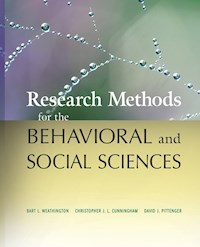
A comprehensive introduction to research methods and best practices for designing,conducting, interpreting, and reporting findings
This text is designed to develop in students a passion for conducting research and an understanding of the practical value of systematic information- gathering and decision-making. It features step-by-step coverage of the research process including research design, statistical considerations, and guidance on writing up and presenting results.
Recognized leaders in the field—authors Bart Weathington, Christopher Cunningham, and David Pittenger—present:
-
Introductions to multiple research designs—including single-participant, multi-group, longitudinal, correlational, and experimental designs—accompanied by examples
-
Bibliographic research and methods for appropriate sampling
-
Identifying, developing, and evaluating reliable and valid approaches to measurement
-
The issues and steps common to all single-factor and multifactor studies, as well as single-subject and nonexperimental methods
-
How to summarize research in writing that conforms to the editorial guidelines of the American Psychological Association
A comprehensive review of research methods and the statistical concepts that support them, Research Methods for the Behavioral and Social Sciences offers the best techniques for studying behavior and social phenomena.
Sie lesen das E-Book in den Legimi-Apps auf:
Seitenzahl: 1269
Veröffentlichungsjahr: 2017
Ähnliche



















Research Methods for the Behavioral and Social Sciences
By
Bart L. Weathington
Christopher J. L. Cunningham
David J. Pittenger
Copyright © 2010 by John Wiley & Sons, Inc. All rights reserved.
Published by John Wiley & Sons, Inc., Hoboken, New Jersey.Published simultaneously in Canada.
No part of this publication may be reproduced, stored in a retrieval system, or transmitted in any form or by any means, electronic, mechanical, photocopying, recording, scanning, or otherwise, except as permitted under Section 107 or 108 of the 1976 United States Copyright Act, without either the prior written permission of the Publisher, or authorization through payment of the appropriate per-copy fee to the Copyright Clearance Center, Inc., 222 Rosewood Drive, Danvers, MA 01923, (978) 750-8400, fax (978) 646-8600, or on the web at www.copyright.com. Requests to the Publisher for permission should be addressed to the Permissions Department, John Wiley & Sons, Inc., 111 River Street, Hoboken, NJ 07030, (201) 748-6011, fax (201) 748-6008.
Limit of Liability/Disclaimer of Warranty: While the publisher and author have used their best efforts in preparing this book, they make no representations or warranties with respect to the accuracy or completeness of the contents of this book and specifically disclaim any implied warranties of merchantability or fitness for a particular purpose. No warranty may be created or extended by sales representatives or written sales materials. The advice and strategies contained herein may not be suitable for your situation. You should consult with a professional where appropriate. Neither the publisher nor author shall be liable for any loss of profit or any other commercial damages, including but not limited to special, incidental, consequential, or other damages.
This publication is designed to provide accurate and authoritative information in regard to the subject matter covered. It is sold with the understanding that the publisher is not engaged in rendering professional services. If legal, accounting, medical, psychological or any other expert assistance is required, the services of a competent professional person should be sought.
Designations used by companies to distinguish their products are often claimed as trademarks. In all instances where John Wiley & Sons, Inc. is aware of a claim, the product names appear in initial capital or all capital letters. Readers, however, should contact the appropriate companies for more complete information regarding trademarks and registration.
For general information on our other products and services please contact our Customer Care Department within the U.S. at (800) 762-2974, outside the United States at (317) 572-3993 or fax (317) 572-4002.
Wiley also publishes its books in a variety of electronic formats. Some content that appears in print may not be available in electronic books. For more information about Wiley products, visit our website at www.wiley.com.
Library of Congress Cataloging-in-Publication Data:
Weathington, Bart L. Research methods for the behavioral and social sciences / by Bart L. Weathington, Christopher J. L. Cunningham, David J. Pittenger. p. cm. Includes bibliographical references and index. ISBN 978-0-470-45803-7 (cloth) 1. Psychology—Research—Methodology. 2. Social sciences—Research—Methodology. I. Cunningham, Christopher J. L. II. Pittenger, David J. III. Title. BF76.5.W43 2010 150.72—dc22
2009041473
ISBN 9780470458037
To Jeanie, Alex, Rebecca, Mom, and Dad for literally everything.—Bart L. Weathington
To God, my wife Lori, my family, and my students and colleagues—thank you for spending time with me on the journey.—Christopher J. L. Cunningham
To my wife, Denise, who has, by example, taught me to enjoy the moment and to worry less about the future, which I cannot control.—David J. Pittenger
Preface
The pursuit of knowledge requires no justification.
—David J. Pittenger
Ditto.
—Bart L. Weathington & Christopher J. L. Cunningham
Philosophy for Writing This Book
For those of us who teach research methods, one of the most gratifying experiences is watching students develop a passion for conducting research and an understanding of the practical value of systematic information gathering and decision making. These students discover that they can convert their natural curiosity about behavior into testable hypotheses. Moreover, they learn that studying research methodology is not arcane and irrelevant. Indeed, they come to appreciate the fundamental value and importance of empirical research. Because the vitality of science depends on the passion to learn more about behavior, it is our belief that a course in research methods is one of the most important courses that any student can take. Therefore, we wrote a book that we hoped would be attractive to students and convey to them our enthusiasm for research. To reach those goals, we strove to incorporate several features in our book.
Style
We wanted the book to be inviting and easily accessible for the reader. Therefore, we gladly used and active narrator voice to make the textbook as engaging and interesting as possible. There is a clear and conversational style to the text, but that does not reflect lack of rigor in the material. Throughout the text, we provide comprehensive accounts of scientists’ best ideas and research methods.
Examples
Another strategy we used was to select familiar and contemporary examples. We based many of our examples on well-known social phenomena and on research that examines interesting topics. Our goal in selecting these examples was to illustrate important topics covered in the chapter and to show how researchers use research tools to answer complex and important questions.
Assumptions
Those familiar with parametric statistics know that they come with many mathematical strings attached. If the researcher cannot ensure that the data and the design of the data collection methods meet these basic assumptions, then the inferences derived from the statistical analysis may be suspect. In some cases, the statistic is extremely robust to violations of its assumptions. Other statistics fail to withstand even minor deviations from the requirements.
An assumption we made in writing this book is that that the reader using this book will have completed at least a general Introduction to Statistics course. Consequently, a certain level of statistical knowledge is assumed, especially the more basic concepts such as measures of central tendency, measures of dispersion, or standard scores. Nonetheless, many students seem to forget much after completing the final exam of their statistics course. This unfortunate phenomenon may mean that a single course in statistics is not enough to develop in students a sufficiently stalwart schema to ensure more efficient and durable encoding and retrieval of material. Therefore, this text does review critical statistical concepts as they relate to specific methodological techniques. Additionally, we included an appendix that can act as a statistics review.
A text should challenge students beyond their current ability. If education is not to extend the grasp of our students, then what is an education for? Thus, while we labored to write as clearly as we could, we also labored to ensure that we challenge students to extend beyond the bounds of their comfort and present to them the tools needed to understand contemporary behavioral research. In doing so, we hope that the instructor recognizes that he or she is not bound to teach every chapter or every topic in each chapter. This is a fairly thick book, and we hope that both student and instructor will recognize that it is a resource from which to draw information.
Integration of Research Methods and Statistical Concepts
It has been our common experience that many students begin a research methods course with only a vague notion of how the statistics they had studied in the prerequisite statistics course are related to research design. Over time, we found ourselves teaching concepts related to statistical analysis along with traditional concepts related to research methods. Indeed, a careful review of statistical techniques requires discussion of research methodology. Similarly, discussions of research design require a review of statistical principles.
Therefore, in writing this book, we wanted to ensure that students receive a comprehensive and detailed review of the best techniques for studying behavior and social phenomena. Consequently, where appropriate our chapters provide a comprehensive review of research methods and the statistical concepts that support them. The review of the statistical principles, while comprehensive, is conceptual and nontechnical. Students who have completed a course in statistics will find these sections to be a useful review of important topics. Students who have not studied statistics will find these sections a suitable and readable introduction to these topics.
For example, the review of sampling procedures examines the different methods researchers use to create representative samples and demonstrates how the Central Limit Theorem allows one to make valid inferences using sample statistics. Other topics receive recurring attention throughout the book, including the important concept of statistical power. The goal is to show students that they can control power by adjusting sample size and by gaining control over specific types of variance—increasing variance due to the independent variable and decreasing variance due to random or sampling error.
Order of Chapters
We arranged the sequence of chapters to both match the steps in conducting research and to aid readers in learning how to design and implement a research project. Consequently, the first few chapters present background information, ethics, and an overview of various research methods. Subsequent chapters review such topics as bibliographic research and methods for generating samples. The next set of chapters reviews how to create reliable and valid measurement instruments. Thus, there are separate chapters on creating tests and using correlation statistics to evaluate the reliability and validity of any measurement. The lessons learned in these chapters set the stage for all types of psychological research.
The subsequent chapters examine the issues and steps common to all single-factor and multifactor studies, as well as single-subject and non-experimental methods. Relatively early in the text is a chapter on how to prepare a paper that follows the editorial guidelines of the American Psychological Association. In most texts it is common to reserve this chapter for the end of the book. However, it has been our experience that waiting until the end of a course to talk about the most common form of final outcome (i.e., a written report) is simply too late for this material to take root. A concrete understanding of what the finished project should look like aids student researchers in learning about and planning a research project.
In writing this text, one of our goals was to allow instructors the flexibility to rearrange the order of the chapters without a loss of continuity. Ultimately the goal of a research methods course is to produce both informed consumers of existing research and informed producers of new or refined knowledge. We believe that the order of chapters aids in the completion of this goal, but some instructors may find that a different order of chapters better fits their style.
Pedagogy
Each chapter uses multiple methods to present the material, including clearly written text, familiar and interesting examples, and visual illustrations to help the reader understand complex and abstract concepts. The specific pedagogical features include:
Research in Action:
Each chapter includes case studies and critical thinking exercises. The goal of these exercises is to help the reader apply critical concepts to a research scenario.
Knowledge Check:
Each chapter contains several Knowledge Check questions, which consist of a series of questions that require the reader to apply the material to objective problems. These questions require more than rote memorization because they ask the reader to apply the material. Answers to these questions are provided in
Appendix C
.
Multiple Presentations of Concepts:
Throughout the book, the reader will find a combination of text, pictures, and examples to illustrate various concepts.
Glossary:
Each chapter contains definitions of important terms.
Statistical Review and Integration:
Appendix A
is a statistics review designed to help students remember and understand basic statistical concepts. Additionally, many chapters have a section that deals with the statistics underlying the topics covered in that chapter.
Statistical tables:
Appendix B
contains a comprehensive list of commonly used statistical tables.
Supplementary Materials
No textbook is complete without ancillary materials to aid the instructor in introducing course material to students. This is especially important for a text on research methods. Accordingly, a full set of PowerPoint slides, a Test Bank, and an instructor’s manual are available to instructors through this book’s website on Wiley’s Higher Education site at www.wiley.com. Of particular note is the inclusion of a Research Journal within the instructor’s manual that provides examples of journal articles that supplement the material presented in this book. We would like to thank the journal Modern Psychological Studies, and particularly its current editor Dr. David Ross, for allowing us to incorporate published articles as applied examples of research methods in practice.
Acknowledgments
Although we are the authors of the book, we cannot claim that what you will read is our work alone. Many people have had a hand in helping in the preparation of this text and in providing us with the training and resources that have allowed us to become researchers and professors. These people have earned our deepest admiration and continued thanks. Any errors, of course, are our own.
We are especially grateful to our editor at Wiley, Patricia Rossi, who has provided us with extensive feedback and guidance while still giving us the flexibility to produce a book we are proud to call our own. Countless professionals working at John Wiley & Sons, Inc., also deserve our sincere thanks. Specifically, we want to thank Katie DeChants and Kim Nir for their valued time and assistance in developing a professional publication.
Many reviewers read and commented on preliminary drafts of this book. The job of a reviewer is to scold the author for making mistakes and to offer praise only when deserved. The reviewers did their job well. Their comments were often humbling because we had failed to describe something as clearly and accurately as possible. Similarly, their comments flattered us when they found parts of the book that they liked. Consequently, the book you are about to read very much reflects their supportive criticism.
Part IOverview of the Research Process
Chapter 1Research and the Social Sciences
CHAPTER OBJECTIVES
Introduction
Why Is Understanding Research Methods So Important?
The Role of Science in Everyday Life
The Scientific Method
Brief History of the Science of Behavior
Bacon
’
s Legacy
Other Important Historical Figures
Assumptions of Science
Requirements for Scientific Research
Research in Action: The Case of Facilitated Communication
The whole of science is nothing more than a refinement of everyday thinking.
—Albert Einstein
Introduction
Welcome to one of the most critical courses in the curriculum for any degree. A basic understanding of research is especially important in the social sciences. Understanding something as complex as social interactions or human behaviors and cognitions is not easy. Without an empirical, scientific approach to the development of a body of knowledge, our understanding of people will be incomplete and rife with error. Having a solid understanding and appreciation of research methods will help you to fully connect with the field you are preparing yourself for at this very moment. Each of us, your authors, is passionate about research for very different reasons. The three of us are psychologists, but our interests and research overlap with many other areas. As you read this text, an understanding of who we are and where we came from may help you to better place the techniques and concepts related to research methods in context with your own career goals. So you can have some idea of where we are coming from in future chapters, here are brief bios for you to consider:
Bart Weathington
I became an academic and “researcher” in a non-traditional way. Growing up I was always fascinated by science (due in part to some very good teachers along the way). I was also very interested in understanding why people behave the way they do. My dad spent most of his career as an industrial engineer helping to streamline processes and improve industrial efficiency. I knew very early that engineering was not for me, but discussions with my dad about what he did for a living instilled in me an understanding that the most important component of any project is the people involved. I went through seven majors in college before figuring out that psychology was, for me, the best combination of my interests. I lucked into a course on psychology applied to business in my junior year and from that time on I knew that was what I wanted to do. However, I was much more interested in applying knowledge than in creating it.
I went to graduate school with the intention of becoming a consultant upon graduation. I wanted to help organizations solve real-world problems and help individuals maximize their potential. Little did I know that the best way I would find to do this would be to combine teaching, consulting, and research. I discovered that the best way to apply knowledge is to have an understanding of how it was learned in the first place. Understanding research methods is the key to this process. I began my career as a consultant who did a little teaching and research on the side. Now I am a teacher and researcher who consults a little on the side. It is my firm belief (and I hope you will take the same understanding away from this text) that understanding how knowledge is identified, created, and refined (i.e., research methods) will help you make better decisions in the future—whether you become a researcher yourself or if you never conduct your own research study outside of a classroom setting. Being an informed consumer of research is as important as being an informed researcher.
Chris Cunningham
Psychology is in my family, but that’s not why I became an Industrial-Organizational (I-O) psychologist. My dad was (and still is) an extremely busy child-and-school psychologist, and my mom is a professor of education at a local college. Thinking about thinking and behavior was probably our favorite pastime and also the source of many dinner-table discussions. This didn’t translate into career goals until the summer between my freshman and sophomore years in college. That summer I lived by Lake Champlain in northern Vermont working as a temporary employee in a variety of roles (think ticket sales and light construction). The work was boring and tedious and I spent a lot of time thinking seriously about what kind of work would actually interest and motivate me for the long haul. Ultimately I decided to major in psychology, but this merely left me with the inevitable question, “Now what do I do?” Over the next two summers, I worked as a child-care counselor and psychiatric intern at a residential treatment facility and hospital in Pennsylvania. Although extremely important, this type of work was not personally rewarding. Pouring my heart and soul into providing therapy and assistance to patients, watching them “finish” treatment, and then watching them be readmitted weeks later in worse shape than before really bothered me.
I began to wonder whether there was another way for me to have a positive impact on peoples’ lives without working in a clinical setting. Remembering my temporary worker experiences and other jobs I had held, I decided to prepare myself for graduate school in Industrial-Organizational psychology. I wanted to figure out a way to improve people’s lives through their work environments. To move toward this goal, I began to focus heavily in graduate school on occupational health and safety issues. The one constant through all of this was my passionate desire to understand something and make things better. These interests can be satisfied only with good research, and I learned the Skills and techniques for this from my psychology training as an undergraduate and graduate student. This drive to learn something new every day and share that with other people is what gets me out of bed every morning. Having an understanding and appreciation of proper research methods and statistical analyses has allowed me to respond to a wide variety of challenges in my academic and consulting work and I sincerely believe these skills form the core of any social science career.
David Pittenger
I fell in love with psychology in high school when I took a general psychology course. When I entered college I decided to be a psychology major. More specifically, I wanted to be a clinical psychologist. I imagined that I would sit in my office, listen to clients tell me their problems, and then dispense helpful advice. All I needed to do was learn how to do therapy—or so I thought. During my first term at college, I took three courses: a freshman orientation seminar, an introduction to philosophy, and an introduction to psychology. From the first day, the psychology instructor emphasized that psychology is a science and that we would learn how psychologists use the scientific method to understand human behavior. What a shock! I had taken biology, chemistry, and physics in high school. These were sciences—how could anyone confuse psychology with a science? What really startled me was when the instructor told us about the major. After the introductory course, we would have to take a course in statistics and then another course in research methods. Then, in our senior year, we would have to conduct a scientific study related to psychology. Math was never my favorite subject, and I had planned to dodge college-level mathematics as artfully as I could. I began to doubt my decision to major in psychology. Was all this science stuff really for me? Was I in the right major? I wanted to help people. Why did I have to suffer through courses in statistics and research methods? Then something interesting happened. My philosophy course surveyed great ideas in western thought. During the middle of the semester, I realized that my philosophy instructor talked about the same topics as my psychology instructor. For example, in my philosophy course we read sections from Wittgenstein’s essay on the meaning of words. In the psychology course we learned how psychologists study children’s language development. I recognized then that psychologists study many of the same questions that have confronted the great thinkers throughout history.
When I began graduate school, I still wanted to be a clinical psychologist and hoped to learn how the science of psychology guided therapists to new and effective treatments. By then I was not surprised to learn that my coursework included statistics and research methods. Even the courses in clinical psychology emphasized how psychologists use research to determine the effectiveness of different therapies. When I finished my master’s degree, I worked in a residential psychiatric hospital as a counselor. I was a member of a treatment team and offered group and individual therapy under the direction of the ward’s psychiatrist. Although I enjoyed my job, I noticed that something was missing. How did we know that our therapy worked? Our clients got better; but did their improvement reflect our efforts, or did they just get better? Other questions nagged at me. Why, for example, do people continue to do something that they have agreed is self-destructive? Why was a specific treatment useful for one client but not another? When I shared my questions with a former professor, his response was, “David, you are asking questions like an experimental psychologist. You want to understand what causes behavior. Go back to graduate school and follow your interests.” I did. I returned to graduate school, where I studied the foundations of psychology—learning, memory, and the physiological basis of behavior—and I am now a professor of psychology teaching the courses that I once dreaded.
Why Is Understanding Research Methods So Important?
Although there are differences across specialty fields in the social and behavioral sciences, there are three core types of information that anyone specializing in these areas must know. The first is basic statistics. The second is to understand the proper methods for developing and evaluating psychological tests and surveys researchers use to measure human thought and behavior. The third is how to conduct and interpret high-quality research. In this book, we will help you with the third type of information. Mixed in the chapters we will also remind you of important statistics that might help you along the way. We will also provide you with the basic information needed to begin the test development and evaluation process. If you feel you need a refresher in basic statistics, a review is included in Appendix A.
Why are these three core topics so important? Think about it— researching, analyzing, and reporting are the skills from your education that will help you find a job, keep a job, and make a contribution to society. You can think big thoughts and theorize all day long, but without these three skills, these great ideas will never translate to credible and applicable science. We do not want your good ideas to be restricted by the boundaries of your mind. This is why we all sincerely hope that you are not dreading this course or fearing something nonspecific about science or research. There is nothing scary here; just a systematic approach to learning, understanding, and questioning that will benefit you no matter what you decide to do with your degree once you graduate. There are many ways to study human behaviors and cognitions, but most prefer to use the scientific method in some way, shape, or form. Statistical description and analysis techniques provide structure to these methods, and good test development and utilization provide the conduit through which good research is conducted. In other words, to become a proficient social scientist you must learn to work with the tools of the trade: the scientific method and its attachments, statistics, and tests and assessments.
The Role of Science in Everyday Life
Thought-Starters
What are some examples of science in your life?
Have you “researched” anything today?
What are some big decisions or questions you are currently considering?
H. G. Wells, the nineteenth-century author, predicted that “statistical thinking will one day be as necessary for effective citizenship as the ability to read and write” (as cited by Campbell, 1974). We strongly believe this prediction has come true. Although you may not plan to become a researcher, obtaining and using an advanced degree in any field of the social sciences (and in many areas of life in general) will force you to confront issues that can be addressed only with the aid of scientific research. Consider the following example issues:
What effect does child care have on child development?
What are the best ways to prevent drug abuse?
Are treatment programs for drug and alcohol abuse effective?
Will a specific test accurately predict how well a person will do on a job?
Will this new drug cure multiple sclerosis?
What is the best way to present new information to a large group of people?
These are clear and direct questions that anyone could ask. Will you send your children to day care? If you do, what will you look for in the program? As a parent, what should you do to discourage your children from using illegal drugs? If you have a management position, should you use personality tests to predict who will be a good employee? These are the types of questions you will face when you start to apply your social sciences training to the real world. Knowledge of the scientific method can be invaluable where the rubber meets the road.
Take, for example, the classic legal case of Daubert v. Merrell Dow Pharmaceuticals, Inc. (1993). In this case, the Supreme Court ruled that judges, not jury members, must determine the merits and scientific validity of testimony given by expert witnesses. In response to the court’s decision, the Federal Judicial Center developed the book Reference Manual on Scientific Evidence (1994) to help judges and lawyers understand the principles of research methods and statistics. As the authors of the book noted, “no longer can judges … rely on their common sense and experience in evaluating the testimony of many experts. … The challenge the justice system faces is to adapt its process to enable the participants to deal with this kind of evidence fairly and efficiently and to render informed decisions” (p. 1). As H. G. Wells predicted, the knowledge of the scientific method is now a vital part of our government and judicial system and therefore our everyday lives.




