


11,99 €
Mehr erfahren.
- Herausgeber: John Wiley & Sons
- Kategorie: Fachliteratur
- Sprache: Englisch
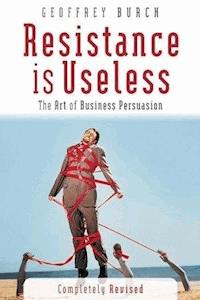
This book will show you how anyone can be persuaded to do anything. Geoff Burch has written a book that will change almost everything you ever believed about business and selling. Combining the quick wit of a stand up comedian with the serious thoughtfulness of a psychoanalyst, he explains the value and power of persuasion - a verbal martial art that, if used correctly will always give you the outcome you desire in your business dealings. Resistance is Useless will show you how to: * Change anyone's opinion on any subject. * Transform a lynch mob into your most devout supporters. * Avoid wasting thousands of pounds on customer care while your accounts department is threatening to pulp your customer's fingers with a hammer. * Understand how a perfect product demonstration can get you hurled into the street by security. * Sell tanks to Genghis khan. Readership: General Business, customer service and sales.
Sie lesen das E-Book in den Legimi-Apps auf:
Seitenzahl: 440
Veröffentlichungsjahr: 2011
Ähnliche


















Resistance is Useless
Resistance is Useless
The Art of Business Persuasion
GEOFFREY BURCH
First published in 1994 by Headline Book Publishing This edition published by Capstone Publishing Ltd (A Wiley Company)
Copyright © 1994 Geoff Burch
Registered office
John Wiley & Sons Ltd, The Atrium, Southern Gate, Chichester, West Sussex, PO19 8SQ, United Kingdom
For details of our global editorial offices, for customer services and for information about how to apply for permission to reuse the copyright material in this book please see our website at www.wiley.com
The right of the author to be identified as the author of this work has been asserted in accordance with the Copyright, Designs and Patents Act 1988.
All rights reserved. No part of this publication may be reproduced, stored in a retrieval system, or transmitted, in any form or by any means, electronic, mechanical, photocopying, recording or otherwise, except as permitted by the UK Copyright, Designs and Patents Act 1988, without the prior permission of the publisher.
Wiley also publishes its books in a variety of electronic formats and by print-on-demand. Some content that appears in standard print versions of this book may not be available in other formats. For more information about Wiley products, visit us at www.wiley.com.
Designations used by companies to distinguish their products are often claimed as trademarks. All brand names and product names used in this book are trade names, service marks, trademarks or registered trademarks of their respective owners. The publisher is not associated with any product or vendor mentioned in this book. This publication is designed to provide accurate and authoritative information in regard to the subject matter covered. It is sold on the understanding that the publisher is not engaged in rendering professional services. If professional advice or other expert assistance is required, the services of a competent professional should be sought.
ISBN 9781841124698 (print); 9781119950028 (ebk); 9781119950035 (ebk); 9781119950042 (ebk)
A catalogue record for this book is available from the British Library.
Typeset in 10/16pt Palatino by Servis Filmsetting Ltd, Manchester Printed in the UK by TJ International Ltd, Padstow, Cornwall
Contents
Introduction
1 The Gentle Art of Persuasion
2 Selling Tanks to Genghis Khan
3 Risky Business?
4 The Gift of the Earhole
5 Mimicking Sheepdogs
6 Keeping Promises, Keeping Customers
7 Welcoming Complaints
8 The Psychology of Persuasion
9 Negotiating: Sympathize, and Trust No One
10 Benefits, Whose Benefits?
11 The Big Ones
12 The End is Nigh: Close or Launch-Pad?
12a And Finally…
Introduction
Oh how the world has changed! In the twilight of the 20th century, the gurus wailed and gnashed about the knowledge economy. The massive power of that chip progenitor of the internet, the communication revolution, the digital age, but at the dawn of the 21st century it all started to unravel. A trail of busted dot coms and broken dreams. Digital giants with 90% of their value wiped out. So much predicted, so little delivered. We should have seen it coming. When I was a kid, I had a book called ‘The Boys Book of the Future’, (or something like that). It was full of truly bonkers stuff that we were supposed to be doing which seemed to involve wearing loads of skin tight tin foil. In the bit ‘The Restaurant of the Future’ we would proceed apparently in our tin foil suits (Dad, strangely enough, although suitably tin foiled, would still have a pipe, Brylcreem his hair and wear driving gloves) to a large hall, where a wall of glass and stainless steel doors would allow us to select one of a thousand dried meals. These would be taken on a plastic plate to a metal table, where we could re-hydrate it at our leisure. Wheeled robots would clear the plates as we put our coins in the payment slots. What is a restaurant of the 21st century like? It is called Tony's Trattoria, there are checked tablecloths, candles, and Tony, a large man with waxed moustache and tomato sauce on his apron. Hand written menus, wine from a barrel, the smell of warm garlic. Behind the scenes, Tony, real name Brian, buys his apron pre-tomatoed, and puts everything in the microwave. In other words, there is superior technology, but as it becomes cheap, reliable and powerful, it also becomes discreet. Cars have very powerful computers but you don't have to mess with them or even see them. This is the mistake the ‘knowledge economy’ made. They believed we did not have to sell anymore. As long as it was bigger, faster, cheaper, the customers would always buy, but the misery of the 90% clubs has contradicted this simple complacency. We all have computers, but we certainly don't do all our shopping on them, as the dot com movement would have liked us to believe. As humans, we like to be with humans. We need to be told a story. We love to have pictures created in our own minds. We truly enjoy being persuaded. The story creates a premium. Organic food isn't really about health, it is about a story. The washed potatoe in the plastic bag tastes the same as the organic one, but the story of the potato firm from the factory can't compete with the story of Lower Potatoington – the rural village where rosy cheeked children pay on the green, stopping only to watch the majestic beauty of the massive working horses, bringing in the treasured potato harvest. Potatoes that, with every bite, return us to an age of innocence free from worry. The problem is that no one sells any more – we are never told the story, we rarely have the delight of paying a little more for being helped to own a treasure instead of a commodity.
This book is possibly aimed at business, negotiators, and salespeople but everyone can benefit. If you have a talent, a product, or an idea, success may have evaded you simply because you failed to persuade.
1
The Gentle Art of Persuasion
All textbooks, training programmes and seminars set out to bring about change. To borrow a statement from the new psychology called neurolinguistic programming, ‘If you do what you have always done, you will get what you have always got. If you don't like what you are getting, then you must change what you are doing.’ This, of course, is a lot easier to say than to do. Most people are unhappy with some aspect of their life or business; but change can be hard and the prospect frightening. At the moment, you are probably thinking of how you and your company might change to become more successful, and how this book might give you some new ideas as the basis for your plans. I hope it will; but think too of the change you are aiming to effect every time you or one of your colleagues tries to sell something, to conduct a negotiation, to implement a set of new working practices. All of these activities, and many more in business and commerce, involve changing someone's mind; and it stands to reason that if you were mentally nodding a moment ago when I said that change can be hard and frightening, you might have a better chance of success in any of these situations if you could make the change you are aiming to achieve a little less hard and frightening for the other party.
Getting Caterpillars Airborne
This is one of the key principles underlying the art of persuasion. In my hippy days as an art college student in the sixties, I used to like the saying, ‘What the caterpillar calls death, we call a butterfly’ – but try telling a quivering little green grub about the benefits of flitting about in the sunshine with glorious purple wings. Or, as the cartoon of a flat-capped caterpillar watching a butterfly pass overhead has him saying to his mate, ‘You wouldn't get me up in one of those things.’ It is in its approach to getting the reluctant caterpillar airborne that persuasion parts company with some of the more fashionable techniques of selling and negotiation.
Just as frightening as the prospect of bringing about change yourself is that of bringing about unwanted change in someone else. Remember the icebergs and my often-sunk Titanic? Here is another example of the dangers of successful persuasion. My wife came to me once saying that one of her friends was very upset because her husband had been going to massage parlours and generally behaving badly. Putting on what I believed to be my truly caring hat, I took this guy out for a drink and told it to him the way it was. I pulled no punches: I tore his behaviour to bits and told him that he was being completely selfish and ignoring the deep responsibilities he owed to his family. As I ranted on I saw his previously irrepressible cockiness disappear to be replaced by a look of chastened penitence. He thanked me for my frankness and we parted.
About two weeks later, we met again and he grasped my hand, thanking me fulsomely and almost tearfully for my help and the way I had changed his life.
‘That's what you did for me, Geoff,’ he said. ‘It's no more Mr Nice Guy for me! You were right: I can get what I want, no matter who gets trodden on in the process. I was weak, you showed me, but I'm not going to be like that any more. Look out, world: I'm going to do the pushing around from now on!’
He left me with my jaw on my chest and the horrible realization that he had heard from me quite literally just what he had wanted to hear. He went on to greater excesses of awful behaviour which, as in any decent Italian opera, led to his eventual downfall – for which I felt somewhat responsible. Since then, I have stopped quoting chapter and verse at people and offered my ideas on a strictly take-it-or-leave-it basis.
So, advice can be something of a loose cannon, and persuading someone to change their view carries a heavy burden of responsibility. Don't be put off by this. The crucial thing is to gain, and keep, control over the process. At the very beginning of this book I said that persuasion, if used correctly, will always give you the outcome you desire. In other words, it will enable you to control the outcome – to predict what would normally be considered unpredictable. That predictability is the very essence of successful persuasion. Professional gamblers are successful because they have learnt how to create predictable outcomes from a sport or activity whose very nature seems to be its unpredictability. Interactions with people should not be a gamble; but most people do not plan an outcome, and the person who does is almost guaranteed success.
Paradoxically, perhaps, achieving this control does not mean going all out for the hard-hitting, attacking approach. Control is not the same thing as coercion. Persuasion is a powerful art, but a gentle one – I like to see it as almost cuddling your opposite number into agreement. I worry about this label ‘business guru’, especially when it is applied to me, because I see other ‘gurus’ and I really don't see myself as one of them. Many of them are highly respected (and even more highly paid). They tend to be aggressive, strident people who use words like TOUGH, WIN and GET. I watched one the other day performing on a theme which had something to do with agreement. He was abrasive, abusive and verbally violent. His audience loved it, and the company who hired him told me that his technique really works.
My approach is so different that I felt one of us had to be wrong, and I hoped it wasn't me. However, as hard as I tried, I couldn't fault either of us. He got the results he promised; I get the results I promise. Then it came to me: it wasn't the effectiveness of the techniques that needed examination so much as their repercussions after the initial objective had been achieved.
Rape or Celibacy?
Take any training seminar, be it on sales, negotiation, team leadership or customer care, and the main objectives seem clear and uncontroversial. It is when these ideas are prefixed with a phrase such as ‘Win At’ that I get worried. ‘Win At Sales’; ‘Win At Negotiation’. It occurred to me that if the simple objective in any of these cases was to take a group of inexperienced people and show them how to ‘Win At’ whatever it was, then the best person to teach you how to ‘Win At Sex’ would be a rapist.
‘That's right, pin them down, hold the knife to the throat with the right hand, while tearing the clothing with the left…’
He could show you the best dark alleys to lurk in and where to find the most vulnerable victims.
Your objective was sex: the rapist shows you how to get it. Your objective is agreement: the tough guru will show you how to get it, how to make people buy without fear of protest or contradiction. You can't blame these advisers, guru or rapist: they told you what you thought you wanted to know.
Now you have to consider just two things. The first is your victim's feeling towards you after the event. I remember one huge, florid-faced loony who told me that he had whipped his team of sales people into the most successful in the business.
‘Smashin’, my team, they find more and more new customers every day.’ Then he sighed. ‘Mind you, they have to, ‘cause people don't do business with us twice.’
The second problem with this approach is that most nice, gentle, normal people do not want to become rapists, even metaphorical ones. Indeed, I often hear plaintive cries from the captains of commerce to the effect that they know how to train their staff to be ‘successful’, but that the staff just don't seem to want to do what they are told. The fact is that most people would prefer to remain commercially celibate rather than use techniques which contradict their own moral code and sense of fair play. I have often had to conduct what were in effect remedial seminars to put right the feelings of a sales force who felt terrified by some of the ‘proven’ methods they had been asked to use. These methods are especially prevalent in the direct sales industry, a sector with a huge drop-out rate – which just goes to show what a lot of basically nice people there are out there.
Does it have to be rape or celibacy? People are often heard to remark that they would rather starve than sell anything. Is that the only choice? Perhaps there is another way, a way that gets you where you want to be, but with a smile on your face and a sense of both satisfaction at what you have achieved and anticipation for the future; a way that will make your team feel that their job is fun rather than keep them awake at nights. This is the way of persuasion, where the objective is achieved by the combination of a gentle attitude and a steely resolve. I referred to persuasion earlier as a sort of verbal martial art, and the best way I can describe it is to compare it to some of the most successful eastern martial arts, which give the impression of kindly passivity but are devastating in use – particularly in the face of aggression, because they use and reflect the power of the aggressor.
The Monk and the Mugger
Imagine encountering a huge thug in the street. You bar his way, stick out your chin and invite him to hit you. He of course joyfully accepts your invitation and flattens you. As you peel yourself off the pavement, you may then see him encounter a small Tibetan monk, who gently steps aside to let him past. The thug is having none of this and shoves and abuses the little monk. To the thug's surprise, the gentle, smiling man lies down in a puddle at his feet. He is astonished and bends over in puzzlement to examine the recumbent holy man. A split second later, the death kick erupts from the puddle, felling the aggressor like a broken tree.
Naturally, you will not want to break the neck of every potential customer; the point is that effectiveness does not depend on aggression on your part, yet makes use of aggression directed at you. If you are not faced with aggression, no violence will result. The problem is that if you are going to make this kind of approach work, you will need to develop the humility to lie in puddles. Most businesspeople would rather have their pedestals smashed from underneath them than lie in a puddle – or, to put it more plainly, would rather face ruin than step outside their own protected and self-justifying position to consider the point of view of the other party. Our monk achieved his end (safe escape) by being prepared to understand the mind of his attacker. Because he knew how the thug would react, he was able to control the situation and to bring about his own predicted outcome. Worth lying in a puddle for?
To look at this theme from another angle, let us turn briefly from the martial arts to the black arts. I live in a large, old house in the centre of a most respectable town. It backs on to an even older and larger house which has been divided into rather smart apartments. For a while, the garden of this house was a regular meeting place for a group of devil worshippers, whom I saw from time to time cloaked from head to toe in black robes and chanting round a fire, complete with all the props: chickens, daggers, etc. They were quite entertaining, if somewhat noisy. (On one occasion I threw a window open and shouted: ‘Hey, keep the noise down, I've got kids trying to sleep up here!’ The Grand High Priest called back: ‘Sorreeee!’ and from then on they continued their sinister rituals in whispers. Only round here could you get committed demonologists who are polite to the neighbours.) What bothered me, though, was why they were going to all this trouble? Why should anyone join a coven to practise black magic? I became obsessed with this mystery and at all my seminars I would tell the story and ask if anyone knew what the point was. A reply that kept coming up was that they were after power. But what sort of power? What was magic, and what sort of power did it give? Then I heard a famous personality who was being interviewed about the occult define belief in magic as ‘belief that you could influence future events through force of will’.
That was it! The power to change the future. If you had a magic spell that would make you millions, when would you get them? Yesterday? Now? Or shortly after you used the spell? In other words, some time in the future? We spend a lot of time wondering what is going to happen to us, or to our businesses, and thinking what we would like to happen (or not): and yet we know, or think we know, that a lot of it is a matter of chance. Anyone may become rich, erupt into boils, or lose the will to live; what makes the prospect of magic exciting is the thought of making any of these things happen exactly where, when and to whom we choose. This is precisely what perfect persuasion – or marketing, or selling, or negotiation – is all about: changing the future through force of will. Magic spells seem to require complicated rituals, precise ingredients and a great deal of faith if the desired outcome is to be achieved; some of these things are also necessary for successful persuasion. But think of the power!
First, of course, whether you are a magician, a company chairman or a photocopier salesperson, you need a clear outcome in view. If you don't know what you want, how can you make it happen? You then proceed to take the appropriate action to make this outcome inevitable. We will go into this in more detail in the ensuing chapters; but for now, those of you who are scoffing at these parallels with superstitious practices and who live in the bright light of today's supposedly logical and rational commercial practices might like to think for a minute of how things might have been handled in the court of King Arthur a few centuries back. You might find some striking similarities.
Follow the Instructions
King Arthur headed an organization which I suppose you could say was in the service sector. His stock-in-trade was administration and management services backed up by a workforce of bloodthirsty warriors. This profitable day-to-day business had to be protected from threats and trouble by a group of ancillary staff, namely the soothsayers and oracles who saw the problems coming and the witches and wizards who dealt with them. Modern counterparts are not hard to find. The cost accountants, finance directors and market research departments would do nicely as soothsayers and oracles – after all, their function is the same. When your accounts department and market intelligence division get together to cast and interpret their rabbits’ entrails, they should come up with information about the future. In a similar way King Arthur would consult his oracle, who might warn him of enemies in the dark wood. King Arthur, on the advice of his soothsayer, could avoid the wood and you, on the advice of your accountants, can avoid a collapsing kumquat market. Market intelligence, whether financial- or marketing-based, is there to tell you about the future.
It is when Arthur has recourse to the wizards that we see more powerful forces at work. Perhaps the King tells Merlin the wizard that his oracle has warned him of enemies in the dark wood.
‘So what do you want me to do?’ says Merlin.
‘Get rid of them,’ says the King.
‘Ok,’ says Merlin, ‘I'll turn them into toads.’
And with a wave of the wand it is done.
Now your modern equivalent of Merlin is your sales and marketing arm. You should be able to go to them with the future threat, problem or desire that your soothsayers have identified and expect them to be able to change the future. Accounts and research departments may be able to predict the future, but only your persuaders are able to change it.
‘Collapse in the kumquat market? Then we will have to create a new one by selling kumquats to untapped markets.’
Successful persuasion, like successful magic, changes the future by force of will.
A word of warning is in order here. Like lots of kids, when I was young I fancied my chances at casting the odd spell. One night I came toddling home from the library with a book of magic. All the spells seemed a bit complicated, but I picked one of the simpler ones that was about becoming irresistible to the opposite sex. Even this one had a rather tricky list of ingredients – cobwebs spun at midnight, bats’ blood and purest gold. Not to be put off by such details, I poked about and found things that I thought were near enough – cotton wool, tomato sauce, and gold foil sweet wrappers. Of course, the spell didn't work, and this made me feel relieved that I hadn't gone to all the trouble of getting the right ingredients as it would all have been a waste of time.
The problem with this attitude came home to me years later, when a client told me what a disaster his advertising campaign had been. He said that he had wasted ten thousand on half-page black-and-white ads in the press.
‘To think,’ he said, ‘Our marketing consultants wanted us to spend ninety thousand on full page, full colour. At least I was able to stop that and save eighty thousand.’
Apparently, during the Second World War, a fully laden bomber had to have its engines on full boost and rewed nearly to destruction, just to clear the hedge at the end of the runway. What my client had just said was like taking that bomber at half throttle and when you crashed into the trees saying: ‘That could have been nasty, it's a good job we weren't going any faster!’ To bring about the future outcome you want, you have to have commitment: half measures or toes in the water won't get you anywhere.
So: you've got your desired outcome in your sights, you're brimming with commitment and straining at the leash to use your power over the future. Or are you? Are you perhaps feeling slightly nervous about this idea of controlling other people in order to get them to do something or, worse, buy something? Before we get too far into the details of how this fascinating art of persuasion might be exercised, we should take a look at what selling is. And isn't.
2
Selling Tanks to Genghis Khan
In the middle of any of my seminars I can strike terror into the hearts of normal, happy people merely by raising the bogey of the high-pressure salesman. This ghoul is responsible for so many misconceptions about selling that I would like to exorcise it before we go much further. It is the notion of the high-pressure sale that fosters the pernicious and widespread refusal to believe that anyone in a commercial organization outside the sales department has anything to do with that rather grubby and regrettable business of ‘selling’ – let alone that all their livelihoods depend on a healthy order book. So strongly do I hold the contrary view – that everyone in an organization not only can but should sell – that I have devoted a whole chapter later in the book to how this works. As we shall see, it goes way beyond saying ‘Have a nice day.’ After all, if you believe in the ideas, services or products generated by your company, surely you will to contribute to the company's growth and prosperity by selling them?
Lesen Sie weiter in der vollständigen Ausgabe!
Lesen Sie weiter in der vollständigen Ausgabe!
Lesen Sie weiter in der vollständigen Ausgabe!
Lesen Sie weiter in der vollständigen Ausgabe!
Lesen Sie weiter in der vollständigen Ausgabe!
Lesen Sie weiter in der vollständigen Ausgabe!
Lesen Sie weiter in der vollständigen Ausgabe!
Lesen Sie weiter in der vollständigen Ausgabe!
Lesen Sie weiter in der vollständigen Ausgabe!
Lesen Sie weiter in der vollständigen Ausgabe!
Lesen Sie weiter in der vollständigen Ausgabe!




