


98,99 €
Mehr erfahren.
- Herausgeber: John Wiley & Sons
- Kategorie: Geisteswissenschaft
- Serie: Contemporary Social Issues
- Sprache: Englisch
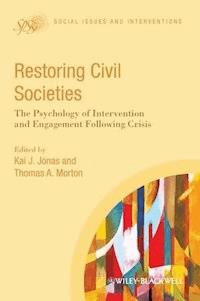
Breakdowns in civil societies can be catalyzed by factors ranging from war and genocide to natural disaster, disease and economic downturns. Restoring Civil Societies examines social processes related to civic engagement in the wake of these societal ruptures. The authors show how crises in civil society can be both pervasive and localized, broad-based and limited to defined social sub-groups. Whatever their scale, Restoring Civil Societies identifies models that analyze the social psychology of crises in order to devise ways of re-activating civic engagement and safeguarding civil society. Focusing on these positive interventions, the authors identify a number of key strategies, ranging from the simplicity and directness of bystander interventions to the volunteer armies mobilized in the wake of natural disasters. They include collective action organized to redress systemic inequalities, and the vital healing role played by truth commissions in Rwanda and elsewhere. Restoring Civil Societies fills the gap between basic research on social issues and translation into social policies and programs-an area which, in light of current economic and social unrest, is more important now than ever.
Sie lesen das E-Book in den Legimi-Apps auf:
Seitenzahl: 577
Veröffentlichungsjahr: 2012
Ähnliche




















Cover
Social Issues and Interventions
Title Page
Copyright
Notes on Contributors
Series Editor's Preface
Chapter 1: Introduction
Civil Societies in Crisis
Reflection on Core Concepts
Actors and Targets for Intervention
Content and Structure
How Should This Book Be Read?
Conclusion
References
Part I: Theoretical Approaches
Chapter 2: Justice Sensitivity as Resource or Risk Factor in Civic Engagement
The Psychology of Justice
Individual Differences in Justice Sensitivity
Conclusion
References
Chapter 3: Regulating Psychological Threat
Control and Order Motivation
Threats to Order and Control
The Effect of Threat on Religious and Scientific Belief Systems
The Effect of Threat on Belief in Societal and Scientific Progress
Discussion
References
Chapter 4: Prosocial Behavior in the Context of Crisis
Specific Motives for Engagement and Involvement Behavior: The Example of Moral Courage
Beyond Simple Motives: Group-Level Determinants
Victim × Situation Determinants
Cultural Variations
Consequences of Aid and Resulting Motives
Conclusion
References
Chapter 5: A Social Ecological Perspective on Risk and Resilience for Children and Political Violence
Conceptual Models for Social Ecological and Psychological Processes Affecting Children
Testing the Conceptual Model in Northern Ireland: A Setting of Protracted Conflict
Conclusion
Acknowledgments
References
Chapter 6: Everyday Helping and Responses to Crises
Volunteerism: A Global Phenomenon
The Volunteer Process Model
Community Connections and Volunteerism
Motivations for Volunteerism
Volunteerism and Crises
Motivations for Prosocial Action and Volunteerism After Crises
Connections to Others and Strengthening Communities After Crises
Conclusion
References
Chapter 7: Collective Action as Civic Engagement
A Multitude of Motives for Collective Action
An Integration of Multiple Psychological Approaches
Theoretical Gaps
Future Directions for Theory, Research, and Practice
Conclusion
References
Chapter 8: Intergroup Relations in Post-Conflict Contexts
Basic Needs and Intergroup Relations
Majority and Minority Perspectives on Intergroup Relations
Psychological Legacies: How the Past Influences the Present and Future of Intergroup Relations
Intergroup Interactions and Intergroup Relations
Strategies for Improving Intergroup Relations
Conclusion
References
Chapter 9: Humanizing Others Without Normalizing Harm
Recognizing the Humanity We Share
Our Humanity or Yours?
Resolving the Two Sides of Humanity
Conclusion
References
Part II: Application and Intervention
Chapter 10: Social Rituals and Collective Expression of Emotion After a Collective Trauma
Truth and Reconciliation Procedures
Rwanda and Gacaca
Truth and Reconciliation Procedures: Do They Heal the Past?
A Psychosocial Perspective on Truth and Reconciliation Procedures
Overview of Our First Investigation
Purposes of the Second Investigation
Second Investigation: Findings and Comments
Conclusion
References
Chapter 11: Competitive Victimhood Among Jewish and Palestinian Israelis Reflects Differential Threats to Their Identities
The Needs-Based Model of Reconciliation
Competitive Victimhood
Applying the Needs-Based Model to Contexts of Competitive Victimhood
Forces that Enable Constructive Dialogue
Conclusion
References
Chapter 12: Identity, Conflict, and the Experience of Trauma
Introduction
Conflict and Political Violence: Likelihood of Experience
The (Re)construction of Social Identity in Conflict
The Role of Identity in Restoring Civil Society?
Negotiating Political Violence and Trauma: The Role of Meaning-Making
Social Support and Reintegration Post-Conflict
Dealing with Trauma and Distress Post-Conflict
Conclusion
References
Chapter 13: Divided by a Common Language?
Introduction
The WRAP Analysis
An Alternative Analysis
Conclusion
Acknowledgments
References
Chapter 14: Civil Society Responses to the HIV/AIDS Crisis
Introduction
Epidemiological Aspects of HIV Disease
“Social AIDS”: HIV/AIDS-Related Stigma and Discrimination
Social Representations of HIV/AIDS in the United States and Western Europe
HIV/AIDS Activism: Helping Within and Across Group Boundaries
Conclusion
References
Chapter 15: Opinion-Based Groups and the Restoration of Civil Society
Establishing Civil Society, Surviving Civil War, and Embracing Civil Rights
Opinion-Based Groups
The Operation of Opinion-Based Groups
Applying and Extending the Opinion-Based Group Concept
Conclusion
References
Chapter 16: Moral Courage Training Programs as a Means of Overcoming Societal Crises
Introduction
Necessity and Challenges of Moral Courage Training Programs
Moral Courage: Acting Under High Demands
Characteristics of Effective Intervention Programs
Theoretically Driven Moral Courage Training Programs
Conclusion
References
Chapter 17: Media as an Instrument for Reconstructing Communities Following Conflict
Media Programs Aimed at Rebuilding Communities Following Conflict
Psychological Predictors of Post-Conflict Media Influence
Evidence from Two Field Experiments
Conclusion
References
Index
Social Issues and Interventions
This edited series of books examines the psychological study of social problems and interventions. Each volume draws together newly commissioned chapters by experts in social psychology and related disciplines in order to provide a multifaceted analysis of a particular contemporary social issue. Utilizing both case studies and theory, this series presents readers with a comprehensive examination of complex social problems while concurrently advancing research in the field. Editors have been chosen for their expertise of the featured subjects, rendering Social Issues and Interventions an urgent and groundbreaking collection for scholars everywhere.
Series editor: Marilynn B. Brewer
Explaining the Breakdown of Ethnic Relations: Why Neighbors Kill
Edited by Victoria Esses and Richard Vernon
Improving Intergroup Relations: Building on the Legacy of Thomas F. Pettigrew
Edited by Ulrich Wagner, Linda Tropp, Gillian Finchilescu, and Colin Tredoux
The Psychology of Social and Cultural Diversity
Edited by Richard J. Crisp
Restoring Civil Societies: The Psychology of Intervention and Engagement Following Crisis
Edited by Kai J. Jonas and Thomas A. Morton
This edition first published 2012
© 2012 John Wiley & Sons, Inc.
Wiley-Blackwell is an imprint of John Wiley & Sons, formed by the merger of Wiley's global Scientific, Technical and Medical business with Blackwell Publishing.
Registered Office
John Wiley & Sons Ltd, The Atrium, Southern Gate, Chichester, West Sussex, PO19 8SQ, UK
Editorial Offices
350 Main Street, Malden, MA 02148-5020, USA
9600 Garsington Road, Oxford, OX4 2DQ, UK
The Atrium, Southern Gate, Chichester, West Sussex, PO19 8SQ, UK
For details of our global editorial offices, for customer services, and for information about how to apply for permission to reuse the copyright material in this book please see our website at www.wiley.com/wiley-blackwell.
The right of Kai J. Jonas and Thomas A. Morton to be identified as the authors of the editorial material in this work has been asserted in accordance with the UK Copyright, Designs and Patents Act 1988.
All rights reserved. No part of this publication may be reproduced, stored in a retrieval system, or transmitted, in any form or by any means, electronic, mechanical, photocopying, recording or otherwise, except as permitted by the UK Copyright, Designs and Patents Act 1988, without the prior permission of the publisher.
Wiley also publishes its books in a variety of electronic formats. Some content that appears in print may not be available in electronic books.
Designations used by companies to distinguish their products are often claimed as trademarks. All brand names and product names used in this book are trade names, service marks, trademarks or registered trademarks of their respective owners. The publisher is not associated with any product or vendor mentioned in this book. This publication is designed to provide accurate and authoritative information in regard to the subject matter covered. It is sold on the understanding that the publisher is not engaged in rendering professional services. If professional advice or other expert assistance is required, the services of a competent professional should be sought.
Library of Congress Cataloging-in-Publication Data
Restoring civil societies: the psychology of intervention and engagement following crisis / edited by Kai J. Jonas and Thomas A. Morton.
pages cm
Includes index.
ISBN 978-0-470-67143-6 (hardback)
1. Civil society. 2. Civil society–Psychological aspects. I. Jonas, Kai J., editor of compilation. II. Morton, Thomas A., editor of compilation.
JC337.R47 2012
300–dc23
2012015982
A catalogue record for this book is available from the British Library.
Cover image: © Clive Watts / Shutterstock.
Cover design by Simon Levy Associates.
Notes on Contributors
Anna Baumert is Assistant Professor for Personality and Psychological Assessment at the University of Koblenz-Landau, Germany. Her research focuses on social information processing and its role in shaping individual differences in moral emotions and justice-related behavior. Specifically, she investigates the causal role of attentional and interpretational tendencies for cooperation and conflict. Currently, she receives funding for research projects on justice sensitivity and information processing as well as on the development of political trust and political engagement.
Leda M. Blackwood is a research fellow at the University of St Andrews and the Scottish Institute of Policing Research. Her PhD in social psychology examined social contextual and social identity factors involved in collective action. She is interested in topics associated with inter- and intragroup processes contributing to alienation, politicization, and social change.
Veronika Brandstätter studied psychology at the University of Munich, Germany. She held a dissertation scholarship of the Max Planck Institute for Psychological Research, Munich, and wrote her doctoral dissertation on volitional processes in goal-striving in Heinz Heckhausen's research group in 1991. She was a postdoctoral fellow from 1991 to 1992 at the Max Planck Institute for Psychological Research, Munich; a senior researcher and trainer at the Leadership and Management Training Unit at the University of Augsburg, Germany, 1992–1993; and a research scientist at the University of Munich in Dieter Frey's social psychology laboratory, 1994–2003. She wrote her postdoctoral dissertation on goal disengagement processes at the University of Munich in 1999. Since 2003, she has been a professor at the Department of Psychology at the University of Zurich, Switzerland. Dr Brandstätter's main research interests are motivation and self-regulation, goal disengagement, moral courage, and motivational processes in leadership.
E. Mark Cummings, PhD, is Professor and Notre Dame Endowed Chair in Psychology. He is the Director of the Family Studies Center and his research interests focus on family factors and child development, especially socio-emotional processes and developmental psychopathology. He is the Principal Investigator on a longitudinal study of children and families in Northern Ireland, a longitudinal study on family and individual differences in child development from early childhood to adulthood, and a randomized clinical intervention program designed to strengthen family relationships by increasing constructive and decreasing destructive conflict behaviors.
Ruth K. Ditlmann is completing her PhD in social psychology at Yale University. She received her Diploma in Psychology from the University of Constance, Germany in 2007. Her research focuses on cultural narratives in intergroup dynamics. In her current research she studies the role of leadership motivation and group membership in dialogues about past injustice between African Americans and Whites. She adopts a multi-method approach, consisting of laboratory studies, content analysis, and field experimentation.
John F. Dovidio is currently Professor of Psychology at Yale University, and previously taught at Colgate University and at the University of Connecticut. His research interests are in stereotyping, prejudice, and discrimination; social power and nonverbal communication; and altruism and helping. Much of his scholarship has focused on “aversive racism,” a subtle form of contemporary racism. He is currently pursuing research investigating factors that motivate both majority and minority groups to act for change to achieve equality in coordinated and effective ways.
Samuel L. Gaertner is Professor of Psychology at the University of Delaware. He earned his PhD in Psychology from the City University of New York Graduate Center in 1970. Together with Rupert Brown, he co-edits Social Issues and Policy Review (a journal of the Society for the Psychological Study of Social Issues). His research interests are in understanding and addressing prejudice, discrimination, and racism.
Justin D. Hackett is an Assistant Professor of Psychology in the Department of Social Sciences at the University of Houston-Downtown. He is an applied social psychologist whose main research interests include examining the antecedents and consequences of social and political activism and the role of feeling part of a global community on concern and involvement in human rights issues. In addition, he is also interested in sexual harassment in the armed forces and increasing the use of empirical research to inform public policy.
Frenk van Harreveld is an Associate Professor of Social Psychology. He obtained his PhD at the University of Amsterdam. He has worked as a visiting researcher at the University of California, Berkeley and the University of Massachusetts, Amherst. His research concerns various aspects of uncertainty and evaluative conflict.
Nick Hopkins is a Senior Lecturer at the University of Dundee. Following an undergraduate degree in Experimental Psychology, he studied Criminology before doing a Social Psychology PhD on social identity processes and social influence. The interest in social identity and influence remains and has led to research concerning the construction of social identities in political communications (e.g., speeches by political candidates standing for election, anti-abortion activists, etc.). Other interests concern the experiences and identity constructions of minorities.
Matthew J. Hornsey is a Professor of Social Psychology and Associate Dean (Research) at the University of Queensland, Australia. His research focuses on the social psychology of intergroup relations, identity threat, criticism, dissent, collective forgiveness, and the tension between individual and group will. He is currently Associate Editor for the journal Group Processes & Intergroup Relations and the Australian Journal of Psychology.
Kai J. Jonas obtained his doctorate in 2002 at the University of Göttingen, Germany, and moved to the University of Jena, Germany. Since January 2008 he has been working at the University of Amsterdam as an Assistant Professor in the Social Psychology Program. His main research interests center around intergroup research and social cognitive approaches to discrimination and prosocial behavior. Furthermore, he develops, trains, and evaluates bystander intervention programs (“Zivilcourage-Trainings”). His work on bystander intervention is widely recognized in scientific and applied contexts and is part of high school textbooks for ethics education, too.
Patrick Kanyangara held a teaching and research assistant position at the National University of Rwanda in Butare, Rwanda. He conducted his doctoral dissertation in psychology at the University of Louvain, Belgium, on psychosocial consequences of participation in the Gacaca Truth and Reconciliation process developed in post-genocide Rwanda. He is currently in charge of a psychosocial intervention program in the UN civil war refugee camps in Chad and in Darfur (Sudan), under the auspices of the Hebrew Immigrants Aid Society.
Girish Lala is a researcher at Murdoch University working in the areas of social cohesion and social action. His research interests include on-line interaction and identity, technological mediation of social change, and facilitating innovative cross-disciplinary methodologies and interventions through new communications technologies.
Elizabeth Levy Paluck is an Assistant Professor of Psychology and Public Affairs at Princeton University. She received her PhD from Yale University in Social Psychology. Her research examines prejudice and conflict reduction, using large-scale field experiments to test theoretically driven interventions, in addition to the topics of political cultural change, the reproduction and change of norms in communities, and civic education.
Robert D. Lowe is a research fellow in the School of Psychology at the University of Central Lancashire, UK. He graduated with a PhD from Lancaster University in 2006 on the topic of social identity theory and context, and has subsequently held postdoctoral appointments at Lancaster University and the University of Limerick. His research considers the relationship between health, violence, and group processes.
Craig McGarty is Professor of Psychology and Director of the Social Research Institute at Murdoch University. He is the author of Categorization in Social Psychology (Sage, 1999) and was previously Head of the School of Psychology at the Australian National University. His current research is focused on collective action, group-based emotion, and opinion-based group memberships.
Christine E. Merrilees, PhD, is a Research Specialist at the University of Notre Dame where she earned her degree in 2009 with a dissertation on effective parenting strategies in a context of political violence. Her methodological training includes advanced longitudinal statistical analyses, survey design and development, and intensive data collection methods including daily and event-based diaries. Her research focus is on socio-emotional processes for youth in contexts of conflict and violence, including papers on child development, parenting, psychopathology, and social identity.
Thomas A. Morton is a Senior Lecturer in Psychology at the University of Exeter. His research focuses on the ways in which people experience and express their identities in relation to others, and the role of strategic considerations and reality constraints in guiding these processes. His work on this theme has covered such topics as intergroup relations, conflict, and forgiveness; intragroup processes, deviance, and change; stigma, prejudice, and stereotyping. He is currently an Associate Editor for the British Journal of Social Psychology.
Orla T. Muldoon is Professor of Psychology at the University of Limerick. She graduated with a PhD from Queen's University Belfast in 1996. This research related to the impact of conflict on children in Northern Ireland. As a John F. Kennedy Scholar, she then engaged in a period of study in the US before returning to positions in the University of Ulster and then Queen's University Belfast. She moved to the University of Limerick in 2007.
Masi Noor is a Senior Lecturer in Psychology at Canterbury Christ Church University, UK. He completed his doctorate degree at the University of Sussex in 2007. His major line of research has focused on the psychology of victimhood following violent intergroup conflict. In appreciation of his scholarship, he was awarded the 2010 APA Peace Psychology Early Career Award. He is also a practitioner in community conflict mediation.
Allen M. Omoto is a Professor of Psychology in the School of Behavioral and Organizational Sciences at the Claremont Graduate University. His research focuses on social and psychological aspects of volunteerism and civic engagement, and on issues related to HIV disease and lesbian, gay, and bisexual concerns. He has worked in the US Congress as an American Psychological Association (APA) Congressional Fellow, and also has been actively involved in governance and policy work in the APA and in the Society for the Psychological Study of Social Issues.
Dario Paez, born in Chile, earned his doctorate degree in 1983 at the University of Louvain, Belgium, with a dissertation on the Social Psychology of Social Movements. Professor of Social Psychology at the University of the Basque Country, his research interests include collective emotions and memory, coping, and affect regulation. He served as consultant to NGOs of human rights in Guatemala, Ecuador, Chile, Peru, Paraguay, and other nations. His latest work addresses the issue of Truth Commissions as rituals of transitional justice and their effects on personal and social well-being in Argentina, Chile, Peru, and Paraguay.
Joop van der Pligt is a full Professor of Social Psychology. He obtained his PhD in 1981 at the University of London. Subsequently he worked for the Institute of Environmental Studies of the Free University at Amsterdam, Exeter University, and the University of Amsterdam. He was a visiting professor at the University of Surrey, UK. His research focuses on risk perception and the acceptability of health-related as well as societal risks.
Tom Postmes is Professor of Social Psychology at the University of Groningen. His research focuses on intragroup processes and behavior including the development of norms and identity within groups. He is currently an Editor for the European Journal of Social Psychology and an Associate Editor for the journal Social Psychological and Personality Science.
Stephen D. Reicher is a Professor of Psychology at the University of St Andrews. His work concerns different aspects of the relationship between social identity and collective action. It covers such topics as crowd behavior, mass social influence, political rhetoric, leadership, nationalism and national identity, intergroup hatred, and the psychology of tyranny.
Bernard Rimé is Professor Emeritus and invited Professor of Psychology at the University of Louvain at Louvain-la-Neuve, Belgium. A past president of the International Society for Research on Emotion (ISRE) and of the Belgian Psychological Society, his research of the last two decades addresses the social psychology of emotion and examines how emotional experiences and emotional events stimulate interpersonal and collective communication and how the social sharing of emotion affects individuals and communities.
Bastiaan T. Rutjens received his PhD at the University of Amsterdam and currently works as a postdoctoral fellow at the University of British Columbia. He is interested in when, and for whom, lacking control is aversive and in the strategies people employ to cope or compensate. Furthermore, his research focuses on the concept of belief in progress and its relation to psychological threats such as existential concerns and lack of control.
Manfred Schmitt is full Professor at the psychology department of the University of Koblenz-Landau, Germany. He teaches personality, individual differences, and psychological assessment. He previously also taught developmental psychology, statistics, and social psychology. His research interests cover methodological and statistical issues such as modeling latent states and traits simultaneously using longitudinal data and modeling nonlinear interactions. He has also worked on the assessment of implicit dispositions with a special interest on moderators of both the convergence of implicit dispositions with explicit dispositions and their effect on controlled and automatic behavior. Among his substantive interests are individual differences in justice behavior, appraisal processes that generate emotion (anger, jealousy, guilt, shame, anxiety, and depression), and the conjoint effects of personality and situation factors on behavior.
Nurit Shnabel is a Lecturer at Tel-Aviv University, Israel, where she also earned her doctorate degree in 2007. Her dissertation developed the Needs-Based Model, a theoretical framework that explores the emotional needs of adversaries involved in a conflict. Since then she has held a postdoctoral position at Yale University. Her research interests include interpersonal and intergroup reconciliation processes, and intergroup relations with a particular focus on sexism. She is also trained in group facilitation and has facilitated encounters (i.e., dialogue groups) between adversarial groups in Israel.
Birte Siem is a postdoctoral fellow at the Fern Universität in Hagen, Germany. She earned her doctoral degree in 2008 at the Fern Universität. In her research, she investigates inter- and intragroup processes, with a particular emphasis on prosocial behavior and on interactions between high status and low status groups.
Mark Snyder is Professor of Psychology at the University of Minnesota, where he holds the McKnight Presidential Chair in Psychology and is the Director of the Center for the Study of the Individual and Society. His research interests focus on the interplay of personality, motivation, and social behavior. He is the author of the book Public Appearances/Private Realities: The Psychology of Self-Monitoring. He has served as president of the Society for Personality and Social Psychology and of the Foundation for Personality and Social Psychology.
Russell Spears is Professor of Social Psychology at the University of Groningen. His research interests are in social identity and intergroup relations, including work on group-based emotions.
Stefan Stürmer is Professor of Psychology at the Fern Universität in Hagen, Germany, and the Chair in Social Psychology. He earned his doctoral degree in 2000 at the Christian-Albrechts-Universität zu Kiel, Germany. In his research, he investigates inter- and intragroup processes, with a particular emphasis on the role of group processes in social movement participation, helping, and altruism. He also serves as a consultant for various city councils and community agencies, concerning measures and policies to foster community action and civic participation.
Laura K. Taylor is a graduate student in the dual PhD program in Psychology and Peace Studies at the Kroc Institute of the University of Notre Dame. Her research interests include identifying risk and resilience processes for children, families, and communities facing political violence. Her dissertation project focuses on the development of aggression and protective factors for adolescents in Belfast. Taylor has research and direct field experience in mental health, transitional justice, and conflict transformation in Colombia, Croatia, Guatemala, Nepal, and Northern Ireland.
Emma Thomas is a Lecturer in the School of Psychology at Murdoch University. Her research interests focus on collective action for social change broadly and global poverty reduction specifically. Her research explores the role of social identity formation and group emotion through small group interaction.
Nadine Thomas is a Lecturer and Research Scientist at the University of Koblenz-Landau, Germany, where she is also writing her doctoral thesis. Her research interests include perceptual, motivational, and cognitive processes associated with justice sensitivity, as well as mechanisms of self-regulation.
Martijn van Zomeren works at the Department of Social Psychology at the University of Groningen. His research interests revolve around the psychology of collective action, with a broad emphasis on identity, morality, emotion, and efficacy processes.
Tessa V. West is an Assistant Professor of Psychology at New York University. She earned her doctorate in 2008 from the University of Connecticut. Broadly speaking, her research focuses on the nature and dynamics of social perception within dyadic and group-level interactions. Her work specifically examines the unique dynamics that unfold during dyadic interracial interactions. She is currently focusing on how altering the meaning that people attach to one another's behaviors can work to facilitate rapport-building and behavioral coordination during one-time-only and repeated interracial interactions.
Vincent Yzerbyt is Professor of Social Psychology at the Catholic University of Louvain, Louvain-la-Neuve, Belgium. His research deals with social cognition, stereotyping, and intergroup relations. His latest work addresses the issue of intergroup emotions. He also focuses on the two fundamental dimensions of social perception, warmth, and competence, and how they compensate each other. The author of a great many scholarly publications and a former President of the European Association of Social Psychology, he currently serves as the founding chief editor of the journal Social Psychological and Personality Science (2009–2012).
Series Editor's Preface
The series of volumes on Social Issues and Interventions represents a joint effort of the Society for the Psychological Study of Social Issues (SPSSI) and Wiley-Blackwell Publishing launched in 2006. Consistent with SPSSI's dual mission of encouraging systematic research on current social issues and bringing the findings of social psychological research to bear on public policy, the goal of the series is to help fill the gap between basic research on social issues and translation into social policy and program interventions. Each book in the series is an edited volume devoted to a specific social issue theme, covering related theory, research, and application.
Editors and contributors to each volume are experts in social psychology and related disciplines in order to provide a multifaceted analysis of a particular contemporary social issue. Utilizing case studies, empirical research, and theory, this series is intended to present readers with a comprehensive examination of complex social problems while concurrently advancing research in the field.
As the fourth volume in the series, Restoring Civil Societies: The Psychology of Intervention and Engagement Following Crisis fulfills the purposes envisioned for this venture, bringing together multiple perspectives to focus on an issue that is vital to democratic societies – achieving and maintaining civic engagement and trust. More specifically, the volume deals with the consequences of political, economic, or environmental crises that destabilize or disrupt civil practices and institutions, and takes on the challenge of addressing what social science can contribute to the mission of restoring civility and cooperative social relationships in the aftermath of societal crisis. Following an introductory chapter in which the editors of the volume define essential terms and lay out the scope and mission of the volume, the 16 chapters cover both theory and practice from different theoretical and experiential vantage points, crossing individual, group, and societal levels of analysis. Importantly, links are drawn between the social psychological theories that are covered in Part I of the book with the applied intervention research covered in Part II. The result is a unique and generative volume that embodies perfectly the intended mission of the SPSSI Social Issues and Interventions book series and should be of interest and relevance to social scientists and policy makers alike.
Marilynn B. BrewerSeries Editor
Chapter 1
Introduction
Kai J. Jonas and Thomas A. Morton
Seventy years ago, the world was in the midst of a global crisis: World War II. Against this backdrop, the newly formed Society for Psychological Study of Social Issues (SPSSI) produced its second yearbook. Civilian Morale, edited by Goodwin Watson (1942), gathered together almost all of the now famous social psychologists of that time to contribute their ideas, and their empirically based knowledge, to the pressing practical problem of maintaining morale at a time of war. Morale, it was argued, was a critical human resource that could contribute to Allied success, and undermining morale among the enemy was seen as equally crucial for their defeat. Each of the contributors to this volume considered the basis of civilian morale, including firm values, clear goals, and a balance between individual and collective will (Gordon Allport), and the forces that might contribute to individual morale at this time of crisis, including democratic structures and ideals (Allport again), group memberships (e.g., nationality, Gregory Bateson; race, Kenneth Clark; and religion, Otto Kleinberg), unemployment (Goodwin Watson), and individual differences, such as time perspective (Kurt Lewin). Finally, contributors considered a range of interventions that could increase or decrease morale in the population, including use of the media (Theodore Newcomb) and specific leadership trainings (Alex Bavelas).
Lesen Sie weiter in der vollständigen Ausgabe!
Lesen Sie weiter in der vollständigen Ausgabe!
Lesen Sie weiter in der vollständigen Ausgabe!
Lesen Sie weiter in der vollständigen Ausgabe!
Lesen Sie weiter in der vollständigen Ausgabe!
Lesen Sie weiter in der vollständigen Ausgabe!
Lesen Sie weiter in der vollständigen Ausgabe!
Lesen Sie weiter in der vollständigen Ausgabe!
Lesen Sie weiter in der vollständigen Ausgabe!
Lesen Sie weiter in der vollständigen Ausgabe!
Lesen Sie weiter in der vollständigen Ausgabe!
Lesen Sie weiter in der vollständigen Ausgabe!
Lesen Sie weiter in der vollständigen Ausgabe!
Lesen Sie weiter in der vollständigen Ausgabe!
Lesen Sie weiter in der vollständigen Ausgabe!
Lesen Sie weiter in der vollständigen Ausgabe!
Lesen Sie weiter in der vollständigen Ausgabe!
Lesen Sie weiter in der vollständigen Ausgabe!
Lesen Sie weiter in der vollständigen Ausgabe!




