


19,99 €
Mehr erfahren.
- Herausgeber: John Wiley & Sons
- Kategorie: Fachliteratur
- Sprache: Englisch
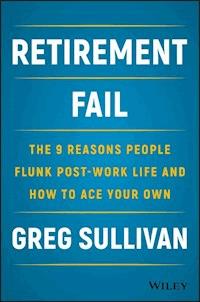
There are nine key reasons people fail at retirement--and they're not what you think. Are you working to avoid these major retirement fails? Every day, people just like you, people who have worked hard and saved carefully for retirement, make decisions that will eventually crack their nest egg. Just because you added to your 401(k) or IRA plan every year, invested wisely, and amassed significant savings, you are not necessarily home free. Ready or not, your decisions all along the retirement path can positively or negatively affect your financial future. In Retirement Fail, top financial advisor Greg Sullivan shares the insights he has gained over his thirty-five-year career in wealth management to help you identify potential pitfalls and learn how to safeguard your hard-earned retirement assets. Because, contrary to what most people think, it is not poor portfolio performance that usually busts your retirement accounts. Rather, it's the emotional decisions you make that can cause major problems. Whether it's buying a vacation home that is beyond your reach, subsidizing your adult kids to a degree that is ill advised, or passing on the umbrella insurance your advisor recommended, the choices you make have an enormous effect on whether you'll be able to enjoy the comfortable retirement you've dreamed about. Retirement Fail: * Lays out the nine common hazards that trip up otherwise well-prepared retirees, encouraging you to think through your decisions and set a course aligned with your values and your ultimate goals * Goes beyond traditional financial advice, using personal stories to illustrate how others have become mired in--or solved--these financial dilemmas * Creates a valuable framework you can use to chart your path or begin conversations with your advisor, so that you can act to protect your financial independence The numerical side of financial planning is one thing--the far more difficult task is looking at the way the decisions we make impact our own future and those around us. Whether you are working with a financial advisor or are going it alone, Retirement Fail shows you the points you need to pay attention to and helps you figure out what your priorities are--and what tradeoffs you may have to make in order to achieve them.
Sie lesen das E-Book in den Legimi-Apps auf:
Seitenzahl: 323
Veröffentlichungsjahr: 2018
Ähnliche


















Table of Contents
Cover
Title Page
Disclosure
Acknowledgments
Introduction
A Kernel of an Idea
Are You Talking to Me?
Where's the Advice?
Note
CHAPTER 1: A (Too) Free Flow of Cash
Your Retirement Spending Picture
Priorities, and Who Decides Them
Setting Goals
Funneling Your Wealth to Meet Your Goals
Building Your Portfolio
Getting Carried Away by Your Passions
Habitual Overspending
When Generosity Goes Awry
Reining In Spending
Notes
CHAPTER 2: The Nest That Won't Empty
Aging Fledglings
Life's Roulette Wheel
The Harvard or Bust Syndrome
A Rocky Path
Failure to Launch
Getting Your Kids Off the Payroll
Notes
CHAPTER 3: Graying Divorce
Dazed and Confused
Why This? Why Now?
First Things First
A Climate of Trust
When the End Is Inevitable
The Basics of the Asset Split
Proceeding After the Split
One Divorce After Another
The Value of a Prenuptial (or Postnuptial) Agreement
Sometimes Divorce Is a New Beginning
Notes
CHAPTER 4: That Home Away from Home
Pinning Down the Fantasy
Is It Really an Investment?
Is It a Lifestyle Asset?
Retirement Home?
Weighing the Risk
Partial Ownership
Is Vacation Home Ownership Right for You?
Notes
CHAPTER 5: The Lure of the Entrepreneur
Be Careful How You Step In
Have a Solid Plan
Beware the High-risk, High-cost Start-up
Avoid Becoming a Vicarious Entrepreneur
Seek Advice
It's Not All Uphill
Finding Work You Love
Notes
CHAPTER 6: Swindler's Mark
Targets of Financial Schemes
Bigger Targets, Bigger Scams
Real Estate Rackets
Annuities and Inappropriate Financial Products
Phishing, Phone Scams, and Identity Theft
Financial Exploitation by Family or Friends
Protecting Yourself
Listen to Your Doubts
Notes
CHAPTER 7: Health Matters
Retirement, Interrupted
Refining Your Views on Health Care
Health Insurance
Long-term Care
Putting Plans in Place
Steps to Take After a Diagnosis
Healthy Aging
Live Long and Prosper
Notes
CHAPTER 8: Life's Unpredictabilities
Didn't See It Coming: Layoff and Early Retirement
Disability
Do I Still Need Life Insurance?
Get Documents in Order
Make Sure to Carry an Umbrella
Rocky Economic Times
Another Unpredictability: Single-Stock Risk
Family Needs
Predicting the Future
Notes
CHAPTER 9: Underliving Your Wealth
Your Money Personality
Living with Fear
When Money Personalities Collide
Gifting
So Enjoy…
Notes
Finding the Right Financial Advisor
You Trust the Advisor
The Advisor Listens and Cares
The Advisor's Expertise Is Deep and Wide
The Advisor Has Experience with Your Profession or Life Situation
The Advisor Plays Well with Others
The Advisor's Fees Are Clear and Transparent
The Advisor Is a Forward-Looking Leader
Checklist:Finding the Right Advisor
About the Author
Resources
Index
End User License Agreement
List of Tables
Chapter 8
Table 8.1 Growth of $1.5 million
Table 8.2 Growth of $1.5 million with withdrawal of $60,000 per year
List of Illustrations
Chapter 1
Figure 1.1 The Retirement Funnels
Guide
Cover
Table of Contents
Begin Reading
Pages
C1
iii
iv
v
vi
ix
x
xi
xiii
xiv
xv
xvi
xvii
1
2
3
4
5
6
7
8
9
10
11
12
13
14
15
16
17
18
19
20
21
22
23
24
25
26
27
28
29
30
31
32
33
34
35
36
37
38
39
40
41
42
43
44
45
46
47
48
49
50
51
52
53
54
55
56
57
58
59
60
61
62
63
64
65
66
67
68
69
70
71
72
73
74
75
76
77
78
79
80
81
82
83
84
85
86
87
88
89
90
91
92
93
94
95
96
97
98
99
100
101
102
103
104
105
106
107
108
109
110
111
112
113
114
115
116
117
118
119
120
121
122
123
124
125
126
127
128
129
130
131
132
133
134
135
136
137
138
139
140
141
142
143
144
145
146
147
148
149
150
151
152
159
160
161
162
163
164
165
166
167
168
E1
Retirement Fail
THE 9 REASONS PEOPLE FLUNK POST-WORK LIFE—AND HOW TO ACE YOUR OWN
Greg Sullivan, CPA, CFP®
President and CEO,Sullivan, Bruyette, Speros & Blayney, LLC
Copyright © 2018 Greg Sullivan. All rights reserved.
Published by John Wiley & Sons, Inc., Hoboken, New Jersey.
Published simultaneously in Canada.
No part of this publication may be reproduced, stored in a retrieval system, or transmitted in any form or by any means, electronic, mechanical, photocopying, recording, scanning, or otherwise, except as permitted under Section 107 or 108 of the 1976 United States Copyright Act, without either the prior written permission of the Publisher, or authorization through payment of the appropriate per-copy fee to the Copyright Clearance Center, Inc., 222 Rosewood Drive, Danvers, MA 01923, (978) 750–8400, fax (978) 646–8600, or on the Web at www.copyright.com. Requests to the Publisher for permission should be addressed to the Permissions Department, John Wiley & Sons, Inc., 111 River Street, Hoboken, NJ 07030, (201) 748–6011, fax (201) 748–6008, or online at www.wiley.com/go/permissions.
Limit of Liability/Disclaimer of Warranty: While the publisher and author have used their best efforts in preparing this book, they make no representations or warranties with respect to the accuracy or completeness of the contents of this book and specifically disclaim any implied warranties of merchantability or fitness for a particular purpose. No warranty may be created or extended by sales representatives or written sales materials. The advice and strategies contained herein may not be suitable for your situation. You should consult with a professional where appropriate. Neither the publisher nor author shall be liable for any loss of profit or any other commercial damages, including but not limited to special, incidental, consequential, or other damages.
For general information on our other products and services or for technical support, please contact our Customer Care Department within the United States at (800) 762–2974, outside the United States at (317) 572–3993, or fax (317) 572–4002.
Wiley publishes in a variety of print and electronic formats and by print-on-demand. Some material included with standard print versions of this book may not be included in e-books or in print-on-demand. If this book refers to media such as a CD or DVD that is not included in the version you purchased, you may download this material at http://booksupport.wiley.com. For more information about Wiley products, visit www.wiley.com.
Library of Congress Cataloging-in-Publication Data is Available:
ISBN 9781119447405 (Hardcover)
ISBN 9781119452966 (ePDF)
ISBN 9781119452980 (ePub)
Cover Design: Wiley
Disclosure
The stories in Retirement Fail are based on actual scenarios and events; however, names and identifying details may have been changed to protect the privacy of those discussed. In some instances, composites have been created.
This book is offered as a resource for informational purposes only. The information is being presented without consideration of the investment objectives, risk tolerance, or financial circumstances of any specific investor and may not be suitable for all investors. Always consult your own financial, legal, and/or tax advisor before making any decisions related to your investment, tax, estate, or financial planning.
To Mom and Dad
For their love and guidance
Acknowledgments
To ace retirement and not fail requires discipline, effort, a little luck, and a lot of wise guidance along the way. The same goes for writing a book. That is why I am so thankful for all the people who have guided, taught, and influenced me during this journey.
My Mom and Dad had the greatest influence on me, encouraging me in ways they may never know. I reference them in the book many times because I learned so much from watching the way they handled tough times and good times, both personally and financially, and talked openly about money and finance while I was growing up. So, Mom and Dad, a big thank-you for your guidance, unconditional love, and support.
I am fortunate to have great siblings and a fabulous brother-in-law, and we are all so close that they allowed me to share stories about them. I know they are very thankful for the stories I left out! Thank you Gail, Bill, Pam, and my brother-in-law Frank, for always being there for me!
Twenty-seven years ago, three men and a lady decided it was time to start a business that focused on providing objective, independent advice to individuals and families without the concern of self-dealing and conflicts of interest. We all took a leap of faith – a lot of faith, because our new job couldn't afford to pay us a salary – but we had a strong belief that we would change the way people receive financial advice, and we aced it! To Jim Bruyette, Pete Speros, and Eleanor Blayney, I will forever be grateful for your leadership and for being patient with me. Most importantly, thank you for making this journey so much fun and for your friendship, which I will always treasure.
At SBSB we have an amazing team of professionals, and this book would not have come to be without the help and inspiration of the whole group. Together as a team, we make a difference in our clients' lives and in the lives of one another. You have all been a part of the stories in this book and the millions more that I haven't written about. To our entire team at SBSB, I want to say thank you for your passion for excellence and your amazing desire to serve our clients with the utmost integrity and respect.
I want to give special thanks to several SBSB partners and colleagues: Kris Andrejev, Jim Bruyette, Patrick Dunne, Gary Ingram, Martine Lellis, Jeff Porter, Barbara Schelhorn, Pete Speros, and Karen Tovey. These advisors gave freely of their time (often their lunch hours) and expertise, agreeing to be interviewed, sharing their experience, and providing indispensible context for the book.
Friends and colleagues in related businesses also offered critical background and shared their stories of attending to clients' special insurance needs. Thank you to Diane Beatty, Virg Cristobal, Stafford Jacobs, Jon Katz, and Kim Natovitz for your generosity in sharing your stories and advice. And a special thank-you to Mark Tibergien, a great friend and mentor, whose wisdom and guidance over the past twenty-five years has been invaluable. Thank you, Mark, for introducing me to Wiley and for your keen insights for this book.
We are so blessed at SBSB to have clients who care about us as much as we care about them. Although it is not appropriate to name any of them here, I want to thank our clients for making this book possible. The stories we share make the situations real and provide tremendous guidance and insight that others can learn from. Thank you to all our clients, who make going to work every day a true joy.
In writing this book I was thinking about how to help people open up and have conversations with their partners and their advisors in areas that are often sensitive, and to provide stories and content that was relevant to creating a successful retirement. I wasn't thinking about marketing. Fortunately, I have Katie King, Caitlin Norton, and Jeanne Rossomme to think about that for me. Your ideas have helped me understand how to share the book and the stories through social media and other means. Thank you for all the guidance and advice on how to get the word out and for your thoughtful comments on the book's cover and the initial manuscript.
One of the core values at SBSB is “Lifetime of Learning.” Out of necessity, in the early 1980s, much of the learning was OJT (on-the-job training). But there was also a group of advisors, passionate about financial planning, who met regularly to share ideas and learn from one another. We eventually formalized the group and named it the Alpha Group. I am proud to say the group today includes many of the most respected and influential leaders in the wealth management profession. A couple of us then brought together a group of leading CEOs in the field and created the Blind Squirrels, a group of entrepreneurs focusing on all aspects of building a great business. The value these two groups brought to me and our profession is immense. Thank you all for sharing your wisdom and experience. I learned from you how to be a better advisor, leader, and CEO.
This book would never have made it to reality if it weren't for Caitlin Norton and Susan Lauzau. I gave Caitlin a tough task: Help me find an experienced professional who knows the book writing world and who can guide me and help me turn my ideas and stories into a book people will enjoy reading. Caitlin did her research and introduced me to Susan Lauzau, a fabulous writer, talented editor, and genuinely humble person. Susan, you have a special gift for creativity and a wonderful ability to endure my endless ideas, changes, and rewrites. You helped make this book real and fun to read. Thank you for keeping me on task and on time. Thank you, too, for your invaluable guidance and for making this an amazing journey.
My kids, David and Lisa, bring me incredible love and joy, and I want to thank them for letting me share a few stories about them in the book. What child wants their dad writing about them and publishing it to the world? Thank you, David and Lisa, for being amazing kids, for all the great adventures we have been on together, for the challenges we have faced together, and most importantly for being my best friends.
Writing a book over an extended twelve-month period while running a rapidly growing company full time requires a lot of TLC and patience. Not from me, but from my loving and caring wife, Pam. Thank you, Pam, for being simply fabulous and wonderful and patient with me throughout this process. Thank you for reading and rereading the many drafts. Thank you for encouraging me along the way and for your love and support. Despite all the hard work over the past twelve months, we still managed to have a lot of fun! I love you.
Introduction
What causes a retirement fail? That is, why do people who have prepared for retirement end up unable to fully enjoy the thing they worked so hard for? I have thought about this question a lot. Most people believe that it's due to poor investments. But I cannot recall a single instance in which investment performance has been the cause of a client losing financial independence or failing to enjoy the life in retirement that he or she desired.
I joke with my clients that, rather than portfolio performance, it's usually the things you have to care for that weigh more than 50 pounds that wreak havoc on retirement finances: Grown kids, houses, horses, cars, boats. Clients laugh with me, sometimes because they have already made these mistakes – or, more often, because they are wondering which decisions down the road will impact their own retirement. What do you think can trip you up in your post-work life? Will it be your finances, health, family, a divorce, a scam? The list goes on.
Retirement Fail is not about going broke or becoming destitute; it is about the personal, emotional, and financial decisions you make that can disrupt the life you could have enjoyed in your post-work life. Whether you have $500,000, $5 million, or $50 million, the issues we discuss are real and relevant, not only for you but for your children and other family members.
I talk with my clients about how to plan for the evitable, for the things you are capable of avoiding. People focus on the inevitable – what will happen, no matter what – and that's important, too. But we humans may be tempted to throw up our hands and leave to chance the very things we truly can control, those we should be taking thoughtful and deliberate steps to avoid. We sometimes court retirement fail.
A Kernel of an Idea
In the fall of 2014, Evan Simonoff, editor-in-chief and editorial director of Financial Advisor magazine as well as editorial director of Private Wealth magazine, called me and asked me to speak at the Inside Retirement Conference, which focuses on current topics that affect retirees. He asked if I could speak on using income-generating assets for retirement in a low-interest-rate environment. “That is a great topic,” I told Evan, “but what I would love to talk about is how people fail in retirement.” No one is talking about this issue, I told him, though 10,000 people are retiring every day. I shared that I had nine reasons I have seen people fail in retirement, and that the best way to avoid those failures was to get the conversation going early. Evan didn't hesitate for a second: “I love it…that's your subject,” he told me.
Every day, I and my colleagues at Sullivan, Bruyette, Speros & Blayney (SBSB) talk with our clients about decision making in retirement and in the lead-up years. And while we discuss investments, how to best allocate portfolios for cash needs, taxes, and other related items, most of our energy goes into discussions that are far thornier. These conversations can be delicate because they often involve a person's most deep-rooted wishes, fears, or insecurities: Maintaining his or her role as provider for the kids (even though the children are in their 30s); recovering one's identity after exiting the professional world by starting a business (even a high-risk business like a trendy restaurant or a vineyard); or buying that dream vacation home (even though it might not be truly affordable).
The topic struck a nerve – the room was packed, and other advisors came up to me after the conference, wanting to learn more about how to have these important discussions with their clients. Evan later wrote a piece for Financial Advisor based on my talk and our conversations, and that, too, generated a lot of buzz and comments from other financial advisors. And the more I thought about it, the more I realized how critical the emotional part of retirement planning and decision making truly is, and how much my clients and others like them could benefit from a guide to take away, with stories that underlined the realities of some common retirement fails.
Are You Talking to Me?
There are plenty of books about how much money you need in retirement and how to save and invest your cash. This is not one of them. I wrote Retirement Fail for those of you who have been preparing for retirement financially but need some guidance to ensure that your plans for a happy, healthy retirement are not compromised. Ready or not, you will be making decisions that can positively or negatively impact your financial future. You may be on track with savings goals, but there are potential pitfalls ahead, and the deepest pits are the ones you don't even see or, in some cases, those you would rather not acknowledge.
Many people have good, strong financial plans, but they don't necessarily notice themselves getting caught up in troubling patterns – or they may be surprised by an event they didn't see coming. The numerical side is one thing; an advisor can easily come up with numbers and projections. The more difficult thing is to look at the way the decisions we all make impact our own future and those around us. Retirement Fail shows you the watch points you need to pay attention to and helps you think through what your priorities are – and what trade-offs you may have to make to reach your goals.
If you're working with a financial advisor – and a Certified Financial Planner Board of Standards (CFP Board) survey indicates that 40% of Americans are now consulting a financial professional1 – you can use this book to help start productive conversations with your advisor. You don't need to stick to the technical investments and hard numbers – as you'll see from the stories in Retirement Fail, we see lots of different scenarios and can offer suggestions for handling many complex issues related to individual and family finances.
We like to share stories, both those of clients (all carefully anonymous, of course) and from our own lives. Money is one of those things people often don't talk about with their friends. That's why stories are so powerful – it's why we use them in our meetings and why I use them throughout this book. We can say, “We know another person who was in your exact spot, and this is what he did.” Everybody likes confirmation or affirmation that they are making wise decisions, or that others faced similar situations and came out on the other side. We can learn from others' successes and take warning from their losses.
Where's the Advice?
My parents dropped me off at the main campus of Penn State University in September 1975. I was surrounded by mountains (locals call the area Happy Valley) and by 30,000 other eager, energetic college students. Mom and Dad took me out for lunch before they left, and my dad asked me what I thought I was going to do when I graduated.
That was an interesting question for a freshman who had not yet been to one class. But I was one of those rare freshmen who actually did have an idea of what I wanted to do. I had loved reading about stocks and different businesses since I was young, so I said, “I am either going to work on Wall Street and help people with their finances or I am going to be CEO of a company and run a business.” Without skipping a beat, he said, “The smartest people I know in business are CPAs [certified public accountants]. You should get a degree in accounting.” Being a bean counter had never crossed my mind – I wanted to help people with their finances and investments.
My father's words stuck with me, though, and when I graduated with a degree in accounting I went to work for Ernst & Whinney (now Ernst & Young) in Washington, DC. After a couple of years in public accounting, I left and joined a local brokerage firm as a financial planner, following my real passion.
Excited about the job change, I called my parents to tell them of my big move. Dad, a bit shocked, said, “Why would you leave a great career in public accounting to become a salesman?” When I told him I was going to be a financial planner, not a salesman, he replied, “Every financial planner I know is just trying to sell me something.”
I thought he didn't know what he was talking about. I had this vision of helping people, not selling to them. But darned if he wasn't right. A few months after I started my job, I went to the national financial planning conference. There were several thousand attendees, and everyone I met was selling something: Insurance, annuities, heavy commission-based mutual funds, private partnerships, and so on. Where was the advice? Who was helping people make smart financial decisions?
I was fortunate in my new job, and one colleague in particular, the late Dave Dondero, took me under his wing and helped me learn how to prepare a financial plan driven by a client's goals and financial capabilities. I taught classes, wrote case studies, and became the in-house expert on tax and financial planning strategies. Most of the people at the company used my work to sell products, but I was learning the craft and building a reputation for providing quality advice.
In 1988 I decided to start my own independent firm, Sullivan Financial Consultants, with the goal of helping clients make smart financial decisions, untroubled by conflicts of interest. Then, in 1991, I was fortunate to partner in a new enterprise with Jim Bruyette, a former colleague of mine from Ernst & Whinney, Pete Speros, and Eleanor Blayney. We all shared the same passion – to help clients make smart financial decisions and to be independent and conflict free. We would provide the advice. We would help people make sound decisions about their finances.
Which brings me back around to the reason I wrote this book – and, more importantly, to the reason you are reading it. At the heart of retirement planning is the question: What is most important to you in your post-work life and how can you translate that into your day-to-day living and decision making? Once you know the answer to that question, you can frame your decisions so that your assets are truly working for you and your spending is aligned with your values and objectives. Retirement Fail helps you answer that essential question, addressing the nine ways you are most likely to compromise your retirement (and visit RetirementFail.com for more information and tips to help you succeed as you move into your post-work life). Armed with a sense of your values and goals – and a true awareness of the challenges that may lie ahead – you can craft a plan that lets you ace your retirement.
Note
1
. “Survey: Americans' Use of Financial Advisors, CFP Professionals Rises; Agree Advice Should Be in Their Best Interest,” CFP Board, September 24, 2015,
http://www.cfp.net/news-events/latest-news/2015/09/24/survey-americans-use-of-financial-advisors-cfp-professionals-rises-agree-advice-should-be-in-their-best-interest.
CHAPTER 1A (Too) Free Flow of Cash
I was talking to a client who was living the good life in Florida. Julia owned a beautiful penthouse condominium, drove a sporty car, traveled frequently with friends, and wore ultra-stylish clothing. Looking at her, you would have thought everything in her life was going well. Underneath the surface, however, lay the nagging question of whether Julia's assets could support her extravagant lifestyle forever. Condominium fees and real estate taxes were upward of $100,000 per year, and her travel expenses typically amounted to about $10,000 per month. She was enjoying life, and why not? This was the way she had lived when she was married, so why should things change?
In her divorce, Julia received a generous settlement, which included her luxury condominium. Of course, she felt her home needed to be thoroughly renovated postdivorce, to reflect her new outlook on life. Essentially, Julia was spending money like she had no financial constraints whatsoever. The divorce agreement did not include lifetime spousal support, however, so she needed to make sure she could live on the assets she received in the settlement.
After a candid conversation with Julia, I realized that she needed help organizing her finances and then gaining control over her spending. She needed some guidelines for setting an appropriate monthly spending limit for herself.
My suggestion that Julia downsize her home to get out from under the large housing expense did not go over well initially. But she came to understand the potential crisis looming and began looking at other housing options. That was the first and most important step: Getting her to recognize that her spending issue was real and that she needed to change certain habits if she wanted to continue enjoying some of the other things that were important to her, such as traveling. Sometimes we have to start with baby steps, even when a big change is ultimately required.
As financial advisors, we see situations like Julia's – in which people are living a lifestyle that outstrips their means – more often than you might imagine. You read celebrity versions of these stories in the press sometimes. The front page will be emblazoned with a headline about a major sports star or movie actor who retired several years earlier and now is declaring bankruptcy. From Jerry Lee Lewis to Gary Coleman to Lenny Dykstra, we've seen dozens of formerly wealthy celebrities file for bankruptcy over the years. Because these celebrities made millions of dollars at the pinnacle of their careers, they think they are eternally rich and can live the high life forever. They forget that their stratospheric income is no longer coming in and they need to live off the assets they've already accumulated.
Your Retirement Spending Picture
How do you envision your life as you grow older and begin working less or retire altogether? Will you travel the world on luxury cruises? Spend half of every year on the white sands that stretch in front of your new beachfront home or Caribbean bungalow? Or perhaps you plan to buy that picturesque horse farm you've always yearned for and occupy your time cultivating the next Derby winner. If you've built up your wealth and planned for this future, these dreams may well be within reach. But it's also possible that unrestrained spending could lead you down a path that will ultimately crack your nest egg. Which scenario comes to pass depends not only on your level of wealth and on how many hefty expenditures you make, but on what you want to accomplish in retirement and the trade-offs you are willing to make to achieve your goals.
Imprudent spending is one major reason people fail at retirement – and it lies at the root of many of the other potential pitfalls I talk about in this book, from the purchase of vacation homes to overgenerous support for adult children. So how can you tell the difference between a luxury (or a lifestyle) you can happily afford – or are willing to make reasonable trade-offs for – and an indulgence that will ultimately undermine your retirement goals? What separates a hard-won dream from a serious mistake? Before we can examine overspending, we have to look at broader spending philosophies and at some of the ways that spending in retirement differs from outlays you make while you are still working at full capacity.
When evaluating retirement plans, nearly everything centers around spending, either directly or indirectly. Most people are, in fact, overly cautious, so the number of people who jeopardize their retirement due to extravagant purchases is not large by percentage; but overspending is a significant problem for those who have it. And sometimes a pattern of free spending is enough to raise caution flags, even if no single expenditure is outsized.
When you are working full time and have a healthy income, it is easy to develop lavish spending habits. Nice vacations, meals out at upscale restaurants, frequent shopping trips, and other treats are among the ways people reward themselves for a productive week's work and cope with the stresses that come with a busy life. In retirement, people may have the same desires for material possessions and entertainment that they had before they stopped working, but now they have more time – more time to travel, more time to shop, more time to pursue potentially expensive hobbies or interests like collecting cars, starting a winery, enjoying multiple homes, or indulging in large-scale boating. And in retirement, their income is a fraction of what it once was, so it's easy to overspend assets.
While conventional wisdom dictates that people need 80% of their preretirement income to maintain their lifestyle in their post-work years, recent research has shown that spending patterns are actually quite variable – while some households do indeed reduce their spending considerably, nearly half spent more in the first two years of retirement than they had while working.1 And 28% of the retirees surveyed spent more than 120% of what they'd spent in the years preceding retirement, with the majority continuing that pattern of increased spending into their sixth year of retirement.2 So, while 80% may indeed represent an average, the spending picture is uneven, with some households cutting spending by a sizable amount and others actually increasing their outlays rather dramatically. According to the data, most of the increased spending was discretionary in nature, used either for travel or for home expenses.
In retirement, you may not be taking a hard enough look at your household spending. As an executive you might have been brilliant at developing business strategy, assessing corporate cash flow, and understanding the company's financial health, but it's possible that you do not take the same clear-eyed view of your own finances. It's much more difficult to see your personal spending rationally, particularly when what you should do and what you want to do are in conflict.
In the corporate world, you are playing with other people's money; when it comes to personal finance, you are, of course, dealing with your own, and your spouse has a say in how the money is being spent. Once you're retired, you are unlikely to be adding to your retirement bucket. You have a finite amount of assets to draw from over an uncertain period of time. For most people, living within one's means requires careful thought and planning.
We find that, for most people, managing their personal finances has never been their strong suit. If you are a person whose career success has come in law, business, sports, or entrepreneurship – or if your money has come to you through an inheritance – you may not be attuned to the details of cash inflows versus outflows and how they relate to your lifestyle and investment assets. You were bringing in more than enough money, so there was no need to pay close attention to what was gushing out.
When you are used to having money in the bank, you may be inattentive to your spending habits. And as long as cash is coming in at a brisk rate, that approach may work. But what happens when your income slows or stops, either because you've decided to retire or because your circumstances change? How will you make the transition from an income based on full-time work to an income based primarily on your investment assets' performance, which is often much less than what you'd been bringing in? How will you decide what “appropriate” or “lavish” spending is, and how will you reset your habits if you need to?
Priorities, and Who Decides Them
One of the difficulties is determining who decides what lavish spending is. Is it the husband or the wife? Do the in-laws, children, friends, or neighbors influence spending decisions? It is easy for people to make judgments about excessive spending when critiquing another individual or family – typically, the definition of excessive is “more than I would spend” on any given item or category.
But people see life differently, and their priorities and spending patterns often originate in their upbringing. Growing up in a family that was either financially stressed or spent extravagantly, hearing frequent parental arguments about finances, and suffering childhood trauma of various types can lead to a complicated or unhealthy relationship with money. Sometimes a person's individual temperament and/or the financial behaviors he or she learned growing up contribute to spending patterns that later cause conflict with a spouse.
Husbands and wives very often have different money personalities. They simply look at money and what it means differently. One spouse might think buying a new car every three or four years is unnecessary and wasteful, while the other considers it a normal and appropriate expense. One partner might view the kids' private school tuition as an extravagance, while the other sees it as an essential investment in their children's future. Who decides, and what impact will those decisions have on the couple's retirement goals?
According to a 2016 Ameriprise survey, approximately 31% of couples disagree about finances at least once a month. The most common points of disagreement are major purchases (34%), decisions about finance and children (24% of respondents who have children), a partner's spending habits (23%), and important investment decisions (14%).3
I was working with a husband and wife, Mark and Teri, both of whom had great jobs, but, based on our financial analysis, were not saving appropriately for their retirement. These two were setting aside money in their 401(k) plans but, given their income level, they needed to save a lot more if they wanted to generate a retirement income in line with their lifestyle.
The biggest obstacle to saving was that Mark and Teri had two children in private middle school at a cost of $30,000 per year, per child. That meant they needed $60,000 in after-tax dollars for tuition. In their tax bracket, the first $110,000 of their income ($60,000 after taxes) was going toward schooling – and this expense was going to continue for five more years before the children were off to college. And, of course, it was likely these kids would be attending private colleges at more than $50,000 per year, per child.
I knew that the neighborhood the family lived in had fabulous public schools because my children attended those schools. So we explored why these parents felt the need to have their kids in private middle school, potentially disrupting or delaying the couple's own future retirement. As we discussed the matter, it became clear that Mark felt they had to “keep up with the Joneses.” They were running with a well-heeled crowd, and he felt the need to say, “My children go to the Potomac School” (a very prestigious school in our area).




