Table of Contents
Praise
Title Page
Copyright Page
Dedication
Table of Figures
Acknowledgements
Introduction
The Structure of This Book
CHAPTER 1 - Why Go Public?
Advantages of Being Public
Disadvantages of Being Public
Weighing the Pros and Cons
PART ONE - THE BUSINESS OF REVERSE MERGERS
CHAPTER 2 - IPOs Versus Reverse Mergers
Advantages of a Reverse Merger Versus an IPO
Disadvantages of a Reverse Merger Versus an IPO
CHAPTER 3 - Shells and Deal Structures
Public Shells
Reverse Merger Deal Structures
Doing a Deal
CHAPTER 4 - Introduction to Rule 419
Rule 419
Life After Passage of Rule 419
Today’s Reverse Merger Market
CHAPTER 5 - China
PRC Regulators Challenge, But Do Not Prohibit, Shell Mergers
Where Are We?
Due Diligence and Other Unique Challenges
Issues in Structuring Reverse Mergers with Chinese Companies
The Outlook: Good!
CHAPTER 6 - Financing
How Not to Do It
How Financing Drives the Deal
Time and Money
CHAPTER 7 - Winning Market Support
The Market Support Challenge
Does an IPO Guarantee Strong Market Support?
How to Build Post-Reverse Merger Support
Ticker? What Ticker?
CHAPTER 8 - Shady Tactics
A Few “Bad Guy” Anecdotes
“Bad Guy” Tactics
Bad Investment Banker Tactics
Looking for Mr. Good Guy
PART TWO - LEGAL ISSUES AND TRAPS FOR THE UNWARY
CHAPTER 9 - Deal Mechanics
Structural and Implementation Issues Relating to Shareholder Approval
Other Legal Issues
Above All Else: Seek Competent and Experienced Advisers
CHAPTER 10 - Due Diligence
The Basics
Clean, Dirty, and Messy Shells (and Footnote 32/172 Shells)
Due Diligence Review of the Private Company
CHAPTER 11 - The Regulatory Regime
Implementation of SOX
June 2005 SEC Rule Changes: Reverse Mergers Are Further Legitimized (but ...
2008 Rule 144 Amendments: Big Changes, Missed Opportunities
PART THREE - OTHER WAYS TO GO PUBLIC, MANUFACTURING SHELLS, AND CURRENT TRENDS
CHAPTER 12 - Self-Filings and Other IPO Alternatives
How Do Shares of Stock Become Tradable?
Self-Filing Through Form S-1 Resale Registration
Mechanics of Form S-1 Self-Filing
Self-Filing Through Form 10 Registration
Brief Overview of Other Methods to Become Public
Which Way to Go?
CHAPTER 13 - Special Purpose Acquisition Companies (SPACs)
Introduction to SPACs: The GKN Experience
The SPAC Resurgence—Bubble and Bust
What Is the Future of SPACs?
Wrap-up on SPACs
CHAPTER 14 - Form 10 Shells
Mechanics of Creating a Form 10 Shell
Raising Money and Finding Shareholders
Selling a Shell
Legal Issues Regarding Form 10 Shells
Advantages and Disadvantages of Form 10 Shells
Endnote on SPACs and Form 10 Shells
CHAPTER 15 - The Experts Speak (Again)
Recent Market Volatility
What of the Predictions from the First Edition?
Current Developments
And So It Goes
GLOSSARY
INDEX
ABOUT THE AUTHORS
ABOUT BLOOMBERG
Table of Figures
FIGURE I.1 Closed Reverse Mergers by Year
FIGURE 3.1 Flowchart of a Reverse Triangular Merger
FIGURE 7.1 Recent IPO Deal Activity
FIGURE 7.2 NYSE Amex Initial Listing Requirements
Figure 7.3 Nasdaq Global and Capital Market Initial Listing Requirements
Praise for the new edition of
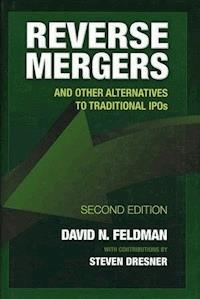
Reverse Mergers
And Other Alternatives to Traditional IPOs
By David N. Feldman With contributions by Steven Dresner
“Reverse mergers and self-filings are important alternatives to traditional IPOs, but with recent rule changes and developments in the market, these transactions have become more complex than ever. David Feldman’s second edition of Reverse Mergers explains these important developments in plain English and is an invaluable resource [for] any participant involved in the business of taking small companies public.”
—TIMOTHY J. KEATING President, Keating Investments
“David Feldman’s new edition of Reverse Mergers is a must for any practicing securities lawyer’s library—along with Romeo and Dye’s Section 16 treatise and Hick’s Resales of Restricted Securities. Once again, in clear and concise language, Feldman takes the reader through the often-tricky landscape of reverse mergers and alternative public offerings and, by way of illuminating real-world anecdotes, teaches the reader how to avoid the potholes and use this financing technique to its fullest potential. A masterful book by the master in the reverse-merger area.”
—MITCHELL C. LITTMAN, ESQ. Founding partner, Littman Krooks
“David Feldman’s Reverse Mergers is the most current go-to source for dealmakers, investors, and entrepreneurs [interested in] going public without an IPO.”
—CHANDRA S. MISHRA, PHD Eminent scholar and professor, Florida Atlantic University
“Feldman’s Reverse Mergers should be required reading for any company planning to go public. It is the definitive source of information for issuers and for professionals involved in executing these transactions—and a roadmap for the industry to follow for many years to come.”
—RICHARD RAPPAPORT, CEO WestPark Capital
“Feldman has a unique ability to walk companies through the reverse-merger process. His thorough understanding of all of the alternatives enables companies to make good business decisions. Reverse Mergers will prove to be invaluable for any company thinking of going public.”
—CHARLES WEINSTEIN Managing partner, Eisner LLP
ALSO AVAILABLE FROM BLOOMBERG PRESS
The Issuer’s Guide to PIPEs:New Markets, Deal Structures, and Global Opportunitesfor Private Investments in Public EquityEdited by Steven Dresner
PIPEs: A Guide to Private Investments in Public EquityRevised and Updated EditionEdited by Steven Dresner with E. Kurt Kim
Hedge Fund of Funds Investing:New Strategies for the Hedge Fund Marketplaceby Joseph G. Nicholas
Market-Neutral Investing:Long/Short Hedge Fund Strategiesby Joseph G. Nicholas
Due Diligence for Global Deal Making:The Defi nitive Guide to Cross-Border Mergers and Acquisitions,Joint Ventures, Financings, and Strategic AlliancesEdited by Arthur H. Rosenbloom
The Securitization Markets Handbook:Issuing and Investing in Mortgage- and Asset-Backed Securitiesby Charles Austin Stone and Anne Zissu
A complete list of our titles is available at www.bloomberg.com/books
ATTENTION CORPORATIONS
This book is available for bulk purchase at special discount. Special editions or chapter reprints can also be customized to specifications. For information, please e-mail Bloomberg Press,
[email protected], Attention: Director of Special Markets, or phone 212-617-7966.
© 2006, 2009 by David N. Feldman. All rights reserved. Protected under the Berne Convention. No part of this book may be reproduced, stored in a retrieval system, or transmitted, in any form or by any means, electronic, mechanical, photocopying, recording, or otherwise, without the prior written permission of the publisher except in the case of brief quotations embodied in critical articles and reviews. For information, please write to Permissions Department, Bloomberg Press, 731 Lexington Avenue, New York, NY 10022, or send an e-mail to
[email protected].
BLOOMBERG, BLOOMBERG ANYWHERE, BLOOMBERG.COM, BLOOMBERG MARKET ESSENTIALS, Bloomberg Markets, BLOOMBERG NEWS, BLOOMBERG PRESS, BLOOMBERG PROFESSIONAL, BLOOMBERG RADIO, BLOOMBERG TELEVISION, and BLOOMBERG TRADEBOOK are trademarks and service marks of Bloomberg Finance L.P. (“BFLP”), a Delaware limited partnership, or its subsidiaries. The BLOOMBERG PROFESSIONAL service (the “BPS”) is owned and distributed locally by BFLP and its subsidiaries in all jurisdictions other than Argentina, Bermuda, China, India, Japan, and Korea (the “BLP Countries”). BFLP is a wholly owned subsidiary of Bloomberg L.P. (“BLP”). BLP provides BFLP with all global marketing and operational support and service for these products and distributes the BPS either directly or through a non-BFLP subsidiary in the BLP Countries. All rights reserved.
This publication contains the authors’ opinions and is designed to provide accurate and authoritative information. It is sold with the understanding that the authors, publisher, and Bloomberg L.P. are not engaged in rendering legal, accounting, investment planning, or other professional advice. The reader should seek the services of a qualified professional for such advice; the authors, publisher, and Bloomberg L.P. cannot be held responsible for any loss incurred as a result of specific investments or planning decisions made by the reader.
Library of Congress Cataloging-in-Publication Data
Feldman, David N.
p. cm.
Includes bibliographical references and index.
Summary: “The top expert in the field of reverse mergers provides an executive summary along with nuts and bolts explanations showing how these deals are done. The revised edition addresses new regulations, SPACs, growth in China, and other key topics”-Provided by publisher.
ISBN 978-1-57660-340-6 (alk. paper)
1. Going public (Securities) 2. Going public (Securities)-Law and legislation-United States. 3. Corporations--United States--Finance. I. Dresner, Steven, 1970- II. Title.
HG4028.S7F45 2009
658.1’64-dc22
2009039854
I am thrilled to dedicate this second edition to thethree people that matter most to me in the world.My amazing wife Barbra remains my sounding board,best friend, and life partner. And, of course, mykids: Sammi brings me great pride in her talent anddedication to helping others, and Andrew never failsto bring me joy and amazement at his extraordinaryintelligence and unbridled love for life.
ACKNOWLEDGMENTS
I REALLY CAN’T BELIEVE IT. Way back in 2003 when talk first started about a book, I had no idea of the impact it would have, and I am humbled and grateful for the outpouring of support and appreciation I have received as the first edition sailed through its first three printings. And now, the second edition! There are many to thank (but more succinctly than last time)!
First are those who helped with this new edition. As always, at the top of the list is my contributor Steven Dresner. Steven was directly responsible for bringing me to Bloomberg Press. His contributions, charts, and data were critically important. Over at Bloomberg Press, thanks to Stephen Isaacs, Judy Sjo-Gaber, and their team for doing a tremendous job on every level, from marketing to content. Thanks to my “experts” for their contributions in the last chapter, and special thanks to lawyer and friend Richard Anslow for providing guidance on certain aspects of the new China chapter.
Let me also thank all my incredible colleagues at Feldman LLP. I especially wish to thank my senior counsel Scott Miller for all your hard work and talent.
Thanks also to Sam Katz of TZP Group for his continued extraordinary leadership of Youth Renewal Fund, Peter Boneparth, formerly of Jones Apparel Group and president of the board of Lawrence Woodmere Academy, and Alan Bernstein, its headmaster. To Bobby Blumenfeld and everyone at the Association for Corporate Growth, thanks for the opportunities you have provided. And one more shout-out to Jeff Meshel and all my friends at the Strategic Forum.
On a personal level, my wife, Barbra, and children, Sammi and Andrew, are truly amazing. Barbra, we make it together through all life throws at us and I’m constantly amazed at your poise and patience. You are an awesome wife and mother and I am so proud of your accomplishments in the community. Sammi and Andrew, thanks for being such a source of pride and happiness in my life.
To all my clients, business friends, and referral sources, I truly owe my success to you, and I thank you very much for all your business, your friendship, your support, and the joy of being able to use my brain every day to assist you. I look forward to coming into work each morning.
Introduction
Over the last decade, Wall Street has discovered that there are more ways to go public than through the traditional initial public offering (IPO), making it easier for more companies to reap the benefits of public status. Public companies find it easier to attract investors than private ones do because investments in public companies are more liquid. Because of this liquidity, public companies can also use their stock more effectively to fund acquisitions and reward executives. Having various options for going public is good news to the vast majority of smaller companies, most of which do not fit the typical profile investment banks use when deciding which companies can successfully accomplish an IPO.
The two most popular alternatives to IPOs are reverse mergers (including mergers with special purpose acquisition companies, or SPACs) and self-filings. The following well-known companies have gone public through reverse mergers:
• Texas Instruments Inc.
• Jamba Juice, Inc.
• Berkshire Hathaway Inc.
• Tandy Corporation (Radio Shack Corporation)
• Occidental Petroleum Corporation
• Muriel Siebert & Co., Inc.
• Blockbuster Entertainment
• The New York Stock Exchange
Less well-known deals are no less interesting:
• In 2006, Cougar Biotechnology merged with a shell company and raised $50 million. In 2009, it was sold for $1 billion.
• In February 2005, an investor group led by billionaire Robert F. X. Sillerman, former owner of well-known concert promoter SFX Entertainment, raised $46.5 million contemporaneously with the acquisition of a public shell company called Sports Entertainment Enterprises, Inc. and the acquisition of an 85 percent interest in Elvis Presley’s name, image, and likeness, and the operations of his home at Graceland. Since then the company, now known as CKX, Inc., has completed several more acquisitions including the proprietary rights to the American Idol television show. In April 2006, it paid $50 million for an 80 percent interest in boxer Muhammad Ali’s name, likeness, and image. Recently, Sillerman offered to take the company private, but that transaction was terminated as a result of the financial turmoil in the fall of 2008.
• In 2002, RAE Systems went public in a reverse merger at $0.20 a share. As of this writing in early 2009 the stock was trading at around $4.
• Global Sources Ltd. reverse merged into The Fairchild Corporation. As of this writing, it has a market capitalization of approximately $430 million.
Alternatives to IPOs have grown in popularity over the last ten years. The number of closed reverse mergers has increased very dramatically since 2000, although activity levels dropped off markedly in late 2008 because of the significant and sudden stock market meltdown. (See FIGURE I.1, Closed Reverse Mergers by Year.) The recession and market uncertainty of late 2008 and early 2009 has hit all sectors of the economy. But many signs indicate that this fast-paced growth will resume and continue in the near future.
There are several reasons for this growth. First, the IPO market effectively closed, seemingly permanently, to all smaller companies in late 2000 following the dot-com bust. Those seeking to go public were forced to find other ways to accomplish their goals. Second, the alternatives to IPOs offer benefits that traditional IPOs do not, especially to companies interested in raising capital in the $5 million to $50 million range. Third, a series of SEC regulations and enforcement policies have turned reverse mergers and self-filings into completely aboveboard, legitimate methods of accessing the capital markets. (There is a history here, which we will cover in Chapter 2. Some of the early practitioners of alternatives to IPOs in the 1970s and 1980s were shady characters.) Fourth, in the past five to six years the number of investors ready and willing to make private investments in public equity (PIPEs) in connection with alternatives to IPOs has increased dramatically. A PIPE is a private placement of equity or equity-linked securities effected for a public company, often with immediate required registration of the equity sold to the investor so that the shares become fully tradable. These days PIPE investors (mostly consisting of hedge funds and institutions), especially those with a longer time horizon with respect to liquidity, are constantly on the lookout for soon-to-be public companies to invest in.
FIGURE I.1Closed Reverse Mergers by Year
Source: DealFlow Media / The Reverse Merger Report
The idea behind the reverse merger is simple yet powerful. To achieve the goal of publicly traded shares, a private company merges into a public one. The public company typically has minimal, if any, day-to-day business operations. For this reason, it is called a “shell.” The public company may be the remnant of a bankrupt or sold organization or specially formed for the purpose of investing in a private company. Either way, the basic maneuver is the same: a private company purchases control of a public one, merges into it, and when the merger is complete becomes a publicly traded company in its own right.
Self-filings, which provide another alternative to an IPO—one that does not utilize a shell—take advantage of the SEC regulation that allows private companies to become public by voluntarily following the same rules (and filing the same documents) that public companies follow. After agreeing to mandatory compliance with the SEC reporting regime, a company earns public status and can then offer securities to the public market or complete a PIPE.
This book is written for seasoned pros and beginners alike. It is—as of this writing—and has been since the publication of the first edition in 2006, the first and only book to explain the business and legal issues specific to reverse mergers and self-filings. My goal was to create a text that would be useful to company CEOs and CFOs as well as the professionals who advise them—lawyers, accountants, consultants, and investment bankers. Please note: I wrote this not just for lawyers. It covers legal issues in plain English.
This book is my best effort to codify what I have learned about alternatives to IPOs over the nineteen years since Feldman LLP, the boutique law firm I founded, and a predecessor firm, began this part of our practice. During that time we have worked with hundreds of clients contemplating reverse mergers and self-filings. Steven Dresner, my friend and contributor to this book, has enriched the text with the wisdom he has gleaned in his capacities as editor of PIPEs: A Guide to Private Investments in Public Equity (Bloomberg Press, 2005), and as the organizer of numerous business conferences on PIPEs and reverse mergers through his company, DealFlow Media.
The Structure of This Book
Chapter 1 discusses the pros and cons of going public. After Chapter 1, the book is divided into three parts. Part One covers the business of reverse mergers. Chapter 2 compares the benefits of a reverse merger to the benefits of an IPO. Chapter 3 presents an overview of the market for shells, how they are formed, and basic reverse merger deal structures. The shell market is ever changing, in no small part due to rule changes by the SEC. Chapter 4 reviews the history behind the famous SEC Rule 419, which for a while in the early 1990s all but stopped the market for creating shells from scratch and taking them public. Chapter 5, added for the first time in this second edition, covers the dramatic presence of Chinese companies in the reverse merger market. It discusses legal and cultural challenges as well as the excitement that any market bubble brings.
Chapter 6 covers the financings that typically accompany a reverse merger, especially those done as PIPE investments. It includes examples of a few specific transactions from the fields of biotechnology, entertainment, technology, and sports, which are analyzed in depth. Issues of disclosure and valuation are discussed. An acknowledged challenge following a reverse merger is building and obtaining support for the company’s newly trading stock. Chapter 7 covers this issue in depth, with the goal of changing attitudes toward the issue. Rather than seeking an immediate “pop” in a stock, as sometimes happens after an IPO, reverse merged companies require patience for support to build over time.
Chapter 8, the last chapter of Part One, provides a road map for those of us (I hope all of us) who seek to steer clear of unsavory and illegitimate activity in this field. Covered here are bad shell owner tactics and bad investment banker tactics. A list of signs that are consistent with behavior of a credible, legitimate player is included. As in all things Wall Street, it is difficult to go anywhere without finding some bad guys. Indeed, the venerable IPO suffered a black eye when state and federal regulators fined IPO underwriters over $2 billion for illegal excesses in the IPOs of the late 1990s. But reverse mergers also have a checkered past, something that has been almost entirely reversed in terms of both perception and reality.
Part Two covers legal issues and traps. Chapter 9 describes deal structures and issues in completing merger agreements. The famous “reverse triangular merger” is examined. Issues in a shell’s capital structure and availability of shares are also discussed. How parties back up their statements and promises is another issue, as is changing the name of the shell after a deal.
Chapter 10 covers a critically important issue in reverse mergers: due diligence. This involves “scrubbing” a shell that may have a history of prior operations, as well as working to avoid or minimize risks from dirty or messy shells (these are two different things). So-called Footnote 32/172 shells, which were targeted by the SEC in its 2005 rulemaking as being of questionable validity and, unfortunately, were made more attractive in the SEC’s amendments to its Rule 144 in 2008, are discussed. These are particularly thorny shells to examine, because they appear to be real businesses that went public, when in fact they are either fake start-ups or very small real businesses that will be stripped out or shut down upon a merger wherein no disclosure of the promoter’s real intent is made.
Chapter 11 discusses the regulatory regime in greater depth. In particular, the chapter explores the sweeping and dramatic legislation, known as the Sarbanes-Oxley Act, which was passed in 2002 following the Enron and WorldCom debacles. This law mandated many changes—most of them for the good—in how public companies act. But, among other things, it has led to increases in the cost of being public. This chapter also reviews the SEC rulemaking of June 2005 that imposed significant new disclosure requirements immediately following a reverse merger. By means of these rules, the SEC sought to eliminate more bad players at the same time as it affirmed that these techniques are a perfectly legitimate means of structuring companies. In addition, this chapter reviews SEC rule changes in 2008 relating to the availability of Rule 144 as a way for shares to become tradable without registration with the SEC.
Part Three covers other ways to go public without an IPO, manufacturing shells, and current trends. It starts with Chapter 12, which covers self-filings in depth and gives an overview of a few other methods of going public without an IPO or reverse merger. There are two ways to go about a self-filing: either by means of a resale registration to allow existing shares to start trading, or through filing a Form 10, which simply puts the company on the mandatory SEC reporting list. Once it is fully reporting, if shareholders have the ability to sell without having their shares individually registered with the SEC, trading can commence.
Chapter 13, which looks at SPACs, continues to be the only primer on a technique that had exploded in recent years before the creation of new vehicles stopped in early 2008. A SPAC, or special purpose acquisition company, is a public shell created specifically to enable a company to go public. It raises large amounts of money that can then be given to the private company it merges with. A SPAC’s shares are permitted to trade (most other manufactured shells’ stock does not trade), and investors in the SPAC get to review and approve the proposed merger. Each SPAC generally has an industry or geographic focus, and has a management team experienced in that sector to review potential merger candidates. As of this writing in early 2009, over 150 SPACs have been formed since 2003. Of these, approximately seventy have completed business combinations and over sixty are public and still awaiting a merger candidate. These shell vehicles had been raising anywhere from $20 million to hundreds of millions of dollars.
The next intense area of current activity, covered in Chapter 14, is manufacturing Form 10 shells. The SEC appears to favor these over some other types of shells (such as those created under Rule 419). Well over 150 of these shells have been formed by clients of my law firm alone!
The last chapter of the book, Chapter 15, reviews a variety of other current issues: the growth in so-called “cash and carry” acquisitions of shell companies, the growing interest in companies from Latin America and Eastern Europe, the SPAC market influx, the growing attractiveness of self-filings, and the dramatic impact of the mostly positive, but also negative, changes to Rule 144. This chapter includes extensive quotes and thoughts from a number of leading industry players, from accountants to investment bankers to attorneys and others.
CHAPTER 1
Why Go Public?
Before deciding how to go public, a company must decide whether to go public. As I often tell my clients, if you can benefit from being public, and can bear the costs of becoming so, you should seriously consider it, regardless of your stage of development.
Advantages of Being Public
In general, there are five major advantages to being public: easier access to capital, greater liquidity, ability to grow through acquisitions or strategic partnerships, ability to use stock options to attract and retain senior executives, and increased shareholder confidence in management.
Access to Capital
It is easier for public companies to raise money than it is for private companies. Regardless of the merits of any specific private company, public companies have five characteristics that make them more attractive to investors than private companies.
Lesen Sie weiter in der vollständigen Ausgabe!
Lesen Sie weiter in der vollständigen Ausgabe!
Lesen Sie weiter in der vollständigen Ausgabe!
Lesen Sie weiter in der vollständigen Ausgabe!
Lesen Sie weiter in der vollständigen Ausgabe!
Lesen Sie weiter in der vollständigen Ausgabe!
Lesen Sie weiter in der vollständigen Ausgabe!
Lesen Sie weiter in der vollständigen Ausgabe!
Lesen Sie weiter in der vollständigen Ausgabe!
Lesen Sie weiter in der vollständigen Ausgabe!
Lesen Sie weiter in der vollständigen Ausgabe!
Lesen Sie weiter in der vollständigen Ausgabe!
Lesen Sie weiter in der vollständigen Ausgabe!
Lesen Sie weiter in der vollständigen Ausgabe!
Lesen Sie weiter in der vollständigen Ausgabe!
Lesen Sie weiter in der vollständigen Ausgabe!
Lesen Sie weiter in der vollständigen Ausgabe!
Lesen Sie weiter in der vollständigen Ausgabe!
Lesen Sie weiter in der vollständigen Ausgabe!
Lesen Sie weiter in der vollständigen Ausgabe!
Lesen Sie weiter in der vollständigen Ausgabe!
Lesen Sie weiter in der vollständigen Ausgabe!