


Erhalten Sie Zugang zu diesem und mehr als 300000 Büchern ab EUR 5,99 monatlich.
- Herausgeber: The History Press
- Kategorie: Geisteswissenschaft
- Serie: Classic Histories Series
- Sprache: Englisch
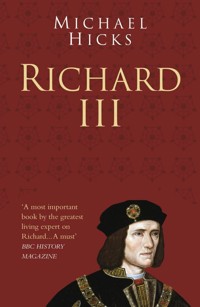
Richard III has been written off in history as one of England's evil kings. His usurpation of the throne from his nephew Edward V and then subsequent generations of pro-Tudor historians ensured his fame as the disfigured murderer portrayed by Shakespeare. In the twentieth century, Richard found his apologists, those who saw him as more sinned against than sinning. This biography – by the leading expert on Richard – strips away the propaganda of the centuries to rescue Richard from his critics and supporters alike, providing a balanced and compelling portrait of this most infamous of kings.
Sie lesen das E-Book in den Legimi-Apps auf:
Seitenzahl: 385
Veröffentlichungsjahr: 2011
Das E-Book (TTS) können Sie hören im Abo „Legimi Premium” in Legimi-Apps auf:
Ähnliche



















RICHARD III
RICHARD III
MICHAEL HICKS
Revised illustrated edition published 2000
Paperback edition first published 2001
This edition first published in 2003 by Tempus Pubblishing
The History Press
The Mill, Brimscombe Port
Stroud, Gloucestershire, GL5 2QG
www.thehistorypress.co.uk
This ebook edition first published in 2012
All rights reserved
© Michael Hicks, 1991, 2000, 2001, 2002, 2003, 2009, 2012
The right of Michael Hicks, to be identified as the Author of this work has been asserted in accordance with the Copyrights, Designs and Patents Act 1988.
This ebook is copyright material and must not be copied, reproduced, transferred, distributed, leased, licensed or publicly performed or used in any way except as specifically permitted in writing by the publishers, as allowed under the terms and conditions under which it was purchased or as strictly permitted by applicable copyright law. Any unauthorised distribution or use of this text may be a direct infringement of the author’s and publisher’s rights, and those responsible may be liable in law accordingly.
EPUB ISBN 978 0 7524 7326 0
MOBI ISBN 978 0 7524 7325 3
Original typesetting by The History Press
CONTENTS
INTRODUCTION
1 The England of Richard III
2 Richard III as Duke of Gloucester
3 Richard III’s usurpation of the throne
4 Richard III and Buckingham’s Rebellion
5 Richard III’s defeat and defamation
6 The man behind the myth
GENEALOGIES
CHRONOLOGY
BIBLIOGRAPHY
INTRODUCTION
Richard III and John are the two wicked kings in English history. Each had the ability and talents of a successful ruler, but each supposedly murdered his nephew and took his throne to the eternal destruction of his own reputation. Richard III was particularly unfortunate to enjoy the fruits of his supposed crime so briefly, to be followed by a Tudor dynasty so highly approved by historians (thus his defeat at Bosworth traditionally divides the Middle Ages from Modern History), and to have his story told by hostile historians of genius. It is Shakespeare’s intense, compelling and utterly damning portrait of a usurper, tyrant and monster that has held the scene until today.
Real people are more complex than that. Nobody who ever lived could be as wicked as this or so lacking in redeeming features. So we argue from our twenty-first-century vantage point. Richard’s advocates, the Ricardians, have grown in the past century from an insignificant minority into an influential and ultimately dominant majority.
The credit belongs to the Richard III Society, founded in 1924 to clear his name, and to a host of novelists and historians. Richard III is now genuinely popular. In 1984 the Trial of Richard III was staged on television: in 1983 at Gloucester and in 1990 at Oxford this author engaged in debates on the resolution that ‘Richard III was more sinned against than sinning’. Richard was acquitted at his television Trial and in both debates the resolution was carried overwhelmingly in his favour.
These results were certain before proceedings began. So thoroughly has public opinion been re-educated that a Ricardian orthodoxy has almost obliterated the Shakespearean tradition. It is the Tudor historians who now stand in the dock.
The Ricardians have rightly drawn attention to Richard’s estimable career before his accession, his unjustified sufferings at the hands of Tudor propagandists, and the false charges that have been laid at his door. This book acknowledges such advances and seeks to build on them. Instead of the Tudor histories it relies overwhelmingly on contemporary sources. Instead of modern deductions about Richard’s motives, it seeks to rescue his own pronouncements from the obscurity where they lie submerged and unrecognized in the hostile narratives of his contemporaries. It focuses on the issues and ideas expressed by Richard and his enemies, the very stuff of Ricardian politics and ideological warfare, and seeks to explain Richard’s bewildering transformation in his own lifetime from the model of nobility via kingship to tyrant and monster.
My approach therefore is to give weight to what Richard and his contemporaries said as well as what they did. Their stated motives deserve as much attention as our cynical deductions from their actions. Of course there are dangers in this approach. What people say may not always be true. There is always a gap between reality and our own perceptions. Room must be left for ignorance and error, propaganda and public relations. There are always those who wish to look better or different, and who want to impress others – mainly employers and potential employers – with qualities that they do not possess. Self-advertisement and propaganda are not the same as dishonesty or untruth. The most effective propaganda is the truth and propagandists can be convinced by their own messages. Even dishonest propaganda is of historical significance. It can assist our understanding of why and how things happened. What people believed about themselves, however mistaken, is often more important than the truth, especially if their belief actually determined their actions. This is particularly true of the career of Richard III. The real Richard was never as good or as bad as he was portrayed, but it was the successive images, not the reality, that influenced events. If we strip away the posturing, the denigration and the public profiles, we may approach closer to the real man. But which Richard was real?
This book is not therefore primarily a conventional life or history of the reign, for both of which Charles Ross’s Richard III remains the standard work. It does not investigate Richard’s patronage, which is exhaustively treated in Rosemary Horrox’s Richard III: A Study of Service. It is not an account of Richard’s posthumous vicissitudes, for which readers are referred to Jeremy Potter’s Good King Richard? It focuses instead on Richard’s reputation during his lifetime, its development or manufacture and repeated reshaping. Richard’s successive reputations were a major influence – perhaps the most potent of all – both on his career and the politics of his time.
It is now over thirty years since I first encountered Richard III as a member of Charles Ross’s Special Subject group at Bristol University. Charles encouraged me to undertake research, externally examined my thesis, advised and assisted me in many ways, and placed all Yorkist historians in his debt with his Edward IV and Richard III. I was equally fortunate to secure as my supervisor at Oxford John Armstrong, the editor of Dominic Mancini’s Usurpation of Richard III. As the years have passed, my historical ideas have developed, not just on Richard, and this is a very different book from the one I would have written twenty or even ten years ago. It has evolved considerably since its own first edition in 1991. Nevertheless, as I have used their work, especially Armstrong’s splendid edition of Mancini and Ross’s paper on ‘Rumour, Propaganda, and Public Opinion in the Wars of the Roses’, I have been acutely conscious both of their influence and of the extent to which they have anticipated my own work. Thus this book is dedicated to their memory, the outstanding Ricardian scholars of the last two generations, now both, alas, no longer with us.
It is a pleasure to acknowledge the benefit this book has received from my contacts with many other medievalists. Most are acknowledged in the bibliography, but particular reference was made in the first edition to Professor Barrie Dobson, Professor Ralph Griffiths, Dr Gerald Harriss, Professor Tony Pollard, Dr Rosemary Horrox and Miss Margaret Condon. Generations of undergraduates have unwittingly assisted me in formulating my ideas. This substantially expanded edition draws on more recent publications, most notably by Professor Pollard again, by Dr Michael K. Jones, Livia Visser-Fuchs and Anne Sutton, which have enabled the arguments to be further developed and refined. A very special debt, as always, is due to my wife Cynthia, who has applauded every new discovery and charted every twist in interpretation in the last thirty years. For her and our three offspring, Richard – like his brother George before him and father-in-law Warwick since – has been a most demanding intruder into our domestic life.
All quotations from original sources, whether originally in Latin or Middle English, have been rendered in modern English.
1
THE ENGLAND OF RICHARD II
THE RICARDIAN ACHIEVEMENT
Five centuries have passed since Richard III was king of England. He reigned for just two years. Then retribution swept away his throne, his life, his dynasty, above all his reputation. History records him as a monstrous irrelevance, an untoward interruption to stable government and the ruin of the House of York. It was over his dead body and over his shame that the Tudors inaugurated their golden age. His example was a dreadful warning to all usurpers and tyrants. For the Tudors, Richard was a usurper, a tyrant, a murderer and a monster: in sum, the enemy of God and Man, who received his just deserts as certainly in heaven as on earth. Nobody depicted this better than Shakespeare. Yet even the Tudor playwright found drama in Richard’s fall and a tragic greatness in the man. Whatever else he was, Richard was undoubtedly a tragic figure: as complete a failure as the most inept of English kings. He left behind no legacy and no line and died for no cause. He fell because he took the crown: the fatal error from which there was no going back. He cannot have enjoyed those twenty-six months of anxiety which were all he was allowed.
Richard was ambitious. Who would not wish to be king? His opportunity came as Lord Protector of his teenage nephew and principal bulwark to his throne. The temptation proved too much. The system made him protector, but we cannot blame the system for what followed. Convention demanded that Richard should give his nephew loyal support. It was a convention that he both acknowledged and flouted. The law of inheritance declared that he could not succeed. That law Richard both recognized and perverted. Like his brother, Edward IV, he manipulated his own election. He achieved his accession by the proper procedures and through the correct channels but nevertheless it was might that was right. Richard reigned in spite of the system, in contempt of the publicly accepted norms of political conduct, and he paid the full price for it. The natural allies of the crown deserted him, even the lifelong adherents of his dynasty abandoned him, unnatural alliances were forged by his foes, and his triumph was brief indeed. As in our own world today, his coup d’état bestowed a momentary ascendancy that endured only until conventional values were reasserted. When the establishment revived, the system triumphed, and Richard was no more.
THE WARS OF THE ROSES
Richard III ruled from 26 June 1483 until 22 August 1485. His reign was the last, conclusive, phase of the Wars of the Roses. We all know the basic facts about these wars. The crown of England was the prize, the houses of Lancaster and York the contenders, and thirty years of bloody civil war were the means. From 1455 to 1485 a dynastic struggle raged. Bosworth was the decisive victory of the Lancastrian Henry VII over the Yorkist Richard III. The wounds were healed by the marriage of Henry Tudor to Elizabeth of York. The Tudor rose united the warring emblems – the red rose of Lancaster and white rose of York – and ushered in more than a century of domestic peace.
Yet almost all this is Tudor propaganda. The official Tudor view still holds sway more than five centuries after the accession of the house of Tudor and four centuries after its extinction. When Queen Elizabeth I died in 1603, such propaganda lost its political point, but it had outlasted all other viewpoints and no rival tradition remained to be revived. This Tudor propaganda was most memorably codified by Shakespeare and repeatedly revamped by Sir Walter Scott and many others. Yet it is almost entirely untrue. The Wars of the Roses did not so obviously begin in 1455 or end in 1485. Rather than a continuous conflict of unchanging contenders, the Wars of the Roses embrace several separate wars between different protagonists. The fighting was brief and the peace was long. For twelve years from 1471 to 1483 there were no battles. Twice there were decisive victories, in 1461 and 1471, but new issues and new personalities generated new frictions and hence new wars.
Dynasticism was a cause, not the cause, and not until 1483, if then, was the lure of a crown to prove irresistible. It is only in retrospect – and then only with a Tudor perspective – that the battle of Bosworth and the year 1485 are decisive. For Henry VII was not the natural heir of Lancaster, nor was he initially the bringer of concord. To defend his usurpation, his predecessor had to be blackened. Surely nothing was worse than Richard III and nobody wished for a return to the horrors of his reign? King Henry was the saviour and hero and King Richard the tyrant and monster. So the propaganda ran, and so it has remained almost until now.
National humiliation, bankruptcy and domestic chaos preceded the civil war. In 1449–50, in just a few months, the English were bundled unceremoniously out of Normandy and Henry VI lost that second crown he had inherited in infancy. An outraged public bayed for reform at home, victory abroad and vengeance on those traitors who had succumbed to the resurgent French. No government could have satisfied such demands, certainly not that of Henry VI, nor did it. Henry exemplified the Christian virtues expected of kings but he did not have the capacity to make and implement policy. Generally uninterested in worldly affairs, without the will to impose his authority or the ability to decide for himself, he was content to be manipulated by those about him and was quite impervious to public opinion. At best impractical and inefficient, at worst other-worldly or mad, Henry VI was a vacuum at the heart of a government that cried out for crisis management.
Richard Duke of York (1411–60), the first cousin and subject of the king, father of the future Edward IV and Richard III, posed as saviour and strove to stop the slide. Repeatedly, by force and otherwise, the duke bypassed Henry to make government effective. Henry, however, remained king and always retained his right to rule. He repeatedly shrugged off his fetters and resumed his ineffective government. Once again the impossibility of restraining a king emerged as the inescapable flaw of the medieval English constitution. At length, frustrated and ambitious, Richard claimed the crown himself, asserting that his descent from Lionel Duke of Clarence, second son of Edward III (r.1327–77), took precedence over the Lancastrian line deriving from the third son, John of Gaunt. This was perhaps sound in theory, but kings did not reign by hereditary right alone, and York’s claim appeared too harsh in practice to the incumbent king. York’s own supporters recoiled and compromised. What York won was not the crown but the succession to it, coupled with the right to rule as protector during Henry’s lifetime. It was too little for his own security, but too much for diehard Lancastrians. There followed not peace, but war, Richard’s own death and the victory of his eldest son, who became Edward IV (1461–83). The knot was cut by a change of king and dynasty, and the future Richard III became a royal prince.
Peace did not return at once, but the victory of 1461 was nevertheless a decisive one that brought the deaths of many prominent Lancastrians and the submission of most of the rest. They included Edward IV’s future queen Elizabeth and her Wydeville kinsfolk. Like it or not, the Yorkist was their king and they made the best of it. The king of a faction became the king of the whole nation with a mandate to restore good government and national pride. If he lacked Henry VI’s Christian virtues, Edward was a bigger and more impressive man, more athletic and more soldierly, more resolute and more decisive, better able both to browbeat and to charm. Early in his reign, of course, he was scarcely a man at all. He was physically well-developed, but intellectually immature and untrained for government. His faults included sloth and lack of attention to business, greed and lust, self-glory and extravagance. Kingship was to be enjoyed, not worked at, and financial retrenchment, the methodical suppression of rebellion and painstaking diplomatic negotiations were best left to others.
Edward made many mistakes in these early years, none greater than his misjudged marriage, and the Lancastrian legacy was dispelled too slowly to arrest disillusionment. And when he did indeed assert himself, deciding his own policy and broadening his ministry, he shouldered aside those who had made him king and now were reluctant to relinquish power.
Those displaced were his Neville cousins: Richard Neville, Earl of Warwick and Salisbury, alias Warwick the Kingmaker, who died in 1471; Warwick’s brothers and brothers-in-law; and his son-in-law George, Duke of Clarence (died 1478), middle brother of the Yorkist kings Edward IV and Richard III. First, in 1469, they tried to eliminate Edward’s new favourites, killing several Wydevilles. They also attempted to imprison the king and govern on his behalf. Then, in 1470, they tried to replace him with Clarence. Only when all these manoeuvres failed and the Nevilles arrived as refugees in France did they ally with erstwhile Lancastrians to restore Henry VI. They succeeded: Henry VI reigned for a second time in 1470–71. Such a coalition of incompatibles did not last. Warwick, Henry VI, and Prince Edward of Lancaster all perished. Clarence made his peace, to be followed by other survivors, notably the future Cardinal Morton and the foremost political thinker of the age, Chief Justice Fortescue. Only the two Tudors, Jasper Earl of Pembroke and his nephew Henry, stagnated in Brittany as irrelevant back numbers. If 1461 was decisive, 1471 was doubly so. There was no basis for any future conflict: no rival claimants, no significant exiles and no dangerous discontent.
Now completely secure, Edward could safely invade France in 1475, albeit briefly, recoup his finances, and stage Clarence’s execution on trumped-up charges in the packed parliament of 1478. These were the years when he reconstructed royal finances from the virtual bankruptcy of Henry VI and justified his proud claim to be ‘guardian of the law’. Three sons were born to him and two survived to continue the dynasty. The Wars of the Roses were over. And yet, when Edward died in 1483, his youngest brother Richard ousted his sons, ruled for two stormy years and died disastrously. A new, Tudor, dynasty reigned and rode out crises as violent as those that swept Richard away. It too could have failed. Instead, Henry VII was victorious and it is his perspective that has shaped ours. Yet he would never have reigned had not the Yorkist consensus been broken and had not disaffected Yorkists in near desperation sought him out. In a very real sense, Henry VII was a Yorkist king. That, in turn, was the work of Richard III, who alienated those most loyal to his brother’s son. It was Richard’s coups d’état in 1483, culminating in his accession, that ended the Yorkist consensus, inaugurated a new era of civil war and let in the Tudors. The Wars of the Roses resumed. And it was Richard who was destroyed.
THE POLITICAL SYSTEM
Such a catalogue of events cannot answer our questions. Why did the Wars of the Roses happen? Why was there civil war? What were the issues at stake? Why did Richard III reign and fall? How could such things happen, when they do not occur and could not recur in the England of today? Part of the answer why lies in a straightforward account of cause and effect, but such causes themselves arise from the political system of which they formed a part.
The England of Richard III was very different from England today. Late medieval England was overwhelmingly rural, a landscape of forest and marsh, thinly populated and with few substantial towns. Economy, society, government and technology alike were underdeveloped by the standards of our modern industrialized society. Yet when we turn to the people and their relationships, it all seems very familiar. We can recognize the ruthless and cynical pursuit of personal power and profit, identify with instinctive self-preservation in times of crisis, and recall modern instances of the ‘ambition and lust for power’ attributed to Richard III.
However, medieval men were not merely people of today clad in outlandish clothes and uttering dialect. Although they were biologically akin to us, their ways of thought were quite alien and their standards of political conduct were not ours. We cannot understand their civilization by reading back our motives into past situations, but must instead try to grasp the ideas of their age. That means not just the ideals and principles which they consciously expressed, but the assumptions, conventions, standards of conduct, and expectations that were often unconscious. Expressions of ideals and principles may be mere lip service, but assumptions about politics and society are implicit. The political theories of the time were formally codified by university academics in elaborate Latin treatises and expressed more informally by politicians and administrators in proclamations, sermons and manifestos, the propaganda of government and opposition.
Propaganda, by definition, aims to influence people and its medieval authors – Richard above all – believed that it did. But this could only happen if its ideology was shared by the target audience. And the target audience was not just the political élite, who could have read the propaganda when it was posted on market crosses and church doors, but the humble and illiterate majority who heard it proclaimed and whose specific interests and concerns were often directly invoked. Their actions could influence events, particularly when they acted en masse, and account therefore had to be taken of their views. They mattered politically. Hence the introduction of successive programmes of reform that appealed to their ideals and aspirations. Hence, too, the deliberate besmirching of opponents with shocking charges such as treason, devil worship, and the murder of a pregnant woman, with which Henry VI’s government sought to dispel popular sympathy for the rebel leader, Jack Cade. In 1483 Richard III brought such techniques in the defamation of his opponents to a new level of sophistication and for his own advantage. Once king, however, he was judged, condemned, and vilified in the same way that he had previously reviled his enemies.
It was the greatest of medieval academics, such as St Thomas Aquinas and Giles of Rome, who developed the political ideas of the Wars of the Roses. Richard III possessed a copy of Giles’s Of the Rule of Princes and presumably knew its contents. Among many anonymous figures who applied them in practice, three stand out. One wrote Richard III’s proclamations and Titulus Regius, the official instrument of his election as king in 1483. Another was Bishop John Russell, Lord Chancellor and chief minister to Edward V and Richard III, when he composed the three sermons discussed here. As keynote addresses for three openings of parliament in 1483–84, these explored in theoretical terms the practical remedies for the pressing problems confronting a beleaguered regime. Equally practical in their propagandist purpose, if ostensibly theoretical, were the treatises of another of Richard’s contemporaries, Sir John Fortescue, Chief Justice in the 1450s, written when he was chancellor-in-exile of Henry VI during the 1460s. These were no airy-fairy idealists formulating abstract theories, but men of affairs addressing contemporary politicians on matters that concerned them gravely and expecting what they said to have a decisive influence on events.
All wrote in an era of civil war of which they did not approve. Even at the height of the Wars of the Roses, such conflict was not the norm, but was seen as an aberration unnatural, undesirable, and in breach of God’s divine plan. Peace and tranquillity were the ideal, their preservation was the chief function of government, and strife and division were to be eschewed.
War was to be entered into as a last resort: in 1471 Edward IV offered concessions to Warwick the Kingmaker in the vain hope of achieving ‘peace and tranquillity’ and ‘to avoid the effusion of Christian blood’. War – especially civil war – was God’s punishment for sin. Indeed the Tudors came to present all the troubles of the fifteenth century in this way. They saw the root cause as the usurpation of Henry IV in 1399, when Richard II – God’s deputy – was deposed from his throne. Retribution was visited by God on Henry IV’s grandson Henry VI. Yet Henry VI, too, had been an anointed king, who could not be unseated without sin, and even as God’s instrument Edward IV earned the punishment that fell on his son, Edward V. For Edward V’s deposition, Richard III was punished when God pronounced his verdict at Bosworth. The Tudors connected the whole sequence of events by a divine cycle of crime and punishment that modern historians have called the Tudor Myth and which is alien to our modern ideas. But it was not alien at the time. The Tudor Myth imposed a particular pro-Tudor interpretation and purpose on the sequence, which identified the Tudors as God’s intended objective, but the underlying concepts of sin, punishment and divine intervention were widely shared, and had indeed been deployed by others for other purposes long before the Tudor victory had occurred or could even have been anticipated. History, after all, was the story of God’s judgements on mankind. There was a Lancastrian Myth long before there was a Tudor Myth. God took a close interest in the world and still intervened in human affairs.
To medieval Englishmen the creation story in Genesis was not a myth. It was the literal truth. It explained their world. They accepted that God had created everything in seven days according to a divine plan that was yet to be fulfilled. Since He was perfect, so too was everything He created, which was ideal both in itself and in relation to everything else. They thought of creation in terms of a great chain stretching from earth to heaven with inanimate things at the bottom, all the forms of life – vegetative, sensitive, and rational – above, and the angels and God at the top. Everything was encompassed in the chain, so that, Chief Justice Fortescue observed, ‘there is no worm that crawls upon the ground, no bird that flies on high, no fish that swims in the depths, which the chain of this order does not bind in harmonious concord’. Harmony and concord were God’s objective and to achieve it He had pre-programmed each creature with the relevant part of His divine plan. The instincts of each creature were part of the law of nature that God had created. God thought not of individual parts, but of wholes: not of individual bees or sheep, but of the hives and flocks to which they belonged; not of individual limbs, but of the human body of which they were part. These units were God’s models for the society to which men belonged.
Human society was thus divine and was divided like the rest of creation into different ranks and occupations, all of which were interdependent and indeed necessary for the good of society as a whole. God wanted all creatures to work together with the harmony of a beehive or the human body. Unfortunately in the beginning Adam and Eve had used their capacity to think to disobey, had been expelled from the Garden of Eden, and had transmitted the capacity and desire to sin to all their successors. Mankind gave selfish desires priority over God’s wishes or the good of society. God therefore intervened again to create a government to impose His will on mankind for its own good.
If society and government were both divine in origin and in purpose, it followed that they needed to be directed as God wanted. Some guidance was provided by the Bible, some by the Law of Nature, which could be deduced from other things that God had created. This was the idea behind the extended parallels drawn between human society and the models that God had provided, such as the human body. Comparison of human society with the human body dates back at least to the Greek philosopher Aristotle. St Paul discussed the members of the Church – or the mystical body of Christ – in terms of the limbs or members of the human body and was followed by such influential thinkers as St Augustine of Hippo, St Thomas Aquinas, Giles of Rome, and, in the fifteenth century, by Chief Justice Fortescue and Lord Chancellor Russell. It was such an influential concept that ‘body politic’ became an alternative term for ‘society’. Sometimes the comparisons are detailed and literal. Thus Russell drew parallels with the head, shoulders, stomach, womb and intestines, feet, hands and eyes:
The right eye is of understanding, the left is of affection [sensuality]. The due and beauteous proportion of man’s two eyes is that the one be like the other both in colour and quantity. It is a monstrous sight that one man has two eyes of divers colours.
So a proper balance must be maintained. Similarly Fortescue identified the heart as the source of life, the blood as the will of the people, the head as the king, and law as the nervous system. Such deductions provided a basis for action.
To judge from the three sermons he drafted for the opening of parliament in 1483–84, the body politic dominated Russell’s thinking. The many different ranks and occupations of people throughout the country comprised a single body. Pursuing the analogy, he concluded in the interests of ‘due proportion and harmony’ that everybody had his own function and place and must content himself with it. ‘This is the means to keep the body in good health and estate. For that body is whole and strong, whose stomach and innards are served by the outward members, so that which suffices is well digested.’ Admittedly it may seem to the feet and hands, ‘which seem to do the most painful labour for man’s living’, that the ‘middle members’ such as the belly, stomach and womb were contributing nothing to the whole, but actually their role was crucial. ‘For when they be fed, they feed again, yielding unto every part of the body that without which no man may live, that is to wit, in all the vein’s blood, digested out of the best of man’s food and repast.’ From this it followed that every limb and trade was needed for the good of society and that none could be spared. ‘There is no member, however noble, that may say to the least and vilest of them all, “I have no need of thee”, for each has been allocated his office and function.’ As all were vital, all must do their duty and perform their office, not selfishly but for the general good of society as a whole:
God wishes that our people of England, who all now separately pursue their own personal advantage and the accomplishing of their particular desires, would instead consider the common and public body of the realm, of which quite rightly a great person is often merely a small member.
Without working together to this common end, society could not function. To enforce His wishes, God had ordained in ‘well governed cities’ officials ‘to oversee and not to permit any owner to abuse his own thing, lest that by the sloth and negligence of the landlords, cities and towns should fall to extreme decay and ruin’. So, too, with every kind of body: ‘the body of man has his physician, the brutal beast his herdsman, the tree and herb his grafter or gardener, the stone his quarrier.’ This body politic, too, ‘may not be left without cure and good curators’. It was the role of government – God’s government – to enforce God’s wishes for the benefit of the human society He had created.
So government had been ordained by God, but God had left open the form of that government for the people themselves to decide. That was how people could reconcile the existence of different kinds of government – the republic of Venice, absolute and constitutional monarchies – with government’s divine status. In England’s case, so it was believed, the people had chosen limited monarchy. It was to protect their property and bodies, so Fortescue believed, that ‘they submitted of their own will to the government of a king’ and had elected the mythical Trojan Prince Brutus to rule over them. Because the people had limited the powers of the rulers they chose, so the king’s power was limited or political rather than regal or absolute. He held power subject to the will of the people, and indeed shared power with them. They were essential to the body politic:
And just as in the body natural [the actual physical body]… the heart is the source of life, having in itself the blood which it transmits to all the members thereof, whereby they are quickened and live, so in the body politic the will of the people is the source of life, having in it the blood, namely, political forethought for the interest of the people, which it transmits to the head and all the members of the body, by which the body is maintained and quickened.
To Fortescue the lawyer, it was the law that was the nerves and transmitted throughout the whole the truth about the rights of every limb. ‘And just as the head of the body natural is unable to change the laws of that body, or to deprive that same people of their substance against their wills’, so too the king could not dispose arbitrarily of the lives and goods of the people but was bound instead to protect them. Thus government existed for the good of the people and not for the personal benefit of princes. ‘The king is given for the sake of the kingdom and not the kingdom for the sake of the king,’ wrote Aquinas. ‘Hence all the power of the king ought to be applied to the good of his realm.’ Henry VI’s government observed that ‘God made not the people for the princes, but he made the princes for the service and for the good and behoof of his people.’ In 1469 Judge Yelverton stated that the judges should exercise their discretion in the manner most beneficial to the common weal. And in 1484 Bishop Russell told Richard’s parliament that ‘all the terms and limitations of our thoughts we ought to refer to one singular point, that is to say, the advancing of the common weal’. By this he meant that the criterion to be applied to decide what was good and what bad was the common wealth or public good. Their touchstone, like ours, was the public interest.
And so it was in practice. Thus in 1469 Warwick and Clarence accused Edward IV’s advisers of neglect of the common weal, charged them with harming the king’s ‘estate and the common weal of this land’, and urged their own reform programme ‘for the honour and profit of our sovereign lord the king and the common weal of all this realm’. In 1470, when Edward IV reasserted his authority, he in turn denounced the reformers as enemies not just of himself but of the common weal and identified as their objective ‘the final destruction of his most royal person and the subversion of this his realm and the commonweal of the same’. So, too, at his accession King Richard III invoked ‘the common and public weal of this land’, and soon after declared ‘his tender and loving disposition that he hath and beareth unto the common weal of this his realm’ against those traitors, who sought among other evils the destruction of himself and ‘the breach of the peace, tranquillity, and common weal of this realm’. Such instances could be cited indefinitely.
Moreover, the notion of the common weal was growing more important. Edmund Dudley, Richard’s erstwhile subject and Henry VII’s later notorious minister, who was imprisoned in the Tower and sentenced to death in 1509, wrote a treatise called The Tree of the Commonwealth. A few years later Sir Thomas More staged a fictional debate in his Utopia between the author, Cardinal Morton, the explorer Raphael, and a lawyer, in which all applied the concept of the weal public to assess English society. Their debate foreshadowed the work of the Tudor Commonwealth men, who made the ideal of the commonwealth into an instrument for their radical restructuring of Tudor society and economy.
In 1485, however, all that still lay in the future. It was not social and economic reform that medieval people saw primarily as the function of their king. As God’s deputies, kings were obviously expected to promote God’s wishes. They swore to uphold the rights of the Church and the Crowland chronicler thought it much to Edward IV’s credit that he persecuted heretics. They had a duty to encourage virtue and to eradicate sin as Richard III tried to do. But their primary responsibilities were defence of the realm and the maintenance of law and order, as Aquinas made clear. Russell thought in exactly the same terms: a prince should ‘give equal justice with pity and mercy and defend his land from outward hostility’. Defence and justice were defined broadly to include foreign policy and covered the whole range of government business that he listed elsewhere:
Thither are brought all matters of weight, peace and war with foreign countries, confederations, leagues and alliances, receiving and sending of embassies and messages, breaking of truces, piracies in the sea, routs and riots, and unlawful assemblies, oppressions, extortions, contempts and abuses of the law…
Citing the Bible, Fortescue agreed: ‘For the office of a king is to fight the battles of his people and to judge them rightfully’; and again, more succinctly and more famously, ‘Lo! To fight and to judge is the office of a king.’ These ideas were commonplace.
Kings were responsible for conducting foreign policy, for decisions about peace and war, and for the conduct of war itself. Ideally, therefore, they should be proficient soldiers and generals, able to lead their forces into battle, as Henry V, Edward IV and Richard III did and Henry VI could not. Defence of the realm was a king’s most expensive responsibility and was one for which he could command financial support for the common weal from his subjects, which they could not refuse in time of necessity. In peacetime kings were expected to meet their general expenditure from their ordinary revenues without recourse to extraordinary parliamentary taxation. Edward IV invoked the doctrine of necessity for the last time in 1483 – ‘it was just, he said, that these sums should be repaid by the public in whose benefit they were spent’ – and Bishop Russell intended employing it on Edward V’s behalf a few months later. Unlike government, which could be conducted adequately by a committee, the military responsibility of a king was his alone, and thus when kings were under-age, as in 1422 and 1483, mad or simple, as in 1454, 1455 and 1460, the royal council appointed
not the name of tutor, lieutenant, governor, nor of regent, nor no name that should impart authority of governance of the land, but the name of protector and defender, the which imports a personal duty of attendance to the actual defence of the land as well against outward enemies if circumstances require as inward enemies if there are any.
This was the office of Lord Protector to which Richard was appointed in 1483 and for which he declared himself admirably qualified. People had come to expect effective protection and glorious victories and anything that fell short of this aroused criticism and produced a reluctance to pay further taxes.
As well as defending society, government had been ordained to maintain order within it. In England the rights of each individual were defined and protected by the ‘laws and customs granted to them by former kings of England’, which Edward IV and Richard III swore to observe at their coronation and which were themselves considered divine. ‘Law is a sacred sanction commending what is honest and forbidding the contrary’, observed Fortescue. ‘All laws that are promulgated by men are decreed by God.’ Justice was therefore the means of enforcing God’s will and it was the king’s duty to see that it did. This did not of course mean that he had to judge every case himself, for English kings had long since created an elaborate judicial system run by professional lawyers administering written law by delegation from the king. It did however mean that he was left with cases not covered by the law, with direct responsibility for offenders too powerful for the courts, and the effective administration of the judicial system itself. When local crime waves demanded the attention of the king in person and he presided over cases himself, so Russell observed, ‘then the administration of justice is wont to be so terrible and precise in process that all the parties and people nearby quake and tremble in fear’. It was also the king’s duty to see that justice was administered impartially, without fear or favour, and was not sold for money. A king swore at his coronation to be impartial and Richard III and Russell were typical in their concern for ‘indifferent justice’, which was also reflected in the elaborate oaths of office they required of royal judges and barons of the exchequer:
You shall swear… that you shall do right to all manner people, as well to the poor as to the rich, and that you shall not disturb the right of the king or any other person against the laws of the land, neither for highness nor for richness nor for hatred nor for the rank of no manner person nor for any good deed, gift or promise of any person which is made for you.
It was here that the king’s government touched his subjects in person and here that his reputation for good governance was won and lost. Henry VI in 1461 was held responsible for the ‘unrest, inward war and trouble, unrighteousness, shedding and effusion of innocent blood, abuse of laws, partiality, riot, extortion, murder, rape and vicious living’ of his reign, and Edward IV in 1469 for ‘disturbing the administration of justice’, condoning maintenance, and for many murders, rapes, robberies, extortions and much oppression. The same charges were made against Edward’s regime by his brother Richard III in 1483, who declared his intention of doing better.
A king’s justice extended beyond punishing criminals to the maintenance of that whole system of law and order on which the existence of civilized society depended. Justice, Lord Chancellor Stillington reminded parliament, was ‘the root of all prosperity, peace and politic rule’. Consequently governments did have a responsibility for economic well-being and could be held to account if it decayed. It was the king’s office, so Fortescue stressed, ‘to make his realm rich’. His reputation suffered if his kingdom was poor, suffered more ‘if he found the realm rich and made it poor’, and became infamous if he reduced it from great wealth to poverty. In 1464 King Edward justified monetary regulation by his concern for ‘the weal and prosperity of this land and the subjects of the same, whose welfare and increase is unto him the greatest comfort that may be’. This recalled his earlier denunciation of Henry VI’s regime for the decline of overseas trade and its failure to create prosperity. Ironically in 1469 King Edward’s own government was itself charged with letting the realm fall ‘in great poverty of misery’ and suffering ‘great hurt and impoverishing’ comparable to that of earlier kings who had been deposed. The charge was repeated in 1483, when Richard held Edward’s government to account for the economic ills of the realm. Looking back, he recalled a golden age when, among other things, there had been good government, obedience to God, domestic tranquillity at home and victory abroad, and
the intercourse of merchandise was largely used and exercised. By which things above remembered, the land was greatly enriched, so that as well the merchants and artificers as other poor people labouring for their living in diverse occupations had sufficient income for the support of themselves and their families, living without miserable and intolerable poverty.
Now prosperity diminished daily, there was misery and adversity, and ‘it is likely that this realm will fall into extreme misery and desolation, which God forbid, unless a convenient remedy for it be duly provided in all goodly haste’. Note here that Richard III accepted responsibility for providing a remedy, as did Russell, who saw it as the task of the government to maintain wealth, to restore ‘ancient prosperity’, and who lamented the selfishness that had depopulated and impoverished parts of the realm.
Everybody shared in government through parliament. Parliament was the place of ‘worldly policy’ where ‘the advancing of the common weal… should be treated’ and where all were represented: lords spiritual, lords temporal, and the commons. Parliament was supreme. It alone could make new laws and grant taxes. It brought the wisdom of the whole community together and what it did could not be corrupt since everyone had consented. As Henry VIII said, he was never more a king than when knit with his members in parliament. Naturally it was the king who directed the body politic:
What is the belly or where is the womb of this great public body of England but that and where the king is himself, his court and his council? For there must be digested all manner of meats, not only common food but also delicacies and sometimes medicines, such as be appropriate to remedy the excesses and surfeits committed at large.
Russell stressed the role of the nobility. Their wealth gave them a vested interest in the common weal, in them stood ‘the politic rule of every region’, and thus on an everyday basis they could intercede for the people with the king. They were best suited to advise a king.




