


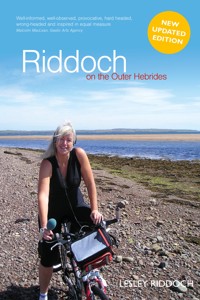
Erhalten Sie Zugang zu diesem und mehr als 300000 Büchern ab EUR 5,99 monatlich.
- Herausgeber: Luath Press
- Kategorie: Lebensstil
- Sprache: Englisch
Riddoch on the Outer Hebrides is a thought-provoking commentary based on broadcaster Lesley Riddoch's cycle journey through a beautiful island chain facing seismic cultural and economic change. Her experience is described in a typically affectionate but hard-hitting style; with humour, anecdote and a growing sympathy for islanders tired of living at the margins but fearful of closer contact with mainland Scotland.
Sie lesen das E-Book in den Legimi-Apps auf:
Seitenzahl: 379
Veröffentlichungsjahr: 2022
Das E-Book (TTS) können Sie hören im Abo „Legimi Premium” in Legimi-Apps auf:
Ähnliche














LESLEY RIDDOCH is one of Scotland’s best-known commentators and broadcasters. She was assistant editor of the Scotsman in the 1990s (and editor of the Scotswoman when female staff wrote, edited and produced the paper) and contributing editor of the Sunday Herald. She is best known however, for broadcasting with programmes on BBC2, Channel 4, Radio 4 and BBC Radio Scotland, for which she won two Sony speech broadcaster awards. Lesley is a weekly columnist for the Herald and National and wrote for the Scotsman until early 2021. She’s also a regular contributor to the Guardian, Scotland Tonight, Question Time and Any Questions. In 2014, she became a familiar figure on TV and radio making the case for Scottish independence and in 2020 won the Saltire Society’s Fletcher of Saltoun Award for contribution to Public Life in Scotland and Independence Campaigner of the Year Award.
Lesley is Director of Nordic Horizons, a policy group which exchanges expertise between the Nordic nations and Scotland and has organised 60 speaker events since 2010. Lesley founded the feminist magazine Harpies and Quines in 1991, was a Trustee of the Isle of Eigg Trust, which led to the successful community buyout in 1997, and founded the charity Africawoman in 2001. In addition to four books, Lesley has presented and co-produced films about Norway, Iceland, the Faroes, Estonia and the Declaration of Arbroath, commemorating its 700th anniversary. Lesley lives by the sea in North Fife where she co-presents a weekly podcast accessible via www.lesleyriddoch.com/podcasts
Provocative and inspired, Riddoch on the Outer Hebrides is a must read, especially for those that think they know the islands inside out. You won’t find a more stimulating or relevant read around.
LAURA MACIVOR, STORNOWAY GAZETTE
A truly interesting book… Lesley Riddoch raises some curiosity-piquing ideas which render this book well worth more than one reading.
FIONA ALLEN, EDINBURGH REVIEW
She can rattle and enrage, but she gets to the heart of the matter and requires that people be honest… This is an interesting, entertaining and challenging read.
RON FERGUSON, PRESS & JOURNAL
If you insist upon cycling from Vatersay to the Lighthouse at the Butt of Lewis, you couldn’t wish for a better companion than the writer and broadcaster Lesley Riddoch... This is a read-in-one-sitting book. Riddoch is fast, engaging, and funny. More importantly, she knows when her subjects are also engaging and funny, and is happy to hand the airtime over to them. It is a series of snapshots, a kind of holiday album. But it is an album compiled by a fascinated, assertive and intelligent visitor.
ROGER HUTCHISON, WEST HIGHLAND FREE PRESS
Chatty without being oppressive and informed without being lecturing, Riddoch’s style nicely brings home the beauty of the islands and the charm of those who live there.
THE HERALD
For Elma Morrison, Mary Schmoller, Morag and Neil Nicolson and other great friends made along the way.
‘The Gaelic Long Tunes’ by Les Murray (New Collected Poems, 2003) is reproduced with the kind permission of Carcanet Press.
The excerpt from ‘The Life of Lord Leverhulme’ by Louis MacNeice (Faber) is reproduced by permission of David Higham Associates.
First published 2007Revised edition 2008New edition 2022
ISBN 978-1-80425-037-2
The author’s right to be identified as author of this book under the Copyright, Designs and Patents Act 1988 has been asserted.
Typeset in Minion Pro Condensed and Gill SansDesign by Tom BeeMaps by Jim LewisPhotographs by Maxwell MacLeod, Cailean MacLean, Eoin MacNeil,Chris Smith and Lesley RiddochGaelic proverb illustrations © Laurie Cuffe
© Lesley Riddoch 2007, 2022
Contents
Preface to the 2022 Edition
Foreword
Angus Brendan MacNeil, MPNa h-Eileanan an Iar
Tuppence Worth
Maxwell MacLeod
Introduction
Lesley Riddoch
Acknowledgements
Barra to Vatersay the Southern Isles
Depopulation, missing women and beach landings
Pabbay not getting to Mingulay
Pabbay, Caithness and ghostly piping
Lochboisdale to Daliburgh South Uist
Ceolas, step dancing, dating and traditions
Daliburgh to Balivanich Benbecula
Gaelic, golf, Transport Ministers and archaeological remains
Balivanich to Lochmaddy North Uist
Second sight and the power of the family
Lochmaddy to Berneray North Uist
Thatching, seal oil, goose hunting and Dun spotting
Leverburgh to Rodel South Harris
The MacLeod mystery and the failed fishing
Rodel to Scalpay Harris
The big Gaelic music argument, tweed and rain
Scalpay to Uig Lewis
Treasure Island and the crofting wind millionaires
Uig to Callanish Lewis
Storytelling, beaches, and midnight hippies at Callanish
Callanish to Ness Lewis
Bungalows, war memorials, windy arguments and Pygmy Island
Stornoway and Eye Peninsula Lewis
The Free Church, ‘Two Ronnies’ and Gaelic
Fifteen Years Later – a Postscript
Bibliography
Appendix
‘Outer Hebrides’ v ‘Western Isles’
Preface to 2022 Edition
It’s 15 years since I sat down to write this book, after cycling the length of the Western Isles for a BBC Radio Scotland series. High time for an update. I've kept the original events and my own perceptions unchanged to provide an accurate snapshot of Hebridean life in 2006 – but important developments are contained in a new postscript.
One development, however, deserves immediate attention.
In 2006, most of the 180 miles we cycled and drove across were owned by large, private and generally absentee owners, as they had been for centuries.
Since then, an incredible change has taken place – the amount of community-controlled land on the Western Isles has almost doubled in 15 short years, leaving just a quarter in private hands.
Credit for the historic shift is entirely due to islanders. Motivation was provided by long years of exclusion. Inspiration was provided by the pioneering home-grown buyout of North Harris in 2003.
And organisation was provided (in part) by the framework of crofting which meant local people had worked and planned together long before big questions about land buyouts were posed. Anyway, the change has been quietly epic – facts are chiels that winna ding. (The facts speak for themselves.)
Before 2006 cycle
Acres (thousands)
Stornoway (gifted in 1923 by Lord Leverhulme)
69.2
Bhlatos (Valtos), 1998
1.7
North Harris, 2003
62
Aline Community Woodland Erisort trust, 2005
1.6
Total: 134.5
After 2006 cycle
Stòras Uibhist, 2006
93.9
Galson, 2007
55.8
West Harris, 2010
19
Scalpay, 2012
1.5
Carloway, 2015
11.4
Pairc, 2015
28
Barvas, 2016
34.5
Gallan Head, 2016
0.1
Keose Glebe, 2016
1.2
Total: 245.4
So, roughly 75 per cent of folk on the Western Isles now live on community owned land and Community Land Outer Hebrides is ‘building upon this success,’ which suggests more is in the offing.
Change has been dramatic because those absentee-owned estates were dramatically large and a domino effect means each community buyout has encouraged its neighbours. Thus, West Harris followed North Harris in 2010 and – amongst other things – built the beautiful Talla na Mara community centre and restaurant (with unbeatable views) complete with units for small local businesses like Flavour chocolate, about which I must try to remember Tha gu leòr cho math ri cuilm (enough is as good as a feast).
Anyway, the ball is now so firmly in the court of Hebridean community ownership, that private landowners (like the Galloway family in Carloway) got on the right side of history by opening up buyout negotiations themselves, whilst others like Fred Taylor on Scalpay, actually gifted his land to islanders. Even though progress was much slower on Pairc and has faltered on Great Bernera, that’s a massive change in 15 short years.
Many of the housing, employment and population problems we encountered during the 2006 cycle trip were the product of centuries-long under-investment, land-exclusion and neglect. These ‘stuck’ problems can finally be tackled now – though unravelling the past isn’t easy.
Building affordable homes and reversing population decline is a slow business with careful planning and consultation needed to ensure homes are built where present and future jobs might be. And often that’s not the old centres of population.
Meanwhile, other factors have muddied the water.
The Covid pandemic sparked a wave of speculative interest in holiday homes on the pristine Outer Isles thanks to their isolation and natural social distancing. House prices have shot up, young locals have been priced out and the islands are suffering the effects of over-tourism, with ferries so solidly booked locals can’t reach hospital appointments or plan holidays. Single track roads are quaint with a small volume of traffic, but nightmarish with hesitant motorhomes or cyclists who won’t pull over occasionally all summer. Life on the super highway is somewhat easier – most islands now have fibre-optic broadband. But the population is still in decline – 29,600 in 1991 and 26,500 in 2020 – a 10 per cent fall in the Western Isles against a 7 per cent rise across Scotland. The islands’ population is also ageing faster than the Scottish average.
The Scottish Government has allocated funds for a £50,000 ‘island bond’ to encourage families to remain or relocate to the islands (though that won’t help locals outbid property millionaires ‘fae sooth’). Meanwhile, women are being encouraged to stand for election in May 2022 after the Western Isles Council returned only male councillors in 2017.
The number of Gaelic speakers on the islands is still in decline. More than half the population (14,066) spoke Gaelic in 2019 but that’s down by a third on 1991. Language learning app Duolingo signed up half a million people to learn Scots Gaelic in 2020, but it’ll take more than that to save the Hebridean Mither Tongue. Can the string of community land buyouts help stabilise local populations and promote Gaelic? Who knows? But there are high hopes – at last.
So Gun cuideam.
(No pressure.)
Foreword
Lesley Riddoch, as her company name proudly boasts, is a feisty woman. This is underlined by her cycle through the Outer Hebrides in summer 2006. By way of contrast, I first cycled round my own native Barra on Easter Sunday 2015, with just one repeat trip. I have known Lesley for many years since we both met on the Island of Eigg sometime last century. Lesley shares with me the feeling that islands are probably the best place a person can live – but in Gaelic, there is a proverb, Is math an sgàthan sùil caraid. In English, ‘A friend’s eye makes a great mirror.’ I know that Lesley Riddoch is just such a friend to the Hebrides, and sensibly, she is not an uncritical friend. She will, as she’s demonstrated on radio many times, hold up a mirror that reveals warts as well as beauty. Her observations, comments and analysis have rearranged my mental furniture. Her book is ultimately an act of social consultancy – I don’t agree with everything and she’d be shocked if I did. She is not a Gaelic speaker but has an awareness of the language’s importance. Which is a great asset amongst English-speaking social commentators. Because we are at a crossroads in the islands linguistically.
We have to face up to the fact that we are living in the last area of the Gaelic language on Earth. Only a minority of children reach school speaking Gaelic but happily many more attend Gaelic medium education today, as the advantages of bilingualism are more widely recognised. We must be positive and nurture all that’s good about our islands to avoid becoming ‘dead end’ Gaelic speakers, where the vernacular and perspectives of 50 island generations stall on our tongues. Look at the Faroe Islands – perhaps the most successful island group in the world with a 10 per cent population growth in the last decade, islands linked by tunnels, and world leading broadband speeds. Despite this though, many Faroese see the resurrection of their own language as the most important driver of progress.
Crofting is also changing. Crofts earn very little but change hands for shocking sums of money – out of reach for most young locals. Change is needed, and I’d suggest that one person should not have more than one crofting tenancy (with perhaps several grazing rights) to democratise access to land. House building grants should also be divorced from the croft and become a general rural housing grant.
In 2022 you can finally access the world from a croft. I’m as well wired to current events in Barra as I am in my Westminster office thanks to BT Broadband. The pandemic has changed work practices and led to increased demand for island and rural life. That’s a good problem to have, but only if there’s room for all – not just the highest bidders.
I’m grateful that someone I admired long before I met her has (again) asked me to write the foreword to her book. One thing I can be certain of – Lesley Riddoch will always argue a position with the best interests of the islands at heart. That won’t stop respectful disagreement. But at least the debate will be feisty.
Angus Brendan MacNeil, MPNa h-Eileanan an Iar
Tuppence Worth by Maxwell MacLeod
A few weeks before my late father’s death at 96 I was sitting talking nonsense to him, as you do. The nonsense was largely an exchange of family stories, short ones, that we both knew and loved. He was a darling man and it wasn’t an easy time for either of us. Eventually I tossed him a juicy worm, knowing he would gobble it up and respond with an absolute corker.
‘So, Father, you have walked this road of life before me. What’s your advice on life’s great journey?’
It was a question he had asked his own father in exactly the same situation half a century earlier. The old boy grinned gratefully for the opportunity to perform and set off on his riff.
‘Funny you should ask me that. I remember asking my own father the same question, and he replied that after a long life he had come to only three conclusions. That it is never wise to cross a fence with a loaded gun, stand up in a small boat, or do business west of Crianlarich – and I agree, I agree!’
Lord how he laughed. I tell you this because of that last line.
‘Never do business west of Crianlarich.’
Now Crianlarich lies in the middle of Scotland – so my father was suggesting that everything that takes place on the Hebridean Islands is a ridiculous waste of time. The particular perversity of that remark needs a bit of explanation.
My family have lived on the Hebrides for at least four hundred years, quite possibly twice that. My cousins still live in the house in Skye that we came from in 1777. I still have the house in Morvern that we lived in next.
My father, Lord George MacLeod of Fuinary, gave much of his life and money to leading the restoration of the Hebridean Cathedral on Iona, mostly using volunteer labour. He had, in fact, thrown away the family fortune by investing west of Crianlarich. Though I don’t begrudge him a penny.
Part of his motivation for that endeavour was wanting young people to become immersed in the experience of working alongside Gaelic stone-masons on high scaffolds as they sang work songs, told tales in the evening of their love of nature and their lack of materialistic ambition, and then crooned exquisite songs, some of them written when Napoleon was but a child.
So that was the great side of the Gaelic culture.
But there was another side too.
All his life George had had to fight against miserable, thrawn folk in the islands who were also Gaels and for whom cynicism or drunkenness were ways of life. Indeed, when I once asked him where he wanted to be buried he had replied: ‘Anywhere but Iona.’
Any honest book about the islands must explore the same dangerous territory without painting Gaels as heroes or villains – they are people… with stories.
Storytelling, and this book is largely a collection of stories, is a vital part of our culture. It’s how we remind each other of who we are, and of the great truths and mysteries. The truths of Hebridean culture are becoming harder to swallow with each passing generation. The next will not know the culture that has cradled the islands for over a thousand years.
If such cultural genocide had happened to the Inuit or the Aborigines, every child in Britain would know about it. As it is, there is hardly a child in the land who could point to Uist on the map, or say a word in Gaelic, though most can parrot a dozen words in French or German.
But does it matter a damn?
Well, apart from warning me not to invest west of Crianlarich, my father would also observe with a sigh, ‘The Gaelic culture is dying and I sometimes want to mourn it, and sometimes am greatly relieved.’
So when my friend of 30 years Lesley Riddoch phoned to ask if I would accompany her on a journey up the Western Isles, I said yes without checking my diary. Anything that was in that diary would have to be cancelled. I would just tell folk the truth and they would understand.
I agreed for two reasons.
Firstly, because I love the woman, and by that I mean that I have an abiding passion for her. She has such conviction and fire for what she does that I admire her very deeply, and yet she is sometimes simultaneously so vulnerable and idiotic that it inspires a deep compassion in me and I also want to protect her.
We irritate each other almost constantly.
We also enjoy each other’s company. God knows why, but we do.
Several times during our intensely busy two weeks together on our island venture I seriously considered abandoning her and I know that the number of times she considered sacking me was even greater. Given that we were only working together for two weeks, that probably means there was scarcely a period of 48 hours when one of us didn’t playfully consider the pleasure that might be experienced murdering the other. In retrospect, I don’t think I have ever enjoyed a fortnight more in my life.
Secondly, I knew that this is a vital time in the history of the islands. The Gaelic culture is just about dead and the ‘Resties’ (we sold the house in the south and bought a cheaper one here, the rest is invested) are arriving in their droves.
Again this poses the question, does it matter a damn?
I think it does, otherwise I wouldn’t have gone.
Why does it matter? If mankind doesn’t turn away from a global culture based on competitive consumption, our time on Earth is limited. Here on the islands we have people who live different, non-materialistic lives that may teach us something.
Some of this collective lifestyle is based on Gaelic tradition, on religious tradition, and on valuing family above all else. A small part is just based on smoking copious amounts of dope.
But all aspects of island tradition are interesting, all worth examining.
And in this book Lesley examines them by using the very technique that is at the core of Hebridean culture: storytelling.
Through her stories she defines the state of, and to an extent the potential of, some of these glorious islands and the cultures that they have created.
Lesley is not only a great storyteller, she is also a great story gatherer.
During her career as a radio journalist in Scotland she has gained the trust of thousands of people – who listened to her broadcasts, sometimes shouting at her, sometimes whooping with delight as she dismantled some prevaricating politician.
It was my job as her assistant to go ahead and find people prepared to talk to her and it was never hard – often they had been having one-sided conversations with her for years and were anxious to meet their pal.
I may have wanted to kill her, but I still love her.
Though you mustn’t believe everything she says about me.
The bitch.
Introduction
A BBC weather presenter has apologised after calling the Western Isles ‘nowheresville’. The Western Isles MP Angus MacNeil offered weather presenters a visit to his constituency. The Met Office forecaster said he ‘deeply regretted’ his choice of words.
BBC News, February 2007
Land Rover is promoting a new colour called Stornoway Grey. A Western Isles councillor claimed the name was ‘offensive, inaccurate and inherently degrading’. Land Rover said Stornoway Grey was one of its strongest colours and helped to ‘keep’ the Western Isles on the map.
BBC News, March 2007
The Outer Hebrides hardly belong to this country or this century. The name says it all. Outer means distant, remote, marginal, unfamiliar.
Hebrides means the place protected by the pre-Christian fire goddess Bride. And the Gaels’ decision to revert to this ancient name after 35 years as the breezy-sounding Western Isles should tell lovers of shopping malls and bouncy castles everything they need to know.
The Outer Hebrides are different. Nearer than Orkney and Shetland – but stranger. In fact their Gaelic name, Innse Gall, literally means ‘Islands of the Strangers’ – a name given by wary Gaelic-speaking Scotti to the Vikings who colonised the islands around 800 AD. Vikings whose descendants are still happy to be called strangers by other Gaels, 1,200 years on.
The Outer Hebrides are a place apart.
Composed of Lewisian Gneiss – the most ancient and unyielding rock. Populated by unyielding Gaels, who therefore still have Scotland’s most ancient language on their tongue. Blessed with natural beauty that is both outstanding, and unpackaged. There are no quaint Tobermory-like towns, no famous Islay-like distilleries and no formidable Cuillin-like peaks to tick off Munro-bagging lists.
A heaven for lovers of wild places. A nowheresville for lovers of foreign holidays, epicurean delights and managed attractions. Exotic for the few. Grey for the many – a giant, blank canvas, regularly daubed with whatever drab colour of paint a car manufacturer cannot sell.
How has this misrepresentation of Europe’s most beautiful island chain been allowed to happen?
In reality the Outer Isles contain stunning landscapes, empty roads, mercifully flat cycling terrain, humour, Gaelic, shellfish, tweed, tradition, loss, music, boats, fear of depopulation, ferries, kindness, churches and passing places aplenty. If that seems ‘grey’ to the marketing folk at Land Rover, they should get out more.
But the Outer Isles are easily and often dismissed. For centuries, mainland opinion has tended to be sentimental at best and hostile at worst. The road along the east coast of Harris was dubbed ‘the Golden Road’ by Scots, horrified so much money had been ‘lavished’ on peasants. It is a beautiful road, but single track, winding and slow. Hardly 24 carat.
Nowadays urban Scots struggle to keep pace with one another and with London – and the slow, low-key, family-based nature of Hebridean life has allowed the island chain to sink beneath mainland radar. Which is generally fine. But the Outer Isles have sunk beneath the living standards of every other Scottish island group too. Which is not fine.
Shetland has been transformed by large-scale trawling and oil. Incomes are amongst the highest in Europe and ferries run day and night to keep outlying islands viable and connected. Wind energy has been embraced swiftly through deals that will give Shetland Islands Council a 50 per cent share of wind wealth. And islanders have integrated incomers attracted by oil money. Witness the spontaneous, defiant and successful campaign to resist the deportation of a Thai sports instructor in 2006. Shetlanders act to defend one another – no matter what rules a distant state tries to impose.
Orkney too has been transformed by the canny combination of heritage and enterprise. Carefully developed branding and intelligently nurtured talent have given Orkney the biggest jewellery industry outside Birmingham. Runic-inspired bracelets, pendants and rings compete for space on ferries and planes with Orkney Cheddar, Orkney Ice Cream, Orkney Herring and Orkney Oatcakes – and the favourite tipple of successive Chancellors, Highland Park. All value-added. All manufactured. All produced locally and therefore all helping to create jobs, profits and skills.
The Northern Isles have got drive, focus and entrepreneurial flair.
The Western Isles seem to have got left behind.
According to the Scottish Annual Business Statistics of 2004, the GVA (a measure of the individual worker’s productivity) was lower for manufacturing in the Outer Hebrides than the other five remote regions that compose the Highlands and Islands Enterprise area – Orkney, Shetland, Argyll and Bute, Highland and Moray.
And yet the Western Isles has the second highest percentage of skilled tradespeople in Scotland. And the educational attainment of Hebridean pupils outstrips every other part of the HIE zone. Wherever they are taking their skills, it doesn’t seem to be local craft industries.
In 2006 there was not a single distillery on the islands – now there are four. But I would still struggle to find a local creamery the length of the Outer Isles. Fish are imported and no large-scale trawling takes place. Traditionally the Hebrides have been net importers of energy with a higher unemployment rate than their northern cousins, a higher incidence of alcoholism and a shorter life expectancy, though over the last ten years that’s improved dramatically. Hebridean girls have seen the largest leap in longevity of any UK region and boys have had the largest leap in Scotland.
Why is life apparently tougher on the Western Isles than elsewhere in the Highlands and Islands?
The Gaels didn’t have easy access to oil deposits like Shetland or fertile soils like Orkney. But the Northern Isles were able to grab control over production of their natural resources. The Western Isles were not. The Outer Hebrides continued to export ‘raw’ fish, tweed and seaweed to middlemen and to mainland manufacturers. And those mainlanders got the jobs, made the profit and learned the skills.
In 1773 Samuel Johnson visited Skye. What he observed there could easily describe the situation on the Outer Hebrides today:
The clans retain little now of their original character, their ferocity of temper is softened, their military ardour is extinguished, their dignity of independence is depressed, their contempt of government subdued and their reverence for their chiefs abated. Of what they had before the late conquest of their country there remain only their language and their poverty. Their language is attacked on every side.
In their sad songs of departure and loss, in their reverence for ‘tradition bearing’, in their aversion to expansion and the modern cash-based society, in their dogged independence, in their Gaelic, in their churches and above all in their powerful families demanding obedience or virtual exile – the Western Isles still bear the fruits and scars of battle. Battle against the secular, pluralist, materialist society Scotland has become. Can they survive? Will they adapt? Were they right?
Cycling up the Hebrides in the summer of 2006 for a 13-part BBC Radio Scotland series, On the Bike, I had modest aims – to stretch my legs and spend some time away from mobile phones, emails, and deadlines.
I experienced much more.
Hermetically sealed in a car, the visitor moves too fast from A to B, and is usually underwhelmed at both ends. No serendipity, no downhill descents into dodgy sheep-grids, no conversations at bus shelters, no skirling bagpipes.
Instead, I spent weeks in touch with two great natural phenomena. The sea, never more than a few miles distant. And the people, unselfconscious repositories of Scotland’s collective psyche.
The plan was that my transit driving companion, Maxwell MacLeod, would carry heavy editing equipment and extra bikes, while I would leapfrog from Barra to the Butt of Lewis, interviewing folk with stories, skills and insights into Hebridean life. The sort of people you never forget meeting but can never coax into a studio. So the great and good are not featured in this book – neither are the large number who spoke but wouldn’t be recorded through shyness, diffidence, wariness or basic mistrust.
It would be easy to leave the Gàidhealtachd to the Gaels and thereby lose a large chunk of Scottish culture and history. Gaelic was our common language only a few centuries back when most Scots lived rural, clan-based, family-centred, land-focused lives. ‘Quaint’ Hebridean customs that survive today were mainstream Scottish customs then – from knowing everyone else’s business to thatching, communal hay making and ceilidhs.
A trip to the Hebrides today is a trip to Scotland’s otherwise inaccessible past. And given the desire for sustainability and stronger community life, it could be a trip to Scotland’s future too.
Admittedly, though, I am biased.
I was a Trustee in the first-ever island community buyout on the Inner Hebridean island of Eigg and I’m chair of the Rum Taskforce to shift control from long-term landowners SNH to community control. I bought land intending to build a house and become a hermit in the north of Skye. A plan which was abandoned after I got married on the innermost Summer Isle, Isle Martin, to a Canadian born on the Isle of Wight. My mother maintains our Caithness-rooted family hail originally from Orkney, where the splendidly self-reliant Westray has become our favourite island destination.
I admire the doggedness and distinctiveness of islanders. And the folk of the Western Isles are amongst the most dogged of the lot, hanging on to their population against all the odds. Large chunks of that population still live like large extended families – with all the comfort and connectedness that brings. But the power of island clans can be a formidable obstacle for those stuck on the ‘wrong’ side of rigidly held views on religion, race, or wind power.
Those views have served to define islanders and exclude strangers. Now many young islanders are feeling excluded too. And yet for traditionalists, the fear of alienating a generation of children is not as great as the fear of change. For some, preservation of island life is a God-given task – a legacy handed down by wronged forebears with whom no easy deal can be made.
But battling the will of God just to surf the net on Sunday isn’t an appealing prospect for young islanders. A shift in emphasis is needed. From the over-examined religious side of Hebridean life to its under-examined practical side. Samuel Johnson spotted the islanders’ Achilles heel centuries ago: ‘The Scots have attained the liberal without the manual arts. They have excelled in ornamental knowledge [without] the conveniences of common life. They are more accustomed to endure little wants than to remove them.’
Of course, it was impossible for islanders to do anything about ‘little wants’ for centuries. But overall, Johnson is still right. In my fortnight of cycling, I found ‘ornamental knowledge’ aplenty – erudite arguments about the origins of step dancing, competent pipers in every other household, and people jigsaw-puzzling ancestral DNA across centuries and oceans. All this often without a decent ferry service, a shop or a functioning public toilet for miles around – ornamental or otherwise. The non-materialist, unworldly sense of worth in in the Western Isles is both part of its charm and part of the reason for its population decline, especially amongst its very worldly youngsters.
The current generation of web-connected, well-educated children are leaving the land of Gaelic, crofts, church adherence and seasonal, manual work. Some may return, disillusioned with a materialistic society long on promise and short on delivery. Some may become mortgage slaves and stay close to the promise of steady work. Meantime, incomers are shoring up school rolls and population numbers. But they cannot easily shore up the cornerstones of Gaelic, crofting, church attendance and weaving. At least not with the ‘untaught’ flair and unquestioning adherence that mark out most locals.
So what does the future hold?
Can the Hebrideans adapt to survive? Should they?
No society is likely to disappear in a decade or five – not even one as quiet and stoic as the Outer Hebrides. Not even the Iron Lady could manage that. But the Isles won’t have quite the same kind of culture if they are not populated by the same kind of people.
Welcoming, colourful, talented, self-doubting and funny. God-fearing, superstitious, polite and fearful, too. Each passing day, cycling, eating, driving and arguing brought me into a marvellously rich human and physical landscape. Each day there were stories, songs and music, told hilariously and fluently by people who would then make panicky searches for someone ‘better educated’ to speak ‘on the wireless’. Each day an exotic ‘pick ’n’ mix’ of language was spoken: English, Scots Gaelic and Macaronic – speech that uses a mixture of languages. Each day there was spontaneous friendliness and knee-jerk wariness. Waves from cars on single track roads evaporating into stony indifference on double track. There was kindness, offers of lifts and cups of tea, if you made a connection – and not so much as a shop selling last week’s bread if you made none. But above all for a radio broadcaster, there were glorious turns of phrase. Little sentences summing up life in mini haikus. Fifteen years later I still savour them, like aural aromatherapy. Motivation in the morning is delivered by DJ MacKay the Harris Tweed weaver saying, ‘Yes it is,’ in response to my formulaic ‘Nice day.’
Calmness returns with Uist crofter Neil MacMillan patiently calculating the last time he spoke English: ‘It was not yesterday, nor the day before that. It was not last week nor last weekend. It must have been two weeks ago. Yes – it was then.’
Life-affirming exuberance is delivered by Dr Finlay MacLeod on a day of clear skies and lashing seas at the Butt of Lewis. ‘Isn’t it marvellous,’ he said, all distance swept aside in a shared moment of childlike awe atop the high cliffs.
These Gaels are emotional conductors, with direct connection to the healing energy still found in family, community and nature. Modern mainland life makes that energy harder to source and those connections harder to maintain. It takes time and an absence of distraction to be aware of nature’s dynamic. Sadly, time is one thing mainlanders don’t have. We know a few Burns songs, can recite the first verse of a few poems and used to go first-footing – but how do we listen to people, how do we value them, how do we behave towards strangers? How do we perform these least theatrical and most basic acts that underpin human culture?
The Hebridean Gaels are neither perfect nor doomed, but the mix of personality and memory they contribute to the composite character called Scotland is vital. It’s different. And in a world tending towards conformity, we need all the difference we can get. Particularly when that difference arises from communitarian traditions that used to be the norm across Scotland three short centuries ago.
If human culture is a crop, then the Hebrides have some of the few remaining genetically unmodified fields. Elsewhere, life is full of hybrids. Commerce and culture, materialism and happiness, mobility and dislocation – how well will they coexist in the long term? We need places that offer an alternative, in case our mainland experiment fails or falters. And it might.
One last thing. Since my original mission was to record enough material for 13 radio programmes in 14 days, I had to speed through villages and past whole communities whose stories have therefore not been described. Apologies. This book is, in every respect, a random set of encounters on the Outer Isles – not a detailed account. Some readers will not understand the term ‘croft’ – others doubtless drafted the latest crofting legislation. I have the ambition of keeping all on board, though I’m sure each sentence will be subject to instant challenge – especially the following basic definitions.
As my mother used to say, it’s a great life if you don’t weaken.
Croft – A croft does not necessarily have a house. It’s a small parcel of land in the crofting counties north and west of the Great Glen, with protected tenure under the Crofting Act of 1886. The crofter shares rights of access to common grazing and, since 1976, has the right to acquire title to the land and become an owner-occupier. The croft is handed down within the family or re-assigned locally.
Free Kirk – The present Free Church (FCs or ‘wee frees’) dates from an early schism in the 1900s when a minority opposed a proposed merger of churches. When the merger to create the United Free Church went ahead, the Free Presbyterians broke away too (FPs or ‘wee, wee frees’). In 2000 another group broke away to form the Free Church Continuing (FCC). The early Free Church backed land reform and opposed landowners choosing local ministers. All branches still use an evangelical style of delivery using only Psalms in their metrical form, sung unaccompanied.
Cráic – Fun or lively conversation, associated with the Irish and Celts. Use it with Gaelic purists (Irish or Scottish) at your peril though – they insist the word was never used in Gaelic society until English speakers implanted it in the 1970s and then Gaelicised the spelling. In Irish cráic means arsehole!
Fèis (plural Fèisean) – the Gaelic word for a festival or feast. Since 1981 the Fèisean movement has set up around 40 week-long Gaelic arts tuition festivals for young local people, which take place mainly across the Highlands and Islands during the summer.
Machair – the Gaelic word for a fertile plain behind a beach covered with a profusion of wild summer flowers. It’s formed when calcium carbonate-rich sand is blown inland from beaches and managed by light grazing and haymaking by crofters. The Outer Hebrides has the biggest single collection of this unique European habitat. The beach tràigh (pronounced ‘try’) is usually fringed with marram – a grass whose extensive root system lets it survive on harsh windswept North Atlantic coasts.
Western Isles Council – has been called Comhairle nan Eilean Siar since 1999 and the Western Isles are officially Na h-Eileanan Siar. But several other names are used too. And choosing the right one can be as sensitive as the great Northern Ireland/Ulster/Six Counties naming dilemma. On the islands, though, no one will ever let you know you’ve got it wrong. The name Western Isles was used only for Westminster elections until it was applied to the new unitary island council created in 1975. Previously the islands were called the Outer Hebrides which derives from the ‘Isles of St Bridgit’, the Celtic goddess of fire, whose powerful grip on island communities may have inspired the Christian creation of St Bride the midwife of Christ. In Gaelic though, Innis Bhrìghde disappeared from use, giving way to Innse Gall (The Isles of Strangers), a strangely derogatory term applied by outsiders during the time of the Norse settlement. Many folk still refer to the islands as An t-Eilean Fada, or ‘The Long Island’; Na h-Eileanan a-Muigh (the Outer Isles) is also heard occasionally. Few islanders (see Appendix) agree on the best name for their home or the reason for it.
Acknowledgements
This book focuses on people. Not facts and figures, perfect histories, or even totally accurate cycling routes. So I’d like to thank the various authors who have given me permission to quote from their work. Maxwell MacLeod gamely modified his rigorously haphazard approach to life to be my support driver. Against all his best instincts, he called ahead to confirm interview and accommodation details, took a multitude of photographs, learned how to make girl-friendly sandwiches, drove with passion and some sciatic discomfort, laughed when things went ridiculously wrong, charmed anxious interviewees like an islander and never complained. BBC Radio Scotland commissioned the series that got me ‘on the bike’ in the first place, supported by the ever resourceful Feisty production crew, John Collins and Claire McVinnie. The Herald gave permission to use the columns that accompanied the radio series. And The Scotsman gave permission to use extracts of subsequent columns written for them. Artist Laurie Cuffe let me use his cartoons of Gaelic proverbs. Their meanings, I’m told, are often opaque even in Gaelic. So I hope any wildly improbable meaning imposed upon them will be excused. Thanks to photographers Eoin MacNeil and Cailean MacLean, and to the Morven Gallery and artist Moira MacLean; to Maureen MacLeod at the Castlebay Hotel, CalMac, John Randall from the Islands Book Trust, Arthur Cormack of the Fèisean organisation and Donald J MacLeod for his painstaking research. Thanks to the Luath team, to my editor Jennie Renton and to Sria Chatterjee. Thanks to all the interviewees who put up with late arrivals, changed arrangements and then broke every unwritten rule of island behaviour by expressing themselves (in English) like no one was listening. Thanks to Hector and Jeannie MacLean who offered a vital communication-free week up beautiful Glen Prosen when I was writing this book and to Malcolm MacLean (no relation) who didn’t close his mind to critical thoughts about his beloved Gaelic. And many thanks to my late mum and dad whose epic car journeys to Caithness for childhood summer holidays sowed the seeds of curiosity about the rest of their beloved Highlands. I have read but never written the following words and feel the force of them for the first time: none of the above is responsible for any offence this book creates or any mistakes I’ve made in spelling, grammar or content – in Gaelic or English.
Barra to Vatersay the Southern Isles
Depopulation, missing women and beach landings
Beach-fringed Barra is a mainlander’s idea of island heaven. But with a population of just over 1,300, it’s teetering on the brink of viability. Dear knows why. An almost Irish mix of pubs and hotels with busy seafood restaurants greets the visitor at Castlebay. And yet female inhabitants have been quietly leaving Barra for years. Perhaps, as the proverb suggests, island women have found it easier to live with lobsters than island men – fabulous sailors who spend more time at sea than the average crustacean.
Perhaps the problem is far simpler. The neighbouring island of Vatersay was nicknamed ‘Bachelor Island’ until the 1990s, when a new causeway let island women leave without having to lift a heavy outboard motor or wheedle a two-hour boat journey from an under-occupied passing man.
Despite the belated arrival of this ‘mod con’ – the birth-rate on the Southern Isles is still low. Consequently, there’s been mainland pressure to scrap the subsidised air service to the famous Cockle Strand, and no plans to improve the five-hour ferry service that arrives from Oban every other day in winter.
Things are tough for Barra. But I suspect tough is what finally gets Barra going.
The hot June day I arrived in 2006, the tar on the road was melting. A stream of cars and lorries rolled through the jaws of the ferry onto the pier at Castlebay – probably the best natural harbour in the whole island chain. Caught between the arriving and departing queues of ferry traffic, I leaned on a wall with my bike and overladen panniers, making patterns in the sticky tar with the chequered tread of my trainers. Maybe mainland roads are made of more substantial stuff these days, but I could almost hear my mother telling me to stop making a mess.
Banks of waving yellow flags (irises) flanked the foreshore and white sand glistened beneath every slowly draining, breaking wave. Gulls swooped and a large, animated red-haired family passed – lively with the business of reunion and arrival.
One child, momentarily missed in the swirl, glanced up with those unusual, dark eyes ascribed by Canadian writer Alastair MacLeod to the Clann Chaluim Ruaidh – a family group physically dispersed across the world but still genetically united in appearance.
Two old men were squinting into the sun by the harbour wall, watching the Captain hang his jacket over the ship’s railing and a deck-hand deftly coil the ferry’s thick ropes; all watched, in turn, by visitors stretched out on the lawns of harbour hotels, their eyes fixed on the towering ferry, like Lilliputians regarding an ocean-going Gulliver.
How on earth could such a beautiful and casually eventful place be struggling to keep its people? Of course, summer is deceptive. Islanders trying to attract ‘new blood’ habitually make incomers stay a winter before making a decision to settle permanently. Even so, it’s astonishing how one long, lazy summer day can put the grim reality of rain, isolation, claustrophobia and cancelled winter ferries completely out of mind. I heaved up the hill to check in at the Castlebay Hotel. Minus the weight of panniers and recording equipment, I zipped back down fast, and freewheeled to the only bicycle shop on the island. Calum was a great find.




