


23,99 €
Mehr erfahren.
- Herausgeber: John Wiley & Sons
- Kategorie: Fachliteratur
- Sprache: Englisch
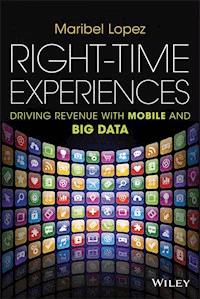
Grasp how mobile, big data, and analytics are combining tochange business processes Right Experience, Right Results: Improving Profits, Margin,and Engagement with Mobile and Big Data illustrates howbusinesses can use mobility, big data, and analytics to enhance orchange business processes, improve margins through better insight,transform customer experiences, empower employees with real-time,actionable insight, and more. The book depicts how companies cancreate competitive differentiation using mobile, cloud computingbig data, and analytics to improve commerce, customer service, andcommunications with employees and consumers. In the past, the technologies used to deliver personalized andcontextual services were either unavailable, unaffordable, orreserved solely for the consumer market. Today, however, the nextwave of computing--mobile, cloud computing. big data, andanalytics--has provided the foundation for businesses tocreate adaptive, personalized applications and services. Deliveredpoint-of-need, these smarter services allow enterprise products andservices to meet the burgeoning demand for always-connected,accurate, and real-time information. Right Experience, RightResults: Improving Profits, Margin, and Engagement with Mobile andBig Data is your guide to the new way of doing things. The bookincludes: * Real world examples that illustrate how companies acrossvarious industries are creating better business processes byintegrating new technologies * A three step action plan for getting started and overcomingobstacles * An electronic checklist with numerous actions that help get youup and running with incorporating mobile, big data, andanalytics * A guide to drawing insight from mobile, social, and othersources to create richer experiences If you're a CEO, chief marketing officer, marketing director, orbusiness manager, Right Experience, Right Results gives youeverything you need to harness technology to breathe new life intoyour business.
Sie lesen das E-Book in den Legimi-Apps auf:
Seitenzahl: 562
Veröffentlichungsjahr: 2014
Ähnliche


















CONTENTS
Cover
Title Page
Copyright
Dedication
Preface
Acknowledgments
Part I: Adapt or Fail
Chapter 1: The Future Is Here
We Are Living in a Connected World
Cloud Computing Enables New Entrants and Business Models
Mobile and Social Change Engagement
Social, Mobile, and IoT Create Big Data
Delivering New Experiences
Summary
Notes
Chapter 2: Marching Backwards into the Future
Three Issues Stall Change
Finding Your Blind Spots
Taming the Beast of External Risks
Summary
Notes
Part II: Why Right-Time Experiences are Key
Chapter 3: New Realities Demand New Right-Time Experiences
Contextual Computing Leads to Insight
Adaptive Makes Interactions Personal
Connected Makes Interactions Actionable
Hertz Drives RTEs
Right-Time Experiences Don't Happen Overnight
The 3 Cs of Right-Time Experience
Summary
Notes
Chapter 4: Communications in a Right-Time Experience
Communications Move from Generic to Contextual
New Devices Change Communications Opportunities
Communications Builds a Bridge to Commerce
Improve the Quality of Civic Life
Summary
Notes
Chapter 5: Care in a Right-Time Experience
Mobile Extends Options and Information to Everyone
Closing the Deal Faster
Enhance and Transform Customer Care Experiences
Using IoT to Improve the Employee and Customer Experience
Transform the Organization with New Options
Curing Cancer with Cognitive Computing
Big Data and Mobile Deliver Predictive Knowledge
Respond to Problems and Opportunities in Real Time
Summary
Notes
Chapter 6: Commerce in a Right-Time Experience
Mobile and Context Change Commerce
RTEs Change B2B Commerce
The Role of Big Data in Commerce
Summary
Notes
Part III: How to Prepare for Change
Chapter 7: Evolve to Right-Time Experiences in Three Phases
Define a Mobile-Enablement Strategy
Evolve to a Mobile-Enabled RTE Business
Phase 1
Phase 2
Phase 3
Summary
Notes
Chapter 8: Understanding the Components of the Technical Plan: Mobility
What's Part of the Plan?
Building Mobile-First Applications
How Much Does It Cost?
Palador's Application Cost Estimate Framework
Summary
Notes
Chapter 9: Understanding the Components of the Technical Plan: Big Data
How Big Data Helps Deliver Better Outcomes
The Business Case for Big Data
The Challenge of Big Data
Summary
Notes
Chapter 10: Engage and Empower Employees
Use Mobile, Social, and Big Data to Recruit
Build a Training Plan
Engage Employees with Games
Get IT on Board and Drive Change
Be Open to Creating New Roles or Expanding Roles
Summary
Notes
Chapter 11: Closing Thoughts
About the Author
Index
End User License Agreement
List of Illustrations
Figure 1.1
Figure 2.1
Figure 3.1a
Figure 3.1b
Figure 3.2
Figure 3.3
Figure 4.1
Figure 4.2
Figure 4.3
Figure 4.4
Figure 5.1
Figure 7.1
Figure 7.2
Figure 8.1
Figure 8.2
Figure 9.1
Guide
Cover
Table of Contents
Begin Reading
Part 1
Chapter 1
Pages
iii
iv
v
vi
xi
xii
xiii
xiv
xv
xvi
xvii
xviii
1
2
3
4
5
6
7
8
9
10
11
12
13
14
15
16
17
18
19
20
21
22
23
24
25
26
27
28
29
30
31
32
33
34
35
36
37
38
39
40
41
42
43
44
45
46
47
48
49
50
51
52
53
54
55
56
57
58
59
60
61
62
63
64
65
66
67
68
69
70
71
72
73
74
75
76
77
78
79
80
81
82
83
84
85
86
87
88
89
90
91
92
93
94
95
96
97
98
99
100
101
102
103
104
105
106
107
108
109
110
111
112
113
114
115
116
117
118
119
120
121
122
123
124
125
126
127
128
129
130
131
132
133
134
135
136
137
138
139
140
141
142
143
144
145
146
147
148
149
150
151
152
153
154
155
156
157
158
159
160
161
162
163
164
165
166
167
168
169
170
171
172
173
174
175
176
177
178
179
180
181
182
183
184
185
186
187
188
189
190
191
192
193
194
195
196
197
198
199
200
201
202
203
204
205
206
207
208
209
210
211
212
213
214
215
216
217
218
219
220
221
222
223
224
225
226
227
228
229
230
231
232
233
234
235
236
237
238
239
240
241
242
243
244
245
246
247
248
249
250
251
252
253
254
255
256
257
258
259
260
261
262
263
264
265
266
267
268
269
270
271
272
273
274
275
276
277
278
279
280
281
282
283
284
285
286
287
288
289
290
291
292
293
294
295
296
297
298
299
300
301
302
Right-Time Experiences
Driving Revenue with Mobile and Big Data
Maribel Lopez
Cover image: © istock.com/Pingebat
Cover design: Wiley
Copyright © 2014 by Maribel Lopez. All rights reserved.
Published by John Wiley & Sons, Inc., Hoboken, New Jersey.
Published simultaneously in Canada.
No part of this publication may be reproduced, stored in a retrieval system, or transmitted in any form or by any means, electronic, mechanical, photocopying, recording, scanning, or otherwise, except as permitted under Section 107 or 108 of the 1976 United States Copyright Act, without either the prior written permission of the Publisher, or authorization through payment of the appropriate per-copy fee to the Copyright Clearance Center, Inc., 222 Rosewood Drive, Danvers, MA 01923, (978) 750-8400, fax (978) 646-8600, or on the Web at www.copyright.com. Requests to the Publisher for permission should be addressed to the Permissions Department, John Wiley & Sons, Inc., 111 River Street, Hoboken, NJ 07030, (201) 748-6011, fax (201) 748-6008, or online at http://www.wiley.com/go/permissions.
Limit of Liability/Disclaimer of Warranty: While the publisher and author have used their best efforts in preparing this book, they make no representations or warranties with respect to the accuracy or completeness of the contents of this book and specifically disclaim any implied warranties of merchantability or fitness for a particular purpose. No warranty may be created or extended by sales representatives or written sales materials. The advice and strategies contained herein may not be suitable for your situation. You should consult with a professional where appropriate. Neither the publisher nor author shall be liable for any loss of profit or any other commercial damages, including but not limited to special, incidental, consequential, or other damages.
For general information on our other products and services or for technical support, please contact our Customer Care Department within the United States at (800) 762-2974, outside the United States at (317) 572-3993 or fax (317) 572-4002.
Wiley publishes in a variety of print and electronic formats and by print-on-demand. Some material included with standard print versions of this book may not be included in e-books or in print-on-demand. If this book refers to media such as a CD or DVD that is not included in the version you purchased, you may download this material at http://booksupport.wiley.com. For more information about Wiley products, visit www.wiley.com.
Library of Congress Cataloging-in-Publication Data:
Lopez, Maribel, 1968-
Right-time experiences : driving revenue with mobile and big data / Maribel Lopez.
pages cm
Includes index.
ISBN 978-1-118-84735-0 (cloth); 978-1-118-94288-8 (ebk); 978-1-118-94289-5 (ebk)
1. Information technology–Management. 2. Technological innovations--Management. 3. Big data–Economic aspects. 4. Strategic planning. I. Title.
HD30.2.L667 2014
658.4′038–dc23
2014018630
Dedication
To my dearest Marco.
Preface
Mobile, cloud computing, and big data are changing the world as we speak. While we've had mobile technology for years, the combination of powerful devices, near-ubiquitous wireless networks, and widespread enthusiastic consumer adoption of mobile has changed the way we live, play, and work. Consumers now hold access to information, games, and services in the palm of their hand. Businesses have the opportunity to offer workflows and business processes to employees wherever they are and on the go. As a result, visionary managers are creating contextual services, in which products, services, and communications adapt to the user (consumers, prospects, and employees) and the situation on the fly, via technology. I show in the pages ahead exactly what this means and how it works.
The move to contextual services—being in the right place at the right time with the right experience—requires more than mobile. It requires breaking down information silos to modify business processes and coordinating IT and business strategies that employ mobile, cloud computing, big data, and the analytics necessary to turn data into information. With these four technologies, businesses are able to do things now that were either immensely difficult or exorbitantly expensive in the past, if they could be done at all.
In this brave new world, the most effective, successful companies will collect and integrate data points, such as location and previous transactions, to generate insights into the needs of employees, prospects, and customers. This integration will lead to better products, services, and business processes. A few organizations today are using some or all of these technologies to deliver economic value and competitive advantage.
Instead of calling these contextual services, real-time services, or personalized services, I believe they are right-time experiences (RTEs) because they occur at the time customers, employees, or partners need them most. While people may not know what a right-time experience is exactly (or how to have it), they understand the value of having the right information or experience at the proper moment. In some cases, RTEs may anticipate a need or desire before it materializes. RTEs don't have to be in real time—for example, an HVAC can alert a business when it's time to order new air filters—but these experiences are the most compelling.
While the concept of contextual services is not new, we are now on the brink of having all of the technology necessary to make an experience's context—its time, place, frequency, and more—available in our applications and services. Executives legitimately worry about issues of privacy and transparency, cost, and control—while more far-sighted competitors take away their business. What most firms are missing is a strategy to turn context into something that improves profits, increases stakeholder engagement, and minimizes user dissatisfaction. Technology is the foundation for enabling the best experience possible.
Right-time experiences are for senior executives, marketers, and IT leaders at established companies. The concept is designed to help leaders of established businesses understand and plan for the massive market transitions that are in the offing. It will also help entrepreneurs, because in many cases they have the ability to build right-time experiences from the beginning and can more easily adjust business models as circumstances change.
This book has three parts. Part I lays out the opportunities and problems, describing technology, market models, and shifts that are right now demanding business leaders to create new strategies or risk extinction.
Part II discusses a new way to think about designing business processes, building products, and creating compelling right-time experiences. It also provides practical, real-world examples of how businesses are building strategies to deal with these changes and deliver RTEs.
Part III provides a framework for an effective action plan for implementing RTEs. Every organization will be different, but the framework's basic elements span different-size companies and various industries. Part III basically answers the question, How do you get started? As a business, you need to figure out a technology, people, and processes strategy. What are the business processes that you might need to change? How do you create these right-time experiences?
This book will illustrate the challenges you'll face and provide guidelines for overcoming these obstacles. At a high level, it will highlight what technologies will be important for your business. It will describe the process changes you need to think about. Once you understand this, you may want to know more about the detailed technical aspects of big data, analytics, and cloud computing. For these technical implementation details, you'll go to another book. This book will provide an understanding of the landscape and what your business needs to plan for.
By the end of the book, leaders will be better prepared to capitalize on the changes in mobile, big data, and cloud computing. Just as important, this book will inspire organizations to provide right-time experiences to customers, prospects, and employees. The results—as I demonstrate in the pages ahead—can be improved margins, higher profits, and enhanced engagement with key stakeholders.
Part I: Adapt or Fail
Mobile, big data, and cloud computing are disrupting traditional business models and giving start-ups and tech-savvy organizations opportunities to give consumers and employees right-time experiences.
Chapter 1: The Future Is Here
Today, technology enables changes in behavior and business processes that were never possible in the past. This confluence of technology and new possibilities is disrupting existing business models. Start-ups across a wide range of industries have challenged established business practices and created new market dynamics. This chapter describes just a few of the possibilities to offer right-time experiences and shows how these benefit the organization and damage the competition.
Chapter 2: Marching Backwards into the Future
Industry leaders recognize that many of today's products and services do not meet current customer expectations, but they don't know what to do about it. In many cases, a substantial change is required, which is always difficult, and rapid change with an unknown outcome is even harder. New market models, however, offer opportunities and threats for established businesses. This chapter discusses the reasons senior executives give for not taking action and how this indecision will impact their companies. It also provides several recommendations for overcoming roadblocks.
Part II: Why Right-Time Experiences Are Key
Chapter 3: New Realities Demand Right-Time Experiences
If existing business practices are about to be outdated, what does a company need to be successful? Businesses need to leverage these new market forces to create RTEs. Mobile, social, sensor, and transaction data provide multiple information sources. Organizations will use new storage and analytics to turn context into actionable insight. New insights from ever-increasing data sources enable businesses to transform generic, rigid products and processes into adaptive and satisfying RTEs. While the number of RTEs possible are limited only by imagination, companies should create at least three that improve the experience: care, commerce, and communications.
Chapter 4: Communications in a Right-Time Experience
Using context such as presence, social network status, and location, a business can transform when, how, and what it communicates to its employees and customers. In the future, software such as augmented reality browsers will be used to overlay digital data on the physical view of an object from a device's camera. For consumers, businesses will link location, product information, and employee availability to build concierge apps that customize services based on a customer's immediate needs. Communications is an integral part of every right-time experience, but in many cases, it is the entirety of a right-time experience.
Chapter 5: Care in a Right-Time Experience
Companies will reshape their business models, increase collaboration, and improve customer relationships with right-time experiences. Enterprises that excel at customer experience understand aspects of customer care exist in every part of a transaction, from presales through postsale service. Technology now enables organizations to deliver service that wasn't possible in the past. If a business is listening, it can learn about problems and potential product opportunities on social media faster than it would through existing customer care channels. In addition, mobile provides a channel for companies to create one-to-one relationships and tap into contextual data from mobile devices. This chapter also discusses how care can be also applied to a company's employees.
Chapter 6: Commerce in a Right-Time Experience
Today, consumers are using smartphones in the store to check pricing, inventory availability, and product reviews. Retailers have to contend with “showrooming”—the phenomenon of a customer viewing merchandise and checking prices in a physical store only to then purchase online or from another retailer. While showrooming has created challenges, mobile also provides an opportunity to reach consumers wherever they are—and frequently at the point of decision. The challenge is to build an information technology and customer-facing strategy that capitalizes upon mobile attributes such as location, activity, and image capture. Additionally, businesses are using mobile and big data to improve business-to-business (B2B) commerce with data capture, analytics, and service at the point of need.
Part III: How to Prepare for Change
Part I set the context of the tectonic shift we are experiencing in technology, society, and business models. Part II demonstrated the value of right-time experiences. Part III describes what organization managers can do to capitalize on this brave new world.
Chapter 7: Evolve to Right-Time Experiences in Three Phases
Business leaders must keep their organizational strategies updated in the face of continually evolving technologies, ensure that their organizations continue to look ahead, and use technologies to improve internal performance. These include extending business processes, improving processes, and transforming the business with new processes. In the first phase, companies will seek efficiencies by moving to cloud computing, shifting business applications to mobile devices, and delivering new collaboration tools. In the second phase, companies push beyond efficiencies and seek ways to improve a business process through mobile enablement and introducing big data and analytics. The third phase transforms the business when a company uses connected devices to deliver new workflows and products it could not create in the past.
Chapter 7 also discusses the need to build a new strategic plan for businesses that combines changes to how we build our processes and technology as well as how we manage our people. The following three chapters will discuss the game plan for each of these in more detail.
Chapter 8: Understanding the Components of the Technical Plan: Mobility
The technical plan has three separate areas: a mobile-enablement strategy, big data, and analytics. As more employees bring their own devices into the workplace, CIOs need a mobile-enablement strategy to distribute, manage, and secure information—a strategy to reduce costs, minimize risk, and provide a path for technological change. Right-time experiences require a business to collect and store more data than it has in the past. Fortunately, big data tools allow IT and business leaders to test numerous hypotheses rapidly. This chapter discusses the tools and options available to executives for mobile enablement.
Chapter 9: Understanding the Components of the Technical Plan: Big Data
This chapter continues on the theme of understanding the technical plan but is specifically related to big data. It defines big data and its challenges. It also provides suggestions for overcoming the challenges of a fragmented and evolving technology landscape as well as a skills shortage of data scientists.
Chapter 10: Engage and Empower Employees
Organizations that find and keep top talent are able to gain competitive advantage, improve customer satisfaction, and dramatically impact the bottom line. This chapter describes how businesses may need to build new roles or groups to deal with technology change. It discusses changes in recruiting and building a training plan to maximize your existing talent. Gamification (a clunky word for an important concept) improves consumer and employee engagement. It drives certain desired behaviors by tapping into an individual's desire for status, achievement, competition, and self-expression. This chapter describes gamification and provides examples to show how the idea can help an organization achieve its goals.
Chapter 11: Closing Thoughts
This final, brief chapter sums up the ideas of right-time experiences. It encourages readers to take advantage of the possibilities that we've only just begun to explore.
Acknowledgments
First and foremost, I'd like to thank my husband, Mark, for his support over the past year and encouragement during the process. A special thanks to Wally Wood, whose support helped me understand that a business book should have more prose and feel less like a boring market research report. To my friends and family, who listened to me whine over the past year. You know who you are, but a sincere thankyou to Amisha Gandi, Nicole Hall, Jo Ann McManamy, and Ricarda Rodatus. To my dear industry friends—Neil Cohen, David Gutleius, Brian Katz, Ray Potter, Benjamin Robbins, Evan Quinn, and Joe Weinman. These people lent their technical knowledge to the task through interviews and reviews. Finally, I'd like to thank all of the companies and interviewees mentioned in the book who've made great strides in building what I call right-time experiences.
Part IAdapt or Fail
Do you remember your first mobile phone? I thought you would. I purchased mine in 1993 when I worked for Motorola. Buying my first mobile phone was as liberating as learning to drive. Mobility had changed my world, and I knew it would change the world in general. I just had no idea that it would take the next two decades to hit mainstream adoption.
We've experienced massive changes in the telecommunications industry. We've seen the rise of the Internet, the e-commerce evolution, and the emergence of nearly ubiquitous broadband wired and wireless networks. I experienced firsthand the impact Nokia's first smartphones had on Motorola's business and how business executives were drawn to the power of communicating with RIM's BlackBerry devices. By the mid-2000s, I was convinced mobility would be the next big thing, and I founded Lopez Research in 2008 to help companies understand the impact mobile technologies would have on their business.
After all my years of writing about the mobile revolution, it was finally here. By 2013, consumers around the globe were using smartphones and other connected devices like digital fitness bands. Employees had begun to bring their personal devices into the workplace, and CIOs around the globe were wrestling with strategies to support this trend while keeping corporate data secure. My clients began to ask questions about building mobile applications and mobile-enabling business processes.
There were still debates over how many mobile operating systems a business should support, but most companies agreed it would be more than one. I realized we had hit the beginning of the mobile maturity curve. It was thrilling and terrifying. Everyone has recognized the importance of mobility and wants to learn more about it. As a business owner, I began to wonder what my business, or any business, would look like in the next five years. I believed the future of mobility was about more than devices and networks. It was also about more than extending existing PC-based business processes to mobile devices.
In 2011, I wrote and presented on what I called contextual communications. I wasn't the only person discussing contextual services, but I found the term didn't resonate with the market at the time. It was difficult to explain contextual services when most people were still using basic mobile phones with limited web browsing. There wasn't a 30-second elevator pitch to describe context-based services. I attempted to define them as personalized and targeted experiences based on knowledge of your previous transactions and current context. Many people equated this with targeted advertising. After years of irrelevant communications and failed promises, people didn't believe compelling and customized business-to-employee (B2E) and business-to-consumer (B2C) communications were possible.
Once mobile becomes an embedded part of a company's technology fabric, how does the future of business products and services change? Will mobile be as transformative as the Internet? What's the future of mobile? This was the shift I set out to understand in 2012. I'm not a futurist, but understanding this transition was critical for my business. We are in the midst of a technology and market transition that is similar to others we've experienced in the recent past but different in subtle ways. Businesses have seen rapid technology change in the past few decades. However, today's environment differs in the pace of change, the economic impact of these changes, and the number of areas that are changing simultaneously. The move to mobile will provide as great of a change as the move from mainframes to PCs.
What I rapidly discovered is the future of mobile isn't about devices and networks. While these items are important, mobility is just the beginning of what a business needs to consider. Mobile's future is in creating contextual services, which are products, services, and communications that adapt to the user and the situation in near-real time. The move to contextual services requires more than just mobile technology. It requires harvesting and combining the benefits of several technology trends simultaneously. It requires breaking down information silos to change a company's existing business processes. It requires building coordinated IT and business strategies that leverage mobile, cloud computing, big data, and analytics.
Leading companies will collect and integrate contextual data points, such as location and previous transactions, to generate new insights into the needs and desires of employees, prospects, and customers. This insight will help businesses create better products, services, and business processes. Businesses are using some or all of these technologies today, but few have combined them in a way that delivers substantial economic value and competitive advantage.
Ultimately, instead of calling these contextual, real-time, or personalized services, I choose to call them right-time experiences (RTEs). While a person might not know what a right-time experience is specifically, he intuitively understands the value of having the right information or experience at the proper moment. Right-time experiences deliver value at the point of need or desire to a company's employees, customers, and partners. In some cases, these experiences may even anticipate a need or desire before it materializes. Right-time experiences don't have to be real time, but those are frequently the most compelling experiences for the recipient.
While the concept of contextual services has been dabbled in before, we are now on the brink of having all of the basic technology to make the contextual information available in our applications and services. What most businesses are missing is a strategy to turn that context into something that improves profits, increases engagement, and minimizes customer dissatisfaction. Right-time experiences aren't about technology. However, technology is the foundation for enabling the best experience possible.
This book is for business and senior IT leaders at established companies. While start-ups may gain insights for future products and services, this book is designed to help leaders of established businesses understand and plan for massive market transitions. In many cases, start-ups are already building right-time experiences and can more easily adjust business models in the face of change.
This book is broken into three parts. The first part discusses technology, market models, and societal shifts that will require business leaders to create new strategies or risk extinction. Part II discusses a new way to think about designing business processes, building products, and creating compelling experiences. It will also provide practical, real-world examples of how businesses are building strategies to deal with these changes. Part III discusses what you'll need to know about the technical components of delivering a right-time experience—particularly mobile and big data.
Each organization will be different, but the basic elements for the framework should span different company sizes and various industries. At the end of the book, I hope you'll feel better prepared for the coming changes and inspired to participate in the new contextual right-time experience economy.
Chapter 1The Future Is Here
Films frequently combine imagination, inspiration, and aspiration. Many films depict life as we wish it to be. The cinema can portray new worlds and new possibilities. Over the years, science fiction has portrayed a world with self-driving cars, robots that clean your house, and smartwatches that can be used as communications devices. In the 2002 science fiction movie , a person could walk into a store and be recognized. There were multitouch interfaces for screens, retina scanning, personalized advertising, and electronic readers. There were smart homes that could sense when you walked into the room and adjust the lights and music to suit your mood. Crime prevention was also automated with computers.
Lesen Sie weiter in der vollständigen Ausgabe!
Lesen Sie weiter in der vollständigen Ausgabe!
Lesen Sie weiter in der vollständigen Ausgabe!
Lesen Sie weiter in der vollständigen Ausgabe!
Lesen Sie weiter in der vollständigen Ausgabe!
Lesen Sie weiter in der vollständigen Ausgabe!
Lesen Sie weiter in der vollständigen Ausgabe!
Lesen Sie weiter in der vollständigen Ausgabe!
Lesen Sie weiter in der vollständigen Ausgabe!
Lesen Sie weiter in der vollständigen Ausgabe!
Lesen Sie weiter in der vollständigen Ausgabe!
Lesen Sie weiter in der vollständigen Ausgabe!
Lesen Sie weiter in der vollständigen Ausgabe!
Lesen Sie weiter in der vollständigen Ausgabe!
Lesen Sie weiter in der vollständigen Ausgabe!




