


1,99 €
Mehr erfahren.
- Herausgeber: Youcanprint
- Kategorie: Geisteswissenschaft
- Sprache: Englisch
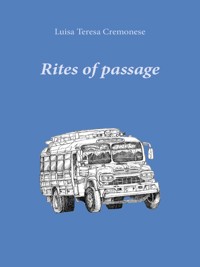
How do you recount thirty years of life, thirty years of working around the world with the aim of alleviating the suffering of others? What do you bring home with you? You open your suitcase and out come moments that insist on being told, that want to find their place in the present. This book is their place, the place where they can find peace and balance with days now filled with small, insignificant things.
Das E-Book können Sie in Legimi-Apps oder einer beliebigen App lesen, die das folgende Format unterstützen:
Veröffentlichungsjahr: 2026
Ähnliche



















Contents
Titolo
Diritto d'autore
Contents
Introduction
Carabiniere Zappalá
Mussolini
William
Svetlana Dragovic’s Death
In the Dark
Benemerito’s Circus
Juana Martin
Leonora
Coming Home
Guide
Copertina
Contents
Start
Luisa Teresa Cremonese
RITES OF PASSAGE
Illustrations by Claudia Maltese
Title | Rites of Passage
Author | Luisa Teresa Cremonese
Editor of the English version | Bertha Sarmina
ISBN | 9791224037934
© 2025. All rights reserved by the Author
This work is published directly by the Author through the Youcanprint self-publishing platform, and the Author retains all rights to it exclusively.
No part of this book may therefore be reproduced without the Author’s prior consent.
Contents
Introduction
Carabiniere Zappalá
Mussolini
William
Svetlana Dragovic’s Death
In the Dark
Benemerito’s Circus
Juana Martin
Leonora
Coming Home
Introduction
How does one recount thirty years of life, thirty years of working around the world under the pretense of alleviating the sufferings of others? Those sufferings that creep up on us and act like a poison if we let them invade us, if we falsely make them our own. Over the years I have learned to respect the suffering of others without pretending to feel what they experienced. The everyday, simple acts of survival such as eating, sleeping, and taking care of oneself, become the means of building bridges between the pain of the past and the life that still awaits us.
This was and is our task in the humanitarian world: to enable people to resume the reassuring repetitiveness of small, everyday actions, without fear or threat. And even if pain and wounds accompany us forever, instinct drives us to survival, and with survival comes the will to live, despite everything. The will to live is one we can share, and we must.
When I think of these thirty years, I see myself wavering, I feel I have walked a fine line. The adrenaline rush of working in emergency situations, the emotional strength of taking in people in distress and offering them shelter, an answer, or assistance, the fight against sometimes obtuse, sometimes hostile systems were all measured against my attempts to build a normal life, a family, around me. In the end, it was family that adapted to the emergency, the travel, and the changes.
Then work time ends and it’s back home. For me, for many people, going home means returning to a memory of normalcy that perhaps no longer exists, that is both appealing and frightening. I realize that many of the things that I have lived through, that have happened to me in these thirty years, are out of place here, but the experience is cumbersome, it demands space. There is an urgency, almost a need, to witness, to make known what I have seen, what I have experienced, to prove that it was not just a dream, or a nightmare, or a fantasy. Sometimes I close my eyes and see a face, a scene, a place, a moment.
I have decided to share some of these through small portraits, capturing as much as possible my memory of how things occurred. I write about these images, these moments that insist on being told, hoping that they will thus release me, give me respite when I close my eyes. My hope is that by committing them to paper, they will find their proper place in the life I lead today, the interior life of big emotions and the small, mundane things that now fill my days.
Carabiniere Zappalá
The journey was devastating. The buses and trucks, some of the oldest and shabbiest I had ever seen, broke down countless times. An untold number of coats of paint covers their original colors, their beatings, dents, and body parts replaced over their long lives. The trucks sport a staggering number of stickers, flags, and objects affixed to the chassis, the sides of the tractor bed, and on the windows. Jesús te ama, Deisy te quiero, El Jaguar de la Selva, Cruz Azul Campeón, are among the most popular inscriptions on the windshields. I watch them move slowly, lumbering through the potholes and ruts of a barely traced road, a white strip in the tropical jungle thick with palms, vines, and tall broadleaf trees. Occasionally the vehicles would snort, make smoke, or emit sinister wails. I watch them with apprehension: What if now one of these clunkers breaks down? What if the engine melts, an axle splits, or the transmission gives out? What if a tire punctures, or there is a shortage of oil or water? Will we have enough fuel for the journey ahead?
The two-day trip turned into five. The heat is unbearable, and the relentless sun beats down on the vehicle roofs, turning them into ovens. The humidity makes the air unbreathable, movements tiring, words heavy. Swarms of insects assail us, or rather, assail me mostly, the palest of the group, forcing me to wear long sleeves at all times and keep the bottom edge of my pants tucked into my socks in an attempt to limit mosquito and other insect access to my skin. The denim jacket I am wearing is an armor against these creatures, but also a relentless weight that makes the heat a real torture.
We are moving forward with exasperating slowness, our destination approaching. Meter by meter, puff after puff, squeak after squeak. At every bend, over every bump, I expect to see something resembling a border post. And meanwhile the jungle around me continues, indifferent to our advance. The jungle is alive with its noises, the cries of birds, the screams of monkeys, the indistinguishable voices of a thousand different animals, trees, and the living earth to which are added those of our caravan.




