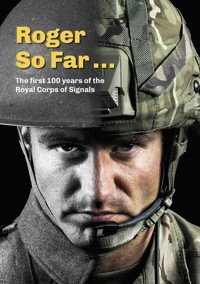
Roger
So Far …
We left Pompey town, in the teeth of a gale
The rain it weren’t ‘alf belting down
The sea was so rough, Most blokes spewing up
You can’t walk on the deck, you just slide
Pioneers platoon sergeant, is a giant of a man
He’s six foot five tall, and nearly as wide
That’s him ower there, spewing ower the side
He lets out a moan, then a long drawn out groan
He’s said I’ve had enough, I want to go home
Early next morning, without any warning
The whole world seemed to explode
Every gun, on every ship,
We’re blowing shit out,
Of that golden strand,
where we were to land
There’re so many shells in the sky, that some angels nearby,
Took fright and made a hasty retreat
With about five miles to go, the captain shouts whoa
And we come to a gentle stop
We put on our gear, take a step to the rear
Then down the gangway we sway
One little hop, and we’re aboard our L.C.A.
We sail once round the ship, and form up line abreast
There dead in front is a place called Lebreche
That’s near where were heading for
Now we are off, but someone’s woken the krauts
And they’re hitting back, with all that they’ve got
No shells are they wasting, we’re taking a pasting
And we’ve still got a half mile to go
As we start our run in, things look a bit grim
But if I get through I’ll tell you, what happened on that epic day
– John Edward ‘Ted’ Varley, born 4 November 1923.
On D-Day, Signalman Varley served with 3rd Divisional Signals
and was attached to 2nd Battalion East Yorkshire Regiment
as a rear link wireless operator.
Roger
So Far …
The first 100 years of the
Royal Corps of Signals
Text written or compiled and edited
by
Nick Kendall-Carpenter
Maps and illustrations drawn and photographs taken or compiled
by
Adam Forty
ROYAL SIGNALS MUSEUM
BLANDFORD CAMP
BLANDFORD FORUM
DORSET DT11 8RH
www.royalsignalsmuseum.co.uk
First published 2020
The History Press
97 St George’s Place, Cheltenham,
Gloucestershire, GL50 3QB
www.thehistorypress.co.uk
© Royal Signals Trustee Limited, 2020
The right of the Nick Kendall-Carpenter to be identified as the general editor of this work has
been asserted in accordance with the Copyright, Design and Patents Act 1988.
All rights reserved. No part of this book may be reprinted or reproduced or utilised in any form
or by any electronic, mechanical or other means, now known or hereafter invented, including
photocopying and recording, or in any information storage or retrieval system, without the
permission in writing from the Royal Signals Museum.
British Library Cataloguing in Publication Data.
A catalogue record for this book is available from the British Library.
e-ISBN 978-0-7509-9541-2
Typesetting and origination by The History Press
This book was commissioned by the Royal Signals Trustee Ltd and compiled by staff from the
Royal Signals Museum. The content was extracted or confirmed from material in the Royal
Signals Archive, from contributions from serving and retired members and friends of the Royal
Corps of Signals and from the books, magazines and websites listed in the bibliography. It is
a celebration of the achievements of the Corps and of the technology it has employed, rather
than a detailed historical record and technical manual. It relies heavily on the memories of
individuals and although attempts have been made to verify the stories and explanations, it is
entirely possible that some errors have crept through. Many more contributions were received
than could fit into the book and material not included is still valued and will be held in the Royal
Signals Archive. The selection process was a difficult one and some excellent material had to be
omitted. The opinions and views expressed are those of the editor and contributors alone and
do not necessarily represent those of HM Government, the MOD or the British Army. Should
any profits be made from the sale of this book they will be donated to Royal Signals charities.
The general editor takes full responsibility for all errors and omissions. He requests that if
anyone finds any errors or gaps in the narrative, they send details of them to him at director@
royalsignalsmuseum.co.uk.
Nick Kendall-Carpenter (general editor)
Adam Forty (picture editor)
Contents
Foreword
8
1. SIGNALLING UNTIL 1914: RUNNERS TO LINE
10
The Birth of Electrical Signalling
12
The Telephone
14
Radio Telegraphy
16
The Royal Engineers Signal Service
18
2. 1914–1918 THE FIRST WORLD WAR
20
Early Days
22
Army Structures, Sizes, Nomenclature and Ranks
23
Runners, Flags, Lights, Animals and Line
24
Field Telephones
26
Women’s Army Auxiliary Corps
27
Gallipoli
28
Yeomanry Victoria Crosses
29
Wireless
30
Interception
32
Scientists and Authors
33
3. 1920–1939 THE FORMATIVE YEARS OF THE CORPS: FROM LINE TO RADIO
34
Formation of the Royal Corps of Signals
36
Yeomanry, Territorial Army and Royal Signals Band
38
Inter-War Campaigns
40
Conflict, Humanitarian Aid and Sport
42
Wireless Between the Wars
44
Antennas
46
Royal Connections, Training and Welfare
48
Relays: Teleprinters and Athletics
50
Expeditions
51
Colonial and Commonwealth Signals Corps
52
4. 1939–1945 THE SECOND WORLD WAR
54
Home Defence
56
Special Operations Executive
57
North Africa and the Balkans
58
Far East
60
Prisoners of War
61
India and Burma
62
SIGINT and Enigma
64
Return to the European Mainland
66
Airborne and Air Formation Signals
68
Radio Security Service, Phantom and Behind the Lines
70
Radio Propagation
72
The Wider Team
74
5. 1945–1970 THE POST-WAR ERA: FROM VALVE TO TRANSISTOR
76
British Army of the Rhine
78
National Service and the McLeod Committee
80
Oscillators and Semiconductors
82
The Middle East
84
Radio Communications
86
Larkspur and Voice Procedure
88
Firearms
90
Boy Service
91
The Master and Signal Officer in Chief
92
Royal Signals Institutions
93
Queen’s Gurkha Signals
94
The Korean War
96
Pipes, Drums and White Helmets
98
SIGINT – COMINT – ELINT – NBC
100
Armoured and Soft-Skinned Vehicles
102
Armoured Brigade Headquarters
104
Reserves
106
Nationalist Conflicts and Insurgencies
108
Airborne: Training and Characters
110
Thailand, Singapore, Malaysia, Kenya, Aden and Gan
112
Global Communications
114
RISTACOM and Bravery
116
The Lineman
117
Keeping Ahead of the Enemy
118
Crypto
120
Families and Sport
122
6. 1970–1995 COLD AND HOT WARS: FROM ANALOGUE TO DIGITAL
124
Northern Ireland: Operation Banner
126
Electronic Warfare
128
Global Taskings
130
Preparing for War
132
Communications in the UK
134
Army Fixed Telecommunication System
136
Linemen and Humour
137
Northern Ireland: Leaps in Technology
138
Clansman Radio and Cougarnet
140
Digitisation, Data and Multiplexing
142
Corps Character
144
Satellite Communications
146
The Falklands
148
Corps Sailors
150
Island Postings
151
Early Computers
152
Ptarmigan
154
Packet Switching
156
Euromux
157
Unexpected Events
158
Trades
159
Remote Postings
160
Women’s Royal Army Corps
162
Northern Ireland, 1980s–1990s
163
Sporting Tradition
164
The End of the Cold War
166
The Gulf War: Operation Granby
168
The Gulf War: Electronic Warfare and Ground Attack
170
The Gulf War: Communications with the Home Front
172
Batteries
173
The Balkans: Initial Operations
174
The Balkans: Operation Resolute NATO Deployment
176
7. 1995–2020 INFORMATION WARFARE: IT AND CYBER
178
The Balkans: NATO Implementation Force (Bosnia)
180
The Balkans: Commercial Equipment (Bosnia)
182
The Balkans: NATO Stabilisation Force (Bosnia)
184
The Balkans: NATO Kosovo Force
186
The Balkans: Connecting the Forces
188
The Internet Arrives
190
CIS: Communications and Information Systems
191
Sierra Leone
192
Sport
194
Afghanistan: Operations Veritas, Fingal and Jacana
196
Iraq: Operation Telic Deployment
198
Iraq: Transition from Warfare
200
Iraq: Innovation
202
Iraq: Countering Insurgents and Improvised Explosive Devices
204
From Clansman to Bowman
206
Iraq: Withdrawal
208
Afghanistan: Provincial Reconstruction Teams
210
Afghanistan: Deployment of the ARRC
212
Afghanistan: The First Tour in Helmand
214
Afghanistan: Transition to Counter-Insurgency
216
Afghanistan: Building the Command and Control Infrastructure
218
Afghanistan: Adapting to the Situation
220
Advances in Terrestrial Radio and Satellite Communications
222
Afghanistan: Operation Herrick 10, OMLTs and RLDs
224
Afghanistan: Improvised Explosive Devices
226
Afghanistan: Electronic Warfare
228
Afghanistan: Campaign Signal Regiments and JFCIS(A)
230
Afghanistan: Air Support
232
Afghanistan: Power Supply
233
Afghanistan: Information Systems
234
Information Systems and Services
235
Afghanistan: Innovation and Improvisation
236
Afghanistan: Kabul
237
Afghanistan: Local Engagement and Heroism
238
Afghanistan: Meeting the Increasing Demand
240
Afghanistan: Humour, Friendships and Helping the Local Community
242
Afghanistan: Withdrawal
244
NATO, Libya, Normandy and the Olympics
246
Deterring a Resurgent Russia
248
Deployed Headquarters
249
Overseas Communications
250
Sporting Achievements
252
Adventure Training and Sport
254
Ceremonial Duties
256
Reserve Forces
257
Career Progression
258
Falcon: Wide Area Communications System
259
New Technologies
260
Cyber Warfare
262
AI, Clouds and Quantum
264
5G
266
Projects Trinity and Morpheus
267
1st (UK) Signal Brigade
268
11th Signal and West Midlands Brigade
270
The Operations Continue ...
272
The Corps as a Family
274
Transforming the Corps’ Culture for its Second Century
275
Acknowledgements
276
Bibliography
278
Abbreviations
280
Glossary and Tables
282
Royal Signals Fatalities in War and on Operations
285
Index
286
Foreword
As part of our Centenary celebrations, this book takes the reader through the history of the
Royal Corps of Signals, starting with our industrial age forebears, to the birth of the Corps
on 28 June 1920 and to the modern Corps fit for the challenges of the digital age. The ability
for military commanders to send and receive information at speed, whilst preventing the
enemy from doing the same, has always been the key to success on operations and for 100
years this has been the role of the Royal Corps of Signals, illustrated by our motto, Certa Cito
– Swift and Sure. ‘Roger So Far’ is known throughout the Armed Forces as a radio message
used to confirm whether the information being transmitted thus far has been received and
understood – and in colloquial use it can of course be used to infer that all has gone well so
far. ‘Roger So Far’ therefore aptly characterises this excellent read.
From trench cables to the dark web, from mobile pigeon lofts to satellites, our history
has always been characterised by leaps in technology and the overriding need to maintain
the ‘vital link’, but I have repeatedly found that it is our Signallers who give us our crucial
advantage, applying old and cutting edge technology, driven by a constant desire to innovate
and get the battle winning messages through, irrespective of the demanding environment in
which they often have to operate.
My sincere thanks go to the authors of this book which rightly shines a light on our people
and our important technologies, and where the 2 come together in stories of courage and
innovation. I should point out that there are thousands of classified, secret stories which the
authors have not been able to publish within these pages, stories which live on in the hearts
and minds of those that have served and those who are still serving.
Many of the more recent stories resonate with my 35 years in the Corps as I am sure
they will with our serving and retired community. I also hope that the content of this book
inspires young people to think about service in the Armed Forces, and specifically the Royal
Corps of Signals, as well as providing an informative read on the underpinning theory and
science, some of which I remember from my Troop Commanders Course at Blandford!
However, I was struck by how much of the detail within this book I did not know, which gives
an indication of the scale of activity within the Corps, and with scale comes complexity.
The complex nature of armed conflict, and military activity below the threshold of conflict,
is on the increase, magnified by the exponential increase in information and the increasing
importance (and vulnerability) of the virtual, connected world. It is right that the final element
of this book is dedicated to a glimpse of the future. Although it is difficult to predict how and
when future technology will materialise, I have no doubt that the men and women of the Royal
Corps of Signals will be at the heart of it, with a culture of continuous adaptation, which will be
as vital in the defeat of our future adversaries in the information battle, as it has been for the
last 100 years.
Lieutenant General Sir Nick Pope KCB, CBE
Master of Signals
8
1. SIGNALLING UNTIL 1914:
RUNNERS TO LINE
The origins of the Royal Corps of Signals lie in the 19th century. This was a period
of considerable growth, conflict and scientific advancement for Britain. By 1837,
when Queen Victoria ascended to the throne, Britain controlled some 2 million
square miles of overseas territories. By the end of her reign, in 1901, the Empire was
10 times bigger and was the largest the world had ever known. Most other
European powers were also seeking to advance their commercial and
territorial interests and this led to periodic tension and
conflict. As the burden of keeping ahead of rivals and
maintaining control of the Empire became more
complicated, the need for faster and more reliable
signalling grew.
PHEIDIPPIDES
The first long-distance
SIGNALLING
signalling was undertaken
Signalling is a term little used in the 21st century, but put simply
by a messenger running on
it is the passing of information or commands between units
foot carrying a verbal or written
or individuals. In one form or another it has been a part of
message. Of these, Pheidippides is
warfare since earliest times. In an army it is critical
the most famous. Legend tells us that
that intelligence about the enemy and other
in 490 BC he ran 150 miles in 2 days
factors that might affect the outcome of an
to request help from Sparta when
engagement is sent promptly to the decision
the Persians invaded. He then
makers; that commands and orders reach
carried the news of victory
those responsible for implementing them
at the battle of Marathon
without delay; and that instructions to
the 26 miles to Athens
move men, munitions, equipment
and died on arrival. The
and supplies around the battlefield
Greeks also used torch
can be sent efficiently
and water telegraphs,
and effectively.
the Roman army used
coloured smoke and the
Greeks, Persians and
Native Americans used
reflected sunlight to flash
messages.
BEACONS
Signallers in
SHUTTER TELEGRAPH
16th-century England
During the Napoleonic Wars, in the
used beacons to send
early 19th century, chains of shutter
long-distance messages
telegraph stations (right) were built
when visibility
in England. The men in these stations
allowed. Famously,
became expert in receiving and passing
the approach of the
on messages through the system of
Spanish Armada was
shutters they operated. When there
communicated from
was good visibility, an average message
Plymouth to London
passed from London to Portsmouth in
in this way. Military
15 minutes using this system, while
communications,
a prearranged signal could be sent
however, were slow
between London and Plymouth and
and unreliable until the
acknowledged back in 3 minutes.
second half of the 19th
century.
10
SLOW COMMUNICATIONS
To pass a message from
London to Kabul during the
First Afghan War of 1839
would have required either
a sea passage around the
Cape of Good Hope or a
sea passage to Egypt, a land
crossing to the Red Sea and
then another sea passage
before the message reached
the Indian Sub-Continent.
Once in what was to become
Pakistan, the message
would have been carried on
horseback almost 900 miles
to Kabul, passing through
some of the most difficult
and dangerous territory in
the world. To get a reply at
all would be a considerable
achievement and one in
less than a year would have
seemed miraculous. It is
hardly surprising that things
could go badly wrong.
LANDMARK ADVANCES
By the end of the 19th century, telegraph, telephone and radio
had been invented, as a result of genius, persistence, altruism
and skulduggery. This made instant global communications a
reality. Galvani, Volta, Cavendish, Ohm, Ampère, Joule, Faraday,
Davy, Henry, Oersted, Tesla, Schilling, Cooke, Wheatstone,
Morse, Meucci, Gray, Bell, Maxwell, Heaviside, Hertz, Lodge,
Marconi, Bose, Flemming and De Forest are some of the eminent
scientists who bear some credit for such progress.
The Birth of Electrical Signalling
By the middle of the 18th century, people foresaw the possibility of using
electricity to carry signals. However, they could not generate or store enough
electric charge to signal for very long.
Alessandro Volta’s voltaic pile
BATTERIES AND ELECTROMAGNETS
All this changed with the invention of the voltaic pile in 1800 by Alessandro Volta.
This was a pile of zinc and copper discs each separated by moist pasteboard discs
that when connected to wires produced a flow of electric charge (a current). It was
the first electric cell or battery. This was followed, in 1819, by the electromagnet.
An electromagnet is a piece of iron with a coil of wire wound around it. It becomes
magnetic when an electric current flows through it and is used to deflect pointers,
ring bells or sound buzzers.
FIVE-NEEDLE TELEGRAPH
In 1837 William Cooke and Charles Wheatstone, who had
previously invented the concertina, produced the first
practical electric telegraph system: the Five-Needle Telegraph.
Electric currents travelled from a battery via combinations of
5 wires to electromagnets at the receiving end. These caused
pairs of needles to deflect and point at individual letters, and
so allowed a message to be sent and read.
MORSE CODE
In 1838 the American portrait painter,
Samuel Morse, created a code – known as
Morse Code – that allowed complex messages
to be sent quickly. During the 1860s, the
Army learnt to use Morse Code for visual
signalling. Morse Code was sent using flags
and this proved very useful during the
WHEATSTONE TELEGRAPH
Abyssinian campaign of 1867–68.
The Wheatstone telegraph soon evolved to use
Morse Code. Initially the transmitter comprised 2
telegraph keys. Pressing one sent a current in one
RECORDERS
direction around an electrical circuit and pressing
Some of the first receivers were inkers (and later
the other sent a current in the opposite
direction.
undulators), recording messages with ink marks
These currents activated electromagnets at the
on paper. These were later replaced by more
receiver and deflected a single needle to the left
reliable sounders, which used electromagnets
or right, indicating dot and dash signals
and adjustable screws to produce a series of
respectively. Although several other types
different sounds that the operators would record
of telegraph evolved, the single-needle
as dots and dashes.
telegraph continued in use well into
the 20th century, particularly for
ling. Later manual
railway signal
telegraphs usually used a single
telegraph key.
WHEATSTONE AUTOMATIC TRANSMITTER
This Wheatstone automatic transmitter
(left), designed in 1867, was weight
driven and used pre-punched paper tape. At the
receiving end the message was recorded onto another tape
with short and long dashes in ink. The system could operate
at up to 60 words a minute but its usual operating speed
was 30 a minute. With modifications the system was still in
service in the middle of the 20th century.
12
CABLE WAGON
Cable wagons were
used to lay the 21 miles
of cable connecting the
8 telegraph offices of the
Army in Crimea.
THE CRIMEAN WAR
Between 1854 and 1856 the British, together with the French and
the Turks, fought the Russians in the Crimea. This campaign saw the
first use of the electric telegraph in war. An underwater cable joined
Balaclava in Crimea with Varna in Bulgaria and from there an overland
system ran to Paris and under the English Channel to London.
CRIMEAN CABLE
In Crimea a team of 26 Royal Engineer (RE) Sappers linked a series
of telegraph offices with copper cable insulated with gutta-percha,
a plant extract similar to rubber. When the system was working,
General (Gen) Sir James Simpson, the Commander-in-Chief, received
so many administrative enquiries from London that he declared ‘the
confounded telegraph has ruined everything.’
C TELEGRAPH TROOP
In 1870 the War Office decided that a
HELIOGRAPH
designated unit was needed to provide telegraph
The Army
communications for the Field Army. As a result,
also modified a
C Telegraph Troop, RE was formed with a
German surveying
complement of 5 officers, 245 other ranks and
instrument that
115 horses, with 4 office wagons for the telegraph
consisted of 2 mirrors
equipment and 8 general purpose wagons for
at right angles. By adding
stores. The first Troop Commander was Captain
an oscillating mirror, it
(Capt) Montague Lambert.
enabled a beam of reflected
sunlight to be interrupted and
so transmit Morse Code. This
was the heliograph, which
was used in the Zulu War
SARAGARHI
of 1879 and subsequently
At the Battle of Saragarhi in 1897,
in India, Africa and during
21 Sikh sepoys (infantrymen) (right)
the First World War (WW1).
in the British Indian Army and
Its last recorded wartime use
a cook were attacked by 10,000
was in 1941 in Sollum, North
Afghan tribesmen. They were
Africa. In good conditions the
manning a small fort that linked
heliograph had a range of over
2 larger forts by heliograph. Rather
40 miles.
than surrender they fought to the
death, killing 180 of the attackers
and wounding many more.
13
The Telephone
Alexander Graham Bell is credited with inventing the telephone in 1876. Lieutenant
(Lt) AH Bagnold then produced a drawing for a military telephone in October 1877.
The Indian Army were using field telephones, designed and manufactured by
Lt GRR Savage, in regimental workshops, for operations in Peshawar by December
1877. It took some time for British officers to accept this new instrument because
early telephones were unreliable and there was no written copy of the message.
RESERVE COMPANIES
During the Second Boer War in South
Africa between 1899 and 1902, much use
was made of existing civilian telephones
and telephone exchanges, but for field
use, specially designed telephones and
exchanges had to be produced. The C
Mark 1 and the D Mark 1 were the first of
a whole family of field telephones to be
developed for the British Army.
The considerable distances over which
British forces were deployed in South
Africa meant more men were needed to
lay and maintain the lines. Consequently
350 officers and soldiers were mobilised
in 1899 from the London and Glasgow
reserve RE telegraph companies. This was
the first operational use of volunteer reserve
telegraph personnel. These telegraph
companies were the forebears of 31st and
32nd Signal Regiments.
A line-laying bicycle
TELEGRAPH IN THE SECOND BOER WAR
Telephone C Mark 1
The British Army laid 18,000 miles of telegraph and
telephone cable during the Second Boer War. A total of
13½ million messages were handled and the number of
signallers grew from 600 to 2,500 men.
14
TACTICAL COMMUNICATIONS
Major General (Maj Gen) John French, later
to be Commander-in-Chief of the British
Telephone C Mark 2
Expeditionary Force (BEF) for the first 16
months of WW1, used both telegraph and
telephone to direct his flank formations in
the Second Boer War. They were also used
on the battlefield to control artillery fire.
HOW A TELEPHONE WORKS – BASIC PRINCIPLES
A telephone is a transducer that converts sound waves into
electrical audio signals and then back to sound waves. The early
field telephones contained a carbon microphone. When a caller
spoke, the sound waves entered the mouthpiece. Behind the
mouthpiece was a thin circular disc or diaphragm and behind this a
container filled with small granules of carbon. When the telephone
line was live, a current from the telephone’s battery passed through
the carbon granules. As the sound waves struck the diaphragm, it
vibrated to reflect the variations
in air pressure caused by
the varying tones of the
voice. This caused the
carbon granules to be
compressed and
released and the
electric current
to vary.
The variations in electric
current were then picked up by the listener’s loudspeaker. This
contained a diaphragm held in position by a permanent magnet.
It also contained an electromagnet that pulled the diaphragm away
from the permanent magnet to varying degrees as current passed
through it. The vibrating diaphragm generated sound waves that
the listener could hear.
GENERATORS
EARLY TELEPHONES
A generator is a device that
Early telephones were usually
produces electrical currents
magneto telephones. These
from mechanical energy
included a small hand-cranked
using electromagnetic (EM)
generator that generated an
induction. A simple type of
electric current that could be
generator is the dynamo
used to alert the operator at
in which a wire loop is
the switchboard with a bell or
rotated between the poles
by dropping a shutter. After
of a permanent magnet
receiving verbal instructions
or magnets to generate
from the caller, the operator
electricity. Generators
would connect the caller’s line
can be used to produce
with that of the person being
direct current (DC)
called. Later central battery
and alternating
systems alerted the operator
current (AC).
when the telephone handset
was lifted from the cradle.
15
Radio Telegraphy
During the mid-19th century, James Clerk Maxwell, a Scottish mathematical physicist
brought together, for the first time, the theories of electricity, magnetism and light in a
single set of equations, now known as Maxwell’s equations and provided theoretical
proof of the existence of EM waves.
The interrelation between the
electronic and magnetic fields
MAXWELL’S DISCOVERY
HERTZIAN WAVE
Maxwell (above) discovered that a change
The continual cycle of changing electrical and magnetic fields creates a
in a magnetic field gives rise to a change in
wave that repeats over time. This repeating wave function has a frequency
the electric field and conversely a change in
measured in cycles per second. In 1888 physicist Heinrich Hertz
the electric field gives rise to a change in the
conducted a number of experiments confirming Maxwell’s theory of EM
magnetic field. This produces a perpetual
waves. His work was so important that the frequency of EM waves bears
electromagnetic wave that would continue
his name – Hertz – and it is the number of cycles per second, or frequency
forever in free space. He also discovered
in Hertz (Hz) that are used to tune or programme radios.
that the wave travels in space at the speed
of light, bringing him to the conclusion that
light is an EM wave.
MARCONI
In 1896 Guglielmo Marconi (right)
demonstrated his wireless communications
system to representatives of the Army,
Navy and Post Office on Salisbury Plain.
Three years later, the Army tested Marconi
wireless sets unsuccessfully during the
Second Boer War. The Royal Navy, however,
had some success using wireless, as did
some commercial shipping companies, and
by the outbreak of WW1 the Army was
using a small number of wireless sets.
16
SPARK SETS
The earliest wireless (later
called radio) sets used spark
gap transmitters. They
generated electric sparks
across small gaps to create
bursts of radio waves.
These could represent
the dots and dashes of
Morse Code and pass
information. The waves
were transmitted via an
antenna and induced small
radio currents in a receiving
antenna. A coherer detected
the arrival of each transmission.
COHERER
A coherer was a small glass tube that contained loosely packed metal
filings. It was attached to a circuit with a battery and to the antenna.
In its usual state the coherer had a high resistance and so did not
allow much current to flow around the circuit. However, when
exposed to radio frequency currents from the antenna
the filings cohered (stuck together) and allowed the
circuit current to pass easily through. The current could
then be detected using a bell or headphones. Coherers
were in due course replaced by crystal detectors, then
valves and then transistors.
Continuous Wave
DAMPED AND CONTINUOUS WAVES
The waves generated by a spark gap transmitter were damped
Damped Wave
waves and their amplitude diminished with time. They had a large
bandwidth, generating a wide range of different wave frequencies,
and so were easy to intercept and prone to interfere with other
transmissions. For this reason, they are now banned internationally.
These damped-wave transmitters were in time replaced by
transmitters emitting continuous waves (CW). These caused less
interference and had better power-to-range ratios. Initially they were
only used to transmit Morse Code but later they were modulated
Spark Transmitter Frequencies
with an audio signal to carry sound. The audio was radio telephony.
17
The Royal Engineers Signal Service
Field Marshal Kitchener of Khartoum served as a
lieutenant with C Telegraph Troop from April 1873
until October 1874.
KITCHENER IN WORLD WAR 1
At the start of WW1, Kitchener
was appointed Secretary of
State for War. Unlike most
of his Cabinet colleagues, he
predicted a long war and the
need for a much larger army.
He is most famous for the
recruitment poster bearing his
likeness. Kitchener drowned with
736 others in June 1916 when
HMS Hampshire, the warship
that was taking him on a mission
to Russia, hit a mine off the
Orkneys and sank.
THE TELEGRAPH BATTALION ROYAL ENGINEERS
The Telegraph Battalion RE was formed in 1884 from C Telegraph Troop
and 2 RE companies that had been formed in 1870 and 1871 to help
construct and operate the public telegraph services of the General Post
Office (GPO). The close relationship with the GPO and British Telecom
(BT) was to continue for the next 150 years.
C Telegraph Troop became 2nd Division, the Telegraph Battalion. Major
(Maj) Charles Beresford was the initial commander of the 2nd Division
and the figure of Mercury (the messenger of the gods) was adopted as their
emblem. It is thought that the inspiration for Mercury as an emblem came
from a statue in Beresford’s father’s garden.
Mercury was subsequently adopted as the
An early photograph of Charles Beresford (then a captain), centre.
cap badge of the Royal Corps of Signals and
Behind him on the tent canopy can be seen the first known use of ‘Jimmy‘.
soon became known as ‘Jimmy’.
JIMMY
There are several theories as to why
‘Jimmy’ was adopted as a term of
endearment for
the emblem.
The most widely
accepted was
that it came from
a very popular
Corps boxer,
called Jimmy
Emblem (right),
who was Army
Champion in 1924
and represented
the Corps from
1921 to 1929.
However, there
is some evidence
that the nickname
pre-dates this.
18
SIGNALLING SKILLS
The RE signallers became
skilled in building long
telegraph lines and
improving existing civilian
systems. They were aided
by the new Airline system,
which consisted of a single
wire conductor carried
on lightweight poles that
could be built at a rate
of 6–8 miles a day. The
signallers became highly
skilled operators and in
one night, during the Nile
Expedition, one telegraph
office handled 550 messages.
CHAINS OF COMMAND
Control of communications was complicated. The
Telegraph Battalion (seen above in 1888 on Salisbury
Plain) was responsible for electrical signalling. Visual
signalling (including flags and lights) was under the
control of a Director of Army Signals. Despatch riders
were drawn from the cavalry and operated under the
direction of the staff of an HQ. During the Second Boer
War the 3 independent and unco-ordinated systems of
command led to rivalry and duplication of effort.
LIEUTENANT GENERAL SIR JOHN FOWLER KCB,
KCMG, DSO
Fowler was commissioned into the Royal Engineers
in 1886 and served 3 tours of duty with the Telegraph
Telegraph Battalion Cycle Section, 1910
Battalion. He was awarded the Distinguished Service
Order (DSO) and Mentioned in Despatches for his service
on the North West Frontier of India.
ROYAL ENGINEERS SIGNAL SERVICE FORMED
Fowler was Director of Telegraphs in the Orange Free
To improve co-ordination, the RE Signal Service was formed
State during the Second Boer War and later Commandant
in 1912 and made responsible for telegraph, telephone,
of the Army Signal Schools at Aldershot and Bulford. He
signal despatch and, later, wireless communications from
was appointed as Director of Army Signals in 1914.
General Headquarters (GHQ) down to brigades and for
During WW1, Fowler was
artillery communications down to batteries. Regimental
Mentioned in Despatches
signallers were responsible for communications within their
8 times and in 1917 was
own units and from units to brigades.
promoted to major general.
He was the only senior
officer who served on the
staff at GHQ continuously
from 1914 to 1918 and was
knighted for his services.
He was Commander of
British Forces in China in
1922–25.
Fowler was appointed
the first Colonel
Commandant of the Royal
Corps of Signals in 1923
and successfully guided
the Corps during its
formative years until 1934.
Lt Gen Sir John Fowler
33kW wireless station, 1910
by David Jagger
19
2. 1914–1918
THE FIRST WORLD WAR
In 1914 Europe was dominated by 6 countries: Britain, France, Germany, Austria–
Hungary, Russia and Turkey. Germany was allied with Austria–Hungary and France
was allied with Russia, while Britain was linked with France. Turkey was leaning
towards the Germans. In 1908 Austria–Hungary had annexed Bosnia and when
Archduke Franz Ferdinand was assassinated in Sarajevo in June 1914, the Austro-
Hungarians blamed Serbia. This led to war between Germany, Austria-Hungary and
Russia on 1 August. On 3 August, Germany declared war on France and invaded
Belgium. The German intention was to move rapidly through Belgium, encircle Paris
and knock France out of the war before Russia could mobilise her forces.
Northern Telegraph Units Territorial Force, 21 August 1914
BRITAIN ENTERS THE WAR
The invasion of Belgium brought Britain into the war. The
Battle of Ypres (1914) and subsequently a period of 3½
small British Expeditionary Force (BEF) took up position on
years of trench warfare began. The defensive combination
the left flank of the French Army and was pushed back in
of trenches, machine guns, artillery and wire proved much
the retreat from Mons. The Germans failed to stick to their
stronger than any offensive weapon on either side until the
plans, lost communication with High Command, outpaced
invention of the tank. This resulted in a war of attrition on
their logistics and then were held and pushed back at the
the Western Front, for both sides, with a succession of major
Battle of the Marne. This action probably decided the war.
battles. These included Verdun (1916), the Somme (1916)
There followed a ‘Race to the Sea’ as the Germans moved
and Passchendaele (1917), and numerous other engagements
north and sought to capture the Channel ports. The Germans
resulting in great numbers of casualties for little return in
were held by the British, French and Belgians at the first
terms of territorial gain.
20
OVERSEAS
Britain’s Dominions and Colonies
came to her aid and fought on
the Western Front (France and
Belgium), in Africa and the
Pacific, as well as in other parts
of Europe and in the Middle
East. Turkey fought on the
German side and was attacked
in the well-conceived but poorly
planned landings in the Gallipoli
Peninsula as well as through its
empire in the Middle East.
Signallers repairing line
Laying Cable in the Field
by Gilbert Holiday
Telephone D Mark 3
VICTORY AND COSTS
Meanwhile, the Royal Navy’s blockade of Germany was starving
the German Army and population of food and materials. In 1917
the Americans joined the war and the Russians sued for peace.
The end of fighting with Russia allowed the Germans to transfer
many hundreds of thousands of troops to the Western Front
with the intention of winning the war before enough of the well-
nourished Americans arrived to tilt the balance against them.
In the spring of 1918, the Germans launched a major offensive.
They very nearly succeeded but were held.
In August 1918, the Allies attacked and
won the Battle of Amiens. A period
of 100 days of mobile warfare
followed. The Allies advanced,
pushing the Germans back until
the Armistice was signed and
hostilities ceased on 11 November
1918. By the end of the war,
16 million people had been killed
and 20 million had been injured.
21
Early Days
When war broke out in 1914 there were less than 6,000 men in the RE Signal Service,
3,000 of whom were partially trained signal units of the Territorial Force (TF). By the
end of the war there were 70,000 signallers. Capt Kenneth Edgeworth was scathing
about the preparations for war. He wrote: ‘The whole business of sending a British
Expeditionary Force to France was so secret that details of the proposed signal
arrangements were never discussed by the War Office with the officers who became
responsible for working them. The result was that the arrangements made by the
War Office were completely futile.’
DESPATCH RIDERS
In August 1914, the Signal Service relied largely on the telegraph,
visual communications, liaison officers and runners, including
motorcycle despatch riders (DonRs – Don being D in the WW1
phonetic alphabet). During the initial highly mobile action there
wasn’t time to set up complex telegraph networks, so there was great
reliance on runners and, in particular, DonRs. Lord French described
the efforts of the DonRs during the retreat from Mons: ‘The Despatch
Riders carried messages at all hours of the day and night, in every
kind of weather and often traversing bad roads blocked by transport.’
It was a dangerous role and many DonRs lost their lives to enemy
snipers and artillery.
Visual signalling using hand-held shutter device
CAPTAIN TOM DAISH MC
Daish (who took the photo on the right) had just
graduated from Cambridge University when war was
declared and he volunteered the next day. He was one
of the minority from the large cohort of Cambridge
DonRs who survived the war. In 1914 he was in action
at Mons (August), Marne and Aisne (September), and
Ypres (October–November). He was commissioned
in 1915 and posted, in 1916, to Salonika as a motor cycle officer fighting the Bulgarians.
He was Mentioned in Despatches in 1916 and awarded the Military Cross (MC) in 1917.
LIEUTENANT COLONEL KENNETH
EDGEWORTH DSO, MC
Edgeworth is probably the only member of
the Corps to have an asteroid (Asteroid 3487
Edgeworth) named after him. During the
war, as a captain, he was responsible for the
construction and maintenance of telegraph and
telephone lines between GHQ, supply bases
and HQs of the various Armies. He was awarded the DSO, the MC and was
Mentioned in Despatches on 3 occasions. In 1920 he transferred to the Royal
Corps of Signals. After retiring, Edgeworth published 4 books on economics
and made his mark as a theoretical astronomer. In 1943 he suggested that a
reservoir of cometary material existed beyond Neptune. In 1992 its existence
A group of DonRs and signallers at
was confirmed and the region was named the Edgeworth–Kuiper Belt. On
Amiens with their French friends,
1 January 2019 the American New Horizons spacecraft, after a journey
21 August 1914.
of almost 13 years, captured the first close-up views of Ultima Thule, an
Edgeworth–Kuiper Belt object, 4.1 billion miles from earth.
22
Army Structures, Sizes,
Nomenclature and Ranks
Army structures, sizes and nomenclature can seem complicated – terminology has
changed over time and some terms have different meanings.
An army group comprises more than one army and is
commanded by a senior general (Gen) or Field Marshal.
For example, 21st Army Group in June 1944, commanded
by Gen Sir Bernard Montgomery.
An army comprises several corps, commanded by a general,
such as the British 14th Army which fought the Burma
Campaign against the Japanese in the Second World War
(WW2) and in 1944 comprised nearly 1 million men. There
were 11 British armies formed in WW1 and 7 in WW2.
A corps is a large field formation capable of independent
manoeuvre. It is made up of several divisions, which might be
temporarily assigned for specific missions. It is commanded
by a lieutenant general (Lt Gen). Its title was at times
expressed as a Roman numeral. For example: II Corps, part of
the BEF that was evacuated from Dunkirk in 1940.
A division usually comprises 3 brigades, but it could have
more or fewer, and supporting arms and services, such as
engineer, artillery and logistic units. It is commanded by a
major general (Maj Gen) and with 3 brigades will be about
15,000 personnel strong. For example, 51st (Highland)
Division, which fought during WW1 and WW2.
A brigade comprises several regiments or battalions, and
often some sub-units, commanded by a brigadier (Brig). The
term may be used to describe a fighting formation, such as
4th Armoured Brigade (a tank formation during WW2) or an
administrative unit, such as 11th Signal and West Midland
Brigade. Depending on its role, a brigade can be 3,000 to
5,000 strong.
A regiment and a battalion are terms used to describe
a unit of the British Army commanded by a lieutenant
colonel (Lt Col) and comprising several squadrons or
companies. ‘Battalion’ is most commonly used for infantry
units but is also used by, for example, the Intelligence
Corps. Since just after WW2, Royal Signals units have
been known as regiments, such as 30th Signal Regiment.
Regiments and battalions vary in size considerably but
usually will be between 350 to 800 personnel strong.
In 1945 though, 10th Signal Regiment comprised 2,000
soldiers in 73 troops.
A squadron or a company is a sub-unit commanded by a
major and is made up of 3 or 4 troops or platoons. The Royal
Artillery equivalent is a battery. Royal Signals regiments
comprise several squadrons. The titles of the squadrons have
changed over the years, but in 2020 most regular squadrons
had numbers in the 200 series, such as 214 Signal Squadron,
part of 2nd Signal Regiment. Royal Signals reserve squadrons
may have titles that reflect their lineage such as 53rd (Wales
& Western) Signal Squadron, part of 39th (Skinners) Signal
Regiment.
A troop or platoon can be commanded by a captain (Capt)
or lieutenant (Lt), but also by a senior non-commissioned
officer (SNCO). They can vary in size from 25 to 80 (or more)
personnel.
An infantry or armoured brigade would usually be supported
by a Royal Signals squadron, an infantry or tank division
would usually be supported by a Royal Signals regiment and
an infantry or tank corps would usually be supported by a
Royal Signals brigade or force of brigade size.
Units each have an identifying name. In the Royal Signals
a troop could be known by a number (640), a letter (Bravo),
commemoratively (Overloon) or by function (Systems
Engineer). Squadrons could be known by number or role or
both. Thus in 1985, 215 Signal Squadron was also 1st Infantry
Brigade HQ and Signal Squadron. Regiments could be known
by number and role such as 4th Line of Communication
Signal Regiment or 30th Signal Regiment. Although officer
ranks are consistent throughout the Army, the names of
the other ranks vary considerably. The Royal Signals uses
signaller (Sig) (signalman until women became fully integrated
into the Corps in 1992), lance corporal (LCpl), corporal (Cpl),
sergeant (Sgt), staff sergeant (SSgt), warrant officer Class 2
(WO2) and warrant officer Class 1 (WO1).
Confusingly, many of these terms are also used to describe
administrative organisations (e.g. infantry regiments, which
are grouped into ‘divisions’) and, of course, we must not
forget the ‘British Army’ and ‘Royal Corps of Signals’.
In 2016 the Ministry of Defence (MOD) envisaged the 2020
British Army would be 82,000 regulars and 30,000 reservists.
Runners, Flags, Lights, Animals
and Line
Runners were slow, manpower intensive and dangerously exposed. As the war
progressed, relay systems were established providing clearly identifiable routes with
staging posts where a runner could rest, having passed his message to a fresh runner.
Visual signalling included the use of flags (semaphore and Morse), lights, shutters,
heliographs and rockets. These were especially useful during and immediately after an
advance. Using flags, however, exposed the operator to death or injury from shrapnel,
while heliograph was constrained by the unreliability of sunlight.
LAMPS AND SHUTTERS
Lamps were exposed, needed to be
accurately laid for maximum efficiency and
had to be well screened from the enemy.
The effectiveness of lamp signalling was
greatly enhanced in the autumn of 1916 by
the introduction of the daylight signalling
lamp but visual signalling cannot work in
smoke or dusty conditions.
CARRIER PIGEONS
In 1915 the French gave the British 15 pigeons. They soon become a
valuable supplementary method of communication. By the end of the war
the British Army had more than 20,000 pigeons. As the distance between
HQs was relatively short, messages could be passed quickly. Unless it was
dark or misty, a message from the trenches could arrive at brigade HQ
within 10 to 20 minutes.
DOGS
Animals carried equipment and helped to lay line. Dogs
proved particularly adaptable and were trained to lay
line and carry messages. Stories of their heroism abound
and many battled on when badly gassed or wounded.
A post mortem on one dog revealed that he had been
carrying and delivering messages for weeks with a
bullet in his lungs and a piece of shrapnel in his spine.
PIGEON 2709
At 1330 hrs on 3 October
1917, during the Battle of
Passchendaele, Pigeon 2709
was despatched to take a signal
to brigade HQ. The flight
should have only taken 20
minutes, but soon after setting
off 2709 was hit by enemy
fire. The bullet broke a leg and
passed out of his body, leaving
the small metal message
cylinder embedded in his side. Although it took him a
further 21 agonising hours, 2709 completed his mission.
The message was delivered at 1030 hrs the next morning
but Pigeon 2709 died shortly afterwards.
24
LINE
After the initial mobile phase in France the armies faced
each other for 3½ years across 500 miles of trenches. Line
(telegraph and telephone) was the most common means of
communication. Line in forward areas was insulated and
laid on or below ground. It was known as ‘cable’ and was
vulnerable to artillery fire. To protect cables within enemy
artillery range they needed to be armoured, buried to a
depth of at least 6ft and camouflaged. To prevent spotting
from the air, the burying was carried out at night.
Initially, to save cable, a single-cable earth return system
was used for telegraph. These circuits just used one wire.
The second wire, or return path, was replaced by using
a ground spike, stuck in the earth. This used the earth’s
conductivity to complete the circuit. Before and during the Battle of the Somme in 1916
AIRLINE
over 50,000 miles of cable was laid, of which 7,000 miles in the forward areas was buried.
In the rear areas, Airline
For the Battle of
became a complex structured
Cambrai in 1917,
network using uninsulated line
13,000 miles of
suspended from high points
cable was laid in
such as telegraph poles, trees
less than a month.
or buildings.
THE CABLE WAGON
Cable wagons were pulled by 6 horses and
accompanied by a team of outriders. These wagons
were modifications of an artillery gun carriage.
They were used extensively to lay cable during
mobile phases of the war. Pictured left is the
world’s last surviving cable wagon, exhibited in the
Royal Signals Museum.
SERGEANT THOMAS WESTWELL
Westwell had been an RE signalman in
the TF and was mobilised as war broke
THROUGH
out. In April 1918, when the Germans
The word ‘through’ has always been used by signallers to confirm that
were almost breaking through, the
communications have been established between the ends of a link. This depiction
55th (West Lancashire) Division was
of an unnamed Lineman lying dead in no-man’s land after having repaired a
in the line. Westwell was awarded the
broken cable, encapsulates the ideal of the signaller, which is to get his message
Distinguished Conduct Medal (DCM)
‘through’ regardless of the cost or difficulty. Field Marshal Sir Douglas Haig, the
‘For conspicuous gallantry and devotion
British Commander-in-Chief, said of the Signals, ‘No Service has shown a more
to duty. Under heavy and continuous
wholehearted and untiring energy in the fulfilment of its duty.’
shell fire, he
Francis Martin was a GPO telegraphist who enlisted in the RE Signal Service
laid a line
in 1915 and served with a cable section until 1917. He painted Through on his
successfully
return to the UK.
and then
assisted other
Through by Francis Martin
linesmen in
difficulties to
lay another.
After 6 hours’
work on
these lines he
volunteered
to take a
detachment
and lay a fresh
line, which was
successfully
and quickly
completed. For
4 days he was almost continuously on
duty, and showed a very fine example of
devotion to duty.’
25
Field Telephones
When the BEF first deployed, the War Office sent telephones and switchboards
designed, like the telegraph, for use with a single wire and an earth return to
complete the circuits. These would have proved useless in the French towns where
the British higher command and supply formations were based because they would
have picked up too much interference. Fortunately, relations between the Signals
and the GPO were good and as the GPO had just finished upgrading its telephones
the Signals were quickly able to secure large supplies of magneto phones and small
switchboards. Staff officers were initially distrustful of the telephone for command
purposes as there was no written record of their instructions. The telegraph form
and the message book reigned supreme. However, use of the telephone soon became
increasingly widespread.
GERMAN INTERCEPTION
TELEPHONE NO. 44
The enemy appeared to have advance knowledge of British
Telephone No. 44 was
raids and attacks, and was shelling trenches at critical
designed for civilian use by
times. Once, in the summer of 1915 when a battalion
the GPO repair teams. It
came up to the front, it heard a German cornet playing
was lightweight, robust
its regimental march. This was because at the front,
and portable. It was
single wire earth return telephones were being used and
issued to the RE Signal
the Germans were able to gain intelligence by attaching
Service Units
listening devices to the earth. The British responded by
and used
replacing the single wires with two cables twisted together,
until 1915.
but supply difficulties meant this was a slow process.
Frequently changed code names for units were introduced
and it was forbidden to use the telephone for
sensitive matters forward of battalion HQ.
Nevertheless, leaks occurred. On one occasion,
the British captured a village after thousands
of lives had been lost in earlier attempts. They
found in a German trench a complete British
operation order for an earlier attack. It was the
prohibition of the use of telephones in trenches
that halted the problem. The introduction of
the Fullerphone in 1916 provided a solution.
THE FULLERPHONE
In 1915 Capt (later Maj Gen) Algernon
Fuller of the RE Signal Service invented
Early version of the
the Fullerphone. This made interception
Fullerphone
through the earth virtually impossible.
The signal was sent in Morse using a very
small DC filtered to eliminate the sharp,
and detectable, voltage changes that
accompanied current transitions when
keying. At the receiving end the DC was
converted to AC by a continuously running
mechanical ‘chopper’ and listened to
through a sensitive earpiece. It was still
used, with modifications, in the early 1950s.
26
Women’s Army Auxiliary Corps
By 1917 the Army was running short of men and so the Women’s Army Auxiliary
Corps (WAAC), later known as the Queen Mary’s Army Auxiliary Corps (QMAAC),
was formed to find women volunteers to fill a variety of non-combat roles. By the
end of the war more than 50,000 women had joined. Those with previous experience
as telephonists were employed as telephone operators and telegraphists, releasing
men to perform other duties. They wore blue and white signaller’s armbands.
VITAL WORK
ISABELLA INNES
A post-war report for the Post
Innes (right) was born in Liverpool in 1896 and, leaving school aged 13, started to
Master General described women
work in an umbrella shop. She later became an apprentice telephonist for the Bell
as being ‘quicker and more
Telephone Company. In 1917 she
accurate, more deft and skilful in
volunteered for the WAAC and
manipulation, more assiduous in
served in France as a telephonist.
attention to signals, more responsive
Demobilised in 1919, Isabelle
to exceptional demands at times of
returned to her old job until she
pressure and more ready to learn and
retired in 1956. She died in 1990.
use the standard expressions’.
HUSH WAACS
In September 1917, 6 of the first ‘Hush’ WAACs arrived in France. They
were fluent in German and were attached to the intelligence branch of
GHQ to decode intercepted communications. The secret nature of their
work gave rise to their nickname.
They slept and messed (fed) in their own accommodation with their
own staff in a corner of the normal WAAC camp. The WAAC/QMAAC
had been organised into 4 units and to identify them different coloured
patches were worn on their shoulder straps. To avoid drawing attention, the
Hush WAACs wore the purple of the ‘miscellaneous’ section and were often
mistaken for gardeners who also wore purple.
27
Gallipoli
In March 1915, what had begun as a naval operation designed to take control of the
Dardanelles from the Turks became a full-scale invasion of the Gallipoli Peninsula.
It involved British, French, Australian and New Zealand troops. After the landings
on 25 April 1915, a second major offensive was launched in August and overall the
8-month campaign was to engage 410,000 British Empire troops. By January 1916,
when the last man was taken off the peninsula, the casualty list totalled 205,000
including 43,000 dead.
2nd LIEUTENANT HENRY MOSELEY
Moseley was a brilliant scientist who
in 1915 was nominated for Nobel
Prizes in both Physics and Chemistry.
His work using X-ray spectroscopy
demonstrated the physical basis
for the atomic numbers and made
sense of the Periodic Table. Soon
after war broke out, Mosley enlisted
in Kitchener’s New Army and
trained as a signals officer with the
RE Signal Service. He landed, as a
CORPORAL CYRIL BASSETT VC
brigade signals officer, at Anzac Cove
Bassett, New Zealand Divisional Signal Company, was
on 5 August 1915 and was killed
awarded the Victoria Cross (VC) for his brave action at
while sending a telephone report
Gallipoli in August 1915. After the New Zealand Infantry
to divisional HQ during a Turkish
Brigade had captured Chunuk Bair Ridge, Bassett succeeded
counter-attack in the Battle of Sari
in laying a telephone line from the old position to the new
Bair, 5 days later. Isaac Asimov
in broad daylight and under continuous and heavy fire. He
wrote, ‘in view of what [Moseley]
subsequently carried out further excellent and gallant work
might still have accomplished … his
repairing telephone lines by day and night under heavy fire.
death might well have been the most
Although he was not wounded, a bullet struck his boot and
costly single death of the War to
2 more passed through his tunic fabric during the fighting.
mankind generally.’
DonRs after disembarking at
Mudros Harbour, Lemnos
Yeomanry Victoria Crosses
Although not engaged in signalling during WW1, the Middlesex, Berkshire and Essex
Yeomanry were subsequently incorporated into the Royal Corps of Signals.
PRIVATE FRED POTTS VC, BERKSHIRE YEOMANRY
Potts was wounded in the attack on Scimitar Hill in Gallipoli on 21 August
1915. He remained with a more seriously wounded comrade for 48 hours and
then, although exposed to Turkish fire, he dragged him back over 600 yards to
the British lines using a shovel as a sledge. He was awarded the VC.
LANCE CORPORAL HAROLD MUGFORD VC, ESSEX YEOMANRY
Mugford was a member of the Machine Gun Detachment of the
Essex Yeomanry and was transferred with them to the Machine Gun
Corps. On 11 April 1917, during an offensive near Arras, on the
Western Front, his squadron
took up positions to defend
against a counter-attack.
Under intense fire, Mugford
got his machine gun into
a forward, very exposed
position and remained there
to inflict severe damage on
the enemy in spite of several
serious wounds. He was
awarded the VC.
MAJOR ALEXANDER LAFONE VC,
MIDDLESEX YEOMANRY
The Middlesex Yeomanry with
Lafone commanding B Squadron
were a part of Gen Allenby’s
Egyptian Expeditionary Force
advancing towards Jerusalem.
At dusk on 26 October 1917
the Regiment took up positions
holding trenches near the
El Buqqar Ridge. The
following dawn they
were attacked by an
overwhelmingly superior
Turkish force. Lafone
was killed while fighting
and encouraging his
men, regardless of
personal danger. He was
posthumously awarded
the VC.
LIEUTENANT COLONEL OLIVER WATSON VC, MIDDLESEX YEOMANRY
Watson was in command of the 5th Battalion King’s Own Yorkshire
Light Infantry. On 27 March 1918 the Battalion held a defensive line on
the Western Front. The Germans launched a series of attacks and the
situation become critical. Watson then led an attack with his reserve.
When he found they were outnumbered, he ordered his men to fall
back whilst he remained to cover their withdrawal even though he faced
almost certain death by so doing. Watson was killed shortly after dawn on
28 March. He was posthumously awarded the VC.
29
Wireless
At the outbreak of the war, wireless was generally considered to be the preserve of
the cavalry, who needed mobile communications. There were valid grounds to be wary
of wireless: it was unreliable, very heavy, easy to intercept, prone to interference and
moreover required long antennas and trained Morse Code operators. The batteries
contained acid, which leaked and caused burns on the backs of the signalmen. They
are believed to be the cause of the Corps nickname of ‘Scaleybacks’.
GROWTH IN THE USE OF WIRELESS
Wireless proved itself in theatres (operational areas)
outside France; in particular in Mesopotamia where No. 41
Wireless Signal Squadron, made up of British and Indian
troops, worked very effectively, and in East Africa, where
very long ranges (100 miles) were achieved. There the
distances involved often meant there were no alternatives,
there was less chance of interception, the disbursement
of the forces reduced interference and frequent use
resulted in increased skill levels. In France, as other
means of communication proved dangerous or insecure
and as technical advances lightened loads and reduced
interference, wireless came to be seen as a valuable
primary means of communication.
THE BF SET
One of the earliest radios to be used in the French
forward areas was the 50W Trench Set, also known
as the BF Set. It was introduced in 1915 and was used
for communications between brigade and division.
It could be carried by 3 men but many more were
needed to carry the batteries necessary to keep it going
during long engagements. It had a range of 2 miles if
its 60–80yd antenna was raised on 15ft poles.
Sgt Langford, 1.5kW Marconi Set, Mesopotamia
20W LOOP SET
In 1917 the 20W Loop Set was introduced
for forward areas. This had a shorter
range but was easier to operate and the
antenna was a square loop of a yard
per side that could be set up away from
(remoted from) the operator. Also in
1917, continuous-wave sets began to
appear in forward areas. These still used
POWER BUZZER
Morse Code but were much less prone to
Power buzzers were introduced in 1916.
causing or being affected by interference.
They were connected to the ground and
In 1918 attempts were made to use
transmitted Morse Code signals through
voice radio telephony in tank-to-tank