


13,99 €
Mehr erfahren.
- Herausgeber: Parkstone International
- Kategorie: Geisteswissenschaft
- Sprache: Englisch
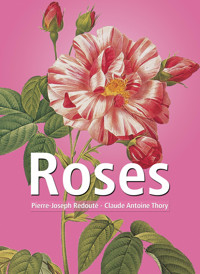
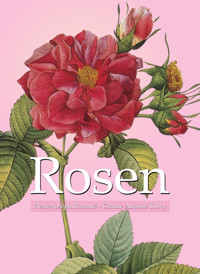
Mega Square Roses presents the large number of different species of this unique flower, which is charged with so many feelings and imbued with powerful cultural significance. Because of the rose’s botanical as well as artistic value, this book features a popular subject for art lovers as well as for people who enjoy the beauty and versatility of flowers. Each of the colourful and detailed illustrations is completed with the aid of valuable scientific information.
Das E-Book können Sie in Legimi-Apps oder einer beliebigen App lesen, die das folgende Format unterstützen:
Seitenzahl: 76
Veröffentlichungsjahr: 2023
Ähnliche



















Pierre-Joseph Redouté - Claude Antoine Thory
Translation: Deborah Davis Larrabee
© 2023, Confidential Concepts, Worldwide, USA
© 2023, Parkstone Press USA, New York
© Image-Barwww.image-bar.com
All rights reserved. No part of this may be reproduced or adapted without the permission of the copyright holder, throughout the world.
Unless otherwise specified, copyright on the works reproduced lies with the respective photographers. Despite intensive research, it has not always been possible to establish copyright ownership. Where this is the case, we would appreciate notification.
ISBN: 978-1-78160-945-3
Contents
Imagery applied to botany, in general and to roses in particular
The Plates
List of Illustrations
A
Alpine Rose
Anjou-Rose
Apothecary’s Rose
Apple Rose
Apple Rose Hybrid
Austrian Copper Rose
Austrian Yellow Rose
Autumn Damask Rose
Autumn-Flowering Variety of China Rose
B
Banks Rose “Lady Banksia Snowflake”
Blush Gallica
Bourbon Rose
Boursault Rose
Burnet Rose “Double Pink Scotch Briar”
Burnet Rose of Marienburg
C
Cabbage Rose
Cabbage Rose “Anemonoides”
Cabbage Rose “Petite de Hollande”
Cabbage Rose “White Provence”
Carnation Petalled Variety of Cabbage Rose
Celery-Leaved Variety of Cabbage Rose
Cherokee Rose
China Rose
China Rose “Longfolia”
China Rose “Old Blush China”
Cottony Rose(variety with double flowers)
Creeping French Rose
D
Damask Rose “Celsiana”
Damask Rose “Celsiana”
Damask Rose “York and Lancaster”
De Candolle Rose
Double May Rose
Double Miniature Rose
Double Moss Rose
Double Pasture Rose
Double Variety of China Rose
E
“Empress Josephine”
F
“Francofurtana”
Field Rose
Foul-Fruited Variety of Tomentose Rose
French Rose
French Rose “Duchesse d’Orléans”
French Rose “Rose d’Amour”
French Rose “The Bishop”
French Rose “Versicolor”
French Rose “Violacea”
French Rose Hybrid
French Rose Hybrid
G
Grassland Rose
Grassland Rose (variety Semi-Double)
H
Hairy Rose (with turpentine odour)
Hudson Bay Rose
J
Japanese Rose
L
Large-Flowered Variety of French Rose
Large-Leaved Variety of French Rose
Lettuce-Leaved Cabbage Rose
M
Malmedy Rose
Marbled Variety of French Rose
Marsh Rose
May Rose
Montezuma Rose
Monthly Rose
Monthly Rose
Monthly Rose
Monthly Rose “Slater’s Crimson China”
Moss Rose “De Meaux”
Multiflora “Seven Sisters Rose”
Musk Rose
N
Noisette Rose
P
Pasture Rose
Portland Rose “Duchess of Portland”
Portland Rose “Rose du Roi”
Provins Royal
R
Redouté Rose
Redouté Rose with Red Stems and Prickles
Rosa Evratina Bosc
Rose of the Bushes
Rose of the Hills
Rosenberg Rose
S
Semi-Double Musk Rose
Semi-Double Sweet Briar
Semi-Double Variety of Marsh Rose
Semi-Double Variety of Marsh Rose
Semi-Double White Rose
Short-Styled Rose
Simple Variety of Boursault Rose
Single Cabbage Rose
Single Moss Rose “Andrewsii”
Small Flowered Eglantine
Stapelia-Flowered Variety of French Rose
Striped Variety of Hudson Bay Rose
Sulphur Rose
Sweet Briar
Sweetbriar “Zabeth”
T
Tea rose “Hume’s Blush Tea-Scented China” Rose
Thornless Burnet Rose
Tomentose Rose (variety Semi-Double)
V
Van Eeden Rose
Variegated Variety of Autumn Damask Rose
Variety of Cabbage Rose
Variety of Cabbage Rose
Variety of Cabbage Rose
Variety of Cabbage Rose
Variety of Cabbage Rose
Variety of China Rose
Variety of China Rose
Variety of Damask Rose
Variety of Evergreen Rose
Variety of French Rose
Variety of French Rose
Variety of French Rose “L’Enfant de France”
Variety of French Rose “Rose d’André du Pont”
Variety of French Rose “Rosier de Provins”
Variety of French Rose or Cabbage Rose
Variety of Moss Rose
Variety of Small Autumn Damask Rose
Variety of Sweet Briar
Virginia Rose
W
White Moss Rose
White Rose “À feuilles de Chanvre”
White Rose “Celestial”
White Rose “Great Maiden’s Blush”
White Variety of Autumn Damask Rose
See, Mignonne, hath not the Rose,
That this morning did unclose
Her purple mantle to the light,
Lost, before the day be dead,
The glory of her raiment red,
Her colour, bright as yours is bright?
Ah, Mignonne, in how few hours,
The petals of her purple flowers
All have faded, fallen, died;
Sad Nature, mother ruinous,
That seest thy fair child perish thus
‘Twixt matin song and even tide.
Hear me, my darling, speaking sooth,
Gather the fleet flower of your youth,
Take ye your pleasure at the best;
Be merry ere your beauty flit,
For length of days will tarnish it
Like roses that were loveliest.
— Pierre de Ronsard
Rosa tomentosa (Flore multiplici)
Cottony Rose (variety with double flowers)
The ingenious allusions to roses that have prevailed in poetry for centuries, the use of roses in celebrations and ceremonies in Antiquity, the cult that roses became for certain populations in modern times seem to be subjects worthy of an introduction to a piece of work dedicated to the reproduction for the reader of that most beautiful of flowers in the fullness of its glory. Instead, since this literary approach to roses has been taken so eruditely by Rosenberg in his Rhodologie and with so much grace and elegance by President d’Orbessan in his Essai sur les roses, readers are simply referred to these works.
In this way, the banal repetitions of some writers who, in dissertations of this nature, have not hesitated to appropriate the erudite research of these two writers without bothering to cite them are avoided. This text takes a different approach. In offering this collection of Roses to the public, this text will present, at the same time, a record of the efforts that pictorial art has made in their regard, from the time that this imagery has been applied to botany, to the present day.
Imagery applied to botany, in general and to roses in particular
If it is true, as the wise author of Elementary Theory of Botany (1813) said: “The most precise description can hardly portray a plant as well as a general view of its form,” it is particularly true of the rose and its many varieties. In fact, among the flowers that have received the gift of mutability in the highest degree, none can be compared to the rose, whose beautiful forms and varied colours are so multiple, that a picture book dedicated exclusively to the rose has become indispensable to anyone who wishes to know and classify these flowers.
The naturalists of Antiquity saw the advantage of representing figuratively the species that they described. Pliny and other ancient writers cite a book entitled Rhizotomicum, in which the author, Cratevas, a Greek botanist who lived under Mithridates, undertook to paint plants and to record the names and properties of each one. It seems the manuscript was destroyed when the Turks took Constantinople in 1453. At the time of the Renaissance, we begin to see writings on natural history illustrated by wood engravings. Hortus Sanitatis by the German botanist Johannes de Cuba, Treatise on Agriculture by Piero Crescenzi (which contains several plates from Hortus Sanitatis), and the Promptuarium Medicinae by Jacques Dondi, are the first works to use this type of engraving applied to plants. Still, the imperfection of these representations made them useless for natural history, and it was not until long after their publication that the art of wood engraving was perfected to the point of being able to produce more or less tolerable likenesses, as can be seen in the works of Conrad Gesner, Fuchs, Matthiole, Castor Durante, Tabernaemontanus and that of Lobel, Clusius, and the Bauhin brothers, without being, nevertheless, great resources for scholars.
Rosa sulfurea
Sulphur Rose
Rosa centifolia (variety Bullata)
Lettuce-Leaved Cabbage Rose
Rosa muscosa (variety Multiplex)
Double Moss Rose
Rosa indica vulgaris
China Rose “Old Blush China”
In fact, all of these authors, with the exception of Fuchs, so reduced the scale of their engravings as to render the objects that they represent nearly unrecognisable and virtually useless to those who consult them. Botany did not gain any real benefit from this procedure until the art of copper engraving began to replace wood engraving and began to be applied to the representation of plants.
Historians do not agree on the work of natural history that is the first of this type: the biographer of the Italian botanical scholar Fabius Colonna maintains that this author’s history of plants, printed in Latin in Naples in 1592, in four folios, contains the first botanical plates engraved on copper. Others declare that this method already had been employed in 1590, in the work of Camerarius, Symbolorum et Emblematum centuriae III, while, according to Seguier, the Italian translation of Dondi’s Promptuarium Medicinae, published in 1536 in Venice under the title Herbolario Vulgare was produced with copper engravings.
In any case, these plant representations have been extremely useful to natural history, and each century has seen them become more perfect, mainly in France, to the degree that they can be seen today. But their advantages have been particularly appreciated since the advent of colour plate printing, a modern invention that has replaced illuminated manuscripts with such success.




