


9,49 €
Mehr erfahren.
- Herausgeber: A.J.Kingston
- Kategorie: Für Kinder und Jugendliche
- Sprache: Englisch
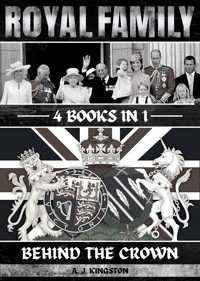
Step behind the curtain and get an exclusive look at the lives of Britain's most iconic family with "Royal Family: Behind The Crown" – a captivating book bundle that features four distinct volumes exploring the history, traditions, scandals, and secrets of the British monarchy.
Book 1, "The Crowned Legacy," takes you on a journey through the storied history of the British Royal Family. From the early days of the House of Windsor to the reigns of current monarchs, this book provides an in-depth examination of the legacy of this historic dynasty.
In Book 2, "The Windsors," you'll get an insider's look at the lives of the British monarchy. This volume explores the personal lives of each member of the royal family, from Queen Elizabeth II to Prince Harry and Meghan Markle, delving into the public and private spheres that shape their existence.
Book 3, "The Hidden Lives Of The Royals," offers a tantalizing glimpse into the scandals, secrets, and surprises that have rocked the British monarchy throughout the years. From rumors of infidelity and illegitimate heirs to royal espionage and murder, this book uncovers the salacious details that the royal family would rather keep hidden from the public eye.
Finally, Book 4, "A Royal Duty," provides a unique perspective on the British monarchy through the eyes of Princess Diana's butler. This book offers an intimate look into the day-to-day workings of royal life, from the inner workings of Buckingham Palace to the personal relationships between staff and members of the royal family.
With "Royal Family: Behind The Crown," you'll gain an unparalleled understanding of one of the world's most iconic institutions. This book bundle is perfect for anyone with an interest in British history, royal traditions, and the personal lives of those behind the crown. Don't miss your chance to step inside the world of the British monarchy and discover the secrets that have been hidden for centuries. Order your copy today!
Das E-Book können Sie in Legimi-Apps oder einer beliebigen App lesen, die das folgende Format unterstützen:
Veröffentlichungsjahr: 2023
Ähnliche











ROYAL FAMILY
BEHIND THE CROWN
BOOK 1
THE CROWNED LEGACY: A HISTORY OF BRITAIN'S ROYAL FAMILY
BOOK 2
THE WINDSORS: A FASCINATING INSIGHT INTO THE LIVES OF THE BRITISH MONARCHY
BOOK 3
THE HIDDEN LIVES OF THE ROYALS: SCANDALS, SECRETS AND SURPRISES
BOOK 4
A ROYAL DUTY: THE PERSONAL DIARIES OF PRINCESS DIANA'S BUTLER
BY A.J. KINGSTON
Copyright © 2023 by A. J. Kingston
All rights reserved. No part of this book may be reproduced or transmitted in any form or by any means, electronic or mechanical, including photocopying, recording, or by any information storage and retrieval system, without permission in writing from the publisher.
Published by A. J. Kingston
Library of Congress Cataloging-in-Publication Data
ISBN 978-1-83938-326-7
Cover design by Rizzo
Disclaimer
The contents of this book are based on extensive research and the best available historical sources. However, the author and publisher make no claims, promises, or guarantees about the accuracy, completeness, or adequacy of the information contained herein. The information in this book is provided on an "as is" basis, and the author and publisher disclaim any and all liability for any errors, omissions, or inaccuracies in the information or for any actions taken in reliance on such information.
The opinions and views expressed in this book are those of the author and do not necessarily reflect the official policy or position of any organization or individual mentioned in this book. Any reference to specific people, places, or events is intended only to provide historical context and is not intended to defame or malign any group, individual, or entity.
The information in this book is intended for educational and entertainment purposes only. It is not intended to be a substitute for professional advice or judgment. Readers are encouraged to conduct their own research and to seek professional advice where appropriate.
Every effort has been made to obtain necessary permissions and acknowledgments for all images and other copyrighted material used in this book. Any errors or omissions in this regard are unintentional, and the author and publisher will correct them in future editions.
Join Our Productivity Group and Access your Bonus
If you're passionate about history books and want to connect with others who share your love of the subject, joining our Facebook group (search for “History Books by A.J.Kingston”) can be a great way to do so. By joining a group dedicated to history books, you'll have the opportunity to connect with like-minded individuals, share your thoughts and ideas, and even discover new books that you might not have come across otherwise. You can also access your FREE BONUS once you joined our Facebook group called “History Books by A.J.Kingston”.
>> Click Here to Join Our Productivity Group <<
One of the biggest advantages of joining our Facebook group is the sense of community it provides. You'll be able to interact with other history book enthusiasts, ask questions, and share your own knowledge and expertise. This can be especially valuable if you're a student or someone who is just starting to explore the world of history books.
>> Click Here to Follow A.J. Kingston <<
>> Click Here to Download your Free Bonus <<
If you love audiobooks, then joining our YouTube channel that offers free audiobooks on a weekly basis can be a great way to stay entertained and engaged. By subscribing to our channel, you'll have access to a range of audiobooks across different genres, all for free. Not only this is a great opportunity to enjoy some new audiobooks, but it's also a chance to discover new authors and titles that you might not have come across otherwise.
>> Click Here to Join our YouTube Channel <<
Lastly, don’t forget to follow us on Facebook and YouTube by searching for A.J. Kingston.
Table of Contents – Book 1 - The Crowned Legacy: A History Of Britain's Royal Family
Introduction
Chapter 1: Origins of the British Monarchy: From Anglo-Saxon Kings to William the Conqueror
Chapter 2: Medieval Monarchy: Magna Carta, the Tudors, and the Rise of Parliamentary Power
Chapter 3: Stuarts and Revolution: The Glorious Revolution and the Age of Enlightenment
Chapter 4: Hanoverians and Empire: George III, Victoria, and the British Empire
Chapter 5: War and the Modern Monarchy: George V, George VI, and the Second World War
Chapter 6: The Queen's Reign: Elizabeth II and the Changing Face of Britain
Chapter 7: The Royal Family in the 20th Century: Scandals, Tragedies, and Triumphs
Chapter 8: The Prince of Wales and the Future of the Monarchy
Chapter 9: The Queen's Consorts: From Prince Philip to Prince Harry
Chapter 10: Royal Weddings: The Love Lives of the British Royals
Table of Contents – Book 2 - The Windsors: A Fascinating Insight Into The Lives Of The British Monarchy
Chapter 1: From Saxe-Coburg and Gotha to Windsor: A Royal Rebranding
Chapter 2: Queen Victoria and Prince Albert: A Love Story for the Ages
Chapter 3: Edward VII: A Playboy Prince and a New Era
Chapter 4: George V: A New Name and a World War
Chapter 5: Edward VIII: The Abdication Crisis and a New King
Chapter 6: George VI: A Reluctant Monarch and a Nation at War
Chapter 7: Queen Elizabeth II: The Longest Reigning Monarch in British History
Chapter 8: Prince Philip: A Lifetime of Service and Controversy
Chapter 9: Prince Charles: The Heir Apparent and His Complicated Personal Life
Chapter 10: Princess Diana: A Tragic Life in the Spotlight
Table of Contents – Book 3 - The Hidden Lives Of The Royals: Scandals, Secrets And Surprises
Chapter 1: The Princes in the Tower: The Mysterious Disappearance of Edward V and Richard of Shrewsbury
Chapter 2: The Reign of Bloody Mary: Religious Persecution and Political Intrigue
Chapter 3: The Execution of Mary, Queen of Scots: A Tragic End to a Scottish Queen
Chapter 4: George IV and Mrs. Fitzherbert: A Secret Marriage and a Constitutional Crisis
Chapter 5: The Munshi Affair: Queen Victoria's Controversial Friendship with an Indian Servant
Chapter 6: The Abdication of Edward VIII: Love, Politics, and the End of a King's Reign
Chapter 7: The Duke and Duchess of Windsor: Nazi Connections and a Life in Exile
Chapter 8: Prince Philip's Greek Roots: A Royal Family Torn Apart by War
Chapter 9: The Profumo Affair: Sex, Spies, and Scandal in the Swinging Sixties
Chapter 10: Princess Margaret's Love Life: Affairs, Heartbreak, and a Royal Wedding Canceled
Table of Contents – Book 4 - A Royal Duty: The Personal Diaries Of Princess Diana's Butler
Chapter 1: An Introduction to the Butler's Life at the Palace
Chapter 2: The Early Years: Joining the Royal Household and Meeting Princess Diana
Chapter 3: The Royal Wedding of Prince Charles and Lady Diana Spencer
Chapter 4: The Arrival of Prince William and Prince Harry: Life at Kensington Palace
Chapter 5: Life as a Royal Butler: Servicing the Needs of the Royal Family
Chapter 6: The Queen's Balmoral Estate: A Look at Royal Life in Scotland
Chapter 7: Princess Diana's Humanitarian Work: A Dedicated Heart for Charity
Chapter 8: The Royal Marriage: Princess Diana and Prince Charles' Relationship Unveiled
Chapter 9: The Butlers and the Royal Children: Nurturing William and Harry's Growth
Chapter 10: The Final Years: Princess Diana's Legacy and Tragic Death
Conclusion
About A. J. Kingston
Introduction
The British Royal Family has always captivated the world with their timeless grace and royal legacy. From Queen Victoria to Queen Elizabeth II, their reign has seen the rise and fall of empires, two world wars, and the transformation of Britain into a modern constitutional monarchy.
In this book bundle, "Royal Family: Behind The Crown," we delve into the rich history and intriguing personal lives of the Windsors.
"The Crowned Legacy: A History Of Britain's Royal Family," the first book in the series, takes us on a journey through time, tracing the family's origins from the House of Wessex to the present day. It is an enchanting tale of bloodlines, politics, and alliances that have shaped the monarchy for centuries.
In "The Windsors: A Fascinating Insight Into The Lives Of The British Monarchy," the second book, we delve into the daily lives of the royal family, examining their unique personalities, roles, and responsibilities. We explore their public appearances, engagements, and ceremonial events, while also getting a glimpse into their private lives.
"The Hidden Lives Of The Royals: Scandals, Secrets And Surprises," the third book, reveals the lesser-known sides of the royal family. It unveils the scandals, controversies, and secrets that have rocked the monarchy, from Edward VIII's abdication to Prince Andrew's infamous interview.
Finally, in "A Royal Duty: The Personal Diaries Of Princess Diana's Butler," the fourth book, we get a rare insight into the life of one of the most famous and beloved members of the royal family. It is an intimate memoir that takes us behind the scenes of Princess Diana's life, revealing her passions, struggles, and heartaches, as seen through the eyes of her devoted butler.
Together, these four books offer a comprehensive and captivating account of the royal family, exploring their history, public image, and personal lives. Whether you are a long-time fan of the monarchy or a newcomer to their world, "Royal Family: Behind The Crown" is a must-read for anyone interested in the British royal family.
BOOK 1
THE CROWNED LEGACY
A HISTORY OF BRITAIN'S ROYAL FAMILY
BY A.J. KINGSTON
Chapter 1: Origins of the British Monarchy: From Anglo-Saxon Kings to William the Conqueror
It is a curious fact that the Anglo-Saxon period, which spanned over 600 years, is often overlooked in the history books. Yet this era saw the formation of England as a cohesive nation, and it was during this time that the foundations of modern British society were laid. At the heart of this period lay the Heptarchy, a complex and ever-changing system of seven kingdoms that vied for power and influence across the land.
To understand the Heptarchy, one must first delve into the murky depths of the early Anglo-Saxon period. It was a time of chaos and upheaval, as Germanic tribes migrated across the North Sea and into Britain, driving out the native Celtic tribes that had inhabited the land for centuries. In the wake of this invasion, a number of small, independent kingdoms emerged, each with its own language, culture, and system of government.
As the centuries passed, these small kingdoms began to merge and consolidate, driven by a combination of military conquest and intermarriage between the ruling families. By the seventh century, seven major kingdoms had emerged, each with its own distinct character and rulership.
The first of these kingdoms was Kent, which was located in the southeast of England. Its rulers, known as the Kentish kings, were the first to convert to Christianity, and as such they were regarded as a major cultural and political force in the region. The most famous of the Kentish kings was undoubtedly Ethelbert, who ruled from 560 to 616. Under his leadership, Kent became a major center of trade and commerce, and he is credited with establishing the first written code of laws in Anglo-Saxon England.
The second major kingdom was Wessex, which lay in the south and west of England. Its kings, known as the West Saxons, were renowned for their military prowess, and they waged a series of successful campaigns against their neighbors throughout the seventh and eighth centuries. The most famous of the West Saxon kings was undoubtedly Alfred the Great, who ruled from 871 to 899. Under his leadership, Wessex became the dominant power in southern England, and he is credited with establishing the first English navy.
The third kingdom was Sussex, which was located in the south of England. Its rulers, known as the South Saxons, were initially overshadowed by their more powerful neighbors, but they played an important role in the early years of the Heptarchy. The most famous of the South Saxon kings was Aelle, who is credited with founding the kingdom in the late fifth century.
The fourth kingdom was Essex, which lay to the east of London. Its kings, known as the East Saxons, were initially overshadowed by their more powerful neighbors, but they played an important role in the early years of the Heptarchy. The most famous of the East Saxon kings was undoubtedly Sebert, who ruled from 604 to 616. Under his leadership, Essex became a major center of trade and commerce, and he is credited with establishing the first English monastery.
The fifth kingdom was East Anglia, which was located in the east of England. Its rulers, known as the East Anglian kings, were renowned for their culture and sophistication, and they played an important role in the development of early English literature. The most famous of the East Anglian kings was undoubtedly Raedwald, who ruled from 599 to 624. Under his leadership, East Anglia became a major center of trade and commerce, and he is credited with founding the first English town.
The sixth kingdom was Mercia, which lay in the midlands of England. Its rulers, known as the Mercian kings, were renowned for their military prowess, and they waged a series of successful campaigns against their neighbors throughout the seventh and eighth centuries.
It was during the tumultuous period of the ninth century that a young Anglo-Saxon prince emerged to forge a new path for England. This was Alfred, son of King Aethelwulf of Wessex, who would later become known as Alfred the Great. His reign, which lasted from 871 to 899, was a period of unparalleled military prowess and political unity, and it is widely regarded as one of the most important periods in English history.
Alfred was born in 849, at a time when England was still in the grip of the Viking invasions. From an early age, he showed a keen interest in military strategy and tactics, and he was trained in the art of war by his father and his elder brothers. As a young man, he witnessed firsthand the devastation wrought by the Viking raids, and he became determined to do whatever was necessary to protect his people and his land.
When Alfred's elder brother, Aethelred, died in battle in 871, he was thrust into the role of king at the tender age of 22. It was a time of great turmoil, as the Vikings continued to ravage the land and threaten the very existence of the Anglo-Saxon kingdoms. But Alfred was undaunted, and he immediately set about organizing his forces and rallying his people to his cause.
The first years of Alfred's reign were marked by a series of setbacks and defeats, as he struggled to repel the Viking invaders and protect his people. But he was a shrewd and determined leader, and he gradually began to turn the tide of the war in his favor. In 878, he scored a decisive victory at the Battle of Edington, which forced the Viking leader Guthrum to sue for peace and accept Christianity.
With the Viking threat temporarily neutralized, Alfred set about the task of rebuilding his kingdom and consolidating his power. He recognized the importance of education and learning, and he personally oversaw the establishment of schools and the translation of important works into English. He also reorganized the legal system and established a system of justice that was based on common law.
But Alfred's ambitions went far beyond the borders of his own kingdom. He recognized the need for a united England that could stand up to the threats of the outside world, and he set about the task of unifying the various Anglo-Saxon kingdoms under his rule. He married his daughter to the king of Mercia, and he formed alliances with other Anglo-Saxon leaders in an effort to create a strong and cohesive nation.
Alfred's efforts to unify England were not without their challenges, and he faced numerous setbacks and defeats along the way. But he was a determined and resourceful leader, and he eventually succeeded in bringing all of the major Anglo-Saxon kingdoms under his control. By the time of his death in 899, he had established himself as the preeminent ruler of England, and his legacy would continue to shape the nation for centuries to come.
It is difficult to overstate the importance of Alfred's reign in the history of England. He was a warrior king who led his people to victory against overwhelming odds, and he was a unifier who laid the foundations for a strong and united nation. His vision and determination continue to inspire us to this day, and his legacy lives on in the rich and vibrant culture of England.
It was a time of great upheaval and uncertainty in the land of the Anglo-Saxons, as the Viking invaders swept across the land, leaving a trail of destruction in their wake. The ninth century was a period of intense conflict and warfare, as the Anglo-Saxon kingdoms fought desperately to defend themselves against this fierce and relentless enemy.
The Vikings were a seafaring people from the north, who had long been a thorn in the side of the Anglo-Saxons. They were fierce warriors, renowned for their skill in battle and their ruthless tactics. They had raided the coasts of England for many years, pillaging towns and villages, and carrying off slaves and treasure. But in the late ninth century, they launched a full-scale invasion of England, intent on conquest and domination.
At the forefront of the struggle against the Vikings was a young and determined king named Alfred of Wessex. He was a warrior king, who had been trained in the art of war from a young age, and he was determined to defend his people and his kingdom from this new and deadly threat.
The early years of the Viking invasion were marked by a series of devastating defeats for the Anglo-Saxons. The Vikings were a fierce and relentless enemy, who seemed to have an inexhaustible supply of warriors and ships. They swept across the land, burning and pillaging everything in their path, and leaving a trail of destruction and death.
But Alfred was not one to give up easily. He was a shrewd and strategic leader, who recognized the need for a new approach to the Viking threat. He began to build a network of fortified towns and strongholds, which could serve as bases for his armies and provide refuge for his people.
Alfred also recognized the importance of intelligence and information in the fight against the Vikings. He established a network of spies and scouts, who could keep him informed of the movements and intentions of the enemy. He also began to develop new tactics and strategies, which could be used to counter the Viking threat.
One of the most important of these tactics was the use of the fyrd, a militia of peasant farmers who could be called up to serve in times of war. This was a new approach to warfare in the Anglo-Saxon world, which had traditionally relied on professional soldiers and mercenaries. But Alfred recognized the importance of a mass mobilization of the population, and he saw the potential of the fyrd as a powerful weapon against the Vikings.
The turning point in the war came in 878, when Alfred led his forces to a stunning victory at the Battle of Edington. This was a decisive moment in the war, which forced the Viking leader Guthrum to sue for peace and accept Christianity. It was a moment of triumph for Alfred, who had proven himself to be a skilled and determined leader, and a true defender of his people and his kingdom.
But the war against the Vikings was far from over. Alfred knew that the enemy could strike again at any time, and he continued to build and fortify his defenses, and to develop new strategies and tactics to counter the Viking threat. He also recognized the importance of diplomacy, and he worked tirelessly to establish alliances and build relationships with other Anglo-Saxon leaders.
Alfred's struggle against the Viking invaders was a defining moment in the history of England. It was a time of great peril and uncertainty, but it was also a time of great courage and determination. Alfred was a warrior king, who led his people to victory against overwhelming odds, and who established himself as one of the greatest defenders of his kingdom and his people.
The year was 1066, and England was on the brink of a momentous change. The death of King Edward the Confessor had left the country without a clear heir to the throne, and a power vacuum had emerged. It was a time of great uncertainty, as the various contenders for the throne vied for power and influence.
Into this volatile mix came William, Duke of Normandy. He had a claim to the throne, based on his distant relation to King Edward, and he was determined to press that claim with all his might. William was a formidable warrior and a cunning strategist, and he knew that the path to the English throne would be long and treacherous.
William's invasion of England was a complex and multifaceted affair. It involved the gathering of a vast army, the construction of a fleet of ships, and the coordination of a series of strategic alliances with other European powers. It was a massive undertaking, and it required a level of organization and planning that was unprecedented in medieval Europe.
But William was not one to be daunted by such challenges. He was a man of great vision and ambition, and he saw the conquest of England as his destiny. He was also a man of great ruthlessness and cunning, and he was prepared to do whatever it took to achieve his goals.
The invasion began in earnest in September of 1066, when William's fleet landed on the coast of Sussex. It was a daring and audacious move, and it caught the English by surprise. The battle that ensued, at a place called Hastings, was one of the most famous in all of English history.
The battle of Hastings was a grueling and bloody affair, with both sides fighting fiercely for control of the field. William's army was heavily outnumbered, but they were better equipped and better trained than their English counterparts. They also had a secret weapon in the form of archers armed with the longbow, which proved devastatingly effective against the English infantry.
In the end, it was William's superior strategy and tactical genius that won the day. He was able to outflank the English and deliver a crushing blow to their forces, killing the English king, Harold Godwinson, in the process. With the English army in disarray, William was able to march triumphantly into London, where he was crowned King of England on Christmas Day of 1066.
But the conquest of England was not over yet. William still faced resistance from various English factions, and he had to fight a series of bloody battles to secure his hold on the country. He also faced a series of uprisings and rebellions, which threatened to destabilize his new kingdom.
But William was a determined and shrewd ruler, and he was able to overcome these challenges through a combination of force and diplomacy. He built a network of castles and fortifications across the country, which served to intimidate and control the English population. He also established a system of government that was based on the feudal model, which gave him tight control over the English nobility.
The Norman Conquest of England was a defining moment in English history. It marked the beginning of a new era, in which the country was ruled by a foreign power for the first time in its history. It also marked the beginning of a new period of prosperity and cultural development, as the Normans brought with them a rich and vibrant culture that would shape English society for centuries to come.
But the conquest was also a traumatic event for the English people. It involved the displacement of thousands of English landowners and the subjugation of the English population. It also marked the beginning of a long and bloody period of conflict between England and France, which would continue for centuries.
The Battle of Hastings was one of the most momentous events in English history. It was a clash of two mighty armies, each led by a formidable warrior. On one side was King Harold Godwinson, the last of the Anglo-Saxon kings of England, and on the other was William, Duke of Normandy, a powerful French noble with a claim to the English throne.
The stakes of the battle were high. The outcome would determine who would rule England and shape its future for centuries to come. For William, the battle was the culmination of years of planning and preparation. He had spent years amassing an army, building a fleet of ships, and securing the support of key allies throughout Europe. He was determined to press his claim to the English throne, and he saw the battle as his best chance to do so.
The battle took place on October 14th, 1066, on a hill near the town of Hastings in southern England. It was a beautiful autumn day, with clear skies and a light breeze. The two armies faced each other across a wide field, with their banners flying high and their weapons gleaming in the sunlight.
The battle began with an exchange of missile fire, as the English archers and Norman crossbowmen traded volleys of arrows and bolts. But the real fighting began when the two armies closed in on each other, their swords and axes flashing in the sun.
The battle was brutal and bloody, with both sides fighting fiercely for control of the field. The English were fighting on their home turf, and they had the advantage of numbers. But the Normans were better trained and better equipped, with a sophisticated system of tactics and strategy that allowed them to outflank and outmaneuver their opponents.
The turning point of the battle came when Harold was killed. The exact circumstances of his death are unclear, but it is believed that he was struck in the eye by an arrow and killed instantly. With their king dead, the English forces began to falter, and the Normans were able to break through their lines and secure the victory.
The aftermath of the battle was chaotic and violent. The English forces fled in disarray, pursued by the victorious Normans. Many were killed or captured, and the country was plunged into a period of instability and conflict that would last for years.
For William, however, the battle was a triumph. He had secured his claim to the English throne, and he had established himself as one of the most powerful rulers in Europe. He would go on to rule England for over two decades, laying the foundations for a new era of prosperity and cultural development.
The Battle of Hastings was a turning point in English history. It marked the end of the Anglo-Saxon period and the beginning of the Norman era. It also marked the beginning of a long and complex process of cultural and political integration, as the Normans brought with them a rich and vibrant culture that would shape English society for centuries to come.
But the battle was also a traumatic event for the English people. It involved the displacement of thousands of English landowners and the subjugation of the English population. It marked the beginning of a long and bloody period of conflict between England and France, which would continue for centuries.
In the end, the Battle of Hastings was a complex and multifaceted event, one that has been the subject of countless retellings and interpretations over the centuries. But one thing is clear: it was a battle that changed the course of English history, and established William the Conqueror as one of the greatest rulers of his time.
Chapter 2: Medieval Monarchy: Magna Carta, the Tudors, and the Rise of Parliamentary Power
The Angevin Empire, also known as the Plantagenet Empire, was a vast and powerful domain that dominated much of western Europe during the twelfth and thirteenth centuries. At the heart of this empire was Henry II, a dynamic and ambitious ruler who transformed the political and cultural landscape of England and beyond.
Henry was born in 1133, the son of Geoffrey of Anjou and Matilda, daughter of King Henry I of England. From a young age, he showed a remarkable talent for leadership, and he was quickly recognized as one of the most capable rulers of his time.
As king of England, Henry set about consolidating his power and expanding his domain. He reformed the legal system, creating the basis for modern English law, and he built a vast network of castles and fortifications that allowed him to assert his authority over the countryside.
But Henry's ambitions went far beyond England. He was determined to create a vast empire that would stretch across Europe, and he embarked on a series of conquests and alliances that allowed him to do just that.
One of Henry's most notable achievements was the acquisition of the Duchy of Normandy, which had been lost to England during the reign of King Stephen. Henry led a campaign to retake the territory, and he was successful in his efforts, restoring English control over the region and establishing a powerful base for further expansion.
But Henry's ambitions did not stop there. He also launched campaigns to conquer other territories, including Wales and Ireland, and he formed alliances with other powerful rulers in Europe, such as the Holy Roman Emperor and the King of France.
Despite his successes, however, Henry's reign was not without its challenges. He faced numerous rebellions and uprisings, including a revolt led by his own sons, who were unhappy with his policies and treatment of their mother, Queen Eleanor of Aquitaine.
Despite these challenges, however, Henry remained a powerful and influential ruler, and he continued to expand his empire throughout his reign. He died in 1189, leaving behind a legacy of military conquests, legal reforms, and cultural achievements that would shape the course of English history for centuries to come.
The Angevin Empire that Henry had created was a vast and complex entity, encompassing not only England and Normandy, but also territories in Wales, Scotland, Ireland, and parts of France. It was a diverse and multicultural empire, with a rich and vibrant culture that reflected the many influences that had shaped it over the centuries.
One of the most notable achievements of the Angevin Empire was the development of the common law, which was based on the principles of justice and fairness, and which would become the foundation of modern English law. The empire also saw the emergence of a powerful and influential aristocracy, who played a key role in shaping the political and cultural landscape of the time.
The Angevin Empire eventually came to an end in the thirteenth century, with the reign of King John and the loss of many of the empire's territories in France. But the legacy of Henry II and the Angevin Empire lived on, shaping the course of English history for centuries to come.
In many ways, the Angevin Empire was a product of its time, reflecting the political and cultural realities of medieval Europe. But it was also a testament to the vision and ambition of a remarkable ruler, who transformed England and the world around him, and left behind a legacy that continues to inspire and captivate us today.
In the annals of English history, few documents have been as consequential as the Magna Carta. Signed by King John on June 15, 1215, this charter marked a turning point in the evolution of English legal and political institutions. Its principles, which sought to limit the power of the monarchy and protect the rights of the people, laid the groundwork for the development of modern democratic governance.
The origins of the Magna Carta can be traced back to the reign of King John, who ascended to the throne in 1199. John was a controversial figure in English history, widely regarded as one of the weakest and most unpopular monarchs of the Middle Ages. He was known for his arbitrary and despotic rule, which included levying heavy taxes on his subjects, seizing church property, and waging costly and unsuccessful wars on the European continent.
The barons of England, who were among the most powerful and influential landowners in the realm, grew increasingly discontented with John's rule. They resented his heavy-handed approach to governance, as well as his tendency to ignore the traditional rights and privileges of the nobility. In 1214, a group of barons formed an alliance and demanded that John agree to a series of concessions that would limit his power and protect their own interests.
The negotiations that followed resulted in the Magna Carta, a document that established a set of basic principles for the governance of England. The charter contained provisions that guaranteed the rights of free men, including the right to a fair trial and the right to due process of law. It also limited the power of the monarchy by establishing that the king was subject to the law, and could not arbitrarily imprison or punish his subjects.
The Magna Carta was not an entirely new invention. Many of its provisions were based on existing laws and customs, such as the Anglo-Saxon concept of the "writ of habeas corpus" (which required the king to justify the detention of a subject), and the principle that taxation should be levied only with the consent of the governed. However, the charter represented a significant advance in the development of English law and politics, and marked a turning point in the relationship between the king and his subjects.
In the aftermath of the signing of the Magna Carta, King John attempted to renege on his promises and reassert his authority. This led to a period of civil war, known as the First Barons' War, which lasted from 1215 to 1217. The war ended in a victory for the barons, who secured the ratification of the Magna Carta by John's successor, Henry III.
The legacy of the Magna Carta is difficult to overstate. Although the charter was not a perfect document, and many of its provisions were limited in their scope, it established the principle that the king was subject to the law, and that his power could be constrained by the will of the people. This idea, which has come to be known as the rule of law, is one of the foundational principles of modern democratic societies.
The Magna Carta also established the principle of parliamentary representation, which would later evolve into the modern system of parliamentary democracy. The charter required the king to consult with the "common council of the realm" before imposing new taxes, and established the right of the barons to elect representatives to a "great council" that would advise the king on matters of state.
Amidst the tumultuous political and social landscape of medieval England, the Plantagenet dynasty emerged as a powerful force in the thirteenth and fourteenth centuries. The reigns of the three Edwards were characterized by complex power struggles, military conquests, and economic growth, shaping the country's identity and setting the stage for future developments.
Edward I, also known as Edward Longshanks, ascended to the throne in 1272 following the death of his father, Henry III. He immediately set about consolidating and expanding English control over the British Isles. Edward's military campaigns in Wales, culminating in the subjugation of the Welsh in 1284, earned him the moniker "Hammer of the Welsh." His military successes continued in Scotland, where he sought to exert control over the Scottish throne. However, his efforts were met with fierce resistance, particularly from William Wallace and Robert the Bruce, who led successful rebellions against English rule. Despite these setbacks, Edward's conquest of Scotland was largely complete by the time of his death in 1307.
Edward II, the son of Edward I, took the throne upon his father's death. However, his reign was marked by political turmoil and military defeats. His reliance on favorites at court, particularly the controversial Piers Gaveston, alienated him from many of his barons. This led to a rebellion in 1311, during which Gaveston was executed. Edward's relationship with his queen, Isabella of France, was also fraught, and she eventually played a pivotal role in his deposition and replacement by his son, Edward III.
Edward III, who ascended to the throne in 1327 at the age of 14, ruled during a period of significant economic growth and military expansion. His reign saw the beginning of the Hundred Years' War between England and France, which would last for over a century. Edward launched several successful military campaigns, including the famous Battle of Crécy in 1346, which solidified English dominance on the battlefield. His reign also saw significant advancements in English architecture and literature, including the works of Geoffrey Chaucer.
The Plantagenet dynasty, and particularly the reigns of the three Edwards, laid the foundation for English political and military dominance in the medieval period. Their legacy extended beyond their lifetimes, with the Hundred Years' War shaping English identity for centuries to come. Despite the challenges and setbacks faced by the Plantagenets, their accomplishments and contributions to English history remain enduring and significant.
In the late fifteenth and sixteenth centuries, the Tudor dynasty emerged as a dominant force in English history. Beginning with the reign of Henry VII in 1485 and lasting until the death of Elizabeth I in 1603, the Tudors oversaw a period of significant political, religious, and cultural change, shaping the course of English history for centuries to come.
Henry VII, the founder of the Tudor dynasty, came to power following the defeat of Richard III at the Battle of Bosworth Field. His reign was marked by a series of political and economic reforms, aimed at stabilizing the kingdom and cementing his own power. He founded the Court of Star Chamber, a legal body designed to enforce royal authority, and encouraged economic growth through measures such as the establishment of cloth-making centers in the West Country.
However, it was the reign of Henry VIII that truly transformed England. A larger-than-life figure known for his multiple marriages and role in the English Reformation, Henry VIII redefined the relationship between church and state. His decision to break with Rome and establish the Church of England, with himself as the supreme head, sparked a period of religious turmoil and upheaval. His dissolution of the monasteries and seizure of church lands also had significant economic implications, redistributing wealth and power throughout the kingdom.
Despite his reputation as a tyrant, Henry VIII was also a patron of the arts and a significant cultural figure. His court was a center of artistic and intellectual activity, with writers such as William Shakespeare and Edmund Spenser finding patronage there.
Following the death of Henry VIII, his son Edward VI briefly took the throne, ushering in a period of Protestant rule. However, his early death paved the way for the reign of his half-sister Mary I, known as "Bloody Mary" for her persecution of Protestants. Her reign was marked by religious turmoil and political instability, and she was ultimately succeeded by her half-sister Elizabeth I.
Elizabeth I, one of England's most famous monarchs, presided over a period of significant cultural and economic growth. Her reign saw the flowering of English literature, with writers such as Shakespeare, Marlowe, and Jonson achieving international fame. She also oversaw significant military victories, including the defeat of the Spanish Armada in 1588.
The Tudor dynasty, and particularly the reigns of Henry VIII and Elizabeth I, had a profound impact on English history and identity. Their legacy extended far beyond their lifetimes, shaping the course of English politics, culture, and religion for centuries to come. Despite the many challenges and controversies they faced, the Tudors remain an enduring symbol of English power and achievement.
In the seventeenth century, England underwent a period of significant political upheaval, marked by a struggle between the monarchy and parliament for control of the government. This conflict, which culminated in the English Civil War and the Glorious Revolution, ultimately led to a shift in power from the monarchy to parliament, laying the foundation for modern British democracy.
The English Civil War, which lasted from 1642 to 1651, pitted the supporters of King Charles I against those of parliament. Charles, a staunch believer in the divine right of kings, had long clashed with parliament over issues such as taxation and religious reform. In 1642, these tensions erupted into open warfare, with Charles's forces fighting against those of parliament, led by Oliver Cromwell and other prominent figures.
The war was a long and bloody struggle, with both sides suffering significant losses. However, by 1649, parliament had emerged victorious, executing Charles I and establishing a republic, known as the Commonwealth. Under the leadership of Cromwell, the country was ruled by a council of military officers, who sought to establish a new order based on republican principles.
However, the republic proved to be short-lived. In 1660, following the death of Cromwell, the monarchy was restored under Charles II, son of the executed king. The period of the Restoration saw a resurgence of royal power, as Charles II and his successors sought to reestablish the authority of the monarchy.
Despite this setback, the seeds of parliamentary power had been sown. The Glorious Revolution of 1688, which saw the overthrow of James II and the installation of William and Mary on the throne, represented a significant victory for parliamentary forces. James II had been a staunch defender of absolute monarchy, and his attempts to establish Catholicism as the dominant religion had sparked widespread opposition.
In response, a group of leading figures in parliament, known as the Whigs, invited William of Orange, a Protestant prince from the Netherlands, to invade England and take the throne. William's forces were greeted as liberators, and James II was forced to flee to France.
The Glorious Revolution marked a turning point in English history, establishing the principle of parliamentary sovereignty and laying the foundation for modern democracy. Under the new settlement, known as the Bill of Rights, parliament was granted significant new powers, including the right to determine taxation, regulate the army, and initiate legislation.
The rise of parliamentary power had significant implications for the monarchy as well. Although the king or queen remained the nominal head of state, their power was increasingly limited by the authority of parliament. The royal prerogative, or the traditional rights of the monarch, were gradually eroded, as parliament asserted its own authority.
The English Civil War and the Glorious Revolution represented a significant shift in the balance of power in England, as parliament emerged as the dominant force in government. Although the struggle was often violent and tumultuous, it ultimately paved the way for the modern democratic state, with its emphasis on the rule of law, popular sovereignty, and the separation of powers.
Chapter 3: Stuarts and Revolution: The Glorious Revolution and the Age of Enlightenment
It was during the reign of James I that the Stuart dynasty began its ascent to the English throne. James I, son of Mary, Queen of Scots, succeeded Elizabeth I, bringing a new era to English history. James I was well-educated and well-traveled, having been born and raised in Scotland, and having spent time as King of Scotland before ascending to the English throne. He was known for his intellectual curiosity and his love of peace, but also for his extravagant spending and his efforts to consolidate power in the monarchy.
During his reign, James I faced a number of challenges, including religious tensions between Protestants and Catholics, the Gunpowder Plot, and conflicts with Parliament over taxation and the role of the monarchy. James I believed in the divine right of kings and saw himself as the absolute ruler of his realm. However, his reign was marked by political instability and growing dissatisfaction with the monarchy.
James I was succeeded by his son, Charles I, who inherited a troubled kingdom. Like his father, Charles I believed in the divine right of kings and sought to rule without the input of Parliament. However, he faced opposition from the House of Commons, which sought to limit his power and protect the rights of the people.
Charles I's reign was marked by political turmoil and religious conflict, culminating in the English Civil War. The war pitted supporters of the monarchy, known as Royalists, against supporters of Parliament, known as Parliamentarians. The Royalists were ultimately defeated, and Charles I was executed in 1649, bringing an end to the monarchy for the first time in English history.
The reigns of James I and Charles I marked a significant period of transition in English history. They were the first monarchs of the Stuart dynasty and their reigns were marked by a growing sense of discontent with the monarchy and the emergence of parliamentary power. These factors would eventually lead to the English Civil War and the rise of a new era in English history.
The English Civil War was a pivotal event in English history that lasted from 1642 to 1651. It was a conflict between the supporters of the monarchy, known as Royalists, and the supporters of Parliament, known as Parliamentarians. The war was fought for a number of reasons, including religious tensions, political disputes, and economic pressures.
One of the main causes of the English Civil War was religious conflict. The English Reformation had led to a split in the Church, with some people supporting the Protestant Church of England and others remaining loyal to the Catholic Church. This led to tensions between the two groups and, ultimately, to conflict. The Royalists tended to be more religiously conservative and supported the Church of England, while the Parliamentarians tended to be more progressive and supported religious tolerance.
Another cause of the English Civil War was political disputes. The Royalists believed in the divine right of kings and saw the monarchy as the supreme authority in the country. The Parliamentarians, on the other hand, believed in the importance of representative government and saw Parliament as the supreme authority. These two views were fundamentally incompatible and led to a breakdown in communication between the two sides.
Economic pressures also played a role in the English Civil War. England was experiencing a period of economic uncertainty, with rising inflation and falling wages. The Royalists tended to be more conservative in their economic policies and were reluctant to make changes that could benefit the common people. The Parliamentarians, on the other hand, were more willing to make economic reforms and were more supportive of the interests of the middle and lower classes.
The English Civil War was a long and brutal conflict that lasted for almost a decade. It was fought on many fronts, with battles taking place across England, Scotland, and Ireland. The war was characterized by a series of battles and skirmishes, as well as sieges and raids.
The war ultimately ended with the defeat of the Royalists and the execution of King Charles I. This marked a significant turning point in English history, as it brought an end to the monarchy and established a republic, known as the Commonwealth of England.
The consequences of the English Civil War were far-reaching. The monarchy was abolished and a republic was established, led by Oliver Cromwell. However, the republic was short-lived and was replaced by the Restoration in 1660, when Charles II was restored to the throne.
The English Civil War also had significant social and economic consequences. The war had caused immense damage to the country, with many towns and villages being destroyed and many people losing their homes and livelihoods. The war also led to significant social upheaval, with many people experiencing changes in their social status and many traditional institutions being challenged.
In summary, the English Civil War was a complex and multifaceted conflict that was fought for a variety of reasons. It was a pivotal event in English history that had far-reaching consequences for the country and its people. The conflict ultimately led to the establishment of a republic and the abolition of the monarchy, but it also caused significant social and economic upheaval. The English Civil War remains an important part of English history and continues to be studied and analyzed by scholars and historians today.
It was during the seventeenth century that England underwent some of the most profound changes in its history. The period was marked by great social, political, and religious upheaval, and it was during this time that the country was transformed from an absolute monarchy to a constitutional one. At the heart of this transformation was the figure of Oliver Cromwell, who rose to power as a military leader and then became the Lord Protector of England, Scotland, and Ireland.
Oliver Cromwell was born in Huntingdon in 1599, and was the son of a wealthy landowner. He was educated at Cambridge University, but his studies were cut short when his father died, and he was forced to return home to manage the family estates. Cromwell soon developed a reputation as a skilled administrator and was elected to Parliament in 1628 as the member for Huntingdon.
Cromwell was a Puritan, and his religious beliefs played a significant role in his political career. He believed that the Church of England was corrupt and needed to be reformed. He also opposed the policies of King Charles I, who he believed was trying to establish a Catholic-style absolute monarchy in England. Cromwell was a strong supporter of the rights of Parliament, and he quickly became one of its most vocal and influential members.
The English Civil War broke out in 1642, pitting the supporters of Parliament against the supporters of the king. Cromwell was initially a relatively minor player in the conflict, but he quickly rose to prominence as a military leader. He formed the New Model Army, which was made up of experienced soldiers and disciplined recruits, and he led the army to a series of stunning victories against the king's forces.
By 1649, the war was effectively over, and Cromwell had emerged as the most powerful man in England. The king had been captured, and Cromwell's army had defeated the last remaining royalist forces. Cromwell was now faced with the task of governing the country, and he decided to establish a republic, which he called the Commonwealth.
The Commonwealth was a radical experiment in government, and Cromwell believed that it would be a model for other nations to follow. He abolished the monarchy, the House of Lords, and the established Church of England, and he introduced a series of reforms aimed at promoting religious tolerance and social justice. However, the Commonwealth was not a success, and Cromwell was forced to resort to increasingly authoritarian measures to maintain order.
In 1653, Cromwell dissolved the Commonwealth and established the Protectorate, with himself as the Lord Protector. The Protectorate was a more stable form of government than the Commonwealth, but it was still a dictatorship, with Cromwell holding all the power. He was a controversial figure, and his rule was marked by censorship, religious persecution, and the suppression of dissent.
Cromwell died in 1658, and his son Richard succeeded him as Lord Protector. However, Richard was unable to hold onto power, and the Protectorate was dissolved in 1660. The monarchy was restored, and Charles II became king.
Cromwell's legacy is a controversial one. He is remembered as a great military leader, who helped to establish England as a world power. However, his reputation as a political leader is more mixed. He is remembered as a champion of liberty and democracy, but he is also remembered as a dictator who suppressed dissent and persecuted religious minorities.
Despite these controversies, Cromwell's influence on English history is undeniable. He played a key role in the transformation of England from an absolute monarchy to a constitutional one, and his ideas about religious tolerance and social justice continue to influence political thinking to this day.
When the monarchy was restored in 1660, it marked the end of the tumultuous Commonwealth period and the beginning of a new era for England. The return of the Stuart dynasty brought about a renewed sense of hope for stability and prosperity, but the reigns of Charles II and his brother James II would prove to be anything but peaceful.
Charles II ascended the throne with the support of the Cavalier Parliament, which was eager to see a return to the traditional values of monarchy and the Church of England. However, Charles was also a pragmatist who recognized the need to work with Parliament to maintain his power. He sought to balance the interests of both the Crown and Parliament, which resulted in a period of relative stability and economic growth.
Under Charles II's rule, England was marked by a newfound sense of freedom and hedonism. The arts flourished, and the scientific revolution gained momentum. However, this was also a time of great social inequality, with poverty and disease rampant among the lower classes.
While Charles II was a popular king, his successor James II proved to be far more divisive. James was a devout Catholic, which immediately put him at odds with the largely Protestant population of England. He also sought to expand the powers of the monarchy and diminish the role of Parliament.
These tensions eventually boiled over into the Glorious Revolution of 1688, which saw James II ousted from the throne in favor of William III and Mary II. The Glorious Revolution was a turning point in English history, as it marked the beginning of the constitutional monarchy and the rise of parliamentary power.
The Restoration period was also marked by the rise of royal absolutism, a political philosophy that placed the king at the center of all decision-making. Charles II was seen as a symbol of this philosophy, and his court was marked by lavish displays of wealth and extravagance.
However, this philosophy was also responsible for the tensions that led to the Glorious Revolution. James II's attempts to expand royal power and limit the role of Parliament were met with fierce resistance, and ultimately led to his downfall.
Despite the conflicts of the Restoration period, it was also a time of great cultural and scientific advancement. The scientific revolution continued to gain momentum, with figures such as Robert Boyle and Isaac Newton making groundbreaking discoveries. The arts also flourished, with playwrights such as William Shakespeare and John Dryden producing some of their greatest works during this time.
In summary, the Restoration period was a time of great change and upheaval for England. The return of the monarchy brought about a renewed sense of hope, but also led to tensions between the Crown and Parliament. The rise of royal absolutism was met with resistance, ultimately leading to the Glorious Revolution and the establishment of the constitutional monarchy. Despite these conflicts, the period was also marked by cultural and scientific advancement, and remains a fascinating period in English history.
It is with great pleasure that I undertake the task of examining the Glorious Revolution of 1688, and the events that led to the establishment of a constitutional monarchy in England. The period of the late seventeenth century was a time of immense change and upheaval, both in England and across Europe. It was a time when the old order was being challenged, and new ideas were emerging about the nature of power and government. The Glorious Revolution was a key moment in this process, and it paved the way for the modern constitutional system that we have today.
At the heart of the Glorious Revolution was a crisis of legitimacy. For many years, the English monarchy had been seen as the source of power and authority in the realm. The monarch had been believed to be chosen by God, and to be the ultimate arbiter of justice and law. However, the reigns of James I and his son, Charles I, had exposed the weaknesses of this system. The Stuart kings had tried to rule as absolute monarchs, but they had encountered opposition from both the aristocracy and the common people. By the time that James II came to the throne in 1685, the situation was on the verge of collapse.
James II was a deeply unpopular monarch. He was a Catholic, and he had come to the throne after the death of his Protestant brother, Charles II. His attempts to promote Catholicism in England had led to widespread suspicion and fear. Many people believed that he was planning to establish a Catholic tyranny, and they were deeply alarmed by his policies. His attempts to dispense with parliament and rule by decree had also caused widespread consternation. The country was on the brink of revolution.
It was in this context that the Glorious Revolution took place. In 1688, a group of English nobles invited William of Orange, the Protestant ruler of the Dutch Republic, to come to England and take the throne. William was married to James II's daughter, Mary, and he had a strong claim to the English throne himself. He arrived in England with a small army, and he was quickly joined by many English nobles and commoners who were opposed to James's rule.
The Glorious Revolution was a remarkably bloodless affair. James II was deeply unpopular, and he had few supporters left. When William and his army arrived in England, James's army melted away. James himself fled to France, and William and Mary were proclaimed joint monarchs. The events of the Glorious Revolution marked a turning point in English history. For the first time, the English monarchy had been removed without violence, and a new system of government had been established.
The Glorious Revolution had several important consequences. First, it established the principle of parliamentary supremacy. William and Mary agreed to accept a Bill of Rights that limited the power of the monarch and affirmed the authority of parliament. This meant that the monarch was no longer the ultimate source of power in the realm. Instead, parliament became the primary law-making body, and the monarch was obliged to act in accordance with its decisions.
Second, the Glorious Revolution helped to establish the principle of religious toleration in England. Although William was a Protestant, he was committed to religious tolerance, and he introduced a policy of toleration that allowed Dissenters (Protestants who did not belong to the Church of England) to worship freely. This policy was enshrined in the Toleration Act of 1689, which allowed Dissenters to worship in licensed meeting houses.
Third, the Glorious Revolution helped to pave the way for the modern constitutional system that we have today. By limiting the power of the monarch and establishing the principle of parliamentary supremacy, the Glorious Revolution laid the foundation for a constitutional monarchy in England.
Chapter 4: Hanoverians and Empire: George III, Victoria, and the British Empire
In the annals of British history, few monarchs have left as lasting an impact as George III. Born in 1738, he ascended the throne in 1760 at the age of 22, and reigned for 59 years, making him the longest reigning king in British history at the time. He was also the first monarch to be born in Britain since the 17th century, and the first to speak English as his first language.
George III's reign was marked by a number of significant events, both at home and abroad. Perhaps the most consequential of these was the American Revolution, which began in 1775 and lasted until 1783. The colonists' rebellion against British rule ultimately led to the formation of the United States of America, and marked a significant turning point in world history.




