


Erhalten Sie Zugang zu diesem und mehr als 300000 Büchern ab EUR 5,99 monatlich.
- Herausgeber: Atlantic Books
- Kategorie: Ratgeber
- Sprache: Englisch
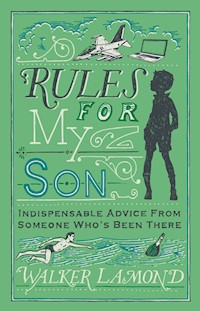
Rules For My Son is a collection of traditional, humorous, and urbane fatherly advice for boys. From the sartorial ("Men should not wear sandals. Ever") to the practical ("Keep a copy of your letters. It makes it easier for your biographer") to even a couple of sure-fire hangover cures ("There is no better remedy than a dip in the ocean"), the book of rules, photos and accompanying quotations is the quintessential instruction manual for becoming a Good Man - industrious, thoughtful, charming, and of course, well-dressed. Hip and witty with a decidedly traditionalist flavour, Rules for My Newborn Son is meant to evoke simpler times when Father knew best and a suitable answer to "Why?" was "Because I said so." Based on the hit blog and presented as a beautifully designed hardback, there is no better gift for the discerning father, father-to-be, or son, this Christmas.
Sie lesen das E-Book in den Legimi-Apps auf:
Seitenzahl: 30
Veröffentlichungsjahr: 2016
Das E-Book (TTS) können Sie hören im Abo „Legimi Premium” in Legimi-Apps auf:
Ähnliche
















Let’s get some things straightbefore I get old and uncool.
for ARTHUR
Contents
Introduction
Rules for My Son
Appendix
Required Listening for Boys
Essential Reading for Boys
Photo Credits
Acknowledgments
INTRODUCTION
Boys need rules. No Spitting. No Swimming. No Fighting. We don’t always like them, but for the most part, they are necessary. Rules keep us safe, eliminate uncertainty, and encourage harmonious social interaction. Yield to Pedestrians. Black Tie Required. They are the simplest and most effective way to pass down tried and true institutional knowledge through the generations. In short, rules are GOOD!
But somewhere along the way, rules got a bad name. People wanted freedom. Authority was questioned, rules were broken, dress codes banished! Rules were seen as antiquated obstacles to individualism and progress. Barbers were ignored, ties packed away. And the game of life suddenly got a bit sloppier, more uncertain, and even a bit less fun.
My father rarely wore socks, a sartorial quirk made permissible by the fact he was often the best-dressed gentleman in the room. This perhaps best exemplifies his approach to life. A vigorous dancer, a dedicated sportsman, and the tireless life of any party, he understood that a man of strong character, who took pride in his appearance and behaviour, was given the most liberty to have fun. And so he had rules. Many of them came from his father, and presumably his father before that. They governed everything from his dress to his business dealings and were based on the notion that there are certain things a Good Man does and certain things he does not do. My father was a Good Man. And he was the kind of father I aspired to be. He passed away shortly after my twenty-second birthday.
This small book began simply as a way to preserve the lessons my father had taught me and perhaps, add my spin on what makes a Good Man. I hoped to have a son of my own one day, so I thought it best to write it all down before the mayhem of actual fatherhood made me too soft or too sanctimonious, and most importantly, before my own childhood was too distant in the rear-view mirror. It would be a father-to-be’s promise to his unborn son: ‘To get some things straight before I get old and uncool’.
Of course, the list needed a bit of updating. My dad could fold a mean pocket square, but he didn’t have much to offer on Internet etiquette. As the list grew, however, what struck me was how many of my father’s rules stood up unchanged – even for a recovering hipster living in New York. Rules for My Son became a set of instructions for being a good man and a good father, not just a list of commandments for any future progeny.
My father and I are not the first men to attempt to define and defend the qualities that make up the modern gentleman. In the book I acknowledge the influences of some very fine men who have offered wise and practical advice through the ages either through their words (George Orwell, Buckminster Fuller, Mark Twain) or their example (Fred Astaire, Mick Jagger, David Bowie). Some of the advice the reader may have heard before. And I should hope so, as many of the rules are distillations of some universal lessons in ethics and etiquette. I have made efforts to cull the classics from the outmoded. After all, not all that is old is good. However, what I hope makes Rules for My Son




