


3,99 €
Mehr erfahren.
- Herausgeber: Edizioni Savine
- Kategorie: Lebensstil
- Sprache: Englisch
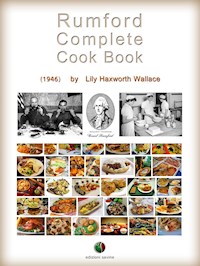
This book is the newest link in perhaps the greatest of cooking traditions. One can start that tradition 85 years ago, when Rumford was the first to issue booklets and folders on better cooking. So useful did these prove that in 1908 Rumford brought out the first edition of its famous Complete Cook Book. With the unequalled testing of the years, friends of this book and sharers in its delights have increased, until today there are more than 5,000,000 copies of it in use.
This edition lives wholly up to the great Rumford tradition. Again, under the skilled direction of Mrs. Lily Haxworth Wallace, it includes the flavor of the old and true, seasoned with the methods of modern practice. The book, however, is well able to speak for itself.
Das E-Book können Sie in Legimi-Apps oder einer beliebigen App lesen, die das folgende Format unterstützen:
Veröffentlichungsjahr: 2017
Ähnliche



















RUMFORD
Complete COOK BOOK
(40th Edition - 1946)
by
Lily Haxworth Wallace
Graduate of National Training School of Cookery, London, Lily Haxworth Wallace is a widely known American food specialist and consultant, a frequent lecturer and writer on home economics. For sixteen years she was homemaking Editor of Woman’s World and is now associated with the Household Arts Department of Ballard School, New York. Author and regular contributor to Practical Home Economics and other magazines, among her many books famous in the culinary world are Sea Food Cookery, Just for Two, and Carving the Easy Way.
New digital edition of:
Rumford Complete Cook Book
by Lily Haxworth Wallace
© 1946 by Rumford Chemical Works
Copyright © 2017 - Edizioni Savine
email: [email protected]
web: www.edizionisavine.com
ISBN 978-88-99914-37-0
BENJAMIN THOMPSON
COUNT RUMFORD
The American ennobled by the courts of Europe because of his pioneer discoveries in cooking.
After a century and a half, he is honored today as the grand master of the great guild of chefs, the first and greatest scientist of the kitchen.
He was the first to study diet; to invent an effective oven, and roauter, and tea kettle, and boiler; to advocate drip coffee; to suggest holes in the handles of pots and pans so they can be hung up; to analyze fuels and the management of heat; to devise the modern air-tight stove; to lay out efficient kitchens; to reason about the construction of oven doors and thereby open up the great field of insulation.
“My principal design” he said, “is to fix the attention of my readers on a subject which is highly interesting and deserving of the most serious consideration. I wish to inspire cooks with a just idea of the importance of their art. In what other art could improvements be made that would more powerfully contribute to the enjoyments of mankind
PREFACE
THIS book is the newest link in perhaps the greatest of cooking traditions. One can start that tradition 85 years ago, when Rumford was the first to issue booklets and folders on better cooking. So useful did these prove that in 1908 Rumford brought out the first edition of its famous Complete Cook Book. With the unequalled testing of the years, friends of this book and sharers in its delights have increased, until today there are more than 5,000,000 copies of it in use.
This edition lives wholly up to the great Rumford tradition. Again, under the skilled direction of Mrs. Lily Haxworth Wallace, it includes the flavor of the old and true, seasoned with the methods of modern practice. The book, however, is well able to speak for itself.
One can, we said above, start the Rumford tradition of cook books 85 years ago; but one can carry twice as far back the unparalleled Rumford tradition of pioneering in the dietary and culinary world. Here are four historical facts:
1790 — Count Rumford made his epochal findings as to the vital importance of certain “nutriment” in the diet, particularly the diet of the very poor. He told how to make good any deficiency in that nutriment. Today we call that “nutriment” by the familiar word “vitamins.”
1857 — Professor Eben Horsford, holder of the Rumford Chair of Applied Science at Harvard and co-founder of the Rumford Company, found that calcium and phosphates in baking powder would largely replace the natural minerals lost from flour in the milling process.
1859 — Rumford Chemical Works gave the country its first baking powder, which remains today the only nationally distributed calcium phosphate baking powder.
1940— The United States Department of Agriculture in its 1939 Year Book stated:
“The minerals and inorganic materials that must be supplied by the diet include sodium, potassium, calcium, magnesium, iron, copper, manganese, sulfur, phosphorus, chlorine, iodine, and probably many others in small amounts. Of these, only four — calcium, phosphorus, iron, and iodine — are likely to be deficient in ordinary diets.
“Calcium forms a large part of the bones and teeth, and it is necessary for normal blood clotting, the steady working of the heart, and normal muscular activity. Phosphorus is also liberally used in the bones and teeth, and it plays a vital part in some of the delicate chemical activities of the body, notably those that release energy from foods. Beginning at birth, children need a generous supply of these two minerals to meet the needs of growth. Evidence indicates, however, that many people of all ages do not get enough calcium. In children, a severe calcium deficiency stunts growth; among older people it sometimes causes ‘late rickets.’ ”
Many things are passed down from generation to generation, things which people hold dear — family names, customs, old silver, precious heirlooms. None, surely, is more precious than a tradition of unfailing leadership. That is the Rumford tradition: leadership toward better cooking, better, more wholesome food.
Definitions of Terms Used in Cookery
A la Creole. Cooked with tomatoes, onions and peppers.
A la Printanière. A soup or stew served with young spring vegetables.
Aspic. A savory jelly for meats, fish, vegetables and salads. Frequently used as a garnish.
Au Gratin. Cooked with browned crumbs and usually with grated cheese.
Bechamel. A rich cream sauce made with stock, milk or cream.
Bisque. A thick cream sauce or soup generally made from shellfish.
Blanch. To dip briefly into boiling water to loosen skin, to reduce strong flavor, or to whiten.
Bouillon. A meat broth.
Bombe. Two frozen mixtures molded together, one used as the lining, the other as the center of the mold.
Bouquet of Herbs. A bunch of various flavoring herbs, used for soups or stews.
Braise. To brown meat or vegetables in a very little hot fat, then add a little liquid and complete cooking by gentle heat in a closely covered vessel.
Canapé. A finger strip of bread or toast spread with a savory compound, usually either fish or egg, daintily garnished and served as an appetizer before lunch or dinner.
Caramel. To melt sugar very slowly in heavy pan over low fire until it liquefies and colors.
Croûtons. Bread of various shapes and sizes, fried (or toasted) golden brown.
En Brochette. Small portions of meat, such as chicken livers, cooked with bacon on a skewer.
Entree. A savory made dish served as a course itself, or between heavier courses, at dinner.
Farci. Stuffed.
Fondue. A preparation of melted cheese, with or without added eggs.
Frappé. Half frozen.
Fry. To cook in hot fat.
Deep fat or French fry: To cook in sufficient fat to completely cover.
Shallow fry: To cook in a smaller amount of fat.
Sauté or panfry: To cook in a shallow pan with very little fat.
Glacé. Frozen or iced. Also glazed; i.e., with meats, brushing over with stock cooked down until almost solid; with sweets, brushing over with egg white or sugar sirup.
Hors d’oeuvre. Tiny savory morsels served as appetizers.
Jardinière. Mixed vegetables.
Lard. To insert strips of fat pork or bacon, with larding needfe, in meats deficient in fat.
Macédoine. A mixture of vegetables or fruits.
Marinate. To make savory in a mixture of seasonings: oil and vinegar, or oil and lemon juice.
Meringue. Stiffly beaten egg whites usually with sugar added
Mousse. A light frothy mixture enriched with cream and frequently thickened with gelatine, frozen without stirring. May be savory or sweet.
Pâté. Individual puff pastry shell with either sweet or savory filling.
Purée. Cooked food pressed through sieve; thick soup.
Roux. A cooked mixture of butter and flour for thickening soups, sauces and gravies.
Salmi. A rich stew of game, half roasted, then cut up and cooked in a sauce.
Souffle. Puffed up and made light by use of well-beaten eggs. May be savory or sweet.
Vol-au-vent. Large sized pâté shell usually filled with creamed chicken, sweetbreads or oysters.
Weights and Measures
All Measurements Are Level
Use only standard measuring spoons and cups. These last are clearly marked to indicate quarters, halves and thirds. Remember that some measuring cups hold exactly one-half pint when filled to the brim, others have the half-pint marking a little below the top. A lipped measuring cup is especially good for liquids.
Quart and pint measures (now available in heat-proof glass) and an accurate scale are also indispensable aids to good cooking.
SOUPS
SOUP STOCK
To each quart cold water allow one pound meat and bone in about equal proportions; one pint cleaned vegetables (carrot, onion, celery, etc. cut in pieces); such soup herbs as parsley, one or two bay leaves, thyme, savory and marjoram, together with a little celery seed or celery salt if fresh celery is not in season.
Wipe meat and cut into small pieces that it may more readily yield its juices; chop bones and put them with meat into a large heavy pan. Add cold water ( Cold water draws juices out of meat into liquid. Boiling water hardens outside of meat and prevents juices being given off ) and bring very slowly to boiling point, skim if necessary and cook slowly (covered) for four hours. Now add vegetables and soup herbs and continue cooking an hour longer. Strain, cool quickly and remove every particle of fat which, when stock is cold, will have hardened and collected in a solid cake on top. The bones, meat and vegetables are sometimes cooked a second time with more water to make what is known as “second stock," not so strong as the first, but better than water for thick soups, sauces and gravies.
If a highly flavored and colored stock is wanted, vegetables and meat are sometimes browned in a little fat before water is added, but this is not advisable where a clear stock is desired. Beef is the meat most commonly used for brown stock, veal or chicken with a little ham for white stock. Cooked meats and trimmings from steaks and roasts may be added to other ingredients in stock-pot.
Stock should never be left to cool in stock-pot but always removed to a clean, cold vessel. When cold keep in refrigerator until needed.
In families where fair-sized joints are frequent, it should rarely be necessary to buy meat for soups, bones and trimmings with a judicious use of vegetables and flavorings furnishing enough for ordinary use. The same rules, given above, apply to making stock under these conditions if a little less water in proportion to meat is used.
OXTAIL SOUP
Melt fat and fry in it carrot, onion and oxtails which have been cut in pieces and rolled in flour. When brown add stock or water, also celery, parsley and bay leaf tied together. Bring to boiling point, shake in barley and simmer about three hours, seasoning when about half done and skimming occasionally. Remove large bones, celery, parsley and bay leaf but return meat from bones to soup. Add Worcestershire sauce and sherry, if used, and serve very hot. Serves 6.
LAMB BROTH
Wipe meat, cut into small pieces, place in saucepan with water, bring slowly to boiling point and simmer one hour, skimming occasionally. Add diced vegetables, barley and seasonings and continue cooking until vegetables are tender, about one and a half hours longer. Sprinkle with parsley just before serving.
For Chicken Broth follow above recipe substituting one old fowl (cut up) for lamb and rice for barley. Serves 6.
TURKEY SOUP (Left-Over)
Break up carcass, remove all stuffing, add water to just cover and simmer two hours with celery and onion. Strain, add bouillon cube and rice, bring to boiling point, season and serve with croutons of fried bread. Serves 4-6.
TOMATO BISQUE
Simmer for twenty minutes tomatoes, onion, bay leaf, cloves, parsley and celery, then press through sieve as much as possible of pulp. Blend butter and flour smoothly in saucepan, add tomato mixture gradually and bring to boiling point, stirring constantly. Season and just before serving combine with scalded milk, beating vigorously for a moment with rotary beater. Serves 4-6.
BASIC CREAM VEGETABLE SOUP
Blend butter and flour in saucepan until perfectly smooth. Gradually add milk and bring to boiling point, stirring constantly. Season and combine with vegetable purée, adding any flavoring desired according to vegetable used. For additional richness a beaten egg yolk or a cup of light cream may be added to the soup just before serving. Any cream soup may be sprinkled with minced parsley or paprika. Serves 4-6.
To prepare vegetable puree use 2 cups diced raw, cooked fresh, or canned vegetables, always including a little minced onion. Simmer until quite tender with 2 cups stock, or water to which a bouillon cube may be added. With cooked or canned vegetables this will take but a few minutes, with raw vegetables a little longer. Press through sieve — there should be 3 cups of puree.
Flavorings
With peas or carrots add a sprig of mint.
With asparagus and spinach a very slight grating of nutmeg. With corn or potato, celery salt.
With onion sprinkle soup with grated cheese just before serving.
OYSTER BISQUE
Chop oysters, drain off liquor, measure and add an equal amount of water. Heat slowly, skim, then put in chopped oysters and cook three minutes. Blend butter and flour smoothly, add milk gradually, bring again to boiling point and simmer five minutes. Combine two mixtures, adding pepper and salt if needed. Put a dot of whipped cream on top of each portion. Serves 4-6.
OYSTER STEW
Allow 8 to 10 shucked oysters to each portion with their liquor just as they come, ½ pint milk, 1 ½ teaspoons butter, ½ teaspoon celery salt and a generous shake of plain salt, black pepper and paprika, with a dash of Worcestershire sauce, if desired.
In making individual portions melt 1 teaspoon of butter in deep pan over hot fire, add oysters with their liquor, also seasonings and allow all to come to boil. Watch closely and as soon as oysters plump up and edges begin to curl add milk and cook all together just to boiling point, without actually boiling. Turn into serving bowls, drop remaining butter on top and dust with paprika.
NEW ENGLAND CLAM CHOWDER
Fry salt pork in large saucepan, add onion and sauté until it begins to brown. Add water and potatoes and cook until potatoes are tender, about 15 minutes. Add milk and again bring to boiling point. Scald clams with their liquor, combine with first mixture, add butter and seasoning and serve immediately, pouring over the crackers or serving these separately. Serves 6.
NEW YORK CLAM CHOWDER
Cook pork until fat flows freely, then remove pork and cook onion in fat until it turns color. Add potatoes, celery, seasonings and water. Meanwhile, scrub clams and steam with boiling water until shells open. Take out clams, set aside soft stomachs and chop hard part finely. Cook this last with clam liquor for 15 minutes, then strain through fine cheesecloth. Add liquor and soft portions of clams to first mixture with tomatoes and continue cooking until potatoes are quite tender. Just before serving add three pilot crackers, broken small, and cook five minutes longer. Serves 6.
CLAM AND TOMATO BROTH
Scrub clams and steam with water until they open. Discard shells, chop clams and cook with liquor, bay leaf and tarragon 15 minutes. Strain, combine with tomato juice, add sugar and pepper, bring to boiling point and serve in cups, topping with a spoonful of whipped cream. Serves 4.
FRENCH ONION SOUP
Peel and slice onions very thinly, cook slowly in butter until clear but not browned; add stock, bring to boiling point and season, then simmer 15 minutes. Sprinkle rounds of toast with cheese, run under broiler for a moment to melt cheese and serve one round on each portion of soup. Serves 4.
BLACK BEAN SOUP
Soak beans overnight in water to cover, drain and place with onion, celery and water in saucepan. Cover, simmer until beans are soft, adding more water as that in pan boils away. Press through sieve, reheat, add seasonings and thicken with butter and flour rubbed smoothly together. Slice egg and lemon thinly and add just before serving. Serves 4.
VICHYSSOISE
Remove stem ends and green tops of leeks, leaving about two inches above white portion, and slice. Melt butter in saucepan, add leeks and saute five minutes. Add potatoes and stock and cook over medium heat until potatoes are tender. Force leeks, potatoes and liquid through sieve, and combine with cream. Season to taste and reheat if to be served hot, garnishing with minced parsley or chives. If to be served cold, chill. Serves 4.
CONSOMME'
Beat egg white slightly, crush shell and add to cold stock. Place over moderate heat and bring to boiling point, beating constantly with a whisk. Let boil five minutes without stirring, add water and let stand five minutes off fire, then strain through doubled cheesecloth or scalded flannel strainer. Add additional seasoning if necessary with a few drops kitchen bouquet if color is desired. Serves 4.
Consomme Julienne. Add to each quart consomme ⅔ cup mixed carrots, turnip and celery cut into inch long matchlike strips and cooked in clear, slightly salted water.
Consomme Brunoise. Add vegetables as above, cutting them into quarter inch dice or into small fancy shapes with vegetable cutter. Add also a few cooked small green peas.
Consomme Royale. Consommé garnished with tiny diced or fancy forms of Royal Custard. For this beat 2 egg yolks with a dash each of salt, onion juice and white pepper. Add ⅓ cup seasoned, fat-free stock. Strain into shallow buttered pan, having custard about a quarter inch deep in pan. Place in pan of hot water, cover and bake in 350° F. oven until set. Let stand a few minutes, then cut into desired shapes.
Consomme with Macaroni. To each quart consomme add ½ cup cooked macaroni cut into quarter inch rings, or use macaroni letters or stars.
SOUP CROUTONS
Cut day old decrusted bread into one-third inch cubes and fry golden brown in hot fat. Or cut buttered bread into cubes and crisp in hot oven. Or again, cut plain toast into cubes. Drop any of these into soup just before serving or pass separately.
FISH
TO BAKE FISH
Wash fish and pat dry. Sometimes there is a thin black filmy skin on inside of haddock, small cod and other fish where entrails were removed which can easily be rubbed off with cloth or small brush dipped into salt.
To stuff a whole fish, pack cavity lightly with stuffing, then either sew up with needle and thread or fasten with tiny skewers and thread. Place in well-greased baking pan, dredge with flour and put a little drippings, bacon fat or two or three slices fat bacon or salt pork over fish which may be covered with greased paper during first half of baking to prevent its becoming too brown. Baste frequently with fat in pan adding more if needed to prevent drying out. When fish such as haddock or whitefish are baked whole the head is left on.
Fillets may be spread with stuffing and rolled up for baking; two thin steaks of fish may have stuffing placed between them sandwich fashion.
The time of baking depends on the thickness of fish. With a stuffed haddock three-quarters to one and a quarter hours will be needed; with thin stuffed cod or halibut steaks about 35 minutes, both in moderately hot oven (375° F.). With stuffed fillets 15-25 minutes; unstuffed fillets 15 minutes in hot oven (400° F.).
STUFFING FOR BAKED FISH
Combine all ingredients, making mixture just firm enough to keep its shape, then use to stuff fish. If preferred, form into small balls and bake in pan with fish, serving as a garnish.
If a more savory stuffing is desired, add to above ingredients 2 teaspoons chopped cucumber pickle, ½ teaspoon grated lemon rind and 1 teaspoon lemon juice.
TO BOIL FISH
Select a small thick fish or a firm slice of a large one. Wash thoroughly and wrap and tie in vegetable parchment paper or cheesecloth. Use a regulation fish kettle with strainer or substitute saucepan with wire frying basket, or place a plate in the pan and lay wrapped fish on it — any of these methods make it easier to remove fish from pan when cooked. A tablespoon of vinegar in the water will keep fish a good color and make flesh firmer.
Water should be quite hot, but not boiling, when fish is put in. If plunged into actively boiling water skin is likely to crack. To further prevent this, water should never actually boil, only simmer during cooking process. Allow six to ten minutes per pound, depending on thickness of fish.
Fish usually boiled are cod, haddock, halibut and salmon.
TO STEAM FISH
Steamed fish is richer in flavor than boiled fish because it is not immersed in water but cooked over it. The same directions apply as to boiling but a little longer cooking time must be allowed.
TO SAUTÉ or PANFRY FISH
Clean, wash and wipe fish thoroughly dry, roll in flour or dip in beaten egg then in bread crumbs or corn-meal, patting crumbs on well. Sauté in shallow frying pan in a little preheated fat, seasoning when half done and turning with broad spatula to brown both sides. Use any preferred fat, solid or liquid.
Such small fish as panfish, porgies, flounders, butterfish or steaks of larger fish, halibut or cod, are suitable for this method of cooking.
TO DEEP FAT or FRENCH FRY FISH
Clean fish, wipe perfectly dry, dip in beaten egg, then in bread crumbs, patting on well to prevent loose ones from falling off and burning in fat. Fry golden brown in deep hot fat (375-390° F.), using enough to completely cover the fish. Drain on soft crumpled paper before serving.
For full directions as to the preparation and heating of the fat, see instructions for Deep Fat or French Frying, page 28.
TO BROIL FISH
Large fish are usually split down back, head and tail removed, small fish being broiled whole. After cleaning, place on well-greased broiler rack for oven broiling or between wires of well-greased portable broiler for open fire cooking. Sear flesh side first then skin side, turning often during broiling process, Place fish quite near heat at first, then, with oven broiling, lower heat to complete cooking. If cooking over an open fire complete broiling at a little distance from fire. Season when about half done.
The more oily fish (salmon, herring, bluefish and mackerel) are best for broiling. When such drier varieties as cod or halibut steaks or fillets are broiled, spread with butter and sprinkle with lemon juice before serving.
Very thick slices of fish may be partly cooked by broiling, cooking then being completed by baking in a very hot oven to insure fish being thoroughly done yet not burned nor overbrowned on surface.
PERFECT FISH BALLS
Peel and cut up potatoes and cook in water to cover with fish until potatoes are tender. Drain, mash very thoroughly, add butter, pepper and egg and beat until light and fluffy. Drop by tablespoonfuls into deep hot fat (375-390° F.) and
fry golden brown. (First dipping spoon into fat prevents mixture sticking to it.) Drain on soft crumpled paper and serve with or without bacon. Serves 4.
FISH PIE
Flake fish, removing any skin and bone, and arrange in casserole. Add Worcestershire or Anchovy sauce to Egg Sauce (see relative page) and pour over fish. Top with crumbs into which butter has been stirred and bake in hot oven (425° F.) 15-20 minutes.
If desired use part of water in which fish was cooked when making the egg sauce. Serves 4-6.
FISH TIMBALES
Mince fish very fine or pass through food chopper. Add crumbs, milk, butter, seasonings and egg yolks beaten until thick. Fold in stiffly beaten egg whites. Turn into individual straight-sided molds, well buttered, place in pan of hot water, cover with buttered paper and bake until firm, 25 to 30 minutes in moderate oven (350° F.). Let stand five minutes, unmold and mask with any preferred sauce — shrimp, oyster, parsley or lobster.
If preferred the timbales may be steamed over open fire [...]




