


7,49 €
Mehr erfahren.
- Herausgeber: A.J.Kingston
- Kategorie: Sachliteratur, Reportagen, Biografien
- Sprache: Englisch
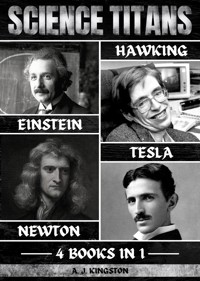
Are you ready to delve into the fascinating world of science and technology with the greatest minds of all time? Look no further than the Science Titans bundle, featuring four iconic scientists who have revolutionized our understanding of the universe and shaped the course of history.
Book 1 takes you on a journey through the life and work of Albert Einstein, whose theory of relativity transformed our understanding of space and time. Explore the mind of a true genius ahead of his time, and discover the insights that shaped his vision of the world.
In Book 2, we delve into the brilliance of Stephen Hawking, one of the most renowned physicists of the modern era. From his groundbreaking work on black holes to his insights into the origins of the universe, Hawking's mind was a beacon of knowledge and inspiration to countless scientists and enthusiasts.
Book 3 takes you back in time to the era of Isaac Newton, the legendary physicist and mathematician whose insights paved the way for modern physics and engineering. Explore his work on gravity, light, and calculus, and discover the ways in which his theories continue to influence science and technology today.
Finally, Book 4 introduces you to the visionary genius of Nikola Tesla, the man who invented the future with his groundbreaking work on electricity, wireless communication, and more. From the Tesla coil to the Wardenclyffe Tower, Tesla's legacy continues to shape our modern world and inspire new generations of innovators.
Individually, each of these books offers a glimpse into the mind and work of a true scientific titan. But taken together, they offer an unparalleled opportunity to explore the cutting-edge of human knowledge and discover the ideas and insights that have shaped our world. Whether you're a science enthusiast or a curious learner, the Science Titans bundle is an essential addition to your library. So don't wait – order your copy today!
Das E-Book können Sie in Legimi-Apps oder einer beliebigen App lesen, die das folgende Format unterstützen:
Veröffentlichungsjahr: 2023
Ähnliche

















SCIENCE TITANS
EINSTEIN, HAWKING, NEWTON, AND TESLA
4 BOOKS IN 1
BOOK 1
ALBERT EINSTEIN: A GENIUS AHEAD OF HIS TIME
BOOK 2
STEPHEN HAWKING: A BRIEF HISTORY OF A BRILLIANT MIND
BOOK 3
ISAAC NEWTON: UNRAVELING THE UNIVERSE'S SECRETS
BOOK 4
NIKOLA TESLA: THE MAN WHO INVENTED THE FUTURE
BY A.J. KINGSTON
Copyright © 2023 by A. J. Kingston
All rights reserved. No part of this book may be reproduced or transmitted in any form or by any means, electronic or mechanical, including photocopying, recording, or by any information storage and retrieval system, without permission in writing from the publisher.
Published by A. J. Kingston
Library of Congress Cataloging-in-Publication Data
ISBN 978-1-83938-329-8
Cover design by Rizzo
Disclaimer
The contents of this book are based on extensive research and the best available historical sources. However, the author and publisher make no claims, promises, or guarantees about the accuracy, completeness, or adequacy of the information contained herein. The information in this book is provided on an "as is" basis, and the author and publisher disclaim any and all liability for any errors, omissions, or inaccuracies in the information or for any actions taken in reliance on such information.
The opinions and views expressed in this book are those of the author and do not necessarily reflect the official policy or position of any organization or individual mentioned in this book. Any reference to specific people, places, or events is intended only to provide historical context and is not intended to defame or malign any group, individual, or entity.
The information in this book is intended for educational and entertainment purposes only. It is not intended to be a substitute for professional advice or judgment. Readers are encouraged to conduct their own research and to seek professional advice where appropriate.
Every effort has been made to obtain necessary permissions and acknowledgments for all images and other copyrighted material used in this book. Any errors or omissions in this regard are unintentional, and the author and publisher will correct them in future editions.
Join Our Productivity Group and Access your Bonus
If you're passionate about history books and want to connect with others who share your love of the subject, joining our Facebook group (search for “History Books by A.J.Kingston”) can be a great way to do so. By joining a group dedicated to history books, you'll have the opportunity to connect with like-minded individuals, share your thoughts and ideas, and even discover new books that you might not have come across otherwise. You can also access your FREE BONUS once you joined our Facebook group called “History Books by A.J.Kingston”.
>> Click Here to Join Our Productivity Group <<
One of the biggest advantages of joining our Facebook group is the sense of community it provides. You'll be able to interact with other history book enthusiasts, ask questions, and share your own knowledge and expertise. This can be especially valuable if you're a student or someone who is just starting to explore the world of history books.
>> Click Here to Follow A.J. Kingston <<
>> Click Here to Download your Free Bonus <<
If you love audiobooks, then joining our YouTube channel that offers free audiobooks on a weekly basis can be a great way to stay entertained and engaged. By subscribing to our channel, you'll have access to a range of audiobooks across different genres, all for free. Not only this is a great opportunity to enjoy some new audiobooks, but it's also a chance to discover new authors and titles that you might not have come across otherwise.
>> Click Here to Join our YouTube Channel <<
Lastly, don’t forget to follow us on Facebook and YouTube by searching for A.J. Kingston.
Table of Contents – Book 1 - Albert Einstein: A Genius Ahead Of His Time
Introduction
Chapter 1: The Early Years: Einstein's Childhood and Education
Chapter 2: The Road to Relativity: Einstein's Scientific Breakthroughs
Chapter 3: The Miracle Year: Einstein's Annus Mirabilis of 1905
Chapter 4: Einstein and the Quantum Revolution: His Contributions to Quantum Theory
Chapter 5: Einstein's Theory of General Relativity: Exploring the Cosmos
Chapter 6: Einstein's Political and Social Activism: A Conscience of Humanity
Chapter 7: Einstein's Later Years: His Work on Unified Field Theory
Chapter 8: Einstein's Legacy: How His Ideas Continue to Shape Science Today
Chapter 9: Einstein's Personal Life: His Relationships, Family, and Hobbies
Chapter 10: Einstein's Impact on Popular Culture: From Science Fiction to Pop Art
Table of Contents – Book 2 - Stephen Hawking: A Brief History Of A Brilliant Mind
Chapter 1: The Early Years: Hawking's Childhood and Education
Chapter 2: The Road to Hawking Radiation: Hawking's Early Contributions to Black Hole Theory
Chapter 3: A Brief History of Time: Hawking's Best-Selling Book and Its Impact
Chapter 4: The Quest for a Theory of Everything: Hawking's Work on Grand Unified Theories
Chapter 5: The Wheelchair Scientist: Hawking's Battle with ALS
Chapter 6: The Science Communicator: Hawking's Popularization of Science and Outreach Efforts
Chapter 7: The Limits of Cosmology: Hawking's Views on God and the Universe
Chapter 8: The Science of the Future: Hawking's Vision for Humanity and the Cosmos
Chapter 9: The Legacy of Stephen Hawking: How His Ideas Continue to Influence Science Today
Chapter 10: The Personal Life of Stephen Hawking: His Family, Friends, and Passions Beyond Science
Table of Contents – Book 3 - Isaac Newton: Unraveling The Universe's Secrets
Chapter 1: The Early Years: Newton's Childhood and Education
Chapter 2: The Principia Mathematica: Newton's Groundbreaking Work on Gravity and Motion
Chapter 3: The Newtonian Revolution: How Newton's Ideas Transformed Science and Philosophy
Chapter 4: Newton's Laws of Motion: The Foundation of Modern Physics
Chapter 5: The Calculus Controversy: Newton's Feud with Leibniz
Chapter 6: Newton's Optics: Discovering the Nature of Light and Color
Chapter 7: The Alchemist: Newton's Secret Pursuit of Transmutation
Chapter 8: The Royal Society: Newton's Contributions to Scientific Institutions
Chapter 9: The Later Years: Newton's Legacy and Impact on Future Generations
Chapter 10: Newton's Personal Life: His Personality, Relationships, and Legacy Beyond Science
Table of Contents – Book 4 - Nikola Tesla: The Man Who Invented The Future
Chapter 1: The Early Years: Tesla's Childhood and Education
Chapter 2: The War of Currents: Tesla's Feud with Edison and the Triumph of AC Power
Chapter 3: Tesla's Inventions: The Alternating Current Motor, the Tesla Coil, and Beyond
Chapter 4: The Wireless World: Tesla's Contributions to Radio and Wireless Communication
Chapter 5: Tesla's Vision for a Better World: The Magnifying Transmitter and Wireless Energy Transmission
Chapter 6: The Wardenclyffe Tower: Tesla's Ambitious Project to Wirelessly Transmit Electricity
Chapter 7: Tesla and the Occult: Exploring His Unconventional Beliefs and Practices
Chapter 8: Tesla's Later Years: His Work on Particle Beams and Other Innovations
Chapter 9: Tesla's Legacy: How His Ideas Continue to Inspire and Influence Science and Technology
Chapter 10: Tesla's Personal Life: His Relationships, Hobbies, and Eccentricities
Conclusion
About A. J. Kingston
Introduction
Science has always been an essential part of human civilization, allowing us to better understand the world around us and develop new technologies to improve our lives. Over the centuries, many brilliant minds have contributed to the field of science, but few have left a legacy as profound and enduring as Albert Einstein, Stephen Hawking, Isaac Newton, and Nikola Tesla.
In this book bundle, we delve into the lives and work of these four science titans, exploring their ground-breaking discoveries, their impact on modern science and technology, and their lasting influence on our culture and society.
Albert Einstein, the physicist who developed the theory of relativity, changed the way we understand the nature of time and space. Stephen Hawking, a theoretical physicist, expanded on Einstein's work and made ground-breaking contributions to the study of black holes and the origin of the universe. Isaac Newton, considered one of the most influential scientists of all time, developed the laws of motion and gravitation, laying the foundation for modern physics. Nikola Tesla, a visionary inventor, revolutionized the fields of electrical engineering and wireless communication with his ground-breaking inventions and ideas.
Through the pages of these books, we will gain insight into the brilliance, passion, and perseverance of these remarkable individuals and the incredible impact they have had on the world of science and beyond. Join us on a journey through the lives and work of these science titans and discover the enduring legacy of their genius.
BOOK 1
ALBERT EINSTEIN
A GENIUS AHEAD OF HIS TIME
BY A.J. KINGSTON
Chapter 1: The Early Years: Einstein's Childhood and Education
In the small town of Ulm, in the Kingdom of Württemberg, there lived a curious child who would one day revolutionize the world of science. This child was none other than Albert Einstein, who would become known as one of the greatest thinkers of the 20th century.
From a young age, Einstein demonstrated an insatiable curiosity and a remarkable intellect. His parents, Hermann and Pauline Einstein, were both Jewish and had immigrated to Germany from Switzerland. They recognized their son's exceptional abilities early on and encouraged his interest in science and mathematics.
Einstein's childhood was marked by a number of significant events that would shape his later life and work. At the age of four, he received a compass from his father, and he was immediately fascinated by the way the needle always pointed north. This experience would later inspire his interest in physics and his famous theory of relativity.
As a child, Einstein was also deeply influenced by his uncle, Jakob Einstein, who introduced him to the joys of mathematics. Jakob was a talented mathematician who often played math games with young Albert, challenging him to solve complex problems and puzzles. Einstein's love of mathematics would stay with him throughout his life and would form the basis for many of his most important discoveries.
Despite his obvious talents, Einstein was not always a model student. He was known to be rebellious and easily bored by the rote learning that was common in German schools at the time. However, he excelled in subjects that interested him, particularly math and physics. He often spent hours lost in thought, working out problems in his head and exploring the mysteries of the natural world.
As he grew older, Einstein's intellectual curiosity and independent spirit continued to set him apart from his peers. He was deeply influenced by the works of scientists such as Isaac Newton and James Clerk Maxwell, and he began to develop his own theories about the nature of space and time.
In 1895, at the age of 16, Einstein attempted to gain admission to the Swiss Federal Institute of Technology (ETH) in Zurich, but he failed the entrance exam. Undeterred, he spent the next year studying on his own and taking private lessons in mathematics and physics. He eventually gained admission to ETH in 1896, where he studied physics and mathematics under the tutelage of some of the most distinguished professors of his time.
Einstein's time at ETH was marked by a number of significant discoveries and innovations. He developed a deep understanding of the principles of electromagnetism and the laws of motion, and he began to explore the idea that the speed of light was constant and that time and space were not absolute but were relative to the observer. These ideas would form the basis for his theory of relativity, which he would publish in 1905.
Despite his groundbreaking work, Einstein faced significant challenges and setbacks during his early career. He struggled to find employment after graduating from ETH, and he was forced to take on a series of low-paying jobs as a tutor and teacher. He also faced opposition and skepticism from many in the scientific community, who were slow to accept his ideas and theories.
However, Einstein remained committed to his work, and he continued to explore new ideas and theories throughout his life. His dedication and passion for science would eventually earn him the recognition and acclaim that he deserved, and his theories would revolutionize the field of physics and change the way that we understand the universe.
In summary, the story of Albert Einstein's early interests and intellect is a testament to the power of curiosity and dedication. From a young age, Einstein demonstrated a remarkable talent for science and mathematics, and he pursued his interests with a passion and commitment that set him apart from his peers.
The story of Albert Einstein's life and work is a remarkable one, and his contributions to the field of physics have changed the way that we understand the universe. However, to truly understand Einstein's life and legacy, it is important to consider the cultural and historical context in which he grew up.
Einstein was born in the small town of Ulm, in the Kingdom of Württemberg, in 1879. His parents, Hermann and Pauline Einstein, were both Jewish, and their family had a long history in Germany. However, despite their deep roots in the country, the Einstein family faced a number of challenges and obstacles due to their religion and ethnicity.
In the late 19th century, Germany was a country in transition. It was undergoing rapid industrialization and modernization, and many Germans were proud of their country's newfound power and prestige. However, this era of progress was also marked by a rise in anti-Semitism and xenophobia, particularly in the wake of the economic crisis of the 1870s.
The Einstein family was not immune to these challenges. Hermann Einstein was a successful businessman, but he faced discrimination and hostility from many of his non-Jewish colleagues and competitors. Despite this, he remained committed to his work and to providing for his family.
Pauline Einstein, meanwhile, was a deeply religious woman who instilled a love of learning and intellectual curiosity in her children. She encouraged young Albert's interest in science and mathematics, and she imbued him with a sense of Jewish identity and pride.
The Einstein family's Jewish identity would continue to shape Albert's life and work throughout his career. Despite his later success and fame, he never forgot his roots, and he remained committed to his Jewish heritage and to fighting against discrimination and prejudice.
In addition to his family background, Einstein was also influenced by a number of cultural and intellectual movements that were shaping German society at the time. He was deeply interested in philosophy and literature, and he was inspired by the works of such luminaries as Immanuel Kant, Friedrich Nietzsche, and Johann Wolfgang von Goethe.
Einstein's intellectual curiosity and love of learning were also shaped by the broader cultural and educational reforms that were taking place in Germany at the time. The country was investing heavily in education and scientific research, and Einstein was able to benefit from the many opportunities that were available to him.
Despite these opportunities, however, Einstein faced significant challenges as a Jewish student in Germany. He was often excluded from academic and social circles due to his religion, and he struggled to find work after graduating from the Swiss Federal Institute of Technology in Zurich.
Despite these setbacks, Einstein remained committed to his work and to the pursuit of knowledge. His dedication and passion would eventually earn him the recognition and acclaim that he deserved, and his theories would revolutionize the field of physics and change the way that we understand the universe.
In summary, the story of Einstein's family background and cultural influences is a complex and fascinating one. Despite facing discrimination and prejudice, Einstein was able to benefit from the many opportunities that were available to him in Germany, and he was able to pursue his interests with a passion and dedication that set him apart from his peers. His legacy continues to inspire people around the world, and his story serves as a powerful reminder of the importance of perseverance and determination in the face of adversity.
The story of Albert Einstein's life and work is one of the most fascinating in the history of science. However, before he became known as one of the greatest thinkers of the 20th century, Einstein faced a number of challenges and struggles during his early education.
As a child, Einstein was known for his curious and inquisitive mind, and he demonstrated a remarkable talent for science and mathematics from a young age. However, despite his obvious abilities, he often struggled in school and faced criticism and skepticism from his teachers and peers.
One of Einstein's earliest struggles in school was with language. German was not his first language, and he often found it difficult to communicate his thoughts and ideas effectively. This made it difficult for him to excel in subjects such as history and literature, which relied heavily on language skills.
Despite these challenges, however, Einstein excelled in subjects that interested him, particularly math and science. He often spent hours lost in thought, working out problems in his head and exploring the mysteries of the natural world.
Einstein's love of science and math would eventually lead him to pursue a career in physics. However, his early education was marked by a number of significant setbacks and obstacles.
In 1895, at the age of 16, Einstein attempted to gain admission to the Swiss Federal Institute of Technology (ETH) in Zurich, but he failed the entrance exam. Undeterred, he spent the next year studying on his own and taking private lessons in mathematics and physics. He eventually gained admission to ETH in 1896, where he studied physics and mathematics under the tutelage of some of the most distinguished professors of his time.
Despite the rigorous and demanding nature of his studies at ETH, Einstein continued to face challenges and setbacks. He struggled with the conventional methods of learning that were common in German schools at the time, finding them to be boring and unengaging. He often clashed with his professors and colleagues, who were slow to accept his unconventional ideas and theories.
Despite these obstacles, however, Einstein remained dedicated to his work and continued to pursue his interests with a passion and commitment that set him apart from his peers. He made significant contributions to the field of physics throughout his early career, including his groundbreaking work on the photoelectric effect and his famous theory of relativity.
Einstein's academic struggles and triumphs serve as a powerful reminder of the importance of perseverance and determination in the pursuit of knowledge. Despite facing significant challenges and setbacks, he was able to overcome his obstacles and make significant contributions to the field of physics.
His legacy continues to inspire people around the world, and his story serves as a powerful reminder of the importance of curiosity, passion, and dedication in the pursuit of academic and intellectual excellence.
The life and work of Albert Einstein is a remarkable tale of intellectual curiosity and achievement. From a young age, Einstein demonstrated a keen interest in science and philosophy, and he pursued his interests with a passion and dedication that set him apart from his peers.
Einstein's early intellectual development was shaped by a number of significant cultural and intellectual movements that were taking place in Germany at the time. He was deeply interested in philosophy and literature, and he was inspired by the works of such luminaries as Immanuel Kant, Friedrich Nietzsche, and Johann Wolfgang von Goethe.
Einstein's interest in philosophy and literature was complemented by his love of science and mathematics. He was fascinated by the natural world and was determined to understand its mysteries. His dedication and passion for science would eventually earn him the recognition and acclaim that he deserved, and his theories would revolutionize the field of physics and change the way that we understand the universe.
One of the key influences on Einstein's intellectual development was the field of electromagnetism. During his studies at the Swiss Federal Institute of Technology in Zurich, he developed a deep understanding of the principles of electromagnetism and the laws of motion. He also began to explore the idea that the speed of light was constant and that time and space were not absolute but were relative to the observer.
These ideas would form the basis for his theory of relativity, which he would publish in 1905. This groundbreaking work fundamentally changed the way that we understand the nature of the universe, and it cemented Einstein's reputation as one of the greatest scientists of his time.
Einstein's intellectual development was also shaped by his experiences with anti-Semitism and discrimination. As a Jewish student in Germany, he often faced exclusion and hostility from his colleagues and professors. This experience heightened his sense of social justice and fueled his commitment to fighting against discrimination and prejudice.
Throughout his life, Einstein continued to explore new ideas and theories, and his work had a profound impact on the field of physics and on our understanding of the natural world. His legacy continues to inspire people around the world, and his story serves as a powerful reminder of the importance of intellectual curiosity and dedication.
In summary, the story of Einstein's intellectual development is a testament to the power of passion and dedication in the pursuit of knowledge. From a young age, he demonstrated a remarkable talent for science and philosophy, and he pursued his interests with a commitment and enthusiasm that set him apart from his peers. His work has had a profound impact on the field of physics and on our understanding of the universe, and his legacy continues to inspire people around the world to explore the mysteries of the natural world with a sense of wonder and awe.
The young Albert Einstein was a remarkable child who demonstrated a keen interest in science and mathematics from a young age. However, his path to university was not an easy one, and he faced a number of challenges and setbacks along the way.
Einstein's early education was marked by a number of significant events that would shape his later life and work. At the age of four, he received a compass from his father, and he was immediately fascinated by the way the needle always pointed north. This experience would later inspire his interest in physics and his famous theory of relativity.
Despite his obvious talents, Einstein was not always a model student. He was known to be rebellious and easily bored by the rote learning that was common in German schools at the time. However, he excelled in subjects that interested him, particularly math and physics.
Einstein's education took a significant turn when his family moved to Switzerland when he was 16 years old. He enrolled in the Aargau Cantonal School in Aarau, where he was able to pursue his interests in science and mathematics with a passion and dedication that had previously been stifled. At Aarau, Einstein excelled in his studies and developed a deep understanding of the principles of mathematics and physics. He was taught by a number of distinguished professors, including Jost Winteler, who would later become a close friend and mentor. After graduating from Aarau, Einstein attempted to gain admission to the Swiss Federal Institute of Technology (ETH) in Zurich. However, he failed the entrance exam, and he was forced to spend the next year studying on his own and taking private lessons in mathematics and physics.
Despite this setback, Einstein remained committed to his education and to the pursuit of knowledge. He eventually gained admission to ETH in 1896, where he studied physics and mathematics under the tutelage of some of the most distinguished professors of his time.
Einstein's time at ETH was marked by a number of significant discoveries and innovations. He developed a deep understanding of the principles of electromagnetism and the laws of motion, and he began to explore the idea that the speed of light was constant and that time and space were not absolute but were relative to the observer.
These ideas would form the basis for his theory of relativity, which he would publish in 1905. This groundbreaking work fundamentally changed the way that we understand the nature of the universe, and it cemented Einstein's reputation as one of the greatest scientists of his time.
Despite his success, Einstein faced significant challenges during his early education. He struggled to fit in with his peers and often clashed with his teachers and professors. However, his dedication and passion for science would eventually earn him the recognition and acclaim that he deserved, and his theories would revolutionize the field of physics and change the way that we understand the universe.
In summary, the story of Einstein's early education is a testament to the power of perseverance and dedication in the pursuit of knowledge. Despite facing significant challenges and setbacks, Einstein was able to pursue his interests in science and mathematics with a passion and commitment that set him apart from his peers. His legacy continues to inspire people around the world to explore the mysteries of the natural world with a sense of wonder and curiosity.
Chapter 2: The Road to Relativity: Einstein's Scientific Breakthroughs
The early theories and experiments of Albert Einstein marked a significant turning point in the history of physics, and they fundamentally changed the way that we understand the nature of the universe. Einstein's work challenged the prevailing scientific orthodoxy of his time, and it paved the way for a new era of discovery and exploration.
Einstein's early theories were rooted in the field of electromagnetism, and they were based on the idea that the speed of light was constant and that time and space were not absolute but were relative to the observer. This concept was revolutionary, and it challenged the prevailing understanding of the nature of the universe.
One of Einstein's early experiments that helped to establish this idea was his work on the photoelectric effect. In this experiment, Einstein observed that the energy of light was absorbed by electrons in a metal, and that this energy caused the electrons to be ejected from the metal.
This observation was significant because it provided evidence that light behaved as a particle, rather than a wave. It also suggested that the energy of light was quantized, meaning that it could only exist in discrete units.
Another important experiment that Einstein conducted was his work on Brownian motion. In this experiment, he observed the random motion of particles in a liquid, and he was able to use this observation to develop a mathematical model that could be used to predict the behavior of atoms and molecules.
This work was significant because it helped to establish the existence of atoms and molecules, which were previously thought to be purely theoretical concepts. It also provided a new way of understanding the behavior of matter at the atomic and molecular level.
Einstein's early work on the nature of light and the behavior of matter would eventually lead him to develop his theory of relativity, which is perhaps his most famous and groundbreaking contribution to physics. This theory fundamentally changed the way that we understand the nature of the universe, and it established Einstein as one of the greatest scientific minds of his time.
The theory of relativity is based on the idea that the laws of physics are the same for all observers, regardless of their relative motion. This concept challenged the prevailing understanding of the nature of space and time, and it paved the way for a new era of scientific exploration and discovery.
Einstein's work on the nature of light and the behavior of matter was deeply rooted in his curiosity and passion for the natural world. His early experiments and theories were based on a deep understanding of the principles of mathematics and physics, and they were driven by a desire to uncover the mysteries of the universe.
In summary, the early theories and experiments of Albert Einstein marked a significant turning point in the history of physics, and they fundamentally changed the way that we understand the nature of the universe. Einstein's work challenged the prevailing scientific orthodoxy of his time, and it paved the way for a new era of discovery and exploration. His legacy continues to inspire people around the world to explore the mysteries of the natural world with a sense of wonder and curiosity.
The Special Theory of Relativity is one of the most significant scientific discoveries of the 20th century. It was first proposed by Albert Einstein in 1905, and it fundamentally challenged the prevailing understanding of the nature of space and time.
At the heart of Einstein's theory was the idea that the laws of physics are the same for all observers, regardless of their relative motion. This concept challenged the longstanding assumption of Newtonian physics that space and time were absolute and independent of the observer.
Einstein's theory of relativity was based on a number of groundbreaking experiments and observations. One of the key observations was the constancy of the speed of light, which Einstein demonstrated in his work on the photoelectric effect.
Einstein also observed that time and space were not absolute, but were relative to the observer. This meant that the passage of time and the measurement of distance depended on the relative motion of the observer and the object being observed.
These observations were revolutionary, and they challenged the prevailing understanding of the nature of the universe. They also had profound implications for the way that we understand the behavior of matter and energy.
Einstein's theory of relativity provided a new framework for understanding the universe that was more consistent with the principles of electromagnetism and the laws of motion. It also provided a new way of understanding the behavior of particles at the atomic and subatomic level.
Einstein's theory of relativity was not without its critics, however. Many scientists and philosophers were initially skeptical of the theory, and some even argued that it was not based on sound scientific principles.
Despite these criticisms, however, the theory of relativity has stood the test of time, and it continues to be one of the most important and influential theories in the history of physics.
Einstein's challenge to Newtonian physics was a significant turning point in the history of science, and it paved the way for a new era of discovery and exploration. It demonstrated the power of scientific inquiry and the importance of challenging established assumptions and beliefs.
In summary, the Special Theory of Relativity was a groundbreaking scientific discovery that fundamentally challenged the prevailing understanding of the nature of space and time. Einstein's work paved the way for a new era of scientific exploration and discovery, and it continues to inspire scientists and researchers around the world to explore the mysteries of the universe with a sense of wonder and curiosity.
The contributions of Albert Einstein to the field of physics are perhaps unparalleled in the history of science. From his early experiments on the photoelectric effect to his groundbreaking theories of relativity, Einstein's work fundamentally changed the way that we understand the nature of the universe.
One of the key aspects of Einstein's method was his use of thought experiments. These were imaginary scenarios that allowed him to explore the implications of his theories without the need for costly or complex experiments.
For example, one of Einstein's most famous thought experiments involved two observers, one standing still and the other moving at a constant speed. According to Einstein's theory of relativity, the observer who was moving would perceive time and space differently than the observer who was standing still.
This concept challenged the prevailing understanding of the nature of space and time, and it had profound implications for the behavior of matter and energy at the atomic and subatomic level.
Einstein's use of thought experiments was just one aspect of his innovative and groundbreaking approach to physics. He was also known for his ability to think deeply and critically about complex problems, and for his willingness to challenge established beliefs and assumptions.
One of Einstein's most famous contributions to physics was his theory of relativity. This theory fundamentally changed the way that we understand the nature of the universe, and it provided a new framework for understanding the behavior of matter and energy at the atomic and subatomic level.
Another significant contribution that Einstein made to the field of physics was his work on quantum mechanics. This field explores the behavior of particles at the atomic and subatomic level, and it has profound implications for the way that we understand the behavior of matter and energy.
Einstein's work on quantum mechanics was highly controversial, and it challenged the prevailing understanding of the nature of the universe. However, his contributions helped to lay the groundwork for the development of new and innovative theories that would eventually lead to the development of new technologies and scientific discoveries.
In addition to his scientific contributions, Einstein was also known for his deep commitment to social justice and his advocacy for peace and understanding between nations. He believed that science and philosophy had an important role to play in shaping the future of humanity, and he worked tirelessly to promote the values of cooperation, compassion, and understanding.
In summary, the contributions of Albert Einstein to the field of physics are a testament to the power of innovation and creativity in the pursuit of knowledge. His use of thought experiments, his deep critical thinking, and his willingness to challenge established beliefs and assumptions have had a profound impact on the field of physics and on our understanding of the universe. His legacy continues to inspire people around the world to explore the mysteries of the natural world with a sense of wonder and curiosity.
Albert Einstein is often celebrated as one of the most brilliant minds in the history of science. However, his contributions to the development of the theory of relativity were not solely his own. Einstein's collaboration with his first wife, Mileva Maric, played an important role in the development of this groundbreaking theory.
Maric was a gifted mathematician and physicist in her own right, and she met Einstein while they were both studying at the Swiss Federal Institute of Technology (ETH) in Zurich. The two quickly became friends, and their friendship eventually blossomed into a romantic relationship.
Together, Einstein and Maric worked on a number of important projects, including the development of the theory of relativity. While Einstein is often credited with the primary authorship of this theory, Maric's contributions cannot be overstated.
For example, Maric helped Einstein to develop the mathematical equations that underpinned the theory of relativity. She also provided critical feedback and insights on many of his early drafts, helping to refine and improve his ideas.
Despite her significant contributions to the development of the theory of relativity, Maric's role has often been overlooked or minimized. Some historians and scientists have even questioned the extent of her contributions, suggesting that Einstein was the primary author of the theory.
However, recent research has shed new light on Maric's contributions to the development of the theory of relativity. Some historians have argued that Maric may have played an even more significant role than previously believed, and that her contributions have been unjustly overlooked.
Regardless of the extent of Maric's contributions, however, there is no denying the importance of her collaboration with Einstein in the development of this groundbreaking theory. Her insights and contributions helped to shape the way that we understand the nature of the universe, and her work continues to inspire new discoveries and innovations in the field of physics.
In addition to her contributions to the development of the theory of relativity, Maric was also a trailblazer in her own right. She was one of the first women to study physics at ETH, and she faced significant obstacles and discrimination throughout her career.
Despite these challenges, however, Maric continued to pursue her passions and to make important contributions to the field of physics. Her legacy serves as an inspiration to future generations of scientists and researchers, and her work continues to shape the way that we understand the natural world.
In summary, the collaboration between Albert Einstein and Mileva Maric was a significant factor in the development of the theory of relativity. Maric's contributions to this groundbreaking theory cannot be overstated, and her legacy serves as an inspiration to future generations of scientists and researchers. The story of Einstein and Maric's collaboration is a reminder of the importance of collaboration and teamwork in the pursuit of knowledge, and it demonstrates the power of diverse perspectives and ideas in shaping the future of science and discovery.
The General Theory of Relativity, proposed by Albert Einstein in 1915, represents one of the most significant revisions to his original theory of relativity. This groundbreaking theory fundamentally changed the way that we understand the nature of the universe, and it has had profound implications for our understanding of space, time, and the behavior of matter and energy.
The General Theory of Relativity built upon the concepts established in Einstein's earlier work on the theory of relativity, but it went further in exploring the nature of gravity and its relationship to the curvature of space and time.
According to the General Theory of Relativity, gravity is not a force between two objects, but rather it is a result of the curvature of space and time caused by the presence of massive objects.
This idea was revolutionary, and it challenged the prevailing understanding of the nature of gravity and its relationship to the behavior of matter and energy. It also provided a new way of understanding the behavior of matter and energy at the atomic and subatomic level.
The General Theory of Relativity was also significant because it helped to unify the principles of electromagnetism and gravity. These two fundamental forces had long been considered to be separate and distinct, but Einstein's theory demonstrated that they were in fact intimately related.
The General Theory of Relativity was not without its critics, however. Some scientists and philosophers were skeptical of the theory, and they argued that it was not based on sound scientific principles.
Despite these criticisms, however, the General Theory of Relativity has stood the test of time, and it continues to be one of the most important and influential theories in the history of physics.
Einstein's work on the General Theory of Relativity was deeply rooted in his curiosity and passion for the natural world. His deep insights and innovative approach to physics were driven by a desire to uncover the mysteries of the universe and to push the boundaries of scientific knowledge.
In summary, the General Theory of Relativity represents one of the most significant revisions to Albert Einstein's original theory of relativity. This groundbreaking theory fundamentally changed the way that we understand the nature of the universe, and it has had profound implications for our understanding of space, time, and the behavior of matter and energy. Einstein's work on the General Theory of Relativity was a testament to the power of innovation and creativity in the pursuit of knowledge, and it continues to inspire scientists and researchers around the world to explore the mysteries of the natural world with a sense of wonder and curiosity.
Chapter 3: The Miracle Year: Einstein's Annus Mirabilis of 1905
Albert Einstein's tenure at the Swiss Patent Office in Bern is often overlooked in discussions of his life and work. However, this period was critical to the development of his scientific ambitions and his approach to scientific inquiry.
Einstein began working at the patent office in 1902, shortly after completing his studies at the Swiss Federal Institute of Technology (ETH) in Zurich. At the time, he was struggling to find employment in the field of physics, and he took the job at the patent office as a means of supporting himself and his family.
Despite the demands of his day job, however, Einstein continued to pursue his scientific ambitions. He spent much of his free time studying and conducting research in the field of physics, and he published a number of important papers during this period.
One of the key factors that allowed Einstein to excel in both his day job and his scientific pursuits was his approach to scientific inquiry. He was known for his ability to think deeply and critically about complex problems, and for his willingness to challenge established beliefs and assumptions.
Einstein's work at the patent office also had a significant influence on his scientific approach. He was exposed to a wide range of technological innovations and inventions, and this experience helped to shape his understanding of the relationship between theory and practical application.
In addition to his scientific pursuits, Einstein was also deeply committed to social justice and political activism. He was a vocal advocate for peace and understanding between nations, and he believed that science and philosophy had an important role to play in shaping the future of humanity.
Einstein's work at the patent office was a critical period in his life and career, and it helped to shape the way that he approached scientific inquiry and the pursuit of knowledge. His willingness to balance his day job with his scientific pursuits demonstrates the importance of perseverance and dedication in the pursuit of one's goals.
In summary, Albert Einstein's tenure at the Swiss Patent Office in Bern was a critical period in his life and career. His work at the patent office helped to shape his understanding of the relationship between theory and practical application, and it influenced his approach to scientific inquiry. Einstein's ability to balance his day job with his scientific pursuits serves as a testament to the importance of perseverance and dedication in the pursuit of one's goals. His legacy continues to inspire people around the world to pursue their passions with a sense of purpose and determination.
In 1905, Albert Einstein proposed a groundbreaking theory to explain a puzzling phenomenon known as the photoelectric effect. This theory fundamentally changed the way that we understand the behavior of light and the nature of matter, and it had profound implications for the development of new technologies and scientific discoveries.
The photoelectric effect is the phenomenon in which electrons are emitted from a material when it is exposed to light. This was a puzzling phenomenon, as the prevailing understanding of the nature of light suggested that it should behave like a wave.
Einstein's theory proposed that light was not only a wave, but also a stream of particles known as photons. According to this theory, the energy of these photons was directly related to their frequency, and this energy was transferred to the electrons in the material when the photons struck the surface.
This theory helped to explain a number of puzzling observations related to the photoelectric effect, and it had significant implications for the behavior of light and the nature of matter. It also provided a new framework for understanding the behavior of matter and energy at the atomic and subatomic level.
The implications of Einstein's theory were far-reaching, and they had profound implications for the development of new technologies and scientific discoveries. For example, the development of the modern solar cell was directly influenced by Einstein's work on the photoelectric effect, as it demonstrated the possibility of converting light into electricity.
Einstein's work on the photoelectric effect was deeply rooted in his curiosity and passion for the natural world. His innovative approach to physics was driven by a desire to uncover the mysteries of the universe and to push the boundaries of scientific knowledge.
In addition to his contributions to the field of physics, Einstein was also known for his deep commitment to social justice and his advocacy for peace and understanding between nations. He believed that science and philosophy had an important role to play in shaping the future of humanity, and he worked tirelessly to promote the values of cooperation, compassion, and understanding.
In summary, Albert Einstein's work on the photoelectric effect represents one of the most significant contributions to the field of physics in the 20th century. His innovative approach to physics and his deep insights into the nature of light and matter have had a profound impact on the way that we understand the natural world. His legacy continues to inspire scientists and researchers around the world to explore the mysteries of the universe with a sense of wonder and curiosity.
In 1905, Albert Einstein published a paper that revolutionized our understanding of the movement of particles in liquids and gases. This paper, which explored the phenomenon known as Brownian motion, had profound implications for the development of new technologies and scientific discoveries.
Brownian motion is the random movement of particles in a fluid, and it had long been a subject of interest for scientists and researchers. However, it was Einstein's paper that provided a comprehensive explanation of the underlying causes of this phenomenon.
Einstein's theory of Brownian motion was based on the concept of diffusion, which is the movement of particles from an area of high concentration to an area of low concentration. According to Einstein's theory, the random movement of particles in a fluid was caused by collisions with other particles, which were themselves in a state of constant motion.
This theory helped to explain a number of puzzling observations related to Brownian motion, and it had significant implications for the behavior of matter and energy at the atomic and subatomic level. It also provided a new framework for understanding the behavior of matter and energy in complex systems.
The implications of Einstein's theory were far-reaching, and they had profound implications for the development of new technologies and scientific discoveries. For example, the development of new technologies in fields such as medicine and materials science was directly influenced by Einstein's work on Brownian motion, as it demonstrated the possibility of controlling the behavior of particles in liquids and gases.
Einstein's work on Brownian motion was deeply rooted in his curiosity and passion for the natural world. His innovative approach to physics was driven by a desire to uncover the mysteries of the universe and to push the boundaries of scientific knowledge.
In addition to his contributions to the field of physics, Einstein was also known for his deep commitment to social justice and his advocacy for peace and understanding between nations. He believed that science and philosophy had an important role to play in shaping the future of humanity, and he worked tirelessly to promote the values of cooperation, compassion, and understanding.
In summary, Albert Einstein's work on Brownian motion represents one of the most significant contributions to the field of physics in the 20th century. His innovative approach to physics and his deep insights into the behavior of matter and energy have had a profound impact on the way that we understand the natural world. His legacy continues to inspire scientists and researchers around the world to explore the mysteries of the universe with a sense of wonder and curiosity.
In 1905, Albert Einstein published a paper that fundamentally changed the way that we understand the nature of space, time, and the behavior of matter and energy. This paper, which introduced the Theory of Special Relativity, represents one of the most significant breakthroughs in the history of physics.
The Theory of Special Relativity built upon the concepts established in Einstein's earlier work on the photoelectric effect and the nature of light. It challenged the prevailing understanding of the nature of space and time, and it proposed a new framework for understanding the behavior of matter and energy at high speeds.
According to the Theory of Special Relativity, the laws of physics are the same for all observers, regardless of their relative motion. This was a radical departure from the prevailing understanding of the nature of space and time, which suggested that they were absolute and independent of the observer.
The implications of this theory were far-reaching, and they had profound implications for the behavior of matter and energy at the atomic and subatomic level. It also provided a new framework for understanding the behavior of matter and energy in complex systems, such as black holes and the early universe.
The Theory of Special Relativity was not without its critics, however. Some scientists and philosophers were skeptical of the theory, and they argued that it was not based on sound scientific principles.
Despite these criticisms, however, the Theory of Special Relativity has stood the test of time, and it continues to be one of the most important and influential theories in the history of physics.
Einstein's work on the Theory of Special Relativity was deeply rooted in his curiosity and passion for the natural world. His innovative approach to physics was driven by a desire to uncover the mysteries of the universe and to push the boundaries of scientific knowledge.
In addition to his contributions to the field of physics, Einstein was also known for his deep commitment to social justice and his advocacy for peace and understanding between nations. He believed that science and philosophy had an important role to play in shaping the future of humanity, and he worked tirelessly to promote the values of cooperation, compassion, and understanding.
In summary, Albert Einstein's Theory of Special Relativity represents one of the most significant breakthroughs in the history of physics. This groundbreaking theory fundamentally changed the way that we understand the nature of space, time, and the behavior of matter and energy. Einstein's work on the Theory of Special Relativity was a testament to the power of innovation and creativity in the pursuit of knowledge, and it continues to inspire scientists and researchers around the world to explore the mysteries of the natural world with a sense of wonder and curiosity.
In addition to his contributions to the field of physics, Einstein was also known for his deep commitment to social justice and his advocacy for peace and understanding between nations. He believed that science and philosophy had an important role to play in shaping the future of humanity, and he worked tirelessly to promote the values of cooperation, compassion, and understanding.
Chapter 4: Einstein and the Quantum Revolution: His Contributions to Quantum Theory
In the early 20th century, Albert Einstein was one of the most prominent critics of the emerging field of quantum mechanics. One of the key issues that Einstein had with quantum mechanics was its inability to explain the behavior of black body radiation, a phenomenon that had been the subject of intense study for decades.
Black body radiation is the electromagnetic radiation emitted by a perfect black body, which absorbs all radiation that is incident upon it. The behavior of black body radiation had long been a subject of interest for scientists, as it had important implications for a wide range of fields, including astrophysics, materials science, and thermodynamics.
Despite the best efforts of scientists, however, no existing theory could fully explain the behavior of black body radiation. This was a major problem for the field of physics, as it threatened to undermine the very foundations of the discipline.
In 1900, Max Planck proposed a radical new theory to explain the behavior of black body radiation. This theory, which became known as Planck's law, suggested that energy was not emitted in a continuous stream, as had been previously thought, but rather in discrete packets known as quanta.
While Planck's theory provided a partial explanation of the behavior of black body radiation, it did not fully explain all of the observed phenomena. This was a major problem for physicists, and it led to intense debate and controversy within the field.
Einstein was one of the most vocal critics of quantum mechanics, and he spent many years trying to develop a new theory to explain the behavior of black body radiation. His work on this problem culminated in a paper that he published in 1917, in which he proposed a new theory that was based on the idea of "light quanta."
According to Einstein's theory, light was not only a wave, but also a stream of particles known as photons. These photons were emitted and absorbed by matter in discrete packets, just like Planck's quanta.
Einstein's theory was a major breakthrough in the study of black body radiation, and it helped to reconcile many of the observations that had previously been unexplained. However, it was also highly controversial, and it was met with skepticism and criticism from many within the field of physics.
Despite these criticisms, however, Einstein's work on black body radiation helped to lay the foundation for the development of modern quantum mechanics. His innovative approach to physics was driven by a desire to uncover the mysteries of the universe and to push the boundaries of scientific knowledge.
In summary, Albert Einstein's early criticisms of quantum mechanics, and his work on the black body radiation problem, represents one of the most significant contributions to the field of physics in the 20th century. His innovative approach to physics and his deep insights into the behavior of matter and energy have had a profound impact on the way that we understand the natural world. His legacy continues to inspire scientists and researchers around the world to explore the mysteries of the universe with a sense of wonder and curiosity.
In 1935, Albert Einstein, Boris Podolsky, and Nathan Rosen published a paper that presented a thought experiment designed to challenge the prevailing interpretation of quantum mechanics. This thought experiment, which became known as the Einstein-Podolsky-Rosen (EPR) paradox, had profound implications for the understanding of the nature of reality and the behavior of matter and energy at the atomic and subatomic level.
The EPR paradox was based on the concept of entanglement, which is a property of quantum mechanics that describes the way that particles can become linked together in a way that defies the conventional understanding of cause and effect. According to quantum mechanics, particles that are entangled share a state, so that if one particle is measured, the state of the other particle is instantaneously affected, regardless of the distance between them.
Einstein, Podolsky, and Rosen argued that this concept of entanglement posed a fundamental challenge to the prevailing interpretation of quantum mechanics. They suggested that the theory was incomplete, and that it failed to provide a complete picture of the behavior of matter and energy at the atomic and subatomic level.
The implications of the EPR paradox were far-reaching, and they had profound implications for the way that we understand the nature of reality. For example, the EPR paradox suggested that there was a fundamental connection between particles that transcended the traditional understanding of cause and effect. This challenged the traditional view of the universe as a series of isolated, independent objects that obeyed fixed laws of physics.
Despite the best efforts of scientists, however, the EPR paradox remained a puzzle for many years. It was only in the 1960s, with the development of new theories of quantum mechanics, that the paradox was finally resolved.
Today, the EPR paradox remains one of the most important and influential thought experiments in the history of physics. It has played a key role in shaping our understanding of the behavior of matter and energy at the atomic and subatomic level, and it continues to inspire new research and new insights into the nature of the universe.
In summary, Albert Einstein's work on the EPR paradox represents one of the most significant challenges to the prevailing interpretation of quantum mechanics in the 20th century. His innovative approach to physics was driven by a desire to uncover the mysteries of the universe and to push the boundaries of scientific knowledge. The EPR paradox helped to lay the foundation for the development of new theories of quantum mechanics, and it continues to inspire scientists and researchers around the world to explore the mysteries of the natural world with a sense of wonder and curiosity.
In the 1950s and 1960s, Albert Einstein began to develop a new approach to quantum mechanics that challenged the prevailing interpretation of the theory. This new approach, which became known as the theory of generalized quantum mechanics, offered an alternative framework for understanding the behavior of matter and energy at the atomic and subatomic level.
Einstein's theory of generalized quantum mechanics was based on the idea that the behavior of particles was not purely random, as was suggested by the prevailing interpretation of quantum mechanics. Instead, he argued that there were hidden variables that determined the behavior of particles in a more deterministic way.
This new approach to quantum mechanics was highly controversial, and it was met with skepticism and criticism from many within the field of physics. However, Einstein remained convinced of the validity of his approach, and he continued to develop the theory throughout the final years of his life.
The implications of Einstein's theory of generalized quantum mechanics were far-reaching, and they had profound implications for the understanding of the nature of reality and the behavior of matter and energy in the universe. For example, the theory suggested that there was a fundamental connection between particles that was not based on purely random interactions, but rather on hidden variables that determined the behavior of the particles in a more deterministic way.
Despite the controversy surrounding Einstein's theory of generalized quantum mechanics, it remains an important contribution to the field of physics. His innovative approach to physics and his deep insights into the behavior of matter and energy have had a profound impact on the way that we understand the natural world.




