


7,19 €
Mehr erfahren.
- Herausgeber: Luath Press
- Kategorie: Geisteswissenschaft
- Sprache: Englisch
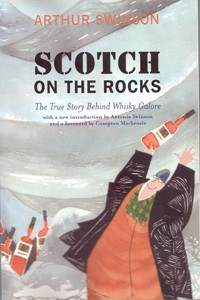
On the night of 4 February 1941, the SS Politician founders off the coast of South Uist. The salvage – nearly a quarter of a million bottles of duty-free whisky and hard currency worth, today, ninety million pounds. And to islanders across the Hebrides, it's theirs for the taking, hiding, drinking or selling. This is the true story behind Sir Compton Mackenzie's Whisky Galore. Arthur Swinson's careful research casts an honest light on the events leading up to – and following – this tremendous bounty. Awash with contraband, the communities nearby faced unexpected problems: from the government; the police; customs inspectors; and, not least, each other.
Das E-Book können Sie in Legimi-Apps oder einer beliebigen App lesen, die das folgende Format unterstützen:
Seitenzahl: 292
Veröffentlichungsjahr: 2020
Ähnliche




















ARTHUR SWINSON was born in 1916 in St Albans, Hertfordshire. He attended St Albans School and later trained as an army officer cadet at Sandhurst Military College, before joining the Worcestershire Regiment. During the Second World War he served in the infantry and the Indian army, seeing action in India, Assam, Burma and Malaya.
After the war he joined the BBC to become a senior producer of documentaries. He left the BBC in 1961 to pursue a career as a full time freelance writer, with 300 plays for television, radio and theatre, and over 30 books of fiction and non-fiction to his name. Writing for Television is a standard work on the subject. Other works range from The Great Air Race to The Orchid King, a biography of the leading orchid hunter Frederick Sander. Swinson became a well known military historian, and his book Kohima, an account of the battle in which he took part, is widely regarded as one of the best works on the Second World War.
He died in 1970, leaving a widow and three children.
Other works by Arthur Swinson include
Non-Fiction
Wingate in Peace and War (Editor)
Writing for Television
Writing for Television Today
Television in the Making (Conributor)
Television (Junior Reference Library)
Six Minutes to Sunset (Amritsar 1919)
A Casebook of Medical Detection
Kohima
North-West Frontier
The Great Air Race
Four Samurai
The Desert Raiders
The Memoirs of Private Waterfield (Editor, with Donald Scott)
Register of Regiments and Corps of The British Army (Editor)
Frederick Sander: The Orchid King
Fiction
The Temple
Plays
The Bridge of Estaban
Admetus
The Sword is Double-edged
The Senora and other plays
Crime
Sergeant Cork’s Casebook
Sergeant Cork’s Second Casebook
Adventure
The Siege of Saragoda
First published 1963 by Peter Davies, London
This edition 2005
eISBN: 978-1-913025-98-4
The paper used in this book is recyclable. It is made from low-chlorine pulps produced in a low-energy, low-emission manner from renewable forests.
Printed and bound by
Bookmarque Ltd., Croydon
Typeset in 10.5pt Sabon
© 1963 Arthur Swinson; Introduction © 2005 Antonia Swinson
To Joy with love
Contents
Acknowledgements
Introduction by Antonia Swinson
Foreword by Sir Compton Mackenzie
‘The Song of the Politician’
CHAPTER 1 A Ship Sails
CHAPTER 2 Quest in the Hebrides
CHAPTER 3 The Quest Continues
CHAPTER 4 The Islanders Attack
CHAPTER 5 The Customs Counter-Attack
CHAPTER 6 The Law in Lochmaddy
CHAPTER 7 The Days of the Shipbreakers
CHAPTER 8 The Mystery Explored
CHAPTER 9 The Final Count
Acknowledgements
MY THANKS ARE DUE
To Her Majesty’s Commissioners of Customs and Excise for making available official documents; also to Mr Maurice Nockles and Mr F G Evans of this Department.
To Mr D H Dickens, Head of the Information Department, Messrs Lloyd’s, London, for providing a complete set of signals from the Politician.
To the Registrar General of Shipping and Seamen for providing a photostat of the ship’s log, and for helping me trace members of the crew.
To the Superintendent, Meteorological Office (Edinburgh), Air Ministry, for information regarding weather conditions.
To the Hydrographer, Hydrographic Department, Admiralty, for information regarding tides and currents in the Hebrides.
To the Secretary, the Royal National Lifeboat Institution, and to Mr Allan MacDonald of the Barra Lifeboat, for information regarding the rescue of the crew.
To the GPO (Edinburgh) for providing the map of the undersea cable.
To Dr W Bullerwell (Chief Geophysicist) and Mr T R M Lawrie (District Geologist) for geological information regarding the Outer Hebrides; also for kindly allowing me to quote from their letters.
To Mr T Huntington (2nd Engineer) and Mr Fothergill Cottrell (Cadet) of the Politician for their personal memories; also to Mr H I Strickland, the ship’s cook.
To Mr David Shaw, Procurator-Fiscal of Lochmaddy for tracing court records.
To Mr Leslie Harrison, General Secretary of the Mercantile Marine Service Association; and to Mr Owen, head of the Marine Department, for helping me trace officers of the Politician.
To the editorial staff of Sea Breezes for providing material for the biography of the Politician.
To Mr Ivan Gledhill, late Surveyor of HM Customs, for his help and advice.
To Mr P E Holden, late of Messrs Arnott, Young & Co., for material regarding the shipbreaking operations.
To the inhabitants of South Uist who kindly gave me their stories; especially Norman MacMillan, Angus John Campbell, John Curry, and Peter MacInnes. Also to John McIsaac and Donald MacDonald of Eriskay, and Kenneth McCormick, formerly of Barra.
To Colonel Charles Cameron for his help and advice while I was in the Outer Hebrides.
And finally to Sir Compton Mackenzie who first brought the story of the Politician to the notice of the world, for his advice, and for generously offering to write the foreword.
Introduction to the 2005 Edition
EARLY IN 2005, with the arrival of the Freedom of Information Act, the SSPolitician began to resurface with the news that apart from the 250,000 bottles of whisky, there was £3m in currency on board, much in Jamaican 10s. notes. Given that the ship was initially bound for the Caribbean in that cold February in 1941, conspiracy theories swirled: that this was spending money intended for the Windsors, in case Hitler had invaded and they had decided not to wait to look the East End in the face after all; or hush money for the former king and his wife, that Winston Churchill was up to his neck in the Politician’s preparation. Whatever the truth, these reports fed a growing fascination with what really happened, already stoked by press reports of a remake of the film of Compton Mackenzie’s bestselling novel Whisky Galore. It seems this was time to take a new look at this dusty slice of Scottish wartime history, indeed to reclaim it for today’s devolved, self-confident Scotland. Yet in all the excitement, it was widely acknowledged that though long out of print, Arthur Swinson’s Scotch on the Rocks, the original true story of what really happened, has never been surpassed.
In 1962, while researching for a programme series on Customs and Excise my father had the opportunity to spend several weeks on the islands interviewing those who had been part of the story. He had originally heard about the SSPolitician a few days after it was wrecked, while stationed in northern India. It seems it was the wonder in the face of the Scotsman who told him about it which stuck in his mind. This was magic, a world away from the dusty terrors of warfare. Real drama in an improbable setting. And whisky, thousands of bottles of it. Just lying off shore waiting for rescue …
In September 2005, I was asked to write a piece for The Scotsman and my family and I travelled in Arthur’s footsteps to Lochboisdale in South Uist. As the ferry brought the sharp beauty of the landscape into view, early childhood memories surfaced: my father returning to our home in Hertfordshire after weeks away with an old whisky bottle he said was treasure from a shipwreck, which was filled with the whitest sand I had ever seen. He also brought a blue and yellow tartan blanket which for years served as a tree house tent or a magic carpet for me and my siblings, Sabra and Sheridan. I also have a later memory of arriving at Freshers’ Week at Edinburgh University and being surprised when a lecturer told me that almost everyone I would meet in Scotland aged over forty would have a copy of Scotch on the Rocks in their bookshelves.
It is the scale of the reality which is striking to any visitor, reared on repeat showings of the 1949 Ealing comedy. The SSPolitician was no puffer boat, but a 7,900 ton cargo ship, and a key player in the nation’s merchant fleet. The channel where it hit the rocks is narrow, the waters shallow enough to have made the ship tower over the landscape and the islanders’ small craft with their swinging Tilly lamps. The islanders themselves would have also been not the jolly rogues of Brigadoon caricature, but literate, thinking individuals, part of a cohesive community imbued with highly evolved, business-like values of integrity and self reliance.
In 1941, despite the shortages, they would also have been economically far better off than many of their rationed countrymen on the mainland, with plentiful supplies of herring, meat and eggs. Major shipwrecks and the resulting stimulus to the local economy were far from uncommon. As my father recorded, there had been no fewer than eight ships which had run aground in the immediate area, three occurring in quick succession at that time. This was business as usual.
Sir Compton Mackenzie memorably described his bestseller Whisky Galore as ‘a modern fairy tale’. Few could argue with its enduring magic. Yet on the islands unexpectedly, I encountered strong feelings that his book had actually done them a disservice. That this unlikely founder of the Scottish National Party – in real life an actor’s son from West Hartlepool – had concocted a Gaelic speaking paradise of canny peasant crofters to bolster his own successful reinvention as a patrician Scot, fixing the Hebrides for all time in a feudal, tourist time warp.
Perhaps to find the true story, it needed another Englishman, one with no pretensions to any Scots heritage whatsoever, to ask the difficult questions. For the true story, as Arthur Swinson found after weeks researching on the islands, was a grittier, far more textured affair, which curdled into island life with few neat and happy endings. The treatment of those jailed – men supposed to give their lives to defend their country in wartime, remember – was shameful. Neither authorities nor islanders were unscathed by the Politician.
As he writes, ‘to anyone who insists on a moral, one can only state I think, that faced with these extraordinary circumstances, the rash became rasher, the drunken more drunken, the avaricious more avaricious, the convivial more convivial, the generous more generous, the treacherous more treacherous, the selfish more selfish, and the commercial more commercial.’
These were real flesh and blood people experiencing the full heat of a gold rush: the sudden discovery of free supplies for all, of a valuable, bountiful and highly portable commodity.
It was always a mystery how on earth my father – very much the moustachioed, Sandhurst and public school educated English army officer – could ever have persuaded the islanders to open up. Yet Arthur was no posturing Captain Waggett, but someone who had grown up through the Depression with few luxuries, winning his way on scholarships with ambitions to be a major playwright, at a time when the theatre so captured the imagination of young men in a hurry.
Arthur was larger than life, loved people and could create a party with his stories. It must also have helped that he was generous to a fault when buying his round! However, I believe it was principally through his seven years in the ‘Forgotten Army’, serving in Burma, India, Assam and Malaya, that he found the means to connect to Hebrideans, so many of whom had shared his experience.
Scotch on the Rocks is therefore as much a journey of self discovery, as that of the celebrated ship. Page after page, you can feel that south east England stress slipping off Arthur’s shoulders, as he encounters the kindliness, prickliness and integrity of island life, and begins to process the trauma of his own war years. Open minded, with a nose for truth and a fine eye for detail, he cuts the islanders some slack, seeing them as neither cut out cardboard thugs or heroes, just people getting on with their lives in a world unfamiliar to him. Scotch on the Rocks remains an extraordinary piece of travel writing, vividly evoking a Hebridean way of life which had changed little since wartime.
The manuscript has not been updated or amended apart from the correction of local names which were misspelt in official documents, but deserves to be seen in its own terms, in its own time. Arthur was an Englishman, writing for a predominantly English public. The cultural references are therefore of his time and place, interesting in their own right to a modern audience. Scotsmen back then were indeed affectionately referred to as Jocks, and as, back in St Albans, Arthur would eat his dinner every night with my mother at 8 pm, he may perhaps be forgiven early on in the book when describing the Scottish high tea taken at 5 pm as an ‘abomination’. (Though he redeems himself later by relishing a ‘delightful Scottish tea’.) As Moray McLaren writing in The Scotsman at the time observed, ‘It is most interesting to follow this Englishman’s conversion. Is his presentation of his conversion [to the islands’ way of life] deliberate art, or is it a result of writing his book as it happened to him? In any event, it is most effective.’
It is also interesting for modern readers to see how attitudes have changed. When Arthur wrote the book, wartime rationing had ended only a few years earlier, and with the 1960s yet to swing into action, deference ruled. Like all his generation who had lived so intensely through World War Two, he retained a faith in national institutions, the landed Establishment and centralised Westminster government, which may strike today’s reader as poignant, especially north of the border! But what makes the narrative sparkle is that he did not hesitate to rattle cages and refused to take no for an answer. As we read, we are swept along in his enthusiasm to find out the truth.
Arthur did not have the advantages of the Internet, nor any Freedom of Information Act. In the early ’60s wartime ‘d’ Notices still bristled. Yet how he managed to get round officialdom and solve the mystery of why the Politician ran off course remains a masterly piece of detective work. Best of all, Arthur Swinson was a storyteller, with an energetic, sparse prose style which remains refreshingly contemporary. As the London Evening Standard observed at the time, Scotch on the Rocks is ‘vastly entertaining’.
As my father concluded, ‘this story happened to the right people and at the right time. In a chaotic world, this does not happen often; and when it does, it should be recorded.’
The true story of the Politician remains as fascinating as ever and I am delighted that his masterly work can now be enjoyed by a new generation.
Arthur Swinson died an untimely death from a heart attack aged 54, just seven years after Scotch on the Rocks was published. In total, he wrote over 30 books, mainly military history, as well as 300 radio and TV plays and documentaries, and even a musical. His creative connection to Scotland continued, in writing both the TV and radio series of Dr Finlay’s Casebook.
To those who knew him, he was a human whirlwind, always working on a thousand projects whether paid and unpaid. In his home town, St Albans in Hertfordshire, he co-founded a still thriving theatre company and poetry society, and would regularly discomfort local councillors with popular petitions to save ancient trees and period buildings from the bulldozers. In his professional life he was a leading campaigner for Public Lending Right, and as an executive committee member of International pen, campaigned energetically for writers imprisoned abroad. He also loved helping ambitious, young people get that first break into the television – one of whom was Harry Potter film producer Mike Newell.
When Arthur Swinson died in 1970, hundreds packed into St Albans Cathedral for his memorial service, unable to believe that this extraordinary, larger than life, driven, kindly personality had actually left town.
Cold, commercial logic in a world of commoditisation of both books and authors, would suggest that there is nothing quite so dead as a dead author. But thanks to the imaginative vision of Luath Press, Arthur Swinson lives on, in this remarkable book.
His talent also endures for the future: in the lives and potential of his two grandchildren, Rory and Ella Swinson Reid, to whom this new edition is dedicated.
Antonia Swinson
Edinburgh, November 2005
Antonia Swinson is an Edinburgh based journalist and writer. Her latest book Root of All Evil? is published by St Andrew Press.
Foreword
IT NATURALLY GIVES me great pleasure to write a foreword to Mr Arthur Swinson’s dogged pursuit of the facts about the SSPolitician, and in doing so to be able to testify to the accuracy with which he has told what everybody will surely find an absorbing tale.
There is only one question to which Mr Swinson has not given me an answer. Why were 20,000 cases of Scotch whisky shipped from Liverpool and how did they get there? I have been told that the Secretary of State for Scotland, the Rt Hon Thomas Johnston, after a lot of whisky was lost by enemy action in Glasgow and in Leith, decided that no more of the precious liquid should be wasted by German bombs and gave orders for all the whisky available to be immediately evacuated. At a Highland gathering in the late St Andrew’s Hall after that great Scottish Secretary had been talking about hydro-electricity I told the audience that much as I admired his achievements over water I was even more grateful for his prompt action over whisky, thanks to which so many of his countrymen were able to enjoy, free of duty, their native spirit in the land that produced it.
And I take this opportunity of declaring that the destruction of so much of that whisky by the Customs and Excise adds one more example to the long and dreary record of bureaucratic hebetude. Cherishing as I do a deep regard and affection for those men and women of the West with whom I lived so happily for many years I am glad to be assured by Mr Swinson that a third of that cargo was salvaged by those who had a moral right to it whatever the law might say.
Two or three years ago as I was walking from Brook Street into Grosvenor Square a lorry pulled up by the zebra crossing. I turned to acknowledge the courtesy as I always do and walked on. Presently I heard footsteps behind me and the driver of that lorry as he caught up with me looked round. ‘Yes, I thought it was you,’ he said. ‘I was one of the crew of the Politician. We had a good deal of it but I expect you had more.’
And as I look back to perhaps a hundred bottles standing to attention along the top of my bookshelves I realize how right he was. I wish Scotch on the Rocks the success enjoyed by Whisky Galore for sixteen years.
Compton Mackenzie
The Song of the ‘Politician’
Don’t ask me why I’m feeling sad,
My thoughts are melancholy.
The truth is that I’ve had a dram
Of whisky from the Polly.
For that’s the ship that came ashore,
And you never saw her like before –
She’d whisky in the hold galore
And it’s led me into folly!
When they brought the news that she was there
I took my boat to board her;
Found silk and cotton, sherry, stout,
And fine goods ranged in order.
But down there in the flooded end
Was every kind of brand or blend
That God or a kindly fate could send –
And me the first marauder!
‘Twas clear to me and clear to all
That ship was wrecked for ever;
And if we left the whisky there
It would be tasted never.
But soon the Customs came around
And though I’d hid it underground
My stock of good ‘Spey Royal’ they found –
And I thought I’d been so clever!
So to Lochmaddy Court I went,
Bewildered and outwitted.
The Fiscal stood and read the charge
But I would not admit it.
The policemen stood around there tense
While the Customs gave their evidence –
But the Sheriff said it didn’t make sense
And so I was acquitted!
So here’s a health to the Captain bold
Of the good ship Politician!
And here’s to the rock she struck that night,
A-sailing on her mission!
What’s left of her can still be found
Off Calvay Isle in Eriskay Sound;
Of all great ships she is renowned –
The Polly!
The Polly!
We shall not see her like again
Though we live from now to a hundred and ten, The good ship Politician!!
Gaelic Ballad by Roddy Campbell
Translated by Norman MacMillan
English version by Arthur Swinson
CHAPTER 1
A Ship Sails
AT 3.05 PM ON MONDAY, 3 February, 1941, a ship steamed gently out of Mersey harbour and headed west down the channel towards the open sea. Though there was a fresh breeze the day was overcast, and by the time she had reached the Bar Light Ship it was dark. The ship was the SSPolitician (gross tonnage 7,939) and her orders were to sail to the north of Scotland and there rendezvous with a convoy. She was then to sail on to Jamaica and the United States of America.
Among seamen she was rated a good, sound ship with excellent crew accommodation. She was fast too for those days and could cruise at seventeen knots. It was her speed, in fact, that had decided that she should go north on her own; ships had been torpedoed in coastal waters, but for a ship like the Politician the risk was considered negligible. She had been built in 1923 by the Furness Ship Building Company, at Haverton Hill-on-Tees, in County Durham, designed for the Pacific trade; and for years she crossed and recrossed the oceans, bearing the name Sofss the SSLondon Merchant, the largest and fastest ship in the Furness Withy line. Then, in 1935, she was sold and renamed the Politician and set to work on the North Atlantic run. Four years later the war broke out and her bright peacetime colours were lost beneath the dull browns and greens of camouflage, as she became engaged in the arduous and often perilous business of saving Britain from starvation. But even in wartime she was a popular ship to sail in. ‘With all those knots,’ the men would say, ‘you can get yourself out of trouble.’
Her Master, Captain Beaconsfield Worthington, was popular too. A Liverpudlian of 63, he had over forty years at sea behind him; and though he may have been a bit dour and humourless, no one was likely to hold that against him.
Frivolity is not a quality greatly admired on the Mersey, especially in sea captains, and in any case he was a man who got on with the job and did not throw his weight around too much. Off the bridge he could be sociable, convivial even. Sometimes he would drop in to see the Chief Engineer (Ted Mossman) or the Second Engineer (Tom Huntington) and drink with them in their cabins till three in the morning. He was not a stickler for detail, and for some tastes he could have glanced at the rule book rather more frequently; but no one would have denied that he was a good skipper, and he knew his job.
The Mate was Mr R A Swain, from Eastham in Cheshire. Though he was twelve years younger than Worthington, some of the crew noticed that he was beginning to look tired and strained. The Second Officer was Mr W P Baker of Liverpool; and the Third Officer Mr R H Platt of Penwortham, Preston. Also among the ship’s complement, which totalled fifty-two, were two cadets: Maurice Watson and Fothergill Cottrell, both aged 17. It was Cottrell’s first voyage, and as he watched the low banks of the channel move slowly past, his anticipation of the adventure to come was tinged with a slight feeling of homesickness and apprehension. He came from a seafaring family, his father being Commander V S Cottrell, RNR, and he had been trained for the sea at Pangbourne Nautical College in Berkshire. But now he was aboard his first ship and receiving his first orders; it was a day he would always remember.
‘How’s her head?’
‘085 degrees, sir.’
‘Keep her steady on that.’
‘Aye, aye, sir.’
There was a company rule that in coastal waters the Captain should remain on the bridge. But rule or no rule, when a ship negotiates the Mersey channel, the Captain would not dare be anywhere else. Though the pilot gives the orders to the AB at the wheel, the responsibility for the ship is still his. The channel is long and tortuous; nowhere is it very wide and at its narrowest it is only twice the width of a football pitch. Apart from other ships, there are hazards such as floating wreckage, mudbanks which are constantly changing their contours, or buoys which have floated out of position. In heavy mist or fog, or in a high wind, the journey can be a nightmare; but even on a clear day there is no time to relax.
Mr Swain, the Mate, was glad of a rest on his bunk. He had been through an exacting forty-eight hours, for, apart from supervising the loading of the cargo, he had had to sign on the crew at the Board of Trade office. Luckily, on this voyage, only one man had failed to report – a fireman – but several were late, and getting all the forms completed and signed had taken some hours. (Later on in the war, the owners were to appoint an officer to do nothing else but look after crews, but in 1941 it was still the Mate’s job.) Things had not been made any easier by the fact that the cargo included whisky – and some of the cases had been mysteriously damaged on their journey to the docks, or on the quayside as they awaited shipment. The bottles in the damaged cases, however, still remained whole, and, in their frequent breaks, the dockers could be seen pouring the neat spirit into their tea mugs and swilling it down. But despite such activities, the whole cargo, including bales of cotton, bicycles, machine tools and everything else was loaded on time.
The Captain’s orders were to anchor for the night at the Bar and then steam north the following morning. As he went up on deck before breakfast he noticed that although the sky was still overcast the wind had freshened a little from the south east, but for February the going should be good. Sunset would be at 1755 hours (1655 GMT) giving him about ten hours of daylight to steam past the Isle of Man, across the Irish Sea, and out through the North Channel. As it happened, the night closed in early and the officer on watch did not see Rathlin Island, off the Irish coast, as the ship went by to the east; but he was not greatly concerned. Soon she was in the open sea and with the Atlantic waves beneath her, long and even, and quite different from the broken rhythms close in to shore. To a sailor the feeling of deep water comes almost as a benediction; he is not only safe, he is where he belongs.
Eight pm. The Third Officer, Platt, came on watch. There was no land till the Skerryvore Lighthouse, sixty miles to the north, and as long as he kept well to the seaward of it, there could be no trouble. At least he hoped not. But at 10 pm with the Skerryvore twenty miles off, the look-out on the bows sang out that there were ships steaming towards them. Summoned from his cabin, the Captain came up on the bridge immediately, and realized that his ship had come into the track of a large convoy. With no moon and with all side-lights dimmed it was not going to be easy to avoid a collision. But he had to go on – there was no alternative, for apart from the impossibility of anchoring, there was his RV with the convoy to consider. If he were late and it sailed without him, the wrath of his employers would descend upon him, not to mention the displeasure of their lordships at the Admiralty. So, carefully, he steered his course through the parallel lines of ships, observing when they zigzagged, and giving his orders to the helmsman accordingly. His men were watching him and he knew it; but his great experience of the sea had not let him down before, and would not now. In half an hour the last ships of the convoy and the inevitable stragglers had gone by to the south, and the crisis was over. Captain Worthington went back to his cabin and the Politician steamed north at seventeen knots.
Midnight. Baker came on watch. Though he had been sitting in a darkened cabin for twenty minutes to let his eyes become adjusted, he noticed immediately that the night was black; and the wind was blowing half a gale from the south east. But his watch passed without incident and at 4 am the Mate came up to relieve him. The ship was now passing the Skerryvore, well to the west, and heading for the wide entrance to the Minch, the channel between Skye and the Outer Hebrides. It was not a track the Politician would have used in peacetime, but with the German submarines attacking merchantmen wherever they could find them, all routing was in the hands of the Admiralty and ships had to go where they were told. Not that the Minch is a particularly difficult channel, except in very rough weather; at its narrowest it is fourteen miles across and for most of its 130 miles it is two or three times that width. Swain checked the ship’s head, had a word with the AB at the wheel, and moved out to take observation from the starboard wing.
There had been several squalls during the night, and now the rain was coming down steadily, striking the white crests of the waves before they hurled themselves across the bows. The wind had begun to howl and though, according to the ship’s chronometer, it was only an hour from first light, it might have been 2 am. The ship rolled and pitched in the blackness; but the orders were to keep going full steam ahead, and they had to be obeyed.
Suddenly there was a shout from the gunner on the starboard wing.
‘Hard a port! Hard a port!’
Swain left the wheel and rushed across to him. ‘What’s up?’
The gunner gesticulated frantically: ‘A battleship on the starboard bow, sir!’
The AB had swung the wheel over, but before the ship could answer there was a loud grating beneath the keel and a violent tremor that shook her from end to end. For what seemed an age she rode half out of the water, then the stern dropped down with a crash and she was motionless.
‘Captain on the bridge!’
Worthington swung out of his bunk, grabbed some clothes and hurried up the stairs. Like most of the crew not on duty, he had been jerked out of his sleep by the crash and was moving instinctively, still half dazed. About him he could hear shouts and cries as men tried to find out what had happened and warn their mates. Down in the engine-room, Tom Huntington was on duty. After the first impact, he had heard something clattering against the side of the ship, and moved along to investigate. It was an electric fan. At first he thought that it had been swung out of position, but then to his horror he saw that the ship had been dented below the water-line for a length of six feet or more. He ran to the blower and put a call through to Mossman’s cabin.
‘Chief – would you come down, please?’
‘I’m on my way.’
The Chief was not one to flap, but when the occasion demanded he could move as fast as anyone. He hurled himself out of the cabin, pushed his way past the men talking excitedly in the corridor and a few seconds later was down below.
Worthington had reached the bridge and was following Swain out on to the starboard wing. ‘What the hell is it?’ he was asking, his brain numbly aware that he had committed the unforgiveable sin of a Captain and let his ship run aground.
‘A rock, sir.’
Peering through the rain and the darkness, the gale shrieking behind him, he could feel rather than see the great mass of rock facing him above the waves. For perhaps five seconds he stood motionless then he turned and strode back to the wheel.
‘Full astern!’
‘Full astern, sir.’
The telegraph tinkled and the reverberation from the engines shook the decks; but the ship did not budge. Motionless the Captain waited… thirty seconds… a minute. Then he barked:
‘Full ahead!’
‘Full ahead, sir.’
Again the throbbing power from the engines, but the ship remained motionless, almost as if she were held in the clutch of a giant hand. For all the power it had to urge her forward, the propeller might have been made of tissue paper.
Down in the engine-room, Mossman and Huntington were obeying the signals as they were transmitted from the bridge, though their engineering sixth sense told them they were useless. They were not even surprised when a fireman ran up, shouting, ‘The water’s coming in, sir!’
Mossman turned to him calmly: ‘All right, I’ve seen it,’ he said. ‘Get back to your post.’
The water had been coming in since the moment of impact, silently, almost apologetically, but from two or three inches it had now risen to a foot. More than that… almost two feet.
‘Full ahead!’
‘Full astern!’
The telegraph kept tinkling as the Captain went on doggedly, trying to free his ship. But, watching the rising water-level, Mossman was getting anxious about his boilers. If an explosion was to be avoided the steam must be got out of them.
‘Sir! Sir!’ A deck hand came splashing towards him from the stern. ‘It’s no use!’
‘What’s no use?’
‘The propeller shaft’s been driven right up against the deck-head. It’s broken right through.’
The firemen had gathered round now in a tight ring. Instinctively they glanced towards the boilers, then turned back towards Mossman to await his order. But he ignored them to speak to Huntington: ‘Tom, ring the bridge. Finish with engines.’
Huntington hesitated a moment. This signal usually comes from the bridge, not the engine-room, but he went to the telegraph nevertheless. Meanwhile Mossman had detailed some men to shut off the fuel and help deal with the boilers; the others he dismissed, and they were soon scrambling up the ladders towards the relative safety of the decks.




