


Erhalten Sie Zugang zu diesem und mehr als 300000 Büchern ab EUR 5,99 monatlich.
- Herausgeber: Luath Press
- Kategorie: Geisteswissenschaft
- Sprache: Englisch
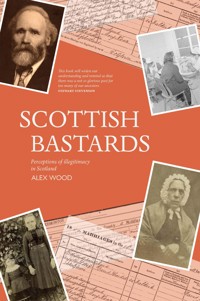
Scottish Bastards: Illegitimacy in Scotland by Alex Wood delves into a fascinating yet often overlooked aspect of Scottish history. This groundbreaking book explores the complex tapestry of illegitimacy woven into the fabric of Scottish life, sparking debate and discussion across generations. Spanning the 18th to the 20th century, Wood meticulously examines changing attitudes towards illegitimacy, revealing how these views have influenced society, literature and culture. Through detailed research and compelling case studies, he illuminates the historical, religious, social and statistical contexts that have shaped perceptions of illegitimate birth in Scotland. Expect an in-depth analysis of the cultural ramifications of illegitimacy, as well as insights into the evolution of attitudes and laws surrounding it. Wood's exploration offers a rich understanding of how societal norms have shifted and the impact on individuals deemed 'illegitimate.' For those intrigued by the intersections of history, culture and identity, Scottish Bastards is an essential addition to your reading list. Don't miss the chance to explore this compelling narrative.
Sie lesen das E-Book in den Legimi-Apps auf:
Seitenzahl: 364
Veröffentlichungsjahr: 2025
Das E-Book (TTS) können Sie hören im Abo „Legimi Premium” in Legimi-Apps auf:
Ähnliche



















ALEX WOOD was born in 1950 and spent his early years in Brechin, Girvan and Paisley. He graduated in English and Education from the New University of Ulster in 1972. He returned to Scotland, trained as a teacher at Moray House College and worked in education for 38 years, completing his full-time professional career as Head Teacher at Wester Hailes Education Centre in Edinburgh. He completed an MLitt in Scottish Studies and an MEd in Education at Stirling University. He later developed a personal interest in genealogy and completed Strathclyde University’s MSC in Genealogical Studies after his retiral and now has a company carrying out family history research. He lived for over 30 years in Linlithgow where he and his wife raised their two daughters, both of whom are now teachers, but recently moved to Winchburgh.
First published 2025
ISBN: 978-1-80425-330-4
The author’s right to be identified as author of this book under the Copyright, Designs and Patents Act 1988 has been asserted.
Typeset in 11 point Sabon by
Main Point Books, Edinburgh
© Alex Wood 2025
To Frances, my rock
Contents
Foreword
Preface: Personal and Family History: the Genesis of an Academic Fascination
Introduction
1 Illegitimacy in Scotland: the Social and Statistical Background
2 The Church and its Discipline
3 Illegitimacy in Literature
4 Illegitimacy in Pre-19th-Century Scotland
5 Four Politicians (Keir Hardie, Ramsay MacDonald, George McCrae, Robert Rowan)
6 Five Literary Figures (Charles Reade, William McGonagall, George Douglas Brown, Jessie Kesson, Hamish Henderson)
7 Illegitimacy and the Middle Class
8 Working-Class Case Studies
9 Adoptees and Surrogacy
10 Conclusions
Appendices
Bibliography
Endnotes
Foreword
THE SUBJECT OF Alex Wood’s new book provides a timely visit to the history, and abolition from Scotland’s legal system, of a ‘four-letter word’ which happens to have seven letters.
As children, the Anglo-Saxon parts of our expanding vocabulary were ‘sweary words’. Whispered in giggling tones into the ears of our schoolmates and then shouted, at a safe distance, to provoke a response from others outwith our own friendship circle. But that seven-letter word used to describe illegitimacy came not from any path chosen by a child. The abuse derived from careless conception. Undeserved and cruel.
Alex quotes from the early parts of the Bible to remind us that children born of unmarried parents are the equals of any of us. Only after the Reformation when the presbyterian Kirk Sessions took over the interpretation of morality, and punishment of infractions, did bastardy assume the gross stigma that it did some 200 plus years ago.
Literature mined the prejudices against illegitimacy to mock the rich and powerful. With Alex describing how Thomas Hardy, Nathaniel Hawthorne and our own revered Robert Burns led the charge in prose, poetry and personal conduct.
But three steps described in this book help us understand how the power of illegitimacy over personal conduct began to ebb and eventually die.
The transfer of birth registration from church to state in 1855 in Scotland loosened the former’s power over the people. Alex tells us how the civil powers later removed the recording of illegitimacy from birth records.
The Registrar General in the 1920s introduced the ‘short certificate’ which removed any hint of a dubious circumstance of birth. The times were changing, ultimately leading to the 2006 Act which abolished illegitimacy from our legal system.
Alex’s book tells us that 7.8% of our births were illegitimate in 1855 but that by 2022, 55% were to unmarried parents. Now that bastardy is history, we’re shown that many significant people had parental uncertainty. I now know that Keir Hardy’s birth was registered with his bearing the name James Kerr. Ramsay MacDonald had no father on his birth registration. But that was no barrier to his becoming the first Labour Prime Minister.
William McGonagall is revealed to have been the father of a number of illegitimate offspring and grandfather of even more. His contemporary fame, however, was rather for his awful poetry.
Hamish Henderson contributed much more to Scotland as a folk song collector and with many other accomplishments to his name. His parentage proved no barrier to his success.
But Scotland was hardly alone in this. Jack Nicholson and Eric Clapton are distinguished members of the ‘club’.
Alex concludes by reminding us of the ‘pain, turmoil and confusion’ inflicted on so many.
His book will widen our understanding of that and remind us that there was a not so glorious past for too many of our ancestors.
Every family was touched by this. Thankfully none will be now.
Enjoy.
Stewart Stevenson, MA FSASCOT FRSSA Editor, The Scottish Genealogist
Preface
Personal and Family History: the Genesis of an Academic Fascination
ILLEGITIMACY HAS LONG been both a feature of Scottish life and a source of passionate debate, detailed research and popular discussion. To this day, despite countless social changes, the term ‘bastard’ remains a crude and frequently used insult.
For the author, interest in the issue has been almost life-long. My maternal grandmother, Mary Ann Sinclair, was illegitimate. I had been aware of that from various comments made by my mother. I knew from my mother that my grandmother’s father had been William Sinclair, a cabinet maker. My grandmother, who lived with us, spoke in great detail about her mother and her mother’s wider family but never, in my presence at least, of her father and his family. On one occasion however, my mother found an old photograph album. My grandmother, then in her mid-80s, was, initially, delighted.
Mary Ann Sinclair (left) withJeannie Sinclair (right)
She smiled, ‘That was my mother’s album.’ She then flicked through the photographs, identifying this relative and that, remembering events, identifying venues, puzzling over a few photographs. She came across one photograph, patently of herself, a young child of about three, along with a tiny, adult woman. ‘That’s me and my auntie, Jeannie Sinclair, the dwarfie woman.’
My interests were immediately stirred. ‘Would that be your father’s sister, then?’ I asked.
The album was slammed shut. ‘That’ll be enough of that!’ She stormed from the room. I had patently hit a sensitive spot. Subsequent to that unintentional slip, she never again (and she lived to be 95) spoke to me of her father’s family. It was not until my interests in genealogy had become systematic, well after her death, that I pursued William Sinclair and his sister, who had indeed suffered from dwarfism.
William Sinclair, it transpired, never married my great-grandmother, left Scotland for the USA six years after the birth of my grandmother, and settled initially in Massachusetts and subsequently in Chicago. He met, and married in 1901, Lydia Smith, who was an English-born hotel keeper in Chicago and 16 years his senior.
I was also aware, from family tales passed on by mother, that my great-grandmother, who was employed as a linen weaver, reasonably secure work for a late-19th-century Scottish woman, had never felt that she ‘needed to marry’ the man who had fathered her child. The implication was that she neither felt pressure to marry him for financial reasons nor for moral reasons. Her daughter, however, my grandmother, undoubtedly felt acute embarrassment over her illegitimacy. My grandmother’s mother died in April 1916. At that point my grandmother was some seven months pregnant and unmarried. It is not known if her dying mother had been aware of her pregnancy. My grandmother’s partner was then serving in the Army. My grandmother approached his father, who summoned him home to marry my grandmother in May. My mother was born in June. My grandfather was killed at Arras the following April. As well as the brief leave granted to him for his marriage, he had one other leave prior to sailing for France. My grandmother’s marriage comprised, therefore, only these two brief periods of military leave. She was recognised by family and contemporaries as both a strong and forceful, but also a deeply troubled, character. She suffered, for the remainder of her life, from severe depression and was regularly hospitalised as a result. Whatever she felt about her own illegitimacy, she was clearly determined, despite falling pregnant while unmarried, that her own child would not be born outwith wedlock. Yet my memories of her are of an elderly woman consumed by guilt and regret.
A fellow genealogist’s tale also illustrates guilt and secrecy. Her great-grandmother had an illegitimate son in the late 1800s. The great-grandmother had lived in England and India with her father, a soldier. The illegitimate son was born in Scotland, but it was claimed by her family that she had been widowed. A deceased Army husband was invented. It was assumed that this had happened in either India or England. Recently, however, the genealogist had her DNA tested and was subsequently contacted by the grandson of her great-grandmother’s illegitimate son. His aunt, the daughter of the illegitimate boy, is still alive though now very old. She remembers her father in the warmest of terms, ‘even though he was illegitimate’. She has spent her life ensuring no one knew of his illegitimacy. The genealogist who contacted me has, to protect the old lady’s sensibilities, removed him from online trees. His now-aged daughter remains terrified that anyone, even now 130 years after the event, might know of her father’s illegitimate birth.
A family member provided a further story. She and her sisters were unaware that their parents were not married until, in the 1960s, the oldest of them was herself about to marry. She required her birth certificate and, seeing it for the first time in her life, became aware that not only were her parents not married to each other, but her mother had been, at the time of her birth, married to a man other than her father. She and her two sisters were not only illegitimate but were, to use a blunt Scottish legal term, ‘adulterine bastards’.
That lifelong reticence exhibited in the slamming shut of the photo album, the perception that public knowledge of an individual’s illegitimacy would tarnish his memory, the ignorance until adulthood of one’s parents’ marital status, are all symptomatic of the shame, secrecy, half-truths and occasional downright lies which surrounded illegitimacy. Yet it has not always been so, in Scotland or elsewhere, and major changes have occurred in the last half-century. Perceptions of, and attitudes to, illegitimacy change over time and vary across social class and geographical locale.
In the course of bringing together the various case studies which appear in this book I have been supported by fellow genealogists, friends and others. In that context I would particularly like to thank Bill Hood, Scott Hyslop, Pauline McQuade, Angela Thomson, Rosemary Thorburn and Marilyn Willette.
Introduction
THIS STUDY SEEKS to examine perceptions of illegitimacy in Scotland, in part through an analysis of the historical, religious, social, literary, cultural and statistical background and in larger part through the examination of case studies. It seeks to examine, from a genealogical research perspective, the impact of such attitudes on biographical literature, particularly of the illegitimate, and on vital records. It is also hoped that the case studies will provide future family historians with insights and strategies to support their own research when they trace illegitimate ancestors.
It looks briefly at the 18th century and earlier but concentrates on the period from the mid-19th to the mid-20th centuries. Attitudes to sex, marriage and child-rearing and, indeed, the very concepts of legitimacy and illegitimacy, have changed radically since the 1960s when the contraceptive pill revolutionised social attitudes. Much of what emerges from these studies will seem incredible to a generation for whom marriage is no longer an unquestioned norm and for whom birth status is irrelevant.
The period spanning from the mid-19th to mid-20th centuries saw Scottish illegitimacy rise to phenomenal levels. In 1866 10.2% of all Scottish live births were illegitimate. Between 1858 and 1873 the proportion of illegitimate births in Scotland never fell below 9%. Two areas of the country, the north-eastern counties of Aberdeen, Banff and Moray and the south-western counties of Dumfries, Kirkcudbright and Wigton, had illegitimacy rates almost double the national average: 17.5% in Kirkcudbright in 1868, 18.6% in Wigton in 1873, 17.8% in Moray in 1876 and 17.6% in Banff in 1876. The background to these variations requires consideration.
In the first place, the industrial revolution entirely altered the Scottish society in the first half of the 19th century. The development firstly of water-powered and later steam-powered textile factories, in which women were employed in large numbers, gave women a potential economic independence never before enjoyed.
At the level of dominant ideologies, the middle of the 19th century saw a fundamental breakdown of the dominance of the Established Church of Scotland. Until the mid-1800s, the overwhelming majority of the Scottish people adhered to the Established Church. The first splits were relatively small: the Original Secession Church in 1733 and the Relief Church in 1761, but the great disruption of 1843, in which the Free Church split from the Established Church, created an entirely new religious pluralism in Scotland. Irish immigration greatly swelled the Roman Catholic population.
Related to the changing nature of the Church in Scotland was the change in the operation of relief for the poor. Until 1845, it had been the preserve of the local Sessions of the Established Church. The 1845 Poor Law Act created Parochial Boards, essentially civil bodies, to operate the Poor Law. Whether ecclesiastical or civil, the Scottish Poor Law was strict in limiting the claims of unmarried mothers for relief, but its separation from the Sessions of the Established Church altered the public perception of the powers of the local Session.
From the 1880s until the outbreak of the 1914–18 War, illegitimacy generally fell. It rose again in each of the War years, from 7.2% in 1914 to 8.0% in 1918. After the war, it once again fell steadily – until the outbreak of the 1939–1945 War, when it rose from 6% in 1939 to 8% in 1945. Thereafter it continued to fall steadily until the 1960s. In 1960 only 4.35% of Scottish live births were to unmarried women.
The invention and subsequent widespread use of the contraceptive pill has been perhaps one of the most significant social changes in the last century. Invented in 1950s America, it was introduced in the UK on the NHS in 1961 for married women only – this lasted until 1967 – and is now taken by 3.5 million women in Britain between the ages of 16 and 49.1 David Steel’s 1967 Abortion Act almost certainly reduced the number of children born outside marriage but, perhaps more importantly, signified a changed moral climate in the United Kingdom.
From the mid-1960s, illegitimacy has re-risen phenomenally as marriage had ceased to be the norm. The Legitimation (Scotland) Act 1968 facilitated the legitimation of a child whose parents were not married at the time of conception and birth.
In 1990, 27.1% of Scottish live births were to unmarried women. By 2022, 55% of live births were to unmarried parents. By that time, however, with the 2006 Family Law (Scotland) Act, the very concept of illegitimacy had been abolished.
DATE
EVENTS
1833
Factory Act restricted child labour and, as a consequence, female labour, especially in textile factories, soared.
1843
The Free Church breaks from the Established Church, taking one third of Established Church Ministers (follows earlier secessions: 1733, Original Secession Church, and 1761, Relief Church).
1845
Scottish Poor Law Act transferred authority from the Sessions of the Established Church to a system governed by Parochial Boards.
1855
Establishment in Scotland of compulsory civil registration of all births, deaths and marriages.
1866
Scottish illegitimacy rates reach all-time high of 10.2% of all live births and never below 9% from 1858 to 1873.
1914–1918
Illegitimacy rates rise during war years to 8% in 1918.
1930
Adoption of Children (Scotland) Act.
1939–1945
Illegitimacy rates rise during war years to 8.6% in 1945.
1940
Introduction of civil marriage in Scotland.
1961
Introduction of contraceptive pill in UK.
1967
Abortion Act.
1968
Legitimation (Scotland) Act.
2006
The Family Law (Scotland) Act 2006 removed the legal distinction between children born to married and unmarried parents. Illegitimacy had been abolished in Scotland.
The chapters which follow examine the details and the consequences of these changes.
CHAPTER 1
Illegitimacy in Scotland: The Social and Statistical Background
TO MAKE SENSE of cultural attitudes to illegitimacy in Scotland, some understanding of the varying extent of the phenomenon is necessary. How common was illegitimacy in Scotland? How did Scottish illegitimacy rates compare with English rates and European rates? And did those rates vary across Scotland? There were unique aspects of Scottish law and custom in respect of birth and marriage. Did these impact on illegitimacy? Did economic and social factors affect attitudes to illegitimacy? Finally, did the differences between the processes of recording births and marriages in Scotland and elsewhere in the United Kingdom affect (or reflect) perceptions of illegitimacy?
The Statistics
The statutory civil registration of births in Scotland commenced in 1855, 18 years later than in England and Wales. The statistics generated by statutory registration provided, for the first time, reasonably accurate, reliable and comprehensive measures of Scottish illegitimacy rates. These were the genesis of the early debates and discussions on the issue. Over the first hundred years of registration, 1855–1954, Scottish illegitimacy rates varied substantially. In 1855, illegitimate births constituted 7.8% of all live births, peaking in 1866 at 10.2%. Between 1856 and 1889, the figures varied from 8% to 10.2%. Between 1890 and 1915 they ranged between 6.2% and 7.7%. They rose gradually during 1914–18, peaking at 8.0% in 1918. Thereafter they again declined, to 5.9% in 1940. During the 1939–45 War they again rose, reaching a maximum of 8.6% (the highest figure since 1878) in 1945. They then dropped to 4.5%, the lowest figure in these 100 years of records, in 1954. Scottish illegitimacy rates then were at their highest in the period between 1856 and 1889, after which they gradually diminished, except for brief blips during the World Wars.i The wartime blips are almost certainly the result of two factors: firstly, some extra-marital pregnancies which may have resulted in marriage but did not do so because the father was killed; and secondly, the itinerant nature of service personnel’s lives leading to brief relationships from which the male moved on without, in some cases, even being aware of the pregnancy.
The 1858–59 European illegitimacy statistics show that Scottish rates were above average, well above the English rates and among the highest in Europe.
Table 1European Illegitimate Birth Rates, 1858–59
COUNTRY
Illegitimate Births Per 100 Live Births
England
6.6
Norway
6.6
Belgium
6.6
France
7.1
Prussia
7.1
Scotland
8.9
Denmark
9.3
Hanover
9.8
Austria
11.3
Illegitimacy in late-19th-/early-20th-century Scotland was consistently higher than in England.
Table 2Illegitimate Births Per 100 Live Births, Scotland/Englandii
SCOTLAND
ENGLAND
1856
8.5
6.5
1866
10.2
6
1876
8.7
4.7
1886
8.2
4.7
1896
7.3
4.2
1906
7.1
4
The first Annual Report of the Registrar General for Scotland,2 with the first statistics arising from the 1855 introduction of statutory civil registration of births, marriages and deaths, initiated discussion on what the Registrar General noted as ‘the high proportion of Illegitimate Births in Scotland’. He stated, having conceded that the 1855 registration of births was less effective than those of marriages and deaths, that even the 7.8% illegitimacy rate identified may be an underestimate and that ‘a larger proportion of these (ie, illegitimate births) than of the legitimate Births escaped Registration’. He stressed that in one aspect illegitimacy statistics in Scotland differed substantially from those in continental Europe. In Europe,
it is especially in the Towns that Illegitimacy acquires enormous dimensions […] In Scotland, however, a somewhat opposite state of matters seems to prevail, inasmuch in the Rural Districts on the Mainland the proportion of illegitimate births is much higher than in the Town Districts. Thus in the Town Districts, 7.1 per cent of births were illegitimate; but in the Mainland Districts the proportion of illegitimate children was 8.6 per cent of the Births. The Insular Districts however, proved a remarkable exception to this, and held what might almost be called the normal relationship to the Towns, inasmuch as in them only 4.3 per cent of Births were illegitimate.
In other words, in Scotland as a whole illegitimacy was most common in the rural districts, next most common in the urban districts and least common on the islands. As we shall see, however, there was considerable variation in the rates in rural areas, with the highest rates being in the north-eastern and southwestern rural areas. There was also considerable variation within the towns.
He continued by identifying the social class aspect of illegitimacy:
in Scotland the illegitimate Births are almost solely confined to the labouring classes; and that the mothers of such children chiefly consist of women employed about a farm or in agricultural labour, of factory girls, of domestic servants, and of persons engaged in needlework.
The statistical background to the debate, however, was not merely the high Scottish illegitimacy rates compared to England and Europe, but the wide variations across Scotland. In 1855 illegitimacy rates varied from 2.5% in Sutherland (the lowest level), to 7.6% in Linlithgowshire (very close to the national average of 7.8%), 18.1% in Aberdeenshire and 18.5% in Dumfriesshire. Rates of illegitimacy in the northeastern and southern counties were twice as high as in the ‘great manufacturing and mining counties which constitute the South-western division’, and almost no illegitimacy occurs ‘among that peculiar race which inhabits our fishing villages’.3 That same pattern remained as clear in 1883 as in 1855.
Table 3Illegitimacy rates, selected scottish counties, 1883
ScottISH COUNTIES
Illegitimate Births Per 100
Orkney
3.3
Ayr
8.8
Berwick
10.3
Roxburgh
10.8
Caithness
11.5
Aberdeen
13.2
Kirkcudbright
14.6
Dumfries
14.7
Elgin
15.2
Banff
16.8
Wigtown
18.2
A detailed analysis of Scottish illegitimacy reveals the extent of the variation.iii There are two blocks of consistently high rates of illegitimacy, the northeastern counties of Kincardineshire, Aberdeenshire, Banffshire and Elginshire/Moray, and the south-western counties of Wigtownshire, Kirkcudbrightshire and Dumfriesshire.
From 1855 to 1954, illegitimacy rates in Banffshire, Elginshire/Moray, Aberdeenshire and Kincardineshire were above the national average in almost every year, often substantially so, as were illegitimacy rates in Wigtownshire, Kirkcudbrightshire and Dumfriesshire. The high illegitimacy levels in the late-19th-century northeast counties continued in the 20th century.4 In 1996 Grampian Health Board’s area had Scotland’s highest teenage pregnancy rates, on a par with 1855 illegitimacy rates in the northeast.5 Local cultural norms appear to have a continuing impact despite changing social and economic conditions.
Perthshire, Forfarshire/Angus and Roxburghshire had rates above the national average in almost every year between 1855 and 1954. Caithness rates were below average until 1868 but thereafter were above the average in every year bar one.
The counties with consistently low illegitimacy rates include many of Scotland’s most industrialised counties. Renfrewshire, Dunbartonshire, Fife and Lanarkshire illegitimacy rates in 1855–1954 were below the national average in every year. In Linlithgowshire/West Lothian and Stirlingshire, illegitimacy rates were below the national average in every year but three.
There are also Highland and Island counties, where initially low illegitimacy rates subsequently rose. In Shetland illegitimacy rates were below the national average until 1914; thereafter they fluctuated with no obvious pattern. Similarly, in Orkney, illegitimacy rates were always below the national average from 1855 to 1892 but fluctuated thereafter. In Sutherland, illegitimacy rates from 1855–1907 were below the national average in every year bar two, but after the 1914–18 War were close to or above the national average. Illegitimacy rates in Ross and Cromarty, 1855–1913, were consistently below average; they rose during 1914–18, were below average in most years until 1928 and thereafter fluctuated usually around or above the national average. Inverness-shire illegitimacy rates never exceeded the national average until 1887, from when, until 1895, they fluctuated close to the national average, and from 1896 until 1954 exceeded the national average in every year bar one. Illegitimacy rates in Argyll were below the national average in every year from 1855 until 1889; thereafter they were above the average for every year bar three. Illegitimacy rates in Nairn fluctuated between 1855 and 1879. From 1880 to 1954 they were above the national average in every year but four. These figures would seem to suggest that illegitimacy in the crofting counties was low, by national standards, from the mid-19th century until the late 19th century or, in some cases, until the outbreak of the 1914–18 War, but thereafter the differentials between national illegitimacy rates and rates in the crofting counties largely disappeared.
The variations were not merely across counties but across the cities and large towns. Illegitimacy rates in Scottish cities were substantially in excess of the rates in English cities and rates in Aberdeen and Dundee significantly higher than in Glasgow and Edinburgh.
Table 4Illegitimacy rates, selected uk cities, 1883
UK CITIES
Illegitimate Births Per 100
London
3.8
Birmingham
4.5
Liverpool
5.8
Glasgow
8.3
Edinburgh
8.5
Dundee
10.4
Aberdeen
10.6
There is also a clear relationship between illegitimacy rates in the large towns and cities and the rates in the county in which they are situated.
Aberdeen, Dundee and Perth, set in counties with high illegitimacy rates, themselves have high rates and significantly exceed the rates in the other cities and large towns. Similarly Paisley and Greenock, in Renfrewshire, a county with a consistently low rate of illegitimacy, both have low rates. Although none of the cities have illegitimacy rates in any way close to those of counties such as Banffshire or Wigtownshire, there is substantial variation across these cities and large towns. The Glasgow and Edinburgh rates fluctuate above and below, but close to, the average. Contrary perhaps to popular Edinburgh perceptions, illegitimacy rates in the capital exceeded those in Glasgow in all these nine years.
It is clear that rates of illegitimacy, having been high across Scotland in the late 19th century, gradually, with the exception of the war years, fell until the early 1960s. The latter part of the 20th century, however, has seen massive rises in levels of births of children to unmarried women. By 1990 more than a quarter of children born were to an unmarried mother. The value placed on, and the status surrounding, both marriage and legitimacy have plummeted.
Table 6Scottish live births, 1920–1990
Year
Total Births
Births to Married Couples
Births to Unmarried Parents
Births to an Unmarried Mother as a Percentage of all Births
1920
136,546
126,342
10,204
7.47
1930
94,549
87,599
6,950
7.35
1940
86,403
81,312
5,091
5.89
1950
92,530
87,6973
4,837
5.2
1960
101,292
96,883
4,409
4.35
1971
86,728
76,699
7,029
8.1
1980
68,892
61,214
7,678
11.1
1990
65,973
48,100
17,873
27.1
Scottish Law and Custom
The Registrar General made one unusual contribution to the initial debate when he stated that the great amount of illegitimacy was not ‘properly accountable to vice’ for, as he stated, ‘the parents of many of the illegitimate children are cohabiting as married parties, are true to each other, and are rearing a family’. In many cases there were multiple illegitimate children born to an individual woman. In several districts of Aberdeenshire in 1855, where details had been noted, of 212 illegitimate births, 38 were the mother’s second child, 13 her third, six her fourth, four her fifth and one her sixth.8 Such an analysis was possible only in respect of the 1855 statistics since, in that year alone, birth certificates noted the number of children a woman had already borne at the time of the birth. The implication, however, is clear: in Scotland, significant numbers of formally unmarried couples were living ‘as married parties’.
It should be added that significant numbers of these stable relationships were the result of wives who had been deserted and who then entered into a new and stable relationship without being able to marry. Divorce was difficult and expensive, and couples would pass themselves off as married, or even go through a bigamous wedding ceremony, to preserve their reputation. Convincing the registrar that their children were legitimate was more difficult, though as the only cases on record are those where the registrar suspected a deception, we cannot know how many couples successfully deceived him and registered their child as legitimate.9
Scotland’s distinctive marriage arrangements were based on mutual consent rather than religious ceremony. The Presbyterian Churches had never (unlike the Roman Catholic and Episcopal Churches) seen marriage as a sacrament. Both ‘regular’ and ‘irregular’ marriages were recognised by the law, the technical difference between the two being that ‘regular’ church marriage required marriage banns being cried in the parish churches of each of the parties.
Despite the Established Church’s dislike of the fact, a ceremony before a Minister was not required for a Scottish couple to be legally married. A man and woman were legally married if they declared themselves to be so before witnesses. Marriages without witnesses, were also legal, but much harder to prove in court unless backed by evidence, such as letters confirming what the couple had done. After 1855, a marriage by declaration could be validated by the parties concerned taking evidence of such a declaration before witnesses to the Sheriff, and a marriage certificate would then be issued. A promise of marriage, followed by a sexual relationship, was also considered a legal marriage – but required some form of proof, such as a written promise of marriage, or an oath sworn before witnesses. Marriages ‘by habit and repute’, even without a formal declaration of marriage, were also legal provided such a couple normally presented themselves in public as husband and wife.
The Church also considered a marriage irregular if the banns were not cried in the parish of residence of each of the parties, a frequent occurrence in the case of rushed marriages. Irregular marriages were frowned on by the Church. Couples who admitted to them were fined by the Kirk Session if, for example, they sought to have their children baptised in church, but they had the same inheritance rights as regularly married couples and their children were legitimate. Although the Church of Scotland did not approve of irregular marriages, it tolerated them and sought to have them regularised, because it feared that if the law did not recognise such relationships, the couple would end up ‘living in sin.’10
As well as Scotland’s distinctive legal definitions of marriage, other factors may have made ‘irregular marriages’ more common than in England. Unlike England, where from 1836 civil (ie non-religious) marriage was legal, the only formal, non-religious marriage permitted in Scotland until 1939 (when registry marriages were introduced) was marriage by declaration before witnesses. Moreover, until 1834, even religious marriages in Scotland could be performed only by ministers of either the Established Church of Scotland or (from 1712) the Episcopal Church. Those, therefore, of a secular bent or, until 1834, those outwith the Established or Episcopal traditions, let alone those of non-Christian religion, had no form of legal marriage ceremony in which they could, in conscience, participate.
Despite the differences in law, the Established Church of Scotland was, from the Reformation until the mid- to late-19th century, committed to maintaining its disciplinary role in respect of morality, particularly sexual morality. The Kirk Session in each parish, the Minister and the Kirk Elders, summoned miscreants for fornication, adultery and other misdemeanours to the Session which then proceeded in quasi-judicial form to interrogate, accuse and discipline.
Beyond the issues of the various legal forms of marriage, one other key difference between Scottish and English law requires mention.
Scots law, unlike English law, made a child born out of wedlock legitimate if the parents married after the birth. The registrar had to make a note of this beside the original entry in the birth register, together with the date of the marriage. After 1860, these amendments also appeared in the Register of Corrected Entries rather than the duplicate registers kept in Edinburgh, though the nature of the parents’ early relationship remained on the public record. But the law was strict about adultery. Children born of an adulterous relationship could not become legitimate, even if their parents married when free to do so.11
In other words, illegitimate Scottish children could be legitimated by subsequent parental marriage providing only that the parents would have been free to marry at the time of the conception.
The status, legitimate or illegitimate, of children was not merely a comment on the character of their parents but had direct and powerful effects. Ultimus haeres (Latin for ‘ultimate heir’) is a concept in Scots law where if a person in Scotland dies without leaving a will (ie intestate) and has no blood relative who can be easily traced, the estate is claimed by the King’s and Lord Treasurer’s Remembrancer on behalf of the Crown. The common law concept was that an illegitimate child was filius nullius: a stranger in law and blood to its parents. An illegitimate child had no automatic right of inheritance. An intriguing court battle occurred in 1855 around the estate of one Mary Oakenhead, who had died in 1852, and who had been married to William Fife or Fyfe.
John Oakenhead, a labourer at Balunie in Stracathro Parish in Angus, half-brother of the deceased, pursued legal action against William Fife, the widower of the deceased. Oakenhead had applied to the Exchequer for the gift of the estate of Mary Oakenhead or Fife, wife of the defender, who had died on the 27th September 1852, without a will and without children. The lack of a will and her illegitimacy meant that her estate fell to the crown as ultima haeres.12 The pursuer and his sisters, who were joint applicants with him, were the legitimate children of the father of the deceased. William Fife had sent a letter to the Queen’s Remembrancer explaining his own superior claims to his wife’s estate. The action being brought by Oakenhead were in respect of Fife’s letter, which Oakenhead claimed was a defamation of character.
Fife’s letter had represented Oakenhead as a person of disreputable character, whose conduct throughout life since he grew up had been of the most reckless and imprudent description – who had given himself up entirely, whenever he had the opportunity, to excessive drinking – who after contracting debts which he knew he could not pay, was obliged to flee the country to avoid proceedings against him by his creditors – and who had stolen from and plundered the defender of his property and effects. Fife also claimed that others of Oakenhead’s family, when Fife’s wife, their sister, had abandoned herself to habits of drinking, had carried away property from his house.13 Damages were laid by Oakenhead at £250. The Court awarded him £50. At the time of the court case, Mary Oakenhead’s estate had not been gifted to either of the claimants. A particularly bitter feud, essentially over money, had the illegitimacy of the dead wife of one party and dead half-sister of the other bandied across the court.
Social and Economic Factors
T.C. Smout indicates that illegitimacy rates in Victorian Scotland appear to have been influenced by two major factors.
Sexual morality in Victorian Scotland, then, was in practice largely a function of the authority relationship between parents and children, and the economic situation of both. Where parents were in a position to exercise control they often enforced sexual restraint and responsibility on their sons and daughters, or at least other people’s sons were obliged to accept responsibility for what they did to daughters. This was especially true where illegitimate additions to the family imposed new burdens on an existing household.14
The rural areas,
with highest bastardy rates were also areas with much year-round employment for girls around the farmhouse and the cowsheds. If a girl had an illegitimate child she could often hand it over to her own mother to look after in her cottage, and pay over part of her wage for its keep.15
In the 19th century two factors appear to have made illegitimacy enormously less common in the Highlands and Islands. Firstly, for women, wage labour there was rare and the only real capacity then for young women to attain any economic independence was to leave their home communities. Secondly, land was extremely congested and young men who made women pregnant had no practical and easy option of setting up independently. Parents in these communities therefore seem to have operated vigilant oversight of offspring, and young people themselves exerted greater restraint. This widely accepted explanation of rural differentials does not, however, explain the differences in the towns and cities, and Scottish research has concentrated largely on the rural northeast and southwest of the country, the areas of highest incidence, with little research into 19th-century, urban illegitimacy.
The industrial developments of the late-18th and early-19th centuries across England and Scotland generated a gradual increase in female labour outside the home. In particular, the transition from family-based and domestically operated handloom weaving to power loom weaving created the first mass female industrial labour force. A few large 18th-century textile factories employed roughly equal proportions of men and women, adults and children.16 Rapid growth in female employment followed the 1833 Factory Act’s limitations on the employment of children. By 1839 almost 60% of English cotton mill employees were female, overwhelmingly single.17 Females constituted 50% of the labour force in early Lancashire textile mills and 61% in Scotland.18 In Scotland, by 1850, ‘unskilled or semi-skilled factory work, and in particular that associated with the textile industry, was dominated by women and girls.’19
For an unmarried mother to maintain an illegitimate child (which, of course, not all such mothers did) certainly required earning capacity since ‘the reforms to the Scottish Poor Law in the 1870s […] left the mothers of illegitimate children ineligible for relief’.20 A circular from the Poor Law Board in 1883 stated that, ‘It is hurtful in practice to grant relief otherwise than in the poor house to […] mothers of illegitimate children’.21 Indeed, illegitimate children could be taken from their mothers by the Poor Law Board. WA Peterkin, visiting officer to the Board of Supervision, stated in 1870 that, ‘If a parochial board think it is desirable for a child to be separated from a parent (we will suppose the mother to be of dissolute habits) the parochial board may take the child into the poor house and relieve the mother of it…’.22
Geographical dislocation, when workers moved from the countryside to the textile towns, accelerated this process of family change. As steam power replaced water power, family stability was threatened, even where the whole family migrated together.23
The development of the textile industry, and the consequent steady, relatively well-paid female work, wrought massive changes on child-rearing and substantially increased the propensity to illegitimacy. The combination of independent wage-earning capacity and the dissolution of traditional moral discipline and restraint seem to have made the bearing of bastards a less alienating prospect than previously. Female textile workers were, for the first time, able to afford to raise illegitimate children without the financial aid of the child’s father.24 Power loom weaving gave women a hitherto unknown economic autonomy:
Even the unmarried mother might be able, through the laxness of ‘moral discipline’ in many mills, to achieve an independence unknown before.25
These patterns of illegitimacy in urban contexts where women had greater financial independence parallels the already noted geographical differentials in illegitimacy rates in rural Scotland. It is a small example, but nonetheless notable, that in Brechin, a small town in Angus dominated from the mid-19th to the mid-20th century by linen weaving, 16% of all live births between 1869 and 1893 were illegitimate.26
One other social factor is crucial to illegitimacy statistics in rural Scotland and that is the tradition of male agricultural workers moving annually, from employer to employer, from farm to farm, at feeing or hiring fairs. Hiring fairs took place in market towns throughout Scotland and at them farm workers negotiated with farmers to secure positions for a six- or 12-month term. The major hiring fairs were at Whitsun (in May) and at Martinmas (in November), although some localities held their fairs at other times of the year. These continued as a regular feature of Scottish agricultural life until the 1939–45 War. One consequence of this system was that agricultural workers, especially young, single men, were highly unsettled, moving from one farm to another, even from one area to another, and with that could escape the consequences of their sexual forays.
It might be thought that, in Victorian Scotland, religion would have been a major influence on illegitimacy rates. Christopher Whatley offers a debatable explanation, rooted in religious affiliations, to geographically differential levels of illegitimacy:
The effectiveness of kirk control is best seen in the low rates of illegitimacy in those parts of Scotland where the rule of the kirk was strongest, that is the central belt of Lowland Scotland. Where levels were higher, as in Ayrshire and Galloway and the north-east, these can reasonably be accounted for by specific cultural factors, Covenanting sentiment and resistance to Church of Scotland rule in the former, and the tradition of Episcopalianism in the latter.27
Smout insists that religion was not a crucial factor in the Highlands, the Islands or Banffshire.28 He makes the point that, on the one hand, the illegitimacy rates in the Catholic parishes of Banffshire were as high as in the Protestant parishes, while in the Hebrides illegitimacy was as low in the Catholic islands as in the Protestant islands. He does, however, indicate that concentrations of Irish families, as in Greenock and Dumbarton, generated low illegitimacy rates,29 an assertion which appears to be substantiated by the figures for Greenock and Paisley in Table 4 and by the notably low illegitimacy rates in Renfrewshire and Dunbartonshire previously noted. In Dundee, however, in the 1860s, where about a fourth of the population were Irish or of Irish extraction, illegitimacy was around 13% of births. This fact was quoted in local debates where a Roman Catholic spokesman, JR Morrell, had stated that low illegitimacy rates in Glasgow and Greenock, with their high Roman Catholic population, were a function of the superior morality flowing from the Roman Catholic Church’s ‘attention given to the religious instruction of females’.30
The Registration and Recording Processes
The introduction in Scotland in 1855 of the statutory registration of births, marriages and deaths, and of a system with some significant differences to those which applied across the rest of the United Kingdom, impacted not only on the day-to-day perceptions of illegitimacy but on the historical understanding of individual cases and of more general trends.
The Scottish system had certain unique characteristics:
Scottish Birth Certificates recorded, in the case of legitimate children, the date and place of the parents’ marriage. Legitimacy was therefore always obvious.
Scottish Birth Certificates (until 1919) recorded explicitly the illegitimacy of a child by inserting the word ‘Illegitimate’ after the child’s name. They also therefore continued the tradition of the Scottish Parish Registers in which a child’s illegitimacy was made both plain and public.
A father’s name was recorded on the birth certificate of an illegitimate child only if he, jointly with the mother, registered the child or if the mother successfully pursued court action to identify the father.
Scottish Marriage Certificates recorded the names of both parents (not merely of the fathers) of both parties. If one party was illegitimate, an accurate marriage certificate will record that the name of the mother of that party was different from that of the father and will thus indicate illegitimacy; or alternatively, it will record the mother’s name and leave a blank against the place for the father’s name.
Scottish Death Certificates recorded the names of both parents of the deceased party. As therefore with marriage certificates, such records, if accurate, can indicate illegitimacy.




