


Erhalten Sie Zugang zu diesem und mehr als 300000 Büchern ab EUR 5,99 monatlich.
- Herausgeber: Jonathan Ball
- Kategorie: Fachliteratur
- Sprache: Englisch
For most of the lifespan of the new South Africa, leadership consultant Adriaan Groenewald has interviewed and written about top political, corporate, entertainment and sports leaders. His leadership model embraces the legacy of Nelson Mandela - to unselfishly unite people around the creation of positive movement towards the impossible, while fearlessly, openly embracing and confronting all obstacles along the way. What makes a seamless leader? The book combines theory and practice in subjects such as decision making, combining success and values, igniting passion and shifting attitude, performance, multiplying leaders for real impact, motivation, courageous conversations, and leading in difficult times or sensitive situations. Short chapters are complemented by 'interview' sections which illuminate principles learned from personal leadership conversations with individuals from different sectors of society, ranging from President Jacob Zuma to Helen Zille and Sizwe Nxasana to Mike Brown.
Sie lesen das E-Book in den Legimi-Apps auf:
Seitenzahl: 513
Veröffentlichungsjahr: 2015
Das E-Book (TTS) können Sie hören im Abo „Legimi Premium” in Legimi-Apps auf:
Ähnliche




















What is seamless leadership?
Seamless leadership, forged in the white-hot foundry of South Africa’s young democracy, is a holistic model of leadership based on interviews with leaders across all sectors of society. Developed by leadership consultant Adriaan Groenewald, seamless leadership was initially inspired by Nelson Mandela’s all-embracing style of leadership.
Seamless leadership grapples with all aspects of leadership including decision making, combining success and values, igniting passion, shifting attitudes and performance, and multiplying leaders for real impact in difficult times or sensitive scenarios.
Each chapter is complemented by interviews with South African leaders, which serve to illuminate principles and real-life situations. Seamless Leadership is an ideal book for leaders and potential leaders across all walks of life, whether in business or politics, sport or entertainment.
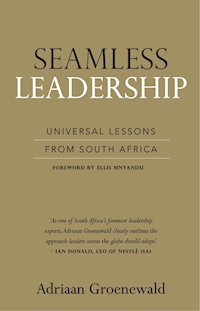
Seamless Leadership
Universal lessons from South Africa
Adriaan Groenewald
JONATHAN BALL PUBLISHERS
JOHANNESBURG & CAPE TOWN
‘Seamless leadership’ is a vital contribution to grooming a future generation of leaders that will guide our nation through turbulent passages that inevitably lie ahead.
— Neal Froneman – CEO Sibanye Gold
This book captures our South African leadership heritage well. A worthwhile read!
— Herman Mashaba – Founder Black Like Me
Better, more effective leadership is the one thing every South African agrees we need. What makes a great leader? Read this book.
— Gareth Cliff
To my father, Louis Groenewald, with whom I am undertaking this remarkable journey, which includes inspiration from above, innovation and hard work. We hope this will make South Africa and the world a better place.
Adriaan Groenewald is the co-founder and MD of leadershipplatform.com, where he consults with various leaders and their teams on creating personal, team and organisational leadership fitness. He presents a weekly leadership show on CliffCentral and regularly writes on leadership for Business Report. He lives in Centurion, South Africa, with his wife and children.
Foreword
It was back in 2010 that Adriaan and I first mooted the idea of doing something unique to foster a national conversation on leadership. Wherever we looked, it seemed as if every aspect of leadership had become an afterthought.
Not long after our initial discussion a bi-weekly feature on leadership was born, with Adriaan as lead contributor. This platform found its way into Business Report, the national financial daily that I have the privilege of editing.
At the outset, our goal was to push the boundaries and bring South Africans and the world at large an unvarnished dose of interviews and insights from leaders from all walks of life. From politics to business, to sports, to academia, to the arts – we said no leader should be off limits. And this is because, we thought, South Africans deserve to know what stuff their leaders are made of.
We also wanted to go back in time to reflect on the leaders’ life stories – where they come from, what obstacles they have had to overcome, and how they hope to inspire the next generation of leaders.
These and many other questions have catalysed into this pertinent and timely book – Seamless Leadership: Universal Lessons from South Africa.
Generally, what is often unappreciated is the fact that South Africa’s legacy is about nothing else but leadership. That legacy is borne out by the contribution that leaders like Nelson Mandela made to bring about change by heeding the call to rise above themselves. And yet, so little attention is given to leadership milestones that have taken the country from a hopeless state to a hopeful future.
In so many ways this book is about revealing the untold story of South Africa to the world. Put simply, that story is about the fact that South Africa is endowed with a diverse tapestry of leaders whose life experiences should inspire hope about our future as a nation. And where else in Africa do you find four Nobel Peace laureates – Chief Albert Luthuli, Nelson Mandela, FW de Klerk and Archbishop Desmond Tutu? Only in South Africa!
In bringing out this book, Adriaan has provided a mirror through which the current generation of South African leaders can look at themselves through the experiences of those featured within these pages. One of the first interviews we did for our leadership conversations project was with President Jacob Zuma in August 2010. In that interview, we got a rare glimpse at what was not generally in the public domain about the President. Such is the nature of the collection of the conversations contained in this book. Not only has Adriaan provided a treasure trove of insights about leadership in the South African context, he has also put together an illuminating spotlight about what may not generally be widely known about the leaders covered herein.
In any other country Herman Mashaba would by now be a household name. Not in South Africa. But here is a man whose life story brings to light the ingenuity of an ordinary entrepreneur who built a black hair care company out of nothing. How about Michael Jordaan? For a long time, he held the sole title of being the most active South African CEO on Twitter. This is someone who knew and understood what social media is, way before other business leaders did, when he was at the helm of First National Bank.
Adriaan also showcases a conversation that we both had with Dr Iqbal Survé, one of South Africa’s leading businessmen. His 2013 purchase of Independent Newspapers, the largest publisher of English newspapers on the African continent, has not only made him a media mogul but a transformative force in what is still a highly contested space in South Africa.
This book gives you as the reader an unadulterated view into what has shaped some of the country’s contemporary leaders, and that is the reason why its scope is not confined to business, but also features luminaries who have excelled in many other endeavours. Gill Marcus, former governor of the South African Reserve Bank, gives us a closer look at what constitutes her leadership philosophy, while the conversation with swimming sensation Chad Le Clos provides insights that were little known about this young man who shot into the spotlight at the London Olympics in 2012 to grab the baton from the American swimming super-hero, Michael Phelps.
So, from the boardroom to the swimming pool, this book goes wherever there is leadership.
Insights from all the stories contained inside the covers are, by and large, an acknowledgement of the breadth and scope of leadership experience that is found in South Africa. It is my hope that they will form a timeless reference for anyone seeking to understand why leaders are the way they are, or are not the way they are supposed to be.
I believe that inside each one of us there is a leader, waiting to seize the responsibility to build, inspire and challenge the status quo. These three tasks may seem so simple, yet they constitute some of the first things that leaders forget.
In this book Adriaan answers the question why leaders become leaders in the first place. His admiration of Nelson Mandela flows in part from a realisation that Mandela spent his life relentlessly pursuing the aim of bringing about a new reality as a leader – replacing despair with hope, and selfishness with magnanimity. This is what leadership meant to Mandela. In this book you will also learn how Mandela’s leadership journey has helped shape the leaders profiled herein.
I know that this book marks just the beginning of a long conversation about leadership. Therefore, it should make it possible for you to start asking big questions about how you can contribute to this conversation. So it is a great privilege to introduce Seamless Leadership to you. Take time to immerse yourself in it, and it will provide you with more than just narratives about leadership, but real, practical and privileged understanding.
Ellis Mnyandu
Johannesburg, February 2015
Preface
A wise and visionary man once said this to me: ‘One day you must show your fellow citizens the worth of belonging to this great nation, chosen above all others to fulfil a destiny peculiar to itself.’ These words stuck with me like my own name, refusing to be erased from my memory.
It was 1984, and I was 17. For years I wondered about the meaning of those words. What peculiar destiny could this nation possibly have to fulfil? We were small, basically an emerging economy, with limited economic status, at the tip of a continent not always seen in a positive light. Many diverse issues threatened to come to a head: we seemed to be destined for serious conflict and even full-scale violence and war.
Then along came Nelson Mandela and other leaders from different arenas and achieved what without a doubt was perceived to be impossible – a relatively peaceful transition and a huge measure of unity across racial and political boundaries.
By this time I was in my early twenties, and by great good fortune I was relatively close to this miraculous occurrence. My uncle, General Tienie Groenewald, had joined with General Constand Viljoen and others to unite Afrikaners in an effort to secure their future. I remember how a friend and I visited my uncle’s home almost every week to sit down and listen to developments around the negotiations, in which he was very involved. We listened in awe as he described the different characters in this national and international political spectacle. I heard about the different options for Afrikaners that were considered at the time, including war. I knew we were very close to a worst-case scenario; we really were!
On 22 April 1994, six days before South Africa’s first-ever democratic elections, the US Ambassador to South Africa received a call from General Viljoen. He explained that they could not reach a compromise with the ANC and NP to sign a negotiated accord that would recognise the Afrikaners’ wish for self-determination and that he had no option but to resort to violence. During a previous engagement the Ambassador had asked the General to inform him should such a situation arise.
The Ambassador asked for 48 hours. The answer was they didn’t have 48 hours. He asked for 24 hours. Again the answer was they didn’t have the luxury of even that. They settled on 8 hours. Within the allotted time the Ambassador came back to announce that signing by both the ANC and the NP would take place at 10 am the very next day, 23 April, at the Union Buildings, and it did. Interesting how much influence a US Ambassador had, or was it the US President? And who would have guessed he played such a prominent role in averting a national crisis?
What preceded this moment in South Africa’s history is a story that could have gone so wrong; a story where humility and big picture thinking conquered ego; a story of great leadership; a story that every citizen in South Africa and beyond should be aware of and grateful for. If we don’t know where we come from it is more difficult to appreciate where we are, 20 years into our democracy.
Does this mean South Africa was that close to more serious disruption, guerrilla war, even full-scale war or a blood bath? According to my uncle, Major-General Tienie Groenewald, there were plans in place that would without a doubt have changed the course of our country’s history.
My uncle started his career as a pilot and climbed the ranks all the way to becoming Chief Director of Military Intelligence. As head of Branch National Intelligence Interpretation, his division interpreted all intelligence information evaluated by the intelligence departments on the security situation, banned organisations and anyone considered an enemy of the State at the time. It was done for President PW Botha’s State Security Council and he was the first person ever to present to these Cabinet Ministers and other leaders on a regular basis. He saw Botha on Thursdays and often interacted with him and senior Ministers, including attending Cabinet team builds. He told me that when PW Botha was in a bad mood he presented and got out of there. When he was in a good mood he would often discuss certain challenging situations with him.
He observed that Botha relied heavily on those members in his Cabinet who could give philosophical inputs, because he was more of a doer, an operational leader. And he was not a man who could sit down and write a constitution; he wanted to use his experts. In this particular case they could not give him what he wanted, which according to my uncle was indicative of how poor the Cabinet make-up was in terms of expertise and leadership.
After a while my uncle asked to be released. He explained why: ‘In two-and-a-half years, not once did we have to come back and say we were wrong in our interpretation. You reach a situation where you are quite influential and so I asked to step down.’ Of course PW Botha asked why, and his answer was: ‘Do you know how the J Edgar Hoovers and Hendrik van den Berghs are created? They are in a key position for too long and then they start manipulating the intelligence to influence decision making.’ His philosophy was that intelligence was to interpret the situation and actions planned by the enemy but never to propose actions to be taken. That was the task of the commander or political decision maker.
Voluntarily stepping down from a powerful position says a lot about his character and value system, which was shaped in a family of ten children, seven brothers and three sisters. My grandfather was his tutor in many respects and my uncle believes he learnt more from him than from anyone else. His philosophy was one of never forcing you into anything. They had a Christian upbringing and of the ten children nine are still alive, married and with no divorces. They were and we still are a tight-knit family. My grandmother passed away at the age of 103. Of her my uncle says: ‘She was the most beautiful woman that I have known in my life and a wonderful person.’ I can attest, she was an amazing person.
After my uncle stepped down PW Botha asked him to get the Bureau of Information off the ground. This lasted until the beginning of 1990. It was during this period that my uncle realised the government did not have the faintest idea of where they were heading. They knew long ago that apartheid could no longer work, but they did not know what to do about it.
When De Klerk took over, my uncle decided on early retirement. Again the President wanted an explanation. The answer was clear and direct: ‘You have many names one can compare you with, Mr President. In European history it would be Neville Chamberlain, who with his policy of appeasement was a great cause of World War II. In South African history, perhaps Piet Retief. It wasn’t wrong for him to negotiate with the Zulu king. It wasn’t wrong to make an agreement. But when he disarmed his people and placed them in a weak position, it not only led to his and his commando’s death but to the biggest bloodshed in our history – the Battle of Blood River. And you, Mr President, have already neutralised your Defence Force; you have already placed yourself in the hands of the ANC, and your actions may lead to the biggest bloodbath this country has ever seen.’ De Klerk did not take kindly to these words.
There was clear intelligence that indicated government was in a stronger position than they realised. While international and local pressure on the National Party to start negotiating intensified, according to my uncle the Russians were withdrawing all their support from the ANC because communism was under threat and they had to deal with their own challenges. They advised the ANC/SACP to ’negotiate and take what you can get’.
Not long after his retirement, an Afrikaner movement, the Boere Vryheidsbeweging (Boer Freedom Movement), asked my uncle to assist in creating unity amongst the Afrikaner people. They created a ‘Committee of 23’ and started liaising with different political and non-political organisations. They then formed a ’national Unity’ committee and this body decided something drastic had to be done. The Unity Committee developed into the Afrikaner Volksfront (AVF). On the suggestion of Dries Bruwer, leader of the Transvaal Agricultural Union, a Committee of Generals was created, with General Viljoen as the leader. They went to Viljoen’s farm and strategised. The approach decided on was three-pronged: mobilise, negotiate, and if needs be, resort to violence.
These leaders achieved the largest-ever mobilisation of Afrikaners and even other groupings that stood for self-determination. Political meetings happened across the country. Hundreds of thousands attended. The mobilisation phase was expanded to those black ethnic groups that supported self-determination, like the Zulus (IFP) and Bophuthatswana. This expanded alliance was called COSAG – Concerned South Africans Group. For a time there was complete unity in this group. According to my uncle it was the perfect example of what could be achieved when moderate leaders decided to negotiate peacefully.
The Generals agreed the mobilisation phase would be successful when the ANC made advances to them for talks, which happened. Jacob Zuma passed a message to Dries Bruwer that Nelson Mandela wanted to meet. The meeting was set up and both General Viljoen and my uncle attended. At the meeting Mandela said: ‘I realise there is no way that the ANC can defeat the Afrikaner people. But there is also no way in which the Afrikaner people can defeat the ANC. If we continue on the road that we are walking now, we will end up in a situation very similar to the Middle East or Ireland. Isn’t there a peaceful way out?’ The response was: ‘We want negotiations, so yes, we will talk.’ Mandela appointed Thabo Mbeki and Jacob Zuma as ANC representatives and negotiations started in November 1993, while COSAG was moving along successfully in its negotiations with the NP government.
Alongside all of this the CODESA process took its up-and-down course. In December 1993 negotiations between the Generals and the ANC had reached a point where the signing of an accord on Afrikaner self-determination was due on 21 December, but it didn’t happen. In a meeting between COSAG, ANC and NP leaders, my uncle asked Joe Slovo whether the ANC would ever allow certain executive powers for the provinces. The answer was no, so he got up and walked out of the negotiations. He was followed by Chief Mangosuthu Buthelezi, Lucas Mangope and others. When this happened the signing of the accord between the Generals and the ANC became an uncomfortable matter. But fortunately talks with the ANC continued, and so did the mobilisation of Afrikaners country-wide.
By the time 20 April 1994 arrived there was a shortened version of the 21 December 1993 accord on the table, ready to be signed. It provided for the Afrikaner Volksfront to not use force and disrupt the elections, while on the ANC side they agreed to continue the negotiation on Afrikaner self-determination on the basis of constitutional principles agreed on and to set up mechanisms to achieve this, and also that when they continued after the elections, if they could not come to an agreement both parties would subject themselves to international mediation. This document is still valid. It became clear to the Generals that the NP would not sign the accord, and certain elements within the ANC felt that progress towards the elections had developed so far that there wasn’t a need to sign anything. The Volksfront felt there was no alternative but to turn to violence. And this is when a call was made to the US Ambassador.
Dramatic plans were in motion, at first not for full-scale war. Because of my uncle’s previous position he had insight into the National Key Points Register, a document containing all the relevant key points across South Africa, like Eskom and the SABC. He says: ‘We had plans and identified the people that would occupy a critical number of these key points.’ They would also take over certain towns controlled by the Conservative Party that they considered to be part of a possible Volkstaat. But they would have no military offensive outside these areas.
They knew that at least half of the Defence Force supported General Viljoen. But if the Defence Force was called upon they would have to act against their own people, who weren’t committing any violence, and most Afrikaners wouldn’t do this. There was a chance of this strategy developing into at least a guerrilla war, however, which required a base area from where they could operate. General Viljoen instructed my uncle to visit Jonas Savimbi, the political and military leader who founded and led UNITA in Angola. His highly secret mission: to garner his support for a base and more.
He travelled illegally in a light aircraft to Angola and met Savimbi from 3 am until 5 am. When asked if they could count on his support the Angolan’s answer was: ‘Inform General Viljoen everything I have is at his disposal, and if I gave him everything it wouldn’t be a fraction of what he has done for us. I could never repay that man for what he has done for me.’
Then my uncle asked this question: ‘If we had to kidnap the key political figures from the ANC and NP (Mandela, De Klerk, Ramaphosa, Meyer, and others), and fly them out to Angola to negotiate on our terms, would you provide us with those facilities?’ Savimbi said he would. The Generals had knowledge of the movements of all NEC members, and the Cabinet was easy because they knew when it met. They even had at least two of Mandela’s bodyguards as inside informants. My uncle admits they needed a bit more time to make sure these plans were absolutely foolproof, but they could have done it.
In the end, why did all this not happen? After all, the perception is that generals are trained for war and want it – a general who hasn’t gone to war isn’t a real general! Maybe our saving grace was that our generals had experienced war. My uncle explained: ‘First of all, Generals know what war is. We also knew that once you start the path of violence there is really no end to it, and you create hatred, which would take generations to eradicate, as shown by the Middle East and Ireland.’
They also realised it would be a war between Afrikaner and Afrikaner. MK (the ANC’s military wing) was no factor; it had no military significance whatsoever. The Generals believed that should they manage to push through the accord they would be establishing a base for peaceful negotiations in the future. What went wrong after the elections was the old problem of disunity amongst Afrikaners, and as a result they lost the power base that would have forced the ANC to continue the negotiations to find a political solution provided for in the Accord of 21 December 1993, which was part of the signed Accord of 23 April 1994. The ANC’s question was always: Who do we make the agreement with? And of course the Volksfront became a political party that lost this aim of a Volkstaat after Viljoen retired.
Fortunately my uncle’s warning to former President de Klerk did not materialise, though it came close. It is clear that what ultimately prevented the ‘prophesied’ blood bath was leaders on all sides, including the Generals, who could control their egos and consider the big picture, and who rose above personal agendas for the greater good. It is a leadership story that illustrates the need for unity in order to succeed, and that its lack will thwart positive movement or progress.
It was leaders like these who made the difference. And it is clear Nelson Mandela rose to the occasion, was true to his calling in life and tenaciously followed inspiration to push for movement towards national unity; to drive purposefully his belief that all human beings were created equal; to sacrifice all that he possessed for a country and world where all human beings can practise their God-given gift of free agency in order to learn and grow towards their full potential.
After all this happened I surprised myself by starting a career that included interviewing top leaders internationally about why and how they achieved success. With South African leaders, conversations revolved around how they led in this very complex environment, which truly is a microcosm of the world. Whatever challenges exist somewhere on the planet, they somehow exist or have existed in South Africa in some form. South Africa is an extremely dynamic political, economic, and social place where leaders are tested on all levels and in every possible way.
So, for most of the lifespan of our ’new South Africa’, born in the mid-1990s, I have interviewed and written about top political, corporate, entertainment and sports leaders. The journey has been fascinating on many fronts and has included interviews and associations with many who knew our icon, Nelson Mandela – President Zuma, Deputy President Motlanthe, Mathews Phosa, son-in-law Dr Kwame Amuah, Roelf Meyer (chief negotiator for the National Party in the 1990s), former DA leader Tony Leon, Dr Iqbal Survé (Mandela’s doctor), DA leader Helen Zille, and many corporate and other leaders. And, of course, my uncle and my own father met Mandela on several occasions.
As we continue to uncover universal leadership processes, models and principles formed in the midst of our South African crucible, it becomes evident that we cannot study successful leaders or leadership in South Africa without also understanding the essence of those leadership attributes that Nelson Mandela symbolised. It is simply not possible to discuss great leadership with any group or individual in South Africa without discovering that their own leadership approach and thinking was somehow, whether obviously or at a deep subconscious level, influenced by the example and successes of Nelson Mandela.
As you read the interviews with other leaders in this book you will notice how many of them naturally refer to Nelson Mandela in some way. He is our nation’s symbol of great leadership, the essence of the kind of leadership needed to be successful in this microcosm of the world called South Africa. And indeed, his leadership – and the positive leadership that in places in South Africa still exists – is the kind of leadership our planet needs. The world embraced Nelson Mandela in life on a large scale, but since his death our need for the essence of what his leadership symbolises has been all the greater.
So what is this peculiar destiny that South Africa must and will fulfil? When destiny and timing collide there is no stopping the movement that will explode. Nelson Mandela is a fitting example of this principle. The collision of his destiny and timing caused an explosion that resulted in a global phenomenon. Our destiny is to bring to the attention of the world that brand of leadership it so badly craves and needs. Collectively leaders of this and other generations have failed the people of this planet. Followers are disillusioned – and when a beacon of hope for better leadership is held up we gravitate towards it as the entire globe gravitates towards Mandela, or to the memory and feelings his leadership brought. The level of gravitation towards Nelson Mandela is a direct reflection of the hunger the world has for better leadership, and we are clearly very hungry!
We in South Africa have started veering off from the path of the essence of South African or Mandela leadership, because universally human beings often struggle to see and fully embrace the good in their own back yard. We have to be careful not to be distracted by this recent global Nelson Mandela frenzy to the point that we miss our destiny of continuing to take South Africa’s leadership legacy to the next level, firstly as an example to the world and secondly proactively taking it to the world.
South Africans must elect and choose leaders that truly attempt to take our leadership legacy forward, so that we can fulfil our peculiar destiny, which means we have a collective responsibility as a nation.
Our South African leadership essence is one of unselfishly uniting around the creation of positive movement towards the perceived impossible, while fearlessly, openly embracing and confronting all perceived negatives, obstacles and constraints along the way. Furthermore, the essence of the universal process used by successful leaders in South Africa is one of extraordinarily high levels of thinking, feeling, desiring, embracing and becoming.
I am speaking here of leadership that understands that in order to get a situation out of a deep hole it needs to create an opposing pole equal to the depth of the problem – an impossible vision that over time is understood (thinking), felt (feeling), desired, embraced by most – and where followers and a country eventually become something greater. It is about creating impossible movement, against impossible resistance, towards becoming the impossible. As the great man said: ‘It always seems impossible until it’s done.’
It has taken me 29 years to process and understand an instruction given to me by a wise and inspired man. To all South Africans I therefore loudly proclaim that we belong to a great nation, chosen above all others to fulfil our peculiar destiny of demonstrating, beyond Nelson Mandela, this leadership that the world is craving. We understand contention and discord on a deep level because we have tasted it. We should therefore understand and strive for its opposite on a deep level, which is true unity, and then live it! We experienced movement from sure disaster to the perceived impossible of unity and growth, performance and improvement, so let us continue doing this, from the top down!
This book, emanating from the crucible of South Africa, is an attempt to bring to the attention of the world that brand of leadership it so badly needs. It is based not only on personal experience but on hundreds of interviews with very successful individuals, one-on-one sessions with senior executives, interactions with youth and so on.
In Seamless Leadership short chapters focus on a seamless leader’s attitude towards certain principles, with added sections on principles learned from personal leadership conversations with individuals from different sectors of society, over many years [of my column in Business Report and Star Workplace], ranging from President Jacob Zuma to Helen Zille and Sizwe Nxasana to Mike Brown.
I do not necessarily hold these leaders up as perfect examples of seamless leadership, but as individuals who possess elements of this attitude, or whose interview highlights a certain seamless leadership principle. I also deliberately place names of ‘competitors’ next to each other throughout the book (Zuma/Zille; Nxasana/Brown), to drive home a principle. Though competition is part and parcel of society, those with a seamless leadership attitude tend to rise above it for the achievement of a much bigger purpose. I trust that this approach will open your eyes to an attitude towards life and leadership that brings much more satisfaction, joy, fulfilment and full potential for yourself, others and society at large.
CHAPTER 1
A leadership attitude for our times
WITH
•Mark Cutifani•Gareth Cliff•Dr Iqbal SurvéThe world has changed dramatically since the 1990s, not only in economics, security, technology, attitudes, fashion, and politics, but also – and perhaps most of all – from the leadership point of view. Persistent economic and political volatility across the globe is accompanied by pervasive distrust between leaders, and between leaders and followers. It also seems that all too often the complex challenges leaders face outweigh their capabilities and expose the weaknesses in their leadership attitudes.
Are current leadership philosophies and development methodologies failing? At the very least it is reasonable to assume that they do not address the deep-rooted attitudes of leaders and how they approach their roles. All the efforts of authors and experts at putting forward sound leadership philosophies do not seem to have been persuasive enough for them to adopt an attitude that will really make organisations, society and the world a better place.
Gill Marcus, former Governor of the South African Reserve Bank, believes that, in the global financial tsunami, as she calls it, leaders must act for the greater good rather than for the good of themselves or their party or whatever entity they represent. Referring to the USA, she commented: ‘Why is there such indecisive leadership? It is because there is national interest and party interest, at a time when we need decisive and coherent leadership, in the interest of all of us.’
For Marcus the biggest challenge leaders face globally, including here in South Africa, is confidence and trust: ’nobody trusts any more, and yet this is crucial to solve the current global economic dilemma. If global leaders through the various institutions and meetings commit to doing something, it seems that the markets don’t trust it is going to happen. We are experiencing a situation where citizens, particularly in the advanced economies, don’t have confidence and trust in their leadership at any level, particularly political. Until trust and confidence is rebuilt, it will be very difficult to stabilise the global economy.’
What is going on? Why is there this lack of trust and confidence, when the world is flooded with leadership courses and literature containing advice on how to earn the trust of followers, and how to be a confident leader? Why do leaders struggle to win the trust of their people? Do followers sense incongruent motives – in other words, are leaders perceived as unauthentic – even though so much is written about authentic leadership? Are leaders not trained well enough? Are followers expecting too much?
I trust that reading this book will bring some clarity. Its purpose is to introduce a leadership philosophy whose time has come; that will take society to a better place and, if adhered to, change the world in a positive way; move it towards becoming more true to its intended destiny, a place where leaders and followers trust one another again; where the title of leader regains its rightful and honourable place in society.
You can see that I believe leadership to be an honour, not a right. It should not automatically be viewed as a synonym for ‘privileged’ or ‘elite’ or ‘popular’ or ‘well known’ or ‘powerful’.
To introduce a message of such importance we have to start at the beginning and shift the reader’s mind towards universal, ‘big picture’ thinking. Why is this so important?
So often, if not always, what helps and motivates us to resolve huge challenges in our personal lives, in business and in society, is the context of a much bigger picture, a goal, vision or purpose that frames the obstacle staring us in the face. This principle most certainly applied during the miraculous political transition of South Africa in the early 1990s. The dream of a better society outweighed individual and selfish agendas. This made it possible to overcome huge challenges and odds.
In life and leadership the following principle holds true: the further we see, the further we can go; the bigger the picture we see at any given moment, the bigger our dream and vision can be. In sum, greater context results in greater decisions. Therefore, if we hope to solve these potential global leadership crises, we need to start with the biggest and most universal picture possible, so that the context and motivation to confront the challenge can overshadow the task.
The big picture of life
Briefly, let’s view life from a simple, logical angle; a big picture that hopefully makes sense to most, across differing beliefs. Embracing this picture could significantly influence your current approach to life and leadership.
There are over 7 billion people on the planet – and that’s not counting the people who have already come and gone, and those of the future. Every one of these human beings enters this world through birth, and – sooner or later – leaves it through death. It is mind-boggling to contemplate that every one of these individuals is unique in the combination of their physical features, geography, language, beliefs, culture and much more. Why do all these different individuals exist on this planet? What is the purpose of being here? Perhaps, if we can establish what we have in common, we will find a clue and even answers to these important questions.
Not by chance, it seems, in between the two opposite ends of life – ‘entry’ (birth) and ‘exit’ (death) – each one of the billions of visitors to this earth experiences the following five fundamentals:
1.Experience SITUATIONS: From infancy through early childhood, early teens through teenage years, young adulthood through to old age, birth to death, from the minute we wake up every day until we go to bed, seven days a week, 365 days a year, we gain knowledge and – mostly – understanding through never-ending situations that cross our path. Some situations are unforeseen or outside our control; some happen through our own doing. They come in shapes and forms that can be seen as either negative or positive.2.Experience PEOPLE (relationships): The moment 7 billion of us were born we were surrounded – for better or worse – by people. It seems life cannot happen without other people, and situations mostly involve other human beings, directly or indirectly. In short, we are here together and not alone.3.Experience freedom of CHOICE (decisions): Especially as we grow older, all of us have the freedom to choose how we react to innumerable situations. Then we also have a choice as to how to utilise the knowledge and understanding gained in our lives. We have to choose how we respond to human beings around us, to different relationships. And, we choose what our attitude is from situation to situation. All this happens within certain boundaries. Eventually we also use our knowledge and understanding to benefit ourselves or to benefit others and society, or both.The boundaries within which we exercise our freedom of choice are put there in several ways. First, there is society in general, in the shape of government and other institutions that create laws and rules within which we operate. When our choices take us outside these boundaries we usually experience some sort of reprimand, intended to bring us back within the boundaries. Second, our belief and value system, mostly by way of cultural background, religion or simply a belief in right and wrong and what lifestyle brings happiness and peace, also places boundaries in our lives. Then, thirdly, boundaries are also created in our own minds by way of personal perceptions about ourselves and what we can and cannot achieve. These personal perception boundaries in our own minds may be the most difficult boundaries to overcome. But more about this later.
4.Experience OBSTACLES, challenges: We all encounter challenges, trials, and obstacles of varying magnitude along the way, whether directly or indirectly (through others). It seems that these obstacles are placed here to help us grow character, to test us to the limit, to discover how we will choose, with the knowledge and understanding gained. The outcome of situations over time also results in perceptions about ourselves, as mentioned above, which quite possibly become the greatest advantage or obstacle to achieving our full potential.5.Experience MOVEMENT: Throughout all the situations, associations with people and obstacles that confront us, we end up making decisions so that we can move forward in life and in relationships. If we don’t make decisions we will mostly stand still. When something or someone stands still, it will stagnate, or even die, literally in some cases. Movement comprises growth, development, improvement or change. Life on this earth is about movement. Movement is life.I call these five commonalities the SiPCOM Experience, which in short captures the truth that all visitors to this planet continually experience Situations (experiences); People (relationships); Choices (decisions); Obstacles (or challenges); and Movement (growth, development). We cannot escape the SiPCOM Experience! And the ‘COM’ in SiPCOM reminds us that all people have this experience in COMMON.
Why these relentless situations? Why are we so intimately linked to other people? Why the freedom to choose? Why all these obstacles and challenges? Why must we move forward? Why are we on this planet?
How to make the best of our journey through life
Planet Earth is the place where we experience SiPCOM; where we are offered the privilege of implementing and practising the five COMmonalities; where we gain experience in these five categories. It all seems to be for a good reason: the world is a huge obstacle course or testing ground that offers its inhabitants an experience of a lifetime! You are thrust into a continuous (no turning back) cycle of gaining knowledge and understanding, through never-ending SITUATIONS, mostly involving other PEOPLE and requiring constant CHOICES (decision making), accompanied by regular OBSTACLES and challenges, in order to MOVE forward. It sounds like a ‘Lord of the Rings’ type of journey, doesn’t it? The only way is forward, to some place (because one can’t make worthwhile decisions without the context of some future), and the outcome can only be personal growth, building character and relationships, learning to make decisions and experiencing movement or success. Of course, the journey involves a risk of failure, too, especially when you add to the mix a conscious decision to make full use of opportunities rather than be an indifferent bystander. In short, SiPCOM is the perfect recipe for moving closer towards one’s full potential.
Just from a logical perspective, it may be difficult to comprehend that this awesome, adventurous journey continues beyond the gateway that we call death. I believe that it has to, and that those of us who make the best of this part of the much bigger journey will be better prepared for whatever lies ahead.
How does one ‘make the best’ of this journey on Planet Earth? After all, we are here and we can only move forward. There is no turning back. We need to take full advantage of SiPCOM, which means we have to develop the abilities and skills to confidently engage situations, people, choices (decisions), obstacles or challenges, for movement within the context of this bigger picture. It will help if we can create a context, make what happens now – today – count, crucially by deciding where we want to move to, where we are going, where and how we want to ‘end up’. In that way we become a ‘forward thinker’, a ‘movement specialist’.
Create movement by becoming a forward thinker: Some situations are unforeseen or out of our control; others are expected or our own doing. We may as well try to determine or influence the ‘own doing’ part as much as we can, for the right reasons. Strangely enough, as we do this we end up giving more meaning and context to most of the unforeseen or ‘out of our control’ situations as well.
To take a very simple example, during grade 9 of high school years a decision must be made about what school subjects to take for the remaining three years. This falls in the category that is outside of the child’s control, though not unforeseen, and there is no option but to make a choice; no alternative, except perhaps to drop out of school. A youngster who is fortunate enough to have done a bit of forward thinking by deciding where he or she wants to go in life, career-wise, because of some knowledge gained through exposure (more situations, more experience), will make wiser decisions. Those who know where they want to move to will possess the necessary context to make the situation and decision count, and in so doing allow seamless movement forward. In this instance the ‘out of your control’ situation is transformed into the ‘own doing’ category. It builds character, because the child moves forward with determination, actually wanting to make the decision as opposed to being forced to.
Compare the child who has no plans for the future. The ‘outside your control’ situation remains as such; it is not about wanting to make the decision so much as avoiding it: the choice of subjects may be those that will bring the most ease and comfort in the short term – the easier ones. This may have impacts later in life – but does it mean that an undecided child, or a late developer, is lost? Of course not. The consequences of the decision may yet turn into a character-building experience as he or she matures and realises that a chosen career cannot immediately be pursued because a bridging course is necessary. This happened to me and I think I turned out all right. However, I would still advocate the first option as the best one.
In this example we see the value of forward thinking and how it assists a child to move forward seamlessly, to make the best of a situation right now. In fact, we often speak about being present in the moment, in order to appreciate a situation to its fullest. Being a forward thinker helps us to live more effectively in the moment. Unknowingly this child is developing an ability to create movement in life, applying a universal skill that gives context and meaning to the situations, people, choices, obstacles and movement that comprise SiPCOM. If parents and teachers promote awareness of the fact that a universal skill is being developed, this will make it even more beneficial.
It is mostly our vision of the future – whether immediate or distant – that triggers and influences our decision making. I am hungry; what shall I have for breakfast (30 seconds into the future)? I want to get to work within 30 minutes; should I take the route through suburbs or on the highway? I want to be fit and slimmer in six months; shall I run or attend gym, or both? I want to meet someone special in my life; shall I accept that blind date or go online? I want to become the CEO of this organisation one day; shall I take on this next challenge as manager in another country or study further, or both? I want to have a happy family; should I work day and night to maximise earnings or cut down on the working hours and spend more time with the kids? If I pay this bribe once I will close this large deal in the near future and earn lots of money and acceptance soon after, but I also value honesty; what shall I do?
There are innumerable possible examples of how the desire to attain a goal – a future state, a dream, a vision, a destiny ... or, in short, where you want to end up – gives context to today’s decisions and movement. As mentioned earlier, one can’t make worthwhile decisions without the context of some desired future state. The clearer the future picture is, the clearer the decision making process. This means being a forward thinker is a critical skill in being a good decision maker and mover. Remember, the further we see, the further we can go; the bigger the picture we see at any given moment, the bigger our dream and vision can be; greater context brings greater decisions.
Make relationships meaningful: So we are here on this earth with others. We may as well make such associations as meaningful as possible. As they say, ‘don’t burn your bridges’. If we have no option but to live this life with other human beings and in the process we can’t help but build relationships, why waste the opportunity? It wouldn’t make sense.
How does one make relationships as meaningful as possible? Logically, if life becomes more meaningful when we make full use of SiPCOM, then relationships will become more meaningful when we somehow assist others to acquire the abilities to effectively engage SiPCOM, so that they too can build character more consciously. To do this is to take a leap towards becoming a leader. Life then becomes more meaningful both for others and for ourselves. It does not make sense for us to consciously experience SiPCOM and move towards our full potential in isolation. Help others to do the same and then life will have much more joy and fulfilment as we surround ourselves with people who experience joy and fulfilment themselves.
Hence, the core purpose of life is ... Together with others, to embrace situations, people, choices, obstacles and movement (SiPCOM) fully, as a forward thinker, to grow and develop one’s own character, and build the characters of others and society, to experience full joy, fulfilment and potential in this life, and perhaps beyond.
I truly believe that all indicators point to the core purpose of living on this planet being to grow and develop the remarkable potential that has been planted inside every human being, including YOU. It is however up to us (choice) to gain knowledge and understanding about what exactly this potential can be and then make the decision to define that destiny or future potential – for ourselves, our marriage, our family, our career, our business, our community and even our country. And then, as we and others move towards the defined potential, learn to deal with the obstacles and challenges that will come our way as sure as night follows day. But, it starts with us.
In short, if all 7 billion (and more) human beings have SiPCOM in common, and if embracing and then sharing it results in their becoming leaders, then it seems our experience on earth is actually an intense leadership development programme for all of us. We are here to continue learning to become leaders. The aim of this book is to introduce to as many as possible an attitude that embraces and engages SiPCOM, consciously making full use of this earthly experience to evolve into thinking and acting like a leader, and then becoming one.
As more and more individuals are persuaded to adopt this attitude I am confident that the ripple effect will lead to an improvement of society at large. The kind of people we hope to multiply will ensure this world remains true to its destiny of being a worthy testing ground that assists human beings to become the best leaders they can be. I call this kind of person a seamless leader. By the way, the ‘S’ in SiPCOM reminds us of Seamless leadership.
And now, I passionately invite you on a seamless leadership journey.
Mark Cutifani – CEO Anglo American
Seamless Leadership Principles:
1. Look out for the seamless leader attitude that Cutifani possesses. Is it any wonder he is leading one of the largest mining houses in the world?2. Try to see signs of his attitude towards SiPCOM. There are many to pick from, including:• Big picture thinking• Emphasis on people• Emphasis on creating movementWhen I sat down with Mark Cutifani he was the leader of AngloGold Ashanti, the most widespread and balanced gold company in the world, with a presence in 25 countries and approximately 63 000 employees, half of whom were in South Africa. They generated about $9 billion a year, with approximately $3 billion cash with which to pay dividends, add to capital, etc. Shortly after our conversation he was elevated to global CEO for Anglo American.
As a gold company, what AngloGold Ashanti does is technically not simple as it mines some of the deepest mines in the world. There are challenges like safety, environmental management, community relationships, and a whole range of other complexities. Yet, while Cutifani was CEO they aimed to grow the business by about 25 per cent over the next three years and to be one of the top five mining companies in the world. Cutifani and his team aimed high, and it certainly seemed near impossible to achieve that without a very high level of commitment from the workforce. So, people had to be the most important assets inside AngloGold Ashanti, or not?
During his first meeting with staff, in his first week, he made a statement: ‘People are not our most important assets.’ Of course there was a deathly silence, and then he continued: ‘People are more than assets. People are the business. I am not a chair, or a table, or even an ounce of gold or a building. These are all assets. I’m more than an asset; I’m a person that can contribute in various ways. At the end of the day, when we as managers sit back and reflect on why we are here, why we do what we do, we do it with people; it’s for people. Every conversation we have is directed for and with people.’ According to Cutifani, ‘if you strip everything aside, leadership is about people, because people are the business’.
When a leader makes such a statement, everything he does must be in line with this ethos. What does he do by way of example to authenticate his strong belief in people? For Cutifani, symbols are very important in leadership, so he listed a few things he does on a daily basis as he heads for the office. For example, when he drives in he acknowledges every individual, including the security guard, with a friendly thumbs-up or wave. Then, he does not have a designated CEO parking space. He says: ‘I am like everybody else. I come to work; I get paid for being here. If I am last in the morning and it means I have to walk 200 metres, that’s okay. Like everybody else, I come here to do the best I can and go home to my family.’ Walking from his car he acknowledges every person in the car park.
When Cutifani started as CEO it seemed like ‘everybody walked head down, not acknowledging one another or saying hello,’ but not long after he walked through the offices in such a way that he could greet everybody. Cutifani does not have a door to his office. If he is in his office anyone in the organisation may walk in and engage him. When he is in his back room it means he is doing something with or without someone where he prefers not to be disturbed. He insists that everybody calls him by his name and not ‘Meneer’ or ‘Sir’. He does not wear a tie, to go with the informal environment. He answers every email he receives from an employee within 48 hours, nine times out of ten. He does these little things very deliberately ‘to demonstrate that AngloGold Ashanti is about people’.
What prepared Cutifani most for his overwhelming leadership task was all the experiences (and mistakes he made) over the years – and his ability to learn from these mistakes. But a very important influence on him as a leader has been his exposure to a researcher called Dr Elliott Jaques and his Requisite Organisation theory. According to Cutifani, Jaques acknowledges that ‘leadership is about, firstly, capability and understanding of what the issues are, and being able to understand and solve or navigate through complex areas, to add value to those in the organisation that can’t necessarily see where the pathway is’.
Cutifani likes this approach and adds that recognising capability and the ability of individuals to see and solve complex problems is a starting point to recognising talent within the organisation. He believes this ability is identifiable at a very early age – watch out for individuals who seem to solve complex challenges with relative ease! After identifying such individuals early in their careers a leader should try to give them as much exposure as possible so that they can develop a broad range of skills.
Cutifani comments: ‘The real role of leadership is to make it very clear to people at all levels of the organisation what their role is, how they make a contribution and what they can do to make a difference within the organisation – and, very importantly, have them feel like they are making a contribution that is making a difference.’
To him leadership is also about articulating a vision and helping people feel what that vision is. But he adds: ‘The ability, then, to put the people, the processes and the structures in place to actually align the work that happens on a daily basis, is the management part of leadership. And, if you don’t have the management part of leadership, all you have is exhortation. If you have the management part you have the substance that backs it up and reinforces the role of the leader in being able to take the organisation through to delivering something special.’
Cutifani struck me as a leader with insight and wisdom. He seems to implement a leadership approach that is able to embrace and navigate through the complex times we live in. I wondered whether he was not at times frustrated when his employees or other leaders around him just couldn’t see the bigger picture. His response was again indicative of a big picture thinker: ‘Leaders are fully accountable for the impact they have on others. At the end of the day there is no point in getting frustrated, because I am accountable. What I have to do is think through how I can better land the message. Because the minute the leader starts blaming someone else, by for example saying “I can’t get the message through,” you are immediately saying the recipient is a dummy. The minute you think that, go and look in the mirror and come to grips with who the dummy is. Your job as the leader is to deliver the message. And leadership is patience.’ If he cannot convince someone of his argument, then it is not well structured or he hasn’t understood where the person is coming from. And, of course, ‘their view may be right, which is why I can’t convince them,’ he adds.
About eight years ago Cutifani and his then management team were discussing a specific issue where half the management team got the point and the other half continued asking questions that he found annoying. Instead of listening he started lecturing. The more the team pushed back the louder Cutifani got. During a subsequent 360 feedback it surfaced that when he could not land the message he would get more difficult and start to lecture. He learnt that ‘at the end of the day you are accountable for how you land the message. Lecturing isn’t going to help. Take a step back, listen to the question and work with them on the question, and you may find that you get to a common landing a lot quicker.’
I believe that in South Africa we have extraordinary leadership challenges and we pride ourselves on our diversity. To successfully engage at least these dynamics, leaders must learn the art of avoiding ‘restrictive leadership’ by adopting its opposite, which is ‘seamless leadership’ – leading with a balanced big picture in mind, while, in an inclusive manner, confidently confronting barriers and boundaries to full potential of whatever entity. No doubt Cutifani is not perfect, and he and his management team will know this. But he certainly strives to demonstrate the qualities of a seamless leader.
Q&A
Q: Tell us something about your childhood that helped prepare you for leadership.
Cutifani:




