


30,99 €
Mehr erfahren.
- Herausgeber: John Wiley & Sons
- Kategorie: Geisteswissenschaft
- Sprache: Englisch
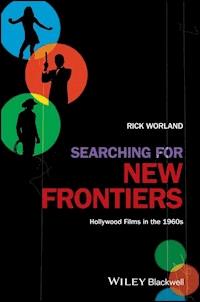
Searching For New Frontiers offers film students and general readers a survey of popular movies of the 1960s. The author explores the most important modes of filmmaking in times that were at once hopeful, exhilarating, and daunting. The text combines discussion of American social and political history and Hollywood industry changes with analysis of some of the era’s most expressive movies.
The book covers significant genres and evolving thematic trends, highlighting a variety of movies that confronted the era’s major social issues. It notes the stylistic confluence and exchanges between three forms: the traditional studio movie based on the combination of stars and genres, low-budget exploitation movies, and the international art cinema. As the author reveals, this complex period of American filmmaking was neither random nor the product of unique talents working in a vacuum. The filmmakers met head-on with an evolving American social conscience to create a Hollywood cinema of an era defined by events such as the Vietnam War, the rise of the civil rights movement, and the moon landing.
Sie lesen das E-Book in den Legimi-Apps auf:
Seitenzahl: 634
Veröffentlichungsjahr: 2018
Ähnliche



















Table of Contents
Cover
Title Page
Acknowledgments
Introduction: Changing Times
Part I: Postwar Hollywood and a Changing America
1 Hollywood, Hitchcock, and the Postwar Era
“The Vital Center” … Cannot Hold
Postwar Film Production and Exhibition
New Looks at Mothers, Genres, and Style
2 Domestic Relations, 1953–1967: Bachelor Pads, Nervous Dads, and Marriages on the Rocks
Bachelor Pads
Nervous Dads (and Moms)
Marriages on the Rocks
Welcoming
The Graduate
3 Negotiating the Civil Rights Movement: Message Movies,
To Kill a Mockingbird
, and the Rise of Sidney Poitier
It’s a Sin
An American Story
Poitier, ’67
Part II: The New Hollywood, Vietnam, and the Schism
4 Art Cinema and Counter‐Culture:
Dr. Strangelove, A Hard Day’s Night, Blow Up, Bonnie and Clyde
, and
Weekend
General Ripper Exceeds His Authority
Meet the Beatles (and the New European Cinema)
Quiet Enigma in Swinging London
“We Rob Banks”
Coda: “Battleship Potemkin Calling the Searchers”
5 Nowhere to Run:
One‐Eyed Jacks, The Man who Shot Liberty Valance, A Fistful of Dollars
, and
The Wild Bunch
The Frontier Myth and the Classical Western
California – or Maybe Oregon
“Who Was Tom Doniphon?”
No Name, Sudden Impact
“Those Days Are Closing Fast”
Destroying and Saving the Village
6 The War: From
The Longest Day
to
The Green Berets
“The Good War” Refought and Rethought
Unconventional Warfare
Art of War
The Only War We’ve Got
7 Far Out:
2001: A Space Odyssey
and
Easy Rider
Beyond the Infinite
Marketing and Reception
From Hell’s Angels to Easy Riders
They Blew It, But …
Afterword
Bibliography
Books
Articles and Chapters in Books
Index
End User License Agreement
List of Illustrations
Chapter 01
Figure 1.1 Alfred Hitchcock pushed the limits of screen content in 1960 in the depiction of Marion (Janet Leigh) and Sam’s (John Gavin) afternoon tryst in
Psycho
.
Figure 1.2 Norman Bates (Anthony Perkins), surrounded by stuffed birds, symbols of both his madness and his murderous intentions.
Figure 1.3 Melanie trapped in a phone booth as swarms of birds attack the town of Bodega Bay in
The Birds
.
Figure 1.4 Melanie (Tippi Hedren) and Annie (Suzanne Pleshette) in
The Birds
. Mutual respect and understanding between two complicated women reflected in this balanced two shot.
Chapter 02
Figure 2.1 “They wouldn’t take a woman for the job, oh no!” Joe (David Wayne), Sylvia (Celeste Holm), and Charlie (Frank Sinatra). Frustrated by the glass ceiling, the smart, professionally accomplished musician Sylvia counterpoints Debbie Reynolds’s marriage‐bent Julie in
The Tender Trap
(1955).
Figure 2.2 The Boys, Howard Duff, Tony Randall, Howard Morris, and James Garner, learn about the ideal bachelor pad from
Play‐Mate
magazine in
Boys’ Night Out
(1962).
Figure 2.3 Cathy (Kim Novak), a graduate student writing a thesis on “The Adolescent Sexual Fantasies of the Adult Suburban Male,” becomes one for the boys in
Boys’ Night Out
. The mirrored wet bar was a de rigueur feature of the perfect bachelor pad.
Figure 2.4 Domestic comedy conventions will not allow Doris Day’s frustrated housewife Kate, ignored at a Broadway society party, to break into song and dance as the piano player flirts with her in
Please Don’t Eat the Daisies
.
Figure 2.5 Dick Van Dyke and Debbie Reynolds wage a harsh domestic battle in the satirical
Divorce American Style
. Stylistic techniques derived from the French New Wave became increasingly visible in Hollywood movies in the second half of the 1960s.
Figure 2.6 “They don’t look very happy”: Mark (Albert Finney) and Joanna (Audrey Hepburn) grimly regard a wedding party in the opening of
Two for the Road
.
Figure 2.7 Happier times in their youth: Mark and Joanna hitchhiking in France in one of the five intermixed periods of their relationship in
Two for the Road
.
Figure 2.8 Ben (Dustin Hoffman) and Elaine (Katharine Ross) in the climax of
The Graduate
. Happily ever after looks unlikely. The New Hollywood has arrived.
Chapter 03
Figure 3.1 The Finch children and Dill are dwarfed in the adult world of the courthouse in
To Kill a Mockingbird
.
Figure 3.2 Lawyer Atticus Finch (Gregory Peck) evokes frontier heroism as he takes aim at the rabid dog threating the town in
To Kill a Mockingbird
.
Figure 3.3 Atticus and his doomed client, Tom Robinson (Brock Peters) in
To Kill a Mockingbird
. Above them can be seen the segregated courthouse balcony.
Figure 3.4 Joey Drayton (Katharine Houghton) introduces her fiancé, Dr. John Prentice (Sidney Poitier) to her parents in
Guess Who’s Coming to Dinner
.
Figure 3.5 “They call me
Mister
Tibbs!” Sidney Poitier’s controlled verbal explosion became the signature line of
In the Heat of the Night
.
Figure 3.6 The slap: detective Virgil Tibbs returns the slap from wealthy Eric Endicott, as Chief Gillespie (Rod Steiger) and the aged butler (Jester Hairston) react in shock (
In the Heat of the Night
).
Figure 3.7 Last gasp of the post‐World War II consensus movie: the case solved, Chief Gillespie carries Virgil’s bag at the railroad station at the end of
In the Heat of the Night
.
Chapter 04
Figure 4.1 Major Kong (Slim Pickens) and his bomber crew open their sealed orders for Wing Attack Plan R. Hand‐held camerawork and lens flare suggest documentary shooting in
Dr. Strangelove
(1964).
Figure 4.2 Peter Sellers as Captain Mandrake, one of his three roles in
Dr. Strangelove
. General Jack D. Ripper (Sterling Hayden) explains how the commies have sapped his precious bodily fluids.
Figure 4.3 Ringo and John hide in a photo booth from screaming fans in the frantic opening of
A Hard Day’s Night
.
Figure 4.4 “It’s like finding a clue in a detective story”: Bill (John Castle), the modernist painter, interprets his work for Thomas (David Hemmings) in Michelangelo Antonioni’s unlikely box office hit
Blow Up
.
Figure 4.5 Thomas’ nude romp with two teenage fashion groupies cost
Blow Up
a Code Seal from the Motion Picture Association of America. MGM released the film anyway under the name of a subsidiary.
Figure 4.6
Bonnie and Clyde
conflates sex and violence. Bonnie strokes the barrel of Clyde’s pistol before their first robbery.
Figure 4.7 “Good afternoon, this is the Barrow gang!” The gang’s one entirely successful bank robbery includes a slapstick car chase set to the bluegrass banjo of “Foggy Mountain Breakdown” by Lester Flatt and Earl Scruggs, music central to the style of
Bonnie and Clyde
.
Figure 4.8 The end: ambushed by police officers, Bonnie and Clyde are riddled with machine‐gun bullets in a sequence of fast cuts, shot with multi‐speed cameras, and showing the most intense violence inflicted on a woman since Hitchcock’s
Psycho
.
Chapter 05
Figure 5.1 Outlaws at the beach: Marlon Brando’s
One‐Eyed Jacks
sets familiar Western genre scenes on the Pacific shore. The physical end of the continent marked the end of the frontier and began the last era of the western’s great popularity.
Figure 5.2 In the feminizing apron Ranse Stoddard (James Stewart) is the cause of a standoff between traditional hero Tom Doniphon (John Wayne) and bad outlaw Liberty Valance (Lee Marvin) in John Ford’s
The Man who Shot Liberty Valance
.
Figure 5.3 Director Sergio Leone introduces the Italian spaghetti western to American audiences in
A Fistful of Dollars
, making Clint Eastwood an international star. Extended close‐ups of faces in montage precede Leone’s quick shoot‐outs.
Figure 5.4 “If they move … kill ’em!” Freeze frame and Sam Peckinpah’s directing credit in
The Wild Bunch
.
Figure 5.5 Sly General Mapache (Emilio Fernández) and the Imperial German agents in
The Wild Bunch
.
Figure 5.6 A Mexican woman shoots Pike (William Holden) after he kills her lover in the bloody climax of
The Wild Bunch
. The inversion of an earlier traumatic incident in Pike’s life is cued by her reflection in the mirror, right.
Chapter 06
Figure 6.1 Soon to be James Bond, Sean Connery, and Norman Rossington play an affable pair of British soldiers at Sword Beach in
The Longest Day
.
Figure 6.2 Steve McQueen’s Pvt. Reese is an alienated loner who never joins the unified military team in the revisionist World War II combat movie
Hell Is for Heroes
.
Figure 6.3 Condemned military prisoners undertake a suicidal commando mission in Robert Aldrich’s
The Dirty Dozen
. John Cassavetes as wise guy Franco (second from right).
Figure 6.4 Unconventional warfare: eyed by a sinister bust, Maj. Reisman (Lee Marvin) and Pvt. Wladislaw (Charles Bronson) don German uniforms to infiltrate the enemy‐held chateau in
The Dirty Dozen
.
Figure 6.5 Pvt. Jefferson (Jim Brown) with grenades, about to detonate explosions to kill trapped Nazi officers and their women in the climax of
The Dirty Dozen
.
Figure 6.6 Major Falconer (Burt Lancaster) on a white horse leading dazed troops and the hymn‐singing deserters in
Castle Keep
. The movie was filmed in the former Yugoslavia.
Figure 6.7 Aldo Ray as Sgt. Muldoon delivers the monolithic communist conspiracy message to George Beckworth (David Janssen) and other members of the press during a public demonstration of Special Forces tactics in
The Green Berets
. The movie opens with an extended justification for the unpopular war in Vietnam.
Figure 6.8 John Wayne directs on the village set of
The Green Berets
, with actor George Takei in the foreground. (From the behind‐the‐scenes documentary
The Moviemakers: “The Green Berets,
” a Robbins Nest Professional Film Services Production. Dir. Elliot Geisinger. Executive Producer Ronald Saland, 1968).
Figure 6.9 Reclaiming “Dodge City” from the Viet Cong after the big battle scene: echoes of John Ford’s cavalry movies and paintings of Custer’s Last Stand.
Chapter 07
Figure 7.1 Weightless space stewardess on the Aries moon flight in
2001: A Space Odyssey
.
Figure 7.2 Interior of the Space Station with the Bell System’s Picture Phone and Howard Johnson’s Earthlight Room in
2001: A Space Odyssey
.
Figure 7.3 Astronaut Dave Bowman (Keir Dullea), suddenly aged by twenty years in the alien “Hotel Room” in
2001: A Space Odyssey
.
Figure 7.4 Roger Corman’s
The Wild Angels
(1967) credit logo.
Easy Rider
(1969) would methodically reimagine tropes from the earlier AIP biker movie, substituting the red, white, and blue for the swastika.
Figure 7.5 A World War II veteran confronts Hell’s Angels over Nazi symbols in
The Wild Angels
: (left to right) Dick Miller, Peter Fonda, and Bruce Dern. The moment was reworked in the acid tension between the bikers and the surly locals in a Louisiana cafe in
Easy Rider
.
Figure 7.6 Ranchers shoe a horse while the Easy Riders change a motorcycle tire: a movie for the moment imagined in terms of the Hollywood Western.
Figure 7.7 “The Pusher don’t care”: Captain America (Peter Fonda) stashes the money from the drug deal in his teardrop gas tank in
Easy Rider
.
Figure 7.8 “Nick, nick, nick … Indians!” After stealing the show as George Hanson, Jack Nicholson became the actor most identified with the New Hollywood of the 1970s.
Guide
Cover
Table of Contents
Begin Reading
Pages
iii
vii
viii
1
2
3
4
5
6
7
8
9
10
11
13
15
16
17
18
19
20
21
22
23
24
25
26
27
28
29
30
31
32
33
34
35
36
37
38
39
40
41
42
43
44
45
46
47
48
49
50
51
52
53
54
55
56
57
58
59
60
61
62
63
64
65
66
67
68
69
70
71
72
73
74
75
76
77
78
79
80
81
83
84
85
86
87
88
89
90
91
92
93
94
95
96
97
98
99
100
101
102
103
104
105
106
107
108
109
111
113
114
115
116
117
118
119
120
121
122
123
124
125
126
127
128
129
130
131
132
133
134
135
136
137
138
139
140
141
142
143
144
145
146
147
148
149
150
151
152
153
154
155
156
157
158
159
160
161
162
163
164
165
166
167
168
169
170
171
172
173
174
175
176
177
178
179
180
181
182
183
184
185
186
187
188
189
191
192
193
194
195
196
197
198
199
200
201
202
203
204
205
206
207
208
209
210
211
212
213
214
215
216
217
218
219
220
221
222
223
224
225
226
227
228
229
230
231
232
233
234
235
236
237
238
239
240
241
242
243
244
245
246
247
248
249
250
251
252
253
254
255
256
257
258
259
260
261
262
263
265
266
267
268
269
270
271
272
273
275
276
277
278
279
280
281
282
283
284
285
286
287
288
289
290
291
Searching for New Frontiers
Hollywood Films in the 1960s
Rick Worland
This edition first published 2018© 2018 John Wiley & Sons Ltd
All rights reserved. No part of this publication may be reproduced, stored in a retrieval system, or transmitted, in any form or by any means, electronic, mechanical, photocopying, recording or otherwise, except as permitted by law. Advice on how to obtain permission to reuse material from this title is available at http://www.wiley.com/go/permissions.
The right of Rick Worland to be identified as the author of this work has been asserted in accordance with law.
Registered Office(s)John Wiley & Sons, Inc., 111 River Street, Hoboken, NJ 07030, USAJohn Wiley & Sons Ltd, The Atrium, Southern Gate, Chichester, West Sussex, PO19 8SQ, UK
Editorial Office9600 Garsington Road, Oxford, OX4 2DQ, UK
For details of our global editorial offices, customer services, and more information about Wiley products visit us at www.wiley.com.
Wiley also publishes its books in a variety of electronic formats and by print‐on‐demand. Some content that appears in standard print versions of this book may not be available in other formats.
Limit of Liability/Disclaimer of WarrantyWhile the publisher and authors have used their best efforts in preparing this work, they make no representations or warranties with respect to the accuracy or completeness of the contents of this work and specifically disclaim all warranties, including without limitation any implied warranties of merchantability or fitness for a particular purpose. No warranty may be created or extended by sales representatives, written sales materials or promotional statements for this work. The fact that an organization, website, or product is referred to in this work as a citation and/or potential source of further information does not mean that the publisher and authors endorse the information or services the organization, website, or product may provide or recommendations it may make. This work is sold with the understanding that the publisher is not engaged in rendering professional services. The advice and strategies contained herein may not be suitable for your situation. You should consult with a specialist where appropriate. Further, readers should be aware that websites listed in this work may have changed or disappeared between when this work was written and when it is read. Neither the publisher nor authors shall be liable for any loss of profit or any other commercial damages, including but not limited to special, incidental, consequential, or other damages.
Library of Congress Catalog Number: 2017042910
Hardback: 9781405192996Paperback: 9781405192989
Cover Design: C. WallaceCover Images: (Background) © spxChrome/Getty Images; (Inset images, top to bottom) © vandervelden/Gettyimages, © chipstudo/Gettyimages, © 4x6/Gettyimages
Acknowledgments
In addition to the writers listed in the bibliography, my discussion of 1960s Hollywood has been informed by the work of several scholars in particular. Godfrey Hodgson’s America in Our Time (1976), and its influential description of the postwar “liberal consensus” provides a nuanced description of important political, social, and cultural forces shaping Cold War America through the Nixon presidency. Hodgson’s models were applied to an analysis of postwar filmmaking in Peter Biskind’s witty and insightful Seeing Is Believing: How Hollywood Taught Us To Stop Worrying and Love the Fifties (1983). Robert B. Ray’s theoretical analysis of Classical Hollywood Style, A Certain Tendency of the Hollywood Cinema, 1930–1980 (1985), combines close analysis of important films alongside a general description of Hollywood output. Tino Balio’s tightly researched United Artists: The Company that Changed the Film Industry (1987) does not overstate the title’s claim, providing clear description of how United Artists’ shrewd commitment to finance or distribute movies to target the three major types of commercial releases in the postwar years – star‐driven dramas, imported foreign films, and low‐budget exploitation movies – established a basic model for other studios. Richard Slotkin’s magisterial cultural history Gunfighter Nation: The Myth of the Frontier in Twentieth‐Century America (1992) is valuable to any discussion of the Western but contains insights into a variety of cultural and political phenomena of the post‐World War II period.
Books need a lot of help to be born. At Southern Methodist University, I would like to thank my colleagues in the Division of Film & Media Arts in the Meadows School of the Arts for freely sharing their knowledge and insights on a variety of topics. The many fine students I have been privileged to teach in various courses on postwar Hollywood have helped me refine and clarify ideas. The directors and staff of Fondren Library and the Hamon Arts Library provided important assistance with accessing research materials, especially former staff members Lisa Daniels Wall and Amy E. Turner. My mentor Jim Curtis, and my friends and colleagues Mary M. Dalton, Eric Pierson, and Rob Spadoni, provided helpful readings of chapter drafts that improved the final version. Any errors, of course, are mine. I owe much to my former Blackwell editor, Jayne Fargnoli, a sharp‐eyed, encouraging, and extremely patient collaborator on this project. I thank my editors at Wiley Blackwell Publishing, Rebecca Harkin and Emily Corkhill for their guidance in completing it, and especially Jacqueline Harvey for her expert copy‐editing.
For immeasurable help in writing this book, I thank my old friends from UCLA days, Joe Ansolabehere and John O’Leary, for the countless talks about movies, television, history, politics, and life that we have enjoyed since the conversation started in 1983. In that spirit, I also salute the memory of our departed friend Steve Viksten, writer, raconteur, and dreamer.
Further gratitude I extend to my family, my wife Kathy, and our now young adult children, Emily (and our son‐in‐law Arturo Morin), Julia, and Ethan who went through their own significant transitions while I labored on this book about a decade of change. I thank them again for their love and support.
Finally, I dedicate this book to the memory of my mother, Frances Appling Worland, who loved to read, and first excited my imagination and lifelong love of adventurous tales in every form by reading the story of Ali Baba and the Forty Thieves to me when I was very young. “Open, Sesame.”
Introduction: Changing Times
Searching for New Frontiers examines Hollywood movies of the 1960s in their stylistic dimensions, as products of a changing industry and of the turbulent times that produced them. In particular, it considers the increasingly common exchanges between mainstream Hollywood and foreign films regularly playing in art houses, as well as with the crass but lively low‐budget movies made for the then numerous drive‐in theaters. Interactions between these disparate forms underlay some of the most memorable and successful movies of the time. Moreover, efforts by Hollywood filmmakers to translate stylistic experiments into popular genre forms were aided by a significant shift in the composition of the domestic audience. About 50 percent of frequent moviegoers were aged 16–24 by 1968, and their numbers were increasing. The new majority audience often rewarded movies that were stylistically inventive and/or that pushed the limits of violence and sexuality to address contemporary issues and attitudes. As such, ongoing struggles over censorship culminated in the Motion Picture Association of America’s (MPAA) first ratings system in 1968, a function of both internal industry pressures and the broader social and cultural climate. This complex period of American filmmaking was neither random nor the result of unique talents working in a vacuum. Artistic, political, and professional agency met particular industry circumstances and changing contexts of reception head on to create Hollywood cinema in the 1960s.
In general, Hollywood movies were often noticeably different in the first versus the second half of the decade, as the industry and the country underwent changes of all sorts. Although there was much continuity in production methods and narrative approach too, a movie released in 1967 is apt to look and feel very different from those made only five years earlier, and not just because it might feature more explicit content.1 As the domestic audience got steadily smaller and younger after World War II, its tastes and expectations and the artistic ambitions of many filmmakers were converging in the direction of innovation and openness to the new throughout the 1960s.
“Movies mattered in the sixties” (and early seventies) is a phrase commonly heard in memoirs and retrospectives of the period, a sentiment not reducible to nostalgia or subsequent disillusionment. Diverse films from home and abroad such as La Dolce Vita (1961), Scorpio Rising (1964), Dr. Strangelove (1964), Persona (1966), Blow Up (1966), Bonnie and Clyde (1967), Easy Rider (1969), Five Easy Pieces (1970), The Conformist (1970), M.A.S.H. (1970), and Mean Streets (1973), to name only a few, indeed make up a remarkable corpus. The extraordinary work of innovative filmmakers, some of them recent university film school graduates, dominates accounts of this era, soon called the New Hollywood. Yet summations focused on innovation and youth never consider that, for example, Bob Hope (aged 57 in 1960) remained an actual movie star throughout the 1960s, averaging more than one film a year in addition to his many TV appearances and his growing role as a Vietnam War cheerleader. We won’t claim much connection between Ingmar Bergman’s Persona and Hope’s I’ll Take Sweden (1965), but the comic’s continuing stardom throughout the decade of “We shall overcome,” “Make love, not war,” “Turn on, tune in, drop out,” and “Hell no, we won’t go” surely tells us something of interest about movies and American culture then. An account of such a rich period should include some bread‐and‐butter movies as well as groundbreaking works. The book aims to survey assorted movies, addressing seemingly incompatible yet parallel modes of filmmaking in times that were hopeful, exhilarating, and daunting.
Indeed, filmmaking of the era unfolded against the most tumultuous period in American history since the Civil War. The two decades bounded by the elections of John F. Kennedy and Ronald Reagan – the period of Civil Rights struggle, the Vietnam War, traumatic political assassinations, the liberation movements for women and gays, the Watergate scandal, and the uneasy assimilation of all these sociopolitical shocks – brought an outpouring of varied movies in response. The diverse aesthetic streams that some filmmakers tapped to connect mainstream Hollywood with exploitation genres (low‐budget movies made by small independent companies) and the foreign art cinema suggest that much of the charge and resonance of movies in this time derived from just this dialectical clash of stylistic impulses, the material circumstances of production and exhibition, and major shifts in the social outlooks of the audiences to whom they appealed.
Overall, the definition or description of what constituted a commercial movie broadened in the 1960s and not always in predictable directions. As we shall note in Chapter 1, the decline in movie attendance prompted Hollywood to reduce its annual production, which then created opportunities for the distribution of more foreign films than ever before and a market for cheap exploitation features. These movies constituted the dominant offerings, respectively, in the art house and the drive‐in theater, the two new branches of the exhibition business. Art houses mainly programmed foreign‐language films with English subtitles, not necessarily the most formally complex works nor even only those in foreign languages. While we associate postwar European cinema with the difficult films of Ingmar Bergman, Michelangelo Antonioni, and Jean‐Luc Godard, mainstream British movies like The Red Shoes (1948), Hamlet (1948), and The Lavender Hill Mob (1951) were early US art house hits.2 Conversely, Italian‐made genre movies (including horror films and westerns), dubbed in English and aimed at broad audiences, had great commercial impact in drive‐ins and neighborhood theaters in the 1960s. Movies from Japan were similarly targeted, with the sophisticated works of director Akira Kurosawa running in art houses while the giant monster battles of Godzilla played widely; yet they came from the same studio, Toho Co. The increasingly international film production and distribution system after World War II forms an important matrix for understanding Hollywood movies of this time.
Further, because the times were so fertile culturally and politically, there were profound responses from filmmakers working in most every established mode, including the artisanal independent film associated with actor‐director John Cassavetes (Shadows [1959], Faces [1968], Husbands [1970]); the cinema verité/direct cinema documentary movement (e.g., Primary [1960], The Chair [1963], Don’t Look Back [1965], Titicut Follies [1967]); and avant‐garde/experimental cinema (filmmakers including Kenneth Anger, Andy Warhol, Michael Snow, Stan Brakhage, Barbara Rubin, et al.).3 Ambitious Hollywood films drew from all of these forms too at certain points. Still, our main subject will be the major studio movie based on the traditional combination of popular stars and genres, movies that continued to aim for the widest possible audience, though the shifting state of the domestic audience often made that challenging.
Moreover, the often exciting and unconventional movies of the New Hollywood like The Graduate (1967) and Easy Rider arose in a particular phase of industry history, the interim between the beginning of media conglomerates in the early 1960s and the consolidation of that trend marked by the rise of “high‐concept” blockbuster cinema in the mid‐1970s. When the powerful talent agency Music Corporation of America (MCA) acquired Universal Studios by merging with its owner, Decca Records, in 1962, Hollywood began a decade of mergers and conglomerization, even as theater attendance continued to fall.4 Jack L. Warner retired as Warner Bros. boss in 1968 and the studio was sold to Kinney National Company, a diversified corporation with holdings in parking lots and funeral homes. Executives of another Kinney subsidiary, the Ashley‐Famous talent agency, headed the studio management team. The new studio entities like MCA‐Universal and Warner Bros.‐Seven Arts (later Warner Communications) now combined movies, television, record labels, publishing, and other subsidiaries, including theme parks, into cross‐promoting media giants. Within a few years the industry would emphasize expensive blockbusters with ancillary profit potential, stifling the New Hollywood that had seemingly arrived by 1967.5 For just over a decade, however, filmmakers taking inspiration from varied aesthetic traditions and national cinemas would enjoy greater freedom to experiment for often receptive audiences.
In the larger social and cultural realm, though, the common denominator of much of the decade’s tension, activism, and impetus was the war in Vietnam – the central event, the conflagration from and through which the major social and political conflicts flowed. The ongoing Civil Rights struggle initially defined the most urgent domestic political issue, but the widening war in Southeast Asia dominated America’s attention for a dozen years, from near the end of the Kennedy administration to the fall of Saigon in April 1975. Consider: Democrat Lyndon B. Johnson won an electoral landslide in 1964 and set about enacting historic Civil Rights legislation that had stalled for a century. Less than four years later he was a virtual prisoner in the White House and withdrew from the 1968 election over bitter opposition to his escalation of the war. His successor, Republican Richard M. Nixon became the first president forced to resign from office, less than two years after his 1972 landslide re‐election, for his role in the Watergate conspiracy. The scandal arose from his administration’s illegal efforts to squelch anti‐war political opponents. Nixon’s Chief of Staff, H.R. Haldeman, who served time in federal prison, later wrote, “Without the Vietnam war there would have been no Watergate.”6
Vietnam remained constantly visible in the nightly newscasts of the three national television networks in those years, earning the title “the living‐room war,” journalist Michael J. Arlen’s indelible phrase that described the average American’s experience of the war as something at once intimate and distant. Even so, the war was nearly invisible on movie screens. Compared to dozens of Hollywood movies in the early 1940s devoted to World War II, John Wayne’s The Green Berets (1968), from Warner Bros., was the only major Vietnam combat film made during the war, a fact that speaks plainly about an increasingly unpopular and divisive conflict with no broad consensus on its purpose or necessity.
Indeed, the combined effects of protest movements from Civil Rights marches to anti‐war demonstrations, the urban ghetto riots of 1965–1968, the murders of popular political leaders, and the student rebellion produced stark political polarization, constituting a virtual war at home. It is this struggle, in its many social and ideological facets, that most often appeared in popular movies, related through the narratives, iconography, and conventions of established Hollywood genres. More subtle social comment can often be found in the revisionist genre movies of this period (e.g., westerns, World War II combat, crime stories, romantic comedies) than in all the preachment of The Green Berets or the campus protest movie The Strawberry Statement (1970).
At least through the early 1960s, however, Hollywood movies continued to mediate the ongoing social issues and tensions of the post‐World War II period, particularly in relation to race and gender, alongside what now appears to have been an increasingly complex attitude toward the traditional ideals of American life expressed in the perennially popular Western genre. To address these changes in movies and American society (which often overlap without an immediately discernible break), the book is divided into two parts. Within each section, the chapters are arranged in relation to significant genres or cycles and evolving thematic trends, addressing a variety of movies that projected and confronted the era’s major social events and conflicts directly or otherwise.
At points we shall emphasize one or more of the major generative mechanisms of industry practice, film style, audience response, and social context, but the aim overall is to address 1960s movies as tangible expressions of these forces. Moreover, we also consider some extra‐textual influences and factors of audience reception such as trailers, promotional materials, and reviews and the interactions of particular movies or cycles with varied cultural forms including the recording industry, television, the celebrity aura of Frank Sinatra’s “Rat Pack,” the frontier myth, the growing counter‐culture, and the efforts and ideology of NASA and the manned space program. These eclectic phenomena also bear importantly on contemporary movies.
The three chapters in Part I, “Postwar Hollywood and a Changing America,” consider the implications of significant transitions in American social and domestic life after World War II and the grappling with these shifts in popular movies coming from an industry that was itself in transition. Chapter 1, “Hollywood, Hitchcock, and the Postwar Era,” outlines the “liberal‐consensus” model of politics and social relations and how it began to unravel in the mid‐1960s; and summarizes the substantial changes the American film industry underwent from 1945 to the early 1960s, changes that contextualize subsequent patterns of production and exhibition. These shifts are demonstrated in the work of Alfred Hitchcock, by 1960 a nearly forty‐year veteran of the studio mode of production in England and Hollywood. Hitchcock was also virtually the first and most influential director to exploit the unusual stylistic options now available for Hollywood filmmakers in the low‐budget drive‐in feature and foreign art film alike, when in succession, he released Psycho (1960) and The Birds (1963) to both profit and notoriety.
Chapter 2, “Domestic Relations, 1953–1967,” considers the renegotiation of gender roles in relation to shifting anxieties about sex, marriage, and family life evident in middle‐class comedies. The “bachelor pad” cycle revolved around this hip urban setting and its implications of sexual license, beginning with the taboo‐breaking The Moon Is Blue (1953) and continuing through the Rat Pack era with Sinatra’s Come Blow Your Horn (1963) and others. The star‐driven domestic comedy (e.g., Please Don’t Eat the Daisies [1960], Take Her, She’s Mine [1963]) finds the middle‐class family ideal in crisis early in the decade, where seemingly simple problems reveal less sunny undertones. As such, the increasing divorce rate became the comic subject of Divorce American Style (1967) and Two for the Road (1967), which also show the growing stylistic influence of the French New Wave films. Similarly, The Graduate was immediately recognized as an important movie marking Hollywood’s turn to the youth audience. In particular, its stylistic energy and satire of middle‐class conformity broke decisively from post‐World War II comedy predecessors.
Chapter 3, “Negotiating the Civil Rights Movement,” summarizes Hollywood’s tentative efforts to desegregate rank‐and‐file movies and to acknowledge more directly the growing political movement for racial equality. The “social‐message” movie of the postwar years included a number featuring sympathetic black characters confronting systemic racism. Yet the most famous of these, perhaps because it focused on noble white characters, was To Kill a Mockingbird (1962) starring Gregory Peck. While it has long been praised for its performances in support of the message, its sharp formal and visual qualities are often ignored. This discussion leads to an overview of the career of Sidney Poitier, the first African American Hollywood star, from his debut in 1950 to his popular but often contentious reign as a major box office star in the 1960s. In particular, we consider Poitier’s three successive hits of 1967, the schoolroom drama To Sir, With Love, the problematic interracial love story Guess Who’s Coming to Dinner, and the polished murder mystery In the Heat of the Night. Though his every performance activated the politics of race in postwar America, Poitier was in other ways a traditional Hollywood star, appearing in three conventionally styled movies released at an important point of social and industry change.
Part II, “The New Hollywood, Vietnam, and the Schism,” considers the rise of a seemingly new kind of Hollywood movie that appealed to counter‐culture sensibilities by questioning traditional values and drawing on techniques from European cinema. Like the identification of the French New Wave in the late 1950s, the notion of the New Hollywood was both derived from the work of a particular group of filmmakers and a shorthand term to describe larger systemic shifts. (The French New Wave is discussed in Chapter 4.) Indeed, the era saw the growing promotion of the director as auteur (author), the outstanding individual stylist already celebrated in the definition and reception of the art cinema. Moreover, as Hollywood realigned to attract what it now recognized as its core youth audience, the Vietnam War and related upheavals began to split the country, effects revealed as well in movies of the late 1960s.
Chapter 4, “Art Cinema and Counter‐Culture,” surveys the stylistic parameters of the international art cinema in contrast to the traditional Hollywood‐style narrative and their interaction to produce four of the decade’s most emblematic movies. Stanley Kubrick’s Dr. Strangelove turned the Cold War nuclear threat on its head by treating doomsday as black comedy, incongruously blending slapstick and a documentary look. Richard Lester’s A Hard Day’s Night(1964) mixed the phenomenal impact of the Beatles with the verve of the French New Wave, introducing its kinetic, self‐conscious method to audiences beyond the art house. Similarly, MGM released Blow Up, the first English‐language film by Italian auteur Michelangelo Antonioni, an enigmatic murder story set in swinging London that became an unlikely hit. Perhaps the defining movie of the New Hollywood, Arthur Penn’s Bonnie and Clyde combined innovative shooting and editing with a blend of comedy and shocking violence that thrilled audiences and startled critics. A short discussion of Godard’s avant‐garde polemic Weekend (1967) considers the limits of innovation in regard to commercial possibilities.
The next chapters offer extended discussion of two popular genres, the western and the World War II combat film, tracing their courses through the 1960s, and in particular considering their tendency to overt revision of traditional genre conventions. Chapter 5, “Nowhere to Run,” addresses the persistent theme of westerns confronting the fate of the cowboy upon the imminent end of the frontier. Indeed, this complex interaction of movies, culture, and politics marked the slow fade of the previously invincible western itself, which vanished from production schedules after 1976. One‐Eyed Jacks (1961), directed by and starring Marlon Brando, takes place on the Pacific shore, the literal end of the continent. More famously, veteran director John Ford’s The Man who Shot Liberty Valance (1962) defined late western themes in the clash of world‐views between frontiersman John Wayne and eastern lawyer James Stewart. The influential “spaghetti westerns,” Italian productions that penetrated international markets with jaded but original takes on the most characteristic American genre, began with Sergio Leone’s A Fistful of Dollars (1964; US release 1967), making Clint Eastwood a star. Sam Peckinpah’s Ride the High Country (1962) was a reflective take on the aging of Western heroes, whereas his masterpiece The Wild Bunch (1969) allegorized the bloody carnage in Vietnam in a stylistically brash and dramatically powerful tale of westerners meeting a violent new century.
Subsequently, Chapter 6, “The War,” considers the paradox of the Vietnam War’s ubiquitous presence in American life and politics in the 1960s whereas its presence in movies is mainly by implication or allegory. Since Hollywood could not or would not represent the conflict directly, the continuing popularity of World War II settings took on references to the widening war in Southeast Asia. The coming social schism was anticipated in two starkly different World War II combat films released in 1962, one traditional and laudatory, the other bitterly revisionist: The Longest Day, an epic restaging of D‐Day with an all‐star cast, and Hell Is for Heroes starring Steve McQueen as a cynical loner who never joins the team. The use of World War II backgrounds for action‐adventure tales like Von Ryan’s Express (1965) set the stage for the more complex The Dirty Dozen (1967), with Lee Marvin leading a suicidal commando raid, where the military establishment is as much an enemy as the Germans. Later, Sydney Pollack’s Castle Keep (1969) borrowed art cinema’s distancing effects to evoke anti‐Vietnam attitudes on wintry European battlefields. While a few mostly forgotten exploitation movies depicted Vietnam combat at mid‐decade, The Green Berets became the only major studio movie that loudly supported the war. Profitable but roundly panned, it combined satisfying but ominously misleading tropes from Wayne’s earlier westerns and World War II movies.
Chapter 7, “Far Out,” analyzes Kubrick’s visually stunning 2001: A Space Odyssey (1968) and Dennis Hopper and Peter Fonda’s low‐cost Easy Rider as key instances of the intersection of mainstream, exploitation, and art cinema styles. 2001 epitomized style–audience juxtapositions, tied to the mainstream through its initial marketing as a science fiction variant of the Hollywood epic and, by association, to the ongoing efforts to land a man on the moon, while simultaneously moving away from both genre and narrative conventions toward an avant‐garde expression through provocative imagery and sound. Peter Fonda had starred in director Roger Corman’s drive‐in hit The Wild Angels (AIP, 1966), an unromantic look at outlaw motorcycle gangs, before methodically reworking its characters and themes for Easy Rider, using frontier references and an elliptical style. While 2001’s groundbreaking visual effects had wide appeal, both movies stoked counter‐culture fascination with psychedelic drugs and non‐Western religions in the search for spiritual and psychic awakenings. Through journeys both inward and outward, these two milestones of 1960s cinema consolidated the arrival of the New Hollywood.
Finally, here are some notes about methods and assumptions in Searching for New Frontiers. While a search for “new horizons” in some fashion pervades many distinctive movies of the decade, apparent for example in matters of social and gender relations, treatment of story and genre conventions, or cinematic form, we do not mean to imply that the frontier metaphor will be forced onto all these diverse movies. Yet, as we shall note in discussion of westerns in Chapter 5 (and in relation to The Green Berets in Chapter 6 and to Easy Rider in Chapter 7), the frontier myth itself carried broader associations. John F. Kennedy’s articulation of the New Frontier motto in his 1960 campaign, for example, tapped a cultural vocabulary that still held powerfully evocative meanings for mid‐century Americans. As such, the rhetoric, as well as actions, of Kennedy’s short administration – and its shocking end in 1963 – cast a long shadow over the next twenty years of American political and social life. Still, we shall construe the idea of new frontiers broadly and not rigidly.
Moreover, while the book aims to discuss a range of movies, it makes no claims to be comprehensive. Popular, evocative, or stylistically interesting films such as West Side Story (1961), Breakfast at Tiffany’s (1961), Goldfinger (1964), Cool Hand Luke (1967), and Midnight Cowboy (1969), to name a few, are mentioned only in passing. This is reflective of nothing but limitations of space and matters of emphasis. Similarly, although the horror genre remained popular and resonant while undergoing substantial evolution from Hitchcock’s Psycho to George Romero’s Night of the Living Dead (1968), I do not consider it in detail as I have written extensively about postwar horror elsewhere. The largest discussion pertains to Psycho’s impact on subsequent Hollywood movies of all sorts and to the horror genre’s prominence in the output of American International Pictures (AIP). However, I am intrigued with the appearance of gothic elements and iconography in unexpected places, including the domestic comedies Please Don’t Eat the Daisies and Mr. Hobbs Takes a Vacation (1962); the Civil Rights drama To Kill a Mockingbird; and the World War II film Castle Keep. The sense of repressed and unresolved psychosocial conflicts the gothic evokes offers another revealing undertone of 1960s Hollywood.
At various points I refer to aspects of Hollywood industry history before 1945 for comparison to the situation of the post‐World War II decades. Historians define the studio era as the system of movie production dominant from about 1920 to 1950. Five major studios (Paramount; 20th Century‐Fox; Warner Bros.; Metro‐Goldwyn‐Mayer [MGM]; and RKO‐Radio Pictures, created by radio broadcasting giant RCA); and three smaller but substantial concerns (Universal, United Artists, and Columbia) dominated the domestic market, and subsequently much of the international market. The five majors were vertically integrated companies that kept stars, directors, and other talent under contract, owned national theater chains, and ran their own distribution systems, collectively controlling about 75 percent of the first‐run box office. The system was so generally stable that the Big Five oligarchy and most secondary studios were able to weather significant disruptions, including the coming of sound technology in the late 1920s, the Great Depression, and World War II.7
Conversely, the industry defined exploitation movies as low‐budget products made by small companies (like AIP) outside the major studio system and sometimes completely independently of Hollywood. Lacking slick production values or stars, they featured risqué or sensationalistic subjects and largely depended on hard‐sell promotion. Exploitation meant old‐fashioned showbiz ballyhoo – hector and entice the suckers to come into the tent for something titillating, shocking, or forbidden. Would the show live up to the hype? Maybe or maybe not; the sell was the thing. (Hollywood was never completely above such methods either, and in the 1970s turned to more sophisticated but similar techniques to promote its costly blockbusters.) Exploitation features were often topical in subject matter too, making direct if lurid expressions of contemporary concerns. Such movies acknowledged the Vietnam War, for instance, far more often than major studio releases ever did in the 1960s.8
Movies that won or were nominated for Academy Awards are often noted. This should not be taken as a claim for their essential “quality.” Oscar nominations typically reflect the dominant tastes of the industry at particular moments, as judged by professional standards and ideals, and further reinforced by reviews and box office returns. Many are the Hollywood productions since 1927 that garnered Academy Awards and were soon forgotten, while others less recognized or even scorned in their time later attained classic or cult status. As such, the awards provide only a rough guide to prevailing industry and critical thinking, not necessarily the most discerning or far‐sighted thinking. Then, too, audience responses are frequently at odds with those of Hollywood insiders. But in a discussion of mainstream studio output such notice of awards helps convey additional context.
In sum, comparative formal and thematic analysis of notable movies and changes in the American film industry will be important to this discussion. As noted, many Hollywood filmmakers in the 1960s became attuned to stylistic innovations and alternatives from sources outside the mainstream, and sought to incorporate those methods into commercial narrative form. From roughly the second half of the decade (and continuing into the 1970s), the New Hollywood film was characterized by attempts to differentiate itself from what had long become conventional standards by a more self‐aware and eclectic approach to cinematic style. How and why this occurred was a function of postwar shifts within Hollywood, American society, and an increasingly international film market. To court more segmented and unpredictable audiences, the form and content of American movies adapted to changing and volatile political and cultural circumstances. The intersection of movies and American society in the seminal decade of the 1960s is the subject of this book.
Notes
1
For a revealing year‐by‐year survey of major films and social developments of the decade see Barry Keith Grant, ed.,
American Cinema of the 1960s: Themes and Variations
(New Brunswick, NJ: Rutgers University Press, 2008).
2
Tino Balio,
United Artists: The Company that Changed the Film Industry
(Madison: University of Wisconsin Press, 1987), 222–224.
3
On Cassavetes and the rise of independent filmmaking see Ray Carney,
John Cassavetes: Pragmatism, Modernism, and the Movies
(Cambridge: Cambridge University Press, 1994). For a survey of the documentary form including cinema verité/direct cinema, Jack C. Ellis and Betsy A. McLane,
A New History of Documentary Film
(New York: Continuum, 2005). On the postwar avant‐garde, see P. Adams Sitney,
Visionary Film: The American Avant‐Garde, 1943–2000
(New York: Oxford University Press, 2002).
4
Paul Monaco,
The Sixties: 1960–1969
(New York: Charles Scribner’s Sons, 2001), chapter 2, “Changing Patterns of Production and the Arrival of the Conglomerates,” 24–39.
5
For detailed discussion see David A. Cook,
Lost Illusions: American Cinema in the Shadow of Watergate and Vietnam, 1970–1979
(New York: Charles Scribner’s Sons, 2000), chapter 3, “Manufacturing the Blockbuster: The ‘Newest Art Form of the Twentieth Century,’” 25–65.
6
H.R. Haldeman with Joseph DiMona,
The Ends of Power
(New York: Time Books, 1978), 79.
7
For fine introductions to the period see Thomas Schatz,
The Genius of the System: Hollywood Filmmaking in the Studio Era
(New York: Pantheon Books, 1988); and Richard B. Jewell,
The Golden Age of Cinema: Hollywood, 1929–1945
(Malden, MA: Wiley Blackwell, 2007).
8
For detailed analysis of the exploitation movie before 1960 see Eric Schaefer,
Bold! Daring! Shocking! True! A History of Exploitation Films, 1919–1959
(Durham, NC: Duke University Press, 1999). On AIP company history, Mark Thomas McGee,
Fast and Furious: The Story of American International Pictures
(Jefferson, NC: McFarland, 1984).
Part IPostwar Hollywood and a Changing America
1Hollywood, Hitchcock, and the Postwar Era
After the sprawling chase picture North by Northwest (1959) became Alfred Hitchcock’s most commercially successful movie, the director long accustomed to production gloss and generous budgets made a characteristically shrewd decision. A keen observer of the audience, Hitchcock noted that lowly exploitation horror movies like AIP’s I Was a Teenage Werewolf (1957) and Allied Artists’ The House on Haunted Hill (1959) were striking gold. So he made one of his own. Psycho (Paramount, 1960) became Hitchcock’s most famous film and one of the most influential of the coming decade. His study continued. As he contemplated his next project in 1961, Hitchcock conducted some research that initially seems surprising. Records indicate that the Master of Suspense went to a screening room and watched Ingmar Bergman’s The Magician (1958) and The Virgin Spring (1960), Michelangelo Antonioni’s L’Avventura (1960), and Jean‐Luc Godard’s Breathless (1960) – among the most acclaimed and demanding works of the postwar European art cinema.1 The result was The Birds (Universal, 1963) with its combination of spectacle and oppressive mood, unusual soundtrack, and open, anticlimactic ending.
In 1962 Hitchcock sat for a series of career interviews with critic‐turned‐director François Truffaut, pillar of the French New Wave movement and fresh from the release of his latest work, the radiant Jules et Jim (1962). Their relaxed and respectful conversations became more direct versions of the artistic dialog Hitchcock’s recent work had undertaken with drive‐in exploitation and art house experimentation – with cinemas, that is, seemingly anathema to his proven command of the crowd‐pleasing, big‐studio genre movie. He was at the forefront of a significant trend. Over the next twenty years, while many Hollywood movies remained doggedly traditional, more ambitious filmmakers worked to incorporate alternative film styles into commercial frameworks with fascinating results. Hitchcock’s unique talents aside, his work throughout the postwar era reflected emerging patterns in the Hollywood industry as well as larger cultural currents in American society.
Coming to America in 1939, Hitchcock made a string of commercially and artistically successful pictures through the World War II years. After the war, while many of his peers struggled in a changing business, Hitchcock thrived. He did so by skillfully engaging virtually every innovation, trend, or challenge that Hollywood faced in those years, often with greater success than the industry as a whole. Hitchcock was an artist of original talent. Yet his continuing success, indeed climb, to popular and aesthetic heights was also due to his being a consummate industry professional. He succeeded not through a single‐minded and rigid method but by careful observation and adaptation to changing industrial and social contexts.
As actors, directors, and producers left the long‐term exclusive contracts that had bound them to particular studios (even before that system was ended by the 1948 Paramount anti‐trust case), the era of independent production began, in which the studios acted as financiers and distributors rather than as originators of movies. For filmmakers, the appeal of independent production was both greater creative freedom and potentially much greater financial reward. In 1948 Hitchcock and producer Sidney Bernstein formed Transatlantic Pictures, intending to alternate production of films between Hollywood and Britain. From this partnership came Rope (1948), an exercise in extreme long‐take shooting, and the less‐memorable Under Capricorn (1949). Rope has since become one of the director’s most praised works but neither movie pleased critics or audiences at the time, ending the venture. Nor did this result please Hitchcock who always measured his professional success in part by the response of wide audiences. Regardless, the precedent established, he struck multi‐picture deals with Warner Bros., Paramount, and other studios through the 1950s which, on the heels of solid box office returns, made him a powerful independent producer‐director with near‐complete control of his work.
Rope also first paired Hitchcock with actor James Stewart, en route to becoming one of the biggest postwar stars. In 1948 Stewart signed an important deal with Universal‐International through his agent, MCA head Lew Wasserman, in which the star took no up‐front salary in exchange for net profit participation of up to 50 percent in his movies. Wasserman was also Hitchcock’s agent, and his four collaborations with Stewart yielded two of the director’s most enduring movies, the suspenseful Rear Window (1954), and what has become for many critics the most powerful work of both careers, Vertigo (1958).2 Artistic success was underpinned by firm mastery of a dynamic industry structure.
Hitchcock sampled other trends as well. When Hollywood turned to making movies in Europe to exploit postwar economic and regulatory conditions there, he responded with To Catch a Thief (1955), taking Cary Grant and Grace Kelly to the French Riviera to produce a sexually charged thriller. As the domestic movie audience declined, the industry’s experiment with 3D technology to draw patrons back led Hitchcock to star Kelly in Dial M for Murder (1954), a drawing room murder story against the grain of more spectacular 3D projects. Barred from direct ownership of television stations or networks, the studios became major suppliers of prime time episodic series by the late 1950s. Leveraging the clever cultivation of publicity that had already made him a celebrity when few directors were well known, Hitchcock undertook one of his most lucrative and visible efforts via the CBS anthology series Alfred Hitchcock Presents, which aired from 1955 to 1964. His humorous on‐camera introductions highlighted one of the most recognizable programs of the time. After the somber Vertigo, a deeply felt project that met a disappointing commercial reception, he returned to a proven form, the romantic espionage thriller North by Northwest, starring Cary Grant and Eva Marie Saint. With its suave, witty hero, deadly villain, and complex set pieces, climaxing with the leads hanging off the giant faces on Mount Rushmore, it was virtually the model for the James Bond spy adventures that began with Dr. No (1962). Still, it is important to reiterate that Hitchcock led none of these trends or innovations. Instead he marked them and responded in his own way, grasping not only the changing contours of the film industry but shifting socio‐cultural dynamics as well.
The balance of this chapter considers three major currents that shaped the style and themes of postwar Hollywood movies: (1) a broad consensus about basic aspects of American social and political life, and its shattering in the late 1960s under pressures unleashed by the Vietnam War, effects that contextualize narrative shifts apparent in many subsequent movies; (2) rearrangements of the film industry after the break‐up of the studio system in 1948, which affected how movies were made and shown; and (3) closely tied to these changes, the simultaneous shrinking and fragmentation of the movie audience into three fairly distinct segments marked by the rise of drive‐ins and art house exhibition. The crash of the postwar ideological consensus was not synonymous with the increasingly divided audiences and exhibition circumstances in the 1960s but, even so, there are suggestive analogies between these phenomena. Finally, we consider how Hitchcock navigated these rapids in Psycho and The Birds, now perhaps his best‐known movies.
“The Vital Center” … Cannot Hold
Writing in America in Our Time (1976) about the growing cultural and ideological split in American society in the 1960s, British journalist Godfrey Hodgson argued:
The schism went deeper than mere political disagreement. It was as if, from 1967 on, two different tribes of Americans experienced the same outward events but experienced them as two quite different realities. A writer in The Atlantic put the point well after the October 1967 demonstrations at the Pentagon. Accounts of that happening in the conventional press and in the underground press … simply didn’t intersect at any point … “Each wrote with enough half truth to feel justified in excluding the other.”3
But it wasn’t always this way. Hodgson and others have described the twenty years from the end of World War II through the mid‐1960s as the era of “consensus politics” in American life, especially the period between the end of the Korean War and Lyndon Johnson’s 1964 landslide. Hodgson understands this as a generalization, pointing to enduring social conflicts, especially the simmering Civil Rights struggle. While the 1950s may be remembered for “the man in the gray flannel suit,” symbol of white‐collar corporate striving for men, and for idealizing the roles of suburban homemaker and mother for women, the postwar years were also the time of existentialism and the Beats, Rosa Parks and rock ’n’ roll, The Feminine Mystique and the Pill. Moreover, a period of unprecedented affluence was suffused with fears of the atomic bomb and international communism. After 1947, Hollywood’s response to congressional investigations was to blacklist anyone in the industry known to have, or even vaguely suspected of having, sympathy with communism or any left‐wing causes, a practice that persisted until Kennedy’s election in 1960. The result was that larger political tensions were often apparent in movies only as subtext or by implication. Neither the times nor the movies produced in them were simple, though, seen from a deeply conflicted and anxious America in the early 1970s, the fifties seemed virtually placid. Still, prevailing social and economic conditions had encouraged consensus thinking.
Hodgson contends that the postwar intellectual climate became prone to consensus theories through the conjunction of two major forces: the booming economy, particularly while America’s international competitors lay physically devastated by the war; and the rise of the nuclear‐armed international communist bloc that the Truman and Eisenhower administrations had pledged to oppose through the global containment policy of measured military and political response to any perceived threats or encroachments. The “liberal consensus,” as Hodgson terms it, was characterized foremost by the belief that “The American free‐enterprise system is different from the old capitalism. It is democratic. It creates abundance. It has a revolutionary potential for social justice.” Moreover, “Thus there is a natural harmony of interests in society. American society is getting more equal. It is in the process of abolishing, may even have abolished social class. Capitalists are being superseded by managers. The workers are becoming members of the middle class.”4




