


33,99 €
Mehr erfahren.
- Herausgeber: John Wiley & Sons
- Kategorie: Geisteswissenschaft
- Serie: New Approaches to Film Genre
- Sprache: Englisch
A lively and reliable narrative account of the horror genre, featuring new and revised material throughout
The Horror Film: An Introduction surveys the history, development, and social impact of the genre. Covering American horror cinema from its earliest period to the present, this reader-friendly volume explores the many ways horror movies have been received by filmmakers, critics, and general audiences throughout the decades. Concise, easily accessible chapters describe historical instances of the genre's social reception based on primary research, analyze landmark films such as Frankenstein, Invasion of the Body Snatchers, and The Texas Chain Saw Massacre, and more.
Incorporating recent scholarship on the genre, the second edition of The Horror Film contains new discussion and context for Hollywood horror films in the 1980s and 1990s, as well as notable developments in the genre such as “torture porn,” found-footage horror, remakes and reboots of past horror films, zombies, and the “elevated horror” debate. This edition explores the rise of new filmmakers such as Ari Aster, Robert Eggers, and Jordan Peele, surveys horror films made by women and African American filmmakers, and investigates contemporary issues in the production and consumption of horror films.
Combining historical narrative with close readings of significant works, The Horror Film:
- Covers major works in the genre such as Cat People, Halloween, and Bram Stoker's Dracula
- Examines important antecedents including gothic literature and the Grand Guignol Theater
- Offers thorough analyses of the style, context, and themes of specific horror milestones
- Provides examples of close analysis that can be applied to a wide range of other horror films
- Discusses important representative titles across the genre's evolution, including more recent films such as 2017's Get Out
The Horror Film: An Introduction, Second Edition, is an ideal textbook for undergraduate surveys of the horror genre and other courses in American film history, and an invaluable resource for scholars, lecturers, and general readers with an interest in the subject.
Sie lesen das E-Book in den Legimi-Apps auf:
Seitenzahl: 852
Veröffentlichungsjahr: 2024
Ähnliche



















Table of Contents
Cover
Table of Contents
Title Page
Copyright Page
Acknowledgments
List of Illustrations
Chapter 1: Introduction: Undying Monsters
Tracking the Thing
It’s All in Your Mind
The Horror Film as a Genre
Growth and Development of Genres
Family of the Fantastic Film
Notes
Chapter 2: A Short History of the Horror Film, Beginnings to 1945
Gothic Literature
Terrible Trio
Georges Méliès and the “Trick Film”
The Grand Guignol Theater
Nickelodeon Nightmares, 1908–14
German Expressionism in the 1920s
Lon Chaney and Hollywood Horror, 1920–30
The “Golden Age” of Hollywood Horror, 1931–9
The Horror Film in the World War II Era
Notes
Chapter 3: A Short history of The horror Film, 1945 to present
Teenage Monsters and the Rise of Science Fiction, 1948–60
Hitchcock’s
Psycho
and Genre Transitions, 1960–8
“American Gothic”: Sex and Violence, 1968–80
Slashers, Splatter, and Postmodern Horror, 1980–95
Genre Trends and Industry Changes, 1990–2005
From “Torture Porn” to “Folk Horror,” 2005–Present
Haunting New Voices
Notes
Chapter 4: Monsters among us: Cases of Social Reception
Hard Times and “Gruesome Pictures”
Will this (Horror) Picture Help Win the War?
“Monsters Are Good For My Children”
Conclusion: Horror and the Culture Wars
Notes
Chapter 5: Edges of the Horror Film: Lon Chaney, Tod Browning, and
the Unknown
(1927)
Lon Chaney, Horror Star
Notes
Chapter 6:
Frankenstein
(1931) and Hollywood Expressionism
Notes
Chapter 7:
Cat People
(1942): Lewton, Freud, and Suggestive Horror
Postscript: Theme and Variations
Notes
Chapter 8: Horror in “The Age of Anxiety”:
Invasion of the Body Snatchers
(1956)
Notes
Chapter 9: Slaughtering Genre Tradition:
The Texas Chain Saw Massacre
(1974)
Notes
Chapter 10:
Halloween
(1978): The Shape of the Slasher Film
Notes
Chapter 11:
Re‐Animator
(1985) and Slapstick Horror
Notes
Chapter 12: Demon Lover:
Bram
Stoker’s Dracula (1992)
Notes
Chapter 13:
Get Out
(2017): The American Horror
Notes
Afterword to the First Edition:Our Haunted Houses
Afterword to the Second Edition:Dark Universes
Appendix: Horror Auteurs
Works Consulted
Index
End User License Agreement
List of Illustrations
Chapter 2
FIGURE 2.1 Expressionist Distortion: Mad Dr. Caligari (Werner Krauss) in his...
FIGURE 2.2 Theatrical Flair: Lon Chaney in
The Phantom of the Opera
(1925)....
FIGURE 2.3
Doppelgänger
: Frederic March in the classic film version of
FIGURE 2.4 Horror Stars of the genre’s classic period: The Frankenstein Mons...
FIGURE 2.5 Sequels and Series in the World War II Era: Lon Chaney, Jr. as th...
FIGURE 2.6 Mood over Monsters: The desperate Jacqueline (Jean Brooks) stalke...
Chapter 3
FIGURE 3.1 Atomic Terrors: The most famous of many radioactive monsters in t...
FIGURE 3.2 Hammer updates the classic genre movies: Christopher Lee as Count...
FIGURE 3.3 Poe goes to the drive‐in: Sebastian Medina (Vincent Price) seized...
FIGURE 3.4 Essence of Exploitation: American International Pictures (AIP) ad...
FIGURE 3.5 Splatter: One of makeup artist Tom Savini’s gory zombie creations...
FIGURE 3.6 Post‐modern Quotation:
The Funhouse
(1981) opens with self‐consci...
FIGURE 3.7 The slasher cycle and a new monster pantheon in the 1980s: The in...
FIGURE 3.8 Torture Porn: Terrified Paxton (Jay Hernandez), menaced by a chai...
FIGURE 3.9 Real Scary: The actors cast in
The Blair Witch Project
(1999) and...
FIGURE 3.10 Artist Annie Graham (Toni Collette) shaken by a miniature likene...
FIGURE 3.11 High School horrors. Supremely confident Jennifer (Megan Fox) an...
FIGURE 3.12 Adelaide Wilson (Lupita Nyong’o) is a mother determined to prote...
Chapter 4
FIGURE 4.1 “Rosie the Riveter” for the genre in wartime: Vampire‐hunter Lady...
FIGURE 4.2 The people next door: CBS’s
The Munsters
and ABC’s
The Addams Fam
...
Chapter 5
FIGURE 5.1 Alonzo the Armless (Lon Chaney) and his diminutive alter ego Cojo...
Chapter 6
FIGURE 6.1 Jack P. Pierce’s makeup for Boris Karloff as the Monster in
Frank
...
Chapter 7
FIGURE 7.1 Simone Simon as the troubled Irena Dubrovna, before a Goya portra...
Chapter 8
FIGURE 8.1 Dr. Miles Bennell (Kevin McCarthy) examines the strange “blank” f...
Chapter 9
FIGURE 9.1 Family dinner: Captive Sally’s nightmarish view of the cannibal c...
Chapter 10
FIGURE 10.1 Final Girl: Fearful but resilient Laurie Strode ( Jamie Lee Curt...
Chapter 11
FIGURE 11.1 Going head to head: Obsessive scientist Herbert West ( Jeffrey C...
Chapter 12
FIGURE 12.1 Androgynous and Orientalist motifs: Gary Oldman as the shape‐shi...
Chapter 13
FIGURE 13.1 Photographer Chris Washington (Daniel Kaluuya), with girlfriend ...
FIGURE 13.2 Tireless Ben (Duane Jones) in
Night of the Living Dead
(1968) pl...
Guide
Cover Page
Table of Contents
Title Page
Copyright Page
Acknowledgments
List of illustrations
Begin Reading
Afterword to the First Edition:Our Haunted Houses
Afterword to the Second Edition:Dark Universes
Appendix:Horror Auteurs
Works Consulted
Index
WILEY END USER LICENSE AGREEMENT
Pages
iii
iv
vii
viii
ix
x
xi
xiii
xiv
xv
xvi
xvii
xviii
1
2
3
4
5
6
7
8
9
10
11
12
13
14
15
16
17
18
19
20
21
22
23
24
25
27
28
29
30
31
32
33
34
35
36
37
38
39
40
41
42
43
44
45
46
47
48
49
50
51
52
53
54
55
56
57
58
59
60
61
62
63
64
65
66
67
68
69
70
71
72
73
74
75
76
77
78
79
80
81
83
84
85
86
87
88
89
90
91
92
93
94
95
96
97
98
99
100
101
102
103
104
105
106
107
108
109
110
111
112
113
114
115
116
117
118
119
120
121
122
123
124
125
126
127
128
129
130
131
132
133
134
135
136
137
138
139
140
141
142
143
144
145
146
147
148
149
150
151
152
153
154
155
157
158
159
160
161
162
163
164
165
166
167
168
169
170
171
172
173
174
175
176
177
178
179
180
181
182
183
184
185
186
187
188
189
190
191
192
193
194
195
197
198
199
200
201
202
203
204
205
206
207
208
209
210
211
212
213
214
215
216
217
218
219
220
221
222
223
224
225
226
227
228
229
230
231
232
233
234
235
236
237
238
239
240
241
242
243
244
245
247
248
249
250
251
252
253
254
255
256
257
258
259
260
261
262
263
264
265
267
268
269
270
271
272
273
274
275
276
277
278
279
280
281
282
283
284
285
286
287
288
289
290
291
293
294
295
296
297
298
299
300
301
302
303
304
305
307
308
309
310
311
312
313
314
315
316
317
318
319
320
321
322
323
325
326
327
328
329
330
331
333
334
335
336
337
338
339
340
341
342
343
344
345
385
386
387
388
389
390
391
392
393
394
395
396
397
398
399
400
401
402
403
404
405
406
407
408
409
410
411
412
413
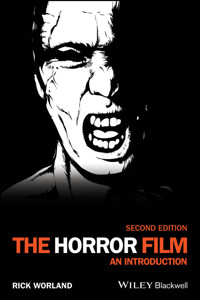
THE HORROR FILM
AN INTRODUCTION
SECOND EDITION
RICK WORLAND
Southern Methodist UniversityMeadows School of the ArtsDallasTX, US
This edition first published 2025© 2025 John Wiley & Sons Ltd
Edition HistoryJohn Wiley & Sons Ltd (1e, 2007)
All rights reserved. No part of this publication may be reproduced, stored in a retrieval system, or transmitted, in any form or by any means, electronic, mechanical, photocopying, recording or otherwise, except as permitted by law. Advice on how to obtain permission to reuse material from this title is available at http://www.wiley.com/go/permissions.
The right of Rick Worland to be identified as the author of this work has been asserted in accordance with law.
Registered OfficesJohn Wiley & Sons, Inc., 111 River Street, Hoboken, NJ 07030, USAJohn Wiley & Sons Ltd, The Atrium, Southern Gate, Chichester, West Sussex, PO19 8SQ, UK
For details of our global editorial offices, customer services, and more information about Wiley products visit us at www.wiley.com.
Wiley also publishes its books in a variety of electronic formats and by print‐on‐demand. Some content that appears in standard print versions of this book may not be available in other formats.
Trademarks: Wiley and the Wiley logo are trademarks or registered trademarks of John Wiley & Sons, Inc. and/or its affiliates in the United States and other countries and may not be used without written permission. All other trademarks are the property of their respective owners. John Wiley & Sons, Inc. is not associated with any product or vendor mentioned in this book.
Limit of Liability/Disclaimer of WarrantyWhile the publisher and authors have used their best efforts in preparing this work, they make no representations or warranties with respect to the accuracy or completeness of the contents of this work and specifically disclaim all warranties, including without limitation any implied warranties of merchantability or fitness for a particular purpose. No warranty may be created or extended by sales representatives, written sales materials or promotional statements for this work. This work is sold with the understanding that the publisher is not engaged in rendering professional services. The advice and strategies contained herein may not be suitable for your situation. You should consult with a specialist where appropriate. The fact that an organization, website, or product is referred to in this work as a citation and/or potential source of further information does not mean that the publisher and authors endorse the information or services the organization, website, or product may provide or recommendations it may make. Further, readers should be aware that websites listed in this work may have changed or disappeared between when this work was written and when it is read. Neither the publisher nor authors shall be liable for any loss of profit or any other commercial damages, including but not limited to special, incidental, consequential, or other damages.
Library of Congress Cataloging‐in‐Publication Data applied for:Paperback ISBN: 9781119715269
Cover Design: WileyCover Image: © jpa1999/Getty Images
Acknowledgments
Acknowledgments for the Second Edition
Revisiting and updating this project on the history, criticism, and reception of the horror genre has been a rewarding and frustrating process. The rewards came in viewing, teaching, and diving deeper into many horror movies made since the first edition of this book went to press near the end of 2005. The quality and inventiveness of filmmaking in the genre, especially in the 2010s was rich and extraordinary, honoring some of the finest works of the past while creating new movies that seem likely to endure. Notably, many of the most original and exciting filmmakers working since about 2000 were students and fans of the genre before they made their first films; their attention to tropes and traditions has invigorated their often formally sophisticated and unnerving films. This has been an excellent time to revisit and update the genre’s development.
The frustration I felt is one that affects every author of a broad topical survey. I have a good friend who teaches and researches Renaissance and Baroque art in Italy and Western Europe. I always joke that scholars in his field have it easy: No one’s making Renaissance and Baroque art anymore. Meanwhile, the film/media historian is faced with a gigantic and expanding global machine that turns out texts of every kind every day. Horror has always been an international genre, though one that Hollywood arguably dominated, as it did much international filmmaking, through the end of World War II. However, from that point on, and increasingly since 2000, horror has become a genuinely global form. Filmmakers and fans everywhere can now easily access and be frightened and inspired by artists in industries and cultural traditions around the world. Influential movies from Hollywood, the UK and British commonwealth, and Western Europe that dominated the second half of the twentieth century, now compete with movies from Eastern Europe and East Asia, especially Japan and South Korea, as well as from Hong Kong and Australia. Latin American filmmakers in Argentina, Brazil, and Mexico produced vivid horror‐fantasy films in the post‐World War II era and down to the present. Authors of survey texts more than ever must offer humble admission that it is virtually impossible to present an all‐inclusive history of even just this one genre. Does the Bollywood industry of India or the Nollywood filmmakers of Nigeria produce horror movies? Evidently, yes. But it will be up to those with much greater cultural and historical knowledge of those regions than me to discuss their history. (And cue me for what to look at and why.) Some may decry any attempt to present a book that implies an all‐encompassing outline of the horror genre, or any subject. But after more than 30 years of teaching assorted surveys of film, television, and media history I feel safe in saying in the most practical terms: You’ve got to start somewhere. Consider this book a start.
The revisions and updates of the original edition consist of the following: corrections of any factual errors, such as release dates of movies or spellings of names; or clarifying some descriptions of scenes discussed. The new material includes embellishing sections of the historical chapters with additional information or context; and with all‐new discussion of films from about 2005 to the present added to Chapter 3. I have made only minor revisions to Chapters 5 through 12, because those essays should stand on their own as written originally and because my opinions about the selected movies have not greatly changed. At various points throughout, however, I have also cited some of the most relevant and outstanding scholarship on individual horror films or periods that has been produced since 2005. I also added Chapter 13, a close analysis of Get Out (2017), a popular and powerful movie that has generated a great deal of discussion and analysis since its release, and that represents several important genre trends of the 2010s.
I must extend thanks for help in completing the new edition. At Southern Methodist University, I thank my friends and colleagues Kevin Heffernan, Derek Kompare, and David Sedman for their advice, support, information, and encouragement. Jolene de Verges, Director of the Hamon Arts Library, and her highly professional and friendly staff, including Chris Rincon, gave prompt attention to my many requests for research materials. Sam Holland, Dean of the Meadows School of the Arts, has fostered and maintained an atmosphere and institution of strong support for scholarship in the humanities that is essential and highly welcome.
I also thank my students at SMU who enlivened my courses on the horror genre, especially those of the past several years, just before, during, and after the COVID‐19 pandemic, when we concentrated on movies made in the twenty‐first century. Their enthusiasm and humor, valuable insights, and occasional expressions of genuine shock made for what I think were many moments of mutual learning.
At Wiley Blackwell Press, thanks to managing editor Pascal Raj Francois for his persistent and prompt information and help in completing this edition.
My close friends John O’Leary, Joe Ansolabehere, and Giles Knox (from the field that has it easy) teach me things every time we talk. But nothing about horror films since none of them like the genre. My internet bud Rob Spadoni, at Case Western Reserve University, however, knows a lot about it but mainly wants to talk about Star Trek. Rob was always helpful in graciously reading drafts and offering important feedback. I hope all these good friends live long and prosper.
My family has been a constant source of love and support. Thanks, and deepest gratitude to my wife, Kathy, our children Emily, Julia, and Ethan, now all vital and creative young adults; and to our fine son‐in‐law Arturo Morin. My earlier books marked the passing of my parents. For this new edition, I want to acknowledge our family’s new addition. I dedicate this book to the life and happiness of our grandson, Montgomery Eloy “Mo” Morin. May he and his generation live in a world of less horror than the one they inherited.
– RW, 2023
Acknowledgments for the First Edition
Over the past decade, several academic writers on the horror film have begun their books with more or less ironic declarations of whether their interest began in childhood or fairly recently, implicitly arguing that one’s credibility to speak about the genre was somehow either enhanced or hurt by just when the writer’s interest began. Such statements indicate that horror may be the original “guilty pleasure;” and underscore again the genre’s roots in the psychological jungles of childhood. I am among those whose fascination started early. In October 1967, I asked my grandfather for a “loan” of seventy‐five cents to buy a strange magazine I had spotted at the drug store, one with silly puns accompanying photos of Godzilla, the Phantom of the Opera, and a still shocking image of a woman with a hatchet buried in her forehead. Realizing this last item might hurt my case, I told Grandpa the money was for a “Halloween magazine.” The description was true enough and it skipped over extraneous details. The pitch worked; and though my interest in the genre has changed and deepened, its multi‐faceted appeal endures.
Scholars and critics of varied backgrounds whose passionate work on the horror film have both inspired me and informed this study include the late Carlos Clarens, R. H.W. Dillard, David J. Skal, Linda Williams, Tony Williams, and Robin Wood.
Special thanks to Barry Keith Grant who initiated an earlier version of this project and provided much valuable editorial commentary and support throughout.
Harry Benshoff, Sean Griffin, and Brian Taves gave their support and encouragement and freely shared their knowledge and insights on horror films and other aspects of film scholarship at important points in the book’s development. Thomas Graham graciously lent his insight and research on Aurora model kits that enhanced Chapter 4.
My friend and colleague Kevin Heffernan was a constant source of information, insight, and invaluable critique that strengthened this study. His work on the economic and formal history of post‐World War II horror kept me aware of the importance of industrial context to the development of the genre overall.
At Southern Methodist University, I must thank Carole Brandt, Dean of the Meadows School of the Arts; Tinsley Silcox, Director of the Hamon Arts Library, and David Sedman for their personal and professional help in the research and writing of this book.
At Blackwell Publishing, Ken Provencher and Jayne Fargnoli provided steady professional advice and encouragement in finally bringing this project to fruition.
Two extraordinary teachers and friends fired my passion for the study of movies and American culture, Dr. James M. Curtis at the University of Missouri, Columbia; and Dr. Howard Suber at UCLA. Thank you for your examples.
Many thanks to my wife Kathy, and our wonderful children Emily, Julia, and Ethan for their love, support, and patience. I could not have done this without you.
Finally, I dedicate this book to the memory of my father, C.I. “Ike” Worland, Jr. The last farmer.
RW
List of Illustrations
Chapter 2. A Short History of the Horror Film, Beginnings to 1945
Figure 2.1
Expressionist Distortion: Mad Dr. Caligari (Werner Krauss) in his office at the mental institution in
The Cabinet of Dr. Caligari
(1920). Source: Directed by Robert Wiene. Produced by Decla. Fair Use.
Figure 2.2
Theatrical Flair: Lon Chaney in
The Phantom of the Opera
(1925). Source: Directed by Rupert Julian. Produced by Universal Pictures. Fair Use.
Figure 2.3
Doppelgänger
: Frederic March in the classic film version of
Dr. Jekyll and Mr. Hyde
(1931). Source: Directed by Rouben Mamoulian. Produced by Paramount Pictures. Fair Use.
Figure 2.4
Horror Stars of the genre’s classic period: The Frankenstein Monster (Boris Karloff) gently tends his late friend Ygor (Bela Lugosi) in
Son of Frankenstein
(1939). Source: Directed by Roland V. Lee. Produced by Universal Pictures. Fair Use.
Figure 2.5
Sequels and Series in the World War II Era: Lon Chaney, Jr. as the Wolf Man in
Frankenstein Meets the Wolf Man
(1943). Source: Directed by Roy William Neill. Produced by Universal Pictures. Fair Use.
Figure 2.6
Mood over Monsters: The desperate Jacqueline ( Jean Brooks) stalked by cultists in Val Lewton’s production of
The Seventh Victim
(1943). Source: Directed by Jacques Tourneur. Produced by RKO‐Radio Pictures. Fair Use.
Chapter 3. A Short History of the Horror Film, 1945 to Present
Figure 3.1
Atomic Terrors: The most famous of many radioactive monsters in the post‐World War II years, Japan’s
Godzilla
(1954). Source: Directed by Ishiro Honda. Produced by Toho Film Co. Fair use.
Figure 3.2
Hammer updates the classic genre movies: Christopher Lee as Count Dracula in
Horror of Dracula
(1958), part of a new series featuring more graphic violence and sexuality. Source: Directed by Terence Fisher. Produced by Hammer Film Productions. Fair Use.
Figure 3.3
Poe goes to the drive‐in: Sebastian Medina (Vincent Price) seized by the delusion of becoming his father, an infamous Inquisitor, in
The Pit and the Pendulum
(1961). Source: Directed by Roger Corman. Produced by American International Pictures. Fair Use.
Figure 3.4
Essence of Exploitation: American International Pictures (AIP) ad slick for
The Thing With Two Heads
(1972), combining the studio’s horror tradition and outlaw biker movies of the 1960s with the 1970s “Blaxploitation” cycle. Source: American International Pictures Pressbook,
The Thing With Two Heads
. (Author’s collection.) Fair Use.
Figure 3.5
Splatter: One of makeup artist Tom Savini’s gory zombie creations in
Dawn of the Dead
(1978). Source: Directed by George A. Romero. Produced by Laurel Group/Dawn Associates. Fair Use.
Figure 3.6
Post‐modern Quotation:
The Funhouse
(1981) opens with self‐conscious reference to
Psycho
by way of
Halloween
. A parodic “rehearsal” before the “real” violence later in the movie. Source: Directed by Tobe Hooper. Produced by Universal Pictures/Mace Neufeld Productions. Fair Use.
Figure 3.7
The slasher cycle and a new monster pantheon in the 1980s: The indestructible Jason Voorhees does it again, and again, and again in
Friday the 13th Part VII: The New Blood
(1988). Source:
Friday the 13th Part VII: The New Blood
. Directed by John Carl Buechler. Produced by Paramount Pictures/Friday Four Films/Sean S. Cunningham Films. Fair Use.
Figure 3.8
Torture Porn: Terrified Paxton (Jay Hernandez), menaced by a chain saw‐wielding sadist in one of the most harrowing scenes of
Hostel
(2005). Source: Directed by Eli Roth. Produced by Next Entertainment/Lions Gate Films. Fair Use.
Figure 3.9
Real Scary: The actors cast in
The Blair Witch Project
(1999) and
Paranormal Activity
(2009) used their real names as their characters’ names, blurring distinctions between fiction and reality. Source: Directed by Daniel Myrick and Eduardo Sanchez. Produced by Haxan Films/Artisan Entertainment. Fair Use.
Figure 3.10
Artist Annie Graham (Toni Collette) shaken by a miniature likeness of her late, still imposing mother in
Hereditary
(2018). Source: Directed by Ari Aster. Produced by Palm Star Media/A24. Fair Use.
Figure 3.11
High School horrors. Supremely confident Jennifer (Megan Fox) and her anxious friend, “Needy” (Amanda Seyfried) in
Jennifer’s Body
(2009). Source: Directed by Karyn Kusama. Produced by Dune Entertainment/Twentieth Century Fox. Fair Use.
Figure 3.12
Adelaide Wilson (Lupita Nyong’o) is a mother determined to protect her family against uncanny threats in
Us
(2019), a tale permitting the principal cast to play dual roles. Source: Directed by Jordan Peele. Produced by Monkeypaw Productions/Blumhouse Productions. Fair Use.
Chapter 4. Monsters Among Us: Cases of Social Reception
Figure 4.1
“Rosie the Riveter” for the genre in wartime: Vampire‐hunter Lady Jane Ainsley (Frieda Inescort) coolly lays a trap for Armand Tesla (Bela Lugosi) in
The Return of the Vampire
(1943). Source: Directed by Lew Landers. Produced by Columbia Pictures. Fair Use.
Figure 4.2
The people next door: CBS’s
The Munsters
and ABC’s
The Addams Family
, both broadcast 1964–6, portrayed the American family as happy denizens of a gothic world.
The Addams Family
(pictured) was adapted from the cleverly weird magazine cartoons of Charles Addams. Source: Created by David Levy. Produced by Filmways Television. Fair Use.
Chapter 5. Edges of the Horror Film: Lon Chaney, Tod Browning, and The Unknown (1927)
Figure 5.1
Alonzo the Armless (Lon Chaney) and his diminutive alter ego Cojo (John George) in
The Unknown
(1927). Source:
The Unknown
. Directed by Tod Browning. Produced by Metro‐Goldwyn‐Mayer. Fair Use.
Chapter 6. Frankenstein (1931) and Hollywood Expressionism
Figure 6.1
Jack P. Pierce’s makeup for Boris Karloff as the Monster in
Frankenstein
(1931) became one of the iconic images of twentieth‐century culture. Source: Directed by James Whale. Produced by Universal Pictures. Fair Use.
Chapter 7. Cat People (1942): Lewton, Freud, and Suggestive Horror
Figure 7.1
Simone Simon as the troubled Irena Dubrovna, before a Goya portrait including sinister felines in Val Lewton’s production of
Cat People
(1942). Source: Directed by Jacques Tourneur. Produced by RKO‐Radio Pictures. Fair Use.
Chapter 8. Horror in “The Age of Anxiety:” Invasion of the Body Snatchers (1956)
Figure 8.1
Dr. Miles Bennell (Kevin McCarthy) examines the strange “blank” found in the Belicec home in
Invasion of the Body Snatchers
(1956). The movie combines a science fiction plot with the chiaroscuro visuals of gothic horror. Source: Directed by Don Siegel. Produced by Allied Artists. Fair Use.
Chapter 9. Slaughtering Genre Tradition: The Texas Chain Saw Massacre (1974)
Figure 9.1
Family dinner: Captive Sally’s nightmarish view of the cannibal clan in
The Texas Chain Saw Massacre
(1974). Fiendish production design by Robert A. Burns. Source: Directed by Tobe Hooper. Produced by Vortex/Bryanston Distributing. Fair Use.
Chapter 10. Halloween (1978): The Shape of the Slasher Film
Figure 10.1
Final Girl: Fearful but resilient Laurie Strode (Jamie Lee Curtis) ventures across the street to confront the evil that awaits in
Halloween
(1978). Source: Directed by John Carpenter. Produced by Compass International Pictures/Falcon International Productions. Fair Use.
Chapter 11. Re‐Animator (1985) and Slapstick Horror
Figure 11.1
Going head to head: Obsessive scientist Herbert West (Jeffrey Combs) revives the severed head and body of his nemesis Dr. Hill (David Gale) to initiate the absurd and gory climax of
Re‐Animator
(1985). Source: Directed by Stuart Gordon. Produced by Empire Pictures. Fair Use.
Chapter 12. Demon Lover: Bram Stoker’s Dracula (1992)
Figure 12.1
Androgynous and Orientalist motifs: Gary Oldman as the shape‐shifting Count gives Jonathan Harker (Keanu Reeves) a pointed welcome in
Bram Stoker’s Dracula
(1992). Source: Directed by Francis Ford Coppola. Produced by American Zoetrope/Columbia Pictures. Fair Use.
Chapter 13. Get Out (2017): The American Horror
Figure 13.1
Photographer Chris Washington (Daniel Kaluuya), with girlfriend Rose Armitage (Allison Williams), fielding increasingly obtrusive and racist remarks from her parents’ friends; and unwittingly on display before the modern‐day “slave auction” in
Get Out
(2017). Source: Directed by Jordan Peele. Produced by Monkeypaw Productions/Blumhouse Productions/Universal. Fair Use.
Figure 13.2
Tireless Ben (Duane Jones) in
Night of the Living Dead
(1968) plans the defense of the isolated farmhouse. Note the background décor that anticipates a key motif of
Get Out
. Source: Directed by George A. Romero. Produced by Image Ten. Fair Use.
Chapter 1Introduction: Undying Monsters
A stranded group approaches the ancient house where a dim light burns in an upper window. As the full moon rises, a pain‐wracked man gasps at the fur growing on his palms. Thunder crashes and lighting illuminates the operating table lifted into the night sky. Eager for furtive sex on a dark night, a young couple hears twigs snap as an apparition raises a hooked blade above them. Seated in a movie theater, these sights and sounds can only mean you are watching a horror film – paradoxically prepared, even eager to see things that may make you want to avert your eyes. Ominous places, grotesque semi‐humans, or outright monsters await, ready to make you confront your own fragile mortality. Who would go here willingly? Millions have, for decades; centuries if we recognize the basic shape and themes of horror narratives in media long preceding motion pictures. Many explanations for the perennial appeal of horror have been advanced, yet most probe similar points: the psychological and emotional reactions of the individual viewer/consumer, most importantly the evocation of mortal fear, one of our most primordial instincts; the dread of a radically non‐human monster; events that challenge traditional conceptions of morality and/or the social good. The horror tale compels us to contend with a particularly violent and uncanny disruption of our unremarkable, everyday experiences, one that carries both individual and social implications.
Say that you seriously enjoy horror movies, and you are likely to elicit reactions that seldom occur should you express affection for love stories or even science fiction. Unless you are with other like‐minded people – and horror is a broadly popular, not elite form – those reactions may range from amused condescension (“kids’ stuff,” “camp”); to quiet opprobrium (“Aren’t there enough real horrors in the world?”); or even suspicions about your emotional health (“You’re drawn to images of women being murdered? Let’s explore that …”). Still others may respond that they avoid horror movies either because they find them too upsetting to be “entertainment” or reject the entire form on moral or political grounds. Those wary of horror films surely understand part of the story: the psychology of the horror film viewer, or at least the emotional reactions such works can provoke are central to the genre’s construction and reception. The monsters in horror stories are powerful and truly immortal beings because no matter how many times they are killed or destroyed, our fear and desire for their company compel their return.
This book surveys the history, stylistic development, and social reception of the American horror film from the earliest period of the genre’s importance to the present. While we will touch on antecedents of the horror film in art, literature, and theater for the themes and motifs they share, cinematic horror will remain the major focus. We examine ways in which horror movies have been produced, received, and interpreted by filmmakers, audiences, and critics throughout the medium’s history. Though horror has proven popular in many media (witness the phenomenal success of the novels of Stephen King and Anne Rice), the mass audiences long attracted to cinematic horror have made it the most prominent cultural source for frightful tales of monsters, madmen, and supernatural evil. Characters and scenes from horror movies permeate our cultural consciousness: the flat‐topped Frankenstein Monster; the Phantom of the Opera unmasked; Bela Lugosi’s black‐caped Dracula; Janet Leigh’s fatal shower in Psycho; Linda Blair’s demonically rotating head in The Exorcist; or an unholy trio of implacable stalkers with preppy names – Michael, Jason, and Freddy – in the slasher series of the 1980s and beyond. The horror film draws together and transforms mythic and literary traditions, forming a pool of images and themes that filmmakers can reference, vary, or revise. Probing such a vibrant yet often controversial genre brings us closer to understanding the functions, meanings, and pleasures of that form as it circulates in changing historical circumstances.
The later twentieth century saw increasingly specialized writing about the horror genre. From the mid‐1970s onward, individual films, auteurs, and stylistic sub‐groups were critiqued from various critical perspectives (by feminist writers especially), submitted to the rigor and variety of analysis previously devoted to the Western, Film Noir, or the cinema of Alfred Hitchcock. Over this same period, however, discernable shifts occurred in intellectual conceptions brought to bear on horror. Critics moved from suggesting that this modern form continues the traditional concerns of ancient mythology and canonical literature for confronting fundamental, even universal philosophical and moral questions about human mortality and the nature of evil; to emphasizing the psychological processes either reflected in or stimulated by horror’s frightening narratives; and to probing the genre for allegories of contemporary social and political ideology. Some would argue this is clear evidence that comprehension of the horror film, indeed of all popular forms, has grown steadily more sophisticated, but in any case, recent approaches have tended to become more historically and culturally specific. Still, the production of historical or critical knowledge is as much related to the intellectual framework one builds, the assumptions or omissions made, as it is to the establishment of empirical facts. Critics tend to combine and borrow pragmatically from various approaches because different insights can result from different interpretive methods.
Horror often achieves its greatest impact when it exposes or flaunts cultural taboos. Yet over time movies proven to have scared audiences in their day and beyond did so because they succeeded first as movies – through cinematic renderings of characters and stories that skillfully manipulated the range of film technique. In this regard, although the very concept of artistic canons has been the subject of intense intellectual and political debate for decades, canon formation remains both inevitable and essential to provide any framework for analysis, regardless of the conclusions or interpretations at which one finally arrives. Simply to describe works of interest does not automatically legitimate these and only these texts as important, valuable, or worthy of consideration. One of the most salient facts about fictional horror is the generally low regard in which it is held – at least publicly – by proponents of “good taste” and higher intellectual and esthetic aspirations. Such disdain invites closer investigation, as it likely obscures a wealth of ideological assumptions. Moreover, when dealing with the popular arts, canons may be formed from both the enduring commercial appeal of certain texts (e.g., the many incarnations of Frankenstein’s Monster) and from the received wisdom of critical tradition, wisdom that can be more readily challenged if one has a broader grasp of the genre as well as the conventional terms of valuation and debate. Danish director Carl Theodor Dreyer’s brooding and difficult Vampyr (1932), for example, though often championed as a genre landmark, is really a high brow “cult movie,” one we might now categorize as an example of the international art cinema style; though a distinguished film filled with uncanny imagery, not remotely a popular work like contemporaneous Hollywood efforts such as The Mummy (1932) or Dr. X (1932). Self‐conscious attention to canon formation that seeks rapprochement between audiences and critics, which acknowledges that each side has something important to tell us about a given movie or period, seems likely to produce a more complete account of a genre and its most significant works.
In the 1960s and early 1970s, a rich period of formal innovation throughout the film medium (e.g., the French New Wave, Direct Cinema documentary, the avant‐garde “New American cinema,” and directors of the New Hollywood grappling with these forms) stimulated increasingly sophisticated popular criticism that enhanced cinema’s cultural prestige. This artistic and intellectual activity meshed with the political and social tumult of the period, from the Civil Rights movement to increasing opposition to the Vietnam War, a subsidiary effect of which was to shift attention to the social dynamics of cultural, especially popular cultural forms. Significant work on film also began to emerge from established academic departments of language and literature, art history, and theater. Partly owing to the need to justify such work to culturally conservative administrators and traditionalist colleagues, these writers analyzed popular movies with steady reference to the canons and concerns of High Culture. For them, film versions of Frankenstein, Dracula, and Dr. Jekyll and Mr. Hyde were ripe for analysis because of their roots in nineteenth‐century novels that had some (though not wholehearted) literary cachet. These initial efforts sought to prove that such sensational fare might not only be redeemed but also incorporated into the canons of the humanistic tradition. The effort was as sincere as the task was formidable since it often failed to satisfy neither traditional cultural elites nor the unabashed fans of movie monsters; or after the early 1960s, account for the lurid exploitation movies that increasingly made up the genre’s most dynamic works.
The fine 1972 anthology Focus on the Horror Film typifies the humanistic criticism I am describing. At what the editors evidently recognized as a significant transitional moment in the genre’s history after the end of censorship in 1968, the writers collected in this volume sought to present a critical and historical overview of horror’s development. The essays are grouped into categories including “The Horror Domain,” “Gothic Horror,” “Monster Terror,” and “Psychological Thriller,” indicating major genre patterns. Titles of two essays in the initial category reference Shakespeare and Yeats. An essay by literary critic R.H.W. Dillard begins,
I suppose that all significant Western art, at least since the medieval period, has been directly concerned with the original fall of man and the consequent introduction of sin and death into the world … The horror film is, at its best, as thoroughly and richly involved with the dark truths of sin and death as any art form has ever been, but its approach is that of parable and metaphor – an approach which enables it … to achieve a metaphysical grandeur, but which also may explain why its failures are so very awful and indefensible.1
Dillard walks a fine line, beginning an analysis of the genre’s particular mediation of the confrontation with mortality and asserting its importance as a cultural voice, while dismissing the likes of I Was a Teenage Frankenstein (1957) or Billy the Kid vs. Dracula (1966), movies “obviously” more suited to the drive‐in than the classroom. Yet how, then, to reconcile serious considerations with the positively thrilling sense of partaking of something that is low, vulgar, and offensive to paternalistic authority, the things that often give the horror film its charge and appeal? This work would have to come a bit later.
Overall, perhaps the greatest contribution of humanistic critics was to take horror films seriously, a simple act that opened many doors. They did so in part by riding the high tide of auteurism, the controversial but suggestive critical notion that certain outstanding directors ought to be considered the principal creators (authors) of their films. In discussing James Whale or Tod Browning as auteurs, critics were insisting on the analysis of these directors’ work as cinematic art, as opposed to earlier rejection of Frankenstein (1931) and Dracula (1931) as shallow mass cultural travesties of their literary predecessors; or, closely related, dismissal on the grounds that monster movies were simply and obviously juvenile entertainment that ought not to impress or engage any “serious” person above age 12. Considered in terms of typical settings, characters, and themes (key components of any genre), horror movies could indeed suggest parallels with ancient myth, gothic literature, and other artistic forms. But to the extent that auteurist critics began to focus attention on the formal properties of the films, they brought a new aesthetic vocabulary to bear on visually rich works produced from at least the 1920s German Expressionist period onward. One might argue that analyses that proceeded from High Culture models or appeals to film‐as‐art were superfluous or even distracting from the subject at hand, but at certain points, such appeals were entirely necessary.
About two decades later, however, freed of the need to rationalize the object of study, James Twitchell’s Dreadful Pleasures: An Anatomy of Modern Horror (1985) still considers the horror film a continuation of themes in art dating from prehistoric times. But for Twitchell, this is merely the starting point for other analyses, including his argument that horror stories “carry the prescriptive codes of modern Western sexual behavior.”2 A similar notion that the horror film both assimilates and secularizes persistently important cultural and philosophical motifs appears in Walter Kendrick’s The Thrill of Fear: 250 Years of Scary Entertainment (1991). The broad, inclusive approaches of English literature professors such as Twitchell and Kendrick remain important to contextualize prevalent issues in horror criticism. Scholars had noted even earlier that the flowering of gothic literature, if dated from the publication of Horace Walpole’s The Castle of Otranto (1764), roughly coincides with the Age of Enlightenment, marked in this case by secularization that increasingly rivals or replaces traditional religious explanations and earlier or co‐existent folk superstitions and practices with skeptical philosophical and scientific inquiry.3 In a period largely stripped of literal belief in the supernatural, a new form of literary expression arose based on confrontations real or presumed with the occult, a form that endures to the present. Why? And what are the implications of this cultural response and its persistent popularity? As I will suggest, these and other analyses of the horror film often seek to map and understand the genre in relation to four major questions, large issues that can be subdivided into more specific areas.
First, just what is a “horror film;” or what are the typical settings, characters, and narrative problems that structure and define this genre? Second, what are the psychological functions of horror? Writing about gothic literature in the twentieth century took it as axiomatic that its “true” meanings were to be found in psychological (particularly Freudian psychoanalytic) conceptions. Because the horror genre is defined by the emotional response it provokes – apprehension, fear, and terror – critics have pursued questions about the individual reader/viewer’s psychological reactions. Third, how has this form evolved over time, or what does the history of the horror film tell us about both its relatively stable and constant aspects and of those that change historically? Finally, what are the social functions of horror? Recent commentators would agree that the psychological and social implications of the genre are closely related, even inseparable, reasoning that the individual is a subject of social formation and conditioning whose personal responses must be mapped onto larger social questions raised by horror as entertainment. Most public discussions of fictional horror center around issues of censorship, the violation of social standards of morality and conduct, and the potential deleterious results from exposure of some members of society, especially children and the socially disadvantaged, to violent, disturbing, and destabilizing horror narratives. But there are other issues to consider in regard to horror’s social meanings, and historical conditions shape reception as much as the genre’s formal features. I will defer discussion of the genre’s social impact to Chapter 4. Yet throughout this book, we will suggest ways in which all these basic questions or areas of analysis overlap.
Tracking the Thing
What do we mean when we use the term “horror film”? An important part of the definition is self‐evident: it is a movie that aims foremost to scare us. But the fear it evokes and how it goes about it is distinct. While we are likely to experience anxiety and fright in other violent genres – a war story, disaster movie, or crime drama, for instance – a horror film evokes deeper, more personal psychological fears in the starkest terms. The most basic fear in the horror story is the fear of death. But this is only the beginning of its impact and appeal. The fate of horror’s most unfortunate characters usually comes down to two possibilities, which a given story may or may not consider synonymous – death, the physical fact of the end of life; and damnation, a metaphysical conception that describes a state in which the immortal “soul” is condemned to eternal suffering and punishment. Creatures in horror stories, as well as their victims, often straddle these two domains in a horrible state that is neither death nor life – the threat of becoming one of the “living dead” or “undead.” The monster can be seen as the personification of death itself which, like the traditional figure of The Grim Reaper, is an ultimately unstoppable opponent relentlessly committed to the destruction of healthy and vibrant human beings. As the perfect title of a sporadically effective horror movie of 2000 had it, seemingly, The Dead Hate the Living. Such stories depict death as the possible start of an even more terrible fate.
As regards the omnipresence of death in horror tales, however, these stories threaten or present us with images not merely of death but of an especially grotesque and painful end, what Stephen King sardonically dubbed “the bad death,” which he considers a fundamental aspect of horror tales.4 Marion Crane was not simply stabbed, she was sliced to pieces; the zombies in Night of the Living Dead (1968) disembowel and eat their victims; opponents of the shadowy corporation in Scanners (1981) do not just suffer strokes, their heads explode; The Texas Chain Saw Massacre (1974) – well, the title says it all. Horror in all periods has thrived on depictions of “bad deaths,” the kind that makes us dwell on physical agony. To learn that someone “died instantly” can provide a certain comfort. But suffering occurs over time, its dread that the pain will be drawn out indefinitely. (Hell is often depicted as endless physical torment, lavish “bad deaths” extended through eternity.) Despite widely varying tones, the deathtraps in Peeping Tom (1960), The Abominable Dr. Phibes (1971), and Saw (2004), frighten not just with the mortal punishment the victims endure but from the soul‐killing depression of knowing that the perpetrator is all‐too human and drawing a sadistic thrill from the victim’s agony. These examples and others wring additional intensity from allowing the victims to contemplate their impending deaths. Moreover, to depict atrocious acts on screen may be decried as gratuitous or tasteless; but when violence is intermingled with sexual sadism, it is likely to raise charges of potential harm in the real world.
As such, another significant dimension of the horror tale is its affinity for the lesson, often metaphysical, implicitly social. Though we will never encounter such unnaturally powerful monsters in the material world, such stories serve as parables or convey a sharp message of warning. As the American horror genre took shape in the early 1930s, censors inside and beyond Hollywood vigilantly insisted that its monsters and transgressing scientists must either perish or live long enough to recant. Regardless, horror stories seem to form a secular, parallel narrative to the essentially religious traditions of the cultures that generate them. Their plots describe situations that carry ultimate consequences for certain characters, which by analogy offer similar alternatives for the reader/viewer regardless of narrative plausibility. Avoid the vampire and we will walk in the sun tomorrow; but should we fall victim to its bite, we may be damned forever. Accordingly, the undead creature can often be checked or wounded by the most familiar Judeo‐Christian religious symbols, the cross, holy water, or a prayer that invokes the Almighty. Even though gothic novels were originally formulated in a skeptical age whose most vibrant minds aimed to question and reject traditional religious dogma, these tales still affirmed the power and persistence of the uncanny, the inexplicable, and the irrational in most aspects of individual and social life.
Besides intending to scare the viewer by presenting images that most people would certainly not wish to see in real life, a major component of the horror film is its star, the monster. Most genres contain a collection of stock characters that appear in assorted variants and combinations, and the horror film is no exception: the mad scientist and his deformed servant, the scoffing authority figure, a wise elder who recognizes the evil, the screaming (usually female) victim, among others. Still, no one goes to a horror movie to enjoy another pair of typical characters, the sturdy hero and wilting heroine often pursued by the monster, the earnest heterosexual couple hoping to put all this behind them the morning after. No, the audience comes to see the creature, the thing, the supernatural menace in whatever near‐human or non‐human form it assumes. Most sub‐genres of horror are built around specific monsters: the zombie, werewolf, vengeful ghost, or psychotic slasher, to name a few. As I suggest later, certain monsters can be thought of as embodying specific threats or fears. The monster is often a liminal figure, an uncertain amalgam or transitional form between living and dead; human and animal; male and female. The most potent character in the genre, the paradox of the monster is that it incites our fear, compels our attention, and quite often courts our empathy and fascination, even though it remains the most remote from any possible reality.
As such, perhaps the most important aspect of the horror story is that its situations and sources of fear are largely irrational. (We will talk more below about the varied possibilities of irrational powers in the related forms of horror, science fiction, and fantasy.) Horror tales can evoke genuine fears; frequently these consist of scenarios common in nightmares of being pursued, trapped, and slaughtered by an overwhelmingly powerful figure. In fact, one of the most complimentary things to say about a gripping horror story is to call it “nightmarish.” Yet in most horror tales, the agents of destruction are purely imaginary creatures, essentially the products of lingering pagan superstition. Put it this way: Though we might check into an out‐of‐the‐way motel and be murdered by a maniac while showering – and for this reason, Psycho, by the way, was generally not considered a “horror movie” upon its 1960 release – it is not possible that we will ever be bitten by a vampire, chewed by a decaying zombie, or torn up by a werewolf. Still, movies featuring these creatures are among the best‐known and most lasting works in the genre. It is this central irrationality that allows the mass‐mediated horror story of the modern technological age to seem a logical extension of monster and hero stories from mythology, folklore, and fairy tales, the last usually intended for young children at a developmental stage at which distinctions between wish and reality, or make‐believe and material, are not so clear.
A supernatural basis is only apparently absent in the slasher films that appeared in the late 1970s where the monster at least begins as a human psychopath; yet the most enduring of these series, such as Halloween and Friday the 13th quickly developed their invulnerable killers as virtual immortals. Still, stressing the irrationality of the threat in the horror genre, many movies may gather under its umbrella even if the monster remains fully human from start to finish. Some of the best of these, however, use so much time and atmosphere to convince us that the weird occurrences are the work of ghosts or a curse that even, when finally told, they are not (e.g., in Rebecca [1940], The Pit and the Pendulum [1961], or Dead Ringers [1988]), our sense that this was all fundamentally uncanny remains. The cultivation of fear and a sense of the psychologically bizarre they evoke is what most aligns these stories with the horror genre.
For more than half a century now, the term “horror movie” has likely evoked acts of graphic violence rather than subtle constructions of ominous atmosphere. Yet over time, horror stories have often differed by how much or how little their atrocities were hinted at or shown directly. In this regard, some have sought to distinguish between “terror” and “horror,” arguing that the former is more artful and unsettling than the latter, which is condemned as esthetically cheap, perhaps even ethically suspect. Author Ann Radcliffe, one of the central figures in the formation of gothic literature, believed the distinction between terror and horror to be an important one, as did actor Boris Karloff, who preferred the term “terror pictures” to describe the work he did for nearly 40 years after he played the Monster in Frankenstein. Radcliffe insisted that “Terror and horror are so far opposite, that the first expands the soul, and awakens the faculties to a high degree of life; the other contracts, freezes, and nearly annihilates them.”5 Nearly two centuries apart, Radcliffe and Karloff agreed that terror was a more refined and difficult performance to achieve than the quick shocks of mere horror – effects that simply disgusted the audience rather than engaged it in the more psychologically complex anxiety of terror. Terror evolved from careful construction of suspense; it disturbed by creating apprehension that something awful was likely to happen to characters we cared about. Also, it was more effective, or so this argument went, because it required the audience to participate intellectually, to actively create the frightening thoughts in their individual minds. In the 1940s, producer Val Lewton became a master of such suggestive effects in finely crafted movies that lacked visible monsters or on‐screen violence. The issue was not censorship, though Hollywood movies were heavily censored at that time, but taste. “Terror” became a conscious aesthetic approach.
Horror, then, is seemingly distinguished by the opposite of restraint. Horror is an emotionally overwhelming form that produces not mere anxiety but revulsion, a sensation that might be literally stomach‐churning: explicit scenes of gory violence and the decay of the grave paraded into view. In the sadistic German film Mark of the Devil [Hexen bis aufs Blut Gequaelt] (1970), about eighteenth‐century witch‐hunting, we see a woman’s tongue ripped out of her mouth by Inquisitors. Nothing is spared or left to the imagination. If terror makes us worry about what might happen to a potential victim, horror shows us; it realizes our worst fears of victimization. However, the claim that the impact of graphic horror is easily achieved and inevitably less effective than a more restrained approach is not upheld by the history of the genre since the mid‐1960s, where complex works from Night of the Living Dead and Last House on the Left (1972) to The Fly (1986) or The Ring (2002) combine grisly effects and unsettling themes whose dark implications outlast their shock value. True, graphic horror with little else to recommend can be quite dull. Mark of the Devil is a less interesting or skillful work than an earlier one that inspired it, Michael Reeves’s Witchfinder General/The Conqueror Worm (1968). Careful writing, direction, and performance usually carry the day in a horror movie, as in any other. As I suggest in Chapter 10, John Carpenter’s Halloween (1978) became such a popular and influential movie owing to its balance of suspense and explicit violence. Nevertheless, in the 1980s, a horror sub‐genre (often called “splatter movies”) appeared (e.g., Dead and Buried [1981], The Burning [1981], Scalps [1983]), largely intended to showcase increasingly gory and spectacular illusions of dismemberment, impalement, and decomposing flesh that drew audiences largely for the craft of the makeup artist. If we simply want to see astonishing demonstrations of gross‐out effects, these movies succeed, too. In any case, the genre is flexible enough to accommodate a range of possible styles.
The final distinguishing mark of the horror film I will describe pertains to its construction of a steadily growing mood of foreboding derived from the story’s setting. In fact, this was the principal form and appeal of its major literary predecessor. Arising in late eighteenth‐century England, gothic fiction formed the basis for the modern horror story. So named because of their typical settings in medieval (gothic) castles, manors, or abbeys, novels such as The Castle of Otranto (1764), The Mysteries of Udolpho (1794), The Monk, (1796), and Melmoth the Wanderer (1820) built their plots around restless spirits, ageless monsters, and unresolved sins of the past that reappear to bedevil modern characters. The gothic novel conventionalized many of the plots, characters, and themes still found in surprisingly similar forms in horror movies. The ghost‐plagued fortress in The Castle of Otranto, written a decade before the American Revolution, established a dark setting to contain guilty family secrets. Castle, ghost, secrets: these gothic tropes were widely familiar by the time Edgar Allan Poe evoked them in “The Fall of the House of Usher” (1839); then knowingly manipulated in Henry James’s eerie psychological tale “The Jolly Corner” (1908), where the association of the dwelling’s architecture and the anatomy of a disturbed mind becomes explicit; parodied in Universal’s The Old Dark House (1932); used to juxtapose a banal postwar motel with the sinister Victorian house behind it in Psycho; or disguised in the vicious thing stalking the dark passageways of a futuristic spaceship in Alien (1979). Though gothic elements grew to define Euro‐American horror stories, we should not assume these settings and themes are essential or natural to all such tales, not in the way that supernatural monsters or fear of the bad death seem to be. Rather, gothic imagery is both historically and culturally particular to the Western world. Horror stories from Asia, Africa, or the Middle East draw on cultural traditions for which the decaying medieval castle or shadowy Victorian manor have no strict parallel. Western societies gradually developed the gothic setting as horror’s most familiar realm.
It’s All in Your Mind
Like other writers on horror, I assume that the underlying irrationality of its scenarios – the certainty that this thing is not real, this situation could not actually occur – provides an allegorical cushion allowing us to contemplate, both intellectually and emotionally, the implications of a variety of threatening, painful, and finally individually and socially important conflicts. Critics have recalled from Greek mythology the polished shield of Perseus that permitted him to look indirectly at an awful monster, the Gorgon, and thus slay it. Freud’s theories that dreams




