


0,00 €
Mehr erfahren.
- Herausgeber: transcript Verlag
- Kategorie: Geisteswissenschaft
- Serie: Edition Politik
- Sprache: Englisch
In present-day South Africa, urban development agendas have inscribed doctrines of desirable and undesirable life in city spaces and the public that uses the space. This book studies the ways in which segregated city spaces, displacement of people from their homes, and criminalization practices are structured and executed. Sara Dehkordi shows that these doctrines are being legitimized and legalized as part of a discursive practice and that the criminalization of lower-class members are part of that practice, not as random policing techniques of individual security forces, but as a technology of power that attends to the body, zooms in on it, screens it, and interrogates it.
Das E-Book können Sie in Legimi-Apps oder einer beliebigen App lesen, die das folgende Format unterstützen:
Seitenzahl: 484
Veröffentlichungsjahr: 2020
Ähnliche



















This open access publication has been enabled by the support of POLLUX (Fachinformationsdienst Politikwissenschaft)
and a collaborative network of academic libraries for the promotion of the Open Access transformation in the Social Sciences and Humanities (transcript Open Library Politikwissenschaft 2020)
This publication is compliant with the “Recommendations on quality standards for the open access provision of books”, Nationaler Open Access Kontaktpunkt 2018 (https://pub.uni-bielefeld.de/record/2932189)
Karl-Franzens-Universität Graz | Universität Wien Bibliotheks- und Archivwesen | Bergische Universität Wuppertal | Carl von Ossietzky-Universität (University of Oldenburg) | Freie Universität Berlin (FU) (Free University of Berlin) | Georg- August-Universität Göttingen | Goethe- Universität-Frankfurt/M (University of Frankfurt am Main) | Gottfried Wilhelm Leibniz Bibliothek – Niedersächsische Landesbibliothek | Gottfried Wilhelm Leibniz Universität Hannover | Humboldt- Universität zu Berlin | Justus-Liebig- Universität Gießen (University of Giessen) | Ludwig-Maximilians-Universität München (LMU) | Martin-Luther-Universität Halle-Wittenberg | Max Planck Digital Library | Ruhr-Universität Bochum (RUB) | Sächsische Landesbibliothek Staats- und Universitätsbibliothek Dresden (SLUB) | Staatsbibliothek zu Berlin (Berlin State Library) | ULB Darmstadt | Universität Bayreuth | Universität Duisburg-Essen | Universität Hamburg (UHH) | Universität Potsdam (University of Potsdam) | Universität Vechta | Universität zu Köln| Universitäts- und Landesbibliothek Düsseldorf (University and State Library Düsseldorf) | Universitäts- und Landesbibliothek Münster (University of Munster) | Universitätsbibliothek Bielefeld (University of Bielefeld) | Universitätsbibliothek der Bauhaus- Universität Weimar (University of Weimar) | Universitätsbibliothek Erlangen- Nürnberg (FAU University Erlangen- Nürnberg) | Universitätsbibliothek Hagen (Fernuni Hagen) (University of Hagen) | Universitätsbibliothek Kassel | Universitätsbibliothek Koblenz-Landau | Universitätsbibliothek Konstanz (University of Konstanz) | Universitätsbibliothek Leipzig (University of Leipzig) | Universitätsbibliothek Mainz (University of Mainz) | Universitätsbibliothek Marburg | Universitätsbibliothek Osnabrück (University of Osnabrück) | Universitätsbibliothek Passau | Universitätsbibliothek Siegen | Universitätsbibliothek Würzburg | Zentralund Hochschulbibliothek Luzern (ZHB) (Central and University Library of Lucerne) | Zentralbibliothek Zürich (Central Library of Zurich) | Bundesministerium der Verteidigung | Landesbibliothek Oldenburg (State Library of Oldenburg) | Leibniz- Institut für Europäische Geschichte | Stiftung Wissenschaft und Politik
Sara Dehkordi, is a lecturer at the Department of Political and Social Sciences at the Freie Universität Berlin. She teaches postcolonial and decolonial theories, on colonial genocide, the Negritude and Black Consciousness Movement, neoliberal urbanism, and critical peace and conflict studies. She has received the German Tiburtius Prize for outstanding research for her work leading to the book »Segregation, Inequality, and Urban Development«.
Sara Dehkordi
Segregation, Inequality, and Urban Development
Forced Evictions and Criminalisation Practices in Present-Day South Africa
D188
Bibliographic information published by the Deutsche Nationalbibliothek
The Deutsche Nationalbibliothek lists this publication in the Deutsche Nationalbibliografie; detailed bibliographic data are available in the Internet at http://dnb.d-nb.de
This work is licensed under the Creative Commons Attribution 4.0 (BY) license, which means that the text may be be remixed, transformed and built upon and be copied and redistributed in any medium or format even commercially, provided credit is given to the author. For details go to http://creativecommons.org/licenses/by/4.0/ Creative Commons license terms for re-use do not apply to any content (such as graphs, figures, photos, excerpts, etc.) not original to the Open Access publication and further permission may be required from the rights holder. The obligation to research and clear permission lies solely with the party re-using the material.
First published in 2020 by transcript Verlag, Bielefeld © Sara Dehkordi All rights reserved. No part of this book may be reprinted or reproduced or utilized in any form or by any electronic, mechanical, or other means, now known or hereafter invented, including photocopying and recording, or in any information storage or retrieval system, without permission in writing from the publisher.
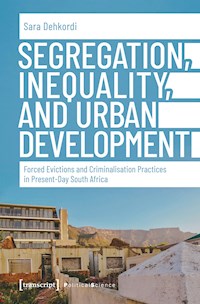
Cover layout: Maria Arndt, Bielefeld Cover illustration: Sara Dehkordi: The ruins of the evicted pensioners’ houses in Pontac, Nelson and Aspeling Street - District Sx, Cape Town Printed by Majuskel Medienproduktion GmbH, Wetzlar Print-ISBN 978-3-8376-5310-6 PDF-ISBN 978-3-8394-5310-0 EPUB-ISBN 978-3-7328-5310-6https://doi.org/10.14361/9783839453100
Inhalt
Acknowledgements
Introduction
Beginnings
Impressions
The book
Chapter one
The colonial archives repertoire
Introduction
Thinking archive with Derrida
Coloniality and the archive
The archive, institutionalisation, and the making of memory
Archive and method
Thinking the forbidden archive
Coloniality and the Urban Development Discourse
Imagining a third space
Conclusion
Chapter two
Policies of Displacement – Forced Evictions and their Discursive Framing
Introduction
The District Six evictions
The evictions of the Joe Slovo Residents
The evictions in Symphony Way
The Tafelsig evictions
Blikkiesdorp
Conclusion
Chapter three
“Cleaning” the streets – Urban Development Discourse and criminalisation practices
Introduction
Politico-economic violence and the coloniality of the present
The category of “the poor” and the disciplining effects of space
Superfluous informal traders
The security sector and the production of fear
The business elite
Urban Development Discourse and media
Conclusion
Chapter four
Architectures of Division
Introduction
First coordinate: Table Mountain
Second coordinate: Vredehoek Quarry
Third coordinate: Victoria Road
Fourth coordinate: Imizamo Yethu
Fifth coordinate: Main Library, University of Stellenbosch
Conclusion
Chapter five
Intervention through art – Performing is making visible
Introduction
Steven Cohen – The Chandelier
The Xcollektiv – Non-Poor Only
Ayesha Price – Save the Princess
Donovan Ward – Living on the Edge
Conclusion
ConclusionS
Epilogue
Bibliography
Books, journal articles, reports and court judgments
To the memory of Siyamthanda Betana and Nuri Dehkordi who were murdered,and Thabiso Betana and Maziar Dehkordi who died whereas they could have lived.
Acknowledgements
This book is indebted to the inputs, analyses, theoretical discussions and attentive criticism of many. I would like to start with Mrs. Magdalene George, Jerome Daniels and Faeza Meyer Fouri. Their openness and analyses of their struggles, the ways in which they relate to their communities and their recalling of their memories allowed me to develop the analysis of this study. Their words lived with me throughout the years. Their resoluteness and above all, their power of endurance, will remain a life-time reminder of fight and hope. Their critical stance towards the role of research and researchers have essentially shaped the book’s entire approach. This study would have been impossible without our conversations and the amount of what I have learned from them.
Heidi Grunebaum has shaped and challenged this work over almost six years. The time she invested in our conversations and the ways in which she supervised the work throughout all its critical stages, cannot be compensated. Especially the methodology this book undertook has been thoroughly influenced by her painstakingly deconstructing imprecise assumptions, use of sources and theoretical framings. Ulrike Schultz’s extensive and committed supervision is irreplaceable for the direction this book undertook. Her straightforwardness and and at the same time, humanness, became the most productive sources. Oddveig Nicole Sarmiento accompanied this work from its very beginning. Conversations with her contributed to various frameworks and concepts. I remain indebted to her guidance and intellectual generosity she invested down through the years. Sara Abbas’s patience and analytical interventions made me rethink the book’s structure and use of method and has influenced my whole understanding of the themes I was working on. I am deeply grateful for her sincere friendship. Countless conversations with Ilham Rawoot have enabled a whole set of subjects related to exclusion and criminalisation to impact this work. I do not want to miss one single of them. Ala Hourani has enriched this work in many different ways. To list all of them is impossible, although it would make the reader sincerely laugh, because his humour is a gift to anyone who wants to learn how making fun of ourselves releases the uptightness that our everyday imposes on us. His scholarly input and ways of articulation has made me rethink many of my own fixed notions and paradigms. Donovan Ward’s contributions in conversations and discussions and his commitment to the themes this book focuses on, tremendously helped the idea of this book to emerge. My deepest gratitude to his analysis and humbleness in all these years. From Xolile Masoqoza I learned the anti-apartheid struggle songs. His tireless commitment has, I think without him knowing, helped me through the different stages of this work. Sabelo Mcinziba’s political analysis has strongly influenced the angle from which the book’s themes were chosen. I cannot thank him enough for our theoretical debates. I also would like to express my profound respect and gratitude to Andreas Feldtkeller. His motivating words have enabled me to continue at times when I became doubtful.
I am deeply indebted to Manjanigh Collective and our comradeship over the years. Would we not have approached countless discussions and working methods together, I would have lacked the theoretical and practical means that were essential to conduct this study the way it was done.
Different contents of this book have been strongly nurtured by the scholarly generosity of the Centre for Humanities Research – University of the Western Cape, during my time at the Centre as a visiting fellow. Discussions at the Centre on theory and method have been substantial to the whole path this book undertook. The study leading to this book was conducted through the Otto Suhr Institute of Political Science of the Free University Berlin. It ows much to the institute’s manner in which doctoral fellows are encouraged to continue their studies despite all kinds of social and economic hardships. I would like to thank Bettina Engels and Daphne Stelter for exceptional mentoring and administrative guidance.
Hardly can I find words for expressing my gratitude to my husband, best friend, and comrade, Behzad Yaghoobpour, who has taught me to remain calm and never surrender. His ability to conceptualise thought, to allow emotions to flow the way they have to, and to hold theoretical discussions until the early morning, enabled me to constantly reflect on content and approach. Asal Akhavan, Greer Valley, Chrisoula Lionis, Dror Dayan and Renate and Kiana Klysch have been great companions who supported this work particularly in the moments when I lost my ability to think clear.
This book owes much to Schohreh Baddii, my mother, and to Masoumeh Fooladpour and Maryam Zia, my late grandmothers, whose strength and truthfulness have determined the whole path through.
Introduction
In my languageevery time we suddenly fall silenta policeman is born.In my languageon the back of each frightened bicyclesit three thousand dead words.In my languagepeople murmur confessions,dress in black whispers,are buriedin silence.My language is silence.Who will translate my silence?How am I to cross this border?
Mohsen Emadi, from the poem - In Memory of Khavaran –
Beginnings
In the country where my history was made, countless people are classified as kaffir, the term that South African media services refer to as the “k-word”. It comes from the Arabic word for “infidel” or “unbeliever”. The original meaning is “the one who hides the truth” and serves as a mark of identification used by the Iranian regime to humiliate, stigmatise and denounce its opponents. Thousands of people marked as kaffir were tortured and killed during the mass executions of communists, and religious and ethnic minorities between 1981 and 1989. The number of dead is still unclear today. In South Africa, the term implies a different complexity of memories of humiliation and pain. With the beginning of colonialism, it was taken from the Arabic language for officials of the Dutch East India Company to verbally categorise those enslaved, who they promised to “uplift” from slave to servant, if they would serve as warders and guardsmen to keep the slaves in their determined order and daily rhythm that was defined by forced labour and physical punishment in its most violent forms.1 In such a way, officials of the Company distinguished between slave and kaffir. During segregation and apartheid, it would not only brand a person’s beliefs or potential resistance against colonial rule and later against the apartheid regime, but it particularly targeted the flesh, so as to underline and celebrate the constructed hierarchy and classification of human bodies, always reminding the black majority of the population, that the power to humiliate was handed over to every single person that was referred to by the government as white.
In February 2012, in Woodstock, Cape Town, a man whose name I unfortunately do not know, around the age of 45, was shivering and walking down Nerina Street. At first glance, I felt that he was frightened. Hesitantly, I asked him if everything was ok. He looked at me, still distressed or perhaps somehow shocked and said: “I am not a kaffir. You understand? I am not a kaffir.” I asked him what had happened. He explained: “I had a job as a gardener in Woodstock. The landlady just fired me today and let me know that I have to leave. Without any reason….without aaaaany reason. But I am not a kaffir. Do you understand? I am not a kaffir.” He was not asking me for any help. While shedding tears, he walked away, towards Woodstock Main road.
In April 2008, I was standing in front of a university seminar class in Berlin, giving a presentation on Walter Benjamin and the relation of his essay, Critique of Violence2 with the South African negotiated revolution, when my lecturer became more and more nervous about the content of my presentation. In fact, I had put together fragments of a narrative and discourse that celebrates the Truth and Reconciliation Commission (TRC), the element of forgiveness during the negotiations, and of course, the beginning of multiculturalism. After my presentation, the lecturer made a very clear statement about how she could see a serious lack of understanding and a deep ignorance from my side, which in her view, emerges from a specific dominant discourse. Even though these were not literally her words, I realised that I might have read Walter Benjamin, Michel Foucault and Giorgio Agamben in order to pass the course, but that it was a superficial reading paired with ignorance. When I saw her passion and commitment to question what it means to, in her words, “read history against the grain”, I went home, thinking about my arrogance of planning an exchange semester in a South African University, without even considering to get in touch with academic texts, novels, poetry or art work that speak outside of narratives, which do not fit into the specific dominant discourse that the lecturer was criticising.
I began to think about silences. What is it that gets silenced in the narrative that markets the new Rainbow-Nation, the concept provided by governmental institutions and different media in South Africa and abroad? What did I silence in my short presentation? What “facts” about South Africa’s transition had I read and seen before that day in the seminar? The answer to the last question fails briefly. I had read Nelson Mandela’s Long Walk to Freedom3; Country of my Skull, Antje Krog’s book about her witnessing the TRC in its actual time period4, and had seen Frances Reid’s documentary film about the TRC5. What I would like to call the “Rainbow-Nation discourse”, as Zimitri Erasmus and Edgar Pieterse already did in 19996, reproduced itself through my presentation in the implied seminar. Articles about and interviews with liberal-democratic Iranian political analysts like Akbar Ganji and Masoud Behnoud, added to the narrative of a successful negotiated revolution in South Africa that would have ended with bloody revenges and civil war, were it not for the selflessness of Archbishop Desmond Tutu, Nelson Mandela and other members of the African National Congress (ANC) in particular, who intervened and asked the population to forgive the apartheid government and move forward.7 Since 1998, when a serious reformist approach developed in between Iranian opposition forces inside Iran and in exile, influenced by the election campaign of Mohammad Reza Khatami and his ministry candidates, the negotiated revolution of the South African context became utilised by Ganji, Behnoud, and other opposition members to rationalise and implement a discourse of forgiveness, negotiations, free elections, and a liberal parliamentarian democratic system.8 This specific narrative does not only repeat the official one of the ANC after the negotiations, but it also celebrates the transition from apartheid to liberal-democracy as a cornerstone in human history.
I am pointing to this discourse and its production and reproduction, as it envisions the main starting point for me to think about silences.
The reaction of the lecturer in that seminar was the first wind that shook my reading of the South African transition in that time. The second long-lasting wind started blowing, when I finally arrived in South Africa, to study in the small university town of Stellenbosch. Starting from the Coca-Cola signs all over Khayelitsha township that I encountered on the way from the airport to Stellenbosch, I began trying to put together a perpetual puzzle. Walking on the one-and-a-half-kilometre long road that leads from Stellenbosch to Kayamandi township, intensified my thinking about the architecture of space and constructions of land and city scape that create division. Encountering the narratives produced in museums and memorial sites that I was able to visit - some in the Western Cape, and some in other provinces such as the Eastern Cape, KwaZulu Natal, and Gauteng - questions of silence and power reappeared and started their journey through my mind that eventually led to this work. Whereas Western mediatic framings of my country, Iran, but also of most other Middle Eastern countries, would predominantly highlight state violence and oppression, South Africa’s path from apartheid state violence to democracy had become a permanent mediatic event that celebrates the country’s transition as an example for liberal-democracy as the one and only political concept in which people could live “freely”.
Impressions
Part of the journey that led to this book were the works of South African scholars, writers and political activists that continue unremittingly to point to different silences and to a specific relation of violence that entails concepts of superiority versus inferiority based on the hierarchisation of human bodies and with it, a classification of social groups into more or less valuable. In this part of the introduction I would like to honour these works and draw a mind-map of the way they became relevant to this book.
While staying away from a comparison of levels of violence or from a determination of any artificial hierarchy of catastrophe and trauma, I draw from Premesh Lalu when he asks the question of the continuation of the modes of evidence of the colonial archive and the ways in which “the nagging resilience of racial formation, not as mere ideological formations but as deeply entrenched cultural effects and formations in South Africa”9 has been addressed by scholars and writers. He points to apartheid as the incarnation of colonialism and the functions of the colonial archive that remain unquestioned in many spheres of knowledge production up until now in present-day South Africa.10 Ashwin Desai’s book on the Abahlali baseMjondolo shack dwellers movement in the province of KwaZulu Natal, titled We are the poors, deals with the marginalisation, attempted isolation, and systematic criminalisation of the active shack dwellers and their families. It delves into how the shack dwellers see themselves, how they express what they struggle for, and how they see their struggle related to the past, present and future.11 The book helped me to formulate questions, but also to understand urban development and planning as part of a project that is as much economic as it is political. Anna Selmeczi’s work that focuses on that same movement, made the relations between shack dwellers and neoliberal urban planning clearer.12 Related to Desai’s analysis of segregated city spaces and their links to forced eviction and criminalisation is Heidi Grunebaum’s and Yazir Henry’s work. They, to put it in Henry’s own words, choose to “objectify” themselves rather than to look at others as subjects of research and analysis,13 when they write about the ways in which everyday life in Cape Town is corroded by the duality of unquestioned privileged life and a huge lower class that is obliged to live in the apartheid-created and postapartheid-perpetuated townships of the Cape Flats. The mountain that separates the middle and upper classes from the majority of the city’s inhabitants in the townships, they use as a metaphor that emphasises how physical segregation and exclusion are actually constituted. Going beyond a mere personal reading, in Where the Mountain Meets Its Shadows, Gruenbaum’s and Henry’s conversation reflects on the relationship of race-concepts with social and political exclusion. Further to this, they zoom in on the role constructed city spaces play in the locating of “the Other” in determined possibilities of interaction and movement.14 Not unrelated to this understanding and to the structural analysis of city spaces, is Grunebaum’s critique of the Truth and Reconciliation Commission that evolved out of her long-term research and engagement with dominant narratives on the one hand, and the narratives silenced, on the other hand. Here, she focuses on how knowledge was produced through a specific conceptualisation of “truth” and “reconciliation” and how these concepts were distributed through the Commission.15 Sarah Nuttall, Carli Cotzee, Njabulo Ndebele and others add to the analytical critique of the commission and of the creation of dominant narratives.16 Reading these critiques was important for the whole discussion on the relation between those dominant narratives and the silences they construct. Whatever politicians in South Africa, national and international media, and the so-called “International Community” portrayed as a righteous step towards the desired Rainbow Nation and what I therefore could not properly locate in the discussion on political transition in South Africa, was turned upside down through my own observation but also through the engagement with these texts. This brought the possibility to set discursive silence as the starting point of my own work, while deliberating its functions throughout the whole process.
Amongst others, Nick Shepherd, Noeleen Murray, Martin Hall, Steven Robins and Matthew Barac write about the space and architecture of the township and how the “landscape of apartheid” still characterises South African cities17. Writing about the power of race concepts in the city of Johannesburg, Achille Mbembe draws a line between the history of their emergence, and the conceptualisation of the city today.18 Zimtri Erasmus speaks of the constructed category of the coloured, its imposition on the categorised subjects, and the restrictions that are forced on coloured identity.19 Harry Garuba delves into the historical articulation of the construct of race and its survival through the continuation of racial othering, respectively the construction of “otherness”, as he puts it. He disapproves of the notion that racism is a phenomenon of the past, just because it is currently generally seen as a construct and emphasises the “intense racialization of the social space of daily life in South Africa”.20 Rafael Marks and Marco Bezzoli write about the privileges of minorities and the exclusions of majorities through specific business constructions such as private cities. In their structural analysis, they focus on the private city project of Century City, that was built between the N1 and Milnerton, a 10 minute drive from Cape Town’s city bowl, so as to demonstrate how the free market has led to new segregation and divided spaces embedded in sharp contrasts between the concentration of poverty on the one hand, and of privileged life on the other.21 J.M. Coetzee has presented an extensive study of the ways in which the Khoi and the San were constructed in anthropological writings and letters during the first decades of the colonisers’ arrival in 1652. With his detailed work, Coetzee clarifies with which language and concepts the “inferior native” was created discursively,22 a discourse that I zoom in onto in the first chapter of this book, because it will help to understand the rhetoric and metaphors used to discredit the majority of the South African population as “lazy” and “not motivated enough to change their lives”.
Several studies reveal the high level of inequality in the South African educational system. Three of them, conducted by Jeremy Seekings, Justine Burns and Michael Cosser, specifically deal with racial and class discrimination in the school- and higher educational system.23
A recent study by Lindsay Blair Howe, City-making from the Fringe: Control and Insurgency in the South African Housing Landscape, has substantially helped to understand national, provincial, and city governments housing policies and discourse, the further conceptualising of displacement and criminalisation and its anchoring in the bigger debate on housing.24
After A History of Inequality in South Africa, Sampie Terreblanche’s last work before his death focuses on the politico-economic reasons for the rapid intensification of poverty, unemployment and inequality between 1986 and 2012 in South Africa. After interviewing Terreblanche in January 2012, his later published new book allows for comparison with his statements in that time.25
The killings of the mine workers by the South African police that followed the platinum miners’ wage strikes in Marikana in the North West province, created a deep shock that probably shook any romanticising narrative of the achievements of liberal-democracy after the transformation in South Africa. Peter Alexander, Thapelo Lekgowa, Botsang Mmope, Luke Sinwell and Bongani Xezwi, were the first to record the workers’ testimonies and to interview the workers in order to analyse the institutional mechanisms that led to the massacre.26
To summarise, the above-listed works deal with related topics without which the perspectives this book undertook would have been impossible. They range from the discursive power of the colonial archive in the postapartheid; the relation of race-concepts with social and political exclusion; the producing of dominant narratives of the past through the Truth and Reconciliation Commission; the socio-political engineering of the township and of segregative architecture; the power of race concepts in South African city spaces; the making of coloured identity and the restrictions that are up until now forced upon it; the connections between racialised social spaces and their pasts; the role of the free market; the creation of the “inferior native” through anthropological texts, letters, pictures and film material and its inextricable links to the present; racial and class discrimination in the educational system; and state violence against mine workers and its meaning in the context of the postapartheid.
The book
This is not a book that ‘discovers’ or ‘unveils’. Thousands of texts have been written by South African and other African scholars and writers, thousands of artworks and poems have been produced on the matter of postapartheid social inequality and segregation, and most importantly, people affected by forced evictions and criminalisation practices do not need researchers to make themselves heard. In all four cases of forced eviction that this book delves into, residents took their demands and formats of resistance into the public sphere. Let us be reminded of Jacques Depelchin, when he points out that, “In the realm of social sciences, so-called discoveries attributed to social scientists are usually made long after they have been discovered by the people who have lived through what the researchers study”.27 Thus, this book is rather an analysis from an internationalist perspective that asks the question of how silences in politico-economic discourses become produced and what it is that can be learned from the people who shared their testimonies, and in a broader sense, from the South African political experience of the past 25 years.
In order to be able to respond to these questions, this book will specifically focus on urban space. Its process of evolution emerged as a challenge to my own understanding of how urban space can be studied. I had to negotiate a way of accepting my position as a member of the middle class in the socio-economic structure of Cape Town and Stellenbosch and the privileges this brings with. I did not live through apartheid nor through the brutal manifestations of colonial and apartheid modes of production still inherent in the postapartheid. The spaces I inhabited were spaces of tension, contradiction, pain, struggle and political self-organisation. But the inevitable outsider-position was a permanent companion that at times I neglected, at times misunderstood and at times embraced. The fact is, that I would most probably not have had the opportunity to speak with heads of governments, business sector figures, and key officials in governmental and semi-governmental institutions, if I had not made use of this same position that at times irritated me so much.
The book zooms in on the practice of forced evictions of residents in the broader Cape Town Metropolitan Area28 and the criminalisation of residents with low income who live in townships, other working-class areas and informal settlements. It especially tries to disentangle and deconstruct the discursive and politico-economic practices that make the normalisation of forced evictions possible. The policies of provincial and city governments and the interests and exercises of business and security sectors, as well as the representation of Urban Development Discourse in local media, form the central fields of the work.
Urban Development Discourse I define as an umbrella term for dominant government and business sector discourses on urban planning, on the role of the market, on the relation of the cities’ inhabitants with the market, on housing, evictions, and socio-economic exclusion and inclusion.
My questions are, how are postapartheid dominant discourses that rationalise and justify forced evictions and the rendering as undesirable, criminalisation and marginalisation of lower-income groups of society constructed? I also want to know how the relationships between government (national/provincial/city) and the business sector are structured and to which extent forced evictions are systematic. As I understand that forced evictions are coupled with criminalisation and marginalisation practices that target people with lower or very low income, I also analyse how the Urban Development Discourse frames the rationalisation of ongoing segregated city spaces. What role do private and public-private security companies play? How are middle and upper-class suburbs guarded and what are they guarded against? How are city spaces being narrated and conceptualised? How are laws and by-laws being used and what connections exist between colonial and apartheid law, and present-day law?
“Low-Income Residents”, “Working Class”, “Lower Class” and “The People”, are the terms that are used to define the people affected by forced eviction and criminalisation. Depending on which term is more explicit for the specific content I am looking at, each one has its own particular connotations. “Low-income residents” is a more precise term, when it relates to the structural analysis of an area/city space, or to a case of forced eviction. “Working class” or “lower class”, I mostly use when pointing out a criminalisation process related to individual subjects on the streets, or their systematic exclusion from certain city spaces. “The people” is a term that I learned from the people affected by forced eviction, when they would explain their relation to politicians, business sector representatives, and security companies. “They don’t care about people”, or, “We are the people of this country”, reoccurred as a self-description in various conversations. This self-description made me think of using the term as in the representation of a political subject that is “the people”. Sometimes, I use the three terms more interchangeably, favouring the one over the other depending on which one I deem as closer to the meaning of the specific content.
My focus on the Western Cape province speaks to its high concentration of class inequalities and divided urban and rural spaces that are still underpinned by race concepts. Although inequality is highly visible all-over South Africa, the Western Cape comprises a very extreme formation of unequal access to a decent life that manifests in its architecture, city spaces, infrastructure, social life, and socio-economic conditions of people. Visibility and invisibility of different categories of violence alternate in highly raced, gendered, and classed urban and rural landscapes.
My approach might be genealogical in the Foucauldian sense or following different methods of Historical Materialism/Marxist Historiography, as it traces lineages of discourses and studies the ways in which they were constructed historically and how political powers influenced epistemes and modes of production whose rationalisation models survived until today. It confronts conditions of the social and looks at why and in which ways they have been dehistoricised and depoliticised. At the same time, giving the approach a title just to be able to categorise it will not necessary help to introduce it. Most important for this work was understanding what Depelchin conceptualises as paradigmatic silences:
“Whereas it is fairly easy to figure out the contours of paradigms because of their visibility, it is much more difficult to decide what paradigmatic silences are…The genealogy of paradigms is easy to map out, but the same cannot be said of paradigmatic silences.”29 Earlier in his book he explains: “Among those who have suffered enslavement, colonisation, steady and relentless economic exploitation, cultural asphyxiation, religious persecution, gender, race and class discrimination and political repression, silences should be seen as facts…Silences are facts which have not been accorded the status of facts.”30
The first chapter concentrates on questions of epistemology, knowledge production, archive and method. While rethinking methodology is a key challenge to this work and will be discussed in this chapter, I will also look at the extent to which the Urban Development Discourse draws from justification and rationalisation models of the colonial project. What metaphors and rhetoric are being repeated to denounce people affected by forced eviction and poverty and how does the colonial archive relate to these questions? To which extent do ideological and conceptual relations exist here between the criminalisation and marginalisation practices of today and those of the black subject in the colonial and apartheid past? I also want to know how the archive itself can be theorised so as to understand its function in discursive practices of the past and the present.
The second chapter zooms in on four cases of forced evictions in the broader Cape Town metropolitan area. This journey starts in District Six, where in 2012, pensioners have been forcibly evicted from a block of houses in a small part of the district that, during apartheid, had remained untouched by the Group Areas Act. As all families affected by eviction from formal houses and structures in the Western Cape, they were offered to move to a so-called Temporary Relocation Camp (TRC) by the city government, an offer which they were able to refuse. Their struggle against the evictions lasted eight years.
The journey continues in Joe Slovo, a section of the Langa township, where, in 2009, approximately 20,000 people were forcibly evicted to give way for the so-called N2 Gateway Project, a housing project of the City in which none of the residents living in that space were considered or included. The N2 is also the very highway that leads from Cape Town International Airport to the city centre, whereas Joe Slovo comprised that part of Langa shacks that bordered on the highway. In light of the Soccer World Cup that was hosted by South Africa in the year after the evictions, court decisions, and the business sector and government’s aims and strategies have been carefully put into context.
The next eviction case I looked at is Symphony Way, a street in the City of Delft, where backyarder families31 had occupied social housing units built by the State, after a mayoral committee member had written open letters, in which he suggested and guaranteed that he will back the occupation of houses. The families were evicted from the houses, but before they were forcibly removed to a TRC in the end of 2009/beginning of 2010, they held a struggle for two years, in which they lived in tents and semi-structures, demanding dignified housing for themselves and their children.
The last stop in this journey is two open fields in Mitchell’s Plain, to which backyarder families had come in May 2011 in order to build structures and start a community life from scratch. An 18 months-long struggle against their eviction left them living in tents without any access to water or electricity, a space that they could not defend. After being evicted over 15 times, the remaining families had no choice but to accept their relocation to Blikkiesdorp by the end of 2012.
In short, here I look at how people being criminalised and marginalised, and how residents being forcibly evicted from their homes without being offered a dignified alternative to live, define and construct their own subjectivity and take initiative, but also at how their criminalisation and eviction is being justified discursively.
The third chapter delves into the discursive practices of the Urban Development Discourse itself. Politicians speak about their aims and investors unveil their motivations and how they see inclusion and exclusion and the people that have no access to their businesses. The People’s Post, a free community newspaper with different editions for different areas in Cape Town, as the most accessible weekly local newspaper will be analysed. I want to understand the arguments that governments, business sector and mainstream media use and the role they play in the construction of the Urban Development Discourse. In this regard, I also zoom in on the security sector, on its role in guarding specific neighbourhoods against ‘others’, and on its function as a facilitator of social and spatial division. Hence, I move from the more specific angle of the criminalisation of residents affected by forced evictions, to the broader perspective on the criminalisation of people with low income in general and expand the study in that sense. This I do with regards to their exclusion from certain city spaces and the discursive framings that enable this exclusion, but also through the lens of the informal trade sector and the criminalisation of traders. I also examine the politico-economic meanings of the concept of the by-law itself and their influence on the practice of forced evictions and criminalisation today. Furthermore, I ask the question: do ideological and/or conceptual relations exist between forced evictions as politico-economic practice of the present and forced removals during colonialism and apartheid? The latter involves removals as part of the implementation of the Group Areas Act, approved by the apartheid state in 1950.32 The former points to the very first practice of forced removals that was supported by the Dutch East India Company, when in a systematic process, European settlers expelled the Khoikhoi and the San from their areas of living and systematically pushed them into the Cape interior. Khoikhoi and San people were either indentured as forced labourers and worked “alongside slaves on the Cape farms”,33 or were forced to leave, together with their herds and flocks, for the settlers to be able to build the first farming and cattle frontiers in which settler’s life could be initiated.34
In the fourth chapter, I will walk, hike, and drive the city of Cape Town and neighbouring Stellenbosch - two central points of interest in the Western Cape. The first one, a relatively huge city with various economic interests of the business sector as well as a reference example of neoliberal policies run by the political sector; the other, a small university town, - the very place where apartheid was theorised and its architecture designed35 -surrounded by wine farms and constantly romanticised by the new narrative of a diverse South Africa. Movement is the central theme of this chapter. Cape Town and Stellenbosch will be approached from five different physical coordinates. Each coordinate opens a new angle and perspective on inclusion and exclusion, on the historical meanings of the sites themselves, and on segregated city spaces that seem so insurmountable in the present-day setting of city, its suburbs, townships and informal settlements.
The fifth chapter will look at artworks that respond to the practices of forced eviction, exclusion and criminalisation. I read the works as the building of counter-archives that are created to prevent the dominant discourse from swallowing all memories and narratives that explain what is happening to the people affected. This might mean that critical art is set as in rebellion and not as an independent entity that can be read outside the formation of discourse and anti-discourse. My argument is that the creation of a third discursive place clear of the effects of social, political, and economic violence is impossible in the world’s current social and politico-economic condition. Following this logic, I will concentrate on one of Xcollektiv’s36 public art works; on one of Donovan Ward’s artistic productions; Ayesha Price’s work against the building of a shopping mall in historical Princess Vlei; and Steven Cohen’s art intervention in the middle of a forced eviction in Johannesburg.
To find answers to my questions, I have held conversations with people affected by forced evictions, conducted interviews and held conversations with functionaries in provincial and city governments, in related institutions, as well as in the business sector; held conversations with artists whose art works speak about forced eviction and criminalisation and have analysed their art works; conversations with informal traders; conversations with security guards that are employed in the public-private security sector; have analysed urban planning schemes, access and non-access to city spaces, law, infrastructure, government and business plans, and processes of forced evictions; discourse analysis that looks at statements of governments and business sector - made in our conversations or press statements-, and articles in local media; and a discussion on the role of archive, epistemology, and method.
Since the massacre of the workers in Marikana in August 2012, many of us are haunted every day by the images of the dead. I hope that the on the 22nd of September 2017 people who were shot and beaten to death by the Red Ant Security Relocation & Eviction Services in the Lenasia-South land occupation in Johannesburg,37 the murdered members of the Abahlali baseMjondolo shack dwellers movement in KwaZulu Natal province,38 and all the other people shot dead in protests, or assassinated elsewhere, will infiltrate our everyday lives not only as reminders of present-day political violence, but also as an appeal to the future. My friend Mohammad Shabangu who recently handed in his doctoral thesis at the English department of the University of Stellenbosch39 once said, “Maybe we have to kill the idea of hope to be able to start from anew. Maybe we have to say, ‘people, let us stop hoping’, as hope has made us passive beings within the violence of the everyday.”40 Being haunted by the dead also means that many have not become used to living with catastrophes, against which writing has remained a tool to disrupt the normalisation of political murder, death under custody, people shot in protests, and massacre. I will leave it to the readers to judge how much this book was able to contribute to this task.
1Cf. for example: Shell, Robert; Shell, Sandra and Kamedien, Mogamat (eds.): Bibliographies of Bondage. Cape Town 2007: p.viii; Crais, Clifton: White Supremacy and Black Resistance in Pre-Industrial South Africa – The Making of the Colonial Order in the Eastern Cape, 1770-1865. Cambridge 1992: p.32.
2Benjamin, Walter: Critique of Violence / Zur Kritik der Gewalt. In: Walter Benjamin – Gesammelte Schriften. Frankfurt a.M. (first published in 1921).
3Mandela, Nelson: Long Walk to Freedom. Boston 1994.
4Krog, Antje: Country of my Skull. New York 1999.
5Reid, Frances: Long Night’s Journey into Day. Australia 2000.
6Erasmus, Zimitri and Pieterse, Edgar: Conceptualising Coloured Identities in the Western Cape Province of South Africa. In: Palmerg, Mai (eds.): National Identity and Democracy in Africa. Uppsala 1999: pp.171-172.
7Cf. Ganji, Akbar: Interview title: Liberty and Democracy. Voice of America – Persian section. June 18, 2006.
8Cf. Ganji, Akbar: Cooperation with an Oppressive Regime? Article in Gooya News (first published in Radio Zamaneh Website): http://news.gooya.com/politics/archives/2013/03/156947.php. June 17, 2013.
9Lalu, Premesh: The Deaths of Hintsa. Postapartheid South Africa and the Shape of Recurring Pasts. Cape Town 2009: p.191.
10Ibid.
11Desai, Ashwin: We are the Poors – Community Struggles in Post-apartheid Soutrh Africa. New York 2002.
12Selmeczi, Anna: Abahlali’s vocal politics of proximity: speaking, suffering and political subjectivization. in: Journal of Asian and African Studies. October 2012, Vol. 47, Issue 5.
13Henry, Yazir: The Ethics and Morality of Witnessing – On the Politics of Antje Krog’s Country of My Skull. Conference: Ethnographic Approaches to Transitional Scenarios: Perspectives from the Global South. Organised by Rechtskulturen.
14Grunebaum, Heidi and Henri, Yazir: Where the Mountain Meets Its Shadows: A Conversation on Memory, Identity, and Fragmented Belonging in Present-Day South Africa. in: Strath, Bo and Robins, Ron: Homelands: The Politics of Space and the Poetics of Power. Brussels 2003.
15Grunebaum, Heidi: Memorializing the Past: Everyday Life in South Africa after the Truth and Reconciliation Commission. New Jersey 2012.
16Nuttall, Sarah and Coetzee, Carli: Negotiating the Past – The Making of Memory in South Africa. Cape Town 1998.
17Shepherd, Nick; Murray, Noeleen and Hall, Martin (eds): Desire Lines: Space, Memory and Identity in the Post-apartheid City. New York 2007.
18Nuttal, Sarah and Mbembe, Achille (eds): Johannesburg – The Elusive Metropolis. Johannesburg 2008.
19Erasmus, Zimitri: Coloured by History, Shaped by Space – New Perspectives on Coloured Identities in Cape Town. Roggebaai 2001.
20Garuba, Harry: Race in Africa: Four Epigraphs and a Commentary. New York 2008.
21Marks, Rafael and Marco Bezzoli: Palaces of Desire – Century City and the Ambiguities of Development. Dordrecht 2001.
22Coetzee, J.M.: White Writings – On the Culture of Letters in South Africa. New Haven 1988.
23Centeno, Miguel Angel and Newman, Katherine S. (eds.): Discrimination in an Unequal World. New York 2010.
24Blair Howe, Lindsay: City-making from the Fringe: Control and Insurgency in the South African Housing Landscape. Zurich 2016.
25Terreblanche, Sampie: A History of Inequality in South Africa. Sandton 2002; Terreblanch, Sampie: Lost in Transformation. Sandton 2012.
26Alexander, Peter; Lekgowa, Thapelo; Mmope, Botsang; Sinwell, Luke and Xezwi, Bongani: Marikana – A View from the Mountain and a Case to Answer. Johannesburg 2012.
27Depelchin, Jacques: Silences in African History. Dar Es Salaam 2005: p.7.
28The metropolitan municipality of Cape Town governs over the greater Cape Town area, which covers an expanse of 2.445 square kilometres. It reaches from Mamre in its north, to Somerset West in its south-east, to Robben Islands in its west, down to Cape Point in its most southern point. The City of Cape Town is the official name given to its governing institution.
29Depelchin, Jacques: Silences in African History. Dar Es Salaam 2005: p.10.
30Ibid.: pp. 3,4.
31“Backyarders” is the self-description of people who live in backyards of other people’s houses, mostly within townships, informal settlements and other working-class areas.
32Cf. Mare, Gerhard: African Population Relocation in South Africa. Johannesburg 1980; Platzky, Laurine and Walker, Cherryl: The Surplus People: Forced removals in South Africa. Johannesburg 1985; Desmond, Cosmas: The Discarded People - An Account of African Resettlement in South Africa. Harmondsworth 1971.
33Worden, Nigel and Crais, Clifton: Breaking the Chains: Slavery and its Legacy in the Nineteens-Century Cape Colony. Johannesburg 1994: p.122.
34Elphick; Richard: Kraal and Castle – Khoikhoi and the Founding of White South Africa. New Haven and London 1977: p.217.
35Cf. Roth, Mia: The Rhetorical Origins of Apartheid – How the Debates of the Natives Representative Council, 1937-1950, Shaped South African Racial Policy. Jefferson 2016: p.48; Coetzer, Nicolas: Building Apartheid: On Architecture and Order in Imperial Cape Town. New York 2016: 61,67-68.
36The Xcollektiv is a group of artists and writers that challenge the urban development plans of the City of Cape Town and actively oppose spatial segregation through interventionist art on the streets. (read further in chapter five).
37Khubeka, Thando: Paul Mashatile ‘Shocked’ by Deadly Land Clashes in Lenasia. Eyewitness article. September 23, 2017.
38See chapter five.
39Shabangu, Mohammad: Globality: The Double Mind of African Migrant Writing. Stellenbosch University. September 2017.
40Conversation with Mohammad Shabangu, July 14, 2017.
Chapter one
The colonial archives repertoire
Discursive power of archive in the face of forced evictions
“They could evict us, take the houses and demolish them. But they can never take away our memories. Our memories will always stay with us […]. This suitcase will go with me, wherever I go.”Magdalene George, February 2015
“… the postapartheid is unimaginable without effecting a strategic invalidation of the modes of evidence of the colonial archive which enabled the violence of apartheid…apartheid was inconceivable without the apparatus of the colonial archive. The colonial archive provided apartheid with its multiple metaphors and strategies of demarcation and segregation…The modes of evidence specific to the colonial archive were not only the foundation on which apartheid was built but its very discursive condition. Apartheid was, we might say, entangled in colonial modes of evidence and born in the shadow of the colonial archive.”1Premesh Lalu
Introduction
A suitcase full of memories. A story untold. Documented evidence of a struggle against the forced eviction from houses in which the pensioners where born. Mrs. George, Jerome Daniels, and Faeza Meyer, each of whom were evicted from different places in the greater Cape Town Area, insist on narrating what has happened in the eviction process themselves. The ways they organised themselves, formed committees, how they were framed and presented their court cases, and the ways in which police and Anti-Land Invasion Unit treated them – all these issues they are determined to raise awareness around by providing access to their narratives and the related material they have collected over the years. The arrangements of that material have formed archives that tell a different story to the official narrative of the particular eviction process. In this chapter I want to know, how can these archives be understood? What does the dominant discourse on forced evictions try to erase, what archives nurture the discourse and how can that what remains untold be read?
This chapter wants to find answers to this question and will discuss memory, method, historiography, and epistemology in relation to this question. The discussion and use of theory evolved out of the necessity to formulate what the people affected by forced eviction and criminalisation were expressing and narrating, their living conditions and the ways in which they accessed their memories on the one hand, and the mechanisms used by governments, business sector and media to undermine histories of eviction, removal, relocation, criminalisation and unequal access to the city, on the other hand. In this vein, this chapter starts from Thinking archive with Derrida, and continues with the discussion on Coloniality and the Archive. It then discusses and formulates answers to the relation between The archive, institutionalisation and the making of memory, and subsequently, between Archive and method. As its next step, the chapter thinks of the people evicted as archivists and will discuss their archives in the section Thinking theForbidden Archives. The aim here is to formulate an understanding of how their archives relate to the dominant discourse on forced eviction, while the concept of forbidden archives will become clearer as well. Through accessing and analysing the colonial archive, its ways to name and frame the black subject, the reciprocal relationship between Coloniality and the Urban Development Discourse will be illustrated and analysed. As the chapters last endeavour, Imagining a third space, in which epistemology can be critically reviewed, will point a way forward for building and formulating the approach this book will undertake.
As in many other works that evolve from an open decolonial perspective, questions of archive, methodology, language and the power to knowledge production are not only central to the study this book emanates from, but they function as a permanent critical voice that challenges, seeks reflection and re-reflection, and that shatters normalised and dominant epistemologies that were/are complicit in the construction and reproduction of colonial/neo-colonial discourse. This perspective evolved out of the necessity to rethink orders of knowledge that were manufactured by the colonial regimes in order to maintain political, economic and cultural hegemony. Coloniality, then, is a power structure that accumulated and settled in the different layers and institutions of society, beginning with its most influential domain in relation to knowledge production, the academy. Considered further, not a single discipline could have been spared, on the contrary, some branches of the humanities and the natural sciences assumed an essential role as actual artisans of colonial discourse. Ann Laura Stoler alludes to “anthropology’s longstanding complicity in colonial politics”.2 Indigenous peoples3 as subjects - those whose study was so desirable-, were at the same time subjects of colonial rule, a condition without which the anthropological encounter would have been impossible. Wendy James points to this dependency when she asserts that, “there was little possibility of a European traveller knowing the people intimately in the pre-colonial period […] the situation of a lone European living for months or years in an ordinary village without a retinue was only possible when benevolent colonial administration was well-established”.4 Accordingly, the interconnectedness of colonialism and anthropology was thus implicated as a logical consequence. This remained the case even if in some instances anthropologists directly contravened colonial administrations and were accused by colonial officials of defending their informants against the colonial regime and acting as their spokesperson.5 As certain as colonial administrations employed anthropologists as advisors on the “Native Problem”6, such as the Union of South Africa did officially after 19257, the formation and implementation of colonial discourse was co-supervised by anthropologists whose work benefited from and was informed by the colonial condition. But when we speak about colonial discourse, we will have to at the same time admit that the complexity of the colonial project’s structures and mechanisms, aims and processes, allowed a certain multiplicity, albeit limited, of discourses to co-exist. Nevertheless, we will need to inquire into the commonalities of these discourses, to understand whether a tangible leitmotif, or better to say, recurring themes of the colonial project exist. To that effect, Lalu’s concluding statement (that heads this chapter) on the role of the colonial archive was chosen purposefully to indicate the suggestion this chapter makes: to include the question of archive as crucial to all layers of one’s approach, and in particular, to the theoretical framing one’s work adopts.
Lalu’s work forms an important pillar in postapartheid theory that had an extraordinary decisive impact on the analysis of the colonial archive’s discursive power in South Africa. Adam Sitze writes in his book review of Lalu’s exercise into the operations of the colonial archive: ‘But The Deaths of Hintsa is no ordinary text. It’s a text that asks us to think twice – both more searchingly and more responsively – about what it is exactly that we want to know, insofar as our intellectual curiosity takes the form of a demand for historical knowledge’.8 What in my view Sitze describes here is a general approach that seeks to not only re-read History and to scrutinise its function as a ‘discursive condition’, but to see this condition as preparer and organiser of the epistemological realities of the present: History here not as merely events of the past, but rather as discipline.
Thinking archive with Derrida
In the discussion about emergence and evolution of the archive, about its substance and structures, Jacques Derrida’s exceptional deconstructivist response appears as the most concrete, but also as the most essential one. Without claiming to have written a theory of the archive, he provides suggestions for a possible future theory. He argues that the substance/content of the archive are elected documents in a “privileged topology” that are housed in a residence/a “domiciliation”. This domiciliation of documents then shifts from the representation of a private space and collection, to the manifestation of a public entity, and therefore, to the establishment of an institution that produces knowledge - its ultimate institutionalisation. The particularity of this institutionalised and released entity is that it is a limited structured corpus. Limit here is understood not as shortage but as active limitation – that unifies, identifies, classifies and brings together an arrangement of signs. This gathering together of signs Derrida articulates as “consignation”, since it turns the different documents into a unit that is “a system or a synchrony in which all the elements articulate the unity of an ideal configuration”.9 This configuration does not allow heterogeneity, because, if it would, it would bring with separation and discordance inside the discourse that is constructed or that is aimed to be constructed.10 This does not mean that not every archive bears inside a certain amount of heterogeneity. But what is unified, identified and classified, is at the same time systematically configured, which also means that it is named and structured. This “topo-nomology”« now becomes protected by the “archontic” principle of guarding the “arkheion”/the archive and, as such, gains authority and legitimacy through the law and right that enable its existence.11 Further, what guards and limits the archive is neither structurally embedded in mysterious entanglements of society, nor is it coincidental or unintended. In my view, one of Derrida’s key statements comes in an extended footnote, where he emphasises, “There is no political power without control of the archive, if not of memory”.12 It is this sentence in the only book that he ever dedicated fully to the question of archive, that I want to underline, and subsequently let breath.
How can we understand what Derrida is suggesting here? I suggest that this conclusion provides the essential answer to the whole inquiry underscoring the question. To control the archive, and therefore memory, means to control the ways in which history is perceived, but also, how it becomes reconstructed and imagined. Implied violences of the present can in this way be cut off from their historical background and reside as isolated conditions of the social, but not of the political. Dehistoricising then means at the same time a depoliticising of the event. We may take the German genocide on the Herero and Nama in Namibia as an example. It is impossible to read the catastrophe of the holocaust as a historical one13




