


10,99 €
Mehr erfahren.
- Herausgeber: John Wiley & Sons
- Kategorie: Fachliteratur
- Sprache: Englisch
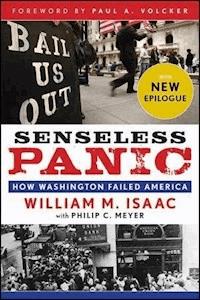
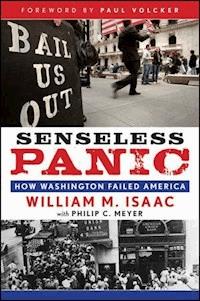
The truth about the 2008 economic crisis from a Washington insider The 1980s opened with the prime interest rate at an astonishing 21.5 percent, leading to a severe recession with unemployment reaching nearly 11 percent. Depression-like conditions befell the country, the entire thrift industry was badly insolvent and the major money center banks were loaded with third world debt. Some 3,000 bank and thrifts failed, including nine of Texas' ten largest, and Continental Illinois, which, at the time, was the seventh largest bank in the nation. These severe conditions were not only handled without creating a panic, the economy actually embarked on the longest peacetime expansion in history. In Senseless Panic: How Washington Failed America, William M. Isaac, Chairman of the Federal Deposit Insurance Corporation (FDIC) during the banking and S&L crises of the 1980s, details what was different about 2008's meltdown that allowed the failure of a comparative handful of institutions to nearly shut down the world's financial system. The book also tells the rousing story of Isaac's time at the FDIC. * Details the mistakes that led to the panic of 2008 and 2009 * An updated paperback revision of the bestselling book on the 2008 economic crisis, including a fascinating new Epilogue * Demystifies the conditions America faced in 2008 * Provides a road map for avoiding similar shutdowns and panics in the future * Includes a foreword by Federal Reserve Chairman Paul Volcker Senseless Panic is a provocative, quick-paced, and thoughtful analysis of what went wrong with the nation's banking system, a blunt indictment of United States policy, and a road map for making sure it doesn't happen again.
Sie lesen das E-Book in den Legimi-Apps auf:
Seitenzahl: 323
Veröffentlichungsjahr: 2012
Ähnliche

















Contents
Foreword
Acknowledgments
Introduction
Part One: No Calm Before the Storm
Chapter 1: Home Alone
Chapter 2: The Early Years (1978–1981)
Chapter 3: The Savings Bank and S&L Crises
Chapter 4: Penn Square Fails
Chapter 5: The Butcher Empire Collapses
Chapter 6: Deposit Insurance Reform/Tackling Wall Street
Chapter 7: Continental Illinois Topples
Chapter 8: Preparing to Leave
Chapter 9: Lessons Learned
Part Two: Here We Go Again
Chapter 10: Policy Mistakes—1989 through 2007
Mark-to-Market Accounting
Deposit Insurance Premiums
Prompt Corrective Action
Mathematical Capital Models
Loan Securitization
Loan Loss Reserves
Leverage on Wall Street
Deregulation of Short Sellers
Repeal of Glass-Steagall
Uncontrolled Growth of Freddie and Fannie
Monetary Policy
Chapter 11: The Subprime Mortgage Problem
Chapter 12: SEC and FASB Blunders
Chapter 13: Schizophrenic Failure Resolution
Bear Stearns
IndyMac Bank
Fannie Mae and Freddie Mac
Lehman Brothers
American International Group (AIG)
Washington Mutual (WaMu)
Chapter 14: The $700 Billion Bailout
Chapter 15: Never Again
Systemic Risk Council
Too Big to Fail
Restore Glass-Steagall
Consolidate and Strengthen Bank Supervision
Increase Capital, Reserve, and Liquidity Requirements
Eliminate Procyclical Rules
Strengthen the SEC and Oversee FASB
Strengthen the FDIC
Resolution Authority
Afterword
Epilogue
Authors’ Notes on Sources
About the Authors
Index
Copyright © 2010 by William M. Isaac. All rights reserved.
Published by John Wiley & Sons, Inc., Hoboken, New Jersey.
Published simultaneously in Canada.
No part of this publication may be reproduced, stored in a retrieval system, or transmitted in any form or by any means, electronic, mechanical, photocopying, recording, scanning, or otherwise, except as permitted under Section 107 or 108 of the 1976 United States Copyright Act, without either the prior written permission of the Publisher, or authorization through payment of the appropriate per-copy fee to the Copyright Clearance Center, Inc., 222 Rosewood Drive, Danvers, MA 01923, (978) 750-8400, fax (978) 646-8600, or on the web at www.copyright.com. Requests to the Publisher for permission should be addressed to the Permissions Department, John Wiley & Sons, Inc., 111 River Street, Hoboken, NJ 07030, (201) 748-6011, fax (201) 748-6008, or online at www.wiley.com/go/permissions.
Limit of Liability/Disclaimer of Warranty: While the publisher and author have used their best efforts in preparing this book, they make no representations or warranties with respect to the accuracy or completeness of the contents of this book and specifically disclaim any implied warranties of merchantability or fitness for a particular purpose. No warranty may be created or extended by sales representatives or written sales materials. The advice and strategies contained herein may not be suitable for your situation. You should consult with a professional where appropriate. Neither the publisher nor author shall be liable for any loss of profit or any other commercial damages, including but not limited to special, incidental, consequential, or other damages.
For general information on our other products and services or for technical support, please contact our Customer Care Department within the United States at (800) 762-2974, outside the United States at (317) 572-3993 or fax (317) 572-4002.
Wiley also publishes its books in a variety of electronic formats. Some content that appears in print may not be available in electronic books. For more information about Wiley products, visit our web site at www.wiley.com.
Library of Congress Cataloging-in-Publication Data:
Isaac, William M., 1943-
Senseless panic : how Washington failed America / William M. Isaac.
p. cm.
Includes index.
ISBN 978-0-470-64036-4 (cloth); ISBN 978-1-118-43198-6 (paper);
ISBN 978-1-118-47319-1 (ebk); ISBN 978-1-118-47328-3 (ebk);
ISBN 978-1-118-47332-0 (ebk)
1. Savings and loan association failures—United States—History. 2. Savings and Loan Bailout, 1989-1995. 3. Global Financial Crisis, 2008-2009. 4. Bank failures—United States—History. I. Title.
HG2152.I88 2010
332.10973—dc22
2010008413
I dedicate this book to my family—the most important people in my life—and to the professional staff of the bank regulatory agencies, particularly the staff of the Federal Deposit Insurance Corporation, who are among the most dedicated and hardworking public servants I have known.
Foreword
As you read Senseless Panic you can expect to be caught up in a financial saga. The story of that saga raises critical questions demanding an urgent response for the future of our banking system and more broadly for the capacity of our government to respond to crises. You will also quickly come to understand that Bill Isaac deserves to be listened to. Beyond his deep experience, he is a man of strong convictions, decisive in thought and courageous in action.
Those are not qualities that most Americans these days associate with men or women administering the work of the federal government. They were not qualities that, for many years, loomed large or necessary in choosing the board of the Federal Deposit Insurance Corporation.
The FDIC was created in 1933 in the wake of the banking collapse in the Great Depression. Its purpose was clear: to insure prompt payment in full for small deposits at failed banks. Combined with authority to examine thousands of banks, confidence in a shattered financial system could then be restored.
That was, and remains, an important purpose. For a while, however, the FDIC did not seem needed. The experience of the Depression induced bankers to be ultra-cautious. During and after World War II, the resurgent economy meant clear weather for banks. For decades, there were practically no bank failures, and the FDIC receded into a kind of bureaucratic backwater. It was not really challenged or influential in policy. When questions of regulatory practice arose, it was the Treasury or the Federal Reserve that held sway.
My first contact with the FDIC in 1963 perfectly reflected both the institutional hierarchy and the absence of challenge. The FDIC had just built a new building placed across 17th Street from the White House. Despite the location and the fine architecture, the opening was not a major Washington event. As a junior Treasury official, I was delegated to represent the department at the dedication ceremony. The speaker was the chairman of the House Banking Committee, one Wright Patman, a man engrained in the strong populist traditions of rural Texas. His theme was clear. There simply were not enough bank failures. The creative instincts of small business were stifled by conservative loan policies. The FDIC was simply doing its job too well.
Chairman Patman had long since left from Washington when his wish was amply fulfilled. A young Bill Isaac was appointed a FDIC board member in 1978, a year or so before the institution had to deal with the potential failure of a large (by the standards of 1970s) Philadelphia bank. The decision was made, with the Federal Reserve in the lead, to provide enough emergency assistance to keep the bank running. Bill Isaac was prescient in his concern that the approach could lead to a policy that some banks were simply “too big to fail.”
Soon, Bill became chairman. It wasn’t long before he and his agency were thrust into a decade-long succession of really serious threats to the stability of our depository institutions and to the U.S. economy. It started with the savings bank and agricultural bank crises, soon followed by the Latin American debt crisis, embroiling the largest international banks. The debacle of the deregulated savings and loan industry followed. One of the largest commercial banks—Continental Illinois—was rescued by the combined efforts of the FDIC and the Federal Reserve. There was a string of bank failures, and near failures, toward the end of the 1980s. The FDIC, along with the Federal Savings and Loan Insurance Corporation, the Federal Reserve, and the United States Treasury were together faced with unique challenges.
Senseless Panic is in part the story of that decade—the actions taken and the lessons learned and the lessons forgotten. The face of banking in the United States changed, with reverberations lasting to this day.
I was the chairman of the Federal Reserve in those days. Like my predecessors, I thought “the Fed” had a special role and broad responsibility for defending and maintaining financial stability. Truth be told, given the pattern over decades, we tended to look to the FDIC as a sort of junior partner. That, I think is fair to say, was not Bill Isaac’s view—not when it came to failing banks.
My first impression of Bill was of a rather brash young man, certainly vigorous and self-assured, but perhaps lacking the seasoning that one might expect of an agency head. He was certainly not deferential. But as we got into the trenches together, I came to realize the importance of his character, of the personal strength desperately needed in perilous times.
Given all of that, there can be no surprise that Bill Isaac has strong views about the official response to the latest and most serious financial crisis. He sets out his view of the way ahead. There is no mincing of words. Senseless Panic is a clarion call to action by Congress, by the regulatory agencies, by accounting standards setters, by rating agencies, and by banks themselves.
I and others might challenge one or another of the specifics or relative priorities. But there can be no question that his sense of urgency is justified and his proposed policies need a thoughtful response.
There is another lesson to be drawn from this book. It concerns an issue never explicitly stated, but relevant and timely when there is such distrust of government and those who serve it.
Bill Isaac was a public servant. In a real sense, he still is, even if not now in formal office. What he demonstrated is that, by force of character and innate ability, he could arouse a rather forgotten old-line government agency into an active vital force, able to respond to crises with vigor and effectiveness.
Fortunately, that spirit remains in the leadership and staff of the FDIC today. It is dealing effectively with matters of momentous importance.
Bill’s book amply reflects the sense of frustration, the exceptional demands emotionally and professionally placed on top officials and staff alike at times of crisis, the rigidity of bureaucracy, and the limitations on resources that are the lot of public servants. But what comes through it all is something else. It is the sense of pride, of having been tested to the maximum, of serving not a personal or a private interest but the American public.
Those are qualities that somehow we as a nation have been losing—not entirely, and I trust not permanently. Of one thing I am sure. We should not and cannot settle for less than a fair share of our country’s best talent when manning the ramparts of governments. That is one key lesson of Bill Isaac’s life story, a lesson at least as important as the reality of the banking crisis.
Paul A. Volcker
February 2010
Acknowledgments
I am grateful to Paul Volcker, Steve Forbes, Phil Meyer, Meg Maguire, Christie Sciacca, Bill Donaldson, Doug Marcian, Jack Ryan, Phil Zweig, Art Laffer, Marcy Kaptur, Jack Murphy, Ralph Nader, Larry Kudlow, Darrell Issa, Theron Raines, Alan Michaels, Peter Tanous, Gary Stern, Charles Isaac and many others who will remain unnamed for generously offering their comments about the book. They made the book better. The views expressed in this book are mine and are not necessarily shared by any of the above individuals or any organizations with which I am affiliated.
Special thanks to my wife, Christine, who encouraged me to battle against the TARP legislation and to write this book. She gave me unwavering support throughout the long hours I have devoted to this book and public policy issues over the past two years.
William M. Isaac
Sarasota, Florida
January 15, 2010
Introduction
The financial panic of 2008 and the ensuing deep recession did not have to happen, and I am appalled by the enormous financial, human, and political cost of it all. Taxpayers, rightly so, are extremely angry about the events of 2008 and 2009—they know instinctively that something does not smell right.
I wrote this book to get the truth out about what happened and why and how we can prevent future crises. We—and I mean all of us and our great country—are in enormous trouble! If we do not take the time to learn what went wrong and how to fix it, we and our children and their children will pay a very big price.
If we let them, our political leaders will do everything in their power to hide their culpability for the mess in which our nation finds itself, and they will enact politically easy legislation that will not address the fundamental causes of the crisis and will, in fact, make things worse. Our leaders are already covering up their role in creating what I call the Senseless Panic of 2008, are trying to deflect blame to “greedy bankers,” and are offering slogans rather than solutions.
Among other things, they are telling us the Troubled Asset Relief Program (TARP) was essential to calming the markets when, in fact, the TARP did far more harm than good. This book exposes the TARP for what it was—an ill-conceived program hastily slapped together by a panicked government working too close for my comfort with a handful of Wall Street firms. It set off an economic and political firestorm from which we have yet to recover.
I had the privilege of leading the Federal Deposit Insurance Corporation during the bank and thrift crises of the 1980s, having been appointed to the FDIC board of directors by President Jimmy Carter in 1978 at the age of 34.
Little did I know when I took the post that the country was about to experience the worst economic and banking crisis since the Great Depression—a crisis that would result in larger and more severe bank failures than in the 1930s.
Inflation had been high throughout the 1970s and it was getting worse. President Carter appointed Paul Volcker as chairman of the Federal Reserve in 1979 with the charge of getting inflation under control. Volcker raised interest rates rapidly and the prime rate soared to an incredible 21.5 percent. Few financial institutions or borrowers could absorb that kind of rate increase.
Following Ronald Reagan’s election in 1980, I was named chairman of the FDIC. The entire banking and thrift sector was in dire straits. A short recession occurred in 1980, followed by a deep and prolonged recession in 1981–1982, with unemployment soaring to almost 11 percent.
From 1980 through 1991, some 3,000 banks and thrifts failed, including many of the largest in the country (nine of the 10 largest Texas banks, for example). The failed banks and thrifts had $650 billion of assets and cost the FDIC fund more than $100 billion (multiply those numbers by six to put them into relative terms to today’s banking system).
It was an extremely difficult period, but the public’s confidence in the banking system held and financial panic was averted. Even as we handled thousands of bank and thrift failures, the economy improved and we enjoyed the longest peacetime economic expansion in history.
Contrast this result in the 1980s with the worldwide financial panic that hit in the fall of 2008 and threatened to push the world into an economic depression. The economy was actually quite strong in pre-financial crisis 2007, unlike 1980–1982, so why did we experience such different outcomes in the financial markets?
It is impossible to listen to or read a news report about the crisis of 2008 and beyond without being told that the problems in this latest crisis are much worse than in any period since the Great Depression of the 1930s. When people do talk about the 1980s, most refer only to the S&L crisis and seem not to be aware how serious the banking and economic problems were during that period.
Most people—members of Congress included—would be surprised to learn that we were so concerned about the condition of our major banks during the 1980s that we developed a contingency plan to nationalize all of them. As late as the presidential debate of 1992, candidate Ross Perot asserted that the FDIC fund was horribly inadequate to cope with what he believed was the massive insolvency of our major banks.
In this book, I discuss how we were able to navigate the treacherous economic and banking waters in the 1980s without creating a financial panic and why we failed to contain the less serious problems in 2008 that nearly sank the financial system.
Having lived 24/7 with the banking and S&L crises of the 1980s, I examine the lessons we learned and failed to learn from that period and identify the mistakes that led to the Senseless Panic of 2008. It was a panic that would not have happened had our political leaders acquired even passing knowledge of what happened during the 1980s and how we dealt with the enormous problems.
Many historians believe that World War II was a continuation of World War I. They believe that the issues that led to the first war were not resolved and the Treaty of Versailles was terribly flawed, so after a 20-year hiatus, the fight was resumed.
Similarly, I believe the banking and S&L crises of the 1980s were misunderstood by our political leaders, the wrong fixes were put into place during the 1990s, and those actions led us directly into the banking crisis of 2008.
Based on what I have seen thus far from the Obama Administration and the legislative efforts on Capitol Hill, we have not gotten any smarter this time around and I fear for the future of our great nation.
Part One
NO CALM BEFORE THE STORM
Chapter 1
Home Alone
I was home alone in Sarasota, Florida, enjoying the tranquil waters of the Gulf of Mexico lapping against the shore. Saturday, September 27, 2008, was a typical steamy day toward the end of an uneventful hurricane season. A storm of another sort was brewing, however, and I was jolted back into reality by the loud ring of my landline. It was the first of many urgent calls I would receive that day from Washington, D.C.
Lesen Sie weiter in der vollständigen Ausgabe!
Lesen Sie weiter in der vollständigen Ausgabe!
Lesen Sie weiter in der vollständigen Ausgabe!
Lesen Sie weiter in der vollständigen Ausgabe!
Lesen Sie weiter in der vollständigen Ausgabe!
Lesen Sie weiter in der vollständigen Ausgabe!
Lesen Sie weiter in der vollständigen Ausgabe!
Lesen Sie weiter in der vollständigen Ausgabe!
Lesen Sie weiter in der vollständigen Ausgabe!
Lesen Sie weiter in der vollständigen Ausgabe!
Lesen Sie weiter in der vollständigen Ausgabe!
Lesen Sie weiter in der vollständigen Ausgabe!
Lesen Sie weiter in der vollständigen Ausgabe!
Lesen Sie weiter in der vollständigen Ausgabe!
Lesen Sie weiter in der vollständigen Ausgabe!
Lesen Sie weiter in der vollständigen Ausgabe!
Lesen Sie weiter in der vollständigen Ausgabe!
Lesen Sie weiter in der vollständigen Ausgabe!
Lesen Sie weiter in der vollständigen Ausgabe!
Lesen Sie weiter in der vollständigen Ausgabe!




