


17,99 €
Mehr erfahren.
- Herausgeber: John Wiley & Sons
- Kategorie: Geisteswissenschaft
- Serie: Themes in History
- Sprache: Englisch
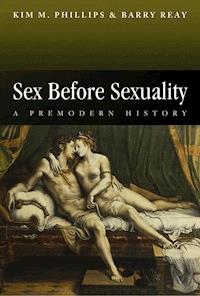
Sexuality in modern western culture is central to identity but the tendency to define by sexuality does not apply to the premodern past. Before the 'invention' of sexuality, erotic acts and desires were comprehended as species of sin, expressions of idealised love, courtship, and marriage, or components of intimacies between men or women, not as outworkings of an innermost self. With a focus on c. 1100–c. 1800, this book explores the shifting meanings, languages, and practices of western sex. It is the first study to combine the medieval and early modern to rethink this time of sex before sexuality, where same-sex and opposite-sex desire and eroticism bore but faint traces of what moderns came to call heterosexuality, homosexuality, lesbianism, and pornography.
This volume aims to contribute to contemporary historical theory through paying attention to the particularity of premodern sexual cultures. Phillips and Reay argue that students of premodern sex will be blocked in their understanding if they use terms and concepts applicable to sexuality since the late nineteenth century, and modern commentators will never know their subject without a deeper comprehension of sex's history.
Sie lesen das E-Book in den Legimi-Apps auf:
Seitenzahl: 415
Veröffentlichungsjahr: 2013
Ähnliche




















Table of Contents
Cover
Themes in History
Title page
Copyright page
List of Images
Acknowledgements
Introduction: Sex before Sexuality
1 Sin
2 Before Heterosexuality
3 Between Men
4 Between Women
5 Before Pornography
Epilogue: Sex at Sea?
Index
Themes in History
Wolfgang Behringer, Witches and Witch Hunts
M. L. Bush, Servitude in Modern Times
Peter Coates, Nature
Mark Harrison, Disease and the Modern World
Jonathan Hart, Empire and Colonies
Colin Heywood, History of Childhood
Randall D. Law, Terrorism
Kim M. Phillips and Barry Reay, Sex before Sexuality
Robert Ross, Clothing: A Global History
J. K. J. Thomson, Decline in Europe
David Vincent, Rise of Mass Literacy
Copyright © Kim M. Phillips and Barry Reay 2011
The right of Kim M. Phillips and Barry Reay to be identified as Author of this Work has been asserted in accordance with the UK Copyright, Designs and Patents Act 1988.
First published in 2011 by Polity Press
Polity Press
65 Bridge Street
Cambridge CB2 1UR, UK
Polity Press
350 Main Street
Malden, MA 02148, USA
All rights reserved. Except for the quotation of short passages for the purpose of criticism and review, no part of this publication may be reproduced, stored in a retrieval system, or transmitted, in any form or by any means, electronic, mechanical, photocopying, recording or otherwise, without the prior permission of the publisher.
ISBN-13: 978-0-7456-2522-5
ISBN-13: 978-0-7456-2523-2 (pb)
ISBN: 978-0-7456-3727-3 (Single-user ebook)
ISBN: 978-0-7456-3726-6 (Multi-user ebook)
A catalogue record for this book is available from the British Library.
The publisher has used its best endeavours to ensure that the URLs for external websites referred to in this book are correct and active at the time of going to press. However, the publisher has no responsibility for the websites and can make no guarantee that a site will remain live or that the content is or will remain appropriate.
Every effort has been made to trace all copyright holders, but if any have been inadvertently overlooked the publisher will be pleased to include any necessary credits in any subsequent reprint or edition.
For further information on Polity, visit our website: www.politybooks.com
List of Images
1 Paul the Hermit Sees a Christian Tempted
2 Hugo van der Goes, Diptychon mit Sündenfall und Erlösung (Beweinung Christi)
3 Les Amants Trépassés
4 Coffret (Minnekästchen)
5 Lorenzo Lotto, Signor Marsilio Cassotti and His Wife, Faustina
6 Raphael (Raffaello Sanzio of Urbino), Self Portrait with a Friend.
7 Fra Carnevale (Bartolomeo di Giovanni Corradini), Presentation of the Virgin in the Temple.
8 Jacob van Loo, Diana and Her Nymphs
9 Gabrielle d’Estrees and Her Sister, the Duchess of Villars
10 Romano, Giulio (Giulio Pippi) (?), Love Scene
11 Misericord of man with open legs in the air
12 Baron Jean-Baptiste Regnault, A Phallic Rite
13 John Keyes Sherwin, A Dance in Otaheite
14 Samuel Middiman, An Offering Before Capt. Cook in the Sandwich Islands
Acknowledgements
We would like to thank the editors at Polity Press for their patience and enthusiasm for the project; Louis Gerdelan and (eagle-eyed) Nina Attwood for expert research assistance; Lisa Bailey for help on late antique and early medieval scholarship; Erin Griffey for her art history expertise; the Faculty of Arts at the University of Auckland for the Faculty Research Development Fund which enabled one of us (Phillips) to find the time to work on the project; our Head of Department, Malcolm Campbell; Sherry Velasco and Marta Vicente for allowing us to draw on their forthcoming publications; our respective partners, Athina Tsoulis and John Bevan-Smith, for their interest and emotional support, and to John for generously compiling the index; and University of Auckland students in courses on the history of sex for enlivening our teaching experience over several years.
Introduction: Sex before Sexuality
A woman bends over a man in a woodland glen. She is elegantly dressed in a low-cut rose-coloured gown, tight around her high breasts and narrow waist, then falling in fullness over a swelling belly. Her golden hair is fashionably dressed with a pointed kerchief. She gazes to the horizon as her right hand grasps the reclining man behind his back and her left reaches boldly under his raised tunic to fondle his naked thigh, or something higher up. We notice two troubled older men at the right of the scene, one raising his eyes and gesturing with dismay. The lady’s right knee is raised to the young man’s chest, pinning him to the ground. As he attempts to rise we see that his hands are bound behind his back. He is a handsome youth with fleshy lips and thick curling hair and his rich blue tunic is lined with fur. At first glance he might be thought to be rising to meet the embrace of the lady, gazing at her with abandoned desire, but at last one notices the bloody object he has spat at her face – his own tongue – and the bloody trail issuing from his mouth.
This scene from the Limbourg brothers’ early fifteenth-century masterpiece, the Belles Heures, made for Jean de France, Duc de Berry (1340–1416), illuminates the story of St Paul the Hermit. Its accompanying text briefly tells the story: ‘Saint Paul, the first hermit, under the vehement persecution of Decius, saw a certain Christian bound to a pleasurable place (inter amena ligatus), and caressed by an impure woman. Whereupon he bit off his tongue and spat in her face. To escape the anguish of temptation he [Paul] fled from Rome.’1The Golden Legend (c. 1260) explains in a little more detail that the unfortunate youth was one of two Christians tortured for their faith under Roman rule in the later third century; the first covered in honey and left to be stung to death by bees, hornets and wasps, the second ‘laid upon a downy bed in a pleasant place … bound down with ropes entwined with flowers’, and accosted by a ‘very beautiful but totally depraved young woman’. Feeling his flesh responding in spite of himself, the youth repelled her in the only way left to him.2
St Paul the Hermit (not to be confused with St Paul the Apostle) is a minor figure in Christian hagiography and reasons for including his life in the Belles Heures are unclear. Most likely it gains a place simply to provide a vivid moment between the image cycles from the lives of the better-known figures St Jerome (who wrote Paul’s hagiography) and St Anthony (who succeeded Paul as a pioneer among Christian hermits and is likely the second of the two older observers in the image in question). The book’s owner, the Duc de Berry, younger brother of King Charles V (d. 1382) and uncle of Charles VI (d. 1422), was an important political figure of his day but is now mainly remembered for his lavish patronage of the arts. His sexual interests and preferences have also been subject to recent scholarly interest. Some art historians have suggested, taking their cues from hints in medieval texts, that he might have been ‘homosexual’. Michael Camille has argued instead that his desire for bodies should be seen in relationship to his connoisseurship of images and things.3 Living in an age when, as we will document at length in the present book, ‘homosexuality’, ‘heterosexuality’ and the other sexual categories familiar to us did not yet exist and women, youths and children were available for the possession of more powerful men, Jean took delight in the faces and bodies of lower-ranking androgynous young males in a manner congruent with the pleasure he took in the books and objets made for him by the greatest artists of his day. This pleasure, moreover, could sit happily alongside his apparent taste for very young or lower-class women.
What lessons or pleasures might the scene of St Paul the Hermit Sees a Christian Tempted have offered its owner? As a medieval Christian, Jean may have read it straight: that is, as an illustration of the temptations of the flesh and the virtues of carnal renunciation. All sexual response was understood in Jean’s day and for several preceding centuries to be tainted to some extent with sin. The seductive was a recurrent trope of Christian literature on sin – figured most prominently in the first woman, Eve, and her role in the fall of humankind – and the seductive woman of this scene could be sister to the ‘dancing girls’ seen tormenting the daydreaming St Jerome a few folios earlier. Alternatively, the near helplessness of the man when provoked by the beautiful ‘depraved’ woman may have roused masculine sympathy. The sexually forward or dominant woman was familiar to readers of courtly literature and viewers of secular art. The assertive woman of the reminds fifteenth-century viewers that women – in this pre-heterosexual erotic regime – allegedly felt lust more powerfully than men and as such were objects of at once phobic and ardent imaginings. Clothed and in control, she poses an erotic alternative to the naked tortured figures of virgin martyrs seen elsewhere in the book. Indeed in the hermit scene the roles are reversed: it is the male victim, bound and assaulted, who has no escape except through brutal action on his own body. The woman’s cold gaze to the horizon, meanwhile, gives clear indication (according to the visual codes of medieval art) that in this case she is not in love. Yet perhaps the youth’s response is more complex than fear or revulsion. As Brigitte Buettner reminds us in her short but scintillating reading of the image, ‘for medieval people all bodily fluids, including semen, were considered to be a form of bleeding’. The youth’s bleeding tongue is, by implication, a form of ejaculation. Another reading could pick up on Jean’s apparently homoerotic inclinations (even if these were not his sole sexual tastes) and see amusing connotations in the handsome youth’s violent rejection of the temptress.
Lesen Sie weiter in der vollständigen Ausgabe!
Lesen Sie weiter in der vollständigen Ausgabe!
Lesen Sie weiter in der vollständigen Ausgabe!
Lesen Sie weiter in der vollständigen Ausgabe!
Lesen Sie weiter in der vollständigen Ausgabe!
Lesen Sie weiter in der vollständigen Ausgabe!
Lesen Sie weiter in der vollständigen Ausgabe!




