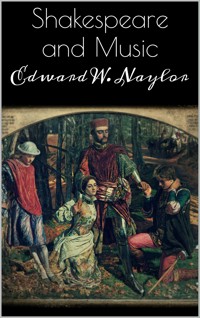
In
the middle, on table.Queen
Elizabeth's 'Virginal.' Date, latter half of 16th century. Outside of
case (not visible in picture) covered with red velvet. Inside finely
decorated. Has three locks. Is more properly a Spinet, the case not
being square, but of the usual Spinet shape—viz., one long side
(front view), and four shorter ones forming a rough semi-circle at
back.Top
row, counting from the right.1.
Tabor-pipe. Modern, but similar to the Elizabethan instrument. French
name, 'galoubet.' Merely a whistle, cylindrical bore, and 3 holes,
two in front, one (for thumb) behind. The scale is produced on the
basis of the 1st harmonic—thus 3 holes are sufficient. It was
played with left hand only, the tabor being hung to the left wrist,
and beaten with a stick in the right hand. Length
over all of pipe in
picture, 1 ft. 2-1/2 in.; speaking length, 1 ft. 1-1/8 in.; lowest
note in use, B flat above treble staff. Mersennus (1648), however,
says the tabor-pipe was in G, which makes it larger than the one in
the picture. A contemporary woodcut (in Calmour's 'Fact and Fiction
about Shakespeare') of William Kemp, one of Shakespeare's
fellow-actors, dancing the Morris, to tabor and pipe, makes the pipe
as long as from mouth to waist—viz., about 18 inches, which agrees
with Mersennus. A similar woodcut in 'Orchésographie' makes the pipe
even longer. Both represent pipe as conical, like oboe. The length of
the tabor, in these two woodcuts, seems to be about 1 ft. 9 in., and
the breadth, across the head, 9 or 10 in. No snare in the English
woodcut, but the French one has a snare.2.
Cornet (treble), date 16th or 17th century. Tube slightly curved,
external shape octagonal, bore conical. Cupped mouthpiece of horn, 6
holes, and one behind for thumb. Lowest note, A under treble staff.3.
Recorder. Large beak-flute of dark wood. Three joints, not including
beak. The beak has a hole at the back, covered with a thin skin,
which vibrates and gives a slight reediness to the tone. The usual 6
finger holes in front, a thumb hole behind, and a right-or-left
little-finger hole in lowest joint.4.
Small French Treble Viol, 17th century.
Back view, same
shape as of all other viols of whatever size. 6 strings, 4 frets.5.
Treble Viol, as used in England and Italy; label inside—Andreas (?)
Amati, Cremona, 1637.
Side view, shews
carved head and flat back. 6 strings, 4 frets, ivory nut.6.
Tenor Viol. English, late 17th century.
Front view, shewing
sloping shoulders. 6 strings, 7 frets, plain head.7.
Viol da Gamba Bow. Ancient shape. No screw. This shape in use later
than 1756.8.
Violoncello Bow. Modern shape, with screw.Bottom
row, counting from left.1.
Bass Viol, or Viol da Gamba, or Division Viol. Italian, 1600. Carved
head, inlaid fingerboard, carved and inlaid tailpiece. 6 strings, 7
frets.2.
Lute. Italian, 1580. Three plain holes in belly, obliquely.
Ornamental back. Flat head. Pegs turned with key from behind. 12
strings—viz., 1 single (treble), 4 doubles, 1 single, and 2 singles
off the fingerboard (basses). 10 frets.3.
Arch Lute. Italian, 17th century. 18 strings, 8 on lower neck, 10 on
higher, off the fingerboard. The latter are 'basses,' and probably
half of them duplicates. 7 frets on neck, 5 more on belly.
INTRODUCTORY
A
principal character of the works of a very great author is, that in
them each man can find that for which he seeks, and in a form which
includes his own view.With
Shakespeare, as one of the greatest of the great, this is
pre-eminently the case. One reader looks for simply dramatic
interest, another for natural philosophy, and a third for morals, and
each is more than satisfied with the treatment of his own special
subject.It
is scarcely a matter of surprise, therefore, that the musical student
should look in Shakespeare for music, and find it treated of from
several points of view, completely and accurately.This
is the more satisfactory, as no subject in literature has been
treated with greater scorn for accuracy, or general lack of real
interest, than this of music.This
statement will admit of comparatively few exceptions, one of which
must here be mentioned.The
author of "John Inglesant," Mr Shorthouse, whether he
"crammed" his music or not, has in that book given a lively
and quite accurate picture of the art as practised about Charles I.'s
time.There
is no need here to name the many well-known writers who have spoken
of music with a lofty disregard for facts and parade of ignorance
which, displayed in any other matter, would have brought on them the
just contempt of any reviewer.The
student of music in Shakespeare is bound to view the subject in two
different ways, the first purely historical, the second (so to speak)
psychological.As
for the first, the most superficial comparison of the plays alone,
with the records of the practice and social position of the musical
art in Elizabethan times, shews that Shakespeare is in every way a
trustworthy guide in these matters; while, as for the second view,
there are many most interesting passages which treat of music from
the emotional standpoint, and which clearly shew his thorough
personal appreciation of its higher and more spiritual qualities.Hamlet
tells us, and we believe, often without clearly understanding, that
players are the
abstracts and brief chronicles of the time,
and that the end of playing, both at the first and now, was, and is,
to hold the mirror up to nature, and
to shew the very age and body of the time, his form and pressure.The
study of this one feature of the "age and body" of
Shakespeare's time, with the view of clearly grasping the extreme
accuracy of the "abstract and brief chronicle" to be found
in his works, will surely go some way to give definiteness and force
to our ideas of Shakespeare's magnificent grip of all other phases of
thought and of action.The
argument recommends itself—"If he is trustworthy in this
subject, he is trustworthy in all."To
a professional reader at all events, it argues very much indeed in a
writer's favour, that the "layman" has managed to write the
simplest sentence about a specialty, without some more or less
serious blunder.Finally,
no Shakespeare student will deny that some general help is necessary,
when Schmidt's admirable Lexicon commits itself to such a misleading
statement as that a virginal is a kind of small pianoforte, and when
a very distinguished Shakespeare scholar has allowed a definition of
a viol as a six-stringed guitar to appear in print under his name.Out
of thirty-seven plays of Shakespeare, there are no less than
thirty-two which contain interesting references to music and musical
matters in the text
itself. There are
also over three hundred stage directions which are musical in their
nature, and these occur in thirty-six out of thirty-seven plays.The
musical references in the text are most commonly found in the
comedies, and are generally the occasion or instrument of
word-quibbling and witticisms; while the musical stage directions
belong chiefly to the tragedies, and are mostly of a military nature.As
it is indispensable that the student of Shakespeare and Music should
have a clear idea of the social status and influence of music in
Shakespearian times, here follows a short sketch of the history of
this subject, which the reader is requested to peruse with the
deliberate object of finding every detail confirmed in Shakespeare's
works.Music
in Social Life.(Temp.,
16th and 17th centuries.)Morley,
"Plain and Easy Introduction to Practical Music," 1597, pp.
1 and 2. Here we read of a dinner-party, or "banket," at
which the conversation was entirely about music. Also—after
supper—according
to custom—"parts"
were handed round by the hostess. Philomathes has to make many
excuses as to his vocal inability, and finally is obliged to confess
that he cannot sing at all. At this the rest of the company
"wonder"—and some whisper to their neighbours, "How
was he brought up?" Phil. is ashamed—and goes to seek Gnorimus
the music-master. The master is surprised to see him—as Phil. has
heretofore distinguished himself by inveighing against music as a
"corrupter of good manners, and an allurement to vices."
Phil.'s experience of the supper-party has so far changed his views
that he wishes as soon as may be to change his character of Stoic for
that of Pythagorean. Thereupon the master begins to teach him from
the very beginning, "as though he were a child."Then
follows a long lesson—which is brought to an end by Philomathes
giving farewell to the master as thus—"Sir, I thanke you, and
meane so diligently to practise till our next meeting, that then I
thinke I shall be able to render you a full account of all which you
have told me, till the which time I wish you such contentment of mind
and ease of body as you desire to yourselfe (Master's health had been
very bad for long enough) or mothers use to wish to their children."
The Master replies—"I thanke you: and assure your selfe it
will not be the smallest part of my contentment to see my schollers
go towardly forward in their studies, which I doubt not but you will
doe, if you take but reasonable pains in practise."Later
on in the Third Part (p. 136) Phil.'s brother Polymathes comes with
him to Gnorimus for a lesson in Descant—i.e.,
the art of extemporaneously adding a part to the written
plainsong.[1]
This brother had had lessons formerly from a master who carried a
plainsong book in his pocket, and caused him to do the like; "and
so walking in the fields, hee would sing the plaine song, and cause
me to sing the descant, etc." Polymathes tells us also that his
master had a friend, a descanter himself, who used often to drop
in—but "never came in my maister's companie ... but they fell
to contention.... What? (saith the one), you keepe not time in your
proportions: you sing them false (saith the other), what proportion
is this? (saith hee), sesqui-paltery
(saith the other): nay (would the other say), you sing you know not
what, it shoulde seeme you came latelie from a Barber's shop, where
you had Gregory
Walker (derisive
name for 'quadrant pavan,' 'which was most common 'mongst the Barbars
and Fidlers') or a
curranta plaide in
the new proportions by them lately found out, called sesqui-blinda,
and sesqui-harken-after."[These
mocking terms, sesqui-paltery,
sesqui-blinda,
and sesqui-harken-after,
are perversions of names of "proportions" used in the 16th
century—as, sesqui-altera
(3 equal notes against 2).]We
find, on p. 208, that both Philomathes and Polymathes are young
University gentlemen—looking forward hereafter to be "admitted
to the handling of the weightie affaires of the common wealth."The
lessons end with their request to the master to give them "some
songes which may serve both to direct us in our compositions, and by
singing them recreate us after our more serious studies."Thus
we find that in Elizabeth's reign it was the "custom" for a
lady's guests to sing unaccompanied music from "parts,"
after supper; and that inability to take "a part" was
liable to remark from the rest of the company, and indeed that such
inability cast doubt on the person having any title to education at
all.We
find that one music master was accustomed to have his gentleman
pupils so constantly "in his company" that they would
practise their singing while "walking in the fields."Finally—that
part-singing from written notes, and also the extempore singing of a
second part (descant) to a written plainsong, was a diversion of such
young University gentlemen, and was looked on as a proper form of
recreation after hard reading.In
the 16th century music was considered an
essential part of a
clergyman's education. A letter from Sir John Harrington to Prince
Henry (brother of Charles I.) about Dr John Still, Bishop of Bath and
Wells in 1592, says that no one "could be admitted to
primam tonsuram,
except he could first
bene le bene con bene can,
as they called it, which is to read well, to conster [construe] well,
and to sing well,
in which last he hath good judgment." [The three
bene's are of
course le-gere,
con-struere, can-tare.]Also,
according to Hawkins (History of Music, p. 367), the statutes of
Trinity College, Cambridge, founded by Henry VIII., make part of the
Examination of Candidates for Fellowships to be in "Quid in
Cantando possint"; indeed,
all members were supposed capable of singing a part in choir
service.[2](Long
before this, in 1463, Thomas Saintwix,
doctor in music,
was elected Master of King's College, Cambridge.)Accordingly,
we find Henry VIII., who, as a younger brother, was intended for the
Church, and eventually for the See of Canterbury, was a good
practical musician. Erasmus says he composed offices for the church.
An anthem, "O Lord, the maker of all things," is ascribed
to him; and Hawkins gives a motet in three parts by the king, "Quam
pulchra es."Chappell's
Old English Popular Music gives a passage from a letter of Pasqualigo
the Ambassador-extraordinary, dated about 1515, which says that Henry
VIII. "plays well on the lute and virginals, sings from book at
sight," etc. Also in Vol. I. are given two part-songs by the
king, 'Pastyme with good companye' and 'Wherto shuld I expresse.'A
somewhat unclerical amusement of Henry VIII.'s is related by Sir John
Harrington (temp. James I.). An old monkish rhyme, "The Blacke
Saunctus, or Monkes Hymn to Saunte Satane," was set to music in
a canon of three parts by Harrington's father (who had married a
natural daughter of Henry VIII.); and King Henry was used "in
pleasaunt moode to sing it." For the music and words, see
Hawkins, pp. 921 and 922.Anne
Boleyn was an enthusiastic musician, and, according to Hawkins,
"doted on the compositions of Jusquin and Mouton, and had
collections of them made for the private practice of herself and her
maiden companions."It
appears from the Diary of King Edward VI. that he was a musician, as
he mentions playing on the lute before the French Ambassador as one
of the several accomplishments which he displayed before that
gentleman, July 19th, 1551.There
is also a letter from Queen Catherine (of Arragon), the mother of
Queen Mary, in which she exhorts her "to use her virginals and
lute, if she has any."As
for Elizabeth, there is abundant evidence that she was a good
virginal player.The
best known MS. collection of virginal music (that in the Fitzwilliam
Museum at Cambridge) has at least always been known as Queen
Elizabeth's Virginal Book, and the following quaint story is quoted
by Hawkins from Melvil's Memoirs (Lond. 1752)."The
same day, after dinner, my Lord of Hunsdean drew me up to a quiet
gallery that I might hear some music (but he said he durst not avow
it), where I might hear the queen play upon the virginals. After I
had hearkened a while I took by [aside] the tapestry that hung before
the door of the chamber, and stood a pretty space, hearing her play
excellently well; but she left off immediately so soon as she turned
her about and saw me. She appeared to be surprised to see me, and
came forward, seeming to strike me with her hand, alledging she was
not used to play before men, but when she was solitary to shun
melancholy." [Queen Elizabeth's Virginal is in South Kensington
Museum.]To
go on with the Royal musicians (who are interesting as such, because
their habit must
have set the fashion of the day),
in James I.'s reign we find that Prince Charles learnt the Viol da
Gamba from Coperario (i.e.,
John Cooper). Also Playford (temp. Charles II.) says of Charles I.
that the king "often appointed the service and anthems himself"
in the Royal Chapel; "and would play his part exactly well on
the bass-violl,"—i.e.,
the viol da gamba.George
Herbert, who was by birth a courtier, found in music "his
chiefest recreation," "and did himself compose many divine
hymns and anthems, which he set and sung to his lute or viol.... His
love to music was such, that he went usually twice every week ... to
the cathedral church in Salisbury; and at his return would say that
his time spent in prayer and cathedral music elevated his soul, and
was his heaven upon earth." But not only was the poet-priest a
lover of church music, for (Walton's Life goes on) "before his
return thence to Bemerton, he would usually
sing and play his part at an appointed private music meeting."
This was fourteen years after Shakespeare's death.Anthony
Wood, who was at Oxford University in 1651, gives a most interesting
account of the practice of chamber music for viols (and even violins,
which, by Charles II.'s time, had superseded the feebler viols) in
Oxford. In his Life, he mentions that "the gentlemen in privat
meetings, which A.W. frequented, play'd three, four, and five Parts
with Viols, as, Treble-Viol, Tenor, Counter-Tenor, and Bass, with an
Organ, Virginal, or Harpsicon joyn'd with them: and they esteemed a
Violin to be an Instrument only belonging to a common Fidler, and
could not endure that it should come among them, for feare of making
their Meetings to be vaine and fidling." Wood went to a
weekly meeting of
musicians in Oxford. Amongst those whom he names as "performing
their parts" are four Fellows of New College, a Fellow of All
Souls, who was "an admirable Lutenist," "Ralph
Sheldon, Gent., a Rom. Catholick ... living in Halywell neare Oxon.,
admired for his smooth and admirable way in playing on the Viol,"
and a Master of Arts of Magdalen, who had a weekly meeting at his own
college. Besides the amateurs, there were eight or nine professional
musicians who frequented these meetings. This was in 1656, and in
1658 Wood gives the names of over sixteen other persons, with whom he
used to play and sing, all of whom were Fellows of Colleges, Masters
of Arts, or at least members of the University. Amongst them was
"Thom. Ken of New Coll., a Junior" (afterwards Bishop Ken,
one of the seven bishops who were deprived at the Revolution), who
could "sing his part." All the rest played either viol,
violin, organ, virginals, or harpsichord, or were "songsters.""These
did frequent the Weekly Meetings, and
by the help of public Masters of Musick,
who were mixed with them, they were much improved."There
seems to have been little that was not pure enjoyment in these
meetings. Only two persons out of the thirty-two mentioned seem to
have had any undesirable quality—viz., Mr Low, organist of Christ
Church, who was "a
proud man,"
and "could not endure any common Musitian to come to the
meeting;" and "Nathan. Crew, M.A., Fellow of Linc. Coll., a
Violinist and Violist,
but alwaies played out of Tune."
This last gentleman was afterwards Bishop of Durham.Thus
we find that in the 16th and 17th centuries a practical acquaintance
with music was a regular part of the education of both sovereign,
gentlemen of rank, and the higher middle class.We
find Henry VIII. composing church music, and at the same time
enjoying himself singing in the three-part canon composed by his
friend, a gentleman of rank.We
find that a Fellow of Trinity at the same time was expected to sing
"his part" in chapel as a matter of course. We find Edward
VI., Mary, and Elizabeth to have all been capable players on lute or
virginals. We find that it was the merest qualification that an
Elizabethan bishop should be able to sing well; and that young
University gentlemen of birth thought it nothing out of the way to
learn all the mysteries of both prick-song (a
written part) and
descant (an
extempore
counterpoint), and to solace their weary hours by singing "in
parts."Immediately
after Shakespeare's time, we find a courtier of James I., and the
ill-fated Prince Charles himself, both enthusiasts in both church and
chamber music; and lastly, two years after the Regicide, we find the
University of Oxford to have been a perfect hotbed of musical
cultivation. Men who afterwards became Bishops, Archdeacons,
Prebendaries, besides sixteen Fellows of Colleges, and sundry
gentlemen of family, were not ashamed to practise chamber music and
singing to an extent which really has no parallel whatever nowadays.There
is plenty of evidence, though more indirect in kind, that the lower
classes were as enthusiastic about music as the higher. A large
number of passages in contemporary authors shows clearly that singing
in parts (especially of "catches") was a common amusement
with blacksmiths, colliers, cloth-workers, cobblers, tinkers,
watchmen, country parsons, and soldiers.In
Damon and Pithias,
1565, Grimme, the
collier, sings "a
bussing [buzzing] base," and two of his friends, Jack and Will,
"quiddel upon it,"
i.e., they sing the
tune and words, while he buzzes the burden.Peele's
Old Wives Tale,
1595, says, "This
smith leads a life
as merry as a king; Sirrah Frolic, I am sure you are not without some
round or other; no
doubt but Clunch [the smith] can
bear his part."Beaumont
and Fletcher's
Coxcomb has"Where were the
watch the while?
good sober gentlemen,They
were, like careful members of the city,Drawing
in diligent ale, and
singing catches."Also
in B. and F.'s
Faithful Friends—"Bell.—Shall's
have a catch,
my hearts?Calve.—Aye,
good lieutenant.Black.—Methinks
a soldier[3]
should sing nothing else;
catch, that catch may
is all our life, you know."[In
Bonduca, a play of
B. and F's., altered for operatic setting by Purcell in 1695, there
is a catch in three parts, sung by the Roman soldiers.]In
Sir William Davenant's (Davenant flourished 1635) comedy
The Wits, Snore,
one of the characters, says—"It must be late,
for gossip Nock, the
nailman,Had
catechized his maids, and
sung three catchesAnd
a song, ere we
set forth."Samuel
Harsnet, in his
Declaration of Egregious Impostures,
1603, mentions a 'merry catch,' 'Now God be with old Simeon' (for
which see Rimbault's Rounds, Canons, and Catches of England), which
he says was sung by
tinkers 'as they
sit by the fire, with a pot of good ale between their legs.'And
in The Merry Devill
of Edmonton, 1631,
there is a comical story of how Smug
the miller was
singing a catch
with the merry
Parson in an
alehouse, and how they 'tost' the words "I'll
ty my mare in thy ground,"
'so long to and fro,' that Smug forgot he was singing a catch, and
began to quarrel with the Parson, 'thinking verily, he had meant (as
he said in his song) to
ty his mare in his ground.'Finally,
in Pammelia,
a collection of Rounds and Catches of 3, 4, 5, 6, 7, 8, 9, and 10
parts, edited by Thomas Ravenscroft, and published in 1609, there is
a curious preface, which states that 'Catches are so
generally affected
... because they are so consonant to
all ordinary musical capacity,
being such, indeed, as all such
whose love of musick exceeds their skill,
cannot but commend.' The preface further asserts that the book is
'published only to
please good company.'To
go on to
instrumental music
among the lower classes of Elizabethan and Shakespearian times; there
is an allusion in the above quoted passage from Morley (1597) to the
habit of playing on an instrument in a barber's shop while waiting
one's turn to be shaved. This is also referred to in Ben Jonson's
Alchemist and
Silent Woman. In
the latter play, Cutberd the barber has recommended a wife to Morose.
Morose finds that instead of a mute helpmate he has got one who had
'a tongue with a tang,' and exclaims 'that cursed
barber! I have
married his cittern
that is common to all men': meaning that as the barber's cittern was
always being played, so his wife was always talking.There
is a poem of the 18th century which speaks of the old times,'In former time 't hath
been upbrayded thus,That
barber's musick
was most
barbarous.'However
true that may have been—at all events it is certain that in the
16th and 17th centuries it was customary to hear instrumental music
in a barber's shop, generally of a cittern, which had four strings
and frets, like a guitar, and was thought a vulgar instrument.[4]Another
use of instrumental music was to entertain the guests in a tavern. A
pamphlet called The
Actor's Remonstrance,
printed 1643, speaks of the
decay of music in
taverns, which followed the closing of theatres in 1642, as
follows:—"Our music, that was held so delectable and precious
[i.e.,
in Shakespeare's times], that
they scorned to come to a tavern under twenty shillings
salary for two
hours, now wander
[i.e.,
1643] with their instruments under their cloaks—I mean, such as
have any—into all houses of good fellowship, saluting every room
where there is company with, 'Will you have any music, gentlemen?'"Finally,
in Gosson's "Short Apologie of the Schoole of Abuse," 1587,
we find that "London is so full of unprofitable pipers and
fiddlers, that a man can no sooner enter a tavern, than two or three
cast of them hang at his heels, to give him a dance before he
depart." These men sang ballads and catches as well. Also they
played during dinner. Lyly says—"Thou need no more send for a
fidler to a feast, than a beggar to a fair."All
this leads to the just conclusion, that if ever a country deserved to
be called 'musical,' that country was England, in the 16th and 17th
centuries. King and courtier, peasant and ploughman, each could 'take
his part,' with each music was a part of his daily life; while so far
from being above knowing the difference between a minim and a
crotchet, a gentleman would have been ashamed not to know it.In
this respect, at any rate, the 'good old days' were indeed better
than those that we now see. Even a
public-house song
in Elizabeth's day was a canon in three parts, a thing which could
only be managed 'first time through' nowadays by the very first rank
of professional singers.