


27,99 €
Mehr erfahren.
- Herausgeber: John Wiley & Sons
- Kategorie: Fachliteratur
- Serie: J-B US non-Franchise Leadership
- Sprache: Englisch
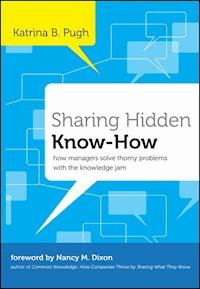
Using knowledge that an organization already has is one of the great management ideas of the last fifteen years. Putting Knowledge to Work provides external consultants, internal facilitators, and leaders with a five-step process that will help them achieve their knowledge management goals. The five steps, Knowledge Jams, show how to set the direction, foster the correct tone, conduct knowledge capture event, and integrate this knowledge into the organization. In addition, the author introduces conversation practices for participants to effectively co-create knowledge and discover context.
Sie lesen das E-Book in den Legimi-Apps auf:
Seitenzahl: 352
Veröffentlichungsjahr: 2011
Ähnliche


















Table of Contents
Cover
Table of Contents
Praise for Sharing Hidden Know-How
Title page
Copyright page
FOREWORD
INTRODUCTION
CHAPTER 1 KNOWLEDGE JAM RATIONALE: SOLVING THORNY PROBLEMS
WHAT’S NOT WORKING?
BLIND SPOTS
MISMATCHES
KNOWLEDGE JAILS
CHAPTER 2 KNOWLEDGE JAM BASICS
STEP 1: SELECT
STEP 2: PLAN
STEP 3: DISCOVER/CAPTURE
STEP 4: BROKER
STEP 5: REUSE
CHAPTER 3 DISCIPLINE 1: FACILITATION
THE FACILITATOR’S MANDATE
1. FACILITATING THE SELECT STEP
2. FACILITATING THE PLAN STEP
3. FACILITATING THE DISCOVER/CAPTURE STEP
4. FACILITATING THE BROKER STEP
5. FACILITATING THE REUSE STEP
CHAPTER 4 DISCIPLINE 2: CONVERSATION
POSTURE OF OPENNESS
PURSUIT OF DIVERSITY
PRACTICES OF DIALOGUE
CHAPTER 5 DISCIPLINE 3: TRANSLATION
BROKERS’ MOTIVATORS
BROKERING BASICS
CHAPTER 6 BESPECKLED, MARRIED, AND EMANCIPATED
BOUNDARY-SPANNING
SURFACING USABLE INSIGHT
PUTTING KNOWLEDGE TO WORK
CHAPTER 7 KNOWLEDGE JAM HERITAGE: PREQUEL TO THE THREE DISCIPLINES
INTELLIGENCE ACQUISITION
ORGANIZATIONAL LEARNING
COLLABORATION TECHNOLOGY
CHAPTER 8 COMPARING KNOWLEDGE JAM TO OTHER KNOWLEDGE-CAPTURE METHODS
A FACILITATION-CONVERSATION- TRANSLATION SCALE
CHAPTER 9 BUILDING A KNOWLEDGE JAM PRACTICE
BUILDING A BUSINESS CASE AND SELLING KNOWLEDGE JAM
CULTIVATING KNOWLEDGE JAM FACILITATORS
MEASURING AND PROMOTING SUCCESS
CHAPTER 10 KNOWLEDGE JAM FOR LEADING CHANGE AND LEVERAGING SOCIAL MEDIA
USING KNOWLEDGE JAM FOR LEADING CHANGE
KNOWLEDGE JAM FOR BUSINESS TRANSFORMATION AND SOCIAL MEDIA
CHAPTER 11 AN INVITATION
WHY KNOWLEDGE JAM (AND OTHER FORMS OF KNOWLEDGE ELICITATION) WILL TAKE OFF
YOU HAVE YOUR TOOLKIT
MORE THAN A BUSINESS TOOL
APPENDIX A KNOWLEDGE TYPES
TOPIC SCENARIOS (FROM THE FACILITATION CHAPTER)
TYPES OF KNOWLEDGE
APPENDIX B KNOWLEDGE JAM TEMPLATES
APPENDIX C GLOSSARY OF TERMS
APPENDIX D CASE STUDIES
CASE STUDY: INSTITUTE FOR HEALTHCARE IMPROVEMENT (HEALTHCARE QUALITY IMPROVEMENT NON-PROFIT)
CASE STUDY: FOREST BIOPRODUCTS RESEARCH INITIATIVE (NEW ENERGY INSTITUTE)
APPENDIX E KNOWLEDGE JAM PRACTICE FAQS
WHAT IS BETTER: AN OUTSIDE OR INSIDE FACILITATOR?
CAN A BROKER BE AN ORIGINATOR?
SHOULD I AUDIO-RECORD A KNOWLEDGE JAM?
WHAT IF YOU CAN’T JAM IN REAL TIME? (THE WIKI ALTERNATIVE)
WHERE DOES KNOWLEDGE JAM FIT IN A KM PROGRAM? DOES IT HAVE TO?
HOW CAN KNOWLEDGE JAM JUMP-START AN ENTERPRISE 2.0 (SOCIAL MEDIA) INITIATIVE?
ACKNOWLEDGMENTS
THE AUTHOR
Index
Praise for SharingHidden Know-How
“The next generation of leadership effectiveness is about conversation and reflective facilitation, not just texts and tweets. Sharing Hidden Know-How makes the case for intentional, conversation-based leadership, and provides the practice model to pull it off. Viewed from above, this important book is itself a conversation between Kate Pugh’s basic propositions and those of a diverse group of other thinkers, all woven into a unified whole. Viewed on the ground, it is an intellectual joyride, coherent, insightful, promisingly pragmatic, and with just the right measure of the personal to fully reveal a fruitful mind in motion.”
—David Kantor, director, Kantor Institute, author, Reading the Room (Jossey-Bass)
“Knowledge is indeed power. But capturing knowledge is not enough. Organizations must have ways to engage those who know with those who need to know in a context-building process that produces real business results. With the Knowledge Jam, Kate Pugh shows you how.”
—Michael Wilkinson, author, The Secrets of Facilitation (Jossey-Bass), managing director, Leadership Strategies
“One of the key ingredients for building capability in diverse, distributed and virtual teams is sharing know-how. Kate Pugh was my partner and advisor as I built that capability for my teams in offshore locations such as Bangalore and Chennai by using the Knowledge Jam process. This book will be an asset for all those who manage or work in virtual teams.”
—Neeraj Wadhera, VP, head of Global Operations, Security and Fraud for a Fortune 100 Financial Services Company
“Organizations today are dealing increasing pressure to accomplish their objectives more effectively, more efficiently, and with fewer resources. Managers are rethinking all aspects of their business strategies to optimize the way they work, including how people connect to people and to information. Sharing Hidden Know-How highlights key issues for managers to tackle and practical strategies for innovative, smarter work.”
—Suzanne Livingston, IBM Social Software, senior product manager, Lotus Connections
“What a fantastic replacement for the long dormant and never used lessons-learned repository! A great book for anyone who doesn’t want their organization to make the same mistake twice. This book provides well documented and effective tools for really learning from your organization. As our business continues to go through transformational change, I hope to make good use of the Knowledge Jam to guarantee our success and make that transformation efficient.”
—Sheryl Skifstad, MBA, MFA, MM, BSEE, senior director, Supply Chain IT at a Fortune 100 company
Copyright © 2011 by Katrina B. Pugh. All rights reserved.
Published by Jossey-Bass
A Wiley Imprint
989 Market Street, San Francisco, CA 94103-1741—www.josseybass.com
No part of this publication may be reproduced, stored in a retrieval system, or transmitted in any form or by any means, electronic, mechanical, photocopying, recording, scanning, or otherwise, except as permitted under Section 107 or 108 of the 1976 United States Copyright Act, without either the prior written permission of the publisher, or authorization through payment of the appropriate per-copy fee to the Copyright Clearance Center, Inc., 222 Rosewood Drive, Danvers, MA 01923, 978-750-8400, fax 978-646-8600, or on the Web at www.copyright.com. Requests to the publisher for permission should be addressed to the Permissions Department, John Wiley & Sons, Inc., 111 River Street, Hoboken, NJ 07030, 201-748-6011, fax 201-748-6008, or online at www.wiley.com/go/permissions.
Readers should be aware that Internet Web sites offered as citations and/or sources for further information may have changed or disappeared between the time this was written and when it is read.
Limit of Liability/Disclaimer of Warranty: While the publisher and author have used their best efforts in preparing this book, they make no representations or warranties with respect to the accuracy or completeness of the contents of this book and specifically disclaim any implied warranties of merchantability or fitness for a particular purpose. No warranty may be created or extended by sales representatives or written sales materials. The advice and strategies contained herein may not be suitable for your situation. You should consult with a professional where appropriate. Neither the publisher nor author shall be liable for any loss of profit or any other commercial damages, including but not limited to special, incidental, consequential, or other damages.
Jossey-Bass books and products are available through most bookstores. To contact Jossey-Bass directly call our Customer Care Department within the U.S. at 800-956-7739, outside the U.S. at 317-572-3986, or fax 317-572-4002.
Jossey-Bass also publishes its books in a variety of electronic formats. Some content that appears in print may not be available in electronic books.
The opening quote in Chapter 11 is from “At the Cliff Edge of Life,” from CROSSING THE UNKNOWN SEA copyright © 2001 by David Whyte. Used by permission of Riverhead Books, an imprint of Penguin Group (USA) Inc.
Library of Congress Cataloging-in-Publication Data
Pugh, Katrina.
Sharing hidden know-how : how managers solve thorny problems with the knowledge jam / Katrina Pugh.
p. cm. – (J-b us non-franchise leadership; 387)
Includes bibliographical references and index.
ISBN 978-0-470-87681-7 (hardback); 978-1-118-01093-8 (ebk); 978-1-118-01075-4 (ebk); 978-1-118-01092-1 (ebk)
1. Knowledge management. 2. Organizational learning. 3. Organizational learning Management. I. Title.
HD30.2.P84 2011
658.4’038--dc22
2010052164
FOREWORD
Sharing Hidden Know-How offers the opportunity for the reader to rethink the idea of lessons learned so that what is learned is an active exchange between those who have just gained important knowledge from a project and co-workers who want to improve the way they are working on a similar topic. The process is not limiting us to a look backward but to regard the process as an act of discovering, with the help of colleagues, what can be drawn from a recent experience.
Any organization must have the ability to learn from its own experience if that organization wants to change and innovate. Unfortunately “lessons learned” has earned a negative reputation in many organizations. And the reality is that such efforts have often been ineffective. However, a new way for organizations to learn from their successes and failures is provided in this book.
Kate Pugh invented the very interactive process that became “Knowledge Jam” while working at Intel and then carried it with her to Fidelity and finally to her own consulting practice. I’ve had the opportunity to work with Kate on a number of Knowledge Jams so I know that the process works. I’ve seen it draw out knowledge that an originating team would not have mentioned without process having stimulated their thinking. And I have even seen the members of the originating team come to a new understanding spurred by a provocative question asked during the Knowledge Jam.
The most difficult aspect of lessons learned has always been moving what has been learned into practice. Knowledge Jam addresses this issue by bringing brokers (representatives of the seeker organization) in to ask questions and to be responsible for implementing what they just learned in their own parts of the organization. Brokers are selected from those groups that are most likely to be able to make use of the knowledge that the originating team has gained through their work. When brokers leave the Knowledge Jam, they do so with specific implementation intentions and are measured as they complete those. The formality of the broker role solves the long-standing impediment to the implementation of lessons learned.
Knowledge Jam is an interesting combination of push and pull. Push happens when I tell you what I think you need to know. Pull happens when you ask a question based on your own need to know.
Knowledge Jam employs push when a manager decides that what has been learned by a project team needs to be shared. Targeted and limited push is the most effective way to push knowledge. Pull happens in the Knowledge Jam through the questions that brokers ask to pull knowledge from the originating team. The questions they ask arise out of their own curiosity and the answers they receive help them implement the lessons learned in their own units.
Knowledge Jam is a conversational process. Conversation remains the most effective way to exchange tacit (“hidden”) knowledge. Explicit knowledge can be shared through documents, but tacit knowledge requires the give and take of conversation, which clarifies meaning, explores alternatives, expands the context, and creates new meaning.
Knowledge management (KM) is badly in need of more processes like the Knowledge Jam. Now, after nearly fifteen years, we have learned that the transfer of tacit knowledge requires conversation, not just documentation, no matter how exhaustively that documentation is written.
The reason why documentation is not the answer lies not in the inadequacy of technology but in how our brains store knowledge. Everything is stored, not in whole chunks, but in bits and pieces of experience. What we think of as tacit knowledge is really the human ability to draw on our past experiences to respond to new problems or questions. My friend Nick Milton tells a story about teaching his daughter to drive. His daughter asked, “When changing gear going down a steep hill, do I put my foot on the clutch before I put it on the brake, or do I brake first?” To answer that question, Nick had to get into the car and put himself “in the situation” in order to draw on his tacit knowledge.
That is what happens in a Knowledge Jam. The originators are asked questions that put them “in the situation” of the brokers. In order to answer the questions, the originators put together bits and pieces from different parts of what was probably a year-long experience. Knowledge that was tacit until the originator heard the question now comes together in the moment of responding. Originators do not “know” the response until faced with the need for it. Karl Weick, the well-known organizational theorist, is fond of saying, “How do I know what I think until I hear what I say?”
If knowledge management wants to meet the challenge of making use of the tacit knowledge, it will have to use processes like the Knowledge Jam, which bring the seeker and the originator into conversation with each other. Knowledge Jam is leading the way!
Nancy M. Dixon, Ph.D., principal, Common Knowledge Associates, and author of Common Knowledge: How Companies Thrive by Sharing What They Know and the “Conversation Matters” blog (nancydixonblog.com).
INTRODUCTION
At a new production facility of a major computer hardware manufacturer, performance appeared relatively stable during the first month of operation. Yet, when veteran operators (who had been “on-loan” to the new facility) departed, yields dropped and outages skyrocketed. Senior management couldn’t comprehend why this could occur. Traditional knowledge-transfer methods, such as veterans’ painstakingly recording procedures and one-on-one job-shadowing, failed to sufficiently engage operators in their future roles and failed to draw out the range of things that could go wrong when all parts of the factory were up and running.
In order to accelerate knowledge transfer between consultants, a leading strategy consulting firm decided to produce video recordings of veteran consultants. After hours of recording time, preparation, tagging, uploading, and promotion, the fifteen-minute videos were not looked at by new project teams, even when those new project teams were doing follow-on work at the same clients as the consultants in the videos. The follow-on teams didn’t find that watching videos “fit” with their road-warrior schedules and provided little value over and above simply reading PowerPoints. They continued to interact directly with the veteran consultants to sound them out about how historical lessons learned would play out in the future projects.
When NGOs tried to introduce fertilizer application procedures to African farmers, initially the uptake was poor. The fertilizer process didn’t fit in with the farmers’ planting routine or the credit structures already in place for seed purchases. Unfortunately, fertilization didn’t fit with the production methods or the local customs either. Until the community could be included in the process, farmers felt their new methods and values were in conflict.1
Sound familiar?
Managers have tried to deal with the failure to spread knowledge across organizations and groups by investing in process, people, and technology. Twenty years ago, it was “intelligence acquisition.” Fifteen years ago, we tried “organizational learning.” Ten years ago we tried “collaboration tools.” Today, we put great hope in Web 2.0 or Enterprise 2.0. And throughout these periods we applied dozens of knowledge-elicitation strategies like after action reviews. These practices each addressed only part of the problem.
Lesen Sie weiter in der vollständigen Ausgabe!
Lesen Sie weiter in der vollständigen Ausgabe!
Lesen Sie weiter in der vollständigen Ausgabe!
Lesen Sie weiter in der vollständigen Ausgabe!
Lesen Sie weiter in der vollständigen Ausgabe!
Lesen Sie weiter in der vollständigen Ausgabe!
Lesen Sie weiter in der vollständigen Ausgabe!
Lesen Sie weiter in der vollständigen Ausgabe!
Lesen Sie weiter in der vollständigen Ausgabe!
Lesen Sie weiter in der vollständigen Ausgabe!
Lesen Sie weiter in der vollständigen Ausgabe!
Lesen Sie weiter in der vollständigen Ausgabe!
Lesen Sie weiter in der vollständigen Ausgabe!
Lesen Sie weiter in der vollständigen Ausgabe!
Lesen Sie weiter in der vollständigen Ausgabe!
Lesen Sie weiter in der vollständigen Ausgabe!
Lesen Sie weiter in der vollständigen Ausgabe!
Lesen Sie weiter in der vollständigen Ausgabe!
Lesen Sie weiter in der vollständigen Ausgabe!




