


17,27 €
Mehr erfahren.
- Herausgeber: Fernhurst Books Limited
- Kategorie: Lebensstil
- Sprache: Englisch
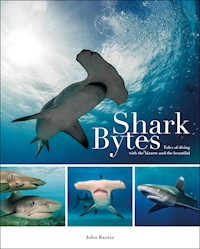
The popular image of sharks is of a dorsal fin cleaving the surface as it rushes to its next kill, but this is a limited caricature. There are over 500 species to choose from, most of whom are far more frightened of humans than vice versa. In this beautiful book, diving veteran John Bantin recounts many tales of his diving with several species of sharks and other marine animals over the last 4 decades. Accompanied by his own stunning photography, the captivating, spectacular and sometimes shocking encounters show the reader what it is like to get up close and personal to these bizarre and beautiful creatures. The sharks covered range from the great whale sharks to the small blacktip reef shark, in locations extending to all corners of the globe.
Das E-Book können Sie in Legimi-Apps oder einer beliebigen App lesen, die das folgende Format unterstützen:
Veröffentlichungsjahr: 2015
Ähnliche


















.
Shark Bytes
Shark Bytes
Tales of diving with the bizarre and the beautiful
John Bantin
.
Published in 2015 by Fernhurst Books Limited
62 Brandon Parade, Holly Walk, Leamington Spa, Warwickshire, CV32 4JE, UK
Tel: +44 (0) 1926 337488 | www.fernhurstbooks.com
Copyright © 2015 John Bantin
John Bantin has asserted his rights under the Copyright, Designs and Patents Act, 1988, to be identified as the author of this work.
All rights reserved. No part of this publication may be reproduced, stored in a retrieval system or transmitted, in any form or by any means, electronic, mechanical, photocopying, recording, scanning or otherwise, except under the terms of the Copyright, Designs and Patents Act 1988 or under the terms of a license issued by The Copyright Licensing Agency Ltd, Saffron House, 6-10 Kirby Street, London EC1N 8TS, UK, without the permission in writing of the Publisher.
Designations used by companies to distinguish their products are often claimed as trademarks. All brand names and product names used in this book are trade names, service marks, trademarks or registered trademarks of their respective owners. The Publisher is not associated with any product or vendor mentioned in this book.
This publication is designed to provide accurate and authoritative information in regard to the subject matter covered. It is sold on the understanding that the Publisher is not engaged in rendering professional services. If professional advice or other expert assistance is required, the services of a competent professional should be sought. The Publisher accepts no responsibilty for any errors or omissions, or for any accidents or mishaps which may arise from the use of this publication.
ISBN 978-1-909911-45-1 (softback)
ISBN 978-1-909911-73-4 (eBook)
ISBN 978-1-909911-74-1 (eBook)
Some of the text originally appeared inDiver Magazineand is used with their permission.
Tailpiece © Bret Gilliam
All cover photographs © John Bantin, except:
Back cover inset © Bob Semple
All photographs © John Bantin, except:
p148 © Bantin/Mattmueller; p197 © Shane Wasik
Edited by Becky Davidson
Designed by Rachel Atkins
This book is dedicated to the memory of Gary Vanhoeck, dock manager at Stuart Cove’s Dive Bahamas, whose life was ended during a failed robbery attempt, May 2015
.
Contents
Introduction
Chapter 1
The Great Hammerhead
Chapter 2
Early Experiences in the Bahamas
Chapter 3
Whitetip Reef Sharks
Chapter 4
The French Connection
Chapter 5
Grey Reef Sharks of the Indo-Pacific
Chapter 6
Beveridge Reef
Chapter 7
Hammerhead Madness
Chapter 8
Dirty Rock, Cocos Island
Chapter 9
Nurses and Leopards
Chapter 10
The Oceanic Whitetip
Chapter 11
Photographing Oceanic Whitetips
Chapter 12
Bottlenose Dolphin
Chapter 13
Silky Sharks and Dolphins
Chapter 14
Whale Sharks
Chapter 15
Tagging Whale Sharks
Chapter 16
Whale Sharks and the Thruster
Chapter 17
Safari or Circus?
Chapter 18
Bull Sharks
Chapter 19
Tiger, Tiger
Chapter 20
The Tasselled Wobbegong
Chapter 21
Shark Diving in the Golden Triangle
Chapter 22
The Sha’ab Rumi Shark Club
Chapter 23
Panic at Gordon Rocks
Chapter 24
Australian Rules
Chapter 25
A Dive on the Wild Side
Chapter 26
Maldives after Dark
Chapter 27
Manta Mania
Chapter 28
Dugongs: Mermaids of Years Gone By
Chapter 29
British Sharks
Chapter 30
What Eats Sharks?
Chapter 31
Shark-feeding: Right or Wrong?
Chapter 32
Is the Only Good Shark a Dead Shark?
Tailpiece
Sharks Keep Messing With My Wallet
by Bret Gilliam
.
Introduction
The chilling sight of a dorsal fin cleaving the surface; those unemotional black eyes; the muscular grey body; the mouth full of razor sharp teeth; the popular image of the predatory shark is enough to make you never to want to go into the sea again yet millions of people splash about in the shallows off tropical beaches and many thousands will scuba dive every year. How come so few people get eaten by sharks?
I am not an expert regarding elasmobranchs, the scientific name for the group of animals to which sharks belong. I make no pretension to be such. I am merely a person who has done a lot of diving in tropical waters thanks to a busy career as Chief Correspondent and Technical Editor to Britain’sDiver Magazine, a career that has spanned more than two decades. I have simply been a ‘shark witness’. During that time I have seen attitudes towards shark encounters change dramatically among some divers, as have my own.
When I first learned to dive in the late 1970s, it was commonly thought that divers were at risk from shark attack and should one see a shark, any shark, during a dive, it would be best to leave the water immediately. Pioneer divers like Ron and Valerie Taylor, Dr Eugenie Clark and film cameraman Stan Waterman were breaking that mould but they were exactly that, pioneers. Getting close to sharks was not practice for the likes of ordinary folk. While Valerie was donning a chainmail suit and encouraging sharks to bite her arm, the rest of us sat back to watch on our televisions knowing that it was the act of a daredevil. We were assured sharks were dangerous.
The story by Peter Benchley and consequent film directed by Steven Spielberg,Jaws, did nothing to dissuade most of us from that opinion, especially taking into account Robert Shaw’s character Quint’s monologue about supposedly surviving the shark attacks after the sinking of the USSIndianapolis.
Very few people, by and large, witness what happens under water. This gives an opportunity for myths and misconceptions to be turned into perceived facts. The mainstream media revels in such misinformation. When technical diving pioneer Rob Palmer died in the Red Sea, through breathing an unsuitable gas for the depth to which he was going, it was inevitable that some newspapers reported that he had been the victim of a shark attack. When a large group of British and other European divers went missing in 2004 at the Brother Islands in Egypt, the media revelled in their loss in ‘shark-infested waters’ only to be disappointed when they turned up unharmed, floating at the surface a little more than thirteen hours later. In 2014, the British public was confronted with newspaper headlines such as ‘Cornish Snorkeller Almost Swallowed By Shark’ along with a picture of someone swimming alongside a huge but harmless basking shark.
On the other hand, it has become a known fact that sharks are essential ingredients in the underwater eco-system of the Planet Earth.
Today, some divers will pay a premium to get very close to sharks, primarily for the purpose of photographing them. Invariably feeding is involved. It’s the promise of an easy meal that will encourage a shark to approach when normally discretion would be its reaction regarding scuba divers.
Other divers want to see sharks on dives but not get uncomfortably close to them. They are happy to watch sharks cruising along reef walls at a safe distance while they cling on, anchored to the reef top in the current that the sharks are obviously enjoying. A majority of divers, along with probably the majority of those that have never set foot in the sea let alone put their heads under the water, still bear an innate fear of shark attack. Each group vehemently defends their position.
The underwater world is nature red in tooth if not claw. Since nearly all the life, even what may look to the uninformed like plants, is animal life, everything is feeding on everything else. We humans are recent newcomers to the environment and, as such, don’t fit into any menu that has evolved over millions of years. It gives the scuba diver the opportunity to get close to and study what goes on without actually being involved in it. That said, it cannot be denied that once there is a free source of food in the water, the rules can change and accidents can happen.
Jeremy McWilliam, the British skipper of an early liveaboard dive boat in the Red Sea, sustained a nasty bite in the face from a large moray eel. However, he was in the process of feeding it with bits of bacon held between his teeth! I was partly to blame when a girl got bitten in the face by a conger eel in the Mediterranean. You can read about it in my bookAmazing Diving Stories. A long time ago I was swimming along a reef wall in Egypt, accompanying diving book author Lawson Wood, when we came across a group of divers in mid-water feeding a large Napolean wrasse with boiled eggs. To our amazement, a large moray eel shot out from the reef and bit away the Napolean’s lower lip in an effort to get a share of the food, before dashing back to the safe cover of the reef. The Napolean wrasse hurtled round in panic, as did the accompanying divers. It could have been any one of them that had got injured and it would have been reported no doubt as an unprovoked attack. So one could say that eels are just as dangerous as sharks but no doubt if this book’s title had been about eels, you probably would not be reading it!
I have tried to give an evenly balanced account of what it is like to dive with sharks, animals that are at or near the top of the underwater food chain. I have included stories of events that happened to me early in my diving career, both as a leisure diver and a professional. These can reveal how my own attitudes have changed.
This book has been written as the result of personal experience plus the research I did with others that inevitably includes opinion, conjecture and even some imagination! When non-diving friends ask what I would do if I was attacked by a shark, I boast, “I can handle it!”
Of course I could not, but I know that my chances of getting attacked by a shark are statistically far less than being struck fatally by a falling coconut on my way to the dive boat or being killed by a faulty toaster at breakfast.
As I said, I am a witness and I am indebted to other shark witnesses who have shared their knowledge and experience with me. Among hundreds of dive guides, too many to recall, there are also people like Jeremy Stafford-Deitsch, Gary Adkison, Mike Neuman, Stuart Cove and Michelle Cove.
As a new diver I was once afraid of shark attack. However, attending numerous different shark feed dives over the years has shown me that it’s mainly man’s input that makes the difference as to whether it is safe or not. Since witnessing them in their own environment I have always enjoyed diving close to sharks. The sharks that turn up at these feeds are the ambassadors for the rest of the shark populations of the world, most of which are now in serious decline through man’s plundering of the ocean.
However, I will never forget one piece of advice given to me by Stuart Cove, the famous shark wrangler of Hollywood movies. He said,“Never forget that sharks are at home in their own environment and they have a lot of very sharp teeth.”
.
Chapter 1
The Great Hammerhead
When tourist boards organise press trips for journalists, their mission is just as political (in that they try not to upset any of their local suppliers) as it is practical in getting as many column inches of publicity as possible. That’s why journalists on press trips to promote holiday destinations usually stay at a different resort every night. It’s important to the tourist board that as many different resorts as possible get exposure.
With dive travel this can be quite arduous, especially if the resorts are very many miles apart and involve transfer by air between them. When you add the extra requirement that one should not fly for twenty-four hours after diving, it can make the logistics quite difficult indeed.
My first visit to French Polynesia was subject to this problem. Each resort was on a different island and French Polynesia covers an area as large as that of Western Europe. I contacted each dive centre in advance of my arrival because it meant I had no time to waste.
Flying from Papeete in Tahiti to Rangiroa took nearly two hours and I was not a little uncomfortable because I was already prepared, wearing my wetsuit. Sebastian met me at the tarmac’s edge when we landed and we drove the short distance to the dive centre. I was soon kitted up in my diving equipment, camera in hand and off to the famous Tiputa Pass by Zodiac.
It’s a narrow channel where the water rips through with the rising tide as it fills Rangiroa’s lagoon, the second biggest lagoon in the world. There’s a standing wave and a resident pod of dolphins that cavort in it. Underwater, Rangiroa is famous for its huge grey reef shark population but there’s plenty of other stuff too. The flow of oxygenated water is just what requiem sharks love since they can surf on the flow in an effortless way while the current flows through their gills.
I worked my way across the channel not without a lot of effort. With one hand occupied with holding a camera rig, I had only the other to drag myself along with. At one point veritable walls of grey reef sharks surrounded us. Wow! Not only that but there were flotillas of eagle rays and tonnes of other fishes too.
Eventually we two divers were alone in the current. Everything had seemed to magically disappear, making itself suddenly scarce. In a complete change of pace, there were no fish visible. It was surreal. I wondered why we stayed where we were. What were we waiting for?
The fact of the matter was that the time pressure put on by an itinerary written by some bureaucrat disconnected from the practical aspects of scuba-diving had given me little chance of a significant dive briefing before I’d taken to the water. I wasn’t expecting what happened next.
I was busy looking at Sebastian. My briefing had been composed of not much more than to stick closely with him. It was at this point a great hammerhead shark (Sphyrna mokarran) passed by from behind me. It came past my right shoulder within inches of my head.
This monster was around five metres long from head to tail. To meet such a massively large animal so unexpectedly underwater is unusual to say the least. It passed by me and swam with a gentle gyration of its body and long tail, in an unhurried way off through the limit of underwater visibility. I was so stunned by its sheer size, it made the grey reef sharks look toy-like by comparison and I failed to raise my camera and squeeze off a single shot of it. Evidently, it was frequently seen by Sebastian in the Tiputa Pass but that was the first great hammerhead I saw and I saw it in great close-up, if in rapidly receding perspective.
Although I often saw a distant silhouette over sunlit back reefs elsewhere in the world, plus a memorable aerial sequence on YouTube of such a shark chasing a stingray in shallow water, with twists and turns as the ray tried to evade its certain demise, it was to be years before I got so close to one again.
When you find yourself confronted head-on by a great hammerhead shark during a dive, its head held low and swaying from side to side like a fighting bull approaching a matador, it can make you stop for a moment and wonder if you had been wise, if you should have been there. Great hammerheads have a fearsome reputation among shark fishermen. They are among the biggest of the tropical requiem sharks, at up to six metres long and weighing maybe half-a-tonne, and they don’t appear to have any natural enemies. Their common name is derived from their sheer size.
They don’t school in social groups like the much smaller and very skittish scalloped hammerheads that divers often get so excited to see, neither do they back down when they see a diver. These are lone hunters that roam the colder currents of tropical seas, which is why a good place to encounter them is on the Gulf Stream where it runs close to the islands of The Bahamas. Even so, it’s only during a short window in winter when the water is at its coldest, that these magnificent nomadic animals migrate by on their way north.
It’s at this time that so-called ‘brave and intrepid’ shark fishermen head out from Florida to get themselves a big shark and the dose of machismo they feel they need to get from doing so.
“I’ve killed hundreds of them over the years,” claimed a fisherman at North Bimini marina in the Bahamas. “They’re dangerous man-eaters and I’m doing the world a favour.”
It’s all very sad because nothing could be further from the truth. They are big animals with a lot of teeth but they appear to pose no threat to either swimmers or divers.
Bimini is the site of theShark Lab, run by iconic Dr. ‘Sonny’ Gruber of theShark Research Institute. With the Gulf Stream passing close by the island it’s a good place to study a wide range of sharks.
Stuart Cove’s girlfriend went to do voluntary work with theShark Laband discovered that they were tagging great hammerheads. The volunteers, mainly girls like Liz, were free-diving with these big animals and attaching tags to them. It seems they were not the man-killers they were made out to be.
Armed with that information, in February 2013 we went to Bimini with Stuart Cove, Bahamian born and ‘Mr Shark’ to those in the world of movies. Contrary to common misconception, Stuart Cove is not a place. He’s a person. He’s been encouraging sharks to come up close to cameras since the making of that scene when Sean Connery as James Bond 007 had a close encounter with a tiger shark when he dived into the wreck of the‘Tears of Allah’. Stuart Cove has been the shark-wrangler on nearly every movie that has featured sharks since then.
We weren’t alone. There were some very well known wildlife cameramen who came along too, including award-winning Andy Brandy Casagrande IV and Frazier Nivens. Video-maker Mark Rackley and his girlfriend Cat Rockett preferred to free-dive with the sharks. Half-a-dozen other keen video pros, several with expensive Red Epic cameras, joined us too, so you can guess YouTube was soon to be flooded with footage gained in that short window of opportunity.
What do great hammerheads eat? They search the sand in the shallow waters of the backreefs for their favourite food source, southern stingrays. They munch through these oblivious to the poisonous spines that the rays impale in their tormentors in a vain attempt at defence. Many of the sharks we saw had the unmistakable evidence of this with spines still lodged around their mouths.
We didn’t have access to any stingray carcasses but Stuart’s crew had managed to acquire sacks of parrotfish heads and barracuda cleanings from the local fishing dock and these would have to do when it came to shark bait.
People don’t eat barracuda for fear of lethal ciguatera poisoning and the sacks of parrotfish heads were labelled ‘grouper heads’, something to bear in mind when ordering grouper fillets in restaurants in that part of the world.
Sharks don’t simply turn up without reason. The right bait is important. As Liz jokingly likes to say, “They are not like dolphins. You can’t simply do yoga at the back of the boat and expect them to appear.”
Besides the obvious feeling of trepidation felt when getting into the water with big and unpredictable predators, there was also the worry that none would actually turn up. We got out to the magic spot where Stuart anticipated they might come to and started chumming the water with scrapings from the barracuda. Scales and tiny bits of barracuda flesh drifted away on the current over the deep wall and a nervous couple of hours passed before the first dark tell-tale shape became ominously silhouetted against the white sand below. These boys were big.
With a gentle current persistently pushing across a soft white sandy bottom, we rigged a long rope held in place by Danforth anchors to give us something to keep us on station. Everybody was sworn to a code that included never chasing after a shark. We then divided ourselves into two groups and had forty-five minutes at one time in the water.
We, in the second group, were concerned that only the first group might get the rarely seen footage. We need not have worried. Two or three sharks at one time turned up, drawn in by the tantalising smell given off by two of Stuart’s stalwart fish scrapers, standing on the sand behind us and letting a mist of seductive scent drift over us. Beto Barbosa buried parrotfish heads in the sand in front of us and the big animals came in remorselessly looking for the free meal. The show was continuous.
Great hammerheads are magnificent creatures. Big aeroplane-wing-like heads with enormous black eyes at either extremity are swayed from side to side in order for them to both get a complete image in forward vision and for the wide range of electro-receptors, the ampullae of Lorenzini, on the underside to search out possible prey. Set back behind is the mouth, full of very visible flesh-ripping teeth.
Their muscular bodies and long tails give them an amazing turn of speed that is belied in still pictures frozen in time as they are. I needed a very fast shutter-speed with my camera to get sharp pictures. When there’s food in the water, sharks don’t muck about. Eating is what they’re good at.
These great hammerheads are fast, very fast, and we were in their element. With no hard bones to speak of, these big animals can turn in a moment and they did, frequently. I was quite glad I wasn’t a stingray.
There was never any question of these sharks getting their fill and going away. When you consider the amount of flesh present on a big stingray, the bait we offered amounted to nothing more than canapés, but the sharks seemed to enjoy the game and came in again and again, searching out the treasure of fish heads buried in the sand. We kept station in the current and the sharks swam swiftly around us, sniffing out the seabed and bursting into a flurry of action when they found something. It’s an amazing feeling to be in close proximity to such enormous creatures that you knew could destroy you in a moment if they so desired, but they don’t. They’re only looking for what they normally eat.
In some ways they reminded me of old fashioned upright vacuum cleaners. The males are distinguished from the females by their huge, sharply pointed dorsal fins.
It was ironic that at times we were distracted by a dozen or so slow-moving yet muscular nurse sharks, also drawn up to the back reef by the smell of a free meal and at times getting in the way. It could have been an iconic nurse shark dive if there had not been more spectacular animals to watch and these sharks were smothered with massive remoras clinging to them.
There were moments when we thought the great hammerheads had gone but time and time again they’d reappear wraithlike out of the gloom and without pause come directly to us for the big close-ups, and we were happy to oblige.
Sharks are quick learners. By the third day they were waiting for us as the boat was moored up. We were getting bolder too.
Beto managed to lure the occasional shark up off the seabed into open water so that we could get the classic overhead hammerhead shot. The huge beasts didn’t seem interested in the fish he held in his hand and he only needed to put it out of sight behind his back for them to lose interest, not something one might try with some other sharks. There was one exciting moment when a great hammerhead dipped into the sand exactly where Beto stood waiting and picked him up so that he gave us a brief impression of an underwater surfboard rider.
By the fifth day we were getting up to five hours at a time with the sharks. The current had dropped, allowing us to dispense with the rope and sand anchors, the sun shone without break and the sharks stayed around. I was able to get wide-angle close-ups that had been unheard of before. We photographed them at dawn through midday and until dusk. In four days I got more than two-thousand useful pictures of them. The girls with us then wanted to free-dive with them and who we were to stop them? Great hammerheads are not remorseless man-eaters. They are remorseless in their search for prey buried in the sand.
While back in 2013, good pictures of these magnificent animals were rare and only obtained as a result of a fleeting encounter, the word soon got round among keen underwater photographers and by the following year the unique spot where we had been was flooded with dive boats disgorging divers armed with cameras during the short window of opportunity. Today there are endless such pictures available but most of these photographers are so pleased just to have such a magnificent large animal in front of their lenses they do little more than record the image. Few try to get truly iconic photographs.
.
Chapter 2
Early Experiences in the Bahamas
In 1994 I went to the Bahamas to fulfil a project for an advertising campaign that required sharks to be featured in the pictures. I went with the then famous cave diver, Rob Palmer. I also recounted the experience for the benefit of readers of Diver Magazine.
Rob Palmer looked less than comfortable as he kneeled on the seabed besides the loaded bait box. The chainmail gloves and long sleeves might protect his arms and hands from those ripping razor-sharp teeth, but if he accidentally got bitten he’d certainly sustain a bruise or two through the stainless steel links. The rest of his body, including his head, seemed strangely unprotected by comparison. I wasn’t worried. I was armed with my camera and intent on getting some good pictures but I admit my heart was racing.
Rob gingerly opened the box and speared a massive lump of tuna with his over-sized fondue fork. Carefully allowing the lid of the box to fall closed, he offered the meat, doing his best to disallow the attention of a thousand yellowtails and four massive Nassau grouper that had made their way up on to the reef top. A jolly giant green moray eel nuzzled expectantly around his knees.
We each carried tuna meat in our pockets and Kentucky Dave, the resident dive guide and that day’s shark feeder, crushed more pieces in his hands, allowing blood and fish oil to mix with the surrounding water.
Suddenly the sharks were upon us. There were about eight or nine of them, circling round. The smallest, at about a metre and a half, was the quickest. The biggest, much bigger than me, wore decorative remoras or shark-suckers like badges of rank. The groupers understood the pecking order and stood down, relegated to being non-participating spectators of the ensuing action.
A shark swooped in and wrenched the meat away from Rob’s spear. The others circled in repeated patterns, disgruntled and searching for easy pickings. Adrenalin pumped through the veins of the warm-blooded section of the audience.
These were female Caribbean reef sharks (Carcharhinus perezi), requiem sharks heavy and regularly fed, the stuff of every mariner’s nightmares.
I found myself continually within touching distance as they brushed past me, but I was well advised to resist the temptation, although once or twice it was necessary to gently push a heavy old black grouper out from in front of my camera lens.
Rob cautiously felt for another lump of tuna in the bait box. The closest shark snatched it from him, teeth extended in a ferocious sharky snarl. It roughly shook the bait and swam away at pace from the other competing sharks.
Rob continued to offer food. I continued to shoot pictures. We’d been given the special privilege of conducting our own shark feed and things were going rather well. Moving continuously in a figure of eight, the sharks made repeated passes. Sometimes two would meet in a head-to-head confrontation. Forget the soundtrack fromJaws. It was not kettledrums that we could hear. It was the sound of our own hearts thumping.
We had positioned ourselves in a clear sandy area surrounded by coral heads, only a short distance from the deep water of the drop-off. More sharks appeared up from the depths. We were only too aware that a bull shark or a tiger might turn up, join the circus and put a very different complexion on matters. A huge great hammerhead was known to be in the area. An unexpected visitor from the outer blue might not be aware of the rules. However, we were assured that those already present were regulars. Stuart Cove, our host, has spent years studying their behavioural patterns.
People are still under the impression that sharks are voracious unselective predators that will eat anything. Evidence shows that they must be starving before they will do this. The Caribbean reef sharks of the Bahamas definitely show an order of preference for the different kinds of fish used as bait with cuts of reef fish such as grouper top of the list. Nor are the sharks entirely unpredictable. Stuart Cove and his team have proved that these sharks are no more or less predictable than any other animal, in the sea or on land.
Because of our own previous experience, Rob and I had been allowed the privilege of conducting our own shark feed. It’s often stated that you cannot dive safely while sharks are feeding. Fifty years ago it wasn’t thought safe to dive because of the sharks and twenty-five years ago people didn’t night dive for the same reason. Our perspective on these impressive predators is changing continually.
I should point out that conducting private shark feed dives is not without risk. One year later I took a girlfriend, a keen diver, over to the Bahamas and once again we were awarded that privilege of the private shark feed. Such was the effect on her of being so close to the sharks, I ended up marrying her!
*
In 1998 I travelled to the Bahamas to photograph a television Gladiator with the sharks. The article published in Diver Magazine was written by Nicola Tyrrell.
The voice crackled over the mobile phone, “It sounds like a great idea, but do these sharks ever bite?”
“Only when they are angry,” Nicola Tyrrell, the writer fromDiverMagazinereplied.
“OK,” the voice laughed.“Gotta go. What time do I need to be at the airport?”
Beefy blond prime-time television Gladiator, James Crossley (stage name: Hunter) had been invited to go to the Bahamas to dive with the sharks and being an utmost competitive individual, he took up the challenge. In the game show he appears to be totally unflappable, super-fit and a giant among men but we quickly discovered his Achilles heel. He suffered from seasickness and the Bahamian weather had taken a turn for the worse with squally weather and an unusually choppy sea.
Nicola reported that the Caribbean reef sharks with which we were about to dive were responsible for about ninety per cent of all shark attacks in the area. Where she got that information from, we really don’t know, but it gave a bit of an edge to the article she wrote. I arranged for my good friend, Canadian Graham Cove, cousin of the owner of Stuart Cove’s Dive South Ocean, to be our shark feeder.
Graham sagely advised James to hide his fear. He explained, “A shark will always choose to sink its teeth into the flesh of a wounded fish rather than a human with a tank on his back,” but added “But I guess there’s no guarantee. These are dumb animals you know…”
We were going to participate in this shark-feeding dive on the flat deck of a wreck that was below us in shallow water. Graham pulled on the long chainmail gloves that protected the full length of his arms.
“Make your way over to the wreck and kneel on the deck. I will be feeding from the bait box. Don’t reach out and touch the sharks. If they touch you, which they will do, stay still and don’t panic. When the feed is over, I will signal OK and you can safely swim back up to this boat.”
Dark shapes circled just beneath the surface but I jumped into the water and the fearless television Gladiator followed me. We descended down the anchor line of our boat but James seemed very reluctant. Maybe the sight of lots of sharks already circling Graham closely below him was putting him off. I went down to where Graham was waiting with the bait box but James stayed way above us. I returned back up the line to him and coaxed him slowly down to the deck of the wreck. It can be very daunting, seeing what you believe are man-eaters, circling around apparently fearless, but James was very competitive and seeing me prepared to swim amongst them, I assumed he’d conquered his fear and he soon joined us.
Nicola described inDiverwhat happened next:
“Suddenly the sharks were everywhere – and so was Hunter’s head. Looking up, down, left and right, he was wide-eyed – with fascination or horror, it was hard to tell. Keeping his arms tight against his side, he shuffled a bit nearer to our shark man, who by now was getting into his stride, stroking and nudging the sharks like playful puppies.
Hunter was within arm’s reach of the bait box. As one of the stockier sharks swooped in, hyper-extending its jaws to snatch a piece of fish from the feeding stick, it brushed against the side of his head. The Gladiator flinched, but only slightly. Another came at him head-on and, in its haste to grab its food, bumped into his chest, flicked its tail and darted away. Seconds later another shark pounced on the bait, missed its aim and clamped its jaws down on Graham’s hand. With an easy shake of his wrist he disentangled himself and pushed it away.
Hunter looked over to me where I was kneeling, out of harm’s way. His eyes were like saucers, his head shaking in disbelief, but he was in control.”
Twenty-five minutes later the bait was gone and with it the sharks. Afterwards, Nicola reported Hunter as asking, “What was I supposed to do if a shark bit me? Wouldn’t we be safer in a suit of armour or in a cage?”




