


18,99 €
Mehr erfahren.
- Herausgeber: goWare e Edizioni Angelo Guerini e Associati SpA
- Kategorie: Geisteswissenschaft
- Sprache: Englisch
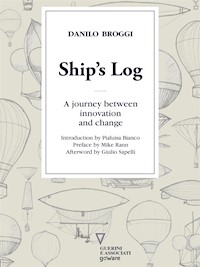
This book is drawn from a collection of articles that first appeared in the «Smart thinking» column of Longitude, the first Italian monthly foreign-language magazine published in English and distributed worldwide.
Longitude, a brainchild of its editor-in-chief, Pialuisa Bianco, head of the Strategic Forum of Foreign Ministry, represents an initiative of «public diplomacy».
The book provides an enquiring perspective at issues concerning international politics and economics, at social, environmental and financial problems, with the aim of raising awareness about the small beating butterfly wings that cause storms. It also represents a culturally introspective analysis of the author’s native country, in which he casts a revealing beam of light, guiding sailors through the tempestuous seas of international affairs, global socio-economic trends and the interconnection of dangers and opportunities.
The author is never assertive and encourages the reader to question and reflect on the great changes that the increasing boost of innovation is bringing about on all levels. The book is an invitation to the reader to get ready through both the calm and the storm, by keeping a clear head and practicing smart thinking.
Das E-Book können Sie in Legimi-Apps oder einer beliebigen App lesen, die das folgende Format unterstützen:
Veröffentlichungsjahr: 2018
Ähnliche




















Cover
Begin reading
About the Author
Introducion by Pialuisa Bianco
Preface by Mike Rann
Afterword by Giulio Sapelli
List of Names and Places
Table of Contents
Thank you for buying this Danilo BroggiShip’s LogA journey between innovation and change
To receive special offer and info on new titlessign up for our newsletter (Italian only)Guerini e Associati
To receive special offer and info on new titlessign up for our newsletter (Italian only)goWare
Or visit us online at
The articles listed in this volume are published courtesy of Longitude
First edition: June 2018
© goWare
Via Reginaldo Giuliani, 88 – 50141 Firenze
www.goware-apps.com
e-mail: [email protected]
© Edizioni Angelo Guerini e Associati Srl
via Comelico, 3 – 20135 Milano
www.guerini.it
e-mail: [email protected]
ISBN 978-88-8195-288-5
Publisher: Alessia Spigariol
Cover design: Chiara Broggi
ePub Development: Elisa Baglioni
goWare is a Florence, Italy startup specialized in digital publishing
Please, send us your comments to: [email protected]
Bloggers and journalists, request your free copy from Maria Ranieri: [email protected]
To communicate any inadvertent omissions or errors in citing sources or extracts reproduced in this book, please contact the publisher.
Table of Contents
Cover
Title Page
Highlights
Colophon
Description
About the Author
Introduction by Pialuisa Bianco
Preface by Mike Rann
Are we ready for change?
Note to reading
01. Building on e-governance (February 2011)
02. Having your cake and eating it too (March 2011)
03. Business betting on risk, again (April 2011)
04. Virtual threats are real dangers (May 2011)
05. Tell us what you need (June 2011)
06. Smoking billions (July 2011)
07. The fine art of Public-Private Partnerships (August 2011)
08. Bringing small businesses to the market (September 2011)
09. A summer of metastasizing finance (October 2011)
10. Still selling abroad (November 2011)
11. Getting government online (December 2011)
12. Integrity and innovation Europe’s new challenge (January 2012)
13. The art of sharing knowledge (February 2012)
14. University gets down to business (March 2012)
15. Turn on, log in, and learn (April 2012)
16. Diplomacy Inc. (May 2012)
17. Research and business (June 2012)
18. Banks, companies and the credit crunch (July 2012)
19. Sticks vs carrots (August 2012)
20. People of Europe, connect! (October 2012)
21. Aggregate of perish (November 2012)
22. Obscured by the cloud (December 2012)
23. Renaissance redux (January 2013)
24. From Bach to bebop (February 2013)
25. Stopping the brain drain (March 2013)
26. Tweeticians (April 2013)
27. Fair play in the corporate world (May 2013)
28. Below the surface (June 2013)
29. Five euros for every student
30. Microcredit 2.0
31. Spanning the digital divide (October 2013)
32. Participatory innovation (November 2013)
33. Innovation and human capital (December 2013)
34. The urban sprawl (January 2014)
35. Video killed the radio star? (February 2014)
36. When average is over (March 2014)
37. Brand strategies (April 2014)
38. Mobility challenge (May 2014)
39. Future shopping with crypto-currency (June 2014)
40. What’s mine is yours (July 2014)
41. Lessons from failure (August 2014)
42. The third industrial revolution (October 2014)
43. Minding the wealth gap (November 2014)
44. Like salmon swimming upstream (December 2014)
45. Who’s afraid of the giants? (January 2015)
46. YouInc: a hired gun for anything (February 2015)
47. Profit is not all it’s cracked up to be (March 2015)
48. The rising shale bubble (April 2015)
49. Vying for (north) pole position (May 2015)
50. Money can’t buy you happiness (June 2015)
51. McDonald’s and (de)globalization (July 2015)
52. Think of me intensely (August 2015)
53. Chinese shadows (October 2015)
54. The (false) Rheingold (November 2015)
55. What a country is worth (December 2015)
56. New threats to business (January 2016)
57. Still far from (fiscal) paradise (February 2016)
58. Small giants in the market turmoil (March 2016)
59. Italiano, music to the world’s ears (April 2016)
60. The one-percent’s offshore blues (May 2016)
61. Crunching the numbers (June 2016)
62. Helicopter money: look out below (July 2016)
63. Pokemon Go: only a game? (August 2016)
64. The best of city living (October 2016)
65. Italy: the urgent need to reverse course (November 2016)
66. 9-9-6, or working to death (December 2016)
67. No work and all play, is it the best way? (January 2017)
68. What makes incompetent people so self-assured (February 2017)
69. Sharing economy or shakedown economy? (March 2017)
70. The hazards of smartphone finance (April 2017)
71. The rise and fall of an electric drill (May 2017)
72. Globalization: good but not good enough (June 2017)
73. How the counter short-termism in business (July 2017)
74. Quantum leaps into the future (August 2017)
75. Regulating cryptocurrencies (October 2017)
76. Nation Brands: China doesn’t just copy (November 2017)
77. Larger than life cities (December 2017)
Reflections on élites in Italian history after reading the writings of Danilo Broggi by Giulio Sapelli
List of names and palces
Description
This book is drawn from a collection of articles that first appeared in the «Smart thinking» column of Longitude, the first Italian monthly foreign-language magazine published in English and distributed worldwide. Longitude, a brainchild of its editor-in-chief, Pialuisa Bianco, head of the Strategic Forum of Foreign Ministry, represents an initiative of «public diplomacy». The book provides an enquiring perspective at issues concerning international politics and economics, at social, environmental and financial problems, with the aim of raising awareness about the small beating butterfly wings that cause storms. It also represents a culturally introspective analysis of the author’s native country, in which he casts a revealing beam of light, guiding sailors through the tempestuous seas of international affairs, global socio-economic trends and the interconnection of dangers and opportunities. The author is never assertive and encourages the reader to question and reflect on the great changes that the increasing boost of innovation is bringing about on all levels. The book is an invitation to the reader to get ready through both the calm and the storm, by keeping a clear head and practicing smart thinking.
About the Author
Danilo Broggi, born in Milan in 1960, is an entrepreneur and start-upper, had managerial positions in both the public and the private sector, has been President of confapi (Italian Confederation of small and medium size enterprises) and Ceo of consip SpA and atac SpA. He was, and still is, member of the board of directors of private companies operating in various sectors (banking, finance, insurance, industry and services), President of the Centro Cultura di Impresa and member of the Advisory Board of the Finance Department of sda Bocconi University.
Introduction by Pialuisa Bianco
Eight years ago I founded Longitude, the Italian monthly on world affairs, the first Italian magazine on international politics published in English and distributed all over the world, with the aim of reaching foreign interlocutors and engaging with them. While programming the content sections, those fixed appointments that qualify a magazine, I came up with a column that I called Smart Thinking. Associating it with Danilo Broggi was automatic. This book springs from that moment, collecting the many varied ideas covered by Smart Thinking tracing them step by step, and creating a logical path throughout these years.
Broggi is a successful and inspired manager. He belongs to a generation that has learned to take action on a whim and turn it into opportunity – a generation that does not contemplate the possibility of surrendering. Perhaps the last generation of a left-brained humanity, trained in analytical exercise, dutifully equipped so as to not to be overwhelmed by naive mythologies or manifest illusions. Understanding innovations, transforming them into a means of creative evolution without losing control of the adventure in which we have been thrown, is precisely this, smart thinking.
The opinions found in this book offer the valuable awareness that innovation, the key word of every futile contemporary conversation, is a fascinating but tricky path in which an ability to get involved and risk assessment are intimately intertwined.
For decades, entrepreneurs and digital gurus of various repute have referred to our era, with a sense of triumph, as the age of innovation. However, innovation is as old as time. And there is nothing novel about the imagination of people who create something new, or about disruptive companies. Not even the pyrotechnic speed of the digital revolution makes a difference. The invention of the steam engine railroaded traditional aspects of society in record time when compared to the time span with which the plow’s invention changed life for the peasants. Globalization is changing society as brutally as industrialization did 150 years ago. How to handle this, is obviously, the heart of the matter.
We live in dynamic times, where change, both in numbers and speed, grows exponentially. What feels different about today, is the range and numbers of individuals or companies that are upending inventions and business models around the world.
What has also changed, is the way the world perceives business – waiting for the next big disrupter, as if a new Steve Jobs could nest in each garage, a digital giant in every algorithm, a new Jeff Bezos in every online sale.
We have become too hopeful and confident about the future of all kinds of startups. We have done so only because we fundamentally misread what this big technological change entails: a pioneering culture, one that actually enjoys and is stimulated by experimentation, even as it includes some necessary failures. And yet, a long-term orientation is a key part of it. Triumphalist analysts argued that the world economy had entered a new era in which every single individual was by definition an innovator, every startup an instant behemoth. They thought tech-disruption was a permanent and effortless new gold rush.
Innovators benefit greatly from being willing to fail, from being willing to experiment. Experimentation naturally involves many procedures that do not work. Dead ends are inevitable. They must never be seen as defeats however, but merely as temporary setbacks. Most of our important advances, take years and involve much work and great patience. A sense of urgency matters, but a long-term perspective is paramount. Inventing is one of the most exciting and risk-filled of human activities. Something akin to sailing across the ocean.
Nevertheless, acceptance of the rough seas, in which both small and great navigate end to end, cannot be taken for granted. We need to understand our strengths and limitations, evaluate opportunities offered by circumstances and make up the rules as we go along, examining and analyzing the various options before they are set in stone.
Innovation is, by definition, a treacherous terrain, a realm of pure, unpredictable subjectivity. How else would you approach a question like this if not by considering every previous example? However, past experience can also teach us by analogy, not only with recipes tried and tested once and for all. It is reassuring to repeat a route you are already familiar with, but it is not always possible. Even projecting data increases, statistics or figures into the future is a dicey proposition. It is always more gripping to read about how we might achieve the improbable than why we can’t. But most of all we have to learn how to gain from failure.
New ideas and models can rarely be found in the mild, self-restrained cultural climate, where we spend 99% of our lives. Innovation that changes how we grasp facts is scary on its own. It forces us to change how we experience the drama of reality.
In short, we have to become more comfortable with uncertainty. In trying to convey any reality, we can never achieve perfect objectivity, rationality, or accuracy of our beliefs. We can instead, strive to be less subjective, less irrational, less ‘wrong’.
The ability to innovate is indeed an instrument that allows us to figure out the inexhaustible complexity of the world. Today it has also become a model. But like any tool it should never be confused with the world it seeks to shape.
If you are ready to embark on a journey, discovering what you don’t know and scrutinizing what you do, measuring yourself against the courage to fail and the anxiety to succeed, then read this book.
* * *
* Pialuisa Bianco, journalist and essayist, strategic adviser to five foreign ministers, founder of Longitude, The Italian Monthly on World Affairs, and of the Strategic Forum of the Ministry of Foreign Affairs.
Prefaceby Mike Rann
Danilo Broggi is a very rare breed. He is a highly successful Italian businessman, based in London and Milan, who is also a public intellectual whose far sighted wisdom can be seen and felt in this extraordinary series of insights recorded over eight years through the international journal «Longitude». His articles cover topics as diverse as cyber security, e-government, crypto currencies, disruptive technologies and artificial intelligence… through to business ethics, corporate social responsibility, the liveability of cities, the importance of failure as a springboard to success, and how freelancers are conquering the world of labour!
In a time when politics is too often reduced to populist, divisive slogans; abusive tweets from at least one world leader or, as we have seen in Italy in recent times, an election carnival of extravagant and un-costed promises, Danilo Broggi stands out as someone who thinks deeply about issues, trends and their underlying causes. He follows their currents but also anticipates their changing patterns and how the global nature of business together with rapidly exploding technological innovation can and will impact on people’s lives and livelihoods in a positive as well as negative way. These changes will also affect the way we are governed and how we will interact with and influence those we elect on issues we care about.
Throughout his writings it is clear that Danilo’s philosophy and analysis is firmly based in prescient common sense, always the best ideology. I am not sure whether he is a pragmatic idealist or idealistic pragmatist!
I met Danilo Broggi through Conversazioni, a new and extraordinary yearly dialogue between leaders in politics, business, public administration, universities and think tanks, the arts and innovation from the UK and Italy. Conversazioni underscores something that I believe Italians understand better than their Anglo-Saxon cousins, that building long term relationships pays much greater dividends in every respect than a transactional approach to every endeavour.
Conversazioni, which Danilo and I helped establish, is very much about the cross fertilisation of ideas. It is convened in a beautiful and historic English stately home that for a few days is transformed into a market place of interests and issues, a departure point to explore the future. In many ways Conversazioni is to dialogue and debate what Danilo’s writings are to the intelligent reader, except that he ranges far beyond the Italy/UK relationship.
After meeting Danilo I soon discovered that not only is he a highly respected entrepreneur and venture capitalist, who has also been a respected senior public servant, but that we shared a passion for action on climate change. I had been one of the world’s first Climate Change Ministers and my State became a national and international leader in embracing renewable energy, going from zero generation to 50% in 16 years. Danilo not only writes about the future but with renewables is actively helping to make it happen in a positive way.
Danilo is an Italian patriot with a world view. Unlike so many these days who hail from the birthplace of Galileo Galilei, Christopher Columbus and Marco Polo, you will never hear the words «Troppo lontana» («too far away») uttered by Danilo. I heard this expression too many times when, as Ambassador to Italy, I was talking with business people about investing in, trading with or winning projects in Australia. The same phrase was used when I mentioned that close to 70% of Australia’s exports went to Asia, with almost 30% going to China. I explained that this was an important reason why Australia is enjoying more than 26 years of continuous economic growth and that our employment growth was at its strongest during the global economic crisis. In response some Italian business people and politicians told me that this was «luck» because Australia had the advantage of adjacency to China and other rapidly transforming markets such as India. Yet Rome and Milan are closer than Sydney or Melbourne to either Beijing or Mumbai! I especially commend to readers of this book Danilo’s analysis of the rise of both China and the implications of the digital and employment revolutions.
Danilo Broggi also writes about the challenges and opportunities facing small and medium sized companies, particularly family firms which dominate in the Italian economy. When I was Ambassador I visited dozens of companies and factories in various parts of Italy, some with established connections to Australia and some where I thought links would be mutually beneficial for both countries. On every visit I witnessed world’s best practice in science, electronics, design, fashion, food, defence and space technologies, automotive excellence, the applied arts, ceramics, medical and scientific instruments and innovations in energy. I was particularly impressed by small family firms whose history, character and identity seemed inextricably part of their products. It explained why Italy is the second biggest manufacturer in Europe, after Germany. Yet so often, I saw how entrepreneurs were let down by Italian politics at its different levels and by the dead hand of bureaucracy which focussed on activity rather than outcomes and compliance rather than impact. In my final speech as Ambassador I reflected that sometimes Italy resembled a beautiful Maserati revving its engine in the garage with the door closed!
During the period that Danilo Broggi wrote these articles Italy had five Prime Ministers: Silvio Berlusconi, Mario Monte, Enrico Letta, Matteo Renzi and Paolo Gentiloni. At the time of writing President Sergio Mattarella has been trying for several months to resolve a parliamentary deadlock that is preventing a government from being formed. At the most recent election in March 2018 populist movements from the extremes of right and left gained the most votes following the collapse in support of more centrist parties. Business and EU leaders are concerned about a potential government comprised of parties whose leaders have attacked the EU and the Euro zone, threatened to defy rulings of the European Central Bank aimed at reining in Italy’s massive public debt, while promising to increase pensions, cut taxes and deport migrants. This is not just an Italian phenomenon. It follows the UK’s referendum vote on Brexit; rising support for extremist leaders and parties around Europe; the election of Donald Trump in the US; and claims of Russian interference and cyber manipulation in a series of democratic elections where facts and fake news seem at war.
Whatever your politics, around the world there is a crying need for better governance, to rebuild trust in public institutions and to build a stronger bridge between electors and the elected. Everywhere I went in Italy people from all walks of life told me that their country needed sustainable major reform. Around Europe there is an urgent need for strong leadership to tackle the debt mountain, provide opportunities for young people and prosecute major reforms of political processes, bureaucracy and economy. The problem is that right now disillusioned people will not vote for real reform while their politicians promise all things to everyone and stick to a formula of «borrow and hope».
Danilo’s writings explore how fast our world is changing. Modern leadership is distributed and citizens expectations of government have changed. People now receive their information differently. They expect two way rather than one way communications with government. The smart leaders of the future must try to foster a culture of governments and citizens jointly owning problems that need to be solved rather than just seeking consensus or consent.
Europe need more business leaders like Danilo Broggi who, in a careful, considered but compelling way point to a different more decent way forward through rough seas. Through his writings in «ßShip’s Log» he celebrates both new ideas and enduring values. This is a rare combination.
I look forward to Danilo Broggi’s next book but in the meantime I commend this one to readers from near and far.
* * *
* Hon Mike Rann, Former Premier of South Australia, Australia’s Ambassador to Italy, UK, Libya and Albania. Visiting Professor, Policy Institute, King’s College London, Ceo Rann Strategy Group.
Are we ready for change?
«May you live in interesting times» is an English translation from a traditional Chinese curse. While on the surface its meaning may sound like a blessing, in reality it is anything but. The Chinese culture interprets this to mean leaving the ordinary quietness of everyday life and to immerse oneself in change (which is directly related to conflict and war). These changes impose disorder to the status quo of immobility and normality. Today we are fully in this era. We are living in very, very interesting times. Is this good or bad? Should we worry or must we simply have total confidence in the future? As a curious observer of things in this world and as one who tries to find the light beam of the lighthouse in the storm, my impression is that we are living in a time of rapid transformation and alongside technological innovations that significantly impact our way of living, acting and being together. What marks this as being special, when compared to the past, is the overwhelming speed of innovation and the growth of technology and its interaction with man. A technological and social revolution of which there is no full awareness. The mass of knowledge available to humanity and the exponential growth in computational capacity are two key drivers of this phenomenon. Social behavior has already been greatly modified: just think of our use of the smartphone or the relationship between adolescents and technology. The dogmas of macroeconomics have been overturned by crypto currencies and the traditional consumer market relationship has been disrupted by advanced technology that allows immediate consumer reach at a very low cost.
The underlying theme remains man and his self-determination to preserve his underlying values. Technologies will continue to transform and change our social system: schools, professions, family, relationships, work, business, politics and public administration and our general citizen-state relationship. These changes are already underway: the Internet of Things, ever-increasing computational capacity, new forms of intermediation among people, robotics, scientific discoveries and related unimaginable industrial applications on the quantum level and within the genome are not the future but the present.
The technology revolution passes us every day and citizens, businesses, institutions and politics (all the more so) must understand its scope and learn how to make good use of it. Here is the problem. I realize more and more that this awareness is a scarcity – that is, the one linked to the power that the network and technology generate – and few realize and understand its enormous scope.
The internet has created illegal markets where anything can circulate. It has brought fake news, bullying to the nth power (out of scale), but also provided knowledge that is much more accessible and to many more people. Enormous computing power and ever smarter and more productive software make Big Data possible: a collection of information available never before seen in history. With what consequences? Social control? Possible threats to democracy? Or the possibility of warding off diseases, preventing crime, saving people from the fury of the elements? Increasingly powerful software makes unimaginable developments in artificial intelligence, robotics and machine learning possible. With what consequences? Threats to employment or a higher quality of life? In one word: dangers? Many, but it equally offers as many great opportunities. But first we must understand and choose what it means to be men. A choice as old as the world itself. To live –for some to survive– we must fight or cooperate? Will they balance the balances based on deterrence? How effective is conviction and to what degree is the threat? We need a vision of the future for communities, of their being together, of their growth and development. The changes taking place and those that will come require a decisive resumption of the fundamentals of being together: respect for others and for human life. One of the gurus of our time, Nicholas Negroponte, the founder of MIT’s Media Lab and host of a recent Milanese conference, shocked those present when speaking about educational systems: «Enough testing and competition,» he said. «Exams kill children, competition is the enemy of education, knowledge is collaboration, and competition between countries on development is a sick concept.» For Negroponte, education is fundamental for building a conscious civil society. A company in which the right to ask is «access, rather than the connection that is a service.» Connectivity is a human right. Access to the network as access to water. «Children,» he says «are our most precious natural resource.»
If you take Negroponte seriously («I am a visionary? I do not make predictions, I only extrapolate from reality what I see and connect it to what I know»), where could it lead us? Negroponte says: «Imagine a world without shops, without offices, without suburbs.» Imagine a world without nations, made up only of cities, with only one language, things that are difficult to imagine happening. «I asked my MIT students who intended to buy a car, nobody raised their hands, and in the sixties everyone wanted the car, it was freedom.» After all, do we really want to go there in the future? Perhaps we prefer to stay warm in our time, safe from the technologies we know how to use and do not scare us. But we know all too well that the future is already here: things happen. To defeat fear and embrace all the adventurous uncertainty of the future we return to where we started: in China (we often talk about it in this book), or rather in China 500 years before Jesus Christ. At the time, Sun Tzu, the General and author of «The Art of War»: «A victorious army first wins, then gives battle, an army destined for defeat first gives battle, then hopes to win.» Not only is the future already here but it is within us. In some ways, just choose it.
Note to reading
The articles collected here, published from 2011 to 2017, are taken from the international magazine Longitude, the first Italian monthly magazine distributed worldwide, covering international politics and economics in English.
Published by Think Tank, Longitude editions, is an independent magazine produced and financed on the market that enjoys a privileged relationship with the Italian Ministry of Foreign Affairs, similar to the relationship between Foreign Affairs magazine and the US State Department.
It was decided to keep the timeline of the articles, considering that most (if not all) refer to facts and/or events that occurred during the period in which I wrote.
I would like to thank for my precious suggestions my brother Mauro, Giuseppe Palombella and Francesco Licci. To my daughter Chiara a special thank for the beautiful cover. For the English version thank to my son Matteo for supporting me in some translations.
01. Building on e-governance (February 2011)
The current macroeconomic situation gives Public Administration a crucially important role in influencing global economic trends, creating an environment that will provide, with the required transparency, an adequate support for investment and mutual exchange policies among all the systems’ main players: citizens, enterprises and public administration itself. The Public Administration’s contribution to this process lies especially in its capacity to produce innovation in the implementation of some of its institutional tasks, among them the delivery of adequate public services and the maintenance of the state machine. In this context, a strategic role is played by e-government, e.g., the use of information and communication technologies to modernize the activities, processes and organization of the administrative machine. This is a process that does not involve only the more developed countries, but also – and especially – the developing economies and those that have been recently become economic powerhouses (i.e., the BRIC group: Brazil, Russia, India and China). In terms of e-government, the Middle East and North Africa (MENA) region – which features a number of shared characteristics as well as many diverse and distinctive elements (organizational, institutional, political, social and economic) – provides an interesting observation point from which to observe and test exchange initiatives, as it contains advanced economies, transition economies and developing economies. The region’s Gross Domestic Product growth rate, according to the CIA World Factbook, highlights the fact that economies of certain developing nations are far more dynamic than more developed economies (for instance that of the E.U., whose 2007-2009 growth has remained fairly stable). Obviously, a macroeconomic context is made up of many elements and a significant GDP growth rate is not necessarily a sign of a good economy. It thus becomes interesting to destructure the individual economies of the aforementioned countries according to a number of variables that define their respective national competitiveness (institutional environment, stability, health and education). In this new context, the position of some countries that are commonly labeled as developing or in transition becomes once again worthy of notice when compared to the E.U. For example, Italy occupies the 48th position out of 139 countries examined, while Qatar is at number 17, Saudi Arabia at 21, Israel 24, the United Arab Emirates 25, Tunisia 32, Oman 34, and Bahrain 37. Clearly these are not isolated cases. Such numbers remind us of the fact that the global economic balance is undergoing a significant change. With the exception of some specific cases (Switzerland, Sweden, Singapore, and the U.S.A.) that are universally recognized as economies where the welfare state, the erosion of the digital divide and the computerization of the economy, society and state machinery are best practices, we are witnessing a new distribution of overall competitiveness and a narrowing of distances between developed economies (e.g., Italy) and economies that are growing, such as Tunisia, (just to remain within the MENA context). What does this brief numeric dissertation tell us? It tells us that the development of the countries that face the Mediterranean must be considered as a development factor for the entire European Union. The countries that lie on the southern shores of the Mediterranean have benefited from a much more sustained economic growth than those that lie to the north. Therefore, the development of the knowhow and the best practices available in those countries could benefit all parties involved. Mutually beneficial cooperation is the key to a long-term strategy that is indispensable to living in a globalized social economic context. It becomes increasingly clear that engaging our best practices to support the development and modernization of Public Administration in those nations acquires a value that is in many ways structural in its potential effects and fall-out. Similarly, exchanging this know-how with others’ best practices would help fill some gaps that undoubtedly still exist. A practical intervention strategy could be based on different levels –on the one hand, in terms of integration and coordination of territorial proximity actions, on the other, in terms of continuity and extension of central reform policies– the whole being coordinated within a wider international network. The first action lever would have to demonstrate the value of local governments’ engagement in international cooperation, based on a bottom up approach that would highlight the characteristics of every single diverse territorial community and thus contribute to maximizing social and territorial cohesion. The second action lever would, on the other hand, highlight how international cooperation is no longer limited to the coordination of monetary, public expenditure control, or infrastructure implementation policies. It would have to also be expanded, through the dissemination of know-how and experience, to the design and implementation of the fundamental components of a nation’s architecture: Public Administration. In addition, it would be necessary to implement a wider-ranging networking system of partnerships with international institutions, know-how dissemination meetings and workshops, as well as knowledge-sharing tools, such as the PEPPOL (Pan-European Public Procurement OnLine) project. This path no doubt requires an effort on the part of everybody involved, but it is especially important that the investment of time and effort is adequate to the task. We need integration among all participants in the exchange and – in light of the strategic role played by e-government – a commitment to provide the best solutions for specific requirements. In this fashion, the administrative apparatus will emerge as the fulcrum of a comprehensive growth strategy for each specific country. Only in this manner will we be able to define a practical long-ranging industrial policy delivering tangible returns to all parties involved.




