


16,99 €
Mehr erfahren.
- Herausgeber: John Wiley & Sons
- Kategorie: Fachliteratur
- Sprache: Englisch
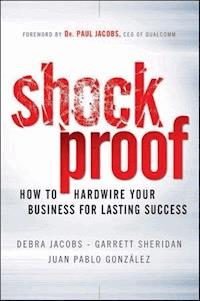
Reinvent your company to deliver sustained profitable growth. As performance lags in the midst of economic cycles, many companies turn to magic bullets such as EVA, Kaizen, or Six Sigma. Unfortunately, these initiatives-along with how they're implemented-often deliver only short-term positive impact or cause more pain than the preexisting condition. Returning to competitive health and profitability in the face of economic downturns requires a dynamic realignment of business strategies, organizational design, and talent management. Based on timely research conducted by Axiom Consulting Partners, Shockproof empowers and enables business leaders, owners and managers to make and maintain the necessary connection between strategies and organization to achieve sustainable performance. * Create an agile business that can rapidly reinvent itself as business conditions change * Foster leadership that knows how to mobilize people to execute and deliver results * Build a workforce that is adaptive, inherently innovative, and energized by the rewards of success As priorities change and challenges arise throughout the ebbs and flows of the economic cycle, let Shockproof guide you to reinvent your company and deliver sustained profitable growth in good times and bad.
Sie lesen das E-Book in den Legimi-Apps auf:
Seitenzahl: 355
Veröffentlichungsjahr: 2010
Ähnliche


















Contents
Foreword
Prologue: A Shockproof Future
Chapter 1: Beware the Big Blue Catfish
Shockproof Elements: Leadership, Strategy, Organization, and Talent
The Shockproof Mind-Set and Capabilities
Connections and Calibrations
The Shockproof Difference in Action
Winning Once versus Being Shockproof
The Journey Begins
Chapter 2: Headlines or Tombstones?
After a While, Crocodile . . .
Is It the Shoes?
Neither Snow nor Rain nor Heat nor Gloom of Night . . .
FedEx Delivers
Consultant, Heal Thyself
Could This Be You?
Glatfelter Goes Beyond Paper
Read Your Next Headline, Using Shockproof Lenses
The Future Is Now: Let’s Get Started
Chapter 3: Make Sure the Strategy Is “Not Wrong”
Economic Downturn Provides Juicy Opportunity
Leaders Who Create the Battle Plan Can Adapt the Battle Plan
Breaking Down versus Breaking Out
Strategy IQ Meets Execution IQ
Make Sure the Strategy Is “Not Wrong,” and Make It Stick
Making Technology More Than an Afterthought
Knowing When to Hit Reboot: Every Strategy Has a Shelf Life
Not Wrong, Not Perfect, but Close Enough
Chapter 4: Beyond Boxes and Lines
Nurse, Scalpel Please
Seeing beyond the Chart
Shockproof Organization Design
An Early Warning Sign Triggers Significant Organizational Change
What’s the Work That Needs to Get Done?
Trading Up
Diagnosing Organization Design Issues the Shockproof Way
Chapter 5: Carbon Paper? Really?!
Talent Acquisition: The People Who Got You Here Won’t Get You There
Talent Deployment: Right People, Right Place, Right Time
Talent Development
Shockproof Rewards Try the Veal—or, How Can the Food Be So Good and the Service So Bad?
How to Think about Rewards
Making the Most of Your Most Valuable Resource
Chapter 6: Connections and Calibrations
Shockproof Companies Maintain the Ready Position
Shock Happens. It’s the Response That Counts.
Dynamic Adjustments Build Muscle Memory
Serving an Ace
You Can’t Lip-Synch Success
The Five Cs of Alignment in Shockproof Companies
Zooming In on the Five Cs of Shockproof Alignment
Chapter 7: Be the Leader You Seek
Only Leaders Can Align
Polish Your Lenses
The Extra Power of Shockproof Lenses
The Systems Lens: Do You See What I See?
The Value Lens: Cutting to the Core
The Change Lens: Nothing Will Bring Back the Hour
The Interpersonal Lens: Advocacy and Inquiry
The Self-Awareness Lens: Mirror, Mirror on the Wall
Are You Beginning to see Things More Clearly?
Sweating the Way Up the Performance Chart
The Shockproof Leader Difference
Chapter 8: Pass the Salt
Notes
Acknowledgments
Index
Shockproof
Copyright © 2011 by Axiom Consulting Partners LLC. All rights reserved.
Published by John Wiley & Sons, Inc., Hoboken, New Jersey.
Published simultaneously in Canada.
No part of this publication may be reproduced, stored in a retrieval system, or transmitted in any form or by any means, electronic, mechanical, photocopying, recording, scanning, or otherwise, except as permitted under Section 107 or 108 of the 1976 United States Copyright Act, without either the prior written permission of the Publisher, or authorization through payment of the appropriate per-copy fee to the Copyright Clearance Center, Inc., 222 Rosewood Drive, Danvers, MA 01923, (978) 750-8400, fax (978) 646-8600, or on the web at www.copyright.com. Requests to the Publisher for permission should be addressed to the Permissions Department, John Wiley & Sons, Inc., 111 River Street, Hoboken, NJ 07030, (201) 748-6011, fax (201) 748-6008, or online at http://www.wiley.com/go/permissions.
Limit of Liability/Disclaimer of Warranty: While the publisher and author have used their best efforts in preparing this book, they make no representations or warranties with respect to the accuracy or completeness of the contents of this book and specifically disclaim any implied warranties of merchantability or fitness for a particular purpose. No warranty may be created or extended by sales representatives or written sales materials. The advice and strategies contained herein may not be suitable for your situation. You should consult with a professional where appropriate. Neither the publisher nor author shall be liable for any loss of profit or any other commercial damages, including but not limited to special, incidental, consequential, or other damages.
For general information on our other products and services or for technical support, please contact our Customer Care Department within the United States at (800) 762-2974, outside the United States at (317) 572-3993 or fax (317) 572-4002.
Wiley also publishes its books in a variety of electronic formats. Some content that appears in print may not be available in electronic books. For more information about Wiley products, visit our web site at www.wiley.com.
ISBN 978-0-470-87254-3 (cloth)
ISBN 978-0-470-93974-1 (ebk)
ISBN 978-0-470-95003-6 (ebk)
ISBN 978-0-470-93975-8 (ebk)
To JT, for bringing forth the lightning, and to Larry, for steadying the lightning rod.—Deb
To my wife Brenna, for her encouragement and support, and our amazing son, Kevin, for his boundless energy.—Garrett
To Alicia and Alejandro, who are teaching me to be Shockproof, and to Kitty, who’s always known how.—Juan
In memory of our friend, colleague, and Axiom founding partner, Peter V. LeBlanc, without whom this book would not have been possible.
Foreword
In today’s business world, shocks are common. Whether the shock is the price of oil spiking to $147 per barrel, a sudden global financial crisis, or a new and disruptive technology, business leaders must prepare for the unexpected or run the risk of becoming obsolete. Of course, it’s difficult to be prepared for the unknown. There are so many future scenarios, it is possible for leaders to get lost in “what if?” and lose sight of where they are headed. At Qualcomm, we have worked hard to create a culture that fosters resilience and adaptability. I believe this culture has been instrumental in helping us innovate, overcome obstacles, and capitalize on world-changing opportunities. These themes are at the core of Shockproof: How to Hardwire Your Business for Lasting Success.
Shockproof tells the story of leaders who align business strategy, organization, and talent to achieve and bolster business results. This alignment does not have to start in the C-suite or be assigned to a project leader. Rather, any leader can use an understanding of Shockproofing to more readily accomplish desired outcomes. This book illustrates that better businesses are more likely to emerge when priorities, work processes, and the critical skills of people are continually recalibrated, as conditions change. It is my belief that leaders in any sized organization and industry can benefit from asking themselves two simple questions. (1) How Shockproof is our business, really? (2) What can we do today to improve the alignment between what needs to be done, how we are organized to do the work, and the way we engage people to get the job done?
—Dr. Paul Jacobs, Chairman and CEO, Qualcomm Incorporated
Prologue
A Shockproof Future
It’s the year 2015. You’re sneaking a quick peek at the cover article in the current Fortune magazine using the latest generation of iPad interactive technology. The article’s headline is simple and compelling:
The Verdict Is In: The Most Successful Global Businesses Are Shockproof
As your eyes scan the iPad screen, the narrative scrolls or stops as you ponder new phrases or skip across familiar terms. The images automatically resize as you need them, the 3-D photos appearing in the tablet’s new holographic display.
The story behind the headline greatly interests you. For months you have been hearing about the remarkable successes of so-called Shockproof companies where leaders dynamically align business strategy, organization design, talent, and management practices to achieve admirable results.
The article showcases dozens of successful businesses that began the quest right around 2010 to develop the habits of a Shockproof enterprise. The results are eye-popping, and the iPad graphics fire your imagination. As you read, you learn that the recession that crippled the global economy beginning in 2008 helped spur numerous leaders to take bold steps to ensure their workplaces would never again be so unprepared to adapt to changing business conditions, whatever the magnitude.
With one move of the eye you extract a chart that summarizes the results achieved by these featured businesses: Some of the names are familiar household names; others are brand new. Almost every industry is represented. You ponder, what made them capable of accomplishing astonishing achievements in the midst of economic, social, and political adversity?
You realize that a number of these businesses have performed so well that many of their competitors are now out of business or facing bankruptcy. You are eager to dive in and find out more about the choices they made that helped them to so nimbly execute their business strategies and adapt and respond to challenges and opportunities.
A few more blinks of the eye and you find within the article another reference to the Shockproof approach and read that these companies shared a common belief that they had the potential to develop “. . . the inherent capability of evolving to overcome challenges and capitalize on emerging opportunities.”
During the last few years, several studies were conducted to determine which factors were most frequently associated with organizational agility and adaptability, and the results became further evidence that a relentless focus on the connections between strategy, organization, and talent provide a clear competitive advantage in unlocking value. You use an app that compares research findings and it spits out four themes common to all the research cited in the Fortune article.
1. Everyone in the business is in sync with and laser-focused on the same high-priority goals that create value for the business.
2. The business is organized to be the right size and shape so that everyone is able to efficiently and effectively achieve shared goals.
3. People have the right skills and necessary attributes to do the work they have been selected to do.
4. Leaders continually adjust how the business is designed and talent is managed so that both align with changes in strategy.
You wonder whether a discipline as straightforward and pragmatic as this Shockproof approach could actually be the key to execution issues associated with your global business.
Farther down you read that, “Business strategists and leadership experts first coined the term Shockproof in 2008 and it inaugurated an earnest dialogue with leaders about how to intentionally develop the capacity to become a Shockproof enterprise.”
Looking up from the tablet you suddenly remember a strategy execution course sponsored by your alma mater; you and your project team did research on emerging thinking in the area of strategy execution. You also recall a group of straight-talking management consultants who were researching and writing about the relationship between strategy alignment and strategy execution. They shared new ideas about the kind of thinking that helps leaders, anywhere in the organization, better connect strategy, organization, and talent to achieve results. You had meant to read their book, Shockproof: How to Hardwire Your Business for Lasting Success, but the day-to-day grind, putting out fires, and hitting quarterly goals took priority, and you never took the time to do so.
You decide now to shut down the Fortune article and move to the Kindle icon on the iPad. It’s time.
You download the latest edition of Shockproof and start reading. . . .
Chapter 1
Beware the Big Blue Catfish
We will now discuss in a little more detail the Struggle for Existence.
—Charles Darwin
As a business leader you enjoy connecting the dots between your own experience and new ideas. That’s how you’ve always learned. Reading about Shockproof businesses and their successes has gotten you fired up. You begin to think about the last time you had a chance to step back from the daily grind and get a fresh perspective. It was at a conference in New York several years ago; where investment bankers and C-suite executives spoke in mostly Darwinian terms about winning and what it takes to compete. You remember an especially entertaining speaker talking about a predatory, big blue catfish that had wiped out several other species of fish with the relentless focus of a trained assassin. The same charismatic speaker referenced celebrity chef Mario Batali, who regularly quips about humans sitting atop the food chain. He’ll put it this way, the speaker quipped, pointing at a PowerPoint picture of a chef inspecting a table of unsuspecting diners: If you’re slower than me, dumber than me, and you taste good . . . pass the salt!1
He also presented a video clip of the African savannah, featuring a kudu running for its life, having been cut out of the herd by a pride of lions. The speaker’s style was polished and his delivery was engaging, but it was the wide array of stories and examples related to his claims about the natural world that most captured your attention. The message and the intended “takeaway” was clear: “It’s good to be the king!”
The next speaker used different analogies, but the message was basically the same: Everybody wants to win and be the top dog, or lead lion, or big blue catfish—pick your species—but the message is the same. It’s even woven into our popular culture. The song “Only the Strong Survive” has been recorded three times since 1969. The songwriter and Darwin seem to agree that certain species have the ability to adapt, survive, and flourish in the face of long odds, whereas others don’t. Size doesn’t always matter. T-rex only comes to life in fantasies like ; but those pesky cockroaches? They’ve been around for quite a while, and it doesn’t look like they’re going away anytime soon.
Lesen Sie weiter in der vollständigen Ausgabe!
Lesen Sie weiter in der vollständigen Ausgabe!
Lesen Sie weiter in der vollständigen Ausgabe!
Lesen Sie weiter in der vollständigen Ausgabe!
Lesen Sie weiter in der vollständigen Ausgabe!
Lesen Sie weiter in der vollständigen Ausgabe!
Lesen Sie weiter in der vollständigen Ausgabe!
Lesen Sie weiter in der vollständigen Ausgabe!
Lesen Sie weiter in der vollständigen Ausgabe!
Lesen Sie weiter in der vollständigen Ausgabe!




