


102,99 €
Mehr erfahren.
- Herausgeber: John Wiley & Sons
- Kategorie: Geisteswissenschaft
- Serie: Parker/Ambrose Series of Simplified Design Guides
- Sprache: Englisch
The gold-standard structural design reference, completely revised and updated with an all-new look
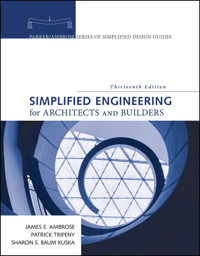
Completely revised to reflect the latest standards and practices, Simplified Engineering for Architects and Builders, 13th Edition, is the go-to reference on structural design, giving architects and contractors a concise introduction to the structures commonly used for typical buildings. It presents primary concepts and calculations for the preliminary dimensioning of principal elements within a building design, focused on key principles of quantitative analysis and design of structural members.
Structural design is an essential component of the architect’s repertoire, and engineering principles are at the foundation of every sound structure. Architects need to understand the physics without excess math. This book covers fundamental concepts like forces, loading, and reactions, to teach how to estimate critical design loads and analyze for final proportions. It provides exactly what you need to quickly grasp the concepts and determine the best solutions to difficult design challenges.
The thirteenth edition of Simplified Engineering for Architects and Builders includes:
- Increased page size for improved visibility and usability
- Newly revised wood, steel, and concrete construction sections allow easy comparison of the latest techniques and materials
- Accompanying instructor manual available online with background discussion, solutions to exercises, additional study materials, and self-tests
A leading reference for over 80 years, Simplified Engineering for Architects and Builders is the definitive guide to practical structural design, ideal for students in architecture, construction, building technology, and architectural engineering.
Sie lesen das E-Book in den Legimi-Apps auf:
Seitenzahl: 917
Veröffentlichungsjahr: 2024
Ähnliche



















SIMPLIFIED ENGINEERING FOR ARCHITECTS AND BUILDERS
Thirteenth Edition
JAMES E. AMBROSE (DECEASED)
PATRICK TRIPENY
SHARON S. BAUM KUSKA
Copyright © 2025 by John Wiley & Sons, Inc. All rights reserved, including rights for text and data mining and training of artificial technologies or similar technologies.
Published by John Wiley & Sons, Inc., Hoboken, New Jersey.Published simultaneously in Canada.
No part of this publication may be reproduced, stored in a retrieval system, or transmitted in any form or by any means, electronic, mechanical, photocopying, recording, scanning, or otherwise, except as permitted under Section 107 or 108 of the 1976 United States Copyright Act, without either the prior written permission of the Publisher, or authorization through payment of the appropriate per-copy fee to the Copyright Clearance Center, Inc., 222 Rosewood Drive, Danvers, MA 01923, (978) 750-8400, fax (978) 750-4470, or on the web at www.copyright.com. Requests to the Publisher for permission should be addressed to the Permissions Department, John Wiley & Sons, Inc., 111 River Street, Hoboken, NJ 07030, (201) 748-6011, fax (201) 748-6008, or online at http://www.wiley.com/go/permission.
Trademarks: Wiley and the Wiley logo are trademarks or registered trademarks of John Wiley & Sons, Inc. and/or its affiliates in the United States and other countries and may not be used without written permission. All other trademarks are the property of their respective owners. John Wiley & Sons, Inc. is not associated with any product or vendor mentioned in this book.
Limit of Liability/Disclaimer of Warranty: While the publisher and author have used their best efforts in preparing this book, they make no representations or warranties with respect to the accuracy or completeness of the contents of this book and specifically disclaim any implied warranties of merchantability or fitness for a particular purpose. No warranty may be created or extended by sales representatives or written sales materials. The advice and strategies contained herein may not be suitable for your situation. You should consult with a professional where appropriate. Further, readers should be aware that websites listed in this work may have changed or disappeared between when this work was written and when it is read. Neither the publisher nor authors shall be liable for any loss of profit or any other commercial damages, including but not limited to special, incidental, consequential, or other damages.
For general information on our other products and services or for technical support, please contact our Customer Care Department within the United States at (800) 762-2974, outside the United States at (317) 572-3993 or fax (317) 572-4002.
Wiley also publishes its books in a variety of electronic formats. Some content that appears in print may not be available in electronic formats. For more information about Wiley products, visit our web site at www.wiley.com.
Library of Congress Cataloging-in-Publication Data Applied for:
Paperback ISBN: 9781119523055
Cover Design: WileyCover Image: Courtesy of Sharon Kuska
PREFACE TO THE THIRTEENTH EDITION
This book focuses on the design of structures for buildings. As with previous editions, the material in this book has been prepared for those without formal training in engineering. Mathematical work is limited mostly to simple algebra. It is particularly well suited for programs in architecture and building construction.
However, as most programs in engineering offer limited opportunity for study of the general fields of building planning and construction, this book can serve as a valuable supplement to engineering texts. It emphasizes the development of practical design, which typically involves minimal effort in structural investigation and significant consideration for circumstantial situations relating to the existence of the building structure. Readers should be better able to converse intelligently with the engineering professional and understand the reasoning behind suggestions being offered.
Changes that occur in reference sources and in design and construction practices make it necessary for periodic updates of the material in this book. This edition has been revised accordingly, although the reader should note that these changes are ongoing, so it is inevitable that some of the material presented here will be outdated within a short time. However, this work concentrates on fundamental concepts and processes of investigation and design; thus, the use of specific data is less critical to the learning of the fundamental material. For actual design work, current references, listed in the reference section of this book, should be consulted.
In addition to updating, each new edition affords an opportunity to reconsider the organization, presentation, and scope of the material contained in the book. This new edition features minor alterations to the basic content of previous editions, although just about everything contained in the previous edition has been retained. Some trimming has occurred, largely to add new material without significantly increasing the size of the book.
One notable change in this edition is a decrease in the amount of information provided for the load and resistance factor design (LRFD) method for wood structures to lower the confusion level of the reader. Because the allowable stress design (ASD) method is still the preferred method used by designers, it remains standard in this edition. Also, this edition provides information on topics such as the thermal effects in axially loaded members, wood decking and wood columns, nailed connections, and steel column base plates. Mass timber is introduced but is still regionally and manufacturer dependent.
To support instructors using this book as a course text, an accompanying website contains complete answers to all the additional problems presented in the text. This website also includes suggestions on teaching and learning strategies, along with potential course curriculum models.
There is also a student website that provides study material to assist in learning this complex material. It is available to anyone using this text, and we encourage all students to take advantage of this resource. Solutions to alternate problems are available for student usage.
For text demonstrations, as well as for the exercise problems, we include some data sources; I extend my gratitude to various industry organizations for their permission to use excerpts from these data sources, with proper acknowledgment provided.
As the author of this edition and as a representative of the academic and professional communities, I want to thank John Wiley & Sons for their continued publication of this widely utilized reference source. I am truly thankful for the support provided by the Wiley editors and production staff.
Finally, I would like to express my appreciation to my family. Writing, especially when added to an already full-time occupation, is very time-consuming. I am grateful for the patience, support, and encouragement of my spouse, children and grandchildren which has made this work possible.
SHARON S. BAUMKUSKA
PREFACE TO THE FIRST EDITION
(The following is an excerpt from Professor Parker’s preface to the first edition.)
To the average young architectural draftsman or builder, the problem of selecting the proper structural member for given conditions appears to be a difficult task. Most of the numerous books on engineering which are available assume that the reader has previously acquired a knowledge of fundamental principles and, thus, are almost useless to the beginner. It is true that some engineering problems are exceedingly difficult, but it is also true that many of the problems that occur so frequently are surprisingly simple in their solution. With this in mind, and with a consciousness of the seeming difficulties in solving structural problems, this book has been written.
To understand the discussions of engineering problems, it is essential that the student have a thorough knowledge of the various terms which are employed. In addition, basic principles of forces in equilibrium must be understood. The first section of this book, “Principles of Mechanics,” is presented for those who wish a brief review of the subject. Following this section are structural problems involving the most commonly used building materials, wood, steel, reinforced concrete, and roof trusses. A major portion of the book is devoted to numerous problems and their solution, the purpose of which is to explain practical procedure in the design of structural members. Similar examples are given to be solved by the student. Although handbooks published by the manufacturers are necessities to the more advanced student, a great number of appropriate tables are presented herewith so that sufficient data are directly at hand to those using this book.
Care has been taken to avoid the use of advanced mathematics, a knowledge of arithmetic and high school algebra being all that is required to follow the discussions presented. The usual formulas employed in the solution of structural problems are given with explanations of the terms involved and their application, but only the most elementary of these formulas are derived. These derivations are given to show how simple they are and how the underlying principle involved is used in building up a formula that has practical application.
No attempt has been made to introduce new methods of calculation, nor have all the various methods been included. It has been the desire of the author to present to those having little or no knowledge of the subject simple solutions of everyday problems. Whereas thorough technical training is to be desired, it is hoped that this presentation of fundamentals will provide valuable working knowledge and, perhaps, open the doors to more advanced study.
HARRYPARKERPhiladelphia, PennsylvaniaMarch, 1938
ABOUT THE COMPANION WEBSITE
This book is accompanied by a companion website:
www.wiley.com/go/SimplifiedEngineering13e
The website features an instructor’s manual and a student study guide.
The instructor’s manual contains examples of teaching materials relevant to the textbook content. Course models and scenarios of required technology courses on structures within a non-engineering curriculum are presented, highlighting teaching challenges and opportunities drawn from experiences.
Additionally, a companion study guide for students serves as a resource for the topic of building structures, offering illustrated solutions to exercise problems to enhance their general understanding of the subject matter.
INTRODUCTION
The principal purpose of this book is to develop the topic of structural design. However, to do the necessary work for design, use must be made of various methods of structural investigation. The work of investigation consists of the consideration of the tasks required of a structure and the evaluation of the responses of the structure in performing these tasks. Investigation may be performed in various ways, the principal ones being the use of modeling by either mathematics or the construction of physical models. For the designer, a major first step in any investigation is the visualization of the structure and the force actions to which it must respond. In this book, extensive use is made of graphic illustrations in order to encourage the reader in the development of the habit of first clearly seeing what is happening, before proceeding with the essentially abstract procedures of mathematical investigation. When working a problem within the book or in practice, the reader is encouraged to begin by drawing an illustration of the problem while identifying the key information that has been provided.
Structural Mechanics
The branch of physics called mechanics concerns the actions of forces on physical bodies. Most of engineering design and investigation is based on applications of the science of mechanics. Statics is the branch of mechanics that deals with bodies held in a state of unchanging motion by the balanced nature (called static equilibrium) of the forces acting on them. Dynamics is the branch of mechanics that concerns bodies in motion or in a process of change of shape due to actions of forces. A static condition is essentially unchanging with regard to time; a dynamic condition implies a time-dependent action and response.
When external forces act on a body, two things happen. First, internal forces that resist the actions of the external forces are set up in the body. These internal forces produce stresses in the material of the body. Second, the external forces produce deformations, or changes in shape, of the body. Strength of materials, or mechanics of materials, is the study of the properties of material bodies that enable them to resist the actions of external forces, of the stresses within the bodies, and of the deformations of bodies that result from external forces.
Taken together, the topics of applied mechanics and strength of materials are often given the overall designation of structural mechanics or structural analysis. This is the fundamental basis for structural investigation, which is essentially an analytical process. On the other hand, design is a progressive refining process in which a structure is first visualized; then it is investigated for required force responses and its performance is evaluated. Finally—possibly after several cycles of investigation and modification—an acceptable form is derived for the structure.
Units of Measurement
Early editions of this book used U.S. units (feet, inches, pounds, etc.) with equivalent SI (Standard International—aka metric) units in brackets for the basic presentation. In this edition, the basic work is developed with U.S. units only. While the building industry in the United States is now in the slow process of changing to SI units, our decision for the presentation here is a pragmatic one. Most of the references used for this book are still developed primarily in U.S. units and most readers educated in the United States use U.S. units as their first language, even if they now also use SI units.
Table I.1 lists the standard units of measurement in the U.S. system with the abbreviations used in this work and a description of common usage in structural design work. In similar form, Table I.2 gives the corresponding units in the SI system. Conversion factors to be used for shifting from one unit system to the other are given in Table I.3.
TABLE I.1 Units of Measurement: U.S. System
Name of Unit
Abbreviation
Use in Building Design
Length
Foot
ft
Large dimensions, building plans, beam spans
Inch
in.
Small dimensions, size of member cross sections
Area
Square feet
ft
2
Large areas
Square inches
in.
2
Small areas, properties of cross sections
Volume
Cubic yards
yd
3
Large volumes, of soil or concrete (commonly called simply “yards”)
Cubic feet
ft
3
Quantities of materials
Cubic inches
in.
3
Small volumes
Force, Mass
Pound
lb
Specific weight, force, load
Kip
kip, k
1000 pounds
Ton
ton
2000 pounds
Pounds per foot
lb/ft, plf
Linear load (as on a beam)
Kips per foot
kips/ft, klf
Linear load (as on a beam)
Pounds per square foot
lb/ft
2
, psf
Distributed load on a surface, pressure
Kips per square foot
k/ft
2
, ksf
Distributed load on a surface, pressure
Pounds per cubic foot
lb/ft
3
Relative density, unit weight
Moment
Foot-pounds
ft-lb
Rotational or bending moment
Inch-pounds
in.-lb
Rotational or bending moment
Kip-feet
kip-ft
Rotational or bending moment
Kip-inches
kip-in.
Rotational or bending moment
Stress
Pounds per square foot
lb/ft
2
, psf
Soil pressure
Pounds per square inch
lb/in.
2
, psi
Stresses in structures
Kips per square foot
kips/ft
2
, ksf
Soil pressure
Kips per square inch
kips/in.
2
, ksi
Stresses in structures
Temperature
Degree Fahrenheit
°F
Temperature
TABLE I.2 Units of Measurement: SI System
Name of Unit
Abbreviation
Use in Building Design
Length
Meter
m
Large dimensions, building plans, beam spans
Millimeter
mm
Small dimensions, size of member cross sections
Area
Square meters
m
2
Large areas
Square millimeters
mm
2
Small areas, properties of member cross sections
Volume
Cubic meters
m
3
Large volumes
Cubic millimeters
mm
3
Small volumes
Mass
Kilogram
kg
Mass of material (equivalent to weight in U.S. units)
Kilograms per cubic meter
kg/m
3
Density (unit weight)
Force, Load
Newton
N
Force or load on structure
Kilonewton
kN
1000 newtons
Stress
Pascal
Pa
Stress or pressure (1 pascal = 1 N/m
2
)
Kilopascal
kPa
1000 pascals
Megapascal
MPa
1,000,000 pascals
Gigapascal
GPa
1,000,000,000 pascals
Temperature
Degree Celsius
°C
Temperature
TABLE I.3 Factors for Conversion of Units
To Convert from U.S. Units to SI Units, Multiply by:
U.S. Unit
SI Unit
To Convert from SI Units to U.S. Units, Multiply by:
25.4
in.
mm
0.03937
0.3048
ft
m
3.281
645.2
in.
2
mm
2
1.550 × 10
−3
16.39 × 10
3
in.
3
mm
3
61.02 × 10
−6
416.2 × 10
3
in.
4
mm
4
2.403 × 10
−6
0.09290
ft
2
m
2
10.76
0.02832
ft
3
m
3
35.31
0.4536
lb (mass)
kg
2.205
4.448
lb (force)
N
0.2248
4.448
kip (force)
kN
0.2248
1.356
ft-lb (moment)
N-m
0.7376
1.356
kip-ft (moment)
kN-m
0.7376
16.0185
lb/ft
3
(density)
kg/m
3
0.06243
14.59
lb/ft (load)
N/m
0.06853
14.59
kips/ft (load)
kN/m
0.06853
6.895
psi (stress)
kPa
0.1450
6.895
ksi (stress)
MPa
0.1450
0.04788
psf (load or pressure)
kPa
20.93
47.88
ksf (load or pressure)
kPa
0.02093
0.566 × (°F − 32)
°F
°C
(1.8 × °C) + 32
Direct use of the conversion factors will produce what is called a hard conversion of a reasonably precise form. Even though all of the work done in this book with be in U.S. units, the tables with SI units are given as a handy reference to readers who may be using reference books in SI units or using both systems.
Accuracy of Computations
Structures for buildings are seldom produced with a high degree of dimensional precision. Exact dimensions are difficult to achieve, even for the most diligent of workers and builders. Add this to considerations for the lack of precision in predicting loads for any structure, and the significance of highly precise structural computations becomes moot. This is not to be used for an argument to justify sloppy mathematical work, overly sloppy construction, or use of vague theories of investigation of behaviors. Nevertheless, it makes a case for not being highly concerned with any numbers beyond three significant digits.
While most professional design work these days is likely to be done with computer support, most of the work illustrated here is quite simple and was actually performed with a hand calculator (the 8-digit, scientific type is adequate). Rounding off of these computations is done with no apologies. However, sometimes the “three significant digit” practice appears inadequate and more accuracy is justified—its all dependent on the situation.
With the use of the computer, accuracy of computational work is a somewhat different matter. Still, it is the designer (a person) who makes judgments based on the computations and who knows how good the input to the computer was and what the real significance of the degree of accuracy of an answer is.
Symbols
The following shorthand symbols are frequently used.
Symbol
Reading
>
Is greater than
<
Is less than
≥
Equal to or greater than
≤
Equal to or less than
∑
The sum of
Δ
L
Change in
L
Standard Notation
Notation used in this book complies generally with that used in the building design field. A general attempt has been made to conform to usage in the reference standards commonly used by structural designers. The following list includes all of the notation used in this book that is general and is related to the topic of the book. Specialized notation is used by various groups, especially as related to individual materials: wood, steel, masonry, concrete, and so on. The reader is referred to basic references for notation in special fields. Some of this notation is explained in later parts of this book.
Building codes use special notation that is usually carefully defined by the code, and the reader is referred to the source for interpretation of these definitions. When used in demonstrations of computations, such notation is explained in the text of this book.
A = unit area
Ag = gross area of a section, defined by the outer dimensions
An = net area
C = compressive force
e = eccentricity of a nonaxial load, from point of application of the load to the centroid of the section
E = modulus of elasticity
f = actual computed stress
F = allowable stress
h = effective height (usually meaning unbraced height) of a wall or column
I = moment of inertia
L = length (usually of a span); uppercase L indicates units of ft, lowercase l is units of in.
M = bending moment
P = concentrated load
s = spacing, center to center
S = elastic section modulus
T = tension force
W = (1) total gravity load; (2) weight, or dead load of an object; (3) total wind load force; (4) total of a uniformly distributed load or pressure due to gravity
w = unit of weight or other uniformly distributed load per unit length of member
W = unit of weight or other total uniformly distributed load (note: usually W = wL or wl)
Z = plastic section modulus
IFUNDAMENTAL FUNCTIONS OF STRUCTURES
This Part I presents various considerations regarding the general nature and performance of structures for buildings. A major part of this material consists of basic concepts and applications from the field of applied mechanics as they have evolved in the process of investigation of the behavior of structures. The purpose of studying this material is twofold: first, the general need for a comprehensive understanding of what structures do and how they do it; second, the need for some factual, quantified basis for the exercise of judgment in the process of structural design. If it is accepted that the understanding of a problem is the necessary first step in its solution, this analytical study should be seen as the cornerstone of any successful, informed design process.
A second major concern is for the sources of the tasks that structures must undertake, that is, for what structures are basically needed. These tasks are defined in terms of the loads that are applied to structures. Considerations in this regard include the load sources, the manner of their application, the combinations in which they occur, and the quantification of their specific values.
Finally, consideration must be given to the possible forms and materials of structures. These concerns affect the determination of the construction of the structures, but they also relate to the general design development of the buildings.
This part provides an introduction to the basic components of structural analysis and design; the remaining parts of the book present amplifications of the issues raised in this part.
1INVESTIGATION OF FORCES, FORCE SYSTEMS, LOADING, AND REACTIONS
Structural systems are designed to safely respond to the forces to which they are subjected. The forces are determined by the magnitude of the loads and the way they are applied to the structure. These loads include gravity loads based on the weight of building materials, the use or occupancy of the structure, and environmental loads. The purpose of the structure involves the transmission of the load forces to the supports for the structure. The external loads and support forces produce resistance from the structure in terms of internal forces that resist changes in the shape of the structure. This chapter treats the basic properties and actions of forces.
1.1 PROPERTIES OF FORCES
Force is a fundamental concept of mechanics but does not yield to simple definition. An accepted concept is that a force is an effort that tends to change the form or the state of motion of a physical object. Mechanical force was defined by Isaac Newton as being a product of mass and acceleration; that is, F = ma. Gravitational attraction is a form of acceleration, and thus weight—a force we experience—is defined as W = mg with g being the acceleration of gravity. Physical objects have weight, but more precisely, they have mass and will thus have different weights when they experience different gravitational effects, for example, on the surface of Earth or on the surface of the moon.
In the United States, aka imperial, unit of gravity force is quantified as the weight of the body. Gravity forces are thus measured in pounds (lb) or in some other unit such as tons (T) or kips (1 kilopound, or 1000 pounds). In the SI (International System, aka metric) system, force is measured in a more scientific manner related to the mass of objects, the mass of an object being a constant, whereas weight is proportional to the precise value of the acceleration of gravity, which varies from place to place. Force in metric units is measured in newtons (N), kilonewtons (kN), or meganewtons (mN), whereas weight is measured in grams (g) or kilograms (kg).
In structural engineering work, forces are described as loads




