


7,60 €
Mehr erfahren.
- Herausgeber: Simply Charly
- Kategorie: Lebensstil
- Serie: Great Lives
- Sprache: Englisch
“This is an elegant, delightful, concise and richly informative introduction to Beethoven, the man and his music, written by a distinguished scholar whose breadth of learning and measured judgment are present on every page.”
—Leon Botstein, music director and principal conductor of the American Symphony Orchestra and president of Bard College
Born in Bonn, Germany, Ludwig van Beethoven (1770-1827) showed musical talent from an early age and was first taught by his musician father, Johann, an alcoholic who often beat his son. At the age of 21, Beethoven moved to Vienna, where he studied with composer Joseph Haydn, and quickly became renowned as a pianist and conductor, as well as a composer. He continued to perform until 1811 when increasing deafness made it impossible, but until his death in 1827, he continued to create timeless works, including such masterpieces as the Ninth Symphony and the late string quartets. Plagued by illness and repeatedly thwarted in love, Beethoven rarely achieved personal happiness; yet he transcended the many setbacks and disappointments in his life to produce some of the greatest music ever written, which has come to be identified with the indomitableness of the human spirit.
In Simply Beethoven, Professor Leon Plantinga offers the lay reader a fascinating account of Beethoven’s life and music in its singular historical context, a time that saw the upheaval of the French Revolution and the Napoleonic conquests, as well as the rise of the European middle class. It was in this milieu that Beethoven composed the groundbreaking, highly individual works that changed the course of music and have continued to inspire and delight listeners for more than two centuries.
For anyone who is interested in knowing more about the extraordinary music that has become an integral part of Western culture, as well as the troubled genius who created it, Simply Beethoven is a perfect introduction to the man and his work.
Das E-Book können Sie in Legimi-Apps oder einer beliebigen App lesen, die das folgende Format unterstützen:
Seitenzahl: 295
Veröffentlichungsjahr: 2020
Ähnliche



















Simply Beethoven
Leon Plantinga
Simply Charly
New York
Copyright © 2020 by Leon Plantinga
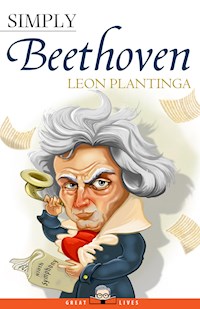
Cover Illustration by José RamosCover Design by Scarlett Rugers
All rights reserved. No part of this publication may be reproduced, distributed, or transmitted in any form or by any means, including photocopying, recording, or other electronic or mechanical methods, without the prior written permission of the publisher, except in the case of brief quotations embodied in critical reviews and certain other noncommercial uses permitted by copyright law. For permission requests, write to the publisher at the address below.
ISBN: 978-1-943657-65-0
Brought to you by http://simplycharly.com
Contents
Praise for Simply BeethovenOther Great LivesSeries Editor's ForewordPrefaceIntroduction 1. The Beginning 2. Beethoven in Vienna: The First Years, 1792-1800 3. Into the New Century, 1800-05 4. Scaling the Heights, 1806-1809 5. Difficult Times, 1809-11 6. Distraction and Coping: 1812-15 7. 1816–1820: More Difficulties 8. Adversity and Triumph, 1821-24 9. Struggle and Culmination, 1825-1827 10. Beethoven’s LegacySourcesSuggested ReadingAbout the AuthorA Word from the Publisher1
Praise for Simply Beethoven
“Simply Beethoven is a brief and eminently readable introduction to the life and works of the revered composer. Plantinga offers the layman reliable information based on his many years as a renowned scholar of the musical world of late-eighteenth and nineteenth-century Europe. This book taps into his long and vast experience as a musicologist and educator, bringing to life the spirit of Beethoven and the turbulent times that stood as the backdrop of his extraordinary creative life. A must-read for lovers of Beethoven seeking a short and reliable introduction to history’s most powerfully influential composer.”
—David Benjamin Levy, author of Beethoven: The Ninth Symphony and Professor of Music, Wake Forest University
“A succinct, insightful synthesis, presented in colorful but precise prose, by the dean of Beethoven studies. The many little-known primary source descriptions of Beethoven are themselves worth the price of this book. If you want to learn about the life and art of Beethoven, Plantinga’s offering is by far the most efficient and pleasurable book available.”
—Craig Wright, author of The Hidden Habits of Genius and Professor of Music, Yale University
“Leon Plantinga presents the ever-inspiring story of Beethoven’s life, music, and legacy with imagination and verve, including a wealth of colorfully telling details that keep the pages turning.”
—Scott Burnham, Graduate Center, City University of New York
“An eminently accessible traversal of Beethoven’s life and principal works, enlightening and consistently entertaining. It affords the layperson a perspective laced with erudition but free of jargon. Highly recommended.”
—Robert Levin, pianist and Emeritus Professor of Music, Harvard University
“This is an elegant, delightful, concise, and richly informative introduction to Beethoven, the man and his music, written by a distinguished scholar whose breadth of learning and measured judgment are present on every page.”
—Leon Botstein, music director and principal conductor of the American Symphony Orchestra and president of Bard College
“This is a fine introduction for the non-specialist by an eminent specialist. Professor Plantinga, author of the definitive study of Beethoven’s piano concertos, has done a masterful job synthesizing the vast scholarship on Beethoven and making it accessible to the general reader.”
—Stephen Hinton, Avalon Foundation Professor in the Humanities, Stanford University
2
Other Great Lives
Simply Austenby Joan Klingel RaySimply Beckettby Katherine WeissSimply Chekhov by Carol ApollonioSimply Chomskyby Raphael SalkieSimply Chopinby William SmialekSimply Darwinby Michael RuseSimply Descartesby Kurt SmithSimply Dickensby Paul SchlickeSimply Diracby Helge KraghSimply Einsteinby Jimena CanalesSimply Eliot by Joseph MaddreySimply Euler by Robert E. BradleySimply Faulkner by Philip WeinsteinSimply Fitzgerald by Kim MorelandSimply Freud by Stephen FroshSimply Gödel by Richard TieszenSimply Hegel by Robert L. WicksSimply Hitchcock by David SterrittSimply Joyce by Margot NorrisSimply Machiavelli by Robert FredonaSimply Napoleonby J. David Markham & Matthew ZarzecznySimply Nietzsche by Peter KailSimply Proust by Jack JordanSimply Riemann by Jeremy GraySimply Sartre by David DetmerSimply Tolstoy by Donna Tussing OrwinSimply Stravinsky by Pieter van den ToornSimply Turing by Michael OlinickSimply Wagner by Thomas S. GreySimply Wittgenstein by James C. Klagge
3
Series Editor's Foreword
Simply Charly’s “Great Lives” series offers brief but authoritative introductions to the world’s most influential people—scientists, artists, writers, economists, and other historical figures whose contributions have had a meaningful and enduring impact on our society.
Each book provides an illuminating look at the works, ideas, personal lives, and the legacies these individuals left behind, also shedding light on the thought processes, specific events, and experiences that led these remarkable people to their groundbreaking discoveries or other achievements. Additionally, every volume explores various challenges they had to face and overcome to make history in their respective fields, as well as the little-known character traits, quirks, strengths, and frailties, myths, and controversies that sometimes surrounded these personalities.
Our authors are prominent scholars and other top experts who have dedicated their careers to exploring each facet of their subjects’ work and personal lives.
Unlike many other works that are merely descriptions of the major milestones in a person’s life, the “Great Lives” series goes above and beyond the standard format and content. It brings substance, depth, and clarity to the sometimes-complex lives and works of history’s most powerful and influential people.
We hope that by exploring this series, readers will not only gain new knowledge and understanding of what drove these geniuses, but also find inspiration for their own lives. Isn’t this what a great book is supposed to do?
Charles Carlini, Simply Charly New York City
4
Preface
In this book, I aim to present the famed German composer Ludwig van Beethoven (1770-1827) in the context of his own time and place. Beethoven’s Europe was in perpetual tumult; as a young man, he witnessed the French Revolution and the Napoleonic conquests that followed. In fact, Napoleon twice invaded and occupied Vienna, where Beethoven lived at the time, with distinct consequences for the composer’s career. Then came the effort to restore order after Napoleon’s defeat at Waterloo in 1815, with the resultant stifling regime under the Austrian Chancellor Klemens von Metternich. Despite all such turmoil, Beethoven pursued his career in Vienna to the end.
He also struggled with personal demons: progressive hearing loss, perpetual illness, repeated disappointment in love. But in the face of all these impediments, he produced a body of music that brought him unprecedented fame in his own time and a central place in all succeeding repertories of classical music.
I hope to give a straightforward account of this composer’s colorful life, and to show something of the nature of his achievement by discussing some of his major compositions, their construction and effect, without resorting to technical language. I have listed at the head of each chapter the compositions that I describe in some detail.[1]
Various friends have contributed to this endeavor; it is a pleasure to acknowledge their help. Prominent among them are people working in the Yale Music Library who have indulged me well beyond the line of duty; they include Karl Schrom, Kathy Mansi, Richard Boursy, Suzanne Eggleston Lovejoy, and the library’s director, Ruthann McTyre. Other colleagues who have lent me an ear and offered advice are Craig Wright and Hannah Lash. I thank my editor in this project, Helena Bachmann, for her careful attention to the text. But I owe the greatest debt to my wife, Ellen Ryerson, for whose constant support (and red pencil) I will always be grateful.
Leon Plantinga New Haven, CT
5
Introduction
Although Beethoven died in 1827, his music continues to absorb and move us. His symphonies, concertos, sonatas, and string quartets stand solidly at the center of the classical instrumental repertory. And this music, though without words, speaks to us eloquently of ideas, aspirations, and notions such as heroism, triumph, death and lament, freedom, and joy. The man himself remains a captivating figure: fiery-tempered, suspicious but given to generous impulses, eccentric in the extreme, unkempt, alternating between despair over his mounting deafness and resolve to overcome its effects; for most of his adult life he was perpetually in love but unlucky in its realization.
This vivid life unfolded amid the social and intellectual tumult surrounding the French Revolution and the Europe-wide disruption of the ensuing Napoleonic saga. Beethoven’s and Napoleon’s careers intersected directly in Vienna during two periods, both times to the composer’s detriment. The first time, the Napoleonic invasion of Vienna in 1805 disrupted the premiere of Beethoven’s only opera, “Fidelio.” The second French occupation of the city, in 1809, ended a satisfying financial arrangement Beethoven had made with his aristocratic supporters, and it marked the beginning of a months-long period when the composer, in his own words, “produced very little coherent work, at most a fragment here and there.” When Napoleon finally disappeared from the scene in 1815, Beethoven had to come to terms with the suffocating Restoration that followed—the “Metternich regime,” essentially a police state centered in the city where he lived.
Bad health plagued Beethoven throughout his adult life: he suffered constantly from colitis, recurrent bouts with bronchitis, and innumerable local infections. But the central burden of his life, seemingly a prohibitive condition for a musician, was deafness. First evident around 1797 when he was 26, this affliction continued to worsen until about 1814, when Beethoven was, for all practical purposes, totally deaf. Added to this in his later years was the drama surrounding Beethoven’s ill-conceived and plainly disastrous guardianship of his nephew Karl: a poignant late-life tale played out just as he marshaled his artistic energy for that final astonishing creative surge that produced the Ninth Symphony, the Missa solemnis, and the late string quartets.
Whatever obstacles he faced, Beethoven became the first composer to achieve great international celebrity during his own lifetime. He managed this just at the beginning of a profound shift in how music functioned in European society. By degrees, Beethoven and his followers pivoted from a dependence on the support of well-to-do patrons, with known tastes, to address an emergent public of uncertain preferences. Beginning in his middle years, Beethoven managed to work delicately poised between these two very different modes of operation: accepting commissions from aristocratic admirers but never entering their employ, and reserving the right eventually to publish these commissioned works for his own profit.
Beethoven also navigated skillfully in a chaotic publishing world. In the absence of international copyright regulations, music publishers in various countries routinely put out pirated editions for which the composer received nothing. At other times, they colluded in obtaining new works, each paying only a part of what the composer asked. But the high demand for Beethoven’s music allowed him to enforce a novel arrangement to overcome such obstacles: simultaneous publication. He would offer a composition to publishers in Vienna, Paris, and London, for example, stipulating that they all release their publication on the same day—and each pay the composer his fee.
Another feature of the musical environment in Beethoven’s time, particularly in Europe’s largest cities, was that emerging institution, the public concert with its new audiences. London led the way with several established concert series featuring professional musicians. In Beethoven’s Vienna, however, things were less organized: the composer himself usually had to initiate the event, arrange for a location (sometimes it was only a large restaurant), conscript musicians, schedule rehearsals, and take care of publicity and the printing of programs. Many of Beethoven’s best-known works were first heard at concerts he and his cohorts laboriously put together. One mammoth event of this kind in 1808, four hours long, featured the premieres of four major works: the Fifth and Sixth Symphonies, the Fourth Piano Concerto, and the Choral Fantasy.
Beethoven began his career as an ambitious performer on a musical instrument, the pianoforte which was itself an innovation of the period. Two basic varieties of pianos existed in the late 18th century: one with a light, delicate mechanism made in Austria and Germany, the other, with a more robust action and sound, from England and France. Beethoven played both, but, as we might expect from a musician with hearing problems, came to prefer those with the stronger sound—which piano makers in both Paris and London obligingly sent him as gifts. The piano in Beethoven’s time—and partly because of his example—evolved from functioning (like the harpsichord) mainly as an accompanying and teaching instrument, to serving as a professional solo instrument as well; it was now often heard in the drawing rooms of aristocratic homes and on the concert stage in that new genre, the piano concerto.
We have a remarkably rich and detailed written record of Beethoven’s life. Responding to his growing celebrity, several of his friends and associates left accounts of their interactions with him. Among these were three, Franz Wegeler, Ferdinand Ries, and Gerhard von Breuning, whose attachment to Beethoven began when the composer still lived in his native Bonn. In Vienna, there was Ignaz von Seyfried and Anton Schindler, the latter a kind of servant/assistant in Beethoven’s later years who provided many long-familiar anecdotes about the composer (but, as we have recently discovered, Schindler had a disconcerting habit of distorting the record to make himself look better).
As Beethoven’s stock rose, recipients of his letters began to save them. And he himself was a compulsive saver. The preliminary sketches he habitually made for his compositions, most of them preserved in some 70 sketchbooks, went with him as he restlessly moved from one apartment to the next in Vienna; some of the sketch leaves he had brought with him from Bonn in 1792 were still at hand when he died. There were also the “conversation books” of his later deaf years: packets of paper upon which his interlocutors scribbled down what they had to say, and to which Beethoven occasionally added his own comments. These too he saved, thus leaving generations of Beethoven biographers a unique source—often both puzzling and informative. The aging Beethoven cut a singular figure in the streets of Vienna: sketch leaves (for jotting down any musical idea that might occur to him while he walked) protruding from one pocket of his long black coat, and a pencil and wad of paper from the other, in case he met a friend along the way.
The present account of this man’s colorful life and his memorable work starts at the beginning, in Bonn, in 1770.
1
The Beginning
Readers may wish to listen to the following work of Beethoven, discussed in this chapter:
Cantata on the Death of Joseph II, WoO 87
Beethoven was born into a family of musicians active at the Electoral court of Bonn in mid-December 1770.
At the time, Bonn was a smallish town of about 10,000 inhabitants, situated on the left bank of the Rhine, some 15 miles south of Cologne and just north and across the river from the picturesque Siebengebirge (“seven hills”), a tourist attraction then and now. The center of activity in the town was the court, presided over by an Elector (or Kurfürst)—one of the seven princes of the German realms entitled to cast ballots for the election of successive Holy Roman Emperors. Electors also held an ecclesiastical office; all four Electors in Bonn in the 18th century were also Archbishops of Cologne, the local see.
The main site of the court’s activities was an imposing palace that has now become the central building of the University of Bonn. Nearby were the handsome Rathaus, or city hall, a marketplace, and streets of neatly tended houses where many employees of the court, including the Beethovens, lived within easy walking distance of their work.
One aspect of court life the Electors took very seriously was music; they cultivated all three of its traditional branches, music for the church, the chamber (or concert room), and the theater. Musical activities routinely absorbed a large share of the court’s budget; even ordinary church services at court featured a full complement of musicians. Many of these musicians also performed in the concerts of the court orchestra—quite a large one by contemporary standards and known for the excellence of its leading players.
The Bonn court also frequently hosted visiting opera troupes, and, toward the end of the century, maintained its own resident opera company. They mounted a full schedule of current French and Italian works, with the addition of local German operas on subjects from everyday life called Singspiele.
In 1733, the Elector Clemens August brought to the court a fine young bass singer from Liège, one Ludwig van Beethoven (the “van” testifies to his family’s Flemish-speaking background), who soon after his arrival married a young woman from the area. They had a son, Johann, whom the father promptly trained as a musician. Johann, too, eventually became a singer at court; but as his father rose in the ranks to Kapellmeister (supervisor of all the court’s musical activities), Johann sank progressively into alcoholism and indolence. He also married a woman from the area, Maria Magdalena Keverich. Their first surviving child (three others died before his birth), named after his grandfather, grew up to become the composer Beethoven.
The family assumed that this son, too, would become a musician and made rigorous, if often rather haphazard, arrangements for his training. More than one neighbor recalled seeing the small child standing before the piano on a footstool, weeping. And in a well-known story from a reliable witness, we hear about father Johann, coming home with the boy’s teacher after a long night of drinking, rousing him for a lesson that would last until dawn. At about this time an observer living in the same house described young Ludwig as “short of stature, broad shoulders, short neck, large head, round nose, dark brown complexion; he always bent forward slightly when he walked. In the house, he was called der Spagnol (the Spaniard).” Several who knew Beethoven as a child recalled him as rather withdrawn, largely absorbed in his own solitary pursuits.
Poverty and strife marked Beethoven’s childhood. His mainly dysfunctional father took no responsibility for his son except for his musical training, and in this, he was both harshly demanding and critical of any show of ingenuity or originality. The young Beethoven spent most of his waking hours on keyboard lessons and practice, and, for a time, with violin and viola study as well; his teachers were all musicians at court.
Father Johann tried twice to present Ludwig as a child prodigy like Mozart, first taking young Ludwig to play in nearby Coblenz at the age of eight. Two years later, in a similar effort, Ludwig and his mother sailed down the Rhine to Holland. The weather was cold; she later recalled holding the boy’s feet in her lap to keep them from frost-bite. Neither of these ventures seems to have been much of a success.
Beethoven in later years always spoke very warmly of his mother, whom acquaintances described as a quiet, serious, long-suffering woman who bore the entire responsibility of caring for the family—while enduring an almost uninterrupted series of pregnancies. Only three of her children lived to adulthood, of whom the composer was the oldest. Contemporaries reported that young Ludwig also clung to his grandfather the Kapellmeister, whom Beethoven later remembered with great admiration. But the association could not have been a lasting consolation for him: the elder Ludwig suffered a debilitating stroke when the boy was two, dying a year later.
For a time, young Beethoven attended an elementary Latin school in Bonn. But his general schooling ended before his 11th birthday, which for those of Beethoven’s social class was not uncommon. Perhaps to compensate for his lack of higher education, Ludwig became an earnest auto-didact in later years. Filled with a simple reverence for Homer, Immanuel Kant, and Friedrich Schiller, he accumulated a considerable—though rather ill-assorted—library. Still, traces of an inadequate elementary education remained with him for life. For example, he never seemed to have learned simple multiplication; as a man in his 40s, he calculated his compensation for publications of his music by repeating the amount per copy in a single long column and adding it up.
Beethoven’s teacher C. G. Neefe
Meanwhile, Ludwig made great strides forward as a musician. In the autumn of 1779, shortly before he turned nine, young Beethoven’s musical prospects improved dramatically with the arrival at court of an admirable musician from Leipzig, schooled in the traditions of the Bach family, Christian Gottlob Neefe. Neefe had been a student of Johann Adam Hiller, a stalwart proponent of musical craft based on strict contrapuntal writing in the Bachian tradition.
Neefe came to Bonn at the age of 31 as a composer and director of Singspiele for the Grossmann theater company, then in residence at the court; but his advanced abilities as a keyboard player soon led to his appointment as court organist as well. Beethoven quickly became his eager pupil, and Neefe supplanted the boy’s father as Ludwig’s principal music teacher. And as early as mid-1782, when Neefe’s operatic duties took him elsewhere, the 11-year-old Beethoven took over his teacher’s duties as organist for church services at court.
In a communication to a musical journal, J. Cramer’s Magazin der Musik, in the spring of 1783, Neefe registered the first public notice of young Beethoven’s musical prowess:
a boy of eleven years and of most promising talent. He plays the clavier very skillfully and with power, reads at sight very well, and—to put it in a nutshell—he plays chiefly The Well-Tempered Clavier of Sebastian Bach, which Herr Neefe put into his hands . . . So far as his duties permitted, Herr Neefe has also given him instruction in thorough-bass. He is now training him in composition and for his encouragement has had nine variations for the pianoforte, written by him on a march—by Ernst Christoph Dressler—engraved at Mannheim . . . He would surely become a second Wolfgang Amadeus Mozart were he to continue as he has begun.
Neefe’s emphasis on the works of Bach in Beethoven’s musical curriculum, particularly on the 48 Preludes and Fugues of TheWell Tempered Clavier, was something of a position statement. By the time young Ludwig was mastering these works in the 1770s, for most of Europe Johann Sebastian Bach’s rigorous music represented all that was pedantic and old-fashioned; one prominent Leipzig critic called such music schwülstig, or “turgid.” The style in fashion in the second half of the 18th century, called galant, was much simpler—often little more than a tune and its accompaniment laid out in predictable rhythmic patterns. The music of Mozart and Joseph Haydn, each in its own way, constitutes a marvelous adaptation of this reigning style. But Neefe, coming from Leipzig, Bach’s city, brought with him a veneration for the intricacy of the stricter, more complex, older style of music, and made it an important building block in Beethoven’s training.
Despite his preferences for music of the past, Neefe fit in well with Bonn’s more progressive intellectual and political currents. He participated actively as a member of the Illuminati, a branch of Freemasonry openly espousing the populist, anti-clerical political positions that were beginning to roil Europe, especially France. And after the Bonn court banned that group, Neefe participated in the local Lesegesellschaft (“reading society”) that pushed similar ideas in a more prudent fashion.
During the 1780s, under the rather progressive Emperor Joseph II, the Austrian empire was generally receptive to at least the more moderate versions of secular Enlightenment thought. But Bonn, situated on its western edge, closer to Paris than to Vienna, was a center of more radical strains of liberalism. A new university, established there in 1784, soon became a hotbed of liberal politics. A lecturer on theology and classical literature there, Eulogius Schneider, emerged in the following decade as a fire-brand supporter of the French Revolution. (He ended his days, ironically, as its victim, dying in Paris in 1794 by the guillotine.) Beethoven spent his early years surrounded by this heady mix of liberalism, revolutionary politics, and Enlightenment optimism. These forces shaped his thought for life.
In his 1783 report on Beethoven’s progress, Neefe mentioned that he had arranged for the publication of some music by his young charge: nine variations on a march by E. C. Dressler, a singer and writer about music whom Neefe had known in Leipzig. This is Beethoven’s earliest known composition. Variations for keyboard were at that time distinctly the province of amateur players; Beethoven’s youthful effort—particularly in the left-hand part—is distinctly more inventive and more difficult than was expected in such music. And in a couple of places, flashes of originality signal the special talent of this 11-year-old.
In the following three years, Beethoven produced a thin stream of new works, all solo piano pieces or Lieder (i.e. secular German songs), including three piano sonatas published in late 1783: the so-called Kurfürstensonaten, dedicated to the ruling Elector (or Kurfürst) Maximilian Friedrich. These sonatas (identified as “WoO 47,” i.e. “work without opus no. 47”), though at points distinctly juvenile, reflect the ambitions of a gifted young musician. The opening movement of the second sonata, in F minor, dramatic and portentous, recalls Haydn’s “Sturm und Drang” symphonies—particularly the first movement of his “Farewell” Symphony of the previous decade. This music also has a certain individual sound to it: a clear foretaste of Beethoven’s special talent for drama in minor keys.
In 1785, the 14-year-old composed some of the most substantial instrumental music of his Bonn years: three spacious piano quartets (for piano, violin, viola, and cello), each in three movements. These works show a distinct advance in coherence and invention over the sonatas written two years earlier. Beethoven’s own favorable view of this music became clear a decade later as he adopted several ideas from these quartets for his newest compositions. The best-known instance of this is in the first piano sonata he equipped with an opus number (thus conferring upon it a certain canonic status), the Sonata Op. 2 no. 1 in F minor. The exquisite Adagio of this work, composed in 1795, is a deft reshaping of a quartet movement he had written as a teenager.
At the beginning of 1784, the 13-year-old musician, until now an unpaid apprentice at court, applied for a regular position as assistant court organist, whose duties included playing for church services, as well as accompanying at concerts and opera performances. Having received the appointment, Beethoven was entitled to wear the official livery of the court musician—including a sword on special occasions. But momentous events in Bonn were soon to disrupt all his plans. In February 1784, the Rhine overflowed, flooding much of the town. The Beethovens lived right on the river, and the family was forced to make a hasty evacuation to temporary quarters where they remained for the rest of the year. Then two months later, the Elector at the Bonn court, Maximilian Friedrich, suddenly died, precipitating the dissolution of all artistic and social functions at court until a successor could be installed.
To the musicians of Bonn, the new Elector, Maximilian Franz, looked like a good choice. As the youngest son of Empress Maria Theresa and Emperor Franz I, and younger brother of the current emperor, Joseph II, he came with the best possible connections to Vienna’s Imperial Court. He played violin and viola, and—though hugely corpulent—loved to dance. He was a passionate devoté of music and theater, and a passionate admirer of Mozart—unaware that the latter, in a letter of 1781, had written about him that “Stupidity oozes out of his eyes.”
Maximilian Franz immediately ordered full reports and financial accounts of all court functions, including musical ones. As a result, young Beethoven now received a small salary and, for the only time in his life, became a paid participant in the musical patronage system.
Friends in Bonn
Beethoven’s work and social activities both revolved around the court, and some of the associations he made there lasted for most of his life. Several of his friends were musicians or sons of musicians. Chief among them was Anton Reicha, exactly Beethoven’s age, who in 1785 arrived in Bonn with his musician father, newly appointed as cellist and leader of the court orchestra. The younger Reicha (who later recalled that he and Beethoven had been, “like Orestes and Pylades, constant companions”) became an estimable composer and writer on music. He later continued his association with Beethoven in Vienna. In 1808, he moved to Paris, where he wrote influential treatises on music history and theory, and eventually counted among his pupils Hector Berlioz, Franz Liszt, and César Franck.
Then there was the Von Breuning family. Helena von Breuning, the widowed mother of four children, welcomed Ludwig into her household, and he apparently spent a good deal of time there. Her daughter Eleonore became his piano pupil and—in a pattern that we shall see oft-repeated—the object of his affections. Her son Stephan and Beethoven formed a sometimes fractious friendship that, as in the case of Beethoven and Reicha, continued in Vienna. With various of these friends, Beethoven played chamber music; the houses where he spent time in Bonn were well known for the fine sounds wafted into the neighborhood.
Two other Bonn natives had a lasting significance in the composer’s life: the physician Franz Wegeler, some five years older than Beethoven, and Ferdinand Ries, a pianist and composer 14 years his junior. Shortly after Beethoven moved to Vienna in 1792 Wegeler followed him there, where, he later recalled, “there was hardly a day when we did not see one another.” In 1802, Wegeler married Beethoven’s former pupil and early love Eleanore von Breuning and settled into a distinguished medical career in Coblenz.
Ries, son of a long-term violinist at court, also moved to Vienna in about 1801 where he became Beethoven’s piano pupil (“three lessons a week,” he reported, and “the accuracy on which he insists surpasses belief”). In 1813 Ries moved to London, where his performances and teaching gained the esteem of the city’s musical world, and where he served as Beethoven’s loyal agent in dealings with the British. Wegeler and Ries together published an extensive and generally reliable collection of reminiscences of Beethoven (Biographische Notizen über Ludwig van Beethoven, 1838).
A report on the musical forces at court that Elector Maximilian Franz commissioned in 1784 took note of Johann van Beethoven, tenor, “age 44 . . . has three sons living in the electorate, age 13, 10, and 8 years, who are studying music . . . Johann Beethoven has a very stale voice, has been long in service, very impoverished.” Somewhat more hopeful is the note on his son Ludwig: “is of good capability, still young, of good and quiet deportment, and impoverished.” But on occasion the boy Beethoven seemed to attract the special attention of the new ruler. Something of a row erupted in the court chapel during Holy Week of 1785 when Ludwig, accompanying at the piano a solo singer in the plainchant Lamentations of Jeremiah, successfully set about to “unhorse” him with unexpected and obscure harmonies. The singer lodged a furious complaint with the Elector, who duly commanded a “simpler accompaniment” (but, some said, he was privately much amused).
First visit to Vienna
The Elector’s estimate of Beethoven was favorable enough that in April 1787 he granted the 16-year-old leave from court duties for a trip to Vienna, apparently with expenses paid. So that spring this still rather provincial young musician had his first taste of one of the world’s grandest capitals.
Since the mid-17th century, Vienna was the seat of the hugely expanded Hapsburg dynasty and a powerful magnet for Europe’s musicians. Italian and French opera were regularly performed at the theater in the Hofburg (the central court complex); German theater and opera could be heard at Schönnbrunn, the summer palace on the outskirts of the city, and at smaller theaters scattered about town. In the grand houses that lined the busy streets near the center of the city, music was the standard entertainment; some even maintained small standing orchestras. But from the beginning of Maria Theresa’s reign, we also see the gradual emergence in Vienna of that new social entity, a “musical public”—some seats at the opera and concerts were now available to anyone, of whatever rank, for the price of a ticket.
In arranging this trip to Vienna, both the Elector and Beethoven apparently had in mind the prospect of study with Mozart, who was then at the pinnacle of his career. He had just returned from a month-long stay in Prague, flush with the success of Figaro the previous spring, and now armed with a new opera commission that was to result, the following autumn, in Don Giovanni.
While the details of Beethoven’s stay in Vienna are hard to trace, the trip was overall surely a disappointment. It is fairly clear that he met Mozart and heard him play piano. His later verdict on that performance, “a fine but choppy—zerhackt—way of playing . . . no ligato,” reminds us that in the 1780s the piano was still a very new instrument; Mozart’s playing surely reflected a keyboard technique formed at the harpsichord. But Beethoven had played the piano from early childhood and was determinedly fashioning a new and distinctive approach to the instrument.
Unfortunately, after less than three weeks in Vienna, Beethoven was abruptly called back to Bonn by news of his mother’s illness. In a letter to an acquaintance in Augsburg, where he had stopped on the way home, he wrote, “The nearer I came to my native city, the more frequent were the letters from my father urging me to travel with all possible speed.” He was still able to spend nearly three months with his mother before she died, in July 1787, at the age of 40; the cause, Beethoven reported, was consumption, the 18th-century term for tuberculosis.
As his father became increasingly dysfunctional, his mother’s death left Beethoven, at 16, effectively in charge of the household of four. Weighed down by his new responsibilities, amid grinding poverty, melancholy, and a bodily affliction he described as “asthma, which may, I fear, develop into consumption,” he settled back into his old life as a fledgling court musician. During this time of crisis, the young man’s circle of friends and associates in Bonn lent a helping hand. Ferdinand Ries’s father Franz, the leading violinist at court, provided some financial support, and the Breuning family was a source of solace. Then, about six months after Beethoven’s mother died, a new figure destined to play a large role in the young musician’s life appeared in Bonn: Count Ferdinand Ernst Gabriel Waldstein, younger son of a highly-placed Bohemian family well connected with various strands of European nobility. At age 26, Waldstein came to Bonn as a novitiate knight of the Teutonic Order, a mystical religious organization with roots reaching back to the 13th century; it had been founded for military protection of Christians on pilgrimages to the Holy Land, but now had become largely a ceremonial presence. As the Elector Maximilian Franz was a Grand Master of the Order, Bonn was an important center of its activities.




