


Erhalten Sie Zugang zu diesem und mehr als 300000 Büchern ab EUR 5,99 monatlich.
- Herausgeber: Fernhurst Books Limited
- Kategorie: Lebensstil
- Serie: Practical Companions
- Sprache: Englisch
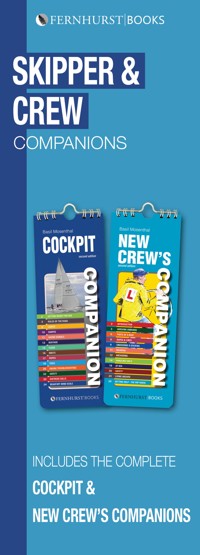
Two of Fernhurst Books' most popular compact, handy guides – the Cockpit Companion and New Crew's Companion – have been bundled together in e-book form for the first time. The perfect quick reference guides to keep on your phone or tablet, easily accessible when you are on board. They are an on-the-water aide memoire of everything the skipper and crew need to know – or find out quickly – when cruising. The Cockpit Companion provides a wide range of information: from lights, shapes and sound signals to knots, ropes and engine troubleshooting. With diagrams and illustrations throughout, this quick reference guide will help to keep you safe when out at sea. The New Crew's Companion is specifically designed for those new to sailing covering what clothes to bring, what the things on the deck are called, how to start helping with the sails and other deckwork. There is also an important section on safety and one on living aboard. It allows new sailors to know what to expect and get the most out of their first sailing experiences. This will be a valued companion for skipper and crew – even first-time crew members.
Sie lesen das E-Book in den Legimi-Apps auf:
Seitenzahl: 54
Veröffentlichungsjahr: 2024
Das E-Book (TTS) können Sie hören im Abo „Legimi Premium” in Legimi-Apps auf:
Ähnliche



















CONTENTS
COCKPIT
GETTING READY FOR SEA
RULES OF THE ROAD
LIGHTS
SHAPES
SOUND SIGNALS
BUOYAGE
FLAGS
KNOTS
ROPES
TIDES
ENGINE TROUBLESHOOTING
SAFETY
DISTRESS CALLS
BEAUFORT WIND SCALE
NEW CREW’S
INTRODUCTION
ARRIVING ONBOARD
PARTS OF A BOAT
ROPES & LINES
UNDOCKING & DOCKING
MOORING
ANCHORING
HANDLING SAILS
AT SEA
SAFETY
LIVING ABOARD
GETTING HELP - THE VHF RADIO
GETTING READY FOR SEA
ESSENTIAL PRE-SAILING CHECKS
•Weather forecast.
•Tide - Make a note – is it springs or neaps?
•Fuel - How much is onboard? Is there reserve fuel?
•Engine - A daily check is essential (see below).
•On deck - Make sure all gear is secure.
•Sails and rigging - A quick look aloft and on deck.
•Below decks - Galley secured, hatches and ports shut, no loose gear around. (Have you looked?)
•Dinghy - Well secured on deck or, if towing, check the tow.
FOR A LONGER TRIP
• Make sure someone ashore knows where you are heading. Register your boat with HM Coastguard – join the voluntary Safety Identification Scheme (CG66).
• Have you checked your charts? You wouldn’t be the first person to find an important chart missing. Do you have an up-to-date almanac aboard?
• Is the tide critical anywhere, e.g. passing round a headland or entering harbour?
• If you are delayed, can you get into your destination harbour after dark?
• In an emergency, or unexpected bad weather, are there alternative harbours or anchorages on the way?
• What is your crew’s strength and experience? Could they cope with unexpected bad weather?
DAILY ENGINE CHECK
Before starting
•Engine compartment - Take a quick look: bilge clear, no oil or water leaks, no loose wires, belts OK.
•Raw water inlet - Valve open, strainer clear.
•Fuel filter - Check for water or dirt with a transparent filter. Drain off if needed.
•Engine oil level - Check with dipstick. Do not overfill.
Starting
• Switch over to starting battery. Start the engine with the gearbox in neutral, and run at medium revs to warm up.
• Check cooling water is running from the exhaust.
•Batteries charging, correct oil pressure. Look at the instrument panel.
While running
• Check the stern gland periodically for leaks. Tighten grease filler (if fitted) as needed.
• Periodically check the gearbox oil when the engine is running and warm. Remember to top up with gearbox oil, not engine oil.
RULES OF THE ROAD
The International Regulations for Preventing Collisions at Sea contain a great number of rules for a whole host of different situations at sea. Below are the basic, and very important, ‘Steering and Sailing Rules’.
VESSELS UNDER POWER
Head-on situation
Power vessels approaching head-on should alter course to starboard and pass down each other’s port side (Rule 14). ‘Green to green, red to red, perfect safety, go ahead’.
Crossing situation
If two power vessels are crossing, the vessel with the other on her starboard side should keep clear (Rule 15). ‘If to starboard red appear, ‘tis your duty to keep clear’.
Overtaking situation
An overtaking vessel must keep clear of the vessel being overtaken. But the vessel being overtaken must not hamper the overtaking vessel (Rule 13). This takes precedence over other rules.
TRAFFIC SEPARATION SCHEMES
(RULE 10)
These are shown on charts.
•Small craft should, whenever possible, use the Inshore Traffic Zones.
•If small craft have to use a traffic lane, they must follow the correct directon for the lane and they must not impede larger vessels.
•If it is necessary to cross a traffic lane make sure your heading is at right angles to the lane, and keep clear of vessels using the lane.
VESSELS UNDER SAIL
Wind on different side for each vessel
Port tack gives way, Starboard should stand-on (Rule 12).
Wind on same side for both vessels
Windward vessel gives way (Rule 12).
ACTION TO AVOID COLLISION
(RULE 8)
•When two vessels are close, it is essential that each vessel understands what the other is doing. In particular small craft must always make their actions clear beyond doubt.
•Any alteration of course to avoid collision must be bold, so that it is clear that the vessel has altered course.
•A series of small alterations should be avoided. This is important at night when the change in aspect of her navigation lights is the only indication that a vessel has altered course.
NARROW CHANNELS
(RULE 9)
•Vessels navigating in narrow channels and fairways must keep to starboard.
•Small craft under 20m and sailing vessels must keep clear of larger vessels that can only navigate in the channel. And they must not pass ahead of such a vessel.
•Do not anchor in a narrow channel or fairway.
RESPONSIBILITIES BETWEEN VESSELS
(RULE 18)
A vessel under power must give way to:
•A vessel not under command
•A vessel unable to manoeuvre easily
•A vessel engaged in fishing
•A sailing vessel (but see below)
A vessel under sail must keep clear of:
•A vessel not under command
•A vessel unable to manoeuvre easily
•A vessel engaged in fishing
LARGE VESSELS
•Cannot alter course quickly and cannot stop quickly.
• May travel fast. Keep a good lookout astern and under the genoa.
• Will be unable to move outside the buoyed channel in shallow waters and Traffic Separation Schemes.
• From the bridge of a large vessel small craft may be hard to see.
SMALL SAILING CRAFT
In general, small sailing craft should be prepared to:
•Avoid large vessels under power.
•Make it clear that they are avoiding them.
• Do so in good time.
COMPASS CONVERSION
CONVERTING TRUE COURSES TO MAGNETIC
Variation west, magnetic best – add variation Variation east, magnetic least – subtract variation
CONVERTING MAGNETIC COURSES TO TRUE
Variation west, magnetic best – subtract variation Variation east, magnetic least – add variation
The same rule applies with deviation.
LIGHTS
VESSELS UNDER POWER
Over 50m
Masthead light • Second masthead light aft and higher sidelights • Sternlight
Under 50m
Masthead light • Sidelights • Sternlight
Under 12m
May show all-round white light (instead of masthead light and sternlight) • Sidelights




