


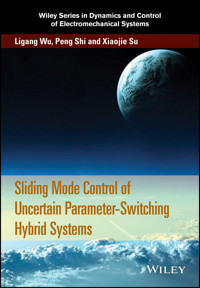
110,99 €
Mehr erfahren.
- Herausgeber: John Wiley & Sons
- Kategorie: Fachliteratur
- Serie: Wiley Series in Dynamics and Control of Electromechanical Systems
- Sprache: Englisch
In control theory, sliding mode control (SMC) is a nonlinear control method that alters the dynamics of a nonlinear system by application of a discontinuous control signal that forces the system to slide along a cross-section of the system's normal behaviour. In recent years, SMC has been successfully applied to a wide variety of practical engineering systems including robot manipulators, aircraft, underwater vehicles, spacecraft, flexible space structures, electrical motors, power systems, and automotive engines.
Sliding Mode Control of Uncertain Parameter-Switching Hybrid Systems addresses the increasing demand for developing SMC technologies and comprehensively presents the new, state-of-the-art sliding mode control methodologies for uncertain parameter-switching hybrid systems. It establishes a unified framework for SMC of Markovian jump singular systems and proposes new SMC methodologies based on the analysis results. A series of problems are solved with new approaches for analysis and synthesis of switched hybrid systems, including stability analysis and stabilization, dynamic output feedback control, and SMC. A set of newly developed techniques (e.g. average dwell time, piecewise Lyapunov function, parameter-dependent Lyapunov function, cone complementary linearization) are exploited to handle the emerging mathematical/computational challenges.
Key features:
- Covers new concepts, new models and new methodologies with theoretical significance in system analysis and control synthesis
- Includes recent advances in Markovian jump systems, switched hybrid systems, singular systems, stochastic systems and time-delay systems
- Includes solved problems
- Introduces advanced techniques
Sliding Mode Control of Uncertain Parameter-Switching Hybrid Systems is a comprehensive reference for researchers and practitioners working in control engineering, system sciences and applied mathematics, and is also a useful source of information for senior undergraduate and graduates studying in these areas.
Sie lesen das E-Book in den Legimi-Apps auf:
Seitenzahl: 321
Veröffentlichungsjahr: 2014
Ähnliche

















SLIDING MODE CONTROL OF UNCERTAIN PARAMETER-SWITCHING HYBRID SYSTEMS
Ligang Wu
Harbin Institute of Technology, China
Peng Shi
The University of Adelaide; and Victoria University, Australia
Xiaojie Su
Chongqing University, China
This edition first published 2014 © 2014 John Wiley & Sons, Ltd
Registered officeJohn Wiley & Sons Ltd, The Atrium, Southern Gate, Chichester, West Sussex, PO19 8SQ, United Kingdom
For details of our global editorial offices, for customer services and for information about how to apply for permission to reuse the copyright material in this book please see our website at www.wiley.com.
The right of the author to be identified as the author of this work has been asserted in accordance with the Copyright, Designs and Patents Act 1988.
All rights reserved. No part of this publication may be reproduced, stored in a retrieval system, or transmitted, in any form or by any means, electronic, mechanical, photocopying, recording or otherwise, except as permitted by the UK Copyright, Designs and Patents Act 1988, without the prior permission of the publisher.
Wiley also publishes its books in a variety of electronic formats. Some content that appears in print may not be available in electronic books.
Designations used by companies to distinguish their products are often claimed as trademarks. All brand names and product names used in this book are trade names, service marks, trademarks or registered trademarks of their respective owners. The publisher is not associated with any product or vendor mentioned in this book.
Limit of Liability/Disclaimer of Warranty: While the publisher and author have used their best efforts in preparing this book, they make no representations or warranties with respect to the accuracy or completeness of the contents of this book and specifically disclaim any implied warranties of merchantability or fitness for a particular purpose. It is sold on the understanding that the publisher is not engaged in rendering professional services and neither the publisher nor the author shall be liable for damages arising herefrom. If professional advice or other expert assistance is required, the services of a competent professional should be sought.
Library of Congress Cataloging-in-Publication Data applied for.
ISBN 9781118862599
To Jingyan and ZhixinL. Wu
To my familyP. Shi
To my familyX. Su
CONTENTS
Series Preface
Preface
Acknowledgments
Abbreviations and Notations
Abbreviations
Notations
Chapter 1: Introduction
1.1 Sliding Mode Control
1.2 Uncertain Parameter-Switching Hybrid Systems
1.3 Contribution of the Book
1.4 Outline of the Book
Part One: SMC of Markovian Jump Singular Systems
Chapter 2: State Estimation and SMC of Markovian Jump Singular Systems
2.1 Introduction
2.2 System Description and Preliminaries
2.3 Stochastic Stability Analysis
2.4 Main Results
2.5 Illustrative Example
2.6 Conclusion
Chapter 3: Optimal SMC of Markovian Jump Singular Systems with Time Delay
3.1 Introduction
3.2 System Description and Preliminaries
3.3 Bounded Gain Performance Analysis
3.4 Main Results
3.5 Illustrative Example
3.6 Conclusion
Chapter 4: SMC of Markovian Jump Singular Systems with Stochastic Perturbation
4.1 Introduction
4.2 System Description and Preliminaries
4.3 Integral SMC
4.4 Optimal Integral SMC
4.5 Illustrative Example
4.6 Conclusion
Part Two: SMC of Switched State-Delayed Hybrid Systems
Chapter 5: Stability and Stabilization of Switched State-Delayed Hybrid Systems
5.1 Introduction
5.2 Continuous-Time Systems
5.3 Discrete-Time Systems
5.4 Conclusion
Chapter 6: Optimal DOF Control of Switched State-Delayed Hybrid Systems
6.1 Introduction
6.2 Optimal - DOF Controller Design
6.3 Guaranteed Cost DOF Controller Design
6.4 Conclusion
Chapter 7: SMC of Switched State-Delayed Hybrid Systems: Continuous-Time Case
7.1 Introduction
7.2 System Description and Preliminaries
7.3 Main Results
7.4 Illustrative Example
7.5 Conclusion
Chapter 8: SMC of Switched State-Delayed Hybrid Systems: Discrete-Time Case
8.1 Introduction
8.2 System Description and Preliminaries
8.3 Main Results
8.4 Illustrative Example
8.5 Conclusion
Part Three: SMC of Switched Stochastic Hybrid Systems
Chapter 9: Control of Switched Stochastic Hybrid Systems: Continuous-Time Case
9.1 Introduction
9.2 System Description and Preliminaries
9.3 Stability Analysis and Stabilization
9.4 Control
9.5 Illustrative Example
9.6 Conclusion
Chapter 10: Control of Switched Stochastic Hybrid Systems: Discrete-Time Case
10.1 Introduction
10.2 System Description and Preliminaries
10.3 Stability Analysis and Stabilization
10.4 Control
10.5 Illustrative Example
10.6 Conclusion
Chapter 11: State Estimation and SMC of Switched Stochastic Hybrid Systems
11.1 Introduction
11.2 System Description and Preliminaries
11.3 Main Results
11.4 Observer-Based SMC Design
11.5 Illustrative Example
11.6 Conclusion
Chapter 12: SMC with Dissipativity of Switched Stochastic Hybrid Systems
12.1 Introduction
12.2 Problem Formulation and Preliminaries
12.3 Dissipativity Analysis
12.4 Sliding Mode Control
12.5 Illustrative Example
12.6 Conclusion
References
Index
End User License Agreement
List of Table
Chapter 5
Table 5.1
List of Illustrations
Chapter 1
Figure 1.1 Dynamic sliding mode control
Figure 1.2 Switched quadratic Lyapunov functions
Figure 1.3 Multiple Lyapunov stability (Case 1: the values of Lyapunov-like functions at the switching instants form a monotonically decreasing sequence)
Figure 1.4 Multiple Lyapunov stability (Case 2: the values of Lyapunov-like function for each subsystem at every exiting instant form a monotonically decreasing sequence)
Figure 1.5 Multiple Lyapunov stability (Case 3: the Lyapunov-like function for each subsystem increases its value during a certain period)
Figure 1.6 The organization structure of the book
Figure 1.7 The main contents of the book
Chapter 2
Figure 2.1 States of the closed-loop system
Figure 2.2 Switching function
Chapter 3
Figure 3.1 States of the closed-loop system
Figure 3.2 Switching function
Chapter 4
Figure 4.1 States of the closed-loop system
Figure 4.2 Switching function
Figure 4.3 Control input
Figure 4.4 Individual paths and the average of the state of the closed-loop system: first component
Figure 4.5 Individual paths and the average of the state of the closed-loop system: second component
Figure 4.6 Individual paths and the average of the state of the closed-loop system: third component
Figure 4.7 Individual paths and the average of the switching function
Chapter 5
Figure 5.1 Switching signal
Figure 5.2 States of the open-loop system
Figure 5.3 States of the closed-loop system
Chapter 6
Figure 6.1 Switching signal
Figure 6.2 States of the open-loop system
Figure 6.3 States of the closed-loop system
Figure 6.4 States of the DOF controller
Figure 6.5 Switching signal
Figure 6.6 States of the open-loop system
Figure 6.7 States of the closed-loop system
Figure 6.8 Control input
Chapter 7
Figure 7.1 Switching signal
Figure 7.2 States of the open-loop system
Figure 7.3 States of the closed-loop system with (7.33)
Figure 7.4 Sliding function with (7.33)
Figure 7.5 Control input (7.33)
Figure 7.6 States of the closed-loop system with (7.34)
Figure 7.7 Sliding function with (7.34)
Figure 7.8 Control input (7.34)
Figure 7.9 Adaptive estimate
r
(
t
)
Chapter 8
Figure 8.1 Switching signal
Figure 8.2 States of the closed-loop system
Figure 8.3 Sliding mode control input
Figure 8.4 Sliding surface function
Chapter 9
Figure 9.1 Switching signal
Figure 9.2 States of the closed-loop system
Figure 9.3 States of the DOF controller
Figure 9.4 DOF control input
Figure 9.5 Individual paths and the average of the states of the closed-loop system
Figure 9.6 Individual paths and the average of the states of the DOF controller
Chapter 10
Figure 10.1 Switching signal
Figure 10.2 Brownian motion
Figure 10.3 States of the closed-loop system
Chapter 11
Figure 11.1 Switching signal
Figure 11.2 States of the closed-loop system
Figure 11.3 Switching function
Figure 11.4 Control input
Figure 11.5 Individual paths and the average of the states of the closed-loop system
Figure 11.6 Individual paths and the average of the switching function
Chapter 12
Figure 12.1 Switching signal
Figure 12.2 States of the closed-loop system
Figure 12.3 Switching function
Figure 12.4 Individual paths and the average of the states of the closed-loop system
Figure 12.5 Individual paths and the average of the switching function
Guide
Cover
Table of Contents
Preface
Part
Chapter
Pages
xi
xii
xiii
xiv
xv
xvii
xviii
1
2
3
4
5
6
7
8
9
10
11
12
13
14
15
16
17
18
19
20
21
22
23
24
25
26
27
28
29
30
31
35
36
37
38
39
40
41
42
43
44
45
46
47
48
49
50
51
52
53
54
55
56
57
58
59
60
61
62
63
64
65
66
67
68
69
70
71
72
73
74
75
76
77
78
79
80
81
82
83
84
87
88
91
92
93
95
96
97
98
99
100
102
103
104
105
106
107
108
109
110
111
112
113
114
115
116
117
118
119
120
121
122
123
124
125
126
127
128
129
130
131
132
133
134
135
136
137
138
139
140
141
142
143
144
145
146
147
148
149
150
151
152
153
154
155
156
157
159
160
161
162
163
164
165
166
167
168
169
170
171
175
176
177
178
179
180
181
182
183
184
185
186
187
188
189
190
191
192
193
194
195
197
198
199
200
201
202
203
204
205
206
207
208
209
210
211
212
213
214
215
216
217
218
219
220
221
222
223
224
225
226
227
228
229
230
231
232
233
234
235
236
237
238
239
240
241
242
243
244
245
246
247
248
249
250
251
252
253
254
255
256
257
258
259
260
261
262
263
264
265
Series Preface
Electromechanical systems permeate the engineering and technology fields in aerospace, automotive, mechanical, biomedical, civil/structural, electrical, environmental, and industrial systems. The Wiley Book Series on dynamics and control of electromechanical systems will cover a broad range of engineering and technology within these fields. As demand increases for innovation in these areas, feedback control of these systems is becoming essential for increased productivity, precision operation, load mitigation, and safe operation. Furthermore, new applications in these areas require a reevaluation of existing control methodologies to meet evolving technological requirements, for example the distributed control of energy systems. The basics of distributed control systems are well documented in several textbooks, but the nuances of its use for future applications in the evolving area of energy system applications, such as wind turbines and wind farm operations, solar energy systems, smart grids, and the generation, storage and distribution of energy, require an amelioration of existing distributed control theory to specific energy system needs. The book series serves two main purposes: 1) a delineation and explication of theoretical advancements in electromechanical system dynamics and control, and 2) a presentation of application-driven technologies in evolving electromechanical systems.
This book series will embrace the full spectrum of dynamics and control of electromechanical systems from theoretical foundations to real-world applications. The level of the presentation should be accessible to senior undergraduate and first-year graduate students, and should prove especially well-suited as a self-study guide for practicing professionals in the fields of mechanical, aerospace, automotive, biomedical, and civil/structural engineering. The aim is to provide an interdisciplinary series, ranging from high-level undergraduate/graduate texts, explanation and dissemination of science and technology and good practice, through to important research that is immediately relevant to industrial development and practical applications. It is hoped that this new and unique perspective will be of perennial interest to students, scholars, and employees inthe engineering disciplines mentioned. Suggestions for new topics and authors for the series are always welcome.
This book, Sliding Mode Control of Uncertain Parameter-Switching Hybrid Systems, has the objective of providing a theoretical foundation as well as practical insights on the topic at hand. It is broken down into three parts: 1) sliding mode control (SMC) of Markovian jump singular systems, 2) SMC of switched state-delayed hybrid systems, and 3) SMC of switched stochastic hybrid systems. The book provides detailed derivations from first principles to allow the reader to thoroughly understand the particular topic. This is especially useful for Markovian jump singular systems with stochastic perturbations because a comprehensive knowledge of stochastic analysis is not required before understanding the material. Readers can simply dive into the material. It also provides several illustrative examples to bridge the gap between theory and practice. It is a welcome addition to the Wiley Electromechanical Systems Series because no other book is focused on the topic of SMC with a specific emphasis on uncertain parameter-switching hybrid systems.
Mark J. Balas John L. Crassidis Florian Holzapfel Series Editors
Preface
Since the 1950s, sliding mode control (SMC) has been recognized as an effective robust control strategy for nonlinear systems and incompletely modeled systems. In the past two decades, SMC has been successfully applied to a wide variety of real world applications such as robot manipulators, aircraft, underwater vehicles, spacecraft, flexible space structures, electrical motors, power systems, and automotive engines. Basically, the idea of SMC is to utilize a discontinuous control to force the system state trajectories to some predefined sliding surfaces on which the system has desired properties such as stability, disturbance rejection capability, and tracking ability. Many important results have been reported for this kind of control strategy. However, when the controlled plants are uncertain parameter-switching hybrid systems including parameter-switching (Markovian jump or arbitrary switching), state-delay, stochastic perturbation, and singularly perturbed terms, the common SMC methodologies cannot meet the requirements.
It is known that the SMC of uncertain parameter-switching hybrid systems is much more complicated because sliding mode controllers must be designed so that not only is the sliding surface robustly reachable, but also the sliding mode dynamics can converge the system’s equilibrium automatically by choosing a suitable switching function. This book aims to present up-to-date research developments and novel methodologies on SMC of uncertain parameter-switching hybrid systems in a unified matrix inequality setting. The considered uncertain parameter-switching hybrid systems include Markovian switching hybrid systems, switched state-delayed hybrid systems, and switched stochastic hybrid systems. These new methodologies provide a framework for stability and performance analysis, SMC design, and state estimation for these classes of systems. Solutions to the design problems are presented in terms of linear matrix inequalities (LMIs). In this book, a large number of references are provided for researchers who wish to explore the area of SMC of uncertain parameter-switching hybrid systems, and the main contents of the book are also suitable for a one-semester graduate course.
In this book, we present new SMC methodologies for uncertain parameter-switching hybrid systems. The systems under consideration include Markovian jump systems, singular systems, switched hybrid systems, stochastic systems, and time-delay systems.
The content of this book are divided into three parts. The first part is focused on SMC of Markovian jump singular systems. Some necessary and sufficient conditions are derived for the stochastic stability, stochastic admissibility, and optimal performances by developing new techniques for the considered Markovian jump singular systems. Then a set of new SMC methodologies are proposed, based on the analysis results. The main contents are as follows: Chapter 2 is concerned with the state estimation and SMC of singular Markovian switching systems; Chapter 3 studies the optimal SMC problem for singular Markovian switching systems with time delay; and Chapter 4 establishes the integral SMC method for singular Markovian switching stochastic systems.
In the second part, the problem of SMC of switched state-delayed hybrid systems is investigated. A unified approach of the piecewise Lyapunov function combining with the average dwell time technique is developed for analysis and synthesis of the considered systems. By this approach, some sufficient conditions are established for the stability and synthesis of the switched state-delayed hybrid system. More importantly, a set of SMC methodologies under a unique framework are proposed for the considered hybrid systems. The main contents of this part are as follows: Chapter 5 is devoted to the stability analysis and the stabilization problems for switched state-delayed hybrid systems; Chapter 6 investigates the optimal dynamic output feedback (DOF) control of switched state-delayed hybrid systems; and Chapters 7 and 8 study the SMC of continuous- and discrete-time switched state-delayed hybrid systems, respectively.
In the third part, the parallel theories and techniques developed in the second part are extended to deal with switched stochastic hybrid systems. The main contents include the following: Chapters 9 and 10 are concerned with the control of switched stochastic hybrid systems for continuous- and discrete-time cases, respectively; Chapter 11 studies the observer-based SMC of switched stochastic hybrid systems; and Chapter 12 focuses on the dissipativity-based SMC of switched stochastic hybrid systems.
This book is a research monograph whose intended audience is graduate and postgraduate students, academics, scientists and engineers who are working in the field.
Ligang Wu Harbin, China
Peng Shi Melbourne, Australia
Xiaojie Su Chongqing, ChinaDecember 2013
Acknowledgments
There are numerous individuals without whose help this book would not have been completed. Special thanks go to Professor James Lam from The University of Hong Kong, Professor Daniel W. C. Ho from City University of Hong Kong, Professor Zidong Wang from Brunel University, Professor Wei Xing Zheng from University of Western Sydney, Professor Yugang Niu from East China University of Science and Technology and Professor Huijun Gao from Harbin Institute of Technology, for their valuable suggestions, constructive comments and support.
Next, our acknowledgements go to many colleagues who have offered support and encouragement throughout this research effort. In particular, we would like to acknowledge the contributions from Jianbin Qiu, Ming Liu, Guanghui Sun, and Hongli Dong. Thanks also go to our students, Rongni Yang, Xiuming Yao, Fanbiao Li, Xiaozhan Yang, Chunsong Han, Yongyang Xiong, and Huiyan Zhang, for their comments. The authors are especially grateful to their families for their encouragement and never-ending support when it was most required. Finally, we would like to thank the editors at Wiley for their professional and efficient handling of this project.
The writing of this book was supported in part by the National Natural Science Foundation of China (61174126, 61222301, 61134001, 61333012, 61174058), the Fok Ying Tung Education Foundation (141059), the Fundamental Research Funds for the Central Universities (HIT.BRETIV.201303), the Australian Research Council (DP140102180), the Engineering and Physical Sciences Research Council, UK (EP/F029195), the Fundamental Research Funds for the Central Universities (2013YJS021), the National Key Basic Research Program, China (2011CB710706, 2012CB215202), the 111 Project (B12018), and the Key Laboratory of Integrated Automation for the Process Industry, Northeast University.
Abbreviations and Notations
Abbreviations
CCL
cone complementary linearization
CQLF
common quadratic Lyapunov function
DOF
dynamic output feedback
LMI
linear matrix inequality
LQR
linear-quadratic regulator
LTI
linear time-invariant
MIMO
multiple-input multiple-output
MJLS
Markovian jump linear system
MLF
multiple Lyapunov function
SISO
single-input single-output
SMC
sliding mode control
SOF
static output feedback
SQLF
switched quadratic Lyapunov functions
Notations
end of proof
end of remark
is defined as
belongs to
for all
sum
field of complex numbers
field of real numbers
field of integral numbers
space of -dimensional real vectors
space of real matrices
set of -valued continuous functions on
mathematical expectation operator
lim
limit
max
maximum
min
minimum
sup
supremum
inf
infimum
rank(⋅)
rank of a matrix
trace(⋅)
trace of a matrix
minimum eigenvalue of a real symmetric matrix
1Introduction
1.1 Sliding Mode Control
Sliding mode control (SMC) has proven to be an effective robust control strategy for incompletely modeled or nonlinear systems since its first appearance in the 1950s [70, 103, 197]. One of the most distinguished properties of SMC is that it utilizes a discontinuous control action which switches between two distinctively different system structures such that a new type of system motion, called sliding mode, exists in a specified manifold. The peculiar characteristic of the motion in the manifold is its insensitivity to parameter variations, and its complete rejection of external disturbances [260]. SMC has been developed as a new control design method for a wide spectrum of systems including nonlinear, time-varying, discrete, large-scale, infinite-dimensional, stochastic, and distributed systems [101]. Also, in the past two decades, SMC has successfully been applied to a wide variety of practical systems such as robot manipulators, aircraft, underwater vehicles, spacecraft, flexible space structures, electrical motors, power systems, and automotive engines [60, 77, 199, 259].
In this section, we will first present some preliminary background and fundamental theory of SMC, which will be helpful to some readers who have little or no knowledge on SMC, and then we will give an overview of recent development of SMC methodologies.
1.1.1 Fundamental Theory of SMC
We first formulate the SMC problem as follows. For a general nonlinear system of the form
where x(t) ∈ Rn is the system state vector, u(t) ∈ is the control input. We need to design a sliding surface
Lesen Sie weiter in der vollständigen Ausgabe!
Lesen Sie weiter in der vollständigen Ausgabe!
Lesen Sie weiter in der vollständigen Ausgabe!
Lesen Sie weiter in der vollständigen Ausgabe!
Lesen Sie weiter in der vollständigen Ausgabe!
Lesen Sie weiter in der vollständigen Ausgabe!
Lesen Sie weiter in der vollständigen Ausgabe!
Lesen Sie weiter in der vollständigen Ausgabe!
Lesen Sie weiter in der vollständigen Ausgabe!
Lesen Sie weiter in der vollständigen Ausgabe!
Lesen Sie weiter in der vollständigen Ausgabe!
Lesen Sie weiter in der vollständigen Ausgabe!
Lesen Sie weiter in der vollständigen Ausgabe!
Lesen Sie weiter in der vollständigen Ausgabe!
Lesen Sie weiter in der vollständigen Ausgabe!
Lesen Sie weiter in der vollständigen Ausgabe!
Lesen Sie weiter in der vollständigen Ausgabe!




