


22,99 €
Mehr erfahren.
- Herausgeber: John Wiley & Sons
- Kategorie: Fachliteratur
- Sprache: Englisch
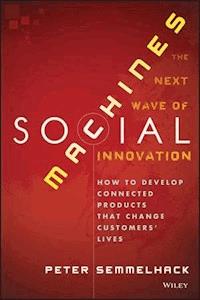
Companies like Facebook and Twitter have redefined social interaction. But what if "machines" like automobiles, bicycles, health monitors, appliances, instruments, and anything else you can connect to the Internet, could all become members of your social network, collect data you care about, and feed it back to you at just the right time? Nike+ is already doing this for your body, but every major industry, from healthcare to cars to home construction, is now building sensors and digital connectivity into their next generation of products. Companies like Ford, Pepsi, Verizon, and Procter and Gamble are also using "social machines" to reach new markets, improve brand/market awareness, and increase revenues. Social Machines is the first book for business people, marketers, product developers, and technologists, explaining how this trend will change our world, how your business will benefit, and how to create connected products that customers love. * Explains how smart phones and tablets enable Social Machines * Describes how digital technology is being "baked in" to the most unlikely new products--even wheelchairs. * Articulates how the "Internet of Things" is becoming social--and why that's the foundation for powerful new business models In the very near future, every great new product will be social. The next stage of interaction between people and our environment is upon us.
Sie lesen das E-Book in den Legimi-Apps auf:
Seitenzahl: 248
Veröffentlichungsjahr: 2013
Ähnliche


















Contents
Acknowledgments
Part I: Social Machines An Overview
Chapter 1: Introduction
Chapter 2: A Social Internet of Things
Chapter 3: Why Social Networks Must Evolve
Everything Will Get Connected
Everything Will Get Smarter
Everything Will Get Social
We’re Running Out of Humans!
Chapter 4: Social Machines and the Future of Humankind
Part II: Every Product Is a Platform
Chapter 5: Overview
Chapter 6: A Brief History of Abstraction
Chapter 7: Social Product Design
Connected versus Social
Example 1—The Weather Station
Example 2—Wheelchairs and Hand Sanitizers
Example 3—The Social Bicycle
Chapter 8: Avatars and the Social Seven
The Social Seven—Overview
The Social Seven—Details
Chapter 9: Spheres of Use, or Why Your New Product Should Do Things You Never Envisioned
Part III: The Business of Social Machines
Chapter 10: Introduction
People Sharing Things
Things Sharing Data
Chapter 11: How to Build a Business Using Social Machines
Retrofit Model
Built-in Model
Chapter 12: My Customer’s Customer Is My Customer
Chapter 13: The Art of Social Pricing
Part IV: Getting Started
Chapter 14: Design Requirements
But First, a Quick Story. . .
How Do I Make My Product Social?
Retrofit Model
Built-in Model
Chapter 15: Getting There from Here
Part V: Scenarios
Chapter 16: Smart Home
Chapter 17: Retail
Chapter 18: Transportation
Chapter 19: Finance
Chapter 20: Health and Wellness
Part VI: Resources
Index
Cover image: iStockphoto/Taice
Cover design: Paul McCarthy
Copyright © 2013 by Peter Semmelhack. All rights reserved.
Published by John Wiley & Sons, Inc., Hoboken, New Jersey.
Published simultaneously in Canada.
No part of this publication may be reproduced, stored in a retrieval system, or transmitted in any form or by any means, electronic, mechanical, photocopying, recording, scanning, or otherwise, except as permitted under Section 107 or 108 of the 1976 United States Copyright Act, without either the prior written permission of the Publisher, or authorization through payment of the appropriate per-copy fee to the Copyright Clearance Center, 222 Rosewood Drive, Danvers, MA 01923, (978) 750–8400, fax (978) 646–8600, or on the web at www.copyright.com. Requests to the Publisher for permission should be addressed to the Permissions Department, John Wiley & Sons, Inc., 111 River Street, Hoboken, NJ 07030, (201) 748–6011, fax (201) 748–6008, or online at www.wiley.com/go/permissions.
Limit of Liability/Disclaimer of Warranty: While the publisher and author have used their best efforts in preparing this book, they make no representations or warranties with respect to the accuracy or completeness of the contents of this book and specifically disclaim any implied warranties of merchantability or fitness for a particular purpose. No warranty may be created or extended by sales representatives or written sales materials. The advice and strategies contained herein may not be suitable for your situation. You should consult with a professional where appropriate. Neither the publisher nor the author shall be liable for damages arising herefrom.
For general information about our other products and services, please contact our Customer Care Department within the United States at (800) 762–2974, outside the United States at (317) 572–3993 or fax (317) 572–4002.
Wiley publishes in a variety of print and electronic formats and by print-on-demand. Some material included with standard print versions of this book may not be included in e-books or in print-on-demand. If this book refers to media such as a CD or DVD that is not included in the version you purchased, you may download this material at http://booksupport.wiley.com. For more information about Wiley products, visit www.wiley.com.
Library of Congress Cataloging-in-Publication Data:
Semmelhack, Peter, 1965-
Social machines : how to develop connected products that change customers’ lives / Peter Semmelhack.
pages cm
Includes index.
ISBN 978-1-118-47168-5 (cloth)
1. Social media—Economic aspects. 2. Social networks. I. Title.
HM741.S46 2013
302.3—dc23
2012050967
I dedicate this book to my wife, Suzanne, and children, Tristan and Victoria, my most important social network.
Acknowledgments
This book is the result of a journey I’ve been on for several years with many people and organizations. To all of my backers and supporters—financial, professional, personal, and otherwise—a sincere thank you. The material in these pages would have been impossible without you. To everyone I have worked with in bringing Bug Labs to life and through all its stages, this book has your collective fingerprints all over it. Thanks for everything you’ve contributed. Thanks to everyone at John Wiley & Sons, Inc., for giving me the chance to write my first book and providing a wonderful staff of editors and artists to support and guide me through it all.
Thanks to my family and friends for putting up with my frequent disappearances and silent treatments as I wrote. And finally, thank you to my wonderful wife and children for being my constant source of inspiration, motivation, and laughter.
Part I
Social Machines An Overview
Machines take me by surprise with great frequency.
—Alan Turing
Chapter 1
Introduction
It was Saturday morning, and Melissa was making a stop at her local Walmart to pick up a few things. As usual, she parked as close as she could and walked the familiar pavement up to the well-lit store entrance. Upon entering, her eye was drawn to something unfamiliar in the lobby. Standing against what used to be an empty wall was now a large, colorful, slightly unusual-looking vending machine. Intrigued, Melissa approached it—and immediately noticed a couple of things. For one, the machine was completely stocked with only one product—bright green Cascade dishwashing detergent samples made by Procter & Gamble (P&G). Second, in place of the normal mechanism by which you would insert coins or bills to make a purchase, there was a large, rectangular, color LCD screen that welcomed her with the line, “Press here to get your free sample!” Her finger instinctively reached out and pressed the screen where instructed. The screen promptly displayed:
Using your smartphone, please visit our product’s Facebook page. After you log in, go to this URL—http://cascade.facebook.com.
If you Like our page, we’ll vend you a free sample of our new Cascade dishwashing detergent right here, right now!
Melissa was hooked. She retrieved her iPhone from her pocket . . . and paused. Was this strange new transaction worth it? By pressing that “Like” button, she would be telling all her Facebook friends that she, in fact, liked this promotion. After examining the machine some more and thinking about the companies involved, she pressed the “Like” button with her pinkie. Two seconds later the vending machine whirred and dropped a sample into the tray for her to pick up. Melissa let out a quick laugh, looked around to make sure it wasn’t some kind of trick, and reached in to grab the sample. She would try it tonight, she decided, and noticing the coupon on the back of the packaging, pondered whether she might just pick up a whole box of it while shopping then and there.
Welcome to social machines, a world in which social networks include not just other people but Internet-connected electronic devices, machines, and contraptions of all kinds. It’s a world where your next Twitter follower could be your refrigerator and your new Facebook friend your brother’s Mustang. It is a business ecosystem of people, companies, and machines collaborating in surprising new ways and opening up innovative possibilities to create real value.
Let’s examine all the people and groups that benefitted from this simple interaction at Walmart.
Melissa
received an immediate, tangible benefit in the form of a useful product sample and coupon.
P&G
gained more than it might have by blindly passing out samples on a street corner. By virtue of the Facebook Like, the company gained access to not just the person
liking
its page but to that person’s entire social graph—information that P&G can now use to more effectively target promotions. Melissa’s friends can immediately see what she’s just liked and, potentially, go visit Walmart themselves and get their own sample, thereby giving P&G access to yet another social graph. Talk about the network effect!
Walmart
got more foot traffic in stores because of all the activity and social buzz around the vending machine. This, combined with the coupon on the back of the packaging, could equate to higher sales at that location.
The vending machine sellers and operators
, instead of just providing a piece of electromechanical dispensing machinery, can now tout that they are providing innovative new ways for brands to interact with their customers and prospects.
The wireless carrier
sells another data plan. Every carrier in the world today is interested selling data plans, and they are thrilled when they can do so on devices other than smartphones. A vending machine (and by association, kiosks, digital signs, etc.) represents a whole new category of device to support and capitalize on.
That’s a lot of beneficiaries from one simple idea and interaction. It’s especially impressive when you consider that it all sprang from combining two distinct, previously separate and unrelated worlds—the online social network and the stationary vending machine, the digital and the physical. It’s a combination you will see much more of in the coming years.
If this sounds entirely too futuristic to you, consider this. The whole concept of social machines is simply an extension of the social contract most of us have already made with a powerful electronic device we carry every day—our mobile phones. If you are like most people, you could not imagine your life without it. Our lives have been inalterably changed by the absorption of this communications technology. It is so engrained that it has become virtually invisible. In fact, the Finnish have coined the term kanny, which roughly translates into “extension of the hand,” to describe not only their mobile phones but their implied relationship with them. Like the watch on your wrist, its use has been completely enmeshed in your daily life. But make no mistake; it is indeed a machine. And it represents just the tip of the iceberg. Companies like Nike, with their successful Nike+ product line that combines fitness metrics with social networking, are unmistakable harbingers of what is to come.
As we will see, human cultures have been building relationships with machines for millennia. Stanford professor Clifford Nass recently conducted research that shows that it’s not uncommon for us to attach very human qualities to our personal computers (which may explain the emotional reaction you feel when it crashes on you!1). And although it is not this book’s goal to delve deeply into cognitive science, it’s worth noting that the whole concept of social machines as logical next step in the evolution of our relationship with technology is, in fact, supported by scholarship. Professor Andy Clark notes in his book Natural Born Cyborgs, “what is special about human brains, and what best explains the distinctive features of human intelligence, is precisely their ability to enter into deep and complex relationships with nonbiological constructs, props and aids.” In other words, machines can teach us many things. We just need to include them in the discussion.
The obvious question arises: Is this just another uber-geeky concept that sounds cool on paper but fails in real life? The short answer is no—and the following are some good examples of why the concept stands a very strong chance of succeeding. Imagine a world in which:
Your car shares valuable geographic, operational, and/or safety data with its “friends”—in this case, the other cars that are “following” it on Twitter—resulting in better gas mileage, ride-sharing opportunities, faster travel times, and the ability to find open parking spaces.
Your house communicates with its occupants and other Facebook “friend houses” to share heating and cooling information, security data, utility usage metrics, and environmental measurements, resulting in improved energy efficiency and healthier, more secure homes and neighborhoods.
Communities of elderly people securely and privately share health information that originates from various monitoring devices with one another, their caregivers, and their loved ones, resulting in lower medical bills, fewer hospital visits, better quality of life, and longer lives.
Retailers are willing to monetize your presence in their stores via discounts and promotions in exchange for the location data and/or purchase history on your smartphone.
Literally hundreds of applications, services, and products that could be developed to capitalize on and support all the benefits listed here—which is just a brief snapshot of the potential areas for innovation. The social framework provides a completely new way of entering markets, demonstrating value, and driving adoption.
The best part is that none of these examples are fantasies. They are all possible today. The technology necessary to make them real exists and is getting cheaper every year. But ironically, the framework for understanding how we can harness these technologies has nothing to do with technology at all. The path forward for the utopian visions of home automation and smart cities is based on something far more mundane. It is a force that has driven countless revolutions before it: the inherent need we humans have to communicate, share our worlds, help one another, and improve our collective lot in life. In a word, this new universe of possibility is based on everything becoming social. As Clay Shirky mentions in his book Cognitive Surplus, “the use of social technology is much less determined by the tool itself; when we use a network, the most important asset we get is access to one another.” We now must consider what it means to include machines in that mix.
As strange as it may sound, the concept of imbuing an inanimate machine with social characteristics is not only a logical, cultural stepping stone but it also makes sound business sense. The example at the start of this chapter is a real one, with real business value—and it’s the first of many we will introduce in the coming pages. The fact is that by combining the best of what we’ve learned about sharing, collaborating, and cooperating via online social networks with everything we know about powerful, secure, potentially mobile, physical devices, we can create a stunningly rich new ecosystem for innovation. It is a new category for exploration that’s part business and part consumer, maybe some hybrid beast called M2C—machine-to-consumer. Whatever acronym fits best, the concept rests firmly on the promise of breaking down the artificial barriers that exist between networked humans and machines.
After all, wouldn’t we be happier with fewer mindlessly blinking DVRs, squawking car alarms, and inane error messages confusing the situation? Wouldn’t it be better if we welcomed, instead of feared, the technology in our lives? Aren’t there wonderful examples of big, successful businesses being built on making technology easier—the canonical example being Apple? To make this happen, we need to make machines a real, trusted, and more integrated part of our community, part of our society—which, coincidentally, leads us back to making things social.
To capture and discuss this new universe of possibility, we need a new dialectic that puts humans and machines on an equal social footing, insofar as it is related to improving the world and all those who inhabit it. That is the purpose of this book—to provide the framework, concepts, and vernacular to assist in the exploration and development of this exciting new world of communication.
1http://www.cfo.com/article.cfm/6820151
Chapter 2
A Social Internet of Things
Social machines” is a framework for recontextualizing and reevaluating the business benefits of Internet-connected devices (the “Internet of Things”) by integrating everything we’ve learned from social networks. It is a way to reframe the value of the Internet of Things to make it more approachable and meaningful to everyone, not just the world’s geeks. This approach provides a new conceptual architecture for product developers that helps move the discussion from the purely hypothetical to the concrete—providing them a distinct and easy to understand point of view.
Lesen Sie weiter in der vollständigen Ausgabe!
Lesen Sie weiter in der vollständigen Ausgabe!
Lesen Sie weiter in der vollständigen Ausgabe!
Lesen Sie weiter in der vollständigen Ausgabe!
Lesen Sie weiter in der vollständigen Ausgabe!
Lesen Sie weiter in der vollständigen Ausgabe!
Lesen Sie weiter in der vollständigen Ausgabe!
Lesen Sie weiter in der vollständigen Ausgabe!
Lesen Sie weiter in der vollständigen Ausgabe!
Lesen Sie weiter in der vollständigen Ausgabe!
Lesen Sie weiter in der vollständigen Ausgabe!
Lesen Sie weiter in der vollständigen Ausgabe!
Lesen Sie weiter in der vollständigen Ausgabe!
Lesen Sie weiter in der vollständigen Ausgabe!
Lesen Sie weiter in der vollständigen Ausgabe!
Lesen Sie weiter in der vollständigen Ausgabe!
Lesen Sie weiter in der vollständigen Ausgabe!
Lesen Sie weiter in der vollständigen Ausgabe!
Lesen Sie weiter in der vollständigen Ausgabe!
Lesen Sie weiter in der vollständigen Ausgabe!
Lesen Sie weiter in der vollständigen Ausgabe!
Lesen Sie weiter in der vollständigen Ausgabe!
Lesen Sie weiter in der vollständigen Ausgabe!
Lesen Sie weiter in der vollständigen Ausgabe!




