


69,99 €
Mehr erfahren.
- Herausgeber: John Wiley & Sons
- Kategorie: Fachliteratur
- Sprache: Englisch
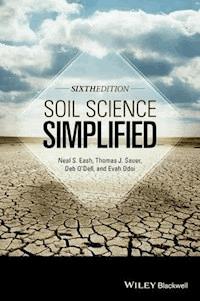
Already renowned as a user-friendly beginners’ guide to soil science, Soil Science Simplified, 6th Edition is an updated version of the beloved textbook that includes even more thorough applications of soil science to interdisciplinary fields. It includes the most recent research concerning uses of soil in municipal, engineering, and other areas, conversion agriculture covering no-till, hoe-till, and the methodology of cover crops, crop rotations, N contribution, and worldwide trends in conversion agriculture. The experienced authors have fully revised and updated the fundamental chapters on physical, chemical, and biological properties to create an ideal introductory text.
Sie lesen das E-Book in den Legimi-Apps auf:
Seitenzahl: 495
Veröffentlichungsjahr: 2015
Ähnliche


















Table of Contents
Cover
Title Page
Copyright
Preface
Chapter 1: Introduction to Soil
What Is Soil?
Nature and Uses of Soil
How Big Is an Acre? A Hectare?
Chapter 2: Soil Formation
The Rock Cycle
Composition of the Earth's Crust
Processes of Rock Weathering
Factors of Soil Formation
Soil Horizon Development
Let's Take a Trip
Chapter 3: Soil Physical Properties
Soil Phases
Soil Separates
Soil Texture
Soil Structure
Benefits of Aggregation
Porosity and Density
Composition of Soil Pores
Soil Consistence
Soil Color
Chapter 4: Soil Biological Properties
Organic Matter and Humus
The Carbon Cycle
Factors Affecting Soil Organic Matter Levels
The Decomposition Process
Factors Affecting the Rate of Decomposition
Importance of Soil Organic Matter
Carbon Sequestration
Plant Roots and the Rhizosphere
Microorganisms
Types of Microorganisms
The Nitrogen Cycle
Immobilization and Mineralization
Denitrification
Biological Decomposition of Rocks
Macroorganisms
Pesticide Use and Soil Organisms
Chapter 5: Soil Chemical Properties
Soil Colloidal System
Silicate Clays
Oxide Clays
Cation Exchange
Anion Exchange
Soil Reaction (pH)
Soil Aggregation
Chapter 6: Soil Water
Hydrologic Cycle
Soil Water Storage and Movement
Water Use by Plants
Drainage
Irrigation
Water Conservation
Chapter 7: Soil Temperature
Importance of Soil Temperature
Factors Affecting Energy Inputs
Energy Inputs and Temperature Change
Heat Transfer in Soils
Soil Temperature Fluctuations
Managing Soil Temperature
Chapter 8: Soil Fertility and Plant Nutrition
Soil Fertility
Conditions Affecting Level and Availability of Plant Nutrients
Nutrient Mobility in Soils
Methods to Increase the Availability of Added Nutrients
Plant Nutrition
Determining Nutrient Needs
Adding Plant Nutrients
Timing of Fertilizer Application
Precision Farming
Organic Farming/Gardening
Composting
Biosolids
Chapter 9: Soil Management
Physical Condition
Tillage Practices
Chemical Characteristics
Biological Characteristics
Crop Production Factors
Chapter 10: Soil Conservation and the Environment
Erosion Processes
Erosion by Water
Erosion by Wind
Erosion by Mass Wasting
Sediment as a Pollutant
Extent of the Problem
Chapter 11: Conservation Agriculture
CA Principles
CA Adoption
Summary of CA Benefits
Bibliography
Chapter 12: Soil Classification and Surveys
The Soil Classification Categories
The 12 Soil Orders
Time Is too Short for Strong Soil Development
Climate Is the Dominant Factor in Soil Development
Parent Material Is Specific
Vegetation Is a Grassland (Prairie) Mollisols: Grassland Soils (6.9%)
Climate and Vegetation Combination Dominates
Vegetation and Parent Material Dominate
Soil Horizons
Description ofthe DiagnosticSurface Horizons (Epipedons)
Descriptions of Subsurface Horizons
Other Diagnostic Subsurface Horizons
Soil Moisture and Temperature Regimes
Soil Surveys
Land Capability Classes
Soil Landscape Appreciation
Chapter 13: Soil and Its Uses
Urban Soils
Engineering Uses
Municipal Waste
Disturbed or Contaminated Lands
Glossary
Index
End User License Agreement
Pages
vii
1
2
3
4
5
7
8
9
10
11
12
13
14
15
16
17
18
19
20
21
22
23
24
25
26
27
28
29
30
31
32
33
35
36
37
38
39
40
41
42
43
44
45
46
47
48
49
50
51
52
53
54
55
57
58
59
60
61
62
63
64
65
66
67
68
69
70
71
72
73
74
75
77
78
79
80
81
82
83
84
85
86
87
88
89
90
91
92
93
95
96
97
98
99
100
101
102
103
104
105
106
107
108
109
110
111
112
113
114
115
116
117
118
119
120
121
122
123
124
125
126
127
128
129
130
131
132
133
134
135
136
137
138
139
140
141
142
143
145
146
147
148
149
150
151
152
153
154
155
156
157
159
160
161
162
163
164
165
166
167
168
169
170
171
172
173
175
176
177
178
179
180
181
182
183
184
185
187
188
189
190
191
192
193
194
195
196
197
198
199
200
201
202
203
204
205
206
207
208
209
210
211
212
213
214
215
216
217
218
219
220
221
223
224
225
226
227
228
229
230
231
232
233
234
235
236
237
238
239
240
241
242
243
244
245
246
247
248
249
250
251
252
253
255
256
257
258
259
260
Guide
Cover
Table of Contents
Preface
Begin Reading
List of Illustrations
Chapter 1: Introduction to Soil
Figure 1.1 Roadbanks can reveal the complexity of the soil.
Figure 1.2 Earthen houses are common in West Africa.
Figure 1.3 Living organisms sooner or later become a part of the soil once again.
Figure 1.4 An acre is 208.7 ft on a side; a hectare is 328 ft on a side.
Chapter 2: Soil Formation
Figure 2.1 The rock cycle shows how heat and pressure, melting and erosion cause rocks to change in form through geologic time.
Figure 2.2 Igneous rocks.
Figure 2.3 Sedimentary rocks.
Figure 2.4 Exposure to weathering causes tiny cracks to develop in the surface of rocks, which allows for chemical reactions with the penetrating solutions.
Figure 2.5 Soils are natural features of the landscape.
Figure 2.6 Parent material in a topographic location is acted on over time by organisms and climate.
Figure 2.7 Bedrock may be blanketed by sediment from several sources.
Figure 2.8 Representative land forms.
Figure 2.9 Grass leaves are normally highest in bases, broad leaves of trees are intermediate, and conifer needles are the lowest.
Figure 2.10 In a drainage catena, the soil reflects the effects of long-term moisture conditions.
Figure 2.11 Land surfaces tend to become smoother over time as hills are worn down and valleys are filled.
Figure 2.12 The profile on the left illustrates a soil from a subhumid grassland; the one on the right shows a soils from a humid hardwood forest region.
Figure 2.13 Biotic cycling helps to concentrate nutrients near the soil surface.
Figure 2.14 A trip through different climatic vegetation regions of the United States would reveal many kinds of soil.
Chapter 3: Soil Physical Properties
Figure 3.1 The approximate proportions of various phases by volume in a moist surface soil.
Figure 3.2 The same mass of mineral has much greater surface area when pulverized.
Figure 3.3 A layered clay crystal is similar in nature to a stack of thin sheets of dough.
Figure 3.4 A textural triangle shows the limits of sand, silt, and clay content of the various texture classes.
Figure 3.5 Soil structural units are classified according to shape and size.
Figure 3.6 Soil without humus becomes cloddy (left), whereas humus-rich soil is granular (right).
Figure 3.7 When rocks weather, they become loosened and less dense as soil is formed.
Figure 3.8 The zone of compaction has a higher bulk density and lower permeability.
Chapter 4: Soil Biological Properties
Figure 4.1 A topographic sequence of soils in a humid temperate climatic zone.
Figure 4.2 The surface soil contains mineral particles and organic matter.
Figure 4.3 Humus, shown as a dark layer, can be derived from leaf litter on the forest floor or from roots in surface soil.
Figure 4.4 Carbon enters the biosphere through photosynthesis and is cycled back into the atmosphere by decomposers and by burning.
Figure 4.5 The rhizosphere is the volume of the soil, water, and air immediately around the plant root.
Figure 4.6 Microorganisms in the soil are instrumental in decomposing plant material, resulting in the formation of humus.
Figure 4.7 The nitrogen cycle.
Figure 4.8 Nodules on the roots of some plants (legumes) contain bacteria that are capable of taking nitrogen from the air to the benefit of the plant.
Figure 4.9 Nematodes are usually microscopic. They can be destructive to crops.
Figure 4.10 Earthworms are essential for mixing organic material with minerals in the soil.
Figure 4.11 Springtails and mites play an important role in the decomposition of dead leaves and stems.
Figure 4.12 Ants are active in tunneling in the soil and enriching it with organic material.
Figure 4.13 In tropical regions, termites build huge mounds in which they concentrate calcium as well as organic material in their nests.
Figure 4.14 The burrowing activities of animals contribute to the porosity and enrichment of soils.
Chapter 5: Soil Chemical Properties
Figure 5.1 Clay particles are extremely small and in some types the layers tend to curl.
Figure 5.2 Ions in silicate clays form a geometric pattern such as in this kaolinite.
Figure 5.3 Development of a negative charge on a silicate clay lattice.
Figure 5.4 Layer lattice crystals of montmorillonite clay have a high capacity to hold plant nutrients, absorb water, and swell.
Figure 5.5 Layer lattice crystals of hydrous mica clays have a lower capacity to hold plant nutrients and to absorb water.
Figure 5.6 Layer lattice crystals of kaolinite clay have a very low capacity to hold plant nutrients and to absorb water.
Figure 5.7 Silicate clays can be identified by use of X-rays.
Figure 5.8 Particle of oxide clay has little or no crystallinity and a very low capacity to hold plant nutrients.
Figure 5.9 Soil colloidal particles attract ions with the opposite electron charge.
Figure 5.10 A “swarm” of positively charged ions around a negatively charged soil particle resembles bees around a hive.
Figure 5.11 A calcium ion (Ca
2+
) (left) migrates in solution toward a negatively charged soil particle to which two potassium ions (K
+
) have been previously attracted. The Ca
2+
ion (right) changes places with the two K
+
ions, which move on into the soil solution. An instance of cation exchange has occurred.
Figure 5.12 Cations move from a mineral, into solution, to the colloid surface, and on into the rootlet by ion exchange.
Figure 5.13 Development of a negative charge on a humus colloid particle.
Figure 5.14 Hydrogen ion concentration is expressed as pH.
Figure 5.15 Soil reaction is usually less than two pH units on either side of neutral.
Figure 5.16 A colloidal clay particle has exchangeable cations around it. Each • (acid) or □ (base) represents billions of ions.
Figure 5.17 A spoonful of soil weighing 10 g (dry) contains about 1.2 quintillion (1.2 × 10
21
exchange sites to which plant nutrients (Ca, K, etc.) can be held available for plant roots.
Figure 5.18 Leaching of the soil ultimately returns bases to the sea.
Figure 5.19 Soil is well aggregated by action of colloids rich in calcium ions (left). Soil runs together in a dense mass by action of colloids containing abundant sodium ions (right).
Figure 5.20 Corn growth is poorer on sodium-rich soil than on calcium-rich soil.
Chapter 6: Soil Water
Figure 6.1 The hydrologic cycle describes the flow of water in the environment.
Figure 6.2 Water that enters the soil may percolate or evaporate or it may be transpired or stored.
Figure 6.3 Soils with large pore spaces, such as sandy soils and well-granulated types, usually have high infiltration and percolation rates, whereas those that have small pore spaces or are in poor physical condition have low infiltration and percolation rates. Runoff occurs if the rate of rainfall exceeds the water infiltration rate.
Figure 6.4 Runoff and infiltration for a 1.5-in. (38-mm) rainfall in 1 h. The infiltration rate decreases as the soil wets until runoff begins after 10 min. Late in the storm, the runoff and infiltration rates are steady. Runoff would have begun later and been less if the soil had a higher infiltration rate.
Figure 6.5 If a plant seedling is not strong enough to lift the soil crust, it dies.
Figure 6.6 Soil water returns to the atmosphere by evaporation from the soil surface and by transpiration from plant leaves.
Figure 6.7 A mulch helps prevent evaporation of water from the soil.
Figure 6.8 Black plastic or tar paper controls weeds and evaporation.
Figure 6.9 Water moves from soil particles with the thickest water films to soil with the thinnest. As the plant root absorbs moisture, water tends to move toward it (capillary movement). Plant roots also grow and extend into zones with more moisture.
Figure 6.10 The water films in A are thickest and the soil is nearly saturated; at B it is about at field capacity; and the thin films in C represent the wilting point.
Figure 6.11 Soil water between field capacity and the wilting point is available to the plant.
Figure 6.12 Water moves into the roots and through the plant primarily by capillary action.
Figure 6.13 The water table can be lowered to the level of the subsurface drainage network.
Figure 6.14 Different types of subsurface drainage systems.
Figure 6.15 Channelization is needed to carry water from subsurface drains.
Figure 6.16 Examples of types of irrigation systems: (A) surface or flood, (B) sprinkler, (C) sub-irrigation, and (D) drip. Photos courtesy of USDA NRCS.
Chapter 7: Soil Temperature
Figure 7.1 The thermal conductivity of a soil depends on its porosity and wetness.
Figure 7.2 Heat can be transferred from warm soil to cool air by forced or free convection.
Figure 7.3 The surface energy budget summarizes heat flow in the soil–plant–atmosphere system. Incoming solar radiation evaporates water, warms the air, and warms the soil that emits long-wave radiation.
Figure 7.4 Variations of surface and subsoil temperatures throughout the day—warming during the day, cooling at night.
Figure 7.5 In the Northern Hemisphere, solar radiation at midday produces the highest temperature on dark soil, but soil temperature is also influenced by several other factors shown here.
Chapter 8: Soil Fertility and Plant Nutrition
Figure 8.1 Phosphorus exists originally as a complex mineral with very low solubility. Weathering breaks it down into less complex forms, some of which can be used by plants.
Figure 8.2 The influence of soil pH on nutrient availability. The wider the bar, the greater the availability.
Figure 8.3 Carbon and oxygen come from carbon dioxide in the air, hydrogen from water in the soil, and other elements are absorbed by plants from the soil.
Figure 8.4 The sulfur in fossil fuels such as coal is the source of sulfur dioxide (SO
2
) emission into the atmosphere when it is burned.
Figure 8.5 Proper collection of soil samples is extremely important. Tests made on carelessly taken samples can be misleading and costly.
Figure 8.6 Grid sampling is an alternative method of sampling where soils are quite variable.
Figure 8.7 Some typical nutrient deficiency symptoms caused by lack of a specific nutrient.
Figure 8.8 A complete commercial fertilizer is reported in terms of varying percentages of N, P
2
O
5
, and K
2
O.
Figure 8.9 Nitrogen may be applied as anhydrous ammonia (NH
3
) gas fed from a pressure tank through hollow knives that cut into the soil.
Figure 8.10 Most nitrogen fertilizers start with ammonia, which reacts with various acids. They exist in gaseous, dry, or liquid forms.
Figure 8.11 Liquid fertilizer may be applied to the soil or, if sufficiently diluted, it can be used as a foliar application.
Figure 8.12 Rock phosphates for making fertilizer are mined from open pits.
Figure 8.13 Potash, a potassium compound, is mined from deposits in the earth.
Figure 8.14 Animal manure improves soil structure as well as supplying nutrients.
Figure 8.15 Lagoons provide storage and maintain the nutrient value of manure.
Figure 8.16 A tractor-powered mobile tank and pump unit for injecting liquefied manure into the soil.
Figure 8.17 Crops can be plowed under as green manure to provide organic matter.
Figure 8.18 Fertilizer distribution using a) broadcast topdressed and b) broadcast incorporated methods of placement.
Figure 8.19 Pop-up or direct seed contact method of fertilizer placement.
Figure 8.20 Band fertilizer placement method.
Chapter 9: Soil Management
Figure 9.1 Grasses are low in nitrogen at maturity and are more slowly decomposed than legumes, which contain much more nitrogen.
Figure 9.2 Minimum tillage or no-till often means planting while residue from the previous crop is still in the field.
Figure 9.3 Disking incorporates crop residue to a shallow depth, a moldboard plow covers the residue, and a chisel plow goes deep but leaves no residue on the surface.
Figure 9.4 Plow pans can form at the depth of tillage and inhibit root penetration because of their increased density. Chiseling or periodic deep plowing can prevent this effect.
Figure 9.5 Implements used for farming.
Figure 9.6 Agricultural lime is produced from limestone quarried from bedrock.
Figure 9.7 Many humid-region soils need regular applications of lime to combat acidity.
Figure 9.8 An illustration of how profit from fertilizer is maximized. In this hypothetical example, the most profitable rate of fertilization is 100 pounds per acre (about 110 kg/ha). Note that the maximum yield does not correspond to the most efficient rate of application.
Figure 9.9 Saline soils (A) usually have “white caps” of salt in the tops of the beds. Growth of crops normally is spotted. Sodic soils (B) are usually dark colored (often called “black alkali”) and are gummy and slick when wet and cracked with a powdery surface when dry.
Figure 9.10 The generalized pH management considerations for soils of the United States. Region A soils are generally above pH 7.0-soils may be saline or sodic. In region B the acid-base relationships are commonly favorable, and in region C the bases have been leached so that lime and fertilizer are needed in high amounts.
Figure 9.11 For some crops such as rice, the straw remaining after harvest is so thick that burning may be the only practical way to manage it.
Chapter 10: Soil Conservation and the Environment
Figure 10.1 Loose substratum (A) slowly develops into soil if surface erosion takes place at a slow rate. Where soil is thin over bedrock (B), erosion of the surface leaves a barren landscape.
Figure 10.2 Agricultural systems commonly accelerate erosion.
Figure 10.3 The impact of raindrops contributes to erosion by breaking up soil aggregates and splashing soil downslope.
Figure 10.4 Gully erosion can be spectacular.
Figure 10.5 Rill and sheet erosion can result in great soil loss.
Figure 10.6 Two safeguards against soil erosion are vegetative cover and well-aggregated soil.
Figure 10.7 Contouring is very helpful in controlling runoff.
Figure 10.8 A grassed waterway offers erosion protection.
Figure 10.9 A drop spillway is an erosion control structure that prevents gully erosion.
Figure 10.10 Furrow dikes trap most of the water that falls as rain or by sprinkler irrigation so it can be used by the crop.
Figure 10.11 Agricultural terraces for rice production in the highlands of Vietnam. These terraces are irrigated and have been productive for more than 1,000 years.
Figure 10.12 Parallel terraces may be drained by buried tiles.
Figure 10.13 Although less common than water erosion, wind erosion can be devastating.
Figure 10.14 Wind erosion transports soil particles by creep, saltation, and suspension.
Figure 10.15 An unprotected soil surface (A) invites erosion, but crop residue on the surface (B) gives protection from wind and water erosion.
Figure 10.16 Stubble-mulching loosens the soil but leaves most of the plant residue on the surface.
Figure 10.17 Shelterbelts and rough soil surfaces can reduce wind erosion.
Figure 10.18 Erosion loss can be great from cave-ins along riverbanks.
Figure 10.19 Cattle paths accentuate ripples made by mass wasting.
Figure 10.20 Erosion not only reduces the value of cropland but also causes serious sedimentation problems.
Chapter 12: Soil Classification and Surveys
Figure 12.1 World soil map.
Figure 12.2 Entisols are weakly developed.
Figure 12.3 Inceptisols are relatively immature.
Figure 12.4 Aridisols are very fragile.
Figure 12.5 Gelisols have permanently frozen subsoil.
Figure 12.6 Most Oxisols are in tropical regions.
Figure 12.7 Andisols have many layers of volcanic ash.
Figure 12.8 Histosols are accumulations of organic matter.
Figure 12.9 One author stands beside a subsidence post at Belle Glade, Florida.
Figure 12.10 Vertisols are rich in clay.
Figure 12.11 Mollisols are very productive.
Figure 12.12 Alfisols have a high base content.
Figure 12.13 Ultisols lack bases and quickly become impoverished under cultivation.
Figure 12.14 Spodosols are very acid.
Figure 12.15 An illustration of a polypedon, pedon, and a soil profile.
Figure 12.16 Ochric epipedon.
Figure 12.17 Mollic epipedon.
Figure 12.18 Histic epipedon on the O horizon.
Figure 12.19 Cambic B horizon.
Figure 12.20 Argillic B horizon.
Figure 12.21 Spodic B horizon.
Figure 12.22 Oxic B horizon.
Figure 12.23 Petrocalcic B horizon.
Figure 12.24 A soil landscape can be broken into several components.
Figure 12.25 Various soil bodies fit together to form the landscape.
Figure 12.26 Mapping unit symbol.
Figure 12.27 A soil mapper makes auger holes to investigate the soil and records the findings on an aerial photograph
Figure 12.28 A detailed soil map of one section of land in Randall County, Texas. It is 1 mile (1.6 km) on each side.
Figure 12.29 A generalized map of Randall County, Texas.
Chapter 13: Soil and Its Uses
Figure 13.1 Soil classification systems used by engineers (AASHTO and USC) have different ranges for particle size distributions than the USDA system.
Figure 13.2 Use of sand and gravel provides a stable base for a structure on potentially unstable ground.
Figure 13.3 Various kinds of soil materials are used in construction of an earthwork.
Figure 13.4 Two examples of earth sheltered installations.
Figure 13.5 Cross-section of a buried pipe and the effect of severe corrosion in a wetland position.
Figure 13.6 Residential wastewaters generated in rural homes are recycled by soil absorption of septic tank effluent.
Figure 13.7 Irrigation of farmland is being tried on a limited basis as a means of disposal for wastewater generated by some small industries such as canneries.
Figure 13.8 Cross-section of a landfill cell when filled.
Figure 13.9 Cross-section of parts of two fields. To the left of the post, the soil is undisturbed. To the right, the topsoil was removed and saved, and then the desired subsoil was removed. The original topsoil was replaced, thereby permitting crop production.
List of Tables
Chapter 2: Soil Formation
Table 2.1 Composition of earth's surface crust
Chapter 4: Soil Biological Properties
Table 4.1 Essential functions performed by soil organisms
Chapter 5: Soil Chemical Properties
Table 5.1 The range in cation exchange capacity of some common clay minerals
Chapter 8: Soil Fertility and Plant Nutrition
Table 8.1 Elements required for plant growth and principal forms in which they are taken up by plants (Eash, Neal S., Cary J. Green, Aga Razvi, and William F. Bennett, eds.
Soil Science Simplified
. 5th ed. Ames, Iowa: Wiley-Blackwell, 2008. Copyright © 2008, John Wiley & Sons, Inc.)
Table 8.2 Essential plant nutrients, function in plant growth, and deficiency symptoms (Eash, Neal S., Cary J. Green, Aga Razvi, and William F. Bennett, eds.
Soil Science Simplified
. 5th ed. Ames, Iowa: Wiley-Blackwell, 2008. Copyright © 2008, John Wiley & Sons, Inc.)
Table 8.3 Fertilizer grades (Eash, Neal S., Cary J. Green, Aga Razvi, and William F. Bennett, eds.
Soil Science Simplified
. 5th ed. Ames, Iowa: Wiley-Blackwell, 2008. Copyright © 2008, John Wiley & Sons, Inc.)
Table 8.4 Combination used to produce nitrogen fertilizers (Eash, Neal S., Cary J. Green, Aga Razvi, and William F. Bennett, eds.
Soil Science Simplified
. 5th ed. Ames, Iowa: Wiley-Blackwell, 2008. Copyright © 2008, John Wiley & Sons, Inc.)
Table 8.5 Average content of essential elements in beef feedlot manure (based on 30 samples from Texas High Plains feedlots, figured at 30% moisture content) (Eash, Neal S., Cary J. Green, Aga Razvi, and William F. Bennett, eds.
Soil Science Simplified
. 5th ed. Ames, Iowa: Wiley-Blackwell, 2008. Copyright © 2008, John Wiley & Sons, Inc.)
Chapter 11: Conservation Agriculture
Table 11.1 Area of land under no-till in the top countries as reported to FAO from 2009 to 2014
Chapter 12: Soil Classification and Surveys
Table 12.1 The 12 soil orders used in
Soil Taxonomy
,
1
their formative elements, correlating FAO classification, and U.S. and worldwide distribution
Table 12.2
Soil Taxonomy
classification scheme
Table 12.3 Examples of soil horizons
Table 12.4 Two soils of Columbia County, Wisconsin
Chapter 13: Soil and Its Uses
Table 13.1 Suitability or limitation rating for soils of the Clarion-Nicollet-Webster association
Table 13.2 Characteristics of soils for engineering purposes
Soil Science Simplified
Sixth Edition
Neal S. Eash
Professor of Biosystems Engineering & Soil ScienceUniversity of Tennessee in Knoxville,Tennessee.
Thomas J. Sauer
Research Soil Scientist in the Soil,Water, and Air Research Unit at theUSDA Agricultural Research Servicein Ames, IA, USA.
Deb O'Dell
Doctoral Candidate in the BiosystemsEngineering & Soil ScienceDepartment at the University of Tennessee in Knoxville, TN, USA.
Evah Odoi
Adjunct Assistant Professorin the Biosystems Engineering & SoilScience at the University of Tennessee in Knoxville, TN, USA.
Illustrated by Mary C. Bratz
Lesen Sie weiter in der vollständigen Ausgabe!
Lesen Sie weiter in der vollständigen Ausgabe!
Lesen Sie weiter in der vollständigen Ausgabe!
Lesen Sie weiter in der vollständigen Ausgabe!
Lesen Sie weiter in der vollständigen Ausgabe!
Lesen Sie weiter in der vollständigen Ausgabe!
Lesen Sie weiter in der vollständigen Ausgabe!
Lesen Sie weiter in der vollständigen Ausgabe!
Lesen Sie weiter in der vollständigen Ausgabe!
Lesen Sie weiter in der vollständigen Ausgabe!
Lesen Sie weiter in der vollständigen Ausgabe!
Lesen Sie weiter in der vollständigen Ausgabe!
Lesen Sie weiter in der vollständigen Ausgabe!
Lesen Sie weiter in der vollständigen Ausgabe!
Lesen Sie weiter in der vollständigen Ausgabe!
Lesen Sie weiter in der vollständigen Ausgabe!
Lesen Sie weiter in der vollständigen Ausgabe!
Lesen Sie weiter in der vollständigen Ausgabe!




