


60,99 €
Mehr erfahren.
- Herausgeber: John Wiley & Sons
- Kategorie: Geisteswissenschaft
- Sprache: Englisch
Conquer the complexity of interior design with a logical, methodical approach
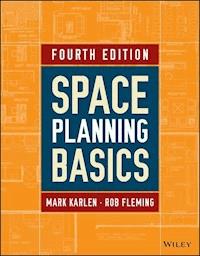
Space Planning Basics is a definitive introduction and principle resource for thousands of designers. With step-by-step methodology based on the author’s several decades of design experience, this authoritative guide has become the de facto reference for an entire generation of designers. This updated fourth edition includes digitized drawings, diagrams, and matrices throughout, and newly added supplemental photographs. The text has been revised to reflect the latest developments in sustainable and universal design, including coverage of daylighting, benchmarking, LEED system standards, and green code issues. The companion website provides AutoCAD files, intrustor videos and matrices to give you a deeper real-world understanding of the design process. This book is perfect preparation for the NCIDQ exam.
Proper space planning goes way beyond sketching a preliminary floor plan. Successful implementation includes a balanced integration of code compliance, system support, and adherence to the client’s functional needs. Sustainability adds a new, important layer of complexity. This book shows you how to approach space planning in a way that ensures all considerations are met, and nothing gets lost in the process.
- Adopt an organized and comprehensive planning methodology
- Work effectively with dimensionally challenging spaces
- Consider building systems, codes, lighting, acoustics, and more
- Develop advanced skills and conquer new challenges
Space planning encompasses many components and processes, making a comprehensive reference necessary for mastery of the field. Space Planning Basics is a thorough, methodical resource that gets you started on the right track, with plenty of room for creativity.
Sie lesen das E-Book in den Legimi-Apps auf:
Seitenzahl: 368
Veröffentlichungsjahr: 2016
Ähnliche


















Space Planning Basics
FOURTH EDITION
Mark Karlen
Rob Fleming
This book is printed on acid-free paper. ∞
Copyright © 2016 by John Wiley & Sons, Inc. All rights reserved.
Published by John Wiley & Sons, Inc., Hoboken, New Jersey.
Published simultaneously in Canada.
No part of this publication may be reproduced, stored in a retrieval system, or transmitted in any form or by any means, electronic, mechanical, photocopying, recording, scanning, or otherwise, except as permitted under Section 107 or 108 of the 1976 United States Copyright Act, without either the prior written permission of the Publisher, or authorization through payment of the appropriate per-copy fee to the Copyright Clearance Center, Inc., 222 Rosewood Drive, Danvers, MA 01923, (978) 750-8400, fax (978) 646-8600, or on the web at www.copyright.com. Requests to the Publisher for permission should be addressed to the Permissions Department, John Wiley & Sons, Inc., 111 River Street, Hoboken, NJ 07030, (201) 748-6011, fax (201) 748-6008.
Limit of Liability/Disclaimer of Warranty: While the publisher and author have used their best efforts in preparing this book, they make no representations or warranties with respect to the accuracy or completeness of the contents of this book and specifically disclaim any implied warranties of merchantability or fitness for a particular purpose. No warranty may be created or extended by sales representatives or written sales materials. The advice and strategies contained herein may not be suitable for your situation. You should consult with a professional where appropriate. Neither the publisher nor author shall be liable for any loss of profit or any other commercial damages, including but not limited to special, incidental, consequential, or other damages.
This publication is designed to provide accurate and authoritative information in regard to the subject matter covered. It is sold with the understanding that the publisher is not engaged in rendering professional services. If legal, accounting, medical, psychological or any other expert assistance is required, the services of a competent professional person should be sought.
Designations used by companies to distinguish their products are often claimed as trademarks. In all instances where John Wiley & Sons, Inc. is aware of a claim, the product names appear in initial capital or all capital letters. Readers, however, should contact the appropriate companies for more complete information regarding trademarks and registration.
For general information on our other products and services please contact our Customer Care Department within the United States at (800) 762-2974, outside the United States at (317) 572-3993 or fax (317) 572-4002.
Wiley publishes in a variety of print and electronic formats and by print-on-demand. Some material included with standard print versions of this book may not be included in e-books or in print-on-demand. If this book refers to media such as a CD or DVD that is not included in the version you purchased, you may download this material at http://booksupport.wiley.com. For more information about Wiley products, visit www.wiley.com.
Cover design: Wiley
Cover images courtesy of authors
Library of Congress cataloging-in-publication data available upon request.
CONTENTS
Preface
Introduction
Recommended Reading
Recommended Readings
1: Planning Methodology
Defining Terms and Intent
The Synthesis Gap
The Design Program
Criteria Matrix
Prototypical Plan Sketches
Completing the Criteria Matrix
Relationship Diagrams
A Final Note on Planning Methodology
Recommended Reading
Codes and Regulations
2: The First Planning Steps: Bubble Diagrams and Block Plans
Bubble Diagramming
Space Planning Exercises
Block Planning
Recommended Reading
*Codes and Regulations
3: Small and Dimensionally Demanding Spaces
Human Factors
Barrier-Free Design Standards
Travel and Egress
Furniture Planning and Placement
Recommended Reading
4: The Building Shell and Major Systems
The Building Shell
Plumbing Systems
Heating, Ventilating, and Air-Conditioning Systems
Recommended Reading
*Codes and Regulations
5: Important Influencing Factors
Building Codes
Green Building Rating Systems
Lighting Design
Acoustical Planning
Planning Rules of Thumb
Flexibility/Multiuse
Furniture
Spatial Quality
Interior Design Specialties
Recommended Reading
6: Developing a Rough Floor Plan
Getting Started
Construction Reality
Start with Plumbing
Major Spaces Next
Circulation Spaces
Basic Room Allocations
Furniture and Equipment
Storage and Filing
Spatial Quality
Sustainability Objectives
Review
Revisions
Recommended Reading
*Codes and Regulations
7: Refining the Solution
Refining the Rough Plan
The Preliminary Floor Plan
Drawing Quality and Techniques
Recommended Reading
8: Developing Skills beyond the Basic Level
Basic Implications
Programs within Programs
Open Plan/Systems Furniture
The Speculative Office Building
Future Expansion
Planning New Buildings
A Final Note
9: Stair Design Basics
Codes, Dimensions, and Configurations
Stair Design Case Studies—Phase I
Stair Design Case Studies—Phase II
Recommended Reading
Appendix A: Stair Terminology
Appendix B: Design Programs and Building Shells
Design Program 1A
Design Program 1B
Design Program 1C
Design Program 2A
Design Program 2B
Design Program 2C
Design Program 2S
Design Program 3A
Design Program 3B
Design Program 3C
BUILDING SHELLS
Building Description 1A
Building Description 1B
Building Description 1C
Building Description 2A
Buiding Description 2B
Building Description 2C
Building Description 2S
Building Description 3A
Building Description 3B
Building Description 3C
Index
Eula
List of Tables
Chapter 5
Table 5.1
Chapter 9
Table 9−1a
Table 9−1b
Table 9−1c
Table 9−1d
List of Illustrations
Chapter 1
Illus. 1–1 Synthesis gap
Illus. 1-2 Site inventory and analysis
Illus. 1–3 Blank criteria matrix.
Illus. 1–4 Criteria matrix by hand
Illus. 1-5 Prototypical plan sketches of office drawn by hand
Illus. 1-6 Prototypical plan sketches of office drawn by CAD
Illus. 1-7 Hand prototypicals sheet 1
Illus. 1-8 Hand prototypicals sheet 2
Illus. 1-9 CAD prototypicals sheet 1
Illus. 1-10 CAD prototypicals sheet 2
Illus. 1–11 Criteria matrix with square feet.
Illus. 1–12 Criteria matrix with square feet and adjacency.
Illus. 1–13 Expanded criteria matrix Illus. 1–13
Illus. 1–14 Relationship diagrams Illus. 1–14
Illus. 1–15 Relationship diagrams by CAD.
Chapter 2
Illus. 2–1. Getting started with bubble diagrams
Illus. 2–2. Bubble diagrams: Design Program 2S
Illus. 2–3. Bubble diagrams: Design Program 2S
Illus. 2-4. Block Plans Sheet 1 and 2 Illus. 2-4. Block Plans Sheet 1 and 2 Illus. 2-4.
Chapter 3
Illus. 3–1 Residential kitchens plans
Illus. 3–2 Residential bathroom plans
Illus. 3–3 Public restroom plans
Illus. 3–4 Specialized equipment—intensive spaces. (a) Mail/copy; (b) control room with plotters and computer station
Illus. 3–5 End of corridor turnaround
Illus. 3–6 Two-way corridor
Illus. 3–7 Right angle corridor turn
Illus. 3–8 Narrow passageway opening
Illus. 3–9 Maximum slope of a ramp
Illus. 3–10 Minimum door opening
Illus. 3–11 Placement of door hardware
Illus. 3–12 Dimensional requirements for handrails
Illus. 3–13 Dimensional requirements for toilet stalls
Illus. 3–14 Dimensional requirements for one-fixture toilet rooms
Illus. 3–15 Dimensional requirements for two-fixture toilet rooms
Illus. 3–16 Multifixture women’s and men’s public restrooms
Illus. 3–17 Residential and hotel bathrooms
Illus. 3–18 Residential kitchens
Illus. 3–19 Conference room
Illus. 3–20 Lounge/living room
Illus. 3–21 Perspective of restroom
Illus. 3–22 Pespective of kitchen
Chapter 4
Illus. 4–1 Building configuration influences space planning
Illus. 4–2 Special partition placement conditions.
Illus. 4–3 Plumbing fixtures grouped along common pipe chase. Construction and maintenance economies demand this type of arrangement.
Illus. 4–4 Rule of thumb for plumbing placement in a very preliminary planning stage.
Illus. 4–5 The placement of new partitions in the renovation of older buildings with systems similar to those illustrated here requires particular attention to construction details
and
acoustic control between rooms.
Illus. 4-6 HVAC air supply considerations: placement of supply air and return grilles
Illus. 4-7 HVAC air supply considerations: elevation/sectional view, human comfort concerns, avoidance of bad draft conditions
Chapter 5
Illus. 5–1 Natural light and air for habitable rooms
Illus. 5–2 (a) Building with generous natural light/view availability provides desirable conditions for a majority of employees. Workstations with low partitions allow daylight to penetrate into space; (b) Building with limited natural light/view availability creates difficult decisions concerning priorities on spaces with windows
Illus. 5–3 Typical reflected ceiling plans
Illus. 5–4a, b Space planning for good acoustics.
Illus. 5–5 Partition construction with sound transmission class estimates.
Illus. 5–6 Typical operating partitions.
Chapter 6
Illus. 6–1 Plumbing use spaces
Illus. 6–2 Incorporate major spaces.
Illus. 6–3 Incorporate circulation spaces
Illus. 6–4 Efficient corridor planning
Illus. 6–5 Basic room allocations
Illus. 6–6 Incorporate furniture
Illus. 6–7 File drawer accommodation
Illus. 6–8 Incorporate storage and filing
Illus. 6–9 (a) Entry and reception desk; (b) interview stations
Illus. 6–10 Marked-up corrections plan
Illus. 6–11 Rough plan revised
Illus. 6–12 Rough reflected ceiling plan
Chapter 7
Illus. 7–1 Minimal technique, CAD
Illus. 7–2 Minimal technique, freehand
Illus. 7–3 Enhanced technique, CAD
Illus. 7–4 Enhanced technique, freehand
Illus. 7–5 An additional hand-drawing technique
Illus. 7–6 An additional digital-drawing technique
Chapter 8
Illus. 8–1 (a) Departmental relationship diagram; (b) Departmental bubble diagram
Illus. 8–2 Stacking diagram
Illus. 8–3 Charrette diagram.
Chapter 9
Illus. 9–1 Shallow riser garden stair
Illus. 9–2 Garden step-ramp path
Illus. 9–3 Accommodating sloping terrain
Illus. 9–4 Roman-era amphitheater utilizing the sloping terrain
Illus. 9–5 Ladder access to southwest American Pueblo settlement
Illus. 9–6 Blois Chateau—famous sixteenth-century spiral stair
Illus. 9–7 Paris Opera House—famous late-nineteenth-century grand stair
Illus. 9–8 Stair to a contemporary penthouse
Illus. 9–9 The Louve, Paris—twentieth-century addition (I.M.Pei, archiect)
Illus. 9–10 TWA Terminal, JFK Airport, NY—(Eero Saarinen, architect)
Illus. 9–11 KPMS Building, courtyard stair, Munich, Germany
Illus. 9–12 Rudimentary rough-hewn stone stair
Illus. 9–13 Roman era ruins in Morocco
Illus. 9–14 Pompidou Center, Paris – exterior escalator (Renzo Piano, architect)
Illus. 9–15 Maximum and minimum riser tread dimensions
Illus. 9–16 Length-of-run differential.
Illus. 9–17 Nosing types.
Illus. 9–18 Three riser min/run
Illus. 9–19 Spiral stair.
Illus. 9–20 Code requirement for center handrails.
Illus. 9–21 Required minimum headroom and handrail dimension.
Illus. 9–22 Handrail types.
Illus. 9–23 Typical area of refuge.
Illus. 9–24 Stair configurations
Illus. 9–25 Stair configurations—continued
Illus. 9–26 Differences in length-of-runs comparing stair and ramp using maximum ramp incline of 1″ for every 1′-0″ height
Illus. 9–27 Stairs adjacent to a building.
Illus. 9–28 Top: Garden stairs. Bottom: Step ramps
Illus. 9–29 Plan and section of single stair showing use of break line.
Illus. 9–30 Plan and section of stair over stair showing use of break lines.
Illus. 9–31 Plan and section of typical mid-landing stairs showing use of break lines.
Illus. 9–32 Sectional perspective.
Illus. 9–33 Case Study 1
Illus. 9–34 Key plan
Illus. 9–35 Building sections and plan details
Illus. 9–36 Techniques for getting required egress stairs exiting directly to the exterior
Illus. 9–37 Case study
Illus. 9–38 Case Study 4
Illus. 9–39 Walls or solid railings on both sides of the wood stair.
Illus. 9–40 Wall on one side, exposed wood stringer on the other.
Illus. 9–41 Notched and exposed stringer
Illus. 9–42 Single central stringer.
Illus. 9–43 Cantilevered treads
Illus. 9–44 Suspended treads.
Illus. 9–45 Freestanding concrete stairs.
Illus. 9–46 Wood stair construction and details
Illus. 9–47 Steel stair construction and details
Illus. 9–48 Concrete stair construction and details.
Appendix B
Illus 1A Building shell—site plan, floor plan and section
Illus 1B Building shell—site plan, floor plan and section
Illus 1C Building shell—key plan, floor plan and section
Illus 2A Building shell—site plan, floor plan and section
Illus 2A RC–Building shell–reflected ceiling plan
Illus 2B Building shell—site plan, floor plan and section
Illus 2C Building shell—key plan, floor plan and section
Illus 2S Building shell—site plan, floor plan and section plan
Illus 3A Building shell—site plan, floor plan and section
Illus 3B Buiding shell—site plan, floor plan and section
Illus 3C 3C Building shell—site plan, floor plan and section
Illus 3C 3C RC–Buiding shell—reflected ceiling plan
Guide
Cover
Table of Contents
Preface
Pages
ix
x
xi
xii
xiii
xiv
1
2
3
4
5
6
7
8
9
10
11
12
13
14
15
16
17
20
21
22
23
28
29
33
34
35
36
37
38
39
41
42
43
46
47
48
49
51
52
53
54
55
56
57
58
59
60
62
63
64
66
67
68
69
70
71
72
73
74
75
76
77
78
79
80
81
82
83
84
85
86
87
88
89
91
92
93
94
95
96
97
98
99
101
102
103
104
105
106
107
108
109
111
112
113
114
115
117
118
119
120
121
122
124
125
126
127
129
130
131
132
133
134
135
136
138
139
140
143
144
145
146
147
148
150
151
152
153
154
155
156
157
158
159
160
162
163
164
165
166
167
168
169
170
171
172
173
174
175
176
179
180
181
182
183
184
186
187
189
191
192
193
194
195
196
197
198
199
200
201
202
203
204
205
206
207
208
209
210
211
212
213
214
215
216
217
218
219
220
221
222
223
225
227
228
229
231
232
233
234
235
236
237
Preface
There are two major new elements to this fourth edition of Space Planning Basics. The first is its digital content (available at www.wiley.com/go/KarlenSpace4e). All of the illustrations, design programs, and building shell drawings can be brought up on your computer screen, so that you can copy illustrations and floor plans and manipulate and work with matrixes and floor plans in completing the many programming and space planning exercises.
The second new element is the integration of sustainable design concepts and information. Sustainability has become a significant, if not essential, factor in the space planning process. For many, sustainable design is associated primarily with green roofs, solar panels and rainwater collection. The creation of high-quality interior spaces includes concerns for human comfort, social interaction, and productive and aesthetically appealing work spaces, all of which are necessary for sustaining a strong and vibrant quality of life. These issues are not new to those who design interior spaces, but they are not generally associated with the broad concepts of sustainability. The integration of sustainability and space planning demands a collaborative and multidisciplinary approach to the space planning process. The revised text in this edition directs the reader to focus on sustainable design concepts and techniques—such as energy and water conservation, improved daylighting, indoor air quality, integrating active mechanical systems, and engagement with the building envelope—as part of the space planning process. This is clearly the necessary direction for those involved in creating the buildings and spaces of our future.
For the past two years I’ve had the opportunity to team teach a collaborative design studio course at Philadelphia University. This past year the studio consisted of 25 students; 14 of them in Professor Rob Fleming’s Master of Science Sustainable Design Program and 11 of them, in my charge, students in the Master of Science Interior Architecture Program. In addition to Rob and me, adjunct faculty in mechanical engineering, landscape architecture, and construction management were also involved. The students in both programs came from a great variety of undergraduate disciplines. They were grouped in teams of four or five students; each team was charged with solving a large and complex adaptive reuse urban project over the course of one semester. In a truly collaborative effort, the interior architects on each team space planned and designed the interior elements, while the others worked with all of the sustainable design concerns of the project. It was a successful and rewarding experience for all involved.
The extra benefit for me was working with Rob Fleming in planning the course and teaching in the studio together. Rob is a particularly devoted and energetic teacher and program manager from whom I’ve learned a great deal. The students in the collaborative studio made use of the previous edition of this book, but I realized that Space Planning Basics needed an infusion of the sustainable design concepts that they had integrated into their problem-solving techniques. I was pleased when Rob agreed to join me as a coauthor in this fourth edition, so that some of his depth of knowledge and experience in sustainable design could become an integral part of students’ experiences with this book.
In addition to my appreciation for Rob Fleming providing new and critical content for this educational tool, I want to acknowledge the collaborative help of two young architects, Madhura Dhayagude and Pratiksha Patel, who have been invaluable in reconfiguring and digitizing much of the book’s graphic material, from diagrams and matrixes to floor plans and sections. I’m indebted to the designer/architect team of Kate Lyons and Peter Elsbeck, who provided the perspective sketches in Chapters 3 and 6. As always, special thanks to Paul Drougas and Seth Schwartz, my editors at Wiley, who have been consistent supporters throughout the entire process. My hope is that the resulting book is of significant value to students in mastering space planning and stair design skills.
MARK KARLEN
Lesen Sie weiter in der vollständigen Ausgabe!
Lesen Sie weiter in der vollständigen Ausgabe!
Lesen Sie weiter in der vollständigen Ausgabe!
Lesen Sie weiter in der vollständigen Ausgabe!
Lesen Sie weiter in der vollständigen Ausgabe!
Lesen Sie weiter in der vollständigen Ausgabe!
Lesen Sie weiter in der vollständigen Ausgabe!
Lesen Sie weiter in der vollständigen Ausgabe!
Lesen Sie weiter in der vollständigen Ausgabe!
Lesen Sie weiter in der vollständigen Ausgabe!
Lesen Sie weiter in der vollständigen Ausgabe!
Lesen Sie weiter in der vollständigen Ausgabe!
Lesen Sie weiter in der vollständigen Ausgabe!
Lesen Sie weiter in der vollständigen Ausgabe!




