


17,99 €
Mehr erfahren.
- Herausgeber: John Wiley & Sons
- Kategorie: Geisteswissenschaft
- Serie: Viewpoints / Puntos de Vista
- Sprache: Englisch
Spaniards in the Colonial Empire traces the privileges, prejudices, and conflicts between American-born and European-born Spaniards, within the Spanish colonies in the Americas from the sixteenth to early nineteenth centuries.
- Covers three centuries of Spanish colonial power, beginning in the sixteenth century
- Explores social tension between creole and peninsular factions, connecting this friction with later colonial bids for independence
- Draws on recent research by Spanish and Spanish-American historians as well as Anglophone scholars
- Includes some coverage of Brazil and British colonies
Sie lesen das E-Book in den Legimi-Apps auf:
Seitenzahl: 368
Veröffentlichungsjahr: 2012
Ähnliche




















Table of Contents
Cover
Viewpoints/Puntos de Vista: Themes and Interpretations in Latin American History
Title page
Copyright page
Dedication
Illustrations
Maps
Figures
Series Editor’s Preface
Preface
Acknowledgments
1 Spain and Its Early Empire in America
Spain on the Eve of Empire
Peninsulars Create Their New World
2 Native Sons and Daughters in the Church
Patronage and the Preparation of Clerics
The Regular Clergy
Rotation in the Orders’ Provincial Offices
Female Convents
The Secular Clergy
3 Native Sons in Office
The Crown’s Conquest
Offices
The Sale of Offices and Appointments
Native Sons
4 The Heyday of Native Sons and Daughters, circa 1630–1750
Social, Financial, and Political Capital
The Sale of Appointments
Native Sons and Other Creoles in the Clergy and Royal Offices
5 Reforms, Commentaries, and Officials, 1750–1808
The Indies at Mid-eighteenth Century
Commentaries
The Peninsular Offensive: Royal Offices
6 The Church, Complaints, and Social Change, 1750–1808
Clergy and Convents
Native Son Complaints
Social Diversity among Native Sons and Daughters
7 From Abdications to Independence
Peninsulars on the Eve of Crisis
Response to the Abdications
Elections and American Grievances
The Cortes of Cádiz
Constitution of 1812
Peninsulars Use the Press
300 Years of Infamy
Creole Appointments to Royal and Church Offices, 1808–1814
The Return of Ferdinand VII
American Panorama, 1808–1814
Anti-Peninsular Policies
From Viceregal New Spain to Independent Mexico
The Plan of Iguala
Independence in Brazil
Glossary
Suggestions for Further Reading
Index
Viewpoints/Puntos de Vista: Themes and Interpretations in Latin American History
Series editor: Jürgen Buchenau
The books in this series will introduce students to the most significant themes and topics in Latin American history. They represent a novel approach to designing supplementary texts for this growing market. Intended as supplementary textbooks, the books will also discuss the ways in which historians have interpreted these themes and topics, thus demonstrating to students that our understanding of our past is constantly changing, through the emergence of new sources, methodologies, and historical theories. Unlike monographs, the books in this series will be broad in scope and written in a style accessible to undergraduates.
Published
A History of the Cuban Revolution
Aviva Chomsky
Bartolomé de las Casas and the Conquest of the Americas
Lawrence A. Clayton
Beyond Borders: A History of Mexican Migration to the United States
Timothy J. Henderson
The Last Caudillo: Alvaro Obregón and the Mexican Revolution
Jürgen Buchenau
A Concise History of the Haitian Revolution
Jeremy Popkin
Spaniards in the Colonial Empire: Creoles vs. Peninsulars?
Mark A. Burkholder
In preparation
Dictatorship in South America
Jerry Davila
Mexico Since 1940: The Unscripted Revolution
Stephen E. Lewis
This edition first published 2013
© 2013 Mark A. Burkholder
Blackwell Publishing was acquired by John Wiley & Sons in February 2007. Blackwell’s publishing program has been merged with Wiley’s global Scientific, Technical, and Medical business to form Wiley-Blackwell.
Registered Office
John Wiley & Sons Ltd, The Atrium, Southern Gate, Chichester, West Sussex, PO19 8SQ, UK
Editorial Offices
350 Main Street, Malden, MA 02148-5020, USA
9600 Garsington Road, Oxford, OX4 2DQ, UK
The Atrium, Southern Gate, Chichester, West Sussex, PO19 8SQ, UK
For details of our global editorial offices, for customer services, and for information about how to apply for permission to reuse the copyright material in this book please see our website at www.wiley.com/wiley-blackwell.
The right of Mark A. Burkholder to be identified as the author of this work has been asserted in accordance with the UK Copyright, Designs and Patents Act 1988.
All rights reserved. No part of this publication may be reproduced, stored in a retrieval system, or transmitted, in any form or by any means, electronic, mechanical, photocopying, recording or otherwise, except as permitted by the UK Copyright, Designs and Patents Act 1988, without the prior permission of the publisher.
Wiley also publishes its books in a variety of electronic formats. Some content that appears in print may not be available in electronic books.
Designations used by companies to distinguish their products are often claimed as trademarks. All brand names and product names used in this book are trade names, service marks, trademarks or registered trademarks of their respective owners. The publisher is not associated with any product or vendor mentioned in this book. This publication is designed to provide accurate and authoritative information in regard to the subject matter covered. It is sold on the understanding that the publisher is not engaged in rendering professional services. If professional advice or other expert assistance is required, the services of a competent professional should be sought.
Library of Congress Cataloging-in-Publication Data
Burkholder, Mark A., 1943-
Spaniards in the colonial empire : creoles vs. peninsulars? / Mark A. Burkholder.
p. cm. – (Viewpoints / Puntos de vista)
Includes bibliographical references and index.
ISBN 978-1-4051-9642-0 (hardback : alk. paper) – ISBN 978-1-4051-9641-3 (pbk.) 1. Creoles–Latin America–History. 2. Creoles–Legal status, laws, etc–Latin America–History. 3. Spaniards–Latin America–History. 4. Spaniards–Legal status, laws, etc.–Latin America–History. 5. Latin America–History–To 1830. 6. Spain–Colonies–Administration. I. Title.
F1419.C74B85 2013
980'.01–dc23
2012025033
A catalogue record for this book is available from the British Library.
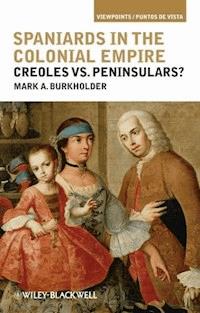
Cover image: A Spaniard and His Mexican Indian Wife and Their Child, by Miguel Cabrera (1763) © The Gallery Collection / Corbis
Cover design by Richard Boxhall Design Associates
For
Sue Burkholder, D. S. Chandler, and James S. Saeger
Illustrations
Maps
1
Bishoprics in the Americas, 1620.
2
Audiencia
Capitals, 1750.
Figures
1.1
A lady of Lima wearing her wedding dress.
2.1
Interior courtyard of the University of Mexico.
2.2
Mercedarian convent. One of many convents for friars in Mexico.
2.3
Interior of cathedral in Mexico City. Appointment to the cathedral chapter of Mexico was a high honor that numerous native sons attained.
4.1
A well-to-do Chilean woman with servant. White women of any means usually had one or more servants.
6.1
Sor Juana Inés de la Cruz. A brilliant native daughter poet of Mexico whose works continue to find readers.
6.2
Equestrian statue of Charles IV. The ill-fated Bourbon monarch of Spain who abdicated to his son Ferdinand VII in 1808 and subsequently to Napoleon.
6.3
Viceregal palace in Mexico City. Interior of the viceregal palace of New Spain in the sixteenth and seventeenth centuries.
7.1
Miguel Hidalgo. A native son cleric who initiated a rebellion against peninsulars in Mexico in 1810.
7.2
Simón Bolívar. A native son of Venezuela, “The Liberator” declared “war to the death” against peninsulars who refused to actively embrace the cause of independence.
Series Editor’s Preface
Each book in the Viewpoints/Puntos de Vista series introduces students to a significant theme or topic in Latin American history. In an age in which student and faculty interest in the Global South increasingly challenges the old focus on the history of Europe and North America, Latin American history has assumed an increasingly prominent position in undergraduate curricula.
Some of these books discuss the ways in which historians have interpreted these themes and topics, thus demonstrating that our understanding of our past is constantly changing, through the emergence of new sources, methodologies, and historical theories. Others offer an introduction to a particular theme by means of a case study or biography in a manner easily understood by the contemporary, nonspecialist reader. Yet others give an overview of a major theme that might serve as the foundation of an upper-level course.
What is common to all of these books is their goal of historical synthesis. They draw on the insights of generations of scholarship on the most enduring and fascinating issues in Latin American history, and through the use of primary sources as appropriate. Each book is written by a specialist in Latin American history who is concerned with undergraduate teaching, yet has also made his or her mark as a first-rate scholar.
The books in this series can be used in a variety of ways, recognizing the differences in teaching conditions at small liberal arts colleges, large public universities, and research-oriented institutions with doctoral programs. Faculty have particular needs depending on whether they teach large lectures with discussion sections, small lecture or discussion-oriented classes, or large lectures with no discussion sections, and whether they teach on a semester or trimester system. The format adopted for this series fits all of these different parameters.
In this sixth volume in the Viewpoints/Puntos de Vista series, Professor Mark Burkholder analyzes Spanish colonialism in the Americas from the vantage point of the “Spaniards” themselves, a group that included peninsulars, recent arrivals born in Spain, and creoles, people born of Spanish descent in the New World. Spaniards in the Colonial Empire: Creoles vs. Peninsulars? discusses the relationship between these groups, and particularly the growing conflict over the Crown’s favoring of peninsulars for political office, which helped predicate the devastating Wars of Independence and, ultimately, the emergence of Latin American nations in the 1820s.
Burkholder skillfully disaggregates the terms “creole” and “peninsular,” both of which included a wide variety of individuals from different social strata. He also examines the many similarities between the groups, including shared social, legal, and economic privileges that placed them atop colonial society. He pays close attention to intermarriages and other forms of union and cooperation between peninsulars and creoles, concluding that open conflict was rare before the Spanish empire in the Americas entered its decline following Napoleon’s invasion of Spain in 1807. Ambitious in scope yet concise and accessible to undergraduate students, this is the only current work that brings the Spaniards in their vast colonial empire to life.
Jurgen BuchenauUniversity of North Carolina, Charlotte
Preface
This short book for undergraduates focuses on a large topic – creoles (Spaniards born in the “Indies,” as they termed the New World), and their relationships, rivalries, and ultimately open conflict with peninsulars (Spaniards born in Spain). It pays particular attention to “native sons” and “native daughters,” terms used as synonyms for “creoles” within the region of their birth, two issues, and an offensive attitude. The first issue is the rewards that native sons and daughters and other creole descendants of conquistadors and early settlers claimed they should receive in recognition of their ancestors’ service to the Crown. The second issue concerns appointments to ecclesiastical and royal offices that native sons believed were legally theirs by virtue of their birthplace. The offensive attitude is the smug superiority that numerous peninsulars displayed in their relations with the rest of society, including native sons and daughters and other creoles, by reason of their birth in Spain and claims of unsullied Spanish ancestry. Portuguese born in Brazil similarly objected to immigrants from Portugal because of their arrogant attitude.
Spaniards in the Indies were either immigrants or born there. While place of birth affected their view of themselves and each other as well as their position in colonial society, all Spaniards in America enjoyed benefits denied to indigenous peoples and others of non-Spanish descent. This was also true in Brazil where Portuguese distinguished between compatriots from Iberia or reinois and native sons known as mazombos or brasileiros. Besides being peninsulars or creoles, Spaniards had other identities: all were natives of (natural de) a specific municipality and a larger administrative region. For example, creoles born in Arequipa, Peru, were native sons and daughters of that city as well as the region under the jurisdiction of the high court or Audiencia of Lima. Regions became their homelands or patrias; municipalities were their hometowns or patrias chicas. Both provided compatriots (paisanos) who frequently supported each other.
The collective term “creoles” is useful when applied broadly to Spaniards born in different jurisdictions. Whenever possible, however, this book employs “native sons” and “native daughters” and distinguishes them from “other creoles” born in different administrative and ecclesiastical units. The Crown made the same distinction. Importantly, it drew upon early Castilian legislation to justify a general policy of excluding native sons from royal offices with judicial responsibilities in their home jurisdiction because of family and economic ties. Native sons and daughters, of course, were not homogeneous. Disputes arose among them as well as with other groups in society. Differences in social “quality” (calidad), occupation and financial status also divided them from other creoles and peninsulars regardless of location or birthplace.
Conflict among Spaniards contesting the rewards of conquest in the New World pitted “old hands” – the first conquistadors and settlers – against later arrivals from Spain – the “newcomers” or “greenhorns.” Antagonism also emerged between native sons, including the legitimate American-born descendants of old hands, and outsiders, whether peninsulars or creoles living away from their homelands. Repeatedly, native sons focused attention on institutions in which they faced discrimination. Initially this included admission to religious orders; subsequently it expanded to elective positions within these orders’ provinces or territorial units. The Crown’s appointment of peninsulars to ecclesiastical and royal offices to which native sons asserted a legal right provoked repeated and outspoken protest.
Despite internal rivalries, all whites in the Indies shared identifiable cultural characteristics. Originally they referred to themselves as “Christians” and “Spaniards” regardless of place of birth. Most arrived in the Indies speaking Castilian Spanish. They shared a belief in Christianity and allegiance to a single monarch; emphasized honor and marital, family, local, and regional bonds; pursued economic interests; and displayed an attitude of superiority toward the rest of society. These commonalities helped to unite them regardless of place of birth.
By the early 1560s, the word criollo or “creole” designated a Spaniard born in the Indies. Criollo is derived from the Portuguese crioulo, a word that imported Africans (bozales) used to refer derogatorily to American-born descendants of earlier slaves. This connection to slavery gave “creole” a pejorative connotation, although by the late seventeenth century, some native sons proudly adopted it. Other synonyms for creole included indiano, hijo de la tierra, benemérito and, especially in the eighteenth century, español americano (American Spaniard) or simply americano (American). From the seventeenth century onward, gachupín (one who wear spurs) in New Spain and chapetón (tenderfoot or greenhorn) elsewhere became widespread although somewhat deprecating terms for recently arrived Spanish immigrants in particular. “Peninsular” as a synonym for a person born in Spain entered frequent usage in the early nineteenth century as an outgrowth of the “Peninsular War,” as the British dubbed the conflict fought against Napoleon’s armies in Iberia from 1808 to 1814. Because of its convenience, historians continue to apply the term when identifying Spaniards born in Spain. Far from their birthplace, these immigrants quickly realized that their identity had to encompass more than the village, town, or even city and bishopric from which they came. Thus, they identified themselves by their “nation” or region in Spain, for example, as Andalusians, Extremadurans, Basques (conflating the Basque Provinces of Vizcaya, Guipúzcoa, and Alava, plus sometimes Navarre), and Montañeses (as persons from the mountains of Burgos north into Cantabria or Santander were known). At times, language separated the immigrants. The majority shared the Castilian dialect, but Basques, Galicians, and Catalans often had to learn that language in America.
Creoles frequently asserted that recent immigrants only sought to get rich quickly and return wealthy to Spain, but probably less than 10% ever did so. Most found work in the Indies, established a residence, and embedded themselves in their new locale. This book uses “radicados” as a collective term for “rooted” Spaniards or Portuguese who settled outside of their homeland (patria) and often married in their new place of residence; developed local economic, family, and political interests; and became heads of citizen households (vecinos) in their new municipality.1
Contemporaries writing about the wars of independence in the early nineteenth century emphasized the importance of peninsular discrimination against creoles and claimed superiority over them as a cause of the conflicts. Independence itself brought the expulsion or execution of peninsulars either during the conflict or soon afterward in every former mainland colony. Native sons and other political and military leaders repeatedly made their Old World rivals scapegoats as well as a source of funds. The Liberator Simón Bolívar’s infamous proclamation of “war to the death” was the most extreme example of anti-peninsular policy. But patriots also hurled phrases like “300 years of servitude” as political slogans and to draw attention to creoles’ claim during and immediately after the wars of sharing centuries of oppression with the indigenous population.
But how widespread was discrimination against creoles? How deep was their antipathy toward peninsulars? It is impossible to know for certain, but after the age of conquest, a relatively small number of immigrants arrived with enviable positions or achieved remarkable financial success. In contrast, examples of poor whites – of both genders and regardless of place of birth – abound.
Enviable peninsulars were those who gained wealth and honors. They included very successful wholesale merchants and a much smaller number of miners; high-ranking officeholders and clerics; and retainers who accompanied viceroys and bishops to their posts, especially in the Habsburg centuries, and received benefits as a result. Aside from clerics, many of these immigrants married native daughters who thus created ties that rooted their husbands in their district of residence and distinguished them from unmarried Spaniards. These radicados were probably as likely to take a “native son” position, or one of several positions, on most issues of the day as were local creoles.
This book is one of the few scholarly efforts to examine the relationship between creoles in general and native sons and daughters in particular with peninsulars from the sixteenth century through independence. It goes beyond claimed discrimination to pay special attention to the extent to which native sons and other creoles actually secured offices. Among its points are the following: (i) all persons recognized as Spaniards in the Indies, regardless of gender or place of birth, enjoyed privileges that set them apart from the rest of the population; (ii) the native son heirs of conquistadors and early settlers could document royal promises of preference for certain appointments; (iii) conflicts between peninsulars and creoles were most vehement in the male religious orders, but occurred in the nunneries as well; (iv) American-born lawyers, especially those educated in Lima, both advocated for native son and other creole preference and were among the beneficiaries of royal patronage; (v) recently arrived peninsulars ignited more opposition than those of longer residence; (vi) cooperation, mutual interest, and native daughter incorporation of peninsulars into local elites through marriage characterized most creole–peninsular relations at the apex of local society throughout the empire; (vii) despite repeated allegations to the contrary, the number of elite creoles genuinely hostile toward peninsulars was rarely large prior to 1808–1810, but increased over the next 10–15 years; and (viii) during the wars of independence and formation of independent states, leaders spawned an unprecedented level of opposition to peninsulars that resulted in confiscation of their property, expulsion, and sometimes death.
Acknowledgments
This book would not have been possible without the work of other historians. While its format and student audience preclude a lengthy multi-language bibliography, I want to single out the contributions of the following scholars: Lucrecia Raquel Enríquez Agrazar; Javier Barrientos Grandon, Michel Bertrand, Paulino Castañeda Delgado, Jorge Comadrán Ruiz, Paul Ganster, Bernard Lavallé, Guillermo Lohmann Villena, Juan Marchena Fernández, Oscar Mazín Gómez, Angel Sanz Tapia, Ernst Schäfer, John Frederick Schwaller, Stuart B. Schwartz, Renan Silva, and Susan M. Socolow. Their publications, materials that D. S. Chandler and I gathered long ago, and subsequent information I have collected provide the core of the book’s discussion of royal officials and clerics.
I thank Jürgen Buchenau and Peter Coveney for supporting the proposal that led to this book and Allison Medoff for shepherding the manuscript through the publication process. Douglas Catterall encouraged me to think of the project as a contribution to the history of the Atlantic World. Conversations and coauthored publications with D. S. Chandler many years ago laid the basis for the book’s emphasis on native sons and radicados. Mary Zettwoch and Erica Marks at the Thomas Jefferson Library of the University of Missouri-St. Louis consistently provided outstanding interlibrary loan service. I greatly appreciate the anonymous readers who offered thoughtful and at times trenchant critiques of the manuscript. Additionally, I am grateful to Kristen M. Burkholder for carefully reading a late draft of the manuscript despite the constraints on her time. The result is a much better book for which I alone remain responsible for errors and foibles. With grace and charm, Carol D. Burkholder endured my seemingly endless hours at the computer. I thank her for her love and support.
Mark A. BurkholderSt. Louis, Missouri
Map 1 Bishoprics in the Americas, 1620.
Map 2 Audiencia Capitals, 1750.
Note
1 This use of vecino as citizen diverges from current usage (ciudadano) that attaches the term to a national state, but contemporaries fully appreciated the difference between a municipality’s citizens and its temporary and even other permanent residents.
1
Spain and Its Early Empire in America
On the eve of Europeans’ first sustained contact with the Americas, Castile was the largest, most prosperous, and most populous kingdom of the Iberian Peninsula. Victory over the Muslims in Granada in 1492 confirmed Castilians’ belief that they enjoyed their God’s favor. Simultaneously it demonstrated that military success led grateful monarchs to reward service on their behalf by enriching aristocrats, elevating commoners into the nobility, and providing poor soldiers with land.
Lesen Sie weiter in der vollständigen Ausgabe!
Lesen Sie weiter in der vollständigen Ausgabe!
Lesen Sie weiter in der vollständigen Ausgabe!
Lesen Sie weiter in der vollständigen Ausgabe!
Lesen Sie weiter in der vollständigen Ausgabe!
Lesen Sie weiter in der vollständigen Ausgabe!
Lesen Sie weiter in der vollständigen Ausgabe!
Lesen Sie weiter in der vollständigen Ausgabe!
Lesen Sie weiter in der vollständigen Ausgabe!




