


13,99 €
Mehr erfahren.
- Herausgeber: Robert Hale Non Fiction
- Kategorie: Geisteswissenschaft
- Sprache: Englisch
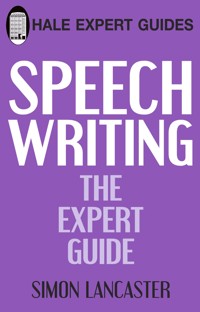
Speechwriting is the definitive guide to writing a speech, revealing all the tools and techniques of the trade, such as how to win an argument, construct a sound bite and perform on stage. The first part of the book covers the arts of persuasion, argument, story telling and metaphor, providing a solid grounding in the theory of speechwriting, which should appeal to anyone with an interest in politics, communication or language. The second part covers the crafts of editing, sound bites, media manipulation, performance and strategy, giving invaluable practical guidance to professional or aspiring speechwriters. This book combines academic rigour with practical nous, drawing on lessons from Aristotle to Obama. It is the essential guide for anyone who writes speeches, for themselves or others, in politics, PR or business.
Das E-Book können Sie in Legimi-Apps oder einer beliebigen App lesen, die das folgende Format unterstützen:
Veröffentlichungsjahr: 2018
Ähnliche


















SPEECHWRITING:THE EXPERT GUIDE
SIMON LANCASTER
ROBERT HALE
First published in 2010 by Robert Hale, an imprint of
The Crowood Press Ltd, Ramsbury, Marlborough Wiltshire SN8 2HR
www.crowood.com
This e-book first published in 2018
This impression 2016
© Simon Lancaster 2015
All rights reserved. This e-book is copyright material and must not be copied, reproduced, transferred, distributed, leased, licensed or publicly performed or used in any way except as specifically permitted in writing by the publishers, as allowed under the terms and conditions under which it was purchased or as strictly permitted by applicable copyright law. Any unauthorised distribution or use of thistext may be a direct infringement of the author’s and publisher’s rights, and those responsible may be liable in law accordingly.
British Library Cataloguing-in-Publication Data
A catalogue record for this book is available from the British Library.
ISBN 978 0 71982 868 3
The right of Simon Lancaster to be identified as author of this work has been asserted by her in accordance with the Copyright, Designs and Patents Act 1988.
All illustrations by Paul Rainey
Six years ago I got married. Since then, my life has just got better and better. This book is dedicated to my lovely wife, Lucy.
Contents
Acknowledgements
Introduction
Chapter One
The Art of Speechwriting
Chapter Two
The Craft of Speechwriting
Chapter Three
The Art of Persuasion
Chapter Four
The Art of Argument
Chapter Five
The Art of Story-telling
Chapter Six
The Art of Metaphor
Chapter Seven
The Craft of Editing
Chapter Eight
The Craft of Soundbites
Chapter Nine
The Craft of Media Manipulation
Chapter Ten
The Craft of Performance
Chapter Eleven
The Craft of Strategy
Epilogue
Glossary
Bibliography
Notes and References
Index
Acknowledgements
Eleven years ago, I was on a train to Harrogate with the newly appointed industry minister, Alan Johnson. Alan was on his way to deliver a speech on employment rights in Harrogate. I was his private secretary, there to do his bidding. I had wanted to be a minister’s private secretary ever since watching Yes Minister at school. I’d loved watching the tension between the loquacious, verbose Sir Humphrey and pithy, plain-speaking Hacker and here I was observing one of those classic Yes Minister moments up close. ‘This is f***ing diabolical,’ said Alan, as he tore through the draft speech prepared by the civil service. ‘I’m starting again,’ he said, taking out his pen. The civil service isn’t keen on ministers winging it, particularly not on contentious issues like employment rights, particularly not before hardened audiences of trade unionists and hacks. But, as soon as he started speaking, the whole room was captivated. During the two hours it took to get from London to Harrogate, Alan had assembled all the essential components of a successful speech.
There was a throat-grabbing opening which expertly exposed the central thesis: ‘Stalin. Mussolini. Hitler. The first thing every despot did on their march to power was destroy the trade union movement. That’s because they knew that free independent trade unions are a fundamental part of a functioning democracy.’ A stat: ‘The Conservative Party have held power for longer in Britain in the twentieth century than the Communists did in Russia.’ A good joke (at my expense): ‘This is the first time my private secretary’s been north of Watford. He thought Harrogate was a scandal at a top public school.’ A metaphor: ‘Employment rights are a safety net, not a trampoline.’ Imagery: ‘I was there at the TUC conferences of the 1970s in my tank top and flares and we voted against a national minimum wage. With 13 million members, this was the glam rock era of the trade union movement.’ A story: ‘When I became General Secretary of the Communication Workers Union, there was a special white phone on my desk. My predecessor, Alan Tuffin, was told by Tom Jackson – his predecessor and a famous public figure in the 1970s – that when the white phone rang it would be a top civil servant or a Government Minister contacting him on important issues concerning BT or the Post Office. Alan spent his ten years as General Secretary under a Tory Government. When he handed over to me he said plaintively that the phone had only rung once. It was a woman asking if that was Sainsburys.’
The speech was not reported in any of the papers and has probably been long-since forgotten by everyone else who attended but it scorched deep on my memory. In that fifteen-minute speech, Alan Johnson irreversibly changed the way I thought about two things: one political and one personal. First, politically: I was brought up in the 1980s with media images of fighting miners and combative party conferences; I’d generally agreed with Margaret Thatcher’s view that trade unions were ‘the enemy within’. But Alan’s speech gave me a completely new perspective on the history of trade unions and their role in modern society; I didn’t go rushing straight out to sign up but he had definitely nudged my thinking along.
On a personal level, I was struck far more profoundly though by the way that Alan’s persuasive skill had helped him shake off the shackles of a poor upbringing and climb up the social ladder, first becoming leader of a trade union, then an MP and then a minister. I found his story amazingly inspiring. A number of people approached me during the coffee break and said what a smashing speech by a smashing person it had been. I agreed wholeheartedly.
I decided there and then that I wanted to be a speechwriter. Two years later, I got my first full-time speechwriting gig writing Patricia Hewitt’s speeches as Secretary of State for Trade and Industry and Minister for Women and Equality. When Alan Johnson joined the Cabinet a few years later, he asked me to write his speeches and I then worked with him across a string of departments, eventually becoming Whitehall’s longest serving speechwriter. I left government in 2007 and set up Britain’s first speechwriting agency: Bespoke. Since then, I have written for all sorts of incredible people, including the CEOs of HSBC and Cadbury, top politicians from left and right, Britpop rock stars, Olympic gold medallists, famous celebrities and rabble rousers. I’ve never looked back, so my deepest thanks to Alan for setting me off on this amazing journey and for remaining such a profound inspiration to me and many others.
This book contains the fruits of ten years writing and studying speeches. As well as working with many great speakers, I’ve worked with many of Britain’s best speechwriters, including Julie Braithwaite, Charlotte Carr, Sam Coates, Phil Collins, Sarah Gibbons, Nicola Gilbert, Tom Greeves, Sara Halliday, Andrew Kaye, Tim Kiddell, Michael Lea, Mark Morris, Fiona Murray, Jo Nadin, Jenny Poole and Matt Shinn. I’ve also worked with some great communication gurus including Professor Marion Banks, Aileen Boughen, David Cracknell, Sheree Dodd, Mario Dunn, Jim Godfrey, Iain Hepplewhite, Sian Jarvis, Deb Lincoln, Bron Madson, Jo Moore, Clare Montagu, Chris Norton, Roger Sharp, Vickie Sheriff, John Shield, Mike Snowdon, Matt Tee, Kitty Ussher, Ben Wilson and Caroline Wright. I also owe a huge debt to Andrew Adonis, Bryan Holden, Tracy Vegro and Mela Watts for giving me a leg up the career ladder at crucial points.
Writing this book has been an unusually isolating experience. I’m incredibly grateful to all those who interrupted my solitude to review early drafts. Particular thanks go to Mike Edwards, Lyndsey Jenkins, Peter Steggle, David Tinline and Tom ‘four brains’ Clark, for providing comments that were far crisper and clearer than my early drafts. I am also inordinately grateful to Paul Rainey (www.pbrainey.com) for taking my childlike doodles and turning them into the fantastic illustrations that now feature throughout this book. I’m grateful to Scott Mason for the number crunching. I’m also grateful to all those at Robert Hale, particularly Alexander Stilwell, Nikki Edwards and Victoria Lyle, for being so kind, considerate and supportive throughout the whole writing process.
But most thanks must go to my family: my mum for instilling in me a love of reading and writing from the earliest age, my brother for his unstinting friendship and support and my lovely wife and wonderful daughter for being the big, big loves of my life. Lucy has not only supported me all the way, she has also lent her own communications expertise to shaping the ideas in this book. She has read the manuscript several times as well as allowing our dinner conversations to drift on to the subject of ‘how to win an argument’ far more times than can be healthy in a marriage. My hilariously funny daughter, Lottie, also made a number of perceptive comments during the drafting process. She aimed carefully targeted splats of baby porridge at the manuscript in the early days and has intervened latterly with long lines of green felt-tip pen. Nothing makes me prouder than seeing Lottie on the floor doodling on the manuscript because she has seen me do the same.
Those are the thanks. Now for the apologies. There are well over 70,000 words in this book and some offence is inevitable. Indeed, if this book didn’t cause offence, I’d be sure I’d have failed. So here goes.
Apology one: I use the male third person pronoun throughout the book. This is simple short-hand and is not designed to offend the fairer sex, of whom I am inordinately fond.
Apology two: I use some pretty abominable reference points in the book, quoting Adolf Hitler, Robert Mugabe and Nick Griffin amongst others. I’m not endorsing them in any way: for the record, I find them all repugnant. But oratory does have a murky side as well as a bright side and a rounded view is necessary.
Apology three: this book contains some pretty nasty and Machiavellian techniques: in sharing them, I do not want to add to the sum of global evil. On the contrary, I rather hope that sharing some of these techniques might help people to spot when they are being spun against, and restore some of the democratic deficit that has built up in the decades since rhetoric was removed from the school curriculum.
Apology four: although I have taken great care to ensure this book’s accuracy, if you do find something that makes you raise your eyebrows, please write to me at [email protected] so that I can correct future editions.
Otherwise, jump on board, put on your seat belt and enjoy the ride. I hope you enjoy your journey through the dark arts of rhetoric as much as I, and if you’re interested in finding out more about speechwriting, do get in touch. I love nothing more than chatting about this extraordinary art which continues to shape so many aspects of the world we live in.
Simon Lancaster
Westminster
Summer 2010
Introduction
Speeches don’t put food on the table. Speeches don’t fill up your tank or fill your prescription or do anything about that stack of bills that keeps you up at night. There’s a big difference between Obama and I – speeches versus solutions, talk versus action.
Hillary Clinton, seeking the Democratic Party’s nomination for the Presidency in 2008
Everybody here sort of lives with the reality that the President is the best speechwriter in the group.
David Axelrod, Senior Adviser to President Obama
Even before the starting gun was fired in the 2010 General Election, the commentators declared it the first-ever ‘social media election’. They said the battle would not be fought on soap-boxes or doorsteps but on PCs and palm-tops, with blogs, emails and tweets as weapons, instead of speeches. This tired old refrain that speeches no longer matter has become common in recent years, usually repeated by those who want to puff up their own achievements by harking back to some mythical golden age that never existed, but it is not new. Tacitus moaned that Ancient Rome was ‘bereft of eloquence’. But Tacitus was wrong in AD 97 and so were the election commentators in 2010.
In fact, speeches provided the current which powered the election: the Prime Minister’s dissolution speech sparked the campaign into life; the manifesto launches provided further surges; and the biggest shock came from Britain’s first televised leaders’ debates. The debates got the nation talking in a manner barely seen since Den and Angie’s heyday. Their impact on the polls was instant and immense, transforming Nick Clegg into Britain’s most popular leader since Winston Churchill, albeit fleetingly.
During the five-week campaign, the three candidates made 1,500 speeches totalling a million words (the televised debates alone comprised 18,000 words). 30 million people responded by going out to vote: 3 million more than in 2005 and twelve times the average viewing audience for Big Brother, for those who consider the comparison valid. But the speeches didn’t stop when the ballot boxes closed. After polling day, the three leaders used speeches to navigate through the ensuing constitutional crisis, using speeches to issue offers (Cameron), to barter (Clegg) and, occasionally, to throw a spanner in the works (Brown). It’s no surprise speeches were such a force, no fewer than six of the principal negotiators were ex-speechwriters: Ed Balls, Andrew Adonis, Oliver Letwin, George Osborne, David Miliband and Ed Miliband were former speechwriters for Gordon Brown, Tony Blair, Margaret Thatcher, William Hague, Neil Kinnock and Harriet Harman respectively. Of course, social media did play a role; people were tweeting, blogging and emailing like crazy – 600,000 tweets were sent in the first leaders’ debates alone – but they were tweeting about speeches! The medium is important, but it will never be more important than the message or the man.
So it is patently nonsense to say that speeches are now irrelevant. The two standard-bearers of next-generation Western leadership both used speeches to rise to power. It was David Cameron’s spectacular ‘look no notes’ performance before Conservative Party conference in 2005 which lifted him from 25/1 outsider to favourite almost overnight. David Davis, meanwhile, the former bookies’ favourite, was forced to fetch his coat after serving up a limp, lacklustre performance at the same conference. Speeches also hoisted Barack Obama up from 150/1 rank outsider to become president of the United States. Hillary Clinton dismissed him as ‘just an orator’ but it was good enough for the American people and rightly so: oratorical skill is a reliable indicator of leadership ability. Obama won the largest share of the House of Representatives in eighty years and became the first black president in history to walk into the White House.
Speeches are evidently crucial in politics, but they also mark the dividing line between success and failure in many other walks of life, like business. Richard Branson, Steve Jobs and Anita Roddick all deliberately used speeches to project their personalities on to their companies, turning Virgin, Apple and the Body Shop into three of the most powerful brands in the world in the process. Their personalization of their companies gave them a magical ‘X Factor’ which set them apart from their competitors. It allowed them to create richer, more emotive connections with their customers and employees, so their shoppers shopped longer and their workers worked harder.
CEO speeches have a huge impact on corporate performance: as a strong speech is a sign of a strong company, so a weak speech is a sign of a weak company. A 2003 study of CEO capital showed that half of a company’s reputation flows from the reputation of the chief executive,i so it is extraordinary that companies will merrily spend millions designing new websites whilst their chief executive is frequently left to scribble his own speeches on the back of an envelope. The consequences would be comic were they not so catastrophic. In 1991, Gerald Ratner wiped half a billion pounds from his company’s value after joking to an Institute of Directors conference that his products were ‘total crap’, adding that some were ‘cheaper than a prawn sandwich but probably wouldn’t last as long’. The public were outraged. Eventually Ratner was forced out of his own family firm and the company had to change its name.
Great orators wield a mighty power. It is the power over the hearts and minds of men; the power to inspire and shame; the power to build a bridge from the past to the future. It was ever so: the history of the world can be told through the history of speeches. As power has shifted, so has rhetorical skill: from the citizens of Ancient Greece to the Emperors of Ancient Rome, to the Popes, to the monarchs, to the politicians, to the business leaders. Oratory has also been a powerful weapon for the oppressed and marginalized. In some ways, it was the original rock ‘n’ roll. In the past, people travelled hundreds of miles to see speeches, just as eager fans travel hundreds of miles to attend top gigs today. Speeches were edgy, dangerous, subversive events where ideas were challenged and egos paraded. Vivid pictures of history’s angry rebels remain imprinted on the cultural conscience: John Ball on Blackheath Common during the Peasant’s Revolt calling for the fellow common man to ‘Cast off the yoke of bondage’; Cromwell’s cries outside Parliament to another generation of corrupt MPs: ‘In the name of God! Go!’ or Malcolm X’s rat-a-tat-tat ‘ballot or bullet’ speech. As Cicero said, ‘[Rhetoric can] raise up those who are cast down, bestow security, set free from peril and maintain men in their civil rights.’
But if rhetoric is an ancient art, it is also something of a lost art. In Ancient Greece, every citizen was entitled to free tuition in rhetoric. Even in Renaissance Britain, a London child could receive a free education in rhetoric but not in maths. Rhetorical skill was rightly seen as an essential part of a successfully functioning society. How could citizens possibly exercise their civil, legal and democratic rights if they were inarticulate? Curiously, rhetoric was removed from the curriculum at about the same time as education provision was extended to the masses. This should be a cause for concern, for the fewer of us who understand rhetoric, the harder it is to guard against its abuses.
We all know that oratory can be a powerful force for good – every speech anthology pompously proclaims oratory’s mighty contribution in the struggle for global peace, freedom and equality – but oratory also has a darker side, about which we hear rather less. Oratory did help to grow formidable movements against apartheid, colonialism and totalitarianism, but it also played an equally crucial role in the execution of the Holocaust, the Iraq War and the Rwandan genocide. Wherever there has been some appalling abomination in history, oratory’s fingerprints have invariably been found all over the crime scene. At its most innocent, oratory is only a form of mass communication; in the wrong hands, it can be a weapon of mass destruction. That is why it remains an essential part of the arsenal of every despotic dictator on the planet from Zimbabwe to North Korea to Turkmenistan.
Oratory isn’t to blame for their crimes any more than the pen is responsible for the writing of Mein Kampf. The speech itself is morally neutral, only as good or as wicked as its perpetrator, but the important question for society is who should possess this skill? Should it be concentrated amongst a small élite or should it be spread across the masses? Ultimately, this is a question for our democracy. I agree with the historian Hayden White that rhetoric should be restored to the curriculum. This would represent a genuine commitment to people power. There could have been no prouder nor more apposite legacy for the last New Labour government than to have had rows of school children sitting in lines rehearsing soundbites (I say this only slightly tongue-in-cheek: a nation better versed in rhetoric might have been better equipped to avert the Iraq War).
This book sets out everything you need to know to be a great rhetorician, whether you work in politics, business, entertainment or PR. Rhetoric is a skill, but it can be learnt. This book reveals how to win an argument, how to structure a soundbite and how to tell a story, exposing the secrets behind a great metaphor, a brilliant performance and a successful persuasive act. The book is based on extensive academic research and practical experience, mixing techniques from Ancient Greece and modern advertising. It is intended to fill the gap between the numerous excruciating guides on ‘How to write a best man speech’ and the eminently worthy but ultimately inaccessible academic texts on rhetoric. This book draws back the curtain and reveals all the trade secrets. You’ll never be able to watch a speech or hear an interview quite the same again.
Rhetoric is an essential skill whether or not you want to be a speechwriter. It provides the key to personal, political and professional power. Rhetoric shapes the way we think, feel and behave; it determines how we’re governed, by whom and in what style; it will be pivotal in the resolution of issues such as climate change, poverty and terrorism. Rhetoric can turn preachers into presidents, paupers into prime ministers, the parochial into the profound. We may not all achieve herculean heights but perhaps, in some modest way, we might be able to use these techniques to make a small difference. Be good.
Chapter One
The Art of Speechwriting
Of all the talents bestowed upon men, none is so precious as the gift of oratory, [anyone] who enjoys it wields a power more durable than that of the great king.
Winston Churchill
[Rhetoric is one of the] greatest dangers of modern civilisation.
Stan Baldwin
Rhetoric is … older than the church, older than Roman law, older than all Latin literature, it descends from the age of the Greek Sophists. Like the Church and the law it survived the fall of the empire, rides into the renascentia and the Reformation like waves, and penetrates far into the eighteenth century; through all these ages, not the tyrant, but the darling of humanity; soavissima, as Dante says, ‘the sweetest of all the other sciences’.
C.S. Lewis, English Literature in the Sixteenth Centuryi
Aristotle’s Golden Triangle of Speechwriting
In 350 BC, Aristotle produced The Art of Rhetoric. It was the first definitive account of the art of speechwriting. Over the centuries, it has been subjected to intense scrutiny from some of the greatest minds in history but emerged unscathed, surviving profound technological, political and social change. As Thomas Babington Macaulay wrote in a nineteenth-century essay about rhetoric, ‘both in analysis and in combination, that great man was without a rival’ii. The Art of Rhetoric comprises three lectures spread out across three books. It was not a work of invention or deduction but observation, meaning that Aristotle did not make up the techniques himself but sat around the tavernas and temples of Ancient Greece studying the techniques of the ‘naturally eloquent’iii and noticing what worked and what didn’t. Judging by the depravity of techniques he suggests, he must have come across a right motley crew of Del Boys: some of the techniques in The Art of Rhetoric would make Alastair Campbell’s eyes water. It remains the ultimate guide to the art of spin.
Aristotle boiled persuasive speaking down to three essential ingredients: ethos (meaning the character and credibility of the speaker, not in its more widely understood modern meaning of ‘the spirit of an organization’), pathos (meaning the emotions of the audience and the emotions of the argument – not, again, in its more widely understood modern meaning of ‘suffering’) and logos (meaning the proof, or apparent proof – Aristotle himself was careful to draw this distinction). Aristotle argued that each of these three elements were not only equally crucial components in any act of persuasive speaking, they were all also mutually supportive. For instance, a speaker would be more likely to sweep his audience along with an emotional appeal if he had previously established his credibility and constructed a robust argument.
We will keep coming back to Aristotle’s golden triangle throughout this book. It remains the cornerstone for any speechwriter. But this chapter also sets out three further golden triangles of speechwriting: the three golden principles, the three golden rhetorical techniques and also the three blackest lies about speechwriting.
The Three Golden Principles of Speechwriting
The first golden principle of speechwriting is that the audience is more important than the speaker. By this, I mean that the true measure of the success of a speech is not how smug and self-satisfied the speaker feels as he leans back into the lush, leather seats of his chauffer-driven car roaring away from the venue, but what the audience is saying as they gather around for that awkward coffee and soggy biscuit back in the conference hall. Most of us will, at some time or other, have experienced that excruciating moment when a fellow delegate asks what we thought of someone’s speech and we realize we can’t remember a damn thing about it – even though we watched it just minutes before.
Audience focus is crucial for a great speech and always has been. Aristotle opens The Art of Rhetoric arguing that: ‘of the three elements in speech-making – speaker, subject and person addressed – it is the last one, the hearer, that determines the speech’s end and object.’ Today, top US communications adviser, Frank Luntz, opens his book, Words that Work, with remarkably similar advice: ‘It’s not what you say – it’s what people hear. You can have the best message in the world, but the person on the receiving end will always understand it through the prism of his or her own emotions, preconceptions, prejudices and pre-existing beliefs.’iv In the past, there was a belief that you could plant an opinion into someone’s mind in the same way as a syringe pumps a drug into someone’s veins: the ‘hypodermic needle model’. Now, it is understood that any communication activity must begin with an understanding of why the audience is there and what they want: the ‘uses and gratifications model’.
Audience focus underpins modern communications theory, as well as the arts of hypnosis, propaganda and advertising. Hypnosis is based on the audience-led approach of ‘pacing and leading’.v Pacing is when the hypnotist aligns himself with his subject through empathy and mimicry, e.g. ‘You are sitting in your chair. You can hear the soft hum of traffic outside.’ The leading comes when the hypnotist starts implanting messages, e.g. ‘You know you can give up smoking.’ Advertising is also fundamentally audience led, driven by customer insights: for instance, the Ronseal ‘it does exactly what it says on the tin’ campaign was based on the insight that DIY customers wanted plain, simple instructions.
The audience must come first. A lack of audience focus has lain behind all of the cause célèbre speech disasters of recent years, perhaps the most famous of which was Tony Blair’s speech to the Women’s Institute in 2000. Blair’s fatal error was to try to lecture 5,000 fundamentally conservative people about the evils of conservatism.vi He said the word ‘new’ thirty-two times in his speech, always in a positive light, whilst the word ‘old’ appeared twenty-nine times, always in a pejorative sense. No wonder he was slow-handclapped and forced to finish his speech early. He had profoundly upset their values. It was like walking into someone’s house and putting your feet on the sofa. The blowback may have been fierce and furious but it was also utterly predictable.
A successful speech is one in which the speaker and audience are aligned: in appearance, if not in fact. A good speaker will not storm into a conference and aggressively impose and assert his views. This would be bound to fail. No one wants to feel hectored or harassed when they listen to a speech. Nor do we go to speeches to be told that what we know is wrong. Rather depressingly, the truth is that we go to speeches looking for information that reinforces our own views, confirming that we have been right along. The academic, Stuart Hall, says that people hail messages in the same way that they hail taxis. So audiences look out for particular messages which they like, take those and leave the rest behind. That’s why racist political parties trawl through speeches by the equality lobby; not because they wish to be converted, but because they are looking for evidence that proves ethnic minorities receive preferential treatment. So the successful speaker will not challenge the audience overtly but instead weaves their proposition in amongst the audience’s pre-existing ideas, almost leaving them with the impression that they came up with the idea themselves. This is not as hard as it sounds. It is actually just a matter of framing. We flash the audience’s views above the front door in blazing neon lights whilst surreptitiously smuggling in our speaker’s opinions through the back door. This is all an illusion but it is a necessary one. We do not seduce someone by telling them how wonderful we are. We seduce someone by telling them how wonderful they are. As John F. Kennedy might have said, ask not what your audience can do for the speaker, ask what the speaker can do for your audience.
The deeper we analyse our audience, the higher our ambitions can be for the speech. Some people may balk at these tactics – they do look sinister in black and white – but they are part and parcel of everyday human interactions. Just observe yourself the next time you are in conversation. We all constantly adapt the style and content of our speech to match the people we are addressing. We speak louder to older people; we use baby talk to toddlers. We refer back to things people have said to us before to encourage them to agree with us. Speechwriting is about translating those same processes to the podium. Anyone who considers themselves too righteous for such techniques might remember Michael Corleone’s immortal line from The Godfather: ‘We’re all part of the same hypocrisy, Senator.’
The second golden principle of speechwriting is that emotions are far more powerful than logic. This seems counter intuitive because it is so seriously counter cultural. From childhood, we are taught that reason must trump emotion (‘Stop crying!’ ‘Pull yourself together!’) When we start working, that conditioning becomes even stronger – we are encouraged to leave our emotions at the door along with our hat and coat. In speechwriting, however, we must flip this back completely. Emotion is the nuclear button of communication: guaranteed to cause an explosive response. The brain’s limbic system, which governs our emotions, is five times more powerful than the neo-cortex that controls our logical minds.vii And the emotional part of our brain is wired right through to the decision-making side. Every great speech in history has involved some form of emotional appeal.
There are many emotions we can appeal to: hopes or fears, anger or affection, pride or shame. The emotion we appeal to must be rooted in knowledge of our audience. Different audiences are predisposed to different emotions. You’re not going to garner pity from an audience that is predominately angry, nor will you find much optimism amongst a crowd that is feeling fearful. Emotional appeals cannot be made randomly. We should find out what the dominant emotion in the room is and play to that. We will usually know what it is either by instinct, intuition or insight. For instance, trade union audiences often seem to be angry, which is why they respond so well to speakers such as Nye Bevan, Arthur Scargill and John Prescott. Charitable audiences, on the other hand, tend to prefer appeals to pity. We must judge the emotional appeal carefully: if the speaker appeals to one emotion when another emotion is more prevalent, we could set our speaker on course for a catastrophic collision. This is what happened to Cherie Booth: she tried to play for pity when many people felt angry about her involvement with a convicted Australian fraudster. Likewise, George Galloway’s appeals to shame over Iraq alienated many people who disliked the war but were proud of ‘our boys’. Both suffered severe backlashes. So we should proceed with care when it comes to emotional appeals. Emotions are like a can of worms: once released, they are impossible to contain again.
Logic is actually an optional extra when it comes to speeches. Speeches move too fast. Logic doesn’t matter. As Macaulay said, we should not imagine that audiences, ‘pause at every line, reconsidering every argument … [when in fact they are] hurried from point to point too rapidly to detect the fallacies through which they were conducted; [with] no time to disentangle sophisms, or to notice slight inaccuracies of expression.’ The truth is that most speeches are stuffed to the brim with logical fallacies and no one even notices. By way of example, one of the most oft-repeated lines in ministerial speeches during the first ten years of New Labour was the (now forgotten) mantra that: ‘In 1997, we gave independence to the Bank of England. Since then, we have experienced the longest, uninterrupted period of growth in the nation’s history.’ This line sought to credit the government for the sustained economic growth using the ancient rhetorical device post hoc ergo propter hoc, meaning ‘after this, therefore because of this.’ This device misleads the listener into assuming a causal connection between two actually unconnected factors because they are placed next to one another. Interestingly, film directors use the same technique to suggest a narrative flow between scenes. It is, however, illusory and therefore useful for deceit.
Most logical fallacies sound deceptively reassuring. When Virgin Galactic’s president, Will Whitehorn, tried to extinguish safety concerns about Richard Branson’s first foray into commercial space flights, he said, ‘Virgin operates three airlines. Our name is a byword for safety.’ Whitehorn was making a general assertion (Virgin is safe) on the basis of a specific truth (that Virgin’s airlines are safe) in order to make an unproven suggestion (that Virgin Galactic will be safe). No connection can be drawn between the safety record of Virgin’s airlines and their future safety in the uncharted territory of space, but the fallacy provided a soothing sense of comfort and that was all that the audience required. Job done!
Again, those who feel a bit uncomfortable about these techniques should bear in mind that even that great and most noble of philosophers, Aristotle, only insisted that a speaker need to create the illusion of logic, they didn’t need to bother whether it was supported or not.
The third principle is that less is more. Gordon Brown’s speeches are packed full with facts, stats and clever lines but the end result is speeches that seem so brutally assertive that the audience is left feeling almost battered and bruised by the end, as if they have been on the receiving end of ‘a boot stamping on a human face,’ to quote George Orwell’s memorable line. Audiences like to be mentally involved in speeches and will turn off if they are not. We should leave the audience space to think about what we’re saying, to find their own connections and paint their own pictures, if they want, rather than imposing our own ideas upon them. Our speeches should contain what graphic designers call ‘white space’.
It’s worth being modest in our ambitions for a speech. A speaker who presents ten pieces of information on a PowerPoint slide is unlikely to get his audience to remember them. More realistically, the audience will simply think, ‘That speaker had ten bits of information (but I can’t remember what any of them were).’ Likewise, a speaker who reels off a long list of statistics is likely only to leave his audience with the impression that he likes statistics. Speeches should always be judged in terms of net achievement, not gross activity – i.e. not what we say, but what they hear. This is something of a paradigm shift, meaning that instead of looking to cram a speech with piles of information, speechwriters should instead focus upon a single brilliant idea or image they want to impress.




