


5,99 €
Mehr erfahren.
- Herausgeber: Gibson Square
- Kategorie: Geisteswissenschaft
- Sprache: Englisch
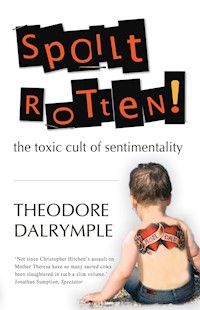
Not since Christopher Hitchens assault on Mother Theresa have so many sacred cows been slaughtered in such a short volume.' Spectator 'One of our most celebrated essayists.' Toby Young, Mail on Sunday '[A] cultural highlight.' Observer 'Surgical demolition.' Guardian In this perceptive and witty book, Theodore Dalrymple unmasks the hidden sentimentality that is suffocating public life. Under the multiple guises of raising children well, caring for the underprivileged, assisting the less able and doing good generally, we are achieving quite the opposite -for the single purpose of feeling good about ourselves. Dalrymple takes the reader on both an entertaining and at times shocking journey through social, political, popular and literary issues as diverse as child tantrums, aggression, educational reform, honour killings, sexual abuse, Che Guevara, Eric Segal, Romeo and Juliet, the McCanns, public emotions and the role of suffering, and shows the perverse results when we abandon logic in favour of the cult of feeling.
Das E-Book können Sie in Legimi-Apps oder einer beliebigen App lesen, die das folgende Format unterstützen:
Veröffentlichungsjahr: 2012
Ähnliche



















‘Crying out to be written.’
Sunday Telegraph
‘[A] cultural highlight.’
Observer
‘Surgical demolition.’
Guardian
‘Witty, always punchy and sometimes rapier-like.’
Tom Adair, Scotsman
‘Not since Christopher Hitchen’s assault on Mother Theresa have so many sacred cows been slaughtered in such a slim volume.’
Jonathan Sumption, Spectator
‘One of our most celebrated essayists.’
Toby Young, Mail on Sunday
‘Excellent…’
Sunday Express
‘Crying out to be written.’
Sunday Telegraph
‘Entertaining… really good stories.’
Express
‘Inimitable.’
Specator.co.uk
About the Author
In this perceptive and witty book, Theodore Dalrymple unmasks the hidden sentimentality that is suffocating public life. Under the multiple guises of raising children well, caring for the underprivileged, assisting the less able and doing good generally, we are achieving quite the opposite – for the single purpose of feeling good about ourselves. Dalrymple takes the reader on both an entertaining and at times shocking journey through social, political, popular and literary issues as diverse as child tantrums, aggression, educational reform, honour killings, Che Guevara, Eric Segal, Romeo and Juliet, the McCanns, public emotions and the role of suffering, and shows the perverse results when we abandon logic in favour of the cult of feeling.
Theodore Dalrymple writes for the Wall Street Journal, Times, DailyTelegraph. For over ten years, he had a column in the Spectator on his work as a prison doctor and psychiatrist. His previous books include The Pleasure of Thinking and Litter. He currently writes expert psychiatric assessments in murder trials.
SPOILT ROTTEN
The Toxic Cult of Sentimentality
THEODORE DALRYMPLE
Contents
About the Author
Title Page
Epigraph
Introduction
1 Sentimentality
2 What is Sentimentality?
3 The Family Impact Statement
4 The Demand for Public Emotion
5 The Cult of the Victim
6 Make Poverty History!
Conclusion
Notes
Also by TheoDore Dalrymple
Copyright
‘Only a man with a heart of stone could read of the death of Little Nell without laughing.’
Oscar Wilde
‘I’ll thcream and thcream and thcream until I’m thick — I can you know.’
Violet Elizabeth, in Just William by Richmal Crompton
Introduction
Children
Arecent report by the United Nations Children’s and Educational Fund (UNICEF) stated that Britain was the worst country of twenty-one advanced countries in which to be a child. Normally I do not set much store by these kind of league-table statements, which are usually based upon many false premises, suppositions and the like, and are designed to produce the very results that will confirm their authors’ prejudices (or their authors’ employers’ prejudices). Rarely do such reports fail to suggest that more government intervention in people’s lives is the answer to the problems with which they deal.
But the UNICEF report is right, grosso modo. If there is a country in the developed world in which childhood is a more wretched experience than in Britain, I do not know it. It is wretched not only for those experiencing it themselves, but for those experiencing British children. The British are a nation that fears its own children.
I see this at the bus stop in the little town in Britain in which I live some of the year. By prevailing standards, the children of this town are by no means bad, but their mere presence in any numbers makes old people at the bus-stop shrivel into themselves, and huddle up together for protection, as the Voortrekkers in South Africa used to form a circle of their wagons at night when travelling through potentially hostile territory. If a child misbehaves — dropping litter, spitting, swearing loudly, bullying another child, pulling hair, drinking alcohol — the old people notice, but say nothing. Tempers these days are short, knives are often long, and children quickly band together to defend their inalienable right to utter egotism.
In Britain, violence committed by and on children has increased very rapidly. The emergency departments of out hospitals report a dramatic rise in such cases, fifty per cent in five years, involving tens of thousands of cases. Teachers are increasingly subjected to threats from their pupils. In the year 2005-6, for example, 87,610 children, that is to say 2.7 per cent of all children at secondary school, were excluded for a time because of verbal or physical attacks on teacher (in Manchester, 5.3 per cent of secondary pupils were so excluded, and it is an unfortunate fact that where metropolitan areas lead, other areas usually follow).
A recent survey showed that a third of British teachers had suffered physical attacks from children, and a tenth of them had been injured by children. Nearly two thirds had been verbally abused and insulted by children. A half of them had thought of leaving the teaching profession because of the unruly behaviour of children, and as many knew of colleagues who had done so.
As if this were not bad enough, five-eighths as many teachers have faced aggression from parents as from the pupils themselves. That is to say, teachers cannot rely on parents to back them up in trying to deal with an unruly, aggressive or violent child, quite the contrary. (This is exactly what my patients who were teachers told me.)
The complacent suggest that ‘twas ever thus, and in a sense they are right. There is no kind of human behaviour that is utterly without precedent: the world is too old for people to invent wholly new ways of behaving. For every act of viciousness, malignity or brutality, there is always an historical precedent. Nevertheless, it is within living memory that in most cases when a child misbehaved in school, and his parents were informed of it by a teacher, the child could expect retribution at home as well as discipline at school. Now, in a large number of cases, he can expect neither. The question is not whether each individual case is without precedent — clearly it is not — but whether the number of cases has increased, and whether there is any reason, other than a decline in the numbers of children, that it should decrease.
It is not only teachers who suffer from the aggression and violence of parents. An article published in 2000 in the Archives of Diseases of Childhood found that nine out of ten trainees in paediatric medicine in Britain had witnessed a violent incident involving a child, nearly half of them within the last year, four out of ten had been threatened by a parent, five per cent had actually been assaulted, and ten per cent had been the object of an attempted assault.
It is important to understand that these figures are quite enough to produce a permanent atmosphere of intimidation, and that this atmosphere of intimidation pervades everything. A single incident has a powerful demonstration effect. Here I will give two examples, drawn from slightly different spheres, of how behaviour is changed by such an atmosphere.
I once had a patient who claimed that he had not worked for a long time because he had a back injury. He received a certificate of ill-health and exemption from work from his general practitioner. Despite his back injury that allegedly prevented him from working, his main interests were judo and jogging, which he did every night without fail. I noticed that in the hospital he got on and off his bed without the slightest difficulty or suggestion of back pain. In short, he was an exceptionally fit and athletic young man.
I telephoned his general practitioner to inform him of my finding, suggesting that his alleged back injury could not justify a certificate of ill-health.
‘Oh, I know all that,’ said the general practitioner to me, as if I were being very naïve in supposing that a certificate should be based upon the truth. ‘But the last time I refused to give such a certificate to someone, he picked up the computer on my desk and threw it at me, and before long we were rolling about on the floor. Since then I have given a sick certificate to anyone who wanted one.’
This, no doubt, helps to explain how it has come about that, despite ever-rising levels of health, as measured objectively, Britain now has millions of certified invalids, more indeed than after the First World War. A relatively small amount of violence is sufficient to produce a large effect.
The second example is that of forced marriage among young women born in Britain of Pakistani descent. Many of them were taken by their parents to Pakistan during their adolescence to be married to a first cousin in the village from which their parents had emigrated. I am no stranger to the varieties of human suffering, but the suffering of these young women to whom the prospect of such a marriage was repellent, and an abomination, was among the worst I have ever encountered.
All of these young women knew of cases in which someone in their situation had been horribly done to death by her own family because she had refused absolutely to go along with such a marriage, thereby dishonouring the family, whose word had been given. The situation of the eldest daughter was particularly acute, for her parents felt that as she went, so went the other members of the family.
Cases of honour-killing, so called, do not need to be very many for them to dissolve the distinction between voluntary and involuntary acceptance of marriage to a first cousin chosen by a young woman’s parents. The very atmosphere that they create, though not numerous, make it difficult to investigate objectively their real frequency and effect.1
Once again, a small amount of violence is sufficient to have a large effect.
Let us now return to the question of childhood in Britain. Are there any intelligible reasons why children and their parents who, by the standards of all previous generations, some of them not so very long ago,2 enjoy excellent conditions of physical health and access to undreamed of sources of knowledge and entertainment, should be anxiety-ridden, aggressive and violent?
There are, and many of them have their origin in sentimentality, the cult of feeling.
The Romantics emphasised the innocence and inherent goodness of children, compared with the moral degradation of adults. The way to make better adults, then, and to ensure that such degradation did not take place, was to find the right way of preserving their innocence and goodness. The right education became the prevention of education.
Along with their innocence and goodness went, or were ascribed to them, other attributes, like intelligent curiosity, natural talent, vivid imagination, desire to learn and ability to find out things for themselves. If the evidence that children were not equal in all respects was too strong to be absolutely denied, the fiction was substituted that all children were endowed with at least one special talent,3 and in that way were equal — all talents being equal, of course.
Romantic educational theory, subsequently provided with a patina of science by committed researchers, is full of absurdities that would be delightfully laughable had they not been taken seriously and used as the basis of educational policy to impoverish millions of lives. Romanticism has penetrated into the very fibre of the educational system, affecting even the way in which children were taught to read. Despising routine and rote, and pretending that in all circumstances they were counterproductive or even deeply harmful, and much hated by children, the romantic educational theorists came up with the idea that children would learn to read better if they discovered how to do so for themselves. Thus, partly on the pretext that English is not a phonetic language (though it is not completely unphonetic either, and indeed the majority of its words are written phonetically), children were presented with whole words and sentences in the hope that they would eventually deduce the principles of spelling and grammar. This is only slightly more sensible than sitting a child under an apple in the hope that it will arrive at the theory of gravity. Most children need a clue, and even those few who don’t could spend their time more profitably on other things. Here I shall give only a selection of some of the things that have been said, apparently believed and acted upon.4
In the examination of any intellectual or social trend, it is impossible to reach its sole and indisputable source, as it is possible to do for some rivers, nor is it necessary to do so. All that is necessary is to show that the trend exists and that it has its intellectual antecedents.
The theorists of education of the nineteenth century and first part of the twentieth laid the foundations for schools that, in large parts of the country, have become little more than elaborate baby-sitting services and the means by which children are kept off the streets, where they might act like piranha fish in a South American river. Never in the field of human history has so little been imparted to so many at such great expense. In Britain, we now spend four times as much per head on education as in 1950; but it is very doubtful whether the standard of literacy in the general population has increased, and it is far from impossible that it might have decreased.
In the area in which I worked, a poor one, I discovered that the majority of my patients who had recently emerged from eleven years of compulsory education, or at any rate of compulsory attendance at school, could not read a simple text with facility. They would stumble over longer words, and would often be completely unable to decipher words of three syllables, pointing to an offending word and saying, ‘I don’t know that one’, as if English were written in ideograms rather than alphabetically. When asked to put into their own words what the passage meant that they had just stumbled through, they would say ‘I don’t know, I was only reading it.’ When asked whether they were any good at arithmetic, half of them replied ‘What’s arithmetic?’ As to their arithmetical ability itself, it can perhaps best be grasped by the reply that one eighteen year-old gave me to the question ‘What is three times four?’
‘I don’t know,’ he said, ‘we didn’t get that far.’
I should point out that these young people were not of deficient intelligence, and in any case I discovered that the mentally-handicapped children of middle class professional parents, who had taken care to educate those children to the maximum of their capacity, were often better able to read and reckon than their much more intelligent age-peers from working-class, or sub-working-class, backgrounds.
Nor was the virtual illiteracy of the young people compensated for by any great development of memory such as often found in pre-literate peoples. Their general level of information was pitiful. In fifteen years, I met three young people among my patients who had recently received a British state education who knew the dates of the Second World War, and I thought it a triumph of natural intelligence in the circumstances that one of them deduced from the fact that there had been a Second that there had been a First, though he knew nothing of it. Needless to say, they did not know the date of anything else in history either.
It is true that my patients were a selected sample, and perhaps not representative of the population as a whole; but my sample was not a small one, and it has to be remembered that it has been proved beyond reasonable doubt that, using the right teaching methods, it is possible to teach nearly 100 per cent of the children coming from the poorest and worst of homes to read and write fluently. This is so, incidentally, even when English is not the language used at home.
It is indicative of the intellectual deformations produced by sentimentality that, when I recounted my experiences to middle-class intellectuals, they imagined that I was criticising or sneering at my patients, rather than drawing attention, with a fury that it required all my self-control not to make absurdly evident, to the appalling injustice done to these children by an educational system that did not even have the advantage (or excuse) of being cheap. Indeed, they largely refused to accept either the truth or the wider validity of my observations, using a variety of mental subterfuges to minimise their significance.
They would say that what I was saying was not true — though all statistical surveys, as well as other anecdotal evidence, suggested that my findings were far from unusual or unique to me. Then they would say that, though true perhaps, it was ever thus, not realising that, even if this were so, it would not justify the present state of affairs. The vast increase in expenditure alone ought to have ensured that what had previously been the case was the case no longer; that previous ages had reasons for not imparting letters to children that were no longer available to us as an excuse for failing to do so; but that, in any case, there was evidence that it was simply not true that it was ever thus.
In France, for example, tests have demonstrated as conclusively as such things can be demonstrated that the level of comprehension of simple written texts, and the ability of today’s children to write the French language correctly, has declined by comparison with that of children educated in the 1920s, when controlled for various factors such as social class.5 Perhaps this is not altogether surprising: when the education correspondent of Le Figaro wrote an article drawing attention to declining standards, he received 600 letters from teachers, a third of which contained spelling errors. And it is obvious that among the reasons for the decline in standards in France are the same gimcrack romantic educational ideas that have held sway in Britain for rather longer.
The reluctance of the romantically-inclined to acknowledge that there was something profoundly wrong with an educational system that left a high proportion of the population unable to read properly or do simple arithmetic (despite the expenditure of vast sums and the more than adequate intelligence of that population to master those skills) probably derived from their unwillingness to give up their post-religious sentimentality, the idea that but for the deformations of society, man was good and children were born in a state of grace.
Some of the things written by romantic educational theorists are so ludicrous that it takes a complete absence of sense of humour not to laugh at them, and an almost wilful ignorance of what children, or at least many or most children, are like to believe them. Perhaps my favourite is from Cecil Grant’s English Education and Dr Montessori, published in 1913:
No child learning to write should ever be told a letter is faulty… every stupid child or man is the product of discouragement… give Nature a free hand, and there would be nobody stupid.
Clearly Mr Grant was much discouraged in his youth, but not nearly enough, I fear.
Over and over again, the romantics stress the glories of spontaneity. Undirected experience and activity are the means by which children learn best and most, and that their inclination to learn will be quite sufficient. Pestalozzi, the follower of Rousseau, said ‘Human powers develop themselves.’ The American philosopher and educationist John Dewey, sounding like Harold Skimpole generalising from his own state of mind, wrote during the First World War, ‘Force nothing on the child… give it free movement… let it go from one interesting object to another… we must wait for the desire of the child, for consciousness of need.’6 ‘The natural means of study in youth is play,’ wrote H. Caldwell Cook, a British educationist from just after the First World War. ‘The core of my faith is that the only work worth doing is play; by play I mean doing anything with one’s heart in it.’
It would take a long time to disentangle all the patently false assumptions and harmful corollaries (some of them very nasty indeed) of this sentimental drivel. More famous and influential than Cook, however, was Friedrich Froebel who, among other things, wrote:
We must presuppose that the still young human being, even though as yet unconsciously, like a product of nature, precisely and surely wills that which is best for himself, and moreover, in a form quite suitable to him, and which he feels within himself the disposition, power and means to represent.
Froebel, who (to be fair to him) lived before there were electric sockets into which crawling babies were inclined to put their fingers, then goes on to point out that the duckling takes to the water by itself, as the chicken takes to pecking the ground. He enjoins us to look anew on the weeds of the fields, to appreciate that, growing where they listeth, they nevertheless show great beauty and symmetry, ‘harmonising in all parts and expressions’. In other words, there are lessons in them there cowslips.
No doubt it will amaze most people that this could have been published, let alone have become influential. But let me here quote from the introductory essay to a book of essays entitled Friedrich Froebel and English Education, published not by one of those niche publishers of books by cranks, but by the London University Press in 1952. The author is Evelyn Lawrence.
The theoretical battle… rages today, but mainly not among the leaders. Most of them were won over long since, at any rate in the field of the Primary school, and we can safely say that Froebel and his followers played a leading part in such improvement as there has been.
What this meant, in essence, was that, by then, the educationists (those who taught the teachers to teach), but not the teachers themselves, had been won over. For some time yet, the teachers resisted. What now seems almost incredible, as late as 1957 the president of the National Union of Teachers was militating for the teaching reading, writing and arithmetic along traditional lines.
The romantics also fostered what might be called the Wackford Squeers theory of education, namely that it should be relevant to the lives and practical needs of the pupils.7 These ideas became enshrined in official thinking much earlier than might suppose, and were not merely the vapourings of innocents, cranks and malcontents. The official Spens report on secondary education in England and Wales, published in 1937, stated that ‘the content [of the curriculum] must grow out of, and develop with, the expanding experience of the pupils.’ In other words, relevance became the touchstone of what was to be taught. It did not seem to occur to the Spens committee, and many educationists since, that one of the purposes of education is to expand a child’s horizons, not to enclose him in whatever little social nutshell fate happens to have enclosed him in.
The Spens report, set up by the Conservative government of the day, demonstrates how quickly the ideas of the educational romantics became a kind of official orthodoxy that initially provoked resistance by those not raised in it, but eventually was unquestioned. In 1931, the same committee had reported on primary education, and in the report of 1937 made reference to its own recommendation:
The Primary School curriculum should be thought of in terms of activity and experience rather than knowledge to be acquired and facts to be stored.
The committee then went a step further:
The principle we quote is no less applicable at the later than at the earlier stages.
This leaves open the question of the age or stage of human existence in an advanced economy at which the acquisition of knowledge and facts (among which are such things as the knowledge of how to read and add up) become important and takes precedent over playing in the sandpit. With such an educational philosophy having become prevalent if not quite universal, it is scarcely any wonder that universities complain that they have to teach remedial mathematics, that many newly-qualified doctors think that the word ‘lager’ (a very important one, considering how many of their patients come to them as a result, direct or indirect, of a surfeit thereof) is spelt ‘larger,’ or that some teachers of history at Oxford have been officially enjoined not to mark down papers because of errors of spelling or grammar (perhaps because, if they did, very few students would get a degree).
The Spens report is a rich source of sentimentality. ‘We think,’ concluded the members, ‘too much of education in terms of knowledge and too little in terms of feeling and taste.’ The idea that feeling and taste cannot be educated in the absence of knowledge and guidance is one that was entirely lost on the authors of the most influential report on English education in the Twentieth century.
Elsewhere, the report says things that contain an element of truth, but are easily overemphasised by the romantic sentimentalists. Pointing out that not everything can be taught by precept, the report says:
A boy may write better English if he has discovered the principles of English composition for himself than if he has merely learnt these principles from a teacher or textbook.
It is, of course, perfectly true that one would not expect a child given a list of precepts of composition8 to compose well, just by virtue of having memorised them and tried by his own to put them into practice, so that his first work of prose would be first rate. This is not how so complex a skill as writing is learnt: but extremists have taken words such as the above to mean that every child should discover everything for himself, from the principles of composition to Newton’s laws of motion and the germ theory of disease. Again, the Spens report is partly right in saying that ‘a great part of the final elements of a liberal education are as a rule acquired in [an] incidental and unconscious fashion,’ but that in no way absolves schools of the responsibility for imparting the skills and knowledge to children to enable the ‘incidental and unconscious fashion’ to work on something other than a vacuum. Every good teacher has always known that education is more than drilling a certain number of undesired facts into a child’s head; but every good teacher has also known that there are things that a child must be taught and come to know that he would never discover for himself, either from inability or disinclination.
It is worth quoting the Spens report at some length to show how the romantic sentimentality took over the official mind much earlier than I, for one, had previously supposed:
We wish to reaffirm a view expressed in our Report on The Primary School (1931), in which we urge that the curriculum ‘should be thought of in terms of activity and experience rather than of knowledge to be acquired and facts to be stored’. Learning in the narrower sense must no doubt fill a larger place in the secondary than in the primary school, but the principle we quote is no less applicable at the later than at the earlier stage. To speak of secondary school studies as ‘subjects’ is to run some risk of thinking of them as bodies of facts to be stored rather than as modes of activity to be experienced;9 and while the former aspect must not be ignored or even minimised, it should, in our opinion, be subordinate to the latter. This remark applies most clearly to ‘subjects’ such as the arts and crafts and music, to which we attach great importance, but which have generally been relegated to an inferior place in the school programme; but upon our view it holds good also of more purely intellectual activities, such as the study of science or mathematics. An unfortunate effect of the present system of public examinations is that it emphasises, perhaps inevitably, the aspect of school studies which we deem to be the less important.
Furthermore:
… the timetable is overcrowded and congested, and leaves too little time to consider and discuss the wide implications of the subject matter with a consequent limitation of the ability to think.
Years later it is common for it to be thought that the possession of an opinion on a subject, which is active, is deemed more important than having any information on that subject, which is passive; and that the vehemence (feeling) with which an opinion is held is more important than the facts (knowledge) upon which it is based. Of course facts are not everything, Mr Gradgrind notwithstanding.10 It is common experience that the best informed people on a subject may miss its point entirely, while less-informed persons may grasp it immediately. But the development of a sense of proportion that makes this feat possible requires a mind well-supplied with knowledge of the world, both implicit and explicit. A mind empty of all facts is hardly in a position to view any question in perspective.
Even great minds have sometimes succumbed to the temptation of sentimentality about children: there are passages from John Locke’s Some Thoughts Concerning Education, of 1690, that would give comfort to the sentimentalists:
… they [children] should seldom be put about doing even those things you have got an inclination in them to do, but when they have a mind and disposition to it. He that loves reading, writing, musick, etc., finds yet in himself certain seasons wherein those things have no relish to him; and if at that time he forces himself to it, he only pothers and wearies himself to no purpose. So it is with children. This change of temper should be carefully observ’d in them, and the favourable seasons of aptitude and inclination be heedfully laid hold of: And if they not often enough forward of themselves, a good disposition should be talk’d into them, before they be set upon any thing.
As for the great poets, though not great thinkers, they too have weighed in on the side of the romantics and sentimentalists:
The mind of Man is fram’d even like the breath
And harmony of music. There is a dark
Invisible workmanship that reconciles
Discordant elements and makes them move
In one society.
Thus Wordsworth in The Prelude of 1805. There doesn’t seem much left for education to do.
Initially there was some common-sense resistance to the romantic point of view, as a school inspector for Manchester implied in 1950 when she wrote:
The teacher is torn between outside opinion… that of the parents and the general taxpaying public who expect a child to read and work during school hours… and her own knowledge that the child learns best through play.11
But the experts had their way in the end, as they usually do, even though their ‘knowledge’ that the child learns best through play could not possibly have been as the result of any experience.




