


Erhalten Sie Zugang zu diesem und mehr als 300000 Büchern ab EUR 5,99 monatlich.
- Herausgeber: Gesellschaft für Schweizerische Kunstgeschichte GSK
- Kategorie: Geisteswissenschaft
- Sprache: Englisch
St Gall cathedral was built in 1755–1770 as the church of the Benedictine monastery, which was dissolved in 1805. In the Middle Ages this church, erected on the site of the hermitage of St Gallus, was one of the most important monasteries in the western world. Today the Abbey Archive and Abbey Library still possess invaluable documentary evidence from that era. The Baroque monastery complex testifies to the flourishing of the prince-abbey in the 17th and 18th centuries. The church, like the adjacent abbey library, built after the plans of Peter Thumb and decorated by the best South German artists of the day, forms the monumental conclusion of a long series of Baroque abbey churches realised by Vorarlberg master builders. St Gall’s abbey district is a UNESCO World Heritage Site, the collections of the Abbey Library and Archive are included in the UNESCO World Documentary Heritage List.
Sie lesen das E-Book in den Legimi-Apps auf:
Seitenzahl: 68
Veröffentlichungsjahr: 2023
Das E-Book (TTS) können Sie hören im Abo „Legimi Premium” in Legimi-Apps auf:
Ähnliche
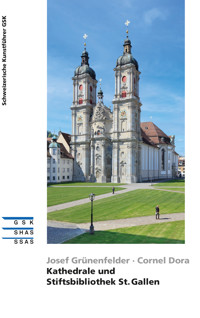


















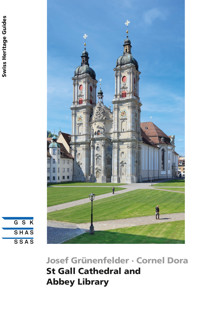
Josef Grünenfelder · Cornel Dora
St Gall Cathedral and Abbey Library
Canton of St Gall
General and Architectural History up to the New Construction of the Abbey Church in the 18th century
The cell of St Gallus
The Benedictine monastery
A short history of the Abbey Church of St Gall
Architectural history up to the Baroque era
Architectural History and Fortunes of the Baroque Abbey Church
Construction of the nave and the rotunda 1755–1757
Artistic decoration 1757–1760
Construction of the choir from 1761 onwards
Decoration of the choir
Structural alterations after the dissolution of the monastery in 1805
Renovation and restoration phases
Exterior of the Abbey Church
The double tower façade
Floor plan and exterior
Tour of the Interior
Inside the church
Ceiling paintings and stucco work
Furnishings and fittings
The crypts
The sacristies and church treasure
Abbey Library
A brief history of the Abbey Library
The Baroque Abbey Library 1758–1784
Appendix
Layout plan
Representatives of the Old Testament, the beatified and the saints are shown on different levels of clouds in the large painting of the cupola. They are united in the worship of the Holy Trinity according to the eight Beatitudes in the Sermon on the Mount.
1 Holy Trinity
2 Virgin Mary
3 John the Baptist
4 Anna and Joachim
5 Joseph
BEATI PAUPERES SPIRITU
Blessed are the poor in spirit
6 Gallus
7 Columban
8 Francis
9 Coelestin
10 Nicholas of Flue
11 Johannes Kalybita
12 Alexius of Edessa
BEATI MITES
Blessed are the meek
13 Francis of Sales
14 John Gualbert
15 David
16 Moses
17 Notker
18 Elizabeth of Hungary
19 Monica
BEATI QUI LUGENT
Blessed are they who mourn
20 Victor
21 Bruno
22 Mary Magdalene
23 Mary the Egyptian
24 Dismas
BEATI QUI ESURIUNT ET SITIUNT IUSTITIAM
Blessed are they who hunger and thirst after righteousness
25 Benedict
26 Thomas
27 Ignatius Loyola
28 Bonaventure
29 Anthony the Hermit
BEATI MISERICORDES
Blessed are the merciful
30 Charles Borromeo
31 Tobias
32 Louis
33 Purchart
34 Martha
35 Martin
BEATI MUNDO CORDE
Blessed are the poor in heart
36 Scholasticca
37 Gerold
38 Catherine of Alexandria
39 Emperor Heinrich II
40 Kunigunde
BEATI PACIFICI
Blessed are the peacemakers
41 Pope Clement II
42 Leo the Great
43 Ulrich
44 Bernhard
45 Elizabeth of Portugal
46 Cyrill
BEATI QUI PERSECUTIONEM PATIUNTUR
Blessed are those who are persecuted for righteousness’ sake
47 Idda
48 Eusebius
49 John Nepomuk
50 Boniface
51 Otmar
52 Ignatius Theophorus
53 Barbara
General and Architectural History up to the New Construction of the Abbey Church in the 18th Century
The cell of St Gallus
The story recounting how the Abbey of St Gall came to be built goes back to the year 612. According to his vita (biography), Gallus, a disciple of the itinerant Irish monk Columbanus, fell ill in Bregenz at that time. The group had been about to leave for Italy after a long stay in the region. Gallus, however, became a hermit and retired to the Forest of Arbon. He built a cell and oratory (place for private worship) in the valley of the Upper Steinach.
St Gallus (c. 550–c. 645)
Gallus belonged to a group of monks who, under the leadership of their abbot, Columbanus, left the monastery of Bangor in Ireland to follow Christ as itinerant monks and to work as missionaries. They founded the Luxeuil Monastery in Burgundy, from where they were later forced to leave, before arriving via a circuitous route in Tuggen in Zurichgau. It was there that Gallus, in his zeal, smashed a heathen idol (an image of a pagan deity). The monks continued their journey, finally arriving in Bregenz on Lake Constance, where they met a Christian community and stayed for some while. Gallus fell ill and therefore remained in Bregenz when Columbanus travelled on to Langobardan in Italy, where he founded the monastery of Bobbio and died in 615.
In the Forest of Arbon, the primeval woods to the south of Lake Constance, Gallus tripped over the root of a tree near the Steinach waterfall while looking for a site for his hermit cell. Interpreting this as a sign from God that this was the place where he should remain, Gallus ordered a bear to collect wood for the fire, rewarding him with a loaf of bread. The bear thus became the saint’s attribute (characteristic, FIG. 1) and can be seen in the armorial bearings of the prince-abbey and the city of St Gall as well as in those of Appenzell. Gallus was a priest-monk, trained in philosophy and theology, and was both headstrong and a nature-lover. He was also a passionate fisherman. Many people came to his cell in search of advice. Gallus refused calls to become the bishop of Constance or the abbot of Luxeuil. Over the years a small community of monks gathered around the cell of St Gallus, who died around 645. His tomb became a destination for many pilgrims. A first vita (biography of the saint) was written a few decades after his death.
FIG. 1, 2 Sandstone figures by Johann Christian Wenzinger on the north front of the rotunda.
St Gallus, an itinerant Irish monk, founded a hermitage c.612 on the site of the later monastery.
St Otmar introduced the Rule of St Benedict to the monastic community c.747. He was to become the monastery’s first abbot.
The Benedictine monastery
Otmar, an Alemannic priest, took over the leadership of the group of hermits in 719. In 747, reacting to pressure from the Frankish majordomos Karlmann and Pippin, Otmar imposed the Rule of St Benedict on the group. He thus became the second founder, after Gallus, of the abbey, which was to survive for over a thousand years.
St Otmar (c. 690–759)
Otmar established the St Gallen monastic community as a permanent monastery. An Alemanni from Lake Constance region, he was trained as a priest at the Rhaetian bishopric of Chur. In 719, the Arbon tribune Waltram appointed him head of the spiritual community at the tomb of St Gallus. From the early 8th century, donations of land, people and privileges to the Gallus monastery were documented in the records of the monastery archives. Political intrigues resulted in Otmar’s banishment to the island of Werd near Stein am Rhein, where he died in 759. The monks bringing his body back to St Gall survived a storm on Lake Constance without coming to harm when, owing to a miracle, a small barrel of wine, all that remained of their provisions, failed to run out. This explains why St Otmar is represented with a wine barrel as his attribute (FIG. 2). He was declared a saint in 864.
A short history of the Abbey Church of St Gall
As early as around the year 700 during the time of Otmar, the St Gall community received numerous donations of land, people and privileges. The monastery soon flourished and was highly regarded during the 9th century. The school was considered a perfect model of monastic and scientific life, in particular under Abbots Gozbert, Grimald, Hartmut, Salomo and Ulrich I. Benedictine scholarship and art reached a high level both in the monastery and scriptorium as well as with eminent teachers such as Notker the German. Through favourable circumstances, documentary evidence of this culture has been preserved until the present day and is stored in the abbey archives and library (see page 46).
Thanks to close links with the kings and emperors of the Carolingian and Ottonian eras, St Gall became one of the most famous monasteries in the Empire. St Gall’s abbots belonged to the chapel royal; some of them even acted as Imperial chancellors. Imperial privileges guaranteed the monastery independence from the Bishop of Constance as of 818 and, later, freedom of the Empire. Closeness to the ruling house, however, sometimes also led to unfavourable connections with Imperial politics.




