


33,99 €
Mehr erfahren.
- Herausgeber: The Crowood Press
- Kategorie: Geisteswissenschaft
- Sprache: Englisch
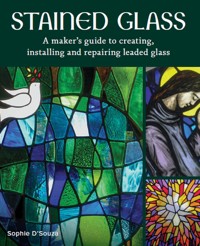
This practical book explains the art of stained glass for the maker. Focusing on leaded glass, it introduces types of glass, cutting and designing for glass, and the processes involved in building your own panel. It also covers installation and restoration of glass, repairing and rebuilding, and quoting for work. Written by a leading maker, this book provides the practical instruction and the inspiration for everyone ready to try this most uplifting of crafts. This exciting book explains the secrets that lie behind the craft, emphasizes the importance of working with light, and celebrates the pure joy and excitement of working with this fragile yet powerful medium. Written with the maker in mind, it guides the reader through the processes of first working with glass through to designing and building your panel. It then goes on to look at the restoration and repair work the stained glass maker is often asked to undertake. This book is a beautiful testament to her talent, and to one of the oldest and most treasured art forms that never disappoints.
Das E-Book können Sie in Legimi-Apps oder einer beliebigen App lesen, die das folgende Format unterstützen:
Seitenzahl: 303
Veröffentlichungsjahr: 2022
Ähnliche




















A well-framed piece will be enhanced both by the frame and the location. This light box frame is understated so as not to compete with the setting.
First published in 2022 byThe Crowood Press LtdRamsbury, MarlboroughWiltshire SN8 2HR
This e-book first published in 2022
© Sophie D’Souza 2022
All rights reserved. This e-book is copyright material and must not be copied, reproduced, transferred, distributed, leased, licensed or publicly performed or used in any way except as specifically permitted in writing by the publishers, as allowed under the terms and conditions under which it was purchased or as strictly permitted by applicable copyright law. Any unauthorised distribution or use of this text may be a direct infringement of the author’s and publisher’s rights, and those responsible may be liable in law accordingly.
British Library Cataloguing-in-Publication DataA catalogue record for this book is available from the British Library.
ISBN 978 0 7198 4138 5
Cover design: Sergey Tsvetkov
DedicationTo my beautiful father and mother
CONTENTS
Introduction: Leaded Glass
1Getting Started
2Glass and How to Cut It
3Designing for Glass
4Leading
5Soldering
6Cementing and Polishing
7Framing and Installation
8Repairing and Rebuilding
9Light Boxes
10Quoting
Useful Organizations
Index
Introduction
LEADED GLASS
First of all, I’d like to say how pleased I am that you have picked up this book. I am hoping this means you are thinking of involving yourself in the wonderful art of stained-glass making. As stained glass is something I have devoted myself to for the past fifteen years, I love to meet a fellow enthusiast. A quick flick through the pages of this book, and its many photos, will show you the variety of obscure and singular elements involved. I hope you will be intrigued to find out more and to dip your toe into this wonderfully satisfying art form.
The impact of a beautiful stained-glass window is unequivocal. It changes throughout the day and enhances any environment.
There are many different crafts you might consider exploring, but one of the particularly enjoyable elements of this craft is the marriage between form and function. Stained glass uses skills developed throughout the ages to make work that is not just beautiful, but that has a very practical purpose: namely, to keep the weather out. These two elements must always be borne in mind. And, when broken down into its constituent processes, stained glass very definitely becomes more than the sum of its parts.
The intention of the book is to cover absolutely anything and everything to do with the making of leaded glass. The craft of making stained glass is centuries old and, in many ways, it is the same now as it was 1,000 years ago. This connection with the past is one of its most appealing aspects and, because of this, it is tempting to approach stained glass as an historical discipline. However, the craft of stained glass is alive and well and being practised in workshops all over the world. While there is undoubtably an historic and academic element to the subject, this book is concerned only with the processes involved in the making of stained glass. In other words, this is a maker’s book, and I will not attempt to include a history of the field. I am not an academic, neither am I an art historian, but I am passionate about furthering the knowledge of this craft.
Although most of the techniques involved have remained largely unchanged across the centuries, there have been advances, notably with glass cutters. We now use cutters with small tungsten carbide-tipped wheels, which afford us accurate and intricate cutting. During the height of stained-glass making in the Middle Ages, glass was cut by laying a hot poker on the glass to induce a break. We are also now able to produce much larger sheets of glass and this can be reflected in our designs, no longer restricted to designing for small pieces of glass.
Another notable difference between the glass of today and that of our forebears is that stained glass was traditionally used as a way of disseminating bible stories and Christian doctrine to the illiterate masses. This didactic purpose is completely lost now. The themes of modern church windows are still theological, but they assume that the congregation has a certain received understanding of the stories and ideas depicted. This has meant that for the first time, we can have windows that are abstract or non-representational. This gives churches the option to fill their windows with stained glass that is both beautiful and evocative, but not tied to the tropes of the past. Stained glass is also commonplace today in secular settings, from domestic dwellings to schools and commercial buildings.
DEFINITIONS
Although it may sound pedantic, I think we need to clarify what we mean by ‘stained glass’. The phrase ‘stained glass’ has come to be loosely applied to all types of art glass. However, strictly speaking, it refers to a window (or panel) that uses ‘staining’ or painting on glass: typical of the type of windows you see in traditional churches. Painting on glass is beyond the scope of this book and actually it is something you would probably tackle after learning the basics of how to build a window. Stained glass can also refer to techniques such as copper foiling, appliqué, and fused work. Again, these techniques are often referred to under the umbrella term ‘stained glass’.
There are many books available that cover all the different methods that can be used when working with art glass. This book will only cover ‘leaded glass’ and will focus in depth and solely on this. Leaded glass refers to any panel made by joining pieces of glass together with lead cames. By focusing on leaded glass alone, I hope that this book will provide the most in-depth learning aid that has been produced on the subject for many years.
It is important to consider why the craft of stained glass has changed so little over the centuries. The problem inherent with innovating within the field of stained glass is that there is no way of testing the longevity of your potential innovation. And so, the tried and tested methods prevail. There is not usually any need for a vastly different approach to making, but it would be nice to, for example, try a different cement recipe and fast forward twenty years to check that it is still sound. Because this is not possible, it is probably best to follow the advice of experience. In the 1960s, a new appliqué method of stained glass was developed. This involved bonding coloured glass to clear plate glass. It was put into a few notable buildings, including Sheffield Cathedral. Only a few years later, all these new appliqué windows began to fail. Some efforts were made at repair, but in the end they were all removed. This sort of experience is catastrophic, not only from an artistic viewpoint, but also from a health and safety stance. Small bits of glass raining down on visitors is never desirable. And so, we return to the tried and tested methods.
In spite of the unfortunate episode of the failing appliqué glass, there have been many innovations within architectural glass (as opposed to leaded glass): this can be seen all around us, from shopping centres to restaurants and banks. In these modern contexts, where stained glass is specified, leaded glass would definitely not be considered a suitable design response. In the huge, largely glass buildings that are common today, printed designs on safety glass is a far more suitable solution to introducing coloured light. Lighting, too, has gone through many innovations in recent years, and often coloured lights are used to enhance modern glass. These modern glass panels would be considered far safer than leaded glass as they are inherently stronger and can be treated to break in a controlled way. They are also a better fit aesthetically because of their scale and modernity.
This does not mean, however, that there is not a place for leaded glass. Its propensity for detail and its heritage character still make it the perfect choice for many buildings. Schools and churches are often drawn to leaded glass as it is a way of signalling establishment and longevity. Its diminutive scale makes it the perfect choice for our homes. And from a stained-glass artist’s perspective, it is definitely a craft for the practitioner rather than the designer. The large modern panels popular in the modern buildings of today are designed by artists but they are fabricated by glass workshops of industrial proportions. This is the main reason I have never been attracted to this more modern kind of work. I want to make windows, not just design them. In fact, I think for me, the making is the best part. Yes, I like designing stained-glass windows, but I love making them.
I work alone and have been largely self-taught which, if I’m honest, has been a bit of a disadvantage. Stained glass, as with any craft, benefits from the experience of ages. I am lucky to have generous colleagues within the stained-glass industry who are always happy to give me the benefit of their know-how. It is for this reason that, three years ago, I started a YouTube channel devoted to sharing and furthering the knowledge of the craft. My channel has hundreds of videos devoted to every aspect of my work and it is my overriding wish that it will, like this book, add to the knowledge base of the craft.
At the beginning of my career, I would have benefitted greatly from a channel devoted to stained glass as well as from a book like this, which addresses the subject in greater depth than the books currently available. It has been a challenge to describe the processes involved in making stained glass in a written form, but it has forced me to break down each step in a methodical and linear way. The many pictures in the book have given me the opportunity to really focus on each step – steps that are sometimes all too fleeting when presented in video form. Although videos give you the chance to see a real-life demonstration, it can be frustrating having to pause and rewind the bit you can’t quite see (we’ve all done it). And so, it is my strong wish that, with this book and my videos, no one learning stained glass needs to feel as if they are doing it on their own.
The light cast by a stained-glass window as it bathes its environment with colour can be every bit as beautiful as the window itself.
It is said that a stained-glass artist works with light, rather than glass. I find this quite a helpful way of thinking. The light cast by a stained-glass window is every bit as beautiful as the glass itself. We are all affected by light. If you are reading this book, you have probably felt yourself affected by stained glass and perhaps this is something you are hoping to explore through your work. This book aims to guide you through everything I have learned on my journey in stained glass. I have tried many different techniques, but I have always returned to leaded glass; it will always be my first love. Though I learned my craft largely on my own, when I could I consulted colleagues but sometimes my learning was simply through trial and error. I hope that with this book you will feel that you have someone to consult. Perhaps it’s not as good as having your very own teacher, but I hope I will have covered just about everything you could ever want to know about making leaded-glass panels (and probably some things you didn’t want to know!).
I would like to stress that this book will show you my approach to building leaded glass. I would not like to give the impression that the way I do things is the only way. Please, if you have the opportunity, consult widely, and learn as much as you can from as many people as possible. I am committed to sharing what I have learned because I am passionate about my craft and ensuring its continuation. More and more, leaded glass is being abandoned by colleges because of a cautious approach to health and safety, and because it is so resourceheavy. It’s hard to persuade colleges that working with lead is anything other than a health and safety nightmare. Simply put, it’s easier for colleges to teach only the glass techniques that don’t use lead. Because of this, I feel an extensive and in-depth book on the subject of leaded glass is more important than ever. These skills have lasted for 1,000 years. I hope my book will contribute to the craft continuing for many years to come.
STAINED GLASS, AN OVERVIEW
At the risk of plot spoilers, I think it would be helpful to have a whistle stop tour of all the stages involved in the making process. All the things I’m about to mention will be explored in great detail in the rest of the book, but I feel a synopsis would be really helpful to understanding the direction of travel.
1.Design your panel. I am using the word ‘panel’ (and not window) because your leaded light is always a panel, but it is not always a window. It is only a window if it’s keeping the weather out. People’s first pieces are often decorative panels for display inside a house.
2.Produce your pattern. Turn your design into two patterns, one to be used as a cutting pattern and one for a making pattern.
3.Cut your glass. As you cut your glass, lay it on your pattern.
4.Make a jig. Using batons, make a jig to accommodate your pattern.
5.Lead your panel. Starting in one corner, begin to fit your glass into your lead came and watch your panel grow.
6.Solder your panel. The joints now need to be soldered to hold the lead and glass together.
7.Cement your panel. To give your panel strength and to make it weatherproof, you now need to push cement (a special putty) in between the glass and the lead.
8.Finishing. The final polish will transform the dull surface of the lead into a panel with a deep, dark bloom.
9.Enjoy your hard work. Hold your panel up to the light and gasp at your achievement and the beauty of your finished item!
A design informed by your imagination, inspiration and an understanding about the structural restrictions of glass.
Cutting glass is your chance to enjoy the colour and texture of glass. You will become more familiar with glass the more you cut it.
After your pieces of glass are cut, now begins the making – and this is done on a simple jig made from a couple of batons.
Lead is soft, malleable and quite forgiving. Its deep grey/black colour develops at the end of the process as it is polished.
After leading your panel together, your joints need to be soldered. This joins everything together.
The next stage of the process is cementing. It is a crucial part of the process as it will make your panel waterproof and sturdy.
Polishing is hard work and a bit messy, but it is the final stage of the process and will transform the finish of your work.
Now enjoy! Hold your stained-glass panel up to the light and enjoy seeing it come to life as the light pours through.
UNDERSTANDING COLOURED GLASS
If you are attracted to glass (and I think it’s fair to assume you are) and this is your first real exploration of the subject, it might be worth getting to know its essence. I would like to suggest a simple exercise. This is basically an exploration of colour, of how it affects you and how it affects the colours around it. This will help you develop your eye for glass and also help you to understand what colour palettes work for you.
Once you have developed some simple cutting skills as described in Chapter 2, cut up some glass into small squares, no larger than an inch. Use as many colours and shades as you can. If you don’t yet have much of your own glass, try approaching colleges or artists for their off-cuts. They will be happy to give them to you as disposing of glass is always an involved process. Now place these squares of glass on a mirror. Try lots of different combinations and orders. For example, just shades of blue. Maybe add in some yellows and ambers to the blues. Perhaps put in lots of different colours. There are, of course, endless combinations and this is the point. Throughout this process, take photos on your phone. This is not just so that you can keep a record, but you will find that looking at your squares of glass via a photo on your screen affords you an extra layer of objectivity. This is a strange phenomenon but one I have found immensely useful when I have been deliberating over colour combinations for use within my work.
How do you respond to this very mixed palette of colours? They are pretty but do they make sense? Some restraint can help when considering your palette.
Perhaps this more subdued palette is more to your liking – or maybe you find it dull and are crying out for more colour?
This restricted palette has an internal harmony but maybe you would prefer to insert a different colour as a foil.
Ambers, yellows and blues go very well together. There is a harmony but with added interest. The colours contrast but don’t clash.
Red and green are opposite to one another on the colour spectrum (seeChapter 3) and so produce a very strong palette.
Purple and green are closer together on the colour spectrum than red and green and so produce a softer blend.
CHAPTER SUMMARIES
Building yourself bespoke storage allows you to make best use of your space and have everything where you want it.
Chapter 1: Getting Started
The first half of this book is devoted to learning the craft of making leaded-glass windows. Everything from types of glass, cutting and designing for glass to the processes involved in building your panel. It begins with a chapter on ‘Getting Started’, which lays out all the tools you would need to begin. It has a focus on a practising stained-glass artist, looking at her studio and how she got started. Seeing around a working studio can be incredibly useful when considering how you might like to set yourself up in a working space – from how to store your glass to how to afford your rent.
Cutting is probably the most important skill to master as, without accurate cutting, leading your panel will be very difficult.
Chapter 2: Glass and How to Cut it
This chapter takes you through everything you need to know about the medium, from the different types of glass available, to where to buy it. Of course, a large part of this chapter is devoted to developing your cutting skills. This is where it all begins. You should learn to cut glass before even thinking about designing a panel. Learning to cut glass will give you an intrinsic understanding of how glass behaves and what you can and can’t do with it. I would also hope that through practising your cutting skills, not only will they improve, but you will become comfortable with the medium and shed any residual anxieties you might have about handling glass.
Let your imagination reign. This design was inspired by fairy stories: a common theme in narrative stained-glass work.
Chapter 3: Designing for Glass
This is the longest chapter in the book. When you first come to design for glass, you may only be focusing on aesthetic considerations. There are, however, a myriad of other structural issues that need to be borne in mind. So, in addition to considering colour, form, scale, perspective and situation, this chapter will give you the know-how to build a strong and long-lasting window. You will learn to design within the boundaries of what is possible to build in leaded glass, rather than seeing these structural parameters as restrictive. And in fact, these design boundaries are what gives stained-glass design its unique feel.
Leading is when you start to assemble your glass jigsaw. Precision is essential if your panel is to go together successfully.
Chapter 4: Leading
If you get your leading right, you will produce a window that fits and has no gaps or holes. It will be strong and will last (if not too directly exposed to the elements) for 100 years. I will cover the different types of lead available, and when you might choose to use them, and the aesthetic choices you are able to make when choosing your lead came. Strengthening your leaded panel is an important part of being able to produce a functioning window and will also be covered in this chapter.
Although soldering can feel like a very alien skill, you will pick it up quicker than you expect and find that imperfect joints can always be corrected.
Chapter 5: Soldering
Covered in Chapter 5 will be the different soldering irons available, their pros and cons, and also what your joints should look like to be both aesthetically pleasing and strong. People worry about their soldering skills. Soldering is a bit like handwriting: that is to say, it will vary from person to person, and we will all get slightly different results. Even experienced stained-glass artists can worry that their joints aren’t up to scratch and that they are being judged and found wanting. In fact, with the light behind your window, the joints will be hardly visible: a comforting thought for us all.
Cementing your work will begin to darken the lead and you will start to see how your finished panel will look.
Chapter 6: Cementing and Polishing
If I’m honest, I find the topic covered in Chapter 6 the dullest part of all the processes involved in building a window. It feels like hours and hours of dirty scrubbing to me. However, just the other day someone mentioned to me that it was their favourite part. So perhaps it’s a matter of perspective. I think I need to work at finding the joy in it all – it’s probably a state of mind! And, actually, the really good thing about getting to the cementing and polishing stage is that it means that your beautiful window is nearly complete.
There is a change in focus in the second half of the book, which is all about installation and restoration. Here, I would like to draw a distinction between conservation and restoration. Conservators work with stained glass in listed buildings. It is a highly developed discipline, which should only be attempted by people trained specifically in this area. Its practices are different from those of the restorer as they must preserve as much of the original window as possible. For example, where with restoration work we might replace a cracked piece of glass, with conservation work that piece of cracked glass may well be edge-bonded and kept in place.
The restoration techniques covered in this book refer largely to those carried out on domestic glass that can be found across the United Kingdom in nineteenth- and twentieth-century homes. There are a couple of reasons I have devoted such a large part of the book to restoration. Firstly, many people come to stained glass because they want to repair the leaded windows in their own homes. And secondly, because if you would like to make stained glass your profession, you will undoubtably be asked to repair or rebuild original windows more often than you are commissioned to design and build a new window.
Although there is not a lot of room for artistic input in rebuilding and repair work, it is a wonderful thing that, unlike in the 1960s and ’70s, people now value the original glass in their homes and want to restore it. The work can be hard and, as mentioned, you may not feel your artistic itches are being scratched, but this work might just keep you afloat professionally. And while we would all like to be commissioned to make windows for Westminster Abbey, there is no shame in any work that keeps the tradition alive. I have always felt excessively lucky to be able to work at the thing I love. Each job I do presents its own challenges, whether it be for a church or a domestic home, and I have the satisfaction of a project completed.
How a piece is to be framed is best considered at the design stage. Where it will be displayed will influence your framing decision.
Chapter 7: Framing and Installation
Everything you ever wanted to know about fitting windows but were afraid to ask! Finding a fitter with the skills to remove and refit stained glass is not always possible. This book will teach you everything you need to know to do your own removal and installation work. All the tools and skills needed are covered, and I hope that this will be enough for you to overcome any reluctance you might have to involve yourself in this part of the job. However, if you look at Chapter 7 and decide that it is not for you, I hope that it will prove to be a useful resource for you to give to a glazier or carpenter unaccustomed to fitting stained glass.
Becoming comfortable with removing damaged stained glass will allow you to extend your practice to repair and rebuild work.
Chapter 8: Repairing and Rebuilding
Here, I discuss the techniques needed for repairing stained glass. I am called upon weekly to quote to repair domestic windows. If I’m honest, it’s not the most exciting work in the world, but it has seen me through many a lean time and, if I am busy doing church work, I pass the jobs on to colleagues. It’s nice to think that today, unlike during the 1960s, people finally value these fine architectural features enough to spend the not inconsiderable amounts needed to repair them. I will also cover the techniques used for in-situ repair work. Though fiddly and not always possible, it is an invaluable skill, and you will find your customers are inordinately grateful.
Mounting your panels within light boxes can create a very different feel to your glass and give you other options for purpose and display.
Chapter 9: Light Boxes
This chapter looks at converting your panels into light boxes. Although you can hang your decorative leaded panels in front of windows, mounting them in light boxes means that they can be displayed anywhere in a home and, actually, they do make beautiful lamps. The advances in LED lighting have really been the stained-glass artist’s friend in this respect. I will show you how you can do this simply and cheaply and without any advanced carpentry or electrical skills.
The number of pieces in a window is often more important than the size of the window when quoting.
Chapter 10: Quoting
A thorny subject. I say ‘thorny’ because I don’t think any of us are really sure when starting out if we are quoting competitively. By ‘competitively’ I mean giving a price that does not massively undercut your competitors but is also not overpriced. If you are getting every job you are quoting for, then it’s a sure sign you are going in too low. This undervalues not just your skills, but the industry as a whole. Chapter 10 will attempt to cover the sort of things you should think about building into your quote. I will even tackle the very tricky subject of what to do if you produce a design, exactly to your client’s specifications, but they decide they don’t like it and want it completely re-worked. People only ever want to be charged for one design even when you have, in fact, produced two.
I really hope that this book will give you the skills and confidence, not only to build successful leaded panels that you will love, but also to help you discover the pure joy of making stained glass. Whatever your goals, be they to work professionally or to fill your house (and your friends’ houses) with stained glass, I wish you well in all your projects. Be proud of your work, and don’t point out any imperfections – you’re probably the only person who will notice them. Happy making!
The number of pieces in a window is often more important than the size of the window when quoting.
The number of pieces in a window is often more important than the size of the window when quoting.
Chapter 1
GETTING STARTED
If you’re reading this book, you may have tried your hand at stained glass via a part-time course and would like to take your interest further. This might feel like quite a leap as you will need to invest in your own tools, glass, lead and, not least, in a place to work. You will have picked up valuable information and experience regarding the tools you need during your lessons, and your teacher will also be a great source of advice on how to take the next steps in your stained-glass journey.
However, not everyone has access to a course in stained glass and, by extension, a friendly teacher to help and advise. It is possible that you’ve never done any stained glass at all and you’re looking for recourses to guide you through the basics and beyond. Many colleges no longer teach leaded glass as it has too many negative health and safety implications to negotiate. And although many stained-glass artists will offer private teaching, you just might not live withing reach of someone able to do this for you. For stained-glass artists to teach privately from their studio, they will need special insurance which may not be available or, if it is, might be prohibitively expensive.
Taking your craft further needs a dedicated space. A converted garage or shed can be a perfect solution.
But if this is the case, all is not lost! In this age of digital media there is plenty of help out there in the form of online tutorials (find my tutorials on the ‘Sophie’s Stained Glass’ YouTube channel), which make it much easier to distance-learn. You should definitely use these recourses. As mentioned in the introduction to this book, there is always more than one way to do things and learning from as many people as possible is generally a principle to be followed. A good example of this is that some people cut glass away from themselves while others cut towards themselves. Which way you end up cutting might depend on who is teaching you. However, if you know that either direction is an option, trial and error will soon determine which feels more comfortable to you. And, although watching your teacher and fellow students at work is a great way to learn, this book, full of photos and explanations, will make the perfect workshop companion: a written and photographic reference where all the information you need is broken down and laid out in front of you, in one place.
In this chapter on getting started, we will cover the tools you need to begin work, both the basic ones that you cannot do without, and more obscure tools, used only occasionally and within a narrow context. We will also look in this chapter at how to set up a workspace, be it small and portable, or a studio solely devoted to your stained glass – a true luxury. We will consider too issues of health and safety, focusing not only on how to protect yourself from the dangers intrinsic to some of the materials you will be handling, but also safety in your workspace.
TOOLS
Fortunately for those keen to make a start in stained glass, the basic tool kit is relatively inexpensive (especially compared to some other crafts), with most items costing below £20 (the exception to this being your soldering iron). As a general principle, buy the best quality tools that you can afford. If you have attended a stained-glass course, you have the advantage of having handled some of the tools before and so will have got a feel for which ones you found essential and which ones you rarely used. All the equipment you need will be available online, which is fantastic as stained-glass shops are relatively few and far between.
The majority of the tools that you will use day to day are hand tools. You will want to keep them close as they become treasured possessions.
While buying online is convenient, especially if you know exactly what you want to buy, I would encourage you to make a trip to a shop in person when you are setting yourself up. The staff in these shops have a wealth of knowledge that they will happily share. They will know which cutters work really well and which don’t. They will be able to direct you to their bestsellers and steer you away from items you could perhaps do without, especially when you’re getting started. You will also bump into other customers if you visit shops in person and you can learn a lot while listening to the questions they ask. They might be professional stained-glass artists with decades of working practice behind them, or they might be complete beginners – either way, they will always have questions and you can always learn something. Or perhaps you’ll make a stained-glass buddy, invaluable to us all for those occasions when a question arises or when we come up against a problem never before encountered.
This type of pen glass cutter is probably the most common. The best sort are oil-filled and weighted at the end for tapping your score line.
Beginners often find these pistol-grip cutters easier to start with. Like the pen type of cutter they are oil-filled and weighted.
This ergonomically designed cutter is less common but can be especially good for people with strength and/or mobility issues.
Grozers or glass pliers have changed little in hundreds of years and are invaluable for easing your cut lines or nibbling the edge of your glass.
Fids or Nova tools (sometimes called lathakins or larakins) are a simple but very effective tool used for manipulating lead into shape.
Oyster knives perform a similar function to that of fids. They have thinner tips, which makes them better for smaller places.
Lead knives do more than just cut and lever lead. Turn them upside down and you can use the other end to hammer in your nails.
This lead cutter’s scissor action makes them easy to use even with little strength. It’s especially good at keeping the lead in shape while cutting.
Lead dykes, or snips, are especially good for nibbling back the end of your lead came when only a small adjustment is required.
Running/breaking pliers are very useful for breaking long straight cuts across large sheets of glass. They can also be used on gentle curves.
Running pliers made of metal are used in the same way as plastic ones. They are superior as the depth is adjustable using the screw.
A wet stone is useful for making the edges of your glass safer to handle. It is the low tech alternative to an electric grinder.
Students often take great comfort in an electric grinder as it can quickly improve a badly cut line. It’s probably better to learn to cut accurately.
Squares, rulers and straight edges are invaluable for some jobs. Always use rulers with a cushioned underside to minimize slip.
Pens to mark up your glass are essential. It’s most helpful to find one with a 2mm tip. Use a white marker for dark sheets.




