


34,99 €
Mehr erfahren.
- Herausgeber: John Wiley & Sons
- Kategorie: Fachliteratur
- Sprache: Englisch
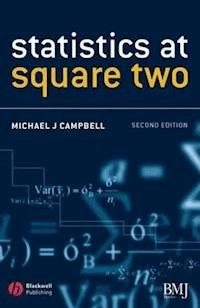
Updated companion volume to the ever popular Statistics at Square One (SS1)
Statistics at Square Two, Second Edition, helps you evaluate the many statistical methods in current use. Going beyond the basics of SS1, it covers sophisticated methods and highlights misunderstandings. Easy to read, it includes annotated computer outputs and keeps formulas to a minimum.
Worked examples of methods such as multiple and logical regression reinforce the text. Each chapter concludes with exercises to stimulate learning.
All those who need to understand statistics in clinical research papers and apply them in their own research will value this compact and coherent guide.
Sie lesen das E-Book in den Legimi-Apps auf:
Seitenzahl: 228
Veröffentlichungsjahr: 2013
Ähnliche
















Contents
Preface
Chapter 1: Models, tests and data
1.1 Basics
1.2 Models
1.3 Types of data
1.4 Significance tests
1.5 Confidence intervals
1.6 Statistical tests using models
1.7 Model fitting and analysis: confirmatory and exploratory analyses
1.8 Computer-intensive methods
1.9 Bayesian methods
1.10 Missing values
1.11 Reporting statistical results in the literature
1.12 Reading statistics in the literature
Chapter 2: Multiple linear regression
2.1 The model
2.2 Uses of multiple regression
2.3 Two independent variables
2.4 Interpreting a computer output
2.5 Multiple regression in action
2.6 Assumptions underlying the models
2.7 Model sensitivity
2.8 Stepwise regression
2.9 Reporting the results of a multiple regression
2.10 Reading the results of a multiple regression
Chapter 3: Logistic regression
3.1 The model
3.2 Uses of logistic regression
3.3 Interpreting a computer output: grouped analysis
3.4 Logistic regression in action
3.5 Model checking
3.6 Interpreting computer output: ungrouped analysis
3.7 Case–control studies
3.8 Interpreting computer output: unmatched case–control study
3.9 Matched case–control studies
3.10 Interpreting computer output: matched case–control study
3.11 Conditional logistic regression in action
3.12 Reporting the results of logistic regression
3.13 Reading about logistic regression
Chapter 4: Survival analysis
4.1 Introduction
4.2 The model
4.3 Uses of Cox regression
4.4 Interpreting a computer output
4.5 Survival analysis in action
4.6 Interpretation of the model
4.7 Generalisations of the model
4.8 Model checking
4.9 Reporting the results of a survival analysis
4.10 Reading about the results of a survival analysis
Chapter 5: Random effects models
5.1 Introduction
5.2 Models for random effects
5.3 Random vs fixed effects
5.4 Use of random effects models
5.5 Random effects models in action
5.6 Ordinary least squares at the group level
5.7 Computer analysis
5.8 Model checking
5.9 Reporting the results of random effects analysis
5.10 Reading about the results of random effects analysis
Chapter 6: Other models
6.1 Poisson regression
6.2 Ordinal regression
6.3 Time series regression
6.4 Reporting Poisson, ordinal or time series regression in the literature
6.5 Reading about the results of Poisson, ordinal or time series regression in the literature
Appendix 1: Exponentials and logarithms
A1.1 Logarithms
Appendix 2: Maximum likelihood and significance tests
A2.1 Binomial models and likelihood
A2.2 Poisson model
A2.3 Normal model
A2.4 Hypothesis testing: LR test
A2.5 Wald test
A2.6 Score test
A2.7 Which method to choose?
A2.8 Confidence intervals
Appendix 3: Bootstrapping and variance robust standard errors
A3.1 Computer analysis
A3.2 The bootstrap in action
A3.3 Robust or sandwich estimate SE
A3.4 Reporting the bootstrap and robust SEs in the literature
Appendix 4: Bayesian methods
A4.1 Reporting Bayesian methods in the literature
Answers to exercises
Glossary
Index
To David, John and Joseph
© 2001 by BMJ Books
© 2006 M. J. Campbell
BMJ Books is an imprint of the BMJ Publishing Group Limited, used under licence
Blackwell Publishing, Inc., 350 Main Street, Malden, Massachusetts 02148-5020, USA
Blackwell Publishing Ltd, 9600 Garsington Road, Oxford OX4 2DQ, UK
Blackwell Publishing Asia Pty Ltd, 550 Swanston Street, Carlton, Victoria 3053, Australia
The right of the author to be identified as the author of this work has been asserted in accordance with the Copyright, Designs and Patents Act 1988.
All rights reserved. No part of this publication may be reproduced, stored in a retrieval system, or transmitted, in any form or by any means, electronic, mechanical, photocopying, recording or otherwise, except as permitted by the UK Copyright, Designs and Patents Act 1988, without the prior permission of the publisher.
First published 2001
Second edition 2006
1 2006
Library of Congress Cataloging-in-Publication Data
Campbell, Michael J., PhD.
Statistics at square two : understanding modern statistical applications
in medicine / Michael J. Campbell. — 2nd ed.
p. ; cm.
Includes bibliographical references and index.
ISBN-13 : 978-1-4051-3490-3 (alk. paper)
ISBN-10 : 1-4051-3490-9 (alk. paper)
1. Medical statistics. I. Title.
[DNLM : 1. Statistics. 2. Biometry. WA 950 C189s 2006]
RA407.C36 2006
610.2'1—dc22
2006000620
ISBN-13: 978-1-4051-3490-3
ISBN-10: 1-4051-3490-9
A catalogue record for this title is available from the British Library
www.charontec.com
Commissioning Editor: Mary Banks
Development Editor: Nick Morgan
Production Controller: Debbie Wyer
For further information on Blackwell Publishing, visit our website:
http://www.blackwellpublishing.com
Blackwell Publishing makes no representation, expressed or implied, that the drug dosages in this book are correct. Readers must therefore always check that any product mentioned in this publication is used in accordance with the prescribing information prepared by the manufacturers. The author and publishers do not accept responsibility or legal liability for any errors in the text or for the misuse or misapplication of material in this book.
Preface
When Statistics at Square One was first published in 1976 the type of statistics seen in the medical literature was relatively simple: means and medians, t-tests and Chi-squared tests. Carrying out complicated analyses then required arcane skills in calculation and computers, and was restricted to a minority who had undergone considerable training in data analysis. Since then statistical methodology has advanced considerably and, more recently, statistical software has become available to enable research workers to carry out complex analyses with little effort. It is now commonplace to see advanced statistical methods used in medical research, but often the training received by the practitioners has been restricted to a cursory reading of a software manual. I have this nightmare of investigators actually learning statistics by reading a computer package manual. This means that much statistical methodology is used rather uncritically, and the data to check whether the methods are valid are often not provided when the investigators write up their results.
This book is intended to build on Statistics at Square One.1 It is hoped to be a “vade mecum” for investigators who have undergone a basic statistics course, to extend and explain what is found in the statistical package manuals and help in the presentation and reading of the literature. It is also intended for readers and users of the medical literature, but is intended to be rather more than a simple “bluffer’s guide”. Hopefully, it will encourage the user to seek professional help when necessary. Important sections in each chapter are tips on reporting about a particular technique and the book emphasises correct interpretation of results in the literature.
Since most researchers do not want to become statisticians, detailed explanations of the methodology will be avoided. I hope it will prove useful to students on postgraduate courses and for this reason there are a number of exercises.
The choice of topics reflects what I feel are commonly encountered in the medical literature, based on many years of statistical refereeing. The linking theme is regression models, and we cover multiple regression, logistic regression, Cox regression, ordinal regression and Poisson regression. The predominant philosophy is frequentist, since this reflects the literature and what is available in most packages. However, a section on the uses of Bayesian methods is given.
Probably the most important contribution of statistics to medical research is in the design of studies. I make no apology for an absence of direct design issues here, partly because I think an investigator should consult a specialist to design a study and partly because there are a number of books available.2–5
Most of the concepts in statistical inference have been covered in Statisticsat Square One. In order to keep this book short, reference will be made to the earlier book for basic concepts. All the analyses described here have been conducted in STATA8.6 However, most, if not all, can also be carried out using common statistical packages, such as SPSS, SAS, StatDirect or Splus.
While updating this book for the second edition, I have been motivated by two inclusion criteria: (i) techniques that are not included in elementary books but have widespread use, particularly as used in the British Medical Journal, the New England Journal of Medicine and other leading medical journals, and (ii) topics mentioned in the syllabus for the Part 1 Examinations of the Faculty of Public Health Medicine in the UK. I now have a section on what are known as robust standard errors, since they seem to me to be very useful, and are not widely appreciated at an elementary level. The most common use of random effects models would appear to be meta-analysis and so this is covered, including a description of forest and funnel plots. I have expanded the section on model building, to make it clearer how models are developed. Simpson’s paradox is discussed under logistic regression. Recent developments in Poissonregression have appeared useful to me and so are included in the final chapter. All practical statisticians have to deal with missing data, hence I have discussed these and I have also added a Glossary.
I am also aware that most readers will want to use the book to help them interpret the literature and therefore I have removed the multiple-choice questions and replaced them with questions based on interpreting genuine papers.
I am grateful to Stephen Walters, Steven Julious and Jenny Freeman for support and comments, and to readers who contacted me, for making useful suggestions and removing some of the errors and ambiguities, and to David Machin and Ben Armstrong for their detailed comments on the manuscript for the first edition. Any remaining errors are my own.
Michael J. Campbell Sheffield, 2006
Further reading
1. Swinscow TDV, Campbell MJ. Statistics at Square One, 10th edn. London: BMJ Books, 2002.
2. Armitage P, Berry G, Matthews JNS. Statistical Methods in Medical Research, 4th edn. Oxford: Blackwell Scientific Publications, 2002.
3. Altman DG. Practical Statistics in Medical Research. London: Chapman & Hall, 1991.
4. Campbell MJ, Machin D. Medical Statistics: A Commonsense Approach, 3rd edn. Chichester: John Wiley, 1999.
5. Machin D, Campbell MJ. Design of Studies for Medical Research. Chichester: John Wiley, 2005.
6. STATACorp. STATA Statistical Software Release 8.0. College Station, TX: STATA Corporation, 2003.
Chapter 1
Models, tests and data
Summary
This chapter introduces the idea of a statistical model and then links it to statistical tests. The use of statistical models greatly expands the utility of statistical analysis. The different types of data that commonly occur in medical research are described, because knowing how the data arise will help one to choose a particular statistical model.
Lesen Sie weiter in der vollständigen Ausgabe!
Lesen Sie weiter in der vollständigen Ausgabe!
Lesen Sie weiter in der vollständigen Ausgabe!
Lesen Sie weiter in der vollständigen Ausgabe!
Lesen Sie weiter in der vollständigen Ausgabe!
Lesen Sie weiter in der vollständigen Ausgabe!
Lesen Sie weiter in der vollständigen Ausgabe!
Lesen Sie weiter in der vollständigen Ausgabe!
Lesen Sie weiter in der vollständigen Ausgabe!
Lesen Sie weiter in der vollständigen Ausgabe!
Lesen Sie weiter in der vollständigen Ausgabe!
Lesen Sie weiter in der vollständigen Ausgabe!




