


2,99 €
Mehr erfahren.
- Herausgeber: Giorgio Sinigaglia
- Kategorie: Lebensstil
- Sprache: Englisch
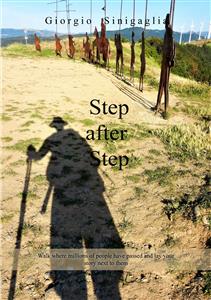
Walk where millions of people have passed and lay your story next to them.
Das E-Book können Sie in Legimi-Apps oder einer beliebigen App lesen, die das folgende Format unterstützen:
Veröffentlichungsjahr: 2018
Ähnliche


















1
G i o r g i o S i n i g a g l i a
Step
after
Step
Walk where millions of people have passed and lay your story next to them
2
3
Sommario
Introduction6
1. San Jean Pied de Port - Roncisvalle8
2. Zubiri, Cesur Menor, Eunate16
3. Puente la Reina, Estella26
4. Los Arcos, Logroño33
5. Ventosa, Santo Domingo de la Calzada, Belorado43
6. San Juan de Ortega, Burgos51
7. Hornillos del Camino, Castrojeriz59
8. Boadilla, Corrión de los Condes, Ledigos66
9. El Burgo Ranero, Mansilla de las Mulas, León74
10. Hospital de Órbigo, Murias de Rechivaldo, Fonceba-don, Ponferrada83
11. Villafranca del Bierzo, La Faba, O Cebreiro, Samos94
12. Barbadello, Portomarín, Gonzar, Melide110
13. O Pedrouzo, Monte do Gozo, Santiago118
14. Negreira, Muxía, Lires, Finisterre132
Sources cited143
Dedicated to:144
Isbn: 9788868851477
Anno domini MMXII
Camino Francés
June - July 2012
All right reserved to the author Giorgio Sinigaglia
Ebook
http://www.bookrepublic.it/book/9788868851477-orme-su-orme/
December 2018
4
5
Introduction
It’s time to go! When this sentence became part of my daily thoughts, I realized that I needed to give rein to my profound conviction that the moment arrived. Compostela became my de-stination. A brief mention of “the way” (Camino) is in order for those readers who are unfamiliar with the term. There are many different roads today, as in the past, which lead one to undertake a spiritual journey. Around the year 1000 ad, there existed three important pilgrimage routes: to Jerusalem and the Holy Land, to Rome and the tomb of Saint Peter and to Santiago di Composte-la and the tomb of the Apostle James. For this latter, those who walked to the destination were called pilgrims, strangers who went through fields. These pilgrims went to Compostela, field of the stars, to pray on the tomb of the apostle James, the first of the apostles to be martyred. As can be imagined, the roads in those past years were nowhere near being as comfortable as the roads we have today, but even then “the way” (Camino) was well-k-nown. People came from practically all parts of the then known world: Rome, Eastern Europe, Germany and even England to visit the tomb. The routes were diverse but they all converged eventually at Compostela.
Today, as in the past, these routes have a special appeal. The French Route, together with the Northern Route and the Franci-gena Route, formed the main axis road which cut across Europe and Italy and lead to Santiago.
There is a well-known passage written by Leon Felipe (1884-1968) which describes very accurately the undertaking that is about to begin: “ No one in the past, nor in the future will go towards God, following the same path that I am using. Every man is bathed by different rays from the Sun and every man re-aches God by a different route “Taking up the pilgrim’s walking stick means, first and foremost, occupying a sacred space where
6
divine power has chosen to manifest itself through miracles.” Such a space is essentially symbolic and you can only access it through symbols and rituals. The word “ritual” may sound crazy or like an empty custom to you. You have to make the effort to return to its deepest meaning since it does not seem possible to perceive the power of the divinity except through ritual. Ritual is an instrument used to perceive God. The mediations may be extraordinarily numerous since they include all the visible forms of the religious person’s answer to the Power with whom he co-mes into contact: from the simplest gesture or a word to the most elaborate celebration. A ritual, in the strict sense of the word, is a symbolic act performed with a certain frequency by a group in accordance with specific norms that attempts to effectively make present the reality of the symbolized supernatural order.” Some of the rituals we perform have the quality since they are from the Catholic Church. Others, that do not have this exact character, we propose as examples, models, initiations that fa-cilitate the symbolic experience of God. When the pilgrim puts his feet on the road, he cannot deny that Jesus Christ the Lord, is the Camino and that the goal is on the other side of the Portico de la Gloria.
He needs, then, a ritual to help him across to the other shore, access to the “space where the divinity has chosen to manifest itself.” (Parar Orar en el Camino, p.33)
7
1. San Jean Pied de Port - Roncisvalle
My “Camino”, begins at Saint Jean Pied de Port, the last town in French territory; a border town, fortified at its up-per level and the point where one leaves the plains and begins the climb up the Pyrenees to reach Spanish territory. I get there by bus from Pamplona, where I arrived via Saragossa by air from Bergamo the day before. Even the day before had its “momen-ts”. Upon boarding the aircraft I noticed the curious looks that some passengers gave me when the saw my boots and couldn’t understand the reason why I was wearing them. When I arrived at Saragossa, just as I was getting on the co-ach, (which would take me to Pamplona) a girl named Yasmin (Spanish and travelling from Pisa) with a pack on her back smi-led at me and spoke to me in Italian. Good, I thought, I can ask her where I should get off to catch the coach to Pamplona; I didn’t even give it a thought that she might also be there for Ca-mino. We began talking and she explained to me that she had my same destination; it was the first sign that I wouldn’t be alone on my journey. When we reached Saragossa we went immediately to the bus station to catch the coach to Pamplona. After a thirty minute wait, we were on our way again in the direction of Pam-plona. When we got there it was almost evening and we started looking for a place to stay for the night. In the center of town there was a small inn which rented rooms and where we were able to get food and lodging.
8
Saragozza
The next day, after a walk around Pamplona, I caught the bus to Saint Jean pied de Port. Yasmin would catch a bus later that evening for Roncisvalle which is another starting point, located, however, in Spain. I arrived in Saint Jean at 4pm, looked for the hostel, had a stamp put on my pilgrim’s passport (Credenziale), and thus began the rite of the “sello” or stamp that will be repe-ated at every arrival and or every important place visited. The hostel attendant is from Liguria and welcomes me by informing me that the rooms are on the next floor and that din-ner and breakfast are included in the price. Howe-ver, he warns me that since the me-als are commu-nal, punctuality is important. There is mass at 6pm in the church of St. James which is located near the bridge whi-ch leads to the historical center of town. No pilgrim misses the opportunity to visit the church. Its architecture is Romanesque, welcoming and has a strong attraction on all pilgrims. The chur-ch makes you feel comfortable and at home. It speaks to you and one spontaneously comes here to listen. This is the attitude that I will adopt along my journey. I (and I think this goes for many others) are very prone to talk to God about our difficulties and our sufferings. Sometimes we thank God for the joys that we re-ceive, but rarely, very rarely do we remain silent and listen. We are not accustomed to remaining silent. It is a sound so strong that we want to cover it so that we do not hear what is inside. In this way we do not hear what He wants to communicate.
9
Saint Jean pied de Port - Eglise de San Jean
10
The mass has a different flavor to it. I feel alone, even if I am among many others who are about to undergo my same expe-rience in one of the best atmospheres for listening. It is the mo-ment of the benediction and the priests ask us to approach the altar of St. James, where they ask each of us our name and where we come from. I realize that there are about a hundred of us and that we represent about fifteen different countries. A small part of the planet is here and getting ready for a special encoun-ter with God. I had an opportunity five years ago to receive the benediction of the pilgrim, but this evening I perceive it in a different, a special way. I remain in the church for a little while longer before heading back for dinner. In truth, I am already late, but intensity of the moment is too strong. I’ll apologize to my fellow diners just as soon as I return. My thoughts flow to these past two days of drawing closer to my destination; to the people I met, to Yasmin, young and in difficulty in finding work; to her kind way of helping me and her many expectations of life.
A moment’s reflection is in order at this point. Each of us has or has had in the past important responsibilities on our shoul-ders, perhaps not in first person or in a key role, but in any event we have made decisions which have lead us to the situation in which we now find ourselves.
In the 70’s, when I first faced the world of employment, the-re were many opportunities for those who had the desire to work which were the result of the rapid growth of the coun-try, of individual initiative and many other factors. From all of
Saint Jean Pied de Port
11
this we derived an enrichment of our conditions of life but also an impoverishment of important values and therefore a conse-quent weakening in the conditions of our country which we see today. The “clever dishonesty” of many, have determined the present paucity of Christian and other ethical values; to each of us our own mirror.
It is the end of the first day on French soil. Tomorrow, the start of the actual pilgrimage which will lead me to Santiago de Com-postela will take place. It’s 8pm and I’m having dinner with the other guests of the hostel. French is being spoken and for the moment I’m keeping pace with the conversation. Tomorrow will be another day. Even better, it will be the day, the start of my pilgrimage.
Outside, a heavy thunderstorm has broken out; let’s hope that this night passes and that tomorrow will be a day of sunshine; the hostler reassures us that tomorrow the sun will be out.
I go to my dorm and lie down on my bunk bed. There are three of us in this four-man bedroom and my thoughts return to the mass earlier in the evening. From the first I struggled to follow the mass in French but I now realize that some things were lost to me. I know the ritual and reflected on the fact that even when the language is known to me, I follow for a while but then I get lost in my own thoughts. I’m not always in tune with what’s going on; God speaks to me but I do not ful-ly understand his message.
landscape at the start
12
The next morning arrives quickly and wake-up starts with the first movements in the dormitory and breakfast… “Il Cami-no” calls us. We are all strangers and yet I feel part of a group; familiarity with the others is immediate. As I leave the entrance of the hostel, the manager says “Buen Camino” as a farewell greeting.
The day is still partly cloudy but promising to be a beautiful sunny day; the clouds begin to part and the Sun begins to come out; I begin my uphill walk to my point of reference, the Oris-son shelter. I begin my walk with the others along the Camino. Deep down inside me I have this urge to compete; something that helped towards the development of the country, but when it becomes an end in itself it represents nothing other than a desire to outdo others and eventually oneself; this urge can only lead to personal destruction and I need to keep it under control. I’m not here to show how good and strong I am but for something else, which I hope to discover.
Passing the town of Hunto, I encounter two girls, Martina and Akj, near a small fountain. One is from Rovigo and the other is Japanese. I’m exhau-sted and tired out; perhaps I started off too quickly and now I am paying the price; a refre-shing drink at the fountain; an exchange of words we all set off together.
When we get to the Orisson shelter, things are better. Lunch is a hearty sandwich and a cof-fee; a photo of a Japanese gent-leman in traditional straw hea-
Orizon shelter and a Japanese pilgrim
13
dgear and we’re off again. A few kilometers ahead of us awaits the statue of “the Vierge de Biakori”. The road has become less difficult and even Akj has learned to breathe more easily. After climbing and descending a few hills we finally come into view of the smiling statue located on a small hilltop in front of us. Inevitable, my thoughts turn to Monte Berico and home. I’m not sure if my travel companions have similar thoughts. A brief respite and we go on again towards “Croix Tibaut”.
When we reach there we are halfway to our first destination. We are sur-rounded by the sounds of serenity; no noise, only the sounds of goats and sheep grazing; wild hor-ses and in the clear sky above some very large birds in search of carcas-ses: the vultures of the Pyrenees.
Silence accompanies us along our Camino. Interrupted every now and then by a “tout bien” and we continue on. By midday we are at the Bentarte hill, near the Spanish border, almost at 1,340 meters which is the highest altitude reached today. Around 2pm we reach the pass and begin to descend, passing through a forest of beech trees which gives us the impression of being in a fairy tale story. A mist penetrates the forest giving it a magical semblance. The descent is rapid and at certain points dangerous. I help navigate my way down with the use of sticks and suddenly
Vierge de Biakori
14
we are there. Through the light rain which begins to fall I can make out the robust walls of Roncisvalle and just below them the monument pla-ced in memory of Roland and his war horse. By 4pm we reach the shelter after walking since 8am for a total of 28 kilometers of which 20 were uphill. We introduce ourselves to the hostel atten-dants, a stamp is put on our pilgrim passports (Credenziale) and we are assigned our beds. In the dormitory, I find my place and after a relaxing shower and half a sandwich I lay down for a short rest. The others do the same. A little after 5pm, I go out for a short walk around the town. I am familiar with the town since I was here in 2005 when I went on my first pilgrimage with a group of 100 other pilgrims. It’s raining a bit so I retrace my steps and stop in front of the church of “the Vierge del Camino”. I enter and immedia-tely I begin breathing in a different atmosphere; on my right a few back-packs are placed against the wall and there are young people in the pews praying; the lights are low and in front of me is the altar with its statue, small but suggestive, so I sit down and recite a few prayers; I then remain quiet and listen: “it’s sweet to be with you”. I go back up to my room and find a new com-panion. In the company of Martina and Akj is Young, a Korean. Martina acts as our translator and we discover that Young is 25 years old, knows four languages, has practically gone around the world and is here for a unique experience. Obviously these young people have something special going for them. The food
Monument of Roland
15
at the hostel was nothing special so we decided to go to the re-staurant near the hotel for dinner. We had the pilgrim’s menu which included: first course, second course, bread, wine, water and fruit or dessert … all for eight euros. Not even at lunch in our local country inns could we spend so little. At 8pm I attend mass with a pilgrim’s benediction at the end. The language has changed. It’s now in Spanish and since many words are similar to Italian, because of their common Latin root, I have little dif-ficulty following the service. The homily talks about the pilgri-mage and our choice to undertake a path not only historic and cultural but also one with a profound Christian tradition; the humanistic cul-ture that it expresses is the transference of a deep expression of the faith of many over the past centu-ries who trampled in the same dust in search of God and men.
Now we are called to receive the benediction of the Pilgrim. Not only am I and the other pilgrims on the march towards un-derstanding our faith and our Christian roots, but we are all in a constant search of our deepest selves and the convictions which sustain us in our daily difficulties both at work and at home.
Roncesvalles - Virgen del Camino




