


17,99 €
Mehr erfahren.
- Herausgeber: McNidder and Grace
- Kategorie: Lebensstil
- Sprache: Englisch
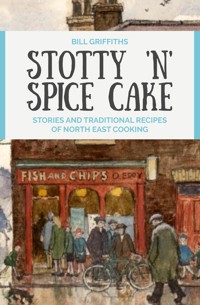
Stotty 'n' Spice Cakebrings together regional recipes, dialect, social history and kitchen technology to give us an insight into how kitchen skills, tools and diets have developed. Bill Griffiths takes us on a journey through cooking history - from the griddle on an open fire and the 'beehive' oven to the widely used, much loved and polished kitchen range (th' yuven). This book describes the changing tastes – as well as changes in supplies of meat, fish and grain over the years to include traditions such as the popularity of oatcakes, broth and bread. Recipes from across the region, such as Leak Pudding, Carlins, Singin'-hinny, Taffle Apple, Barley Broth and wartime recipes 'Warton Pie' (Wartime Pie) of course, all served with much home grown North East humour. A joyous celebration of the history of the food and its people from the North East of England.
Das E-Book können Sie in Legimi-Apps oder einer beliebigen App lesen, die das folgende Format unterstützen:
Seitenzahl: 250
Veröffentlichungsjahr: 2023
Ähnliche

















Stotty ‘n’ Spice Cake
Stories and Traditional Recipes of North East Cooking
Bill Griffiths
Contents
Introduction
Setting the table
Cooking is a topic that relates not only to family and home but holds a respectful interest for all of us that eat. It also serves as a fascinating window on North East history, society and dialect – and that is the viewpoint of my research and study, that brings together public responses at dialect meetings, from correspondence, questionnaires and printed sources from all over the region.
There are two main themes – the story of cooking on an open fire and that of cooking with kitchen range and the oven – with recipes included in their appropriate place. There is only a brief look at the world of post-oven cooking. A glossary section lists and analyses the dialect words involved, under subject headings and a final part (it may be the best) contains longer examples of dialect writing, past and present.
Please note that the recipes – sensible though they seem – should be regarded as guides. Exact recipes are always to be treated with some caution – they seldom suit every cooker or every cook and there will be many workable local variants for each recipe. Improvisation, adaptation and sheer trial and error are essential skills in the kitchen, as you will learn (if you have not already done so).
2
‘Stewart Beveridge’s birthday party’ by Jimmy Forsythe, 1957.
List of Recipes
Turf Cakes
Kale or (Cawl)
Leek Pudding
Pease Pudding
Carlins
Tatie ‘n’ tormit toppin
Rabbit Pie
Clootie Pudding
Beef Stew
Cow Heel Mould
Sausage Seasoning
Cumberland Sausage
Mackerel grilled, barbequed or oven-baked
Fish Pâté
Fish Pie
Fish Cakes
Barley Bannocks
Porridge
Hasty Pudding
Oatcakes
Girdle Cake
Singin’-hinny
Pikelets
Claggum (Caramel toffee)
Sugarless Toffee
Taffle Apple
Wild Gooseberry Jam
Fluffin
Butter Beans
Stotty Cake
Panackelty
Pan haggerty
A maslin (mixed grain) loaf
Bacon Pastry
Gooseberry Tart
Rice Cake
Shortbread
Fruit Batter
Kirkbymoorside Gingerbread
Chatton Cheese Quiche
North Shields Kipper Canape
Trifle
Chocolate Truffles
Ice cream
Part One
The open fire
‘Noo give me a weel banked fire an’ a kettle on the hob – that’s what ah call comfort.’
Scott Dobson, Stotty Cake Row, 1971
The wood fire
The hearth was the focal centre for the house and whether that was walled with sticks and daub or local stone and roofed with straw, heather or rough limestone slabs, there are two generalities we can assert of the medieval homestead:
1. The fire would be in the middle of the floor of the main room (often the only room).
2. The typical fuel would be wood – not precluding the use of dried cow-dung (‘cassons’), heather, furze (‘whinns, for baking’ are mentioned in the expenses of Sherburn Hospital, 1686) or peat.
The hearth would be a circle of beaten earth, probably ringed with stones. A grate to lift the fire up is not strictly needed. Nonetheless, in smarter households, the placing and arranging of new logs could be managed with the help of a set of firedogs. These took the form of an iron stand that provided low-level support for new fuel and a modest circulation of air, while keeping a compact fire together (wood ignites from direct contact with other burning wood). The two uprights served to pivot a roasting spit or other cross-member on which a cooking-pot could hang. 6
Firedogs
The reek
Reek (smoke) would be left to find its way out through the loosely assembled roof – not so far away, as the homes were only single-storey. Indeed, well into the seventeenth century, John Ray travelling in East Lothian in 1692 reported of the North that:
…the ordinary country houses (were) pitiful cots, built of stone, and covered with turves, having in them but one room, many of them no chimneys, the windows very small holes, and not glazed.
The modest dimensions provide a hint as to the constructive use of wood smoke – for preserving food. Ideal would be fires burning oak, beech, walnut, hazel and fruit woods (less useful: sycamore or soft woods). Offcuts (‘spiles’) from the everyday carpentry of early times would be best. Peat, on higher moorlands, could serve equally well.
Today smoking food is reckoned a specialist task, but back in the Middle Ages it was a process available to everyone in their own homes. Our common word ‘pudding’ seems to derive from 7the animal stomach or intestines into which ingredients would be stuffed to make a traditional haggis or sausage for smoking. In the rafters above each hearth, where the smoke collected, would surely hang a stick of herring, a string or two of sausages or a ham, putting to good use what would seem to us the main disadvantage of early house design. The broad chimneys of Tudor buildings would be equally useful for smoking; but no one in later times would care to have their food preserved and flavoured by coal or coke fumes!
Ridding
One aspect of the open, central wood fire worth noting is the infrequency with which the hearth would need to be cleaned. Keeping a fire going continuously rather than stopping and cleaning it out regularly would be an obvious advantage and it seems that ash was left to accumulate as long as practical. As Lawrence Wright points out, ‘The ash must be kept deep upon the hearth, as a reservoir of heat’. It was usual ‘to let the wood ash accumulate on the open fire until the fire itself was burning a foot or two above the floor-level’ (Allingham, 1909). Practically, before the invention of matches, no one would wilfully want a fire to go out. Whether it was possible to leave the hearth to one annual clearing up is uncertain, but the tradition certainly developed of ritually disassembling the fire, cleaning the hearth and rekindling the fire anew on a special day each year.
In the South this was at Easter, hence ‘Spring Cleaning’ – reflecting the tradition from the Roman calendar and the Christian Church that the New Year began in March. In the North it was a mid-winter affair associated with Viking-like fondness for fire festivals and celebrating the New Year at the end of December. Here is an account of the New Year’s Eve customs in East Durham in the 1930s, described by Margaret Reed of Seaham:
There was a lot of preparation… A special shop for a start – if there was any money left over from Christmas. Our best supper was an ox tongue with pease pudding, but there would also be freshly baked mince pies and so on, depending on funds. From morn till midnight, everything was geared 8to welcoming in the New Year. Everything that could be polished, scrubbed or cleaned was brightened up. The floors would all be swept – to get rid of the year’s accumulation, as it were. For us children, the treat was being allowed to stay up. We were bathed, and dressed in our ‘second best’ – not quite the very best, but smart enough.
By 9 pm, the fires would have been let to go out, then the ashes cleared out, and the cold grates left ready to receive new fire… About ten to twelve, our father would set out, with some coals and sticks (kindling) with him – to make sure (on return) there would always be fire in your hearth for the coming year. All the family men would gather at the bottom of the street and await midnight. The New Year would be signaled by the church bells ringing and the ships in harbour would blow their whistles, the pits too, while we waited silent indoors for the first footer. This would be our own father of course.
The fire would be lit, all the doors to the rooms through the house opened, everyone within wished a Happy New Year! There would be a little cake and a drink; the front door would be left open for any callers and people would go round and visit, but especially family. I think it was during the War that it became less of a family occasion, more of a general gesture of goodwill to your friends and so on.
Conditions had changed remarkably from wood-burning hearth in a cottage to coal fire in a mining terrace house, but this ritual rekindling of the fires is only explicable in terms of the practices of the Medieval hearth and its olden-time wood fire.
For the younger post-war generation, the New Year has symbolised a looser sense of conviviality. Charles Trelogan reports from New Herrington, near Sunderland:
On New Year’s Eve the fire was cleared of all the ashes – ‘a clean start for the New Year’. The first footer would carry a piece of coal to place on the burning or newly cleaned fire. Also, front doors were left open so that the convivial caller could come in for a drink. 9
The fireside
A gradual but important change during the Middle Ages was the move of the fireplace from the centre to the side of the room, at the wall. This was essential in better two-storey buildings, as the main room would be on the first floor and you would be ill-advised to light a fire on the wooden floorboards. The walls of taller buildings, whether bastles, castles, peel towers or manor house, would be of stone, into which a suitable flag base for a fire could be easily set. This new arrangement was later found convenient in single-storey stone cottages at one end, or long-houses, fires back-to-back at a central wall, and had the advantage that smoke could be channeled outside through a simple flue.
The flues were initially plain vents for smoke, and not yet intended to create updraughts; tall chimneys are not needed for wood fires. The typical Tudor fireplace for burning wood would be a broad space, so as to accommodate logs of varying sizes, saving on the amount and accuracy of sawing or chopping needed, plus space at the side for a pile of new wood to dry, ready for use.
Such wide fireplaces would ideally double in function for heating and cooking unless a separate kitchen was available. If the flues needed occasional scraping, a bairn was considered ideal for the task; and the soot obtained would by no means be wasted: mixed with gum arabic, it made our earliest black ink. The large Tudor fireplace is associated inevitably with succulent joints of meat roasted on a spit. If the heat came from one fixed direction, i.e. below, the meat could only be cooked evenly by the ruse of keeping the joint turning. Spit-roasting is still possible with a ‘rotisserie’, though hardly on the scale of a Tudor banquet, whole ox or whatever. Well, a whole ox is traditional at the Houghton Feast in Co. Durham if you want to find out how it’s done.
Here is a description of a simple case of open fire roasting from G. MacDonald in Scotland, first half of the nineteenth century:
In a few minutes Grizzie entered, carrying a fowl just killed, its head as she came all but dragging on the ground at the end of its long, limp neck. She seated herself on a stool, somewhere about the middle of the large space of the kitchen floor and proceeded to pluck and otherwise prepare 10it for the fire. Having last of all split it open from end to end, so turning it into something not unlike an heraldic double eagle, she approached the fire, the fowl in one hand, the gridiron in the other.
Peat fires
Useful peat could be cut in many upland areas, and forms something of a special case: a peat fire could require a ‘wind hearth’, that is with a hollow below so that bellows could introduce extra air to make the peat red-hot. Generally, peat burned slowly and with low heat, but had advantages as suggested by M. Hartley:
The turf fires were famous and when well-made, with a wet turf pushed into the ashes and a scuttle of turf mould thrown on, they kept in overnight. Many people, especially innkeepers of the moorland inns, claimed that their fires had not been out for a hundred years.
Like other open fires, cooking tended to be in simple pots hung over the fire:
Although some houses had bread ovens, and bread was also baked by placing dough on the hot turf ashes, the characteristic cooking in the moorland houses and cottages was by means of a variety of pans over a turf or peat fire; this continued long after ranges were installed, well into the 1930s, until this type of fuel ceased to be harvested.’
The peat smoke undoubtedly added a special dimension to the flavour of the food. This is hard to recapture, but here is a recipe:
Turf Cakes
1 lb flour
3–4 oz. lard
a bit of salt
1 tsp baking powder
½ cup of cream or milk
11Mix the ingredients together and bake as one cake in a large frying pan with a lid on.
‘…they were about half an inch thick and were turned with a knife and cloth after five minutes,’ Hartley, 1972.
The switch to coal
Coal became more available and its advantages more widely appreciated in cities like London from the sixteenth century on. In all big towns wood was a relatively scarce and expensive commodity – it would have to be transported in for a start and the priority claim was for timber for shipbuilding, house-building and other serious carpentry needs. For industrial processes too, coal made a better and more available source of heat than wood-based charcoal. Using transport by sea, it became economic to ship coal to London and this according to Daniel Defoe was the origin of the term ‘sea-coal’.
Coal radiates more heat than wood and so makes a more efficient heating and cooking fuel – but has special needs that radically influenced house design. It required a fireplace at the wall and walls or at least a surround of stone or brick; a flue to the outside for the truly noxious fumes; and for that flue to be extended upwards in the form of a chimney to provide sufficient updraught to draw away any carbon monoxide and other gas products and to draw in oxygen at the base to help the coal ignite and continue burning. Exact figures we lack, as the temperature for the ignition of coal varies with its carbon content. The point is, to maximise the flow of air, a narrow fireplace and flue was favoured coupled with a lofty chimney. Neglecting this, we learn from the HRCM that ‘Queen Eleanore was forced to leave Nottingham Castle where she was staying in 1257, on account of the objectionable smoke produced by the burning of sea coal.’
An iron grate of some kind to lift the fire up helped increase the access to oxygen by directing the updraught through the body of the fire, as did use of a set of bellows or a ‘blazer’ or ‘bleezer’ – a metal screen that could be held across the fireplace-opening to 12channel the draught. The fireplace for a coal fire is ideally narrow and modest of scale.
Early fire grate
If wider old-style fireplaces were to be used for coal, a smaller grate would be set centrally, often a sort of lattice box of wrought iron, or perhaps some of the space would be bricked in. ‘Coal needs to be contained in a compact mass so that enough heat will be generated for its combustion,’ Eveleigh, 1983.
The ‘great rebuilding’, which saw smaller farmsteads and cottages replaced with ‘modern’ two-storey brick farmhouses is reckoned to have occurred later here than in the South. In the North East it was a movement typical of the seventeenth century, when securer leases and longer tenures encouraged tenants to invest in ‘new build’ which would serve for generations to come. Stone continued to be used, though brick was gaining in popularity – initially imported from Holland as ballast in collier ships. Single-storey rubble-stone houses were now likelier to be labourers’ cottages or used for storage than to form the farmhouse proper.
Unlike the token or non-chimneys of the wood fire age, the chimneys for coal fires could not be disguised or overlooked and 13this made the unit of the fireplace an ideal basis for levying a seventeenth century tax, known as the Hearth Tax.
From the records of the tax we learn, for example, that in 1664 Dawdon in East Durham had one building with 17 hearths (surely the now ruinous fortification and demolished manor house known as Dalden Tower). There was also one building with two hearths, maybe a farmhouse or minister’s home; and six buildings with just one hearth, presumably labourers’ or small-holders’ cottages. The Age of Coal had arrived, with its own social distinctions and markers of status.
Using a coal fire
Clinker and ash would need to be cleared out regularly from below the grate of a coal fire to ensure the passage of a good current of air. In view of the intense heat generated, this could only be partially done while the fire was alight. Once a day or once a week, the coal fire would need to be left to die out and a thorough cleaning undertaken – but the extra work was likely to seem worth the improved radiating heat that a well-managed coal fire can provide.
In place of free-standing firedogs to suspend cooking vessels from, a branch or iron rod could be lodged across the flue opening, and pots could hang from that, using a chain and ‘S’ hook to vary the height. According to Heslop, a ‘galley-baak’ was ‘the balk or beam fixed across a chimney over the fire… The galley-baak was sometimes a tree branch with the bark stripped off, but otherwise undressed and unsquared. In this case it was commonly called a ‘peeled grain’ as described by (Tibbott):’
(An) early method of holding pots and cauldrons over the fire was to suspend them from a chain or pot-hook hanging from a cross-beam in the chimney. The chain consisted of large, round or elongated links and the pots were hooked to it and the hanging point adjusted by means of a simple ‘S’-type hook.
Height adjustment could be made alternately by using a vertical strip of metal with notches to seat hooks; this was called a ‘rackin’ (i.e. racheting) crook. Horizontal movement was possible if a 14‘crane’ was used, anchored in front of and to one side of the fire: ‘By swinging it, the suspended pot could be held in position above the fire, or moved away from it…’, Tibbott. In a more graphic summary, Beatrix Potter describes how Tom Kitten ‘jumped right up into the fireplace, balancing himself upon the iron bar where the kettle hangs.’
Utensils
The kitchen was (and is) much more than a source of fire for cooking, as described by Allingham:
The kitchen, in the smaller cottages, is, of course, living-room and kitchen combined, generally spanned by a huge oak beam. Above the mantlepiece runs a rack for the long, bright spits used with the wood fires and sometimes the elaborate clockwork apparatus, for turning the spit, is still to be seen. The old oak dresser, bright with its china and pewter, the latter all too rare now, is the best furniture for the kitchen and with the well-scrubbed table and wooden chairs, just fit in the general scheme.
Some idea of the range of cooking utensils and kitchen equipment can be obtained from notices of auctions in the local press of old. Here is a list of kitchen and pantry goods, related to open fire cooking, from the one house at Guisborough, via an auction notice in the Middlesbrough Weekly News, 19 May 1860 (see p. 15).
The cooking facilities an open fire provided might seem crude by modern standards, but were versatile enough, adapted to both ‘flat’ foods and liquids.
Basic would be a metal pot or cauldron for stew or for boiling water to cook in – like earlier pottery vessels that were thrown on a wheel, it had a rounded body and rounded bottom. Practically, this helped heat spread more evenly round the vessel when it was set over the fire. In the kitchen of Michael Jeffreyson of Darlington, 1612 (Surtees Society col. 201), were found:
… a paire of great rackes, a drippin pane, a reckincroke, a cauldon & a kettle, a maskefatt [for infusing or perhaps 15brewing], a cooling tub, a draftub, a sae [tub], two skeles [pails] & a litle bordd [table], three seckes and two pooks [bags].
2 dressers containing a quantity of drawers…
kitchen table
4 trays…
metal tea and coffee pot
fender and fire irons
brass and tin candlesticks
2 fire guards
meat jack
flour tin
dish covers
flour cask
jars
meat safe
plates, dishes, etc.
shredding knife
scales and weights
7 pans of various sizes and 2 frying pans
Gridiron
water tins
small barrel churn
table
meat hastener
large wine bin
dripping tins
and a pickle tub…
Auction notice, kitchen and pantry list.
A typical cauldron would be made of metal, cast in one piece; they were still standard ware in Scotland in the mid-nineteenth century for making broth. Sometimes the cauldron had three stubby legs to give it more stability when set on the ground. This type was more usually called a ‘yetling’. A smaller pan with three short legs and a long handle was known as a ‘skillet’. A long handle is a sure sign of a cooking utensil designed for the open fire!
For flat goods such as oatcakes, a bakestone was the earliest support, placed directly by or in the open fire. In Wales and the Pennines, flat oatcakes were baked on a bakestone, a heated stone slab placed on the hearth. The bakestone or ‘backstone’ was a flat, thin stone slab on the edge of the fire, used for baking unleavened cakes upon, before iron plates were used. Stones are still in use for oatcakes. (See p.45 for oatcakes recipe). 16
Dutch oven
In due course, a metal griddle took the place of the stone slab: griddles or girdles are thick circular plates of iron, usually about 12 inches diameter. It was an ideal surface for cooking oatcakes large or small and similar flat grain-based products on. The oatcake was also amenable to being part-cooked and then stored for later re-heating. How? Raine says:
A fleak in Yorkshire is something resembling a gate suspended horizontally a foot or two from the top of a room, and bearing the bread and cheese and bacon of the family.
Or in Brockett’s definition ‘flaik, flake – a wooden frame at the top of a kitchen for keeping oatcakes upon.’ Secure from rodents if not from smoke and other kitchen stithe, these part-cooked oatcakes would be conveniently available for re-use at any time by toasting at the fire. As Florence White notes: ‘It must be crisped quickly before it is to be eaten’, Good things.
An enterprising way of cooking with an open fire was the so-called ‘dutch oven’, used from the early eighteenth century on: ‘they were made of tinplate and stood in front of [i.e. facing] the fire, the bright surface reflecting the heat, reducing cooking time and saving fuel’ Eveleigh, 1986. Reputedly, it was a tasty way of cooking bacon. ‘We all had our home-fed bacon and a Dutch oven used to fix onto the front of the bars of the fire and there were prongs out where they used to put the rashers of bacon on and the fat and grease used to fall into the bottom’, Cawson & Kibblesworth. For a story of a dutch oven and its bacon, see p. 153. 17
Though fires and fireplaces had come a long way in a few centuries, the cooking process remained much the same. Whether from wood or coal, the heat was more or less directly transferred to the food. Exceptionally small items could be wrapped and cooked in the hot wood embers, to simulate oven cooking, but cooking on an open fire remained in general a uni-dimensional affair and limited in that the source of heat could not be speedily adjusted: you needed to set your pan nearer to or further from the heat, your cooking vessel higher or lower – thankfully a large cauldron was unlikely to ‘boil over’.
Diet
An additional limitation would be the range of ingredients available, hence the importance of the cottage garth, aka kitchen garden, aka allotment. A discouragement here was that rural jobs were seasonal and the tenure of a labourer’s cottage often short-term, so that there was little incitement to maintain a cottage or work its garden under such circumstances.
For those with low income who lived away from the main centres of trade and communication, the countryside may have seemed less than idyllic. In 1810 John Bailey reported of agricultural labourers in Co. Durham:
The food and mode of living of the labouring classes are very simple: the bread generally used is made of maslin [mixed grain flour], leavened and baked in loaves, called brown bread; the most usual breakfast is bread and milk and in winter when the latter is scarce, hasty pudding or crowdy is substituted for it; for dinner, pudding, or dumpling and potatoes, with a small portion of animal food, or bread and cheese, with milk and very often bread and milk only; for supper, bread and milk, or potatoes and milk and when the latter is scarce, treacle beer is used in its stead.
The foods were basically organic, local and seasonal. The more isolated your dwelling, e.g. in the Dales in the west of our region, the more self-sufficient you would need to be. The basis of the diet was carbohydrates – grain, potatoes, turnips; while protein and fat was provided by a small amount of animal food and milk or 18cheese. Green vegetables are seldom mentioned, though they were surely grown and would be an important contribution to what we recognise as a balanced diet – beans and peas had been in cultivation since Anglo-Saxon times; the greens associated with growing other vegetables would not be wasted, e.g. sprout tops. Cabbage was perhaps commonest, since ‘kale-pot’, literally cabbage pot, was the standard name for a stew pot. This is evidenced in the border ballad The Battle of Otterbourne:
The Otterbourne’s a bonnie burn;
‘Tis pleasant there to be;
But there is nought at Otterbourne
To fend [provide for] my men and me.
The deer rins wild on hill and dale
The birds fly wild from tree to tree;
But there is neither bread nor kale
To fend my men and me…
The kale-pot
At noon, when frae yor daily toil
Yor freed te dine – the pot i’ boil
Wi’ broth, at hyem [home], yor heart ‘ill cheer,
Gud dinners myek the hoose mair dear,
But broth, withoot thor’s plenty peas
An’ barley i’ them, seldum please;
For barley, peas, – green, whole, an’ splet,–
Cum te maw shop, the best ye’ll get.
Joe Wilson
One of the basic arts of cooking over an open fire – so traditional as to be virtually prehistoric – was broth or stew in a cauldron-shaped cooking-pot. A traditional standard and by no means the preserve of witches. Notwithstanding Joe Wilson’s ‘Aw’ve seen her gurn [grin] just like one o’ Macbeth’s witches roond the kyel-pot.’
Today a large saucepan or a casserole is used for preference, but the term kale-pot endured well into the nineteenth century.
Broth was the simplest meal that could be cooked in a kale-pot and had the added advantage that it could be made in a large 19quantity, left to simmer, used when needed and then topped up and reheated for late-comers. Within reason, it provided a continuous source of nourishing food – and an oatcake or flat stottie was the ideal accompaniment, to dip in or wipe the bowl clean with afterwards.
Well into the 1950s, it served as a symbol of sociability, as Tom Moreland records:




