


Erhalten Sie Zugang zu diesem und mehr als 300000 Büchern ab EUR 5,99 monatlich.
- Herausgeber: McNidder and Grace
- Kategorie: Geisteswissenschaft
- Sprache: Englisch
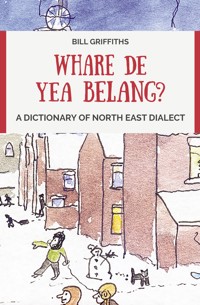
Where de yea belang?brings together the distinctive vocabulary of the North East dialect. "Abackabeyont, bait-poke, cracket, drucken, etten, fettle, guissie pigs, lonnin, marra, nyen, plote, queen-cat, reckling, skinch, tew, upcast, vine, willok, yem, zookers!" If you enjoy finding out about dialect words – how and where and when they were used – and where they came from – this is the best guide to help you explore the world of North East dialect. Until the 20th century, dialect was a marker of economic, social and cultural change. We know that the North East maritime connections with the Dutch led to the introduction of many 'new' words. The Scottish influence of the keelmen (fisherman) on the Tyne and their effect on local language was much more radical. Although the Tyneside dialect and identity and this way of speaking is fast waning, the popularity of discovering this language and dialect shows there is still a great interest in the languages and dialect of the past. The late Bill Griffiths (1948–2007)was an extraordinary writer and poet: radical, experimental and scholarly, but also had a great sense of humour. He was a wonderful champion of the North East, its people and heritage. Born in Middlesex, he read history before graduating in 1969. Bill ran his own independent press and published political pamphlets and essays on the arts and poetry. After gaining a PhD in Old English he fled London and settled in Seaham where he embraced the northern way of life. 'He was also a scholar of Old English and dialect who know how to make his work accessible. Private and uncompetitive, he was at least these things: poet, archivist, scholar, translator, prison-rights campaigner, pianist, historian, curator, performer, editor, short-story writer, essayist, teacher, book-maker and lyricist. The Saturday before he died, Bill discharged himself from hospital to host the Dialect Day at the Morden Tower in Newcastle upon Tyne. He died as he lived: cataloguing, awarding Best Dialect prizes, opera on his radio, the poetry paramount.' Obituary, The Independent, 20 September 2007.
Sie lesen das E-Book in den Legimi-Apps auf:
Seitenzahl: 624
Veröffentlichungsjahr: 2024
Das E-Book (TTS) können Sie hören im Abo „Legimi Premium” in Legimi-Apps auf:
Ähnliche


















i
Whare de yea belang?
A Dictionary of North East Dialect
Bill Griffithsii
Contents
Preface
This dictionary began in the mid-1990s and has grown ever since. It is a guide to the language used in current North East dialect speech as well as ‘classic’ texts of the nineteenth and twentieth centuries. In this revised and updated edition, we introduce more words, and quotations to show word use.
As well as the dictionary section we begin by looking at how the North East dialect developed over the centuries – not in isolation, but interacting with a surprising number of influences including immigration, local industry and trade contacts abroad. Words, like ideas, soon pass frontiers.
We have taken ‘dialect’ to mean words typical of the North East, that are not regularly part of ‘standard’ English. It is useful to note that few words are unique to any county or region. A special use of even a common word will be worth noting; new coinings are not to be automatically dismissed as ‘slang’. North East dialect is at heart a spoken language, a flexible experience, and open to change. This book has been written to encourage a better appreciation of what thankfully is becoming recognised as an essential part of the region’s ‘intangible heritage’.vi
Part One
The History
If we take language as the attribute of a nation and dialect that of a region, this is not to suggest that dialect is subordinate to ‘national’ language. In the case of English dialects, their roots go back to the fractionalising of society in the era of Viking and Norman invasions, so that many features of Northern English precede the efforts to set up a national English in the fifteenth and sixteenth centuries. The model is more one of parallel development and it would be more useful to think in terms of varieties of English, developing in parallel and interacting over a long period.
To what extent the ‘dialects’ of Old English (‘OE’ – the language of the Anglo-Saxons) can be taken as the direct source of Medieval dialects is debatable. Language is continuous, but the slight differences between Anglian (Mercian and Northumbrian) in the North, and West Saxon (in the South) give little warning of the divergence that was to take place. In vocabulary the Anglo-Saxon North already preferred ‘bairn’ to ‘child’ for example, and uncontracted forms of the verb to contracted ones, e.g. cymeðthan cymð (‘comes’), weorðestthan wyrst (‘become’); but even these distinctions were likely to be minimised by the spread of Late West Saxon as a written norm in the late tenth century, at a time when Wessex had absorbed the other ‘kingdoms’ into a recognisable England.
The real jolts that led to language change came with the arrival of the Vikings in the ninth century and the Normans in the eleventh, though there are understandably no exact records of how the spoken language changed or when. The Vikings contributed many new words to Northern English, some of which also entered Southern speech early on. The Normans effected a more total takeover of the state: under their rule, Anglo-Saxons were replaced by Normans in key positions and the status of English demoted. Instead of English being the language of government and literature, charters, wills, and other administrative and 2legal records would be kept in Latin, while the business of the ruling class would be conducted in Norman-French.
Deprived of any central supervisory machinery that might have secured its cohesion and consistency, spoken English diversified, curiously along the line from London to Cheshire that had served as the dividing line between West Saxon and Viking influence in King Alfred’s day (880s). To the north of that line was the Danelaw, to the south the Saxon kingdoms with West Mercia and Kent. Either these traditional loyalties were very persistent or – a distinct possibility – the divergence between Northern and Southern English had begun earlier, its effects obscured by the traditional nature of the written language. This affects the question of when words from Old Norse (‘ON’, the Viking language) entered English: in the ninth and tenth centuries, when Viking power was considerable and the cultural current ran (as it were) from Viking to Anglian; or in mid eleventh to twelfth centuries, when Viking power was on the wane, and the once-dominant settlers assumed a lower profile in Anglo-Norman society.
The making of Middle English
In the Middle Ages, English in the South exhibited many sound changes but was more conservative in its grammar; the North proved more conservative of vowel sounds, but more innovative in its vocabulary and grammar. It is these changes that lay the real basis of Medieval and modern dialects.
For example, the long OE vowel /a/ can change into /o/ in the South: the OE word acbecomes oakin the South, but stays as acin the North, later breaking to give yek; finnd(find) retains a short vowel in the North, but lengthens and breaks to a diphthong in the South; the Northern /u/ (sometimes written ‘oo’) retains its OE value, while in the South it later changes to the dark ‘uh’ sound.
In the North it is to be expected that more words from ON would be absorbed than in the South. Many of these were never adopted into ‘national’ English, and either died out in the North (e.g. maugh‘brother-in-law’ or tawm‘a fishing line’) or survived to give a distinctive feel to Northern dialects (e.g. marra‘work-mate’, cree‘animal pen’). Paradoxically, while many OE words had died out by the end of the Middle Ages, examples can be better preserved in Northern than Southern English, e.g. thoofor you, neepfor turnip. (Perhaps this was 3because of the keenness in the South to introduce new words based on French and Latin.)
The extent of Viking influence in the North East is a point of debate. When, in an East Durham charter of 1155 we find side by side as names of witnesses: Eilwin de Saham, his son Raven de Slinglawe, John son of Herebert de Saham, Roger Dreng, Ranulf de Hassewelle, Ailmar de Daltune, and the aristocratic Reinald Escolland – mixing Viking, French and Anglo-Saxon name elements – we are at a loss to determine whether this apparent mix is the result of chance relocation, intermarriage or a cross-cultural fashion in Christian names. It is to be remembered that language is a cultural, not a genetic matter; and it is certain that words of ON origin have long been in use in areas not believed to have been settled directly by Vikings. An example is beck(from ON) which corresponds to OE burn(e)‘stream’. If dialect followed the lines of Viking settlement, beckshould not be found in Co. Durham or Northumberland. It is true these areas show a relative lack of ON placenames and memorials, but it is unlikely this early exemption continued long, and beckis now the standard term in Co. Durham for a local stream.
Tendencies to regional consistency were at work even in the Middle Ages – for there was mobility as well as stability inherent in the feudal system: in interchange between manorial estates, in the access to local and regional markets and fairs, in the realities of feudal warfare, and in the obligation of pilgrimage. It is likely that throughout the Middle Ages the Church provided a channel of communication and a degree of cohesiveness within and between the fledgling dialects. It was not after all the Normans’ aim to extinguish English society, rather they acted as a super-class exploiting, but at the same time depending on the English population. They would hardly want their serfs to converse in Norman-French.
Major changes also occurred in grammar. Old English was an inflected language (like German or Latin) with different endings for masculine, feminine and neuter nouns, strong and weak adjectives, and the four cases (nominative for the subject of a sentence, accusative for the object, genitive for the possessive, and dative for indirect object or instrumental). Plus, different endings for singular and plural! Of these, only apostrophe-s for the genitive (king’s,etc.) and –s for the plural (kings,etc.) have survived for the noun.
An inflected language means the role of a word in the sentence is clear whatever the word order; in Modern English we need to observe 4the word order subject-verb-object to make the meaning clear: ‘the king killed the lion’ is very different from ‘the lion killed the king’. The loss of inflexions (case endings) was the major change that gave Modern English its simple, streamlined grammar.
One theory is that when Viking had to speak to Anglian, the niceties of inflexion tended to be lost, and a compromise language, a sort of mix or ‘pidjin’ resulted, with a simpler structure. However, it should be noted that OE itself did not satisfactorily distinguish between subject and object cases, leading early on to a risk of ambiguity. Even in the Anglo-Saxon period there was a tendency to adopt ‘sense order’ to make the meaning clear. Moreover, case endings (suffixes) were unaccented tags at the end of a word; because they were little emphasised, over time they tended to level (become similar). This led to greater dependence on sense order and that in turn reduced the usefulness of suffixes – a circular process that could account for their loss. Vulnerable and disestablished as English was, the spoken language had no way of monitoring or regulating change.
Some steps in the process, however, may have been deliberate. In the case of verbs, the endings for the present tense are also reduced to plus-s or non-s (speakand speaks). There is no precedent for this in OE or ON, and the conclusion is that the useful formula for nouns was applied to verbs, perhaps as a conscious improvement (simplification).
Many of these grammatical changes had their basis in the North. The South retained more of the OE verb inflections, and as late as 1611 these are found in the King James Bible of 1611 (e.g. saith, hath, casteth…). Not that Southern English had not changed also, but whether independently or in awareness of the North is less clear.
There may be differences, for example, in the rate North and South adopted French words. These came in two waves – Norman-French (also called Anglo-Norman) of the late eleventh to early thirteenth centuries, and Parisian or Central French of the thirteenth and fourteenth centuries. Norman-French often had initial /w/ where Parisian French had / gu/, e.g. William/Guillaume, warrant/guarantee; also /k/ for /ch/ as in cauldronand later chauldron. A strong early influence from Anglo-Norman may be assumed in the North East, given the importance of the Norman ‘Palatinate’ of Durham; but this seems more evident in the commonness today of Norman-French personal names and French elements in place-names than in the dialect.5
National English and the reaffirmation of dialect
With the break-up of the Angevin Empire in the early thirteenth century, the Anglo-Norman nobility faced the need to commit themselves to either England or France. In time, those noble families settled here came to think of themselves as English, and this opened the way for the reversal of the eclipse of the English language. The shock and destabilisation of the Black Death may equally have served to revise notions of identity and national structure. By the fourteenth century, impressive works of poetry were being composed in English dialects (TheGreenKnight, Langland’s PiersPlowmanand Chaucer’s more French-aware CanterburyTales), each in some way with the approval of noble patronage; and in 1362 Parliament and the Courts were first conducted in English.
In the fifteenth and sixteenth centuries, national unity became an urgent political consideration after the War of the Roses, and a form of English that seems largely a fusion between the vocabulary of the South and the syntax of the North is favoured as a new standard written English. (It is not necessary to invoke Midlanders moving to London to account for this; it could have been purely an executive decision. Indeed, it might be less accurate to speak of the Tudor revolution in government than the Tudor revolution in English.) The new ‘national’ English is employed in government documents; it is taught as the written norm in the new Grammar schools; it is promoted by printing and (in the seventeenth century) defined in dictionaries. It achieved a stability that has not been radically challenged since. It increasingly affected the speech of the educated class – and though it is true a written language usually follows the spoken language; it can equally be the case that written language can influence what is spoken.
Dialects might have been expected to weaken or even disappear under this competition from an ‘official’ English. In fact, during the seventeenth century, when arguments became violent over what England stood for and what path it should take, regional dialect returned to prominence. Perhaps there was no clear political purpose to this move – there were risings both in favour of James II and William-and-Mary in Yorkshire in 1688; rather Northern dialect was reasserted as a general symbol of ancient rights or regional identity against the presumption of the South.
In 1673 (in Moorman’s words) “the York printer, Stephen Bulkby, had issued, as a humble broadside without author’s name, a poem which 6bore the following title: AYorkshireDialogueinYorkshireDialect;BetweenanAwdWife,aLass,andaButcher.” This was followed in 1683 by a booklet AYorkshiredialogueby George Meriton (1634–1711), a lawyer and antiquary of Northallerton; and his sequel ThePraiseofYorkshireAle (1697).
These are non-political, even dully commonplace in their material. George Meriton was also author of a history of England, which, while it condemned the execution of Charles I, gave a detailed and impartial account of the Civil War. Whether the Yorkshire of this time be deemed separatist or radical (it included the home of General Fairfax, Andrew Marvell was MP for Hull), we seem to be evidencing a county beginning to use its history and language as a means towards current identity rather than as an assertion of ready-made historical allegiances. One clue here is that Meriton included a clavis– a key or glossary – with his work, showing he was associating his efforts with a broader audience, and intended to be part of an intellectual as well as local scene.
In the same decades, it was the Royal Society (RS) that was providing the main initiative in the field of dialect research. Thomas Sprat (1635–1713), Bishop of Rochester in 1684, and historian of the Royal Society, set the ground rules by which dialect and common language in general was to be admired and imitated:
They [the RS] have exacted from all their members, a close, naked, natural way of speaking; positive expressions; clear senses; a native easiness: bringing all things as near the mathematical plainness, as they can: and preferring the language of Artizans, Countrymen, and Merchants, before that, of Wits, or Scholars.
HistoryoftheRoyalSociety, 1667
John Ray (1628–1705), better known as a pioneer of botany and plant classification, was also the first author of a major dialect study, the CollectionofEnglishWords,NotGenerallyUsed(London, 1674), which lends dialect for the first time an acknowledged academic status. His may also be the claim to have undertaken the first dialect research, as he “toured around the country in the course of his language investigations” (Fox, 2000).
White Kennet (1660–1728) was Dean and afterwards Bishop of Peterborough; his manuscript Etymological Dictionary(preserved in the British Library as LansdowneMS1033) goes further than Ray, in that his national collection of dialect words was provided with notes on word 7origins in Old English or the Norse languages, and – important for our purposes – notes of which counties a word was used in. It is supposed he benefited from having the great scholar of languages, George Hickes, as a lodger in the 1690s; he may also have had access to the material Ray was collecting.
These were the sort of people who were giving dialect a new status and a dual future – as living language and academic discipline. They can be helpfully viewed as scientists – men who were concerned with collecting the evidence of language around them, much as they would be with natural history specimens. Presumably it was in this sense that dialect was seen as one of the legitimate focuses of the Royal Society.
None of these pioneers should be viewed as primarily political activists. But it is worth considering that some of the appeal of dialect at this time may have been as a symbolic counterpoise to an over-centralised and arbitrary (Stuart) government. If so, it pointed the way forward to the role of dialect in the next century and more.
In the North East
In the 1720s a Newcastle schoolmaster, Edward Chicken, produced a poem, TheCollier’sWedding, in which the narrative is in flawless ‘national’ English rhyming couplets, but the speech of the collier hero is given in dialect, and the wedding customs of the collier class, settling in Benwell near Newcastle, are described with some merriment. The force of the satire depends on a city audience that spoke and thought Metropolitan English and practised Metropolitan manners. It must have seemed to more urbane Novocastrians like a step back in time.
The language that served as the currency of North Eastern culture was the traditional speech of rural areas, brought into urban centres by migrating workers and their families. They responded to the new opportunities in what we could broadly call ‘industrial’ work – shipbuilding, coal mining, chemical manufacture and transport. The key to all this was the potential for deeper mining, made possible by the atmospheric engine in the eighteenth century and the steam engine in the nineteenth century that effectively pumped out water from the mine workings. But where did the new workers come from? The wedding customs described by Edward Chicken seem to derive from rural Northumberland, or so Brockett assures us in his dictionary (s.v. ‘bride-ale’). Heslop (1892–96) held a similar opinion’.8
“To these dalesmen [i.e. from Tynedale and Riddesdale] we owe the strong clanship of the colonies of pitmen and keelmen scattered along Tyneside and throughout the colliery districts.”
However, Thomas Wilson, writing of Gateshead speaks of similar customs his side of the river:
But feast and fun, and fuddled heeds,
The stockin’-thrawin’, and the beddin’,
Here nyen o’ maw description needs—
Thou’ll find them i’ the Collier’sWeddin.
Pitman’s Pay, Pt.3
How the agricultural was transformed into the industrial can be seen in particular words. ‘Goaf’ from ON golf, meaning the bay of a barn with its wooden supports, and attested in that sense in East Anglia at least, becomes the part of a coal mine where the coal has been removed and only the structure of props held up the roof. Similarly, inbyeand outbyeare found in the North East relating both to directions around a farm and in the workings of a pit. Cavil– to choose work station by lot – was probably the same process used to allot shares of the olden common field.
It is wrong, in this sense, to see urban dialect as less authentic or ‘ancient’ than rural speech: it is rural speech transformed – with both innovative and retentive tendencies. It was and remains ‘living’ dialect.
If the North East was a little slower than Yorkshire and Lancashire in publishing its dialect, this changed in the 1790s, when a flood of broadsheets presented songs to a ready market in the growing industrial settlements of Tyneside and Co. Durham. Publishers tended to be also collectors of songs, like John Bell: he himself compiled a manuscript dictionary of Tyneside words (Newcastle University Library MSBell/White12). John Trotter Brockett, another Tynesider, published his extensive NorthCountryWordsin 1817, with new editions in 1829 and 1846. A transformation was underway – economic, social and cultural, with dialect as a marker of its progress.
Dialect and immigration
Mining fuelled the growth of North East industry and brought Newcastle to prominence as the major centre of coal finance and export. But it is well to remember that mining was also typical of the Upper Pennines, and that what we now regard as quintessential open countryside was 9once a fever of lead and copper mining. Copper mining was encouraged in Cumberland by Queen Elizabeth’s minister Cecil in 1566, lead mining was put on a commercial basis in the Pennines by the seventeenth century; Wakelin (1977) refers to German assistance in the reign of Henry VIII. How much this Pennine industry exhibited continuity with the coal mining to the east is uncertain: a lead mine was called a ‘groove’ rather than a ‘pit’, and a list of mining terms from Derbyshire by Thomas Houghton in 1681 has little in common with later North East coal mine usage. In ParliamentaryPapers(1861, XXI, Pt.2, p.323) there is this note on the west of Co. Durham:
The general character of the lead miners presents a striking contrast to that of the colliers. They consist of families which have lived for ages on the spot – a steady, provident, orderly, industrious people, engaged from year to year by the lead-owners, and generally, besides their work underground, cultivating a small farm, which in many cases is their own freehold… They have been subjected to very little intermixture for ages past, as appears by their language, which differs considerably from that of the neighbouring country, approximating more to the dialect of the lowlands of Scotland. Lowland Scots being the most conservative of dialects based on English.
A more active influence on Tyneside dialect may have come from maritime connections with the Dutch. While some words could have been transmitted by Flemish settlers under Norman rule (see Wakelin, 1977; Llewellyn, 1936) – the loan-words plackand dackerare likely examples – the expected route might rather be through maritime contact between Tynesiders and the Dutch in the seventeenth to nineteenth centuries. The Dutch were a major sea-faring nation then, and although the Eastland Company, founded 1568, handled English cloth exports to the Baltic, “the trade between England and the Netherlands (in the seventeenth century) was largely in the hands of the Dutch, while much of England’s trade with other countries was carried on in Dutch vessels” (Llewellyn, 1936). Most notably, exports of coal from the Tyne to Europe were handled via Amsterdam from the second half of the eighteenth century on. The Dutch and English shared herring fishing grounds, whaling grounds, trade routes, and in the eighteenth and early nineteenth centuries a strong mutual interest in smuggling (a word that itself comes from Dutch).10
It may well be this link to Dutch that first sets North East industrial speech a little apart from its rural source, with words like ‘pea-jacket’, ‘hoy’, ‘geck’, ‘gliff’, ‘haar’, ‘mizzle’, ‘plote’, ‘pluff’, ‘stot’, ‘yuke’ and so on. Admittedly, it is often difficult to be certain of exact word origins: if you go back far enough, English, Dutch, Danish and other Germanic languages share a degree of common ancestry; but if the word is not noted down till 1700 or 1800 in English, we have good reason to look for a more modern source outside our borders or at least outside our main culture.
A further influence on Tyneside dialect surely came from Scottish immigrants in the early nineteenth century. There was a strong Scottish contingent in the keelmen who loaded the coal onto the ships in the Tyne. By 1700 there was an estimated 1,600 such keelmen servicing a fleet of some 400 keelboats (Haswell). As a class, they tended to settle on the Quayside area, and their occupancy of Sandgate is reflected in the well-known dialect song The Keel Row. According to W. Stanley Mitcalfe (1937), “In the seventeenth and eighteenth centuries a considerable number of the keelmen were of Scottish origin, and many of these men were accustomed to return to Scotland in the winter. Lists of keelmen at the town hall dated 1729 show a surprising number of keelmen originating from near Edinburgh, and in some lists as many as fifty percent.”
This raises some very interesting speculations, not only about the sources of nineteenth century Tyneside dialect, but about the origin of the word ‘Geordie’ itself. The word divvent,for example may well be Scottish in origin – it is found as standard in the dialogue in George MacDonald’s novel CastleWarlock(1882). MacDonald, born 1824, was brought up in Aberdeenshire, but left Scotland in 1848, living afterwards in the south of England and abroad. Divventis entirely absent from the long poems on mining by Thomas Wilson (written in Gateshead, 1826–30, but referring to the early century); in Brockett only divis mentioned briefly as “very common among the vulgar” for ‘do’; he also lists dinnaand disna(without location). A list of Alnwick words about 1870 mentions divand dinnabut not divvent. Divventwould thus seem be a Scotticism brought direct by Scottish workers to Tyneside rather than a term that slowly filtered down via Northumberland. Another Scottish mannerism may be the frequent word-ending -ie/y (smaaly, Santy, forky-tail, etc.) There are many examples of this in Scottish dialect, but few in the North East until the nineteenth century.
Scots influence also worked in a more intellectual sphere. A North Easterner well enough placed to attend university would likely choose 11Edinburgh rather than Oxford or Cambridge. Political sensibilities also tended to be linked. In reaction to the ‘unreformed’ Corporation (City Council) in Newcastle, and the dominance of an unreformed Parliament in London, the tone of popular politics veered to the radical, embracing republicanism and democracy, and more aligned to feeling in Scotland than London. Booklets of songs published on Tyneside in the 1800s and 1810s contain both reformist and anti-French texts, plus a fair proportion of Scottish songs and imitations of Burns’ work.
For nearly a hundred years the main cultural current in Britain had flowed from south to north. Now (late eighteenth century) it reversed itself. Out of Scotland came thinkers, politicians, inventors, and writers who would restore Britain’s self-confidence, and equip it with the tools to confront modernity on its own terms. They remade its politics. They galvanised its intellectual and educational institutions; they gave it a new self-image and a new sense of its place in history. They also redid its infrastructure and refitted its empire. The ‘Scottish invasion’ of the first three decades of the nineteenth century prepared the way for the great triumphs of the Victorian age.
Herman, 2003
Irish immigration became a major factor after the tragic famine of the mid 1840s. Their impact on North East dialect should have been considerable, but is less easy to trace. Of words, perhaps skillyhas an Irish origin. Their influence on pronunciation may have been more significant, but again it not easy to assess. In a poem TheBombardmentofBerryEdge, written in Newcastle (1856) there is a parody of the Irish accent which shows little evident link with North East dialect. The text includes as Irish /sh/ for /s/ e.g. shlipfor slip, shtopfor stop, shcampfor scamp, mishterfor mister; confusion of /th/ and /t/ e.g. bettherfor better, tunderingfor thundering; a rejection of the fronted form of long /e/: lavefor leave, spakefor speak, complatelyfor completely, plaisefor please, etc; plus, jinefor join.
It may be that Tyneside dialect had settled and confirmed itself by the mid nineteenth century and resisted further change; or it may be that Irish immigrants served as unskilled labour, with little status and cultural impact, whereas “The Scots who came South were very often skilled men seeking better pay and wider opportunities” (Clarke, 1977). 12In another interpretation, Shields (1974) suggests that Irish settlement in the mid Tyne area led to an audible dilution of dialect.
The many publications on dialect in Tyneside in the nineteenth century give the impression of a stable dialect, its non-standard form emphasised by phonetic spellings. But this cannot disguise the fact that, compared, say, with the Northern English of the fifteenth century, it had moved a good deal closer to ‘standard’ English. Its grammatical framework had much in common with the South (either because of interaction or because many features of ‘standard’ grammar originated in the North anyway). It certainly cannot be said to be a separate language. Yet the North East had in its own way developed a pronunciation and a lexis that was increasingly distinctive from Lancashire, Cumbria and Yorkshire.
The wonder is that dialect had not been completely overwhelmed by centuries of State English. The sheer number of dialect speakers is one reason for this, and their increasing concentration in urban centres during the nineteenth century. This new urban population had little access to education and no reason to identify themselves with the speech of the Metropolis. Rather, the need for local identity and the growing strength of regionalism during the nineteenth century helped affirm the role of dialect. But there is another factor, in that the ‘ruling class’ may have preferred the lower orders to retain a different ‘language’ – not unlike the feudal dichotomy. In pursuit of a settled society, nineteenth century England was close to creating a caste system, in which one’s status, work and type of language was decided by one’s parentage. Dialect then was a useful social marker, a matter to be regretted or to be proud of, according to one’s viewpoint.
The Great North Coalfield
Extending from Ashington in the north to Trimdon in the south, the Great North Coalfield would be expected to be synonymous with North East dialect. Consistency in communication would surely be an essential precaution for the safety and efficiency of a coal mine, though in fact Greenwell’s list of technical mining terms (1848) has relatively few obvious dialect words. The factor of mobility of workers within the coalfield would seem to support the argument for consistency. Thus, looking at a random street (German Row) at Seaham Colliery in the 1871 census, we find it holds some 60 adults born inside County Durham but some 68 born outside the County. Of the 60 from within Durham, only five 13were born in Seaham; of those from outside the County, 18 came from Northumberland, 22 from the Tyne area, and 28 from elsewhere, e.g. Ireland, Wales, Cornwall and Cumberland.
Through the birthplaces of successive children in one family, we can see a marked tendency for the mineworkers to move around from pit to pit, sometimes making almost a yearly change of abode.
A sense of identity as miners and dialect speakers is evident in the following report of Durham miners taking part in a rally in Newcastle to extend suffrage in 1873:
A great many of the lads, especially from the Durham district, had evidently never been in Newcastle previously, and the air of wonder with which they gazed at the crowds, at the buildings, and especially at the fine folks who occupied the windows, was very amusing. If the quality criticised and quizzed them, the lads returned the compliment, and it was entertaining enough to catch snatches of criticism on the manners and customs of the upper ten thousand of Newcastle, reduced to the purest ‘pitmatical’, shouted across the streets, as the men and lads belonging to collieries swept by where I stood in the crowd.
NewcastleWeeklyChronicle,19 April 1873, Supplement
This is the first mention of ‘pitmatical’ as a name for North East dialect – deriving from ‘pitmatics’ (the craft or science of mining, itself modelled on words like ‘mathematics’). ‘Geordie’ was first applied to the talk of Tyneside by Scott Dobson in his 1969 book LarnyerselGeordie.
The capital of the coalfield is indisputably Newcastle; its international links and high proportion of immigrant workers made it also the centre of innovation in dialect. Some but not all features of Tyneside English were adopted generally (like ‘stot’ and ‘hoy’); yet there is also a considerable degree of local variation throughout the coalfield, with terms like butterloggy(butterfly) or spell(splinter) in the south that can be viably seen as pre-industrial forms, and likewise fadge(round loaf) or bagie(turnip) in the north. Such innovations as transpired on Tyneside (and perhaps Wearside) are understood but not used throughout the region; they seem to have spread patchily and survived even more patchily.
Of course there are no precise borders which you step over and find the dialect transformed. Rather there are focuses of loyalty, perhaps 14based on which central town people look to for recreation, shopping and social activities. In former days, these would have been the main market towns, ecclesiastical centres, and focuses of organised entertainment; today it is likely to be governed by public transport routes or the supermarket you take your car to. (I recall ladies in Trimdon in the 1990s bemoaning the downgrading of their bus services to Durham in favour of services to Peterlee; people in Wheatley Hill spoke of Hartlepool as their main shopping centre, etc.)
The survival of local loyalties in dialect reminds us that an agricultural world exists side by side with the industrial (and sometimes overlaps in personnel); it reflects the scattered nature of the industrial settlements away from Tyneside and Wearside; a further factor may be the growing interest in dialect exhibited by all classes as the nineteenth century progressed (with the emphasis on the ‘pure’ rural form); and indeed, the lack of linguistic cohesion within the mining community. Jack Lawson’s autobiography AMan’sLife, published in 1932, gives the following picture of Boldon Colliery ca.1900:
Its population consisted of people from every part of the British Isles, some of the first generation and some of the second, all boasting they were Durham men, though their parents spoke the dialect or had the accent of the distant place of their birth… there was a combination of Lancashire, Cumberland, Yorkshire, Staffordshire, Cornish, Irish, Scottish, Welsh, Northumbrian, and Durham accents, dialects, and languages. It was a polyglot population, and the Durham dialect, so marked among the children, did not hold unrivalled sway among their elders.
This last comment is revealing, for it indicates that children influenced each other more to a consistency of speech than parents influenced them; their acute hearing and accurate miming, along with their own pressures to reach a youthful standard could be a major unrecognised factor in the perpetuation of local dialect.
Social variations
There are variations in lexis other than geographical ones. The vertical strata of society make a difference, and Palgrave in Hetton-le-Hole in the 1890s noted that people would tend to try to speak more refinedly 15to him (as the minister). Those, like Thomas Wilson, who escaped the mining world for a desk job, would have to learn Standard Written English at least.
Other pressures applied. As early as 1845 (Kemble) it was noted:
Increased opportunities of intercommunication with other provincials or the metropolis (dependent upon increased facilities of locomotion, the improvement of roads and the spread of mechanical devices) sweeps away much of these original [dialect] distinctions, but it never destroys them all.
Schooling seems to have been a more formidable discouragement to dialect, intentionally or unintentionally. National primary schooling, introduced in the early 1870s, did not overtly outlaw dialect (in the way it stopped Welsh being spoken in Wales). But many saw it as a discouragement:
The decline [in dialect] would set in with education easier of attainment and would be hastened from 1870 onwards by compulsory education. Many of us remember being told to speak properly and drop the ‘Weardale twang’. No dialect words were in the school books, nor were any ever written and this alone was sufficient to bring about its decline. Some schoolmasters did their best to ridicule it out of existence, describing it as coarse, vulgar and gawkish.
Lee, 1950
But schooling also had less predictable effects:
As we were put into higher classes we were taught to read by the phonetic method, that is to split the word in syllables and pronounce each to form the word.
Wade, 1966
It is to this mode of teaching that we might trace examples of ‘spelling pronunciation’ that are still apparent and have helped to modify certain pronunciations. Thus, long /o/ in the North East broke to /iu/ (biuts, skiul, etc.). But either in imitation of the south or from teaching practices, a new long vowel has emerged in this context (almost ‘coooker’) unlike the shorter southern equivalent. Fakadefor ‘façade’ is another 16example. (This possibility of spelling influencing pronunciation was first noticed in the 1920s by Harold Orton.)
The potential of dialect does not appear to have been exploited by nineteenth century Chartists or Trade Unionists, who used printed notices in ‘Standard’ English, either for the convenience of their printers or as an indication of the national level of their aspirations. Despite the affirmation of the triple role of dialect in regional identity, class identity and counter-identity, and the strong record of composition and publication in dialect (especially on Tyneside) that give the impression that the nineteenth century was the heyday of dialect appreciation – culminating in the great six-volume EnglishDialectDictionaryof 1898–1905 – there was a warning sign in the publication of TheQueen’sEnglishby Henry Alford, Dean of Canterbury Cathedral in 1864. Insistence on ‘correct’ English needed no more defence than did patriotism.
The Twentieth Century
In the twentieth century, North Easterners have been bombarded by other forms of English – American English in the cinema, Army Slang English in two world wars (with Commonwealth as well as US input), BBC ‘proper’ English on radio and TV, School English in the form of correct diction classes (in some grammar schools!), and Specialist Jargons in endless official forms and professional reports. This in itself need not have disadvantaged dialect: North Easterners are adaptable and capable of understanding and even speaking a second language.
However, something of the creativity and egalitarian humour of the earlier nineteenth century use of language was in abeyance. Windows, the Newcastle music shop, printed editions of favourite songs; this tradition was properly kept alive in schools and local choirs; but where was the inventiveness? If the 1900s were arguably the heyday of the North Eastern economy, this optimism died down by the 1920s, with all the agony of low pay and unemployment; a confident mobility of population gave way to fixed conditions and few prospects of improvement.
Lawson (1932) claimed:
“There are no strange dialects now, because there are no strangers from other parts, for, as is well known, the county cannot even employ all its own. There is only one dialect now, and only Durham people. The melting-pot process is complete.”
The ‘stability’ and the rather scattered and small-scale nature of Co.Durham pit villages perhaps brought about some of the local 17variations in words now evident. However, local differentiation should not be over-stressed. (We should be sceptical of Shaw’s Pygmalion, where Professor Higgins seems able to identify London accents not only by area, but even by street. That is good fun, but denies the whole point of language, which is communication.)
During the twentieth century there was arguably less enthusiasm for dialect among womenfolk than men. Lady Londonderry in election campaigning in the 1930s addressed her attentions to the womenfolk of Seaham ward as the most rewarding way of boosting votes for the Conservative cause (Lynne, 1997). Similarly, we learn:
Happily, the younger miners, while possessing a liberal reserve of ‘pitmatic’ for street-end and other familiar uses, are able to converse in a near approach to conventional English.
The younger womenfolk are better still. They take more pride in appearance and correct speaking.
NorthernDailyNews,31 May 1919
A correspondent who grew up on Tyneside in the 1940s writes:
My idea would be that women tend to be more socially aspirational than men, hence strive after a less broad way of speaking. It was always my mother (and never dare call her Mam) who corrected me when I used such expressions as – ‘Give us a one’ – but of course in the 1940s these things mattered much more than either before or since. My mother was certainly less broad than my father although he was a teacher. His grammar was good but his vocabulary contained a fair few dialect words. Words like ‘fozey’ which my mother did use would probably have been claimed by her as not being dialect.
AK
A preliminary survey of North East dialect in 2001 showed considerable knowledge of and support for dialect among the over-60s; a good knowledge of dialect among those in their 30s to 50s; but relatively little dialect awareness among younger adults. Assuming this tentative result to be valid, what has happened to dialect in the last 50 years?
The 1950s, with its radio programmes WhatCheorGeordieand North Countryman, seemed to augur well for dialect. The 1970s ‘revival’ of 18Geordie on Tyneside in the brilliant comic writing of Scott Dobson likewise. But Dobson’s picture of the average beer-drinking, leek-growing pitman has all but passed from the picture. The loss of so much heavy industry in the region from the 1960s on – culminating in the pit closures of the 1990s – highlighted the reality that dialect was not so relevant to other employment contexts.
The introduction of compulsory secondary schooling after the Second World War is properly seen as a great advance, but without the guarantee of a job in the pits or shipyards, pressures for education have become paramount; the English ‘O’ Level exam has proved a powerful vehicle of change simply because it is an unavoidable passport to professional status.
Mobility of population has returned to the North East, but this time in the form of emigration. Economic regeneration is badly needed, but how to achieve it is another matter. The standard political solution has been a reliance on Modernism and (it seems to me) a distrust of the past. The risk that dialect itself might be viewed as a ‘conservative’ force is not particularly encouraging.
Internationally, the stream of ideas has run from a politically and culturally dominant America to Europe in recent decades, paralleled by a purely independent youth culture. Identities are under challenge. (“We might as well,” a North East MP remarked to me, “put all the pieces in a bag and shake them up.”) Would a Regional Assembly for the North East help?
The Twenty-First Century
The dialect situation has deteriorated, but…
The 2001 survey, alluded to earlier, showed the continuity of a core of dialect vocabulary that remains useful and popular. New elements (like the Romany of Charver Taak) are reaffirming the fun and character of North East speech; the traditional pronunciation and musical cadence of the dialect remains largely in place. Strategies of survival become evident: dialect words are doubled up to make their meaning clear (guissie-pig, hacky-dirty, mell-hammer, clag-candy, etc). Semi-redundant words find new uses – keks, sneck, dut. Words with an interesting sound take on an emphatic role (stot, clag, ploat). New compounds and word-formations are around.
There is certainly change, but it would be churlish to regard this simply in terms of loss. Discoveries in genetics seem to have boosted an 19interest in family history that gives us a new way to view continuity and approach the past. Curiosity at least has been aroused, new identities are being forged, and as part of this process of renewal, dialect (past, present and future) is arguably attracting more attention than ever.20
Part Two
The Dictionary
22Sample entry
A
aa, aw I (first person sg. pronoun)
exx. BewickTyne 1790s, Coxhoe 1916, etc. “where is aa?” Haldane Newc 1879; “Aa divvin’ knaa” Graham Geordie 1979. [OE ic (pronounced ‘ich’) becomes long ‘i’ in Middle English; breaks to ‘ia’, then reduced to long ‘a’. Though conventionally spelt ‘aw’ on Tyneside, the sound in fact is that of a long ‘a’ (aa, ah)]
aa to own
exx. BrockettNewc & Nth 1829, Dinsdalemid-Tees 1849, Tanfield Lea C20/2. “whee’s aa this?” HullMSwNewc 1880s [OE ah ‘(he) owns’]
aabut …but
“aabut overtyen us” Pitman’sPayG’head, 1826. “Thoo will, will thi? Abbut thoo’ll not!” HullMSwNewc 1880s. EDDdistribution to 1900: Nth [all…but or aye…but]
aad, aud, aald old
“alde walles” Cuthbert D’m C15/mid; “coal wis nowt but aad trees an’ things” Haldane Newc 1879; “aad milk – skimmed milk” HullMSwNewc 1880s; “aad bodee – old person” DoddTanfield Lea C20/2. [OE (Ang) ald rather than WS eald]
aad-farant old-fashioned, strange
“as audfarandly as a man of threescore” RaineYx 1702; “an audfarand bairn – a child of promising abilities, also grave, sober, etc.” BellMSNewc 1815. EDDdistribution to 1900: Sco, Nth. [ON fara]
aal, aw, a’ all
“my putting’s a’ done” ‘Collier’s Rant’ Newc, C18/2; “aal aboot stones an’ what not” HaldaneNewc 1879; “aal ees watter, aal ees puff – all his capacity” HullMSwNewc 1880s; “aal the world and pairt of Gyetside” GeesonN’d/D’m ‘1969’. [OE (Ang) all rather than WS eall]
aall togither altogether
“aall togither like the folks o’ Shields” Graham Geordie 1979
aan, awn, ain own (adj)
“his awen pople” CuthbertD’m C15/mid; “he’s ma ain for ever mair” BobbyShaftoeC18/mid; “wor aan bonny river” Allan’sTynesideSongsp.531, 1879; “let him ax for ‘t his aansel” GeesonN’d/D’m 1969. [OE agan, g changing to w]
aareet alright
“thats irrit” CT New Herrington 1930s; “aareet?” (a greeting) NE 2004
aback / abacka behind, on the
other side of “a wreck abacker the pier” GreenWearside 1879; “hoyed aback o’ the fire” (to the back of) DobsonTyne 1970. EDDdistribution to 1900: Nth, Sco. [OE on bæce]
abackabeyont etc. far, far away
“aback-a-behint where the grey mare foaled the fiddler” BrockettNewc & Nth 1829; “he lives abacka beyont” GrahamGeordie 1979; “bakabiyont – far away” DoddTanfield Lea C20/2; 24“Abackabeyont – Gateshead” Leslie Newc 1992. EDD distribution to 1900: Nth
abed in bed
“She also used to say my granda was ‘abed’” i.e. ill AW re High Spen C20/1; “Shhh, your grandad’s a-bed” RTThrockley C20/2
aboon above
“she’s aboon ith’ chamber” Kennet1690s Yx; “wor steeple stands abuin St Nicholas’” OilingG’head 1826; “thoo… was niver abi’an three mile fra’ the’ oon door sti’ans” EgglestoneWeardale 1870s; “abyun – above” Tanfield Lea 1960. EDDdistribution to 1900: Sco, Nth, eMids [OE abúfan]
ace see excellent
addle to earn
exx. Ray 1674, Atkinson Cleve 1868, Upper Teesdale 2001 Q etc. “my father had addled a vast in trade” NMGS1806 re Yx. EDDdistribution to 1900: Nth. NE2001: not in use. Plus“addlings – earnings”. [OE edléan ‘a reward’]
afear’d afraid
“thor’s nowt to be afeared on” GrahamGeordie 1979. EDDdistribution to 1900: general. NE 2001: low use. Plus“as fear’d as a moose” Allan’sTynesideSongsp.27, 1805. See also flay
afore before (adv, conj)
“afwore” (before) BewickTyne 1790s; “byeth hint and afore” Allan’sTynesideSongsp.245, 1827; “While ye toast yor shins afore the lowe” (fire) MCMayTyne 1891; “we’ll git up afore the sparrow farts” Ashington C20/mid. EDDdistribution to 1900: general. NE 2001: low use
afterdamp gas containing Carbon Monoxide
“after-damp – the residual gases after an explosion in a coal pit” BrockettNewc & Nth 1829; “after-damp – carbonic acid” Nicholson1880. EDDdistribution 1900: N’d, D’m, wYx
again against
“All that is agayn ye pes, or ye right” RaineYork 1415; “mind ye’re riddy agyen ee gets back” HullMSwNewc 1880s; “I used to work agin him” (alongside) JRSeaham C20/1; “Ah’m agyen this sortathing” DobsonTyne 1972
ahad 1. a grip; 2. on fire
1. “Aa gets ahaad on’t” Hay Ushaw Moor C20/1; 2. “yer stacks is ahaad!” HullMSwNewc 1880s; “the chimlas ahad” DobsonTyne 1969
ahint behind (prep, adv)
“ahint the coonter he sat i’ the shop” Allan’sTynesideSongsp.316, 1827; “he’s close ahint” AtkinsonCleve 1868; “come in ahint” (drover’s cry to dog) GeesonN’d/D’m 1969; “she’s away ahint one them trees” IrwinTyne 1970. EDDdistribution to 1900: ahind – Sco, N.I., Nth; ahint – Sco, N’d [OE æthindan]. See also behint
airt quarter of the compass, direction
“the wind is in a cold airt” Kennet 1690s Yx; “fra a’ airts ‘n’ pairts” EgglestoneWeardale 1870s. EDDdistribution to 1900: Sco, N’d, Yx, Lx. NE 2001: not in use [Gaelic aird]
aix axe
“Lukey’s aix and saw” Pitman’sPay2, G’head 1828; “a choppin aix” HaldaneNewc 187925
ajee / agee aslant, crooked
“a bonnet agee” BellMSNewc 1815; “with his short blue jacket; and his hat agee” Allan’sTynesideSongsp.336, C19/1; “agee [ajee] – awry, crooked” Dinsdalemid-Tees 1849; “ajee-wagee” cenD’m 2001 Q. EDDdistribution to 1900: Nth, Sco, Ire. Plus“jee – crooked, awry” BrockettNewc & Nth 1829. See also jee-wye
aller see eller
amain out of control
“two waggons coming after me amain” ErringtonFelling/Heworth re 1790s; “amain – vehicle running out of control” DoddTanfield Lea C20/2. EDDdistribution to 1900: N’d, D’m, C’d, Yx [OEDgives as C16 formation]
amang among
“amang thur hills” EgglestoneWeardale 1870s. Plus:“inamang” HullMSwNewc 1880s
amell amidst, among
“amell, ameld – among” Ray1674; “amel – between” BaileyD’m 1810; “amell 7 and 8 o’clock” AtkinsonCleveland 1868. EDDdistribution to 1900: N’d, C’d, Yx. NE 2001: not in use [ON ámilli]
annanters see enanters
ane see yan
anenst / nenst beside, towards
“for pavyng anenst the kyrk lone, ii d.” RaineYork 1530; “I sat close anenst him” AtkinsonCleve 1868; “The cash was paid nenst his year’s rent” BrockettNewc & Nth 1829. EDD distribution to 1900: general. NE 2001: not in use [OE on efn ‘face to face’]. See also forenenst
arf / arfish / erf timorous
“Ise arf” (I am afraid) Grose 1787; “its an awfish hike” (frightful) Bell MSNewc 1815; “erf or ergh – afraid” BellMSNewc 1830s; “ah felt arfish in the dark” AtkinsonCleve 1868. EDDdistribution to 1900: Sco and East Coast. NE 2001: not in use [OE (Ang) arg, ON argr]
argie to argue
“argy – the popular pronunciation of argue” Brockett Newc & Nth 1829; “divvent argie” GrahamGeordie 1979. EDDdistribution to 1900: general. NE 2001: in use. Plus“argufy – to argue” AtkinsonCleve 1868; “argify” GP S’m 1998
arles / earles a retaining fee, deposit
“arles – earnest or advance of wages” Ray1674; “Given the smith in arles for the bell, 1 s.” RaineBedlington 1674; “arles… the money that was commonly given in Northumberland and Durham to confirm a hiring or binding” EveningChronicle18 Oct 1938. EDDdistribution to 1900: Sco, Ire, Nth. NE 2001: not in use [OFr arres, erris ‘earnest, pledge’]. Plus“the fitters…arled the keelmen for their services during the coming year” Mitcalfere Tyne ca. 1800
arran-web spider-web
exx. Nth 1829, mid-Tees 1849. EDDdistribution to 1900: D’m, Yx. Ne 2001: not in use [OF arraigne ‘spider’] Plus “yrayn” (a spider) Durham C15/2; “atter-cop – a spider (also D’m, N’d, S.Scots)” Atkinson Cleve 1868; 26“spinner-mesh – a spider’s web” Atkinson Cleve 1868
arsy-varsy head over heels
ex. Grose 1787. EDD distribution to 1900: NE, Mids
ashet dish
“serving dish or pie dish” GeesonN’d/D’m 1969. EDD distribution to 1900: Sco, N’d [Fr assiette]
ask / asker newt
“ask, asker, esk – a water newt” BrockettNewc & Nth 1829; “ask – a newt or small lizard, distinguished as a drie ask and a water ask” BellMSNewc 1830s; “lizard or newt… a newt is only a wet ask when found in water…when found elsewhere it is classed with the dry asks and like them is reputed to be poisonous” Hull MSwNewc 1880s. EDDdistribution to 1900: ask – Nth, Sco, Ire; asker – Yx, Mids [OE aðexe] Plus “during the breeding season the males developed red bellies for female attraction and were called ‘red arstys’” CT New Herrington C20/mid
ass ashes
ex. BrockettNewc & Nth 1829. Plus“ass-midden – a heap of ashes collected for manure” BrockettNewc & Nth 1829; “ass-midden – the heap of ashes…of the household” AtkinsonCleve 1868
astite as soon as, as willingly
“Aw’d astite de nought as de that” Bell MS Newc 1815. EDD distribution to 1900: Nth, Sco, NE 2001: not in use [ON títt ‘often’]. See also stite
at up to, doing
“Where’s Bruce at?” Seaham 2004 per BG
‘at see that
atop / atoppa on the top (of)
“a-top o’ the dike” HullMSwNewc 1880s. EDD distribution to 1900: general
atwee in two
“Eneugh to rive atwee the heart” Pitman’sPay2, G’head 1820s. EDDdistribution to 1900: atwee – NE; atwo – general
atween between
“atween the twee leets” (at twilight) EmbeltonTyne 1897. EDDdistribution to 1900: general. Plus“inatween” (after verbs of motion) HullMSwNewc 1880s; “atwix” GrahamGeordie 1979
aud – see aad
aup – see yep
aw – see aa
awn – see aan
ax / ast ask
“axing pennies ti buy backy” OliverNewc 1824 p.9; “ast fer sumthing ta eat” EgglestoneWeardale 1870s; “we mun ax Geordie” HaldaneNewc 1879; “Ye may weel ax” Parker‘Tyne Valley’ 1896 p.88; “he was assin’ where they’d getten hed?” (hid) DunnB’p Auck 1950; “the aad chep axed him whe dun it” IrwinTyne 1970. EDDdistribution to 1900: general. [OE axian, acsian, variant of ascian]. Plus:“he jus’ come roond unaxed” LeslieNewc 1992.27
axletooth molar
“assil tooth or axle tooth – a grinder” BrockettNewc & Nth 1829. EDDdistribution to 1900: Nth, Sco. [ON jaxl ‘molar’]
aye 1. ever, always. 2. yes
1. “haldand ay his first will” Cuthbert D’m C15/mid; “yer aye fashin yen wi somethin or other” Bewick Tyne 1790s; “the gimmers aye are short of milk” Northumbrian Words III, C20/ mid re Kielder. EDDdistribution to 1900: Sco, N’d, W’d [OE a (long ‘a’) ‘ever, always’]
2. yes: “aeyh, eyeh” BewickTyne 1790s etc.; “aye, sartly…” EmbeltonTyne 1897. “Oh-aye – reet oh” DobsonTyne 1970-71. EDDdistribution to 1900: general; NE 2001: in common use. [derived from aye ‘ever’]. Plus“yis” Allan’sTynesideSongsp.480, 1869; “u’m, h’m or umhim – an indifferent, careless manner of assenting to what is said… very common in Newcastle” BrockettNewc & Nth 1829; “aha” (mild assent) B’d Castle 2001 Q
ayont beyond
“far ayont the hill” GeesonN’d/ D’m 1969; “ten miles ayont Hell” GrahamGeordie 1979. EDDdistribution to 1900: Sco, Ire, Nth. See also beyont
B
babby baby
exx. Dobson Tyne 1974. Plus “babba” JBShildon C20/mid; “babby-hoose is a playtime ‘house’ outlined on the ground with the most ornamental material available, usually pebbles or boodies” Hull MS wNewc 1880s
baccy tobacco
“we’ll tak a bit baccy” BellNewc 1812 p.89; “Ah’s off me bakky!” EmbletonTyne 1897; “bacca” Coxhoe1916. EDDdistribution to 1900: general
backcast 1. to change retrospectively, 2. a reversal
1. “We canno’ backcast it – we cannot now order it differently” 1892 Palgrave Hetton 1896. EDD distribution to 1900: Sco, parts of Nth
2. “back-cast – a relapse of health, etc.” Atkinson Cleve 1868; “Thoo’s getten a backcast” – you’ve got a relapse” Palgrave Hetton 1896
back-by back there
“If ye lamp shoud gan oot hinny divvent leave it way back-by” Taylor Dawdon C20/2
back end latter part, autumn
“back-end – the autmnal part of the year, the latter end of any given time” BrockettNewc & Nth 1829; “end of a week, a month, a year” AtkinsonCleve 1868; “part of the year after harvest” HullMSwNewc 1880s. EDD distribution to 1900: Sco, Nth, Mids. NE 2001: in low use
backower backwards, back again
“they cam back ower hyem” Allan’sTynesideSongsp.451, 1862; “back ower” (backwards) HaldaneNewc 1879; “so a cam back ower” S’m 2004 per BG. EDDdistribution to 1900: N’d, D’m, Yx
back shift the second shift
“back-shift – the second shift of hewers in each day. It commences about four hours after the pit begins to draw coals” Nicholson 1880; “In the back shift one worked from 9 a.m until 5 p.m.” Hitchinre Seaham 1910s p.62; “in bakk – afternoon shift” DoddMSTanfield Lea C20/2. EDDdistribution to 1900: N’d, D’m, Yx. See also foreshift
bad unwell, ill
“bad, badly – poorly, indisposed, ill or sick” AtkinsonCleve 1868; “bad wi’ the beor” DobsonTyne 1970; “Ee, I was dead bad last night” PG H’pool C20/2. EDDdistribution to 1900: general
baffweek/end non-pay week/end
“the baff week is o’er” BellNewc 1812 p.38; “baff-week – the week in which the pitmen receive no pay; a card not a trump is a baff one” BrockettNewc & Nth 1846; “baff Saturday – the day… when the men’s work is made up, the wages being paid on the succeeding Friday.” Nicholson1880; “it’s the baff week, thoo sees, an ah hae ne 29brass!” EmbletonTyne 1897; “The alternate weekend to ‘pay’ weekend in the days of fortnightly payments” NorthumbrianIII1990 re Backworth. EDDdistribution to 1900: N’d, D’m. [Brockett1846 and GeesonN’d/D’m 1969 equate ‘baff’ with ‘blank’. EDDsuggests variant of bauch, which from ON bágr ‘hard up’]
bagie see turnip
baggy stickleback, etc.
“baggies – small fish that youngsters catch and put in a jam jar” RVWinlaton, 1950s. EDDdistribution to 1900: sSco, N’d
bain ready, etc.
“sho made hir bayne”, “to ete…we were bayne” (ready) CuthbertC15/mid; “bain – willing, forward” Ray1674; “bain – ready, near” BaileyCo.Durham 1810; “bainer way – nearer route” Dinsdalemid-Tees 1849. EDDdistribution to 1900: Nth, Mids, Sco, Ire. [ON beinn ‘direct, ready’]
bairn child
“sho was with barne” CuthbertC15/mid; “barn, bearn – a child… bearn-teams – boods of children” Ray1674; “Bobby Shaftoe’s getten a bairn” Co.D’m C18/mid; “a heap o’ hungry bairns” Pitman’sPayG’head 1820s; “en a little bairnie’s pot” ArmstrongTanfield C19/2; “seeben lad bairns” Egglestone, Weardale 1870s; “it’s a clivvor bairn that knas its own fathor” Ashington C20/mid; “hee’s aawnly a bairn” VIZ42. EDD




