


9,99 €
Mehr erfahren.
- Herausgeber: Leopoldo Fu
- Kategorie: Ratgeber
- Sprache: Englisch
Tired of getting general career advice and advice from your well-meaning manager that are abstract and not actionable? Wish you had more knowledge that empowered you to improve every day? Tired of trying to apply general advice by just trying a bunch of stuff without any solid idea on how to make it actually work in the real world? Wish you had practical ideas that were vetted and well-reasoned by an experienced peer that understands how to create techniques that are effective and practical and useful immediately? How about clear examples of realistic situations to showcase how they can used in the real world?
This book answers all those questions. Written by a software engineer with a decade of experience, respected and trusted by peers and bosses as both a mentor and individual contributor, and has a keen interest in continuously improving individuals, teams, and organizations through open collaboration, agile thinking and executing, and empowering everyone.
In today's competitive, globalized knowledge-based economy with an ever increasing population of well-connected humans, robots, and artificial intelligence, it can seem daunting to just keep ourselves up-to-date enough to not become obsolete, let alone become a high performer or become an exceptional thinker and executor like Elon Musk or Warren Buffett. Yet, that is precisely what you will get out of this book: a set of effective mental tools and essential knowledge to upgrade yourself into a high performer. Clear examples of how to use each tool are provided, as well as examples of how you can utilize several mental tools together to maximize your performance in common situations that knowledge workers encounter on a regular basis.
Das E-Book können Sie in Legimi-Apps oder einer beliebigen App lesen, die das folgende Format unterstützen:
Veröffentlichungsjahr: 2020
Ähnliche



















Leopoldo Fu
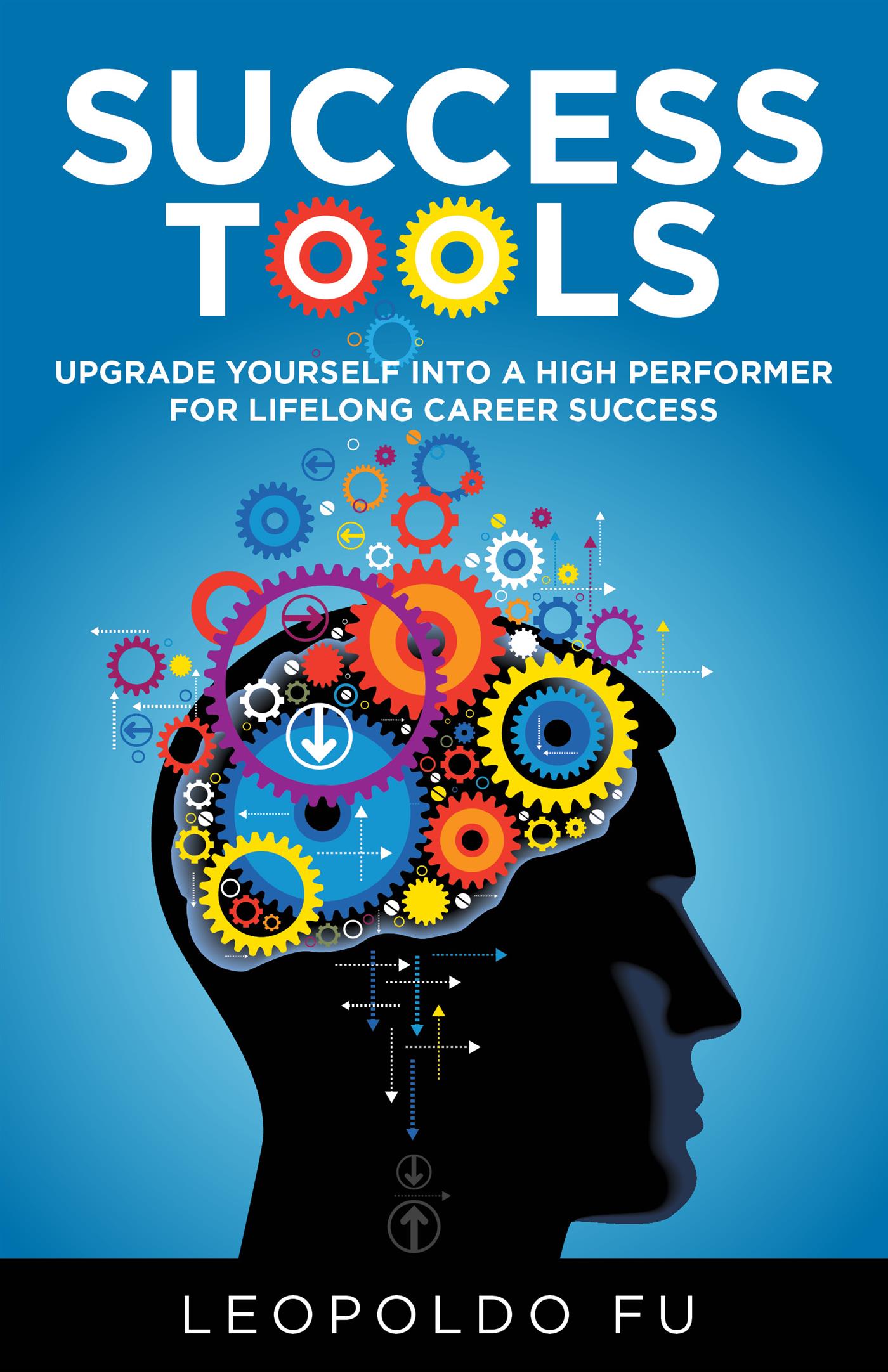
Success Tools
Upgrade Yourself into a High Performer for Lifelong Career Success
Copyright © 2020 by Leopoldo Fu
All rights reserved. No part of this publication may be reproduced, stored or transmitted in any form or by any means, electronic, mechanical, photocopying, recording, scanning, or otherwise without written permission from the publisher. It is illegal to copy this book, post it to a website, or distribute it by any other means without permission.
Leopoldo Fu has no responsibility for the persistence or accuracy of URLs for external or third-party Internet Websites referred to in this publication and does not guarantee that any content on such Websites is, or will remain, accurate or appropriate.
Designations used by companies to distinguish their products are often claimed as trademarks. All brand names and product names used in this book and on its cover are trade names, service marks, trademarks and registered trademarks of their respective owners. The publishers and the book are not associated with any product or vendor mentioned in this book. None of the companies referenced within the book have endorsed the book.
First edition
Cover art by Asya Blue
This book was professionally typeset on Reedsy Find out more at reedsy.com
Contents
Introduction
Why Learn These Concepts?
How to Best Read this Book
The Three Perspectives
How to Learn
Phases of Learning
Get Started
Get Better
Get Faster
Use it or Lose it
The Enemy of Practice
Have a plan
Focus on process instead of output
The Curse of Expertise
Critical Reasoning
Reading Comprehension
Continuous Lifelong Learning
Learn By Connections
Identifying Opportunities to Learn
Reasoning Techniques to Expand Learning
Comparison
Apply Recently Learned Knowledge
Presence in the Moment
Explain What You Learn
How to Change Thinking and Behavior
Awareness
Changing Assumptions
Commitment to Deliberate Action
Foundational Wisdom
Health
Sleep
Sleep Inertia
Forced Wakening
Sleep Deprivation
Circadian Rhythm Mismatch
Poor Sleep Quality
Mind-body Connection
Meditation
Gut-brain Connection
Self-Compassion
Understand Yourself and Others
Introvert vs Extrovert
Helping Introverts
Helping Extroverts
Fluid vs Crystallized intelligence
Growth vs Fixed Mindset
Biases
Recency Bias
Confirmation Bias
Personal Experience Bias
Simple Google Search Bias
Tradition and Old Data Bias
My Methodology
Learn about the topic
Willpower is Not Infinite
The Self-fulfilling Prophecy
The Placebo Effect
Performance Tools
Mental Models
Circle of Competence
First Principles Thinking
View From All Perspectives
Spectrums
Gap analysis
Potential Outcomes Analysis
Analyzing Past Perceived End States
Apply Concept to Itself
Explore through Multiple Levels of Abstraction
Value to Cost Analysis
System Organization - Flat Vs Hierarchy
Hierarchy
Flat
Inversion
Techniques
The Pause
The Reset
Reframing
Visualization
Performance Recall
Best Practices
Single-tasking instead of multitasking
Surround Yourself with Those Better than You
Skill Stacking
Ensure Time is on Your Side
Iteration
Ownership – Business Owner
Example Applications
Negotiation
Challenge
Opportunity
Public Speaking Fear
Challenge
Opportunity
Worker Drone in Large Organization
Challenge
Opportunity
Notes
Introduction
This book is a practical career success framework. The framework’s first goal is to obtain useful, fundamental, knowledge of how people work individually and together as a group. This fundamental knowledge will form the basis for informed rational thought that will guide you to think, behave, and interact with others effectively. You will look inwardly to understand yourself, train yourself to think critically, to examine, learn, and act with reason. With knowledge and earnest, rational thinking, you will be able to truly understand others. This understanding will allow you to perform at your best, multiplying your value several times over as you increase the performance of everyone around you.
The framework’s second goal is to provide you with a multitude of powerful mental tools to quickly expand your arsenal of techniques from thinkers and doers. As you learn these techniques, you will enjoy additional benefits from thinking critically about each technique to understand when it applies, learning even more by practicing them, and continuously improving to build out your own personal set of thinking tools.
The framework’s third goal is to showcase the usage of multiple mental models to navigate real types of scenarios effectively to produce highly positive outcomes while learning and improving yourself along the way. These example guides for real-world scenarios will provide a useful blueprint for that specific scenario and also act as illustrative mental fodder to allow you to have an idea of how to apply multiple mental tools in practice.
Throughout this book are concepts, techniques, and principles that are widely applicable in various aspects of life and career. Many of these principles can be applied in practice on an ongoing basis, which is why this framework is appealing and effective; the user of the framework will continuously accumulate what they have learned and will build momentum from small wins.
The structure and approach of this framework are:
Learn how to learn effectivelyIntimately understand and learn how to improve the fundamental inner workings of peopleLearn mental tools to apply to various situations in order to perform at a high levelExample usage of multiple techniques to deal effectively with real scenariosIncluded throughout this book are links to (mostly) free articles and resources that complement the material in this book and can give more in-depth knowledge about particular terms or topics. I highly encourage you to follow these links and absorb the knowledge contained therein to expand your knowledge and take full advantage of this book.
Why Learn These Concepts?
By learning the concepts in this book and applying them regularly, you can retain an edge compared to the competition. You may ask, what are we competing with? The answer is twofold: other people from an increasing population that is getting ever more educated and provided with increasingly easier access to knowledge; and ever advancing technology in the form of automation and artificial intelligence that will replace many tasks currently performed by humans.
In the rush to learn and try to keep up with advances in technology, it can be easy to forget that what makes us invaluable are the things that set us apart from AI. The ability to learn and form connections between seemingly unlike concepts. The creativity to create something new. To effectively interact with and understand other human beings. The ability to adapt in both the short-term and the long-term to changing circumstances. And with these inherent abilities, we are able to continuously improve upon these abilities to achieve ever greater feats.
How to Best Read this Book
This book can be read fully sequentially, but in tune with online content ingestion, I highly encourage you to follow links provided in this book, to other sections in the book and information outside this book, and seek additional information for every topic or idea in this book as you read through the book. You will get a lot more out of this book if you actively engage with the ideas and concepts presented by:
Identifying where you have seen or experienced these ideas or similar ideas before.




